August 15, 2026


"[C]ritics of the state of the discipline say sociologists who aim to change the conditions they study can no longer claim to be rigorous scientists."
"A report released over the weekend about the state of scholarly standards in the field said it had been compromised by politics that influenced the discipline’s values and priorities. The report was produced by a commission led by Vanderbilt University and Washington University in St. Louis, where leaders have argued that higher education is in need of reforms. The commission found that scholarship in the humanities and social sciences was sometimes in the service of political goals. 'Some topics cannot be studied or cannot be studied in an honest way,' said Jukka Savolainen, a Wayne State University criminologist and sociologist who is not part of the commission. For scholars studying incarceration, he said, 'the only research that’s rewarded and allowed and encouraged is to find the umpteenth way in which incarceration is harmful.'"
From "Conservatives Don’t Like Sociology. Some Sociologists Don’t Either. A group of sociologists broke away in protest from their colleagues over disagreements about Israel. Some worry the political stances are harming the field" (NYT gift link).
From "Conservatives Don’t Like Sociology. Some Sociologists Don’t Either. A group of sociologists broke away in protest from their colleagues over disagreements about Israel. Some worry the political stances are harming the field" (NYT gift link).
"... Americans love to turn to women when the house is burning down. Social scientists call it the glass cliff — the phenomenon in which women are recruited to lead failing companies."
"President Trump’s businessman brand of governance has many Americans feeling this nation is failing. I suppose the dumpster fire of climate denialism, political corruption and general scamminess of, well, everything would be dire enough circumstances to make a female president possible. In particular, Democrats — whom you might expect to be wary of placing another female candidate before the American public — are facing a political disaster of their own making.... [A] lot of Democrats are faithful to conventional political wisdom that they cannot win the White House by running from the left. Ocasio-Cortez is made for this moment.... As we learned in 2008, when history says it’s your time, it’s your time."
Writes Tressie McMillan Cottom, in "Is Ocasio-Cortez Ready for the Glass Cliff?" (NYT gift link).
Writes Tressie McMillan Cottom, in "Is Ocasio-Cortez Ready for the Glass Cliff?" (NYT gift link).
"There's a little bit of a quicksand feeling."
Althouse enters Lake Mendota for the first time after all these years.
Meade, who's great at instigating variations on old rituals, made the video.
"The other book I’ve been reading, Michael Glover Smith’s 'Bob Dylan as Filmmaker: No Time to Think,' takes up Dylan’s... forays into the world of cinema."
"I got to witness one of them a few weeks ago, when I attended a rare public screening of the provocative and polarizing 2003 flick 'Masked and Anonymous,' co-written by Dylan and Larry Charles. I hadn’t seen it before, but I immediately entered the cult of admirers who believe it was unfairly maligned when it was first released. (Roger Ebert called it 'a vanity production beyond all reason.' I hope Dylan chose to take that as a compliment.) I have also had the 'Masked and Anonymous' soundtrack on repeat — especially its eclectic assortment of Dylan covers by a global panorama of artists like the Sertab Erener, Francesco de Gregori and the Magokoro Brothers. You’ve never truly heard 'My Back Pages' until you’ve heard it in Japanese."
Writes Lindsay Zoladz, in "My Summer of Bob Dylan/Hear tracks inspired by his Long Hot Summer Tour, including 'My Back Pages' and 'Mississippi'" (NYT gift link, where you will find a playlist that includes "My Back Pages" in Japanese).
Writes Lindsay Zoladz, in "My Summer of Bob Dylan/Hear tracks inspired by his Long Hot Summer Tour, including 'My Back Pages' and 'Mississippi'" (NYT gift link, where you will find a playlist that includes "My Back Pages" in Japanese).
Here's "Bob Dylan as Filmmaker: No Time to Think." And for a second book Zoladz writes about, "After the Flood/Inside Bob Dylan's Memory Palace." Both of those links work to send a commission to me.
As for "Masked and Anonymous," I couldn't find it streaming anywhere. Meade, who's seen it twice, seems to think it's on YouTube, but here's a link to buy the DVD, if you still have a DVD player. It's only $9.48. Here's the trailer:
"An early affection for tossing pots on the wheel led her to graduate school... where she studied both ceramics and sculpture with Peter Voulkos... who believed in subjecting clay to Abstract Expressionist theatrics."
"As Ms. Heilmann later recalled, Mr. Voulkos liked to walk across the classroom holding a homemade pot, then trip (or rather, as she said, 'fake trip'), with the pot smashing on the floor. He would collect the broken shards and assemble them into a surprisingly interesting sculpture. Ms. Heilmann’s own early sculptures, which consisted of ragged-looking objects constructed from inexpensive craft-shop materials like plastic clay, tin foil, cotton balls, bamboo and glitter, similarly sought to foreground the process of their making."
From "Mary Heilmann, Painter of Vividly Wobbly Abstractions, Dies at 86/An emblem of the obstacles faced by women artists of her generation, she was 67 when her first museum retrospective opened to rave reviews in 2007" (NYT gift link).
From "Mary Heilmann, Painter of Vividly Wobbly Abstractions, Dies at 86/An emblem of the obstacles faced by women artists of her generation, she was 67 when her first museum retrospective opened to rave reviews in 2007" (NYT gift link).
ADDED: Something about the attitude in the comments here made me remember a line from the movie "Blue Moon":
She’s a college student. Sophomore. Yale. Not the general school; that’s for the guys. This is the School of Fine Arts! Bohemian goddesses in gray smocks mixing paint in morning light. She’s all of twenty years old.
I bought the screenplay so I could quote that. (I highly recommend that movie, by the way. It's the most like "My Dinner with Andre" that I've ever run across: An unusual man talks about theater for a long time. Catch it on Netflix.)
I do appreciate the commenters focusing on the phrase "An emblem of the obstacles."
"Over the past 21 terms, the closest any member of the court got to Justice Jackson’s loquaciousness was Justice Stephen G. Breyer..."
"... who was famous for unspooling elaborate hypothetical questions featuring flights of fancy like marshmallow guns (in a case about attempted robbery) and tomato children (in a case about a federal drug law). Still, Justice Breyer... uttered an average of 818 words, or roughly two thirds as many as Justice Jackson [who averages 1263 words]. The runner-up to Justice Jackson in the four years since she joined the court... is Justice Sonia Sotomayor, at 791 words. His colleagues treated Justice Breyer’s professorial digressions with bemused tolerance. Justice Jackson’s extended questioning, by contrast, has been a source of annoyance to some of the other justices, The New York Times reported last October...."
Writes Adam Liptak, in "How a Covid-Era Scramble Transformed Supreme Court Arguments/Live audio, a new format and new voices have transformed and unsettled the court’s signature public ceremony" (NYT gift link).
Writes Adam Liptak, in "How a Covid-Era Scramble Transformed Supreme Court Arguments/Live audio, a new format and new voices have transformed and unsettled the court’s signature public ceremony" (NYT gift link).
Liptak offers 3 reasons why Justice Jackson seizes the opportunity to speak far more than anyone else and in defiance of clearly expressed annoyance: 1. She developed her style as a trial judge, the only judge in the courtroom, 2. Her side of the Court is outnumbered, 3. As the junior member of the Court, she's forced to go last when the Justices speak in order of seniority.
Jackson's outsized role at oral argument is so extreme, and so much attention has been paid to it. Clearly, she's choosing it, in spite of the criticism and even disdain and ridicule. She must believe she's doing exactly the right thing. Perhaps she views her contribution as proportionate if you measure not by the number of Justices but by the weight and power of the ideas they represent.
August 14, 2026

"Jason Arday obituary: youngest ever black Cambridge professor/Sociology of education academic who made history before his career unravelled after accusations of plagiarism dies aged 41."
An obituary in the London Times.
Arday, who claimed to have been diagnosed with global developmental delay and autism spectrum disorder, was apparently unable to talk until the age of 11, and unable to read or write until he was 18. Despite this remarkable setback, by his early thirties he had begun writing and publishing academic papers, and he won his first academic post soon after....
We talked about Arday a few days ago, here. He was accused of plagiarism and various lies that made him a laughingstock. Now, apparently, he has killed himself. Though he is responsible for his deceit, I feel the greatest blame lies with the University that advanced him beyond anything that made sense.
"As expected, Mr. Farage easily defeated dozens of fringe and novelty candidates, including Count Binface, who wears a trash-can-themed costume."
"None of Britain’s other major parties participated in the race, the results of which were announced early Friday. They called it a political stunt engineered by the Reform leader to distract from the investigation. Mr. Farage received 22,239 votes, or 63 percent. Count Binface, a character played by Jon Harvey, 46, a writer and comedian, received 9,455 votes, or 27 percent. Mr. Binface’s previous best result was 1 percent in a London mayoral election."
From "Farage Wins Special U.K. Election That He Initiated, as Expected/Nigel Farage, the leader of Reform U.K., won the Clacton by-election with 63 percent. Count Binface, his costumed main rival, came second with 27 percent, a personal best" (NYT gift link).
From "Farage Wins Special U.K. Election That He Initiated, as Expected/Nigel Farage, the leader of Reform U.K., won the Clacton by-election with 63 percent. Count Binface, his costumed main rival, came second with 27 percent, a personal best" (NYT gift link).
"This is no different from what the Heritage Foundation wants for women in the US. Except maybe instead of burqas..."
"... they want us in milk maid dresses, heavy hideous makeup, plastic surgery and naked. And it's actually worse when I think about their plans for society as a whole with illiteracy, poisoned food, toxic 'health' care, etc. Separation of religion and state must happen to even attempt a free society. This is why this concept exists."
A highly rated contribution to the comments section for "Afghan Women Erased From Public Life in Five Years of Taliban Rule/Decrees restricting the rights of women and girls to study, work, travel and act independently now threaten to damage Afghanistan permanently, experts say" (NYT gift link).
Rubio and his Pop-Tarts.
RFK Jr. and Marco Rubio are getting into the act
But there are also lots of things out there like this:Fake news…….
— Marco Rubio (@marcorubio) August 13, 2026
I prefer cherry flavor https://t.co/bVMZJV9dPl
And this:When Marco goes for the pop tarts 😂 pic.twitter.com/kbbr6XUNZf
— Politi_Rican 🇵🇷 𝕏 🇺🇸 (@TheRicanMemes) August 13, 2026
Marco Rubio in the first ever Kellogg’s Pop-Tarts ad 🤣💀 pic.twitter.com/4X5STDt7my
— DFF (@DumbFxckFinder) August 13, 2026
"The shooter did not miss his intended target and did not chamber another round, leaving the spent cartridge in the rifle."
Wrote the lawyers for Tyler Robinson, quoted in "Charlie Kirk Suspect Fights Death Penalty, Says No Others Were in Danger/Prosecutors say they can seek the death penalty against Tyler Robinson because he also endangered people near Charlie Kirk, who was shot in the throat last year. Mr. Robinson’s lawyers note that the gunman struck only his target" (NYT gift link).
The Amish method of dating makes sense to me.
Ex-Amish social media creator Lovina Hershberger Zook, who has amassed some six million followers sharing Amish recipes and stories, explains the traditions of dating in the community she grew up in, one of the most conservative among the Amish.
— CBS Sunday Morning 🌞 (@CBSSunday) August 14, 2026
The 23-year-old tells @faithsalie… pic.twitter.com/tRylTEwCZm
That made me think of this "Modern Love" discussion in the NYT: "Am I Too Anxious for Love? Jenny Singer worried the deep, loving relationship she wanted wasn’t something her brain would let her have" (gift link).
The hotness.
 Magazine array at my hairdresser's.
I was struck by People's limited vocabulary. Is "hot" all they can come up with anymore? Does does word connote sexiness anymore? Or just popularity. Also, that Wisconsin bride is so glum. Aren't brides suppose to glow with happiness? I don't think a bride's magazine would ever do a cover story on forced marriage or even grim golddigging. Too bad she didn't find that "hottest billionaire." And, in case you are curious, I did not arrange the magazines to emblazon "Charles Manson Was My Grandfather" across her chest.
"By the time your grandmother starts using the wilting rose emoji, it’s done, you’ve got to move on."
I'm reading "😭 or 😂: Do Your Emojis Make You Look Old? When it comes to emoji usage, we’re all just following teen girls" (NYT gift link).
Interesting, but I am old. I'm permanently freed from worrying over looking old. I am not the "your" in this "by the time your grandmother starts using it" test. I am the grandmother. I mean, I'm not a grandmother. I have no grandchildren. But I'm 75. I'm so far within the age group that there's nothing even to quibble about. It is therefore impossible for me to work on my emojis as a way to look young. My use of any emoji make not only makes me look old. It makes the emoji look old. Apparently, I have the power to make emojis look old.
Just as I'm drafting this post, I'm getting an emoji from Meade, answering a text I sent at 4:30 a.m.:
Being up at 4:30 a.m. makes me look old, as does the inability to watch a baseball game that begins at 9:10 p.m. But if you don't look, you can have a "live" experience in the morning if you're careful where you click, but...

Not being able to see the teeny tiny emojis is also making me look old. But this is my new freedom. Not to care about emojis. They're not for me. They are for teenaged girls.
"If you can merge gaming with aviation, why not?"
🚨 2,000+ Gamers Hired for AIR TRAFFIC CONTROL@SecDuffy: “They multitask. They have to think on their feet. They work with their hands and their eyes, and they’re making great controllers… We had 14,000 applicants, 8,000 qualified. We were getting the best and the brightest.” pic.twitter.com/C0U6eRj0IC
— Laura Ingraham (@IngrahamAngle) August 14, 2026
August 13, 2026

"She was trying to find the humor in her own story, that of an American parent, but one who had been wrongly held in a prison in Italy for years..."
"... for the 2007 murder of her roommate when both women were studying abroad there. But the sold-out audience, 150-strong, at first only occasionally tittered at her gags about life in prison, tabloid infamy and the idiosyncrasies of child-rearing.Then, she told a joke about her daughter’s favorite game. It’s called 'Momma goes to Italy,' Knox said. In the game, her daughter grabs the bars of a jungle gym at their local playground and screams, 'Let me out! Let me out!' Knox mimed a wild-eyed convict desperately grabbing the bars of a prison cell. The audience’s snickers turned into the night’s first belly laugh."
From "Amanda Knox Takes the Stage, Reclaiming Her Story Through Comedy/In a solo show at the Edinburgh Fringe, Knox is trying to turn her tabloid infamy into stand-up humor, despite an intense backlash" (NYT gift link).
From "Amanda Knox Takes the Stage, Reclaiming Her Story Through Comedy/In a solo show at the Edinburgh Fringe, Knox is trying to turn her tabloid infamy into stand-up humor, despite an intense backlash" (NYT gift link).
"The U.S. Department of Health and Human Services (HHS) today released a report Wolves in White Coats: How Doctors and Hospitals Pushed and Profited from the Fraud of “Gender Medicine'..."
"... a commissioned report examining insurance coding practices, perverse financial incentives, and the provision of sex-rejecting procedures for minors. Drawing on Centers for Medicare & Medicaid Services (CMS) Guidance, Department of Justice (DOJ) investigations, peer-reviewed scientific literature, hospital records, whistleblower testimony, nationwide insurance claims analyses, and interviews with patients and parents, the report presents HHS’ findings and recommendations about the industry pushing and profiting off so-called “gender medicine.” A shortform documentary illustrating the report’s findings and highlighting the stories of victims of predatory gender medical practices was also released in conjunction with the report...."
Here's the video (the "shortform documentary"):
From the HHS press release.
Vance is taking the lead in the announcement:
For years now, some hospitals and healthcare providers have been subjecting children to horrific, experimental treatments in service of radical gender ideologies. Today, thanks to the Wolves in White Coats report released by @HHSGov, we know why: profit. It turns out that… pic.twitter.com/B7K7iumpYC
— JD Vance (@JDVance) August 13, 2026
"That’s what it is to be a Jew, in some ways. Being really comfortable with tension, and being comfortable with paradoxes..."
"... and understanding that we’re a people, we’re a nation, we’re an ethnicity, we are a religion, too. We don’t fit naturally. And that’s why we’re such a pain. It’ll give a lot of grist for people to argue at over kitchen tables, as we have been doing for over 3,000 years."
Said California State Senator Henry Stern, a Democrat, quoted in "Are Jews an Ethnic Group? California Considers the Question. A bill would allow Jews to identify themselves as an ethnic group on state forms. Supporters argue it’s a step toward acknowledging the complex nature of Jewish identity" (NYT gift link).
Stern is the son of the actor Daniel Stern:
Said California State Senator Henry Stern, a Democrat, quoted in "Are Jews an Ethnic Group? California Considers the Question. A bill would allow Jews to identify themselves as an ethnic group on state forms. Supporters argue it’s a step toward acknowledging the complex nature of Jewish identity" (NYT gift link).
Stern is the son of the actor Daniel Stern:
I have to use the tag "Judaism" for this post. I don't mean to be coming down on the side of those who say Jews are a religious group. I'm against tag proliferation and "Judaism" and "anti-Semitism" are longstanding tags. And I don't have separate tags for each ethnic group. I just use "ethnicity." There's also "race consciousness" and "racial politics."
"A Wisconsin city spent millions on a grocery store. It didn’t go well/Madison spent millions to build a supermarket across the street from another one."
An opinion piece in The Washington Post.
After eight years of development and more than $8 million spent by the city of Madison, Wisconsin, Maurer’s Urban Market will open in the Bay Creek neighborhood later this month. Local officials have pitched the store as a measure to prevent a “food desert” in that part of town. The truth: Maurer’s is right across the street from another grocery store. And within a mile of three others. How this glut came to be is a good illustration of why the government is not cut out for the grocery business....
"My office will use every tool available to protect innocent lives."
Said the Texas Attorney General, Ken Paxton (who is running hard for a U.S. Senate seat), quoted in "A Fight Over Abortion and Surrogacy Ends With a Baby Born in Texas/The baby, who was born Wednesday with a severe heart defect, drew the attention of anti-abortion activists and the Texas attorney general after the intended parents wanted the surrogate mother to have an abortion" (NYT gift link).
[The surrogate, McKenna] West, who did not respond to an interview request for this story, said in an interview this month with the former Fox News and current YouTube host Megyn Kelly that she did not support abortion and felt “trapped” by the surrogacy contract, which permitted the intended parents to end the pregnancy via abortion....
[Lincoln] Wilson, the lawyer for Ms. West, said that the legal case was not over and that Ms. West would continue to fight for custody of the boy, who must undergo weeks of surgeries “before he’s really in the clear.”
Here's that Megyn Kelly presentation:
"The Ivy League graduate had briefly planned to pursue an ‘extreme emotional disturbance’ defence after pleading not guilty to murder of healthcare boss."
I'm reading "Luigi Mangione expected to discuss 'plea deal on Friday'" in the London Times.
You can tell the publication is British and not just by the spelling of "defence." It's the forefronting of "Ivy League graduate" rather than his being considered especially cute, which is what counts in America.
"ICE is planning to buy up to $20 million worth of electric gloves designed to allow agents to deliver painful shocks to detainees."
I'm reading "ICE’s new weapon: painful electric shock gloves/The glove is manufactured by a firm called Compliant Technologies" (London Times).
The Glove — Generated Low-Output Voltage Emitter — "is not effective through clothing or hair and can be degraded on individuals and animals that are extremely hairy."
So what body parts do you grab with your electrified hands? I was able to find what I think is Compliant's manual. My search for "face" only turned up a couple instance of "surface": "Periodic cleaning of the outside surface area of the G.L.O.V.E. SHALL only be done with 'My-Shield' wipes or surface cleaner in order to maintain the warranty on the G.L.O.V.E."
Also from the manual (at page 15):
August 12, 2026


"I, like many a young woman, was once wildly judgmental about plastic surgery. I grew up in the 1990s..."
"... at the bizarre, lonely intersection of second-wave feminism and Manhattan privilege. Many of the girls in my private high school had their breasts enlarged and their noses shrunk. I congratulated myself for not following suit, even though I didn’t have a bump on my nose and I wasn’t flat chested. My mother, the writer Erica Jong, had a whole gestalt back then: pro-sex feminism, which of course meant keeping herself appealing enough for men to want to have sex with her. She worried about her own weight and beauty constantly. Julia Phillips, a successful film producer and writer, once compared her to 'Miss Piggy when her face is in repose'.... My mom was the concubine of more than a few powerful men. To preserve that status, she had a face-lift in her 50s. Many of the feminists who populated my mother’s narrow townhouse — Andrea Dworkin, Betty Friedan and Phyllis Chesler among them — did not believe in molding themselves into something different for men’s delectation. These women rejected the beauty-obsessed power structure that my mother embraced. Instead, they hoped to change that culture by refusing to comply with it...."
Writes Molly Jong-Fast, who got a deep plane face- and neck-lift, in "I’m Not Going to Lie About My Neck" (NYT gift link).
Writes Molly Jong-Fast, who got a deep plane face- and neck-lift, in "I’m Not Going to Lie About My Neck" (NYT gift link).
Moving the frozen eggs to the front burner.
I don't know how much more of this we'll be seeing, but I wanted to record what seems like an incipient trend, the women's issue we somehow suddenly need — egg freezing.1. A couple days ago, in an episode of the NYT "Daily" podcast, "Why Adults Are Getting Cancer at a Younger Age," there was the story of a 36-year-old woman with breast cancer, facing surgery and chemotherapy, who was asked by her doctors if she wanted to freeze her eggs: "And so first things first, like my brain wasn't even on the cancer. My brain was like all the things that go into freezing your eggs and what that meant for like my future and what that meant. Like my boyfriend and I at that time, like we weren't talking about having kids...." And the journalist assures us that "egg freezing is a really intense process, it's intense emotionally and it also intense physically."
2. In yesterday's NYT, there was "Ocasio-Cortez Opened Up About Freezing Her Eggs. She Got Women Talking. Many women say being open about the fertility treatment is a form of empowerment. But critics say all the talk can be misleading" (gift link). "Until about 2012, freezing eggs to preserve fertility was considered an experimental intervention for urgent cases like cancer patients whose fertility would be compromised by treatment. Like breast cancer, menopause and menstruation, egg freezing has become yet another women’s health issue in which open discussion is seen as a form of empowerment. Ms. Ocasio-Cortez herself said that it was 'badass that I’m going to be giving myself shots in the green room' of a TV studio..."
NBC’s Steve Kornacki at a loss for words.
NBC’s Steve Kornacki reacts to the USB drives that were missing election data in Wisconsin.
— Brandon Doggett (@brandondoggett) August 12, 2026
“Are you serious? They have to do… God… Okay…” pic.twitter.com/Byj6KQJBX9
"I'm not going to travel the world with a cooler full of sauerkraut. It's ridiculous. I can't do it!"
🤣 LMAO! Marco Rubio just dropped this hilarious response to Sec. RFK Jr.'s diet
— Eric Daugherty (@EricLDaugh) August 11, 2026
Q: Have you adopted RFK's diet of red meat and fermented vegetables?
RUBIO: "No! This is a CRAZY diet. This is a diet that consists of eating sauerkraut and meat. Now you understand like this is… pic.twitter.com/qgaMNjsIhu
"There was so much vulnerability and yearning there. It was heartfelt and pure girl power. Arlene on that song was inspiring. I wanted to record a record like that."
Said Ronnie Spector, about "hearing 'Maybe' for the first time on her grandmother’s Philco radio as a teenager."
Quoted in "Arlene Smith, Whose Song ‘Maybe’ Helped Define Doo-Wop, Dies at 84/With the Chantels, a groundbreaking female vocal group, she tugged heartstrings with the indelible hit and paved the way for a wave of 'girl groups'" (NYT gift link).
At that point, doo-wop — born of city street corners — was dominated by male acts like the Penguins (“Earth Angel”), Frankie Lymon and the Teenagers (“Why Do Fools Fall in Love”) and the Del-Vikings (“Come Go With Me”).
Despite the fact that a few pioneering Black female groups like the Teen Queens (“Eddie My Love”) and the Bobbettes (“Mr. Lee”) had hits before the Chantels, the record industry “didn’t know what to do with us,” Ms. Smith later said in an interview with the site ClassicBands.com.
"Maybe" is the subject of Episode 65 of the great podcast "A History of Rock Music in 500 Songs." Excerpt:
"For now, we polka."
Tonight's all about @DavidCCrowley. He's earned this win and the accolades.
— Tony Evers (@Tony4WI) August 12, 2026
I am so proud of David—he's the future of our Party, and I can't wait for him to be our next governor.
For now, we polka. Tomorrow, we're back at work to win.@TomTiffanyWI, we'll see you in November.
Trump said we could just "bop along" in Iran: "We could just keep it alone, and they’re going to fail. We could just keep, you know, doing sort of just like nice and easy, relaxed."
Quoted in "Trump floats ‘easy, relaxed’ Iran war phase focused on hurting regime’s economy: 'I’m their banker.'"
“I’m sort of negotiating. You see, they’re very devious negotiators because they’ll agree to something, then they’ll go out and tell the press that they never agreed to it. They’re very dishonest people.”
“We have three strategies,” he declared.
The race was close, but Francesca Hong has conceded and the risk of a democratic socialist Governor for Wisconsin is over.
At least this time around.
Here's the NYT report (gift link):

My questions:
• What proportion of the votes for Hong were supporters of the Republican candidate Tom Tiffany — voters who thought Hong would be a weak opponent for him? It was an open primary, and I saw some open encouragement of this behavior. Tiffany obviously had his nomination sewn up. You can see that David Crowley only won by about 3,000 votes. How much larger would his margin of victory have been without those insincere strategic votes for Hong?
• Why did Hong concede so quickly, with such a narrow margin? Why not wait at least until all the votes are in? Why not ask for a recount? She's entitled to a recount if the margin is 1% or less, but it's only paid for by the state if it's less than 0.25%. To drag out the process after the primary would help Tiffany. That's good reason not to indulge in a recount, but why not wait until all 100% of the votes are counted? She conceded when it was less than 95%.
• Why were the polls so bad?! The final Marquette poll, from July 22–27, released July 29, had Hong at 38% and Crowley at 7%. There was also another candidate at 16% (Barnes), but he dropped out. Still, giving all the Barnes votes to Crowley would only put Crowley at 23%. That 38% for Hong looked awfully strong. But I wouldn't assume the polls got it wrong. The polls inspired a lot of people to attack Hong, making her look unusually foolish and driving a lot of Democrats into voting for what is practical and strategic and not for the radical who excited them so much.
• Speaking of exciting radicals in Wisconsin, these votes were falling into place as a highly visible and emotional street protest was escalating in Madison after the death of Corey Ruiz. Though Ruiz had apparently attacked the police with a knife, Hong quickly denounced his killing as "a state-sanctioned… execution." Those protests went on for 2 weeks, mostly during the period when there were no new polls. How much did those impassioned protests turn Wisconsin voters against Hong?
***
As for me, I was going to sit this one out, but in the end I did go over to the Congregational Church and cast a vote.
August 11, 2026

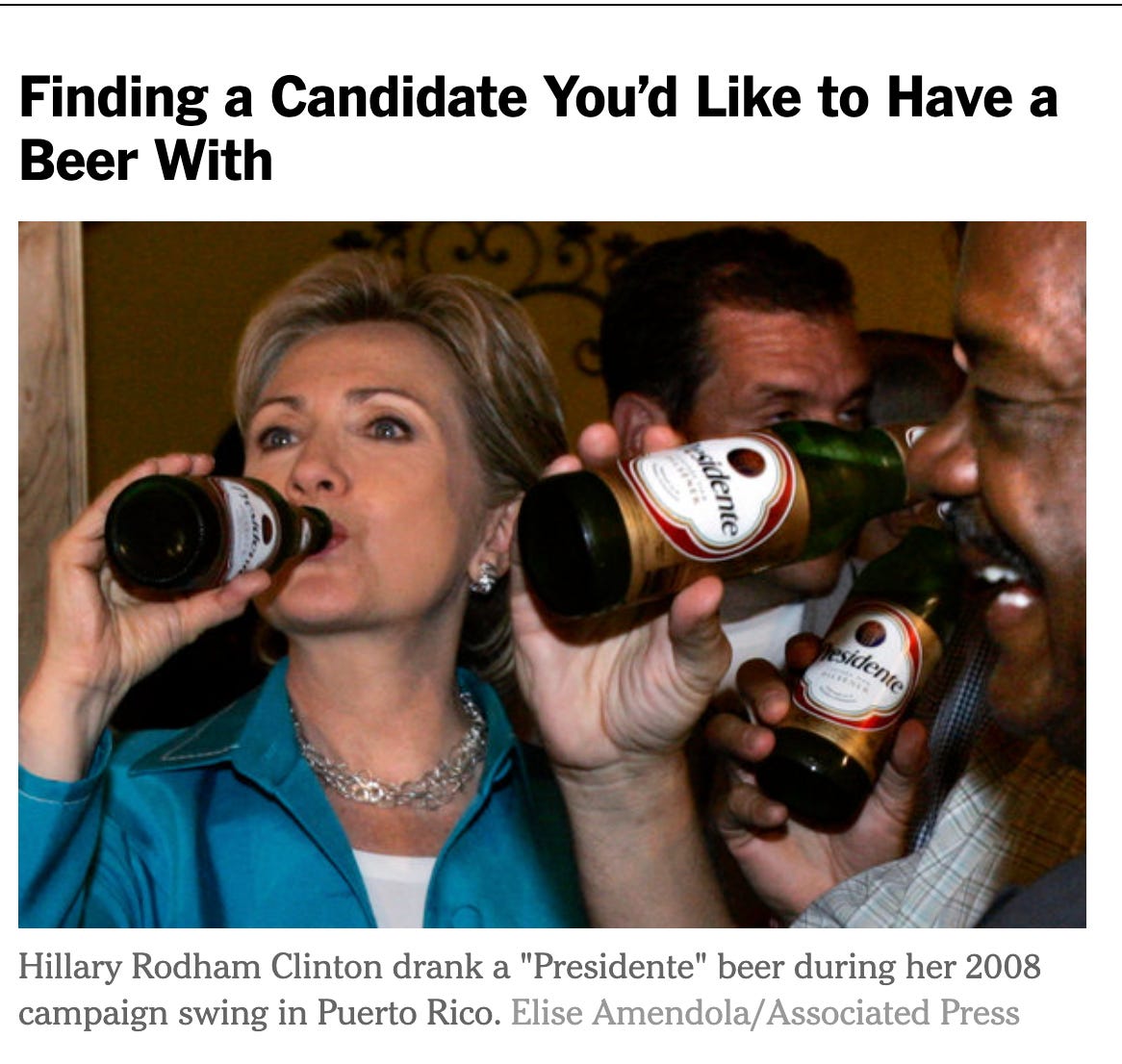
"What a blast from the past! The New York Times hasn’t pulled out the infamous 'beer test' for a political candidate since May 22, 2015..."
"... when it ran ['Finding a Candidate You’d Like to Have a Beer With.'] The 'beer test' was once a massively overused campaign reporting cliché. It grew out of a Sam Adams ad campaign in the 2000 race, and from Bush-Gore through the 2016 cycle it was nearly impossible to escape 'beer test' coverage. Then Donald Trump won the 2016 beer test by default — it was hard to imagine Hillary Clinton having a beer at all — leading even Slate to pronounce 'there has never been and perhaps never will be a candidate you’d be more eager to have a beer with than Donald Trump.'
That's Matt Taibbi, in "Cliché Alert: Return of the 'Beer Test'/The New York Times reverts to old form, thanks to a blue-party schism" (Racket).
That's Matt Taibbi, in "Cliché Alert: Return of the 'Beer Test'/The New York Times reverts to old form, thanks to a blue-party schism" (Racket).
Here's the NYT article that set Taibbi off: "He’s Not a Democrat. Democrats Love Him Anyway."
I invite you to persuade me to go over and vote in the Wisconsin primary today.
Observing myself, I believe I am abstaining. 

Of course, as I've said many times, I'm a big believer in the right to not to vote. It's like the right not to speak. Or the right not to profess any religion.
UPDATE:
"Debbie Rodman, the keeper of a 3,694-day streak, once stood on top of a toilet at Yellowstone National Park in an attempt to receive enough Wi-Fi..."
"... to solve the Crossword. Ten years in, 'it’s been part of my daily routine for so long, I will never voluntarily give it up,' Ms. Rodman, 67, said. 'Someday when the lights go out, that’ll be how my streak ends.'"
From "What It Takes to Keep a Puzzle Streak for Years/Meet the players who persist through childbirth or intense athletic feats to ensure they solve Wordle and other puzzles every day" (NYT gift link).
From "What It Takes to Keep a Puzzle Streak for Years/Meet the players who persist through childbirth or intense athletic feats to ensure they solve Wordle and other puzzles every day" (NYT gift link).
"Now, I’m 13 days post-op. Only one of my friends has been negative about it."
"Before the surgery, he said, 'It’s weird to me that you’d do this, because you’re someone who preaches embracing who you are.' The confusing thing is that he’s very 'black pill,' which is a trend that says you need to be beautiful in order to get a job or find a soul mate. I hate black pill, because it’s pushing the narrative that hurt me as a little girl: that looks are the only things that matter.... Maybe I’m contributing to that narrative by getting this procedure. But I looked in the mirror after my surgery, and I thought, Wow, this feels like the real me. It sucks that I have to change a part of me to truly like myself."
Said "R., 18, is an incoming college freshman from Colorado who got a deep neck-lift and rhinoplasty," quoted in "Three People on Why They Wanted New Faces" (NYT gift link).
Said "R., 18, is an incoming college freshman from Colorado who got a deep neck-lift and rhinoplasty," quoted in "Three People on Why They Wanted New Faces" (NYT gift link).
That realization "Wow, this feels like the real me" is so "Twilight Zone."
"Zuckerberg acknowledged 'a risk that an imbalance of power between individuals and government leads to a loss of freedom or totalitarian state.'"
"His solution was to create superintelligence which ensured that users were responsible for deciding the model’s values, not the developer. He said there should be 'a fully private mode for personal agents where even Meta or any other service provider cannot see or grant access to your information.'"
"That's as strange as it gets."
I’ll take “things I’ve never seen before” for 500 please. pic.twitter.com/gWVQkBDV2b
— Michaela Bennett (@MichaelaB_22) August 11, 2026
Fish swallows golf ball.
The London Times reports: "Charl Schwartzel of South Africa had to take a one-stroke penalty after his attempt on the 134-yard par-three 7th at Trump Bedminster ended up in the water, and was swiftly swooped upon by a resident fish."
August 10, 2026


"These days I am a middle-aged man who works the door at a bar in Chicago that is reasonably popular with the youths, and I am routinely flummoxed..."
"... by the sartorial flotsam that comes packing itself in. The other night a guy came in with a shoulder-length butt cut and his T-shirt tucked into his jeans. 'Now there’s a dork,' I thought. I could’ve clocked him from down the block. But no. An hour later I went outside, and he was making out in the alley with a six-foot freaking supermodel — and she was goth. Or at least she was dressed like what I consider to be a goth; nowadays I don’t even know..... Why is everybody under the age of 30 these days dressed like an actual lunatic?... The subcultures of my youth were a sort of surrogate extended family. In a society jettisoning the type of organizations and communities that stitched it together over the 20th century, finding someone or a group of someones who were the same thing as you served as a bulwark against the fracturing sense of atomization. Making up a subculture every couple of months basically does the opposite, keeping you permanently aloof from the kids around you. I mean, half these things barely sound like groups of anything. What the hell is a performative matcha boy — some guy who drinks a thing? How’s that going to be your tribe?"
Writes Thomas Morton, in "Gen Z-ers Dress Like They’ve Never Worn Clothes Before" (NYT gift link)(lots of photos at the link).
#1 reason for blogging this story: It used my favorite word, "flummox."
"I'm not sure why WaPo covered this, but ignored trump wearing a wig that is styled like his mother's hair during her last year of life."
That's the top-rated comment (by far) on the WaPo article, "Alexandria Ocasio-Cortez says she’s freezing her eggs/The Democratic congresswoman, 36, said she made the decision to undergo the fertility procedure to 'feel more in control of my life'" (gift link).

I was trying to figure out whether and how to blog the AOC story. I saw her video yesterday:
I haven't seen such a display of political abdominal flesh since the days of LBJ and his gall bladder surgery:AOC is starting her journey for freezing her eggs!
— Winter (@LeftyWinter) August 9, 2026
Sharing her doing the shot.
"Don't be weird about this even though I know you all will be".
She knows the internet so well. pic.twitter.com/2ywzN8R5d9
Still wondering how to blog that. But what's all this about Trump and his wig?
"It recounts an immigrant’s life story, told by a Mexican construction worker who toiled, prospered, became an American citizen..."
"... and brought up American children, including a son lost in Afghanistan. 'They were raised to believe in this country,' he sings, heaving a sigh that speaks volumes before continuing, 'that I barely recognize now.' Widowed and alone, all too aware of brutal immigration arrests, he’s going back to his long-ago Mexican hometown."
That's a description of the song "Volver a Celaya," by Steve Earle and Los Lobo, in "9 Songs We’re Talking About This Week/Karol G returns, Steve Earle and Los Lobos link up and Temper City climbs the charts" (NYT gift link).
That's a description of the song "Volver a Celaya," by Steve Earle and Los Lobo, in "9 Songs We’re Talking About This Week/Karol G returns, Steve Earle and Los Lobos link up and Temper City climbs the charts" (NYT gift link).
"Hobbies have helped Kimura feel more secure and find her voice, partly because many of her hobbies end with a finished product..."
"... giving her a feeling of accomplishment. Unlike the women in previous generations in her family, whose lives were centered on marriage and raising children, she feels empowered to pursue the activities that bring her happiness. 'I feel like I can design my future,' she said. As for romantic relationships, Kimura said she’s not closed off to dating indefinitely. 'I just don’t feel like I’m in such a rush anymore.'"
"The Korean supergroup BTS has pulled its blockbuster album 'Arirang' from Grammy Awards consideration, in protest..."
"... of the new Asian Pop Music Performance category....The Recording Academy has been cooking up new categories for years. It started out with 28 in 1959. We’re up to 100 now.... Some reflect true genres and discrete markets. But most are the malignant offspring of the record business’s historical segregation, which divided Black and white artists into separate genres and markets, even if they were playing sonically similar music.... After a song from 'K-Pop Demon Hunters' won big this year, Asian Pop was created...."
Writes Dan Charnas, a professor at the Clive Davis Institute of Recorded Music at NYT, in "Pop Music Is the Problem" (NYT gift link).
Here's how I'd frame the question: Why don't the Grammys have a category called White Pop Music?
There are 2 directions to go with that question. You could say it's white supremacy or you could say it's anti-racism.
August 9, 2026


RIP Beth.
The London Times tells us: "Grassley is not the first member of Congress to develop a strong attachment to a piece of machinery. John Boehner, a former Speaker of the House, appears frequently with his lawn mower. The senator John Kennedy has a cross trainer in his garage that he has named Margaret, 'after Margaret Thatcher because both kick butt.' His wife, Becky, 'won’t let me bring Margaret in the house,' he said, in a video posted this year. So he uses Margaret in his garage and then lifts weights, watched over, metaphorically speaking, by his Iron Lady companion."It’s a sad day at Grassley household…. For my 34 years and 15 yrs before that at my mother in law’s home Beth has worked dependably….
— Chuck Grassley (@ChuckGrassley) August 8, 2026
It's just by chance — and consistent blogging methodology — that Margaret Thatcher came up twice today. The earlier post is about her plan to send coca-eating moths to Peru.
"Is that Peter Thiel’s boy with that Ohio charisma he’s got? That guy. I think we’ve had enough of him."
"The last thing that he said that made any sense was 'Hillbilly Elegy,' after he said that Donald Trump had no business being president of anything. That was the last time he made sense, and then he decided to suck up to power."
Said Abdul El-Sayed, quoted in "Vance rips Michigan’s ‘crazy’ El-Sayed: would be a ‘terrible senator'" (NY Post).
Said Abdul El-Sayed, quoted in "Vance rips Michigan’s ‘crazy’ El-Sayed: would be a ‘terrible senator'" (NY Post).
"Margaret Thatcher’s government spent £100,000 on a top-secret plan to 'bomb' Peru with voraciously hungry moths in a radical attempt to destroy cocaine crops."
The London Times reports.
The method is relatively cheap and simple. From what is known of Eloria [noyesi] it might be thought of as a ‘smart bomb’ with a very short range."...
"The moth is indigenous to Peru and is highly host-specific to the coca bush. There is no evidence of it feeding on other plants … Its use as a control agent could, therefore, be concealed."
I wonder what else has been going on in the use of tiny animals in warfare. I found this, at the History website: "Bugs of War: How Insects Have Been Weaponized Throughout History/For millennia, six-legged soldiers have been conscripted to torment enemies."
At the end of the 2nd century, the Roman emperor Septimius Severus was on his way to wresting control of Mesopotamia from the local monarchs.... As the Roman legions advanced on the desert stronghold of Hatra.... The defenders crafted earthenware bombshells loaded with scorpions.... As Severus’s men reached the walls of Hatra, scorpion bombs rained down....
More recently:
During the Vietnam War, the Viet Cong dug a network of underground tunnels allowing them to decide when and where to fight.... Feeling his way through a dank passage, [an American] “tunnel rat” might overlook a trip wire and have a load of scorpions rain down from a hidden cavity in the roof. The Viet Cong also conscripted the Asian giant honeybee.... Soldiers gingerly relocated colonies to trails used by the Americans and then attached a small, explosive charge.... For their part, the U.S. military funded a research program to devise an apparatus to spray the Vietnamese enemy with the alarm pheromone of bees, thereby converting the local insects into fierce allies.... But the “weapon” was never deployed....
AND: Wikipedia has an article, "Entomological warfare."
Entomological warfare (EW) is a type of biological warfare that uses insects to interrupt supply lines by damaging crops, or to directly harm enemy combatants and civilian populations. There have been several programs which have attempted to institute this methodology; however, there has been limited application of entomological warfare against military or civilian targets, Japan being the only state known to have verifiably implemented the method against another state, namely the Chinese during World War II. However, EW was used more widely in antiquity, in order to repel sieges or cause economic harm to states. Research into EW was conducted during both World War II and the Cold War by numerous states such as the Soviet Union, United States, Germany and Canada. There have also been suggestions that it could be implemented by non-state actors in a form of bioterrorism. Under the Biological and Toxic Weapons Convention of 1972, use of insects to administer agents or toxins for hostile purposes is deemed to be against international law.
A poster from 1942:

"Starting in the mid-2000s, the Democratic Party adopted a position that retail politics was due for an internet upgrade."
"Turning up for church hall meetings was well and fine. But haven’t you heard that Americans are bowling alone? Better to email. Phone banking turned into text-a-thons, where volunteers sent millions of text messages to cellphones we had not yet learned to ignore.... That... felt like the future in 2008.... By 2020, the Democratic advantage in digital campaigning was long gone.... As algorithms turned neighbors into unrecognizable partisans with crazy conspiracy theories, Silicon Valley abandoned the Democrats for Trump. Through it all, the frantic fund-raising text messages just kept coming.... [In the Michigan primary,] Abdul El-Sayed upset the deep-pocketed, establishment choice, Haley Stevens, by building a relational campaign on an economic populist message. El-Sayed won, in part, by characterizing the $62 million in outside money that backed Stevens’s campaign as a sign of... political corruption...."
Writes Tressie McMillan Cottom, in "Socialists Are Winning Because They Listen to People" (NYT gift link).
So... money isn't the answer. You need something other than money, and the socialists do have something. How, then, can they be stopped? The linked column puts it like this: "I’d be looking for the candidates who are thinking and running as if they know that bases are made of people, not dollars."
If you really wanted to show that you are about people, you wouldn't say "bases are made of people." You'd say people matter and hide that the reason they matter to you is they're what is required to make a "base."
The socialists are to the Democratic Party what the Tea Party was to the GOP. All they need now is their Trump.
Subscribe to:
Posts (Atom)


 Posts
Posts