July 25, 2009
Something about the events of this last week has me thinking again...
... about this old Bob Dylan poem, that I thought about a lot, circa 1965:
first of all two people getFrom the back cover of "Another Side of Bob Dylan."
together an' they want their doors
enlarged. second of all, more
people see what's happenin' an'
come t' help with the door
enlargement. the ones that arrive
however have nothin' more than
"let's get these doors enlarged"
t' say t' the ones who were
there in the first place. it follows then that
the whole thing revolves around
nothing but this door enlargement idea.
third of all, there's a group now existin'
an' the only thing that keeps them friends
is that they all want the doors enlarged.
obviously, the doors're then enlarged
fourth of all,
after this enlargement
the group has t' find
something else t' keep
them together or
else the door enlargement
will prove t' be
embarrassing
Stripes: yes. Men in shorts: no.
And the baby agrees with me.
Now, to continue with my idiosyncratic review of fashion at the Farmers Market in Madison this morning:
1. Men in Shorts is a complex subject, and some men do better than others:
Note that the 2 men in shorts are both wearing black socks, yet only one is making a bad mistake. The other one is doing it right. Plus, carrying a kid on your shoulders is a good look for a nonsleazy guy.
2. Here are 2 women dressed completely differently, and both, I think, are completely charming:
3. I would also like to express my strong approval of this latter-day hippie look, heavy on the day-glo pink — and, in the case of "Cher," day-glo green:
And I'm giving hippie boy a pass on those knickers.
Tags:
babies,
Cher,
fashion,
hosiery,
Madison,
men in shorts,
photography,
s
Let's think about the larger meaning of Henry Louis Gates's Larger Meaning Doctrine.
So Henry Louis Gates accepts Barack Obama's invitation to have a beer at the White House with Sgt. James Crowley:
I, for one, would probably freak out, cause a scene, prompt a neighbor to call the cops, get arrested for disorderly conduct, and... well, this is not about me but my unfortunate experience will only have a larger meaning if we can all use this to diminish the baneful effects of the Larger Meaning Doctrine.
It was very kind of the President to phone me today. Vernon Jordan is absolutely correct: my unfortunate experience will only have a larger meaning if we can all use this to diminish racial profiling and to enhance fairness and equity in the criminal justice system for poor people and for people of color.Now, let's think about this. What if everyone followed this Larger Meaning Doctrine? Something happens to an individual, and he could drop it or apologize or look into the particular details of the case, but instead he insists that his experience should represent some big problem in the world that people ought to be concerned about, that his case should be the jumping off point for something much more general, so that his problem isn't wasted but yields Larger Meaning for us all. Imagine how annoying that would be! And now think about how you'd react if these Larger Meaning adherents also topped off their demands by declaring "this is not about me."
And to that end, I look forward to studying the history of racial profiling in a new documentary for PBS....
If my experience leads to the lessening of the occurrence of racial profiling, then I would find that enormously gratifying. Because, in the end, this is not about me at all; it is about the creation of a society in which 'equal justice before law' is a lived reality.
I, for one, would probably freak out, cause a scene, prompt a neighbor to call the cops, get arrested for disorderly conduct, and... well, this is not about me but my unfortunate experience will only have a larger meaning if we can all use this to diminish the baneful effects of the Larger Meaning Doctrine.
Reason for the late start to blogging this morning.
The Farmers Market. $45 spent on perhaps 12 items, including 2 different tomato purchases. And cheese curds, which we are now squeaking our way through at a State Street café, along with a second dose of coffee... and today's first dose of WiFi.
Tags:
blogging,
café,
cheese,
Madison,
off-blog Althouse,
photography,
redness,
shopping,
tomatoes,
WiFi
July 24, 2009
After fleeing the crime scene naked on a bicycle...
... this is how you end up "posing" for the police evidence photo. There's no male frontal nudity at that link, but there is some choice male backal nudity.
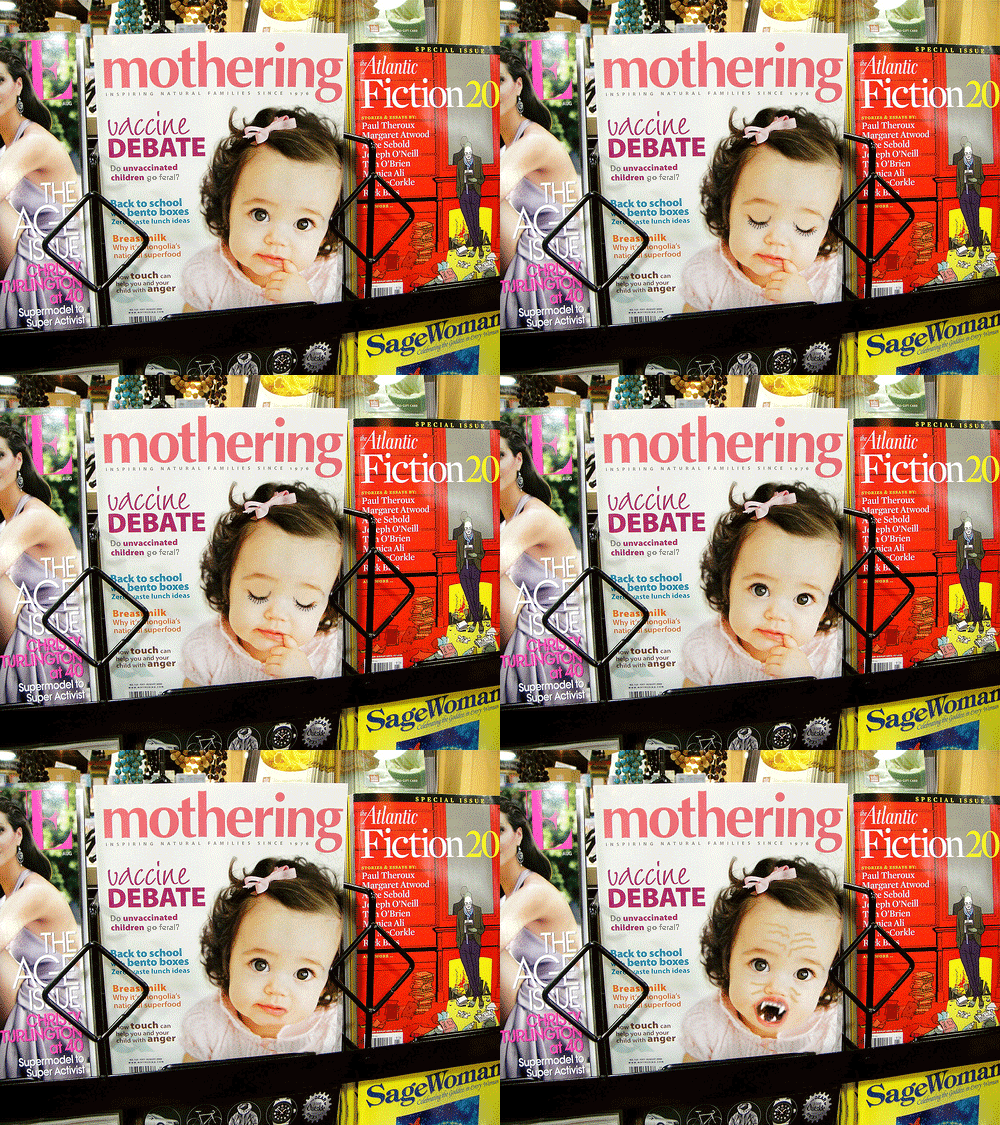
This magazine cover freaked me out.
Each element of it freaked me out more than the next. There's the big debate about whether it's okay for you not to get your child vaccinated because of the way other people's children are taking responsibility for keeping diseases out of the way of your precious bundle of purity. There are those bento box lunches. Breast milk and Mongolia. "How touch can help you and your child with anger."
And then there's that cover baby with the giant forehead. Photoshopped? But why? To convey braininess? Braininess in a baby who is looking to you for answers... questioning you... do you know enough about vaccination dangers, elite food packaging, breast milk in those distant places where people must be so wise and pure, and touch, come on, touch me — how?! — touch me or I might become enraged in ways that you — you with your tiny brain — cannot possibly imagine.
IN THE COMMENTS: rhhardin said:
Each element of it freaked me out more than the next.
That's a favorite, up there with "fills a much needed gap."
LOL. You got me there.
And Chip Ahoy says he's freaked out too:
Tags:
babies,
breastfeeding,
Chip Ahoy,
crazy,
emotion,
motherhood,
photoshopping,
purity,
rhhardin,
women's magazines
What's missing from this NYT article about Henry Louis Gates?
The article starts out with genuinely sympathetic stories about another black man who was arrested twice, then ties it to the Gates story. "[B]lacks and others said that what happened to Professor Gates was a common, if unacknowledged, reality for many people of color." Now, that quote bothers me, because it assumes that "what happened to Professor Gates" is the same as the "common, if unacknowledged, reality for many people of color." But that's not my question about this article.
I have a question about this:
If the ID did not show the address of the house that had been broken into, then Crowley's continuing investigation into whether Gates really lived there was perfectly reasonable. (Or do you — did Gates? — think that affiliation with Harvard University should end the matter?) Moreover, Gates's belligerence and presentation of himself as a person too important to be questioned should have heightened Crowley's suspicion that Gates didn't live there. While a person who really lived in the house might get outraged, many — I think most — would respect the need to make sure that there was no crime in progress and quickly find something in the house — such as an addressed envelope — that connected the name to the address.
A person who didn't belong in the house would not have that option and would be forced to pursue a different strategy, and protesting the investigation might be that strategy. The police officer is obviously not going to accept shouted assertions that this is my house and questioning of his authority. He shouldn't!
ADDED: In this radio interview, Crowley — at around 6:30 — says that he was shown only a Harvard ID, which had no no address and that an ID with an address "would have been helpful." Thanks to commenter Mike for pointing me there. Bearbee, the commenter, points me to Gates's interview with his daughter, in which Gates says:
By the way, in the linked interview, Gates goes on to say:
Crowley says that Gates's "tone" was "peculiar." And I'm wondering why the question "Is there anybody in the home with you?" would have upset him so much. It could have been just that it was an invasion of his privacy, but think about this along with the fact that Gates didn't seem to want to report the damage to his door that made him need to force it open when he got home. Did Gates already somehow know who had broken the door while he was away, so that he wanted to protect that person? Was that person in the house, such that the question "Is there anybody in the home with you?" felt threatening to Gates?
I have a question about this:
The police and Professor Gates offered differing accounts of what happened after officers arrived. The police said Professor Gates initially refused to show identification and repeatedly shouted at officers. Professor Gates said that he had shown photo identification to Sergeant Crowley but that the sergeant had not appeared to believe that he lived there.There's a crucial, missing fact that the journalists, Susan Saulny and Robbie Brown, don't seem to have any interest in. What I want to know — and I haven't seen it mentioned in other articles — is whether Gates's photo ID had the address of the house on it. Was it his University ID? My UW ID doesn't have my home address on it. I have read elsewhere, not in this article, that Gates rented the house. Perhaps he had a driver's license with a different address of his on it.
If the ID did not show the address of the house that had been broken into, then Crowley's continuing investigation into whether Gates really lived there was perfectly reasonable. (Or do you — did Gates? — think that affiliation with Harvard University should end the matter?) Moreover, Gates's belligerence and presentation of himself as a person too important to be questioned should have heightened Crowley's suspicion that Gates didn't live there. While a person who really lived in the house might get outraged, many — I think most — would respect the need to make sure that there was no crime in progress and quickly find something in the house — such as an addressed envelope — that connected the name to the address.
A person who didn't belong in the house would not have that option and would be forced to pursue a different strategy, and protesting the investigation might be that strategy. The police officer is obviously not going to accept shouted assertions that this is my house and questioning of his authority. He shouldn't!
ADDED: In this radio interview, Crowley — at around 6:30 — says that he was shown only a Harvard ID, which had no no address and that an ID with an address "would have been helpful." Thanks to commenter Mike for pointing me there. Bearbee, the commenter, points me to Gates's interview with his daughter, in which Gates says:
... I got out my Harvard ID and my Massachusetts driver’s license which includes my address and I handed them to him.So there is a real factual dispute here. (Also: My lawyer's eye catches the phrase "my address" and makes me want to ask the follow up: "By 'my address,' do you mean the address of the house Crowley was questioning you about?")
By the way, in the linked interview, Gates goes on to say:
So he’s looking at my ID, he asked me another question, which I refused to answer. And I said I want your name and your badge number because I want to file a complaint because of the way he had treated me at the front door. He didn’t say, ‘Excuse me, sir, is there a disturbance here, is this your house?’—he demanded that I step out on the porch, and I don’t think he would have done that if I was a white.Crowley tells us the question was: "Is there anybody in the home with you?" (at 4:40 in the radio interview). It was asked, Crowley says, because of his concern that the man he was talking to was not one of the persons seen breaking into the house. Now, it seems that Gates knew that the front door had been tampered with before he arrived home, so why wasn't Gates worried about whether there was someone somewhere in the house? Shouldn't Gates have taken the opportunity to tell the police that when he arrived home, he discovered evidence of a break-in? Why didn't he seek Crowley's help with that?
Crowley says that Gates's "tone" was "peculiar." And I'm wondering why the question "Is there anybody in the home with you?" would have upset him so much. It could have been just that it was an invasion of his privacy, but think about this along with the fact that Gates didn't seem to want to report the damage to his door that made him need to force it open when he got home. Did Gates already somehow know who had broken the door while he was away, so that he wanted to protect that person? Was that person in the house, such that the question "Is there anybody in the home with you?" felt threatening to Gates?
Subscribe to:
Posts (Atom)