July 30, 2018

"'Ruth Bader Ginsburg' was trending on Twitter Sunday night, and liberals across the Internet panicked."

"'My heart stopped for a moment,' tweeted writer Wajahat Ali. Dedicated RBG fans feared the worst. They refused to look up the news. They prayed. They offered their kidneys. 'I was on my way to the hospital to donate all my organs,' wrote another fan. 'Please be alive, please be alive, please be alive …,' tweeted another."

So begins the WaPo article "Ruth Bader Ginsburg says she has ‘at least 5 more years’ on the Supreme Court. Her fans rejoice."

By the way, should a Supreme Court Justice have "fans"? Or perhaps a better way of putting it: Is it a compliment to a Supreme Court Justice to speak of her having "fans"?

I've been reading Bill Bryson's "Made in America: An Informal History of the English Language in the United States":
Fans in the sense of enthusiasts is presumed to be a shortening of fanatics, but the conclusion is only speculative. Mencken suggests that it may come from fancy, as in to fancy someone’s chances. In the early days [of baseball] supporters weren’t called fans but cranks, presumably because they cranked up the home team with their cheering.
I'm enjoying this book but I don't trust any of the assertions in it. I think that's interesting, but then I check. For example, I was just writing about baby boomers in the previous post, and it made me remember that Bryson said the term "baby boom" wasn't coined "until 1978, in an article in the New Yorker." But it's very easy to look up "baby boom" in the OED and see "baby boom" was used as far back as 1880 (and obviously not just for the post-WWII baby boom (in 1880, it was "the Iowa baby boom")). In 1941, Life Magazine had "Whatever the reasons, the U.S. baby boom is bad news for Hitler." Referring to the people born in a baby boom as "baby boomers" is newer, but it was around in 1963:
1963 Salt Lake Tribune 8 Dec. 83 Statistics show that..long hours of television viewing put an extra strain on chairs, causing upholstered seating pieces to wear out three to four times faster than in the days before television and the baby-boomers.
So what about "fans"? Putting aside a couple strange things in the 1600s, "fan" to refer to enthusiastic spectators, did originate with respect to baseball (as early as 1889), and the OED gives no regard to Mencken's theory but says it's a shortening of "fanatic" — that is, a crazy, delusional, unrealistically enthusiastic person.

As for "crank," the OED has this definition (in an entry that begins with "crank" as a bend in a path or a winding path:
colloq. (orig. U.S.). A person with a mental twist; one who is apt to take up eccentric notions or impracticable projects; esp. one who is enthusiastically possessed by a particular crotchet or hobby; an eccentric, a monomaniac. [This is probably a back-formation < cranky adj.1 4.] 
IN THE COMMENTS: Referring to the previous post, dda6ga dda6ga says:
Combine two postings; does the notorious RBG like to be called Grandma?
Sharp question. I love when commenters connect to other posts. And I know the answer to the question: Bubbe.

And here's an article from The Forward, "The Battle Over What To Call Your Grandma":
[S]adly, outside the ultra-Orthodox community fewer Jewish women want their grandchildren to call them bubbe, claiming it’s too Old World. Perhaps, though, the real reason is that bubbe is simply too Jewish. So now some grandmothers are choosing the Israeli word, “savta,” whereas others simply resort to English-language monikers.

It seems the term bubbe has taken on negative connotations, similar to many other terms related to Jewish women, as in the classic “Jewish mother” or “mother-in-law.” The B-word is seen as a vestige of a previous era, causing modern, educated women to run the other way....

Negative associations with “bubbe” appear even in classic Yiddish literature and folklore. In Abraham Goldfaden’s famous operetta, “The Witch,” the sorceress herself is called Bubbe Yakhne. Morris Warshawsky’s song, “Di Mezinke Oysgegebn” [“Marrying Off My Youngest Daughter”], describes the many lively scenes at a wedding, including one verse where “Bubbe does the kazatsky” — an image that’s apparently meant to evoke laughter, since grandmothers are expected to sit quietly and with dignity, rather than to clown around and dance “like the men.”...

A Jewish grandmother can — like me — be a Barnard grad, an editor and even something of a boxer, yet at the same time instill in her grandchildren the importance of Jewish memory. No word captures this vital role better than bubbe.
ADDED: Why did RBG choose 5 years as the length of time she sees herself serving? That would only get her to 2023, a point in the next presidential term that gives the winner of the 2020 election the power to appoint her successor.

First, it's a milestone year for her. She'll be 90. But she's not promising to step down upon turning 90, because she said "at least 5 years."

If we see her statement as political — and not simply about round numbers — there are 2 reasons to put her prediction in the form that she did. She's accustoming us to the idea of a Justice properly serving when she is in her 90s, in case Trump is reelected and she must hang on until 2024. But she's also implicitly stressing the importance of defeating Trump in 2020. She's found a subtle clever way to say I can last another term and I can't last another term. Both statements are important politically, but said plainly, they contradict. And a Supreme Court Justice shouldn't speak plainly when speaking plainly makes political motivation plain.

"I was never thrilled about the actual name 'Dad,' which in American culture is someone who tells bad jokes and wears socks with sandals."

"He is Lord of the Grill and the Duke of Fix-it. He’s the best of the 'good guys,' but when it comes to the nitty-gritty of parenting, 'Mom' schedules the appointments, buys the clothes and makes the play dates. It is a common division of labor for most heterosexual couples: Moms do more.... I, with callused hands, spent a great deal of time with our children when they were infants. As an academic, I was grateful for long summers and even longer, Swedish-style paternity leaves. I took the kids to usual spots like parks and zoos, but we also went to places like Mommy and Me Yoga and baby swim lessons. I quickly learned that the daytime world of child care, even in New York City, is populated almost exclusively by mothers, nannies and children...."

Writes Kevin Noble Maillard (a lawprof) in "When Being a Good ‘Dad’ Gets You Promoted to ‘Mommy’" (NYT). His 3-year-old daughter calls him "Mommy." And his 5-year-old son had called both parents “mama” until he was "steer[ed]" toward "papa" and took to calling his father "Mimi."

Maillard — who knows of a 10-year-old boy who calls his father “Honey” — likes the idea of children being "creative" in what to call their parents. He contrasts that to grandparents, who choose what they are to be called.

Did you know grandparents have that privilege? I experienced that phenomenon in my childhood, when my paternal grandmother — who felt she was too youthful to be called "grandma" — got away with determining that she would be called "Mom" (and therefore that her husband was "Pop"). I grew up thinking of "Mom" and "Pop" as words for grandparents and never advanced from calling my mother "Mommy" to calling her "Mom." She simply became "Mother."

As for my father, he was, for me, for his entire life and beyond, "Daddy." I never got the slightest clue whether he started that or perpetuated it or whether he liked it or not. Maybe that was because it was a time in American culture when fathers didn't muse openly about how they felt about relationships.

Anyway, on the topic of grandparents claiming the power to name themselves, Maillard links to "Grandude? G-dawg? Nonny? Boomers Name Themselves" (NYT):
... I know a grandma who goes by Z. And one who has zero Italian ancestors but nonetheless dubbed herself Nonny, a variant on Nonna, because it felt distinctive. And a Brookline, Mass., woman named Suzanne Modigliani, whose daughter’s friends used to abbreviate that to SuMo. Now, she’s GranMo....

... Georgia Witkin’s “The Modern Grandparent’s Handbook” actually lists 251 grandparental names (I counted), divided by gender into three categories: Traditional, Trendy and Playful. I wouldn’t volunteer to be known as Sweetums, G-dawg, Faux Pa or Grandude, however playfully, but apparently some folks have....

Partly, it’s a boomer thing. Tradition didn’t always seem a good enough reason....

But here’s my deeper suspicion: However mightily my peers may pine for grandchildren and adore them when they arrive, some don’t want to acknowledge being old enough to be dubbed Grandpop or Granny...
Ha ha. Just like Mom in the 1940s! (I was born in 1951, but I was the third grandchild.)
My friend Ellen Edwards Villa sent her mother a “grandma” charm for her charm bracelet when her first grandchild was born. The gift came back by return mail. Her mother, a mere 69 at the time, objected that she wasn’t old enough to be a grandma. She insisted her grandchildren call her Sweetie Pie, instead, and they did.
Ha. When my first husband told his mother we were going to have a baby — her first grandchild — what he thought would be funny and nice was to call her on the phone and respond to her "hello" with "Hi, Grandma." She was not delighted but offended. Instead of talking about this wonderful new person approaching our world, the subject had to be the way she was not old.

Boomers always think it's about Boomers, but this thing of women insisting they are not old is old old old.

Which is why I prefer to say I am old.

July 29, 2018

Lake Mendota, Sunday morning.

55457862986__29EED76F-D5C4-4337-AAC7-FC41B00159BC

... talk about anything you want in the comments.

"The internet has always been lawless, but the chaos of the Trump era has worsened online nastiness to the point where even I, a verifiably snarky internet writer..."

"... have grown sick of it all. Desperate for an antidote, I started dabbling in wholesome activities: bicycling, crossword puzzles, baking and writing in my journal. 'Oh no! You’re becoming a hippie,' my mother said after I informed her of my new hobbies. In these efforts to self-soothe, I made a life-changing discovery: Making sourdough bread is the opposite of using the internet...."

From a NYT essay by Eve Peyser, "I Wanted a Dog. I Bake Bread Instead." The headline highlights the dog/bread alternatives as opposed to the escape-from-the-internet theme. I'm guessing that's because dog gets hits... on the internet.

Anyway, I'm blogging this because of the mother's concept of "hippie" and the idea that it could include crossword puzzles. But I like the idea of the younger generation rediscovering the hippie lifestyle, especially if it's envisioned in positive ways — with "wholesome activities."

Also, this article fit with something else I was just reading, "In a divided U.S., therapists treating anxiety are hearing the same name over and over: Donald Trump/'Trump Anxiety Disorder' may not be an official diagnosis, but therapists know the symptoms" (Politico), which chimed with something I'd already blogged this morning, Trump himself using the term Trump derangement syndrome.

Isn't it interesting that therapists are seeing the reaction to Trump as a disorder?! And that Politico framed it that way.

Maybe mainstream media is noticing a lot of people who feel the way I do, that the antagonism to Trump is so over-the-top that it's weirder than Trump. We turn away... and toward the man we originally resisted because he was too weird.

I tried to find a picture of a hippie doing a crossword puzzle, but my search had the serendipitous effect of turning up this New Yorker humor piece from last February: "Former Hippies Put in Horrible Position of Rooting for F.B.I." ("'I always dreamed I’d spend my retirement surrounded by my grandchildren, telling them that the F.B.I. were fascist pigs,' Carol Foyler, a former hippie who lives in Santa Cruz, said. 'That dream has been shot to hell.'").

"We have 2.7 percent unemployment, an opioid crisis that has significantly impacted employability and the reality of an aging population that will absolutely require direct service care at some point."

Said a professor quoted in "New Hampshire, 94 Percent White, Asks: How Do You Diversify a Whole State?" (NYT).

"How Do You Diversify a Whole State?" is one question. Why do you want to diversify the whole state? is another. And it is the question the quote I picked out seems to answer. The state needs a lot of health-care workers to tend to the existing sick and unemployable population.

Wait. "Shed Legacy" is a terrible name for a city.


Here's the article Drudge links to, "City report on Confederate monuments raises idea of renaming Austin."

I'm just laughing because Meade read the Drudge line to me out loud and I couldn't understand the last 2 words, which I assumed were the new city name people wanted. When he said it more clearly "Shed Legacy," I had a genuinely hilarious fraction of a second of thinking of "Shed Legacy" as the name for a city.

ADDED: My willingness to see Shed Legacy as the name for a town comes in part from just recently having read this, in Bill Bryson's "Made in America: An Informal History of the English Language in the United States":
There is almost nothing, it would appear, that hasn’t inspired an American place name at some time or other. In addition to breakfast foods and Shakespearean plays, we have had towns named for radio programs (Truth or Consequences, New Mexico), towns named for cowboy stars (Gene Autry, Oklahoma), towns named for forgotten heroes (Hamtramck, Michigan, named for a Major John Hamtramck), towns that you may give thanks you don’t come from (Toad Suck, Arkansas, and Idiotville, Oregon, spring to mind), at least one town named for a person too modest to leave his name (Modesto, California), and thousands upon thousands of others with more prosaic or boring etymologies (not forgetting Boring, Maryland).
And here's Mental Floss's compilation of "The Funniest Town Name in All 50 States":
3. ARIZONA // WHY... This teeny-tiny community near the U.S.-Mexico border is named after the Y-shaped intersection of two nearby highways. But because of an Arizona law requiring place names have at least three letters, "Y" became... "Why."...

8. DELAWARE // CORNER KETCH... from a rough-and-tumble local bar, whose patrons were so quarrelsome that townspeople would warn strangers, "They'll ketch ye at the corner."...

17. KENTUCKY // BUGTUSSLE... when workers helped out during the harvest, they would sleep in barns—on hay that was infested with doodlebugs... the workers stayed so long that the bugs grew big enough to “tussle” for the prime napping spots....

22. MICHIGAN // HELL...  In the 1830s, the town settler, George Reeves, made a deal with local farmers to trade his homemade whiskey for the grain they grew. When the farmer’s wives knew their husbands were off dealing with Reeves, they were known to remark, “He’s gone to hell again.”...

35. OHIO // KNOCKEMSTIFF...  When approached by a woman asking him how to keep her cheating husband home and faithful, the preacher responded simply: “Knock ‘em stiff.”...
Imagine the origin story for the town of Shed Legacy. There was a shed, a popular trysting spot, and many of the town's original residents were born of mothers who got pregnant there. People got to pointing to that shed and joking that the entire population of the town had come from that shed. The town was the Shed Legacy. And the name stuck.

Lawyer on lawyer on lawyer on lawyer action.


ADDED: Funny that Trump himself uses the term "Trump Derangement Syndrome."

Are you one of those people who eat the same thing every day?

My question is prompted by an article I'm reading — from 2015 about Oliver Sacks:
“I’m a compulsive eater. I can’t have much food in the fridge.” Sacks has eaten the same meals every day for years: oatmeal or Grape-Nuts for breakfast, and canned fish for lunch and dinner. When I ask about this, Sacks stands and shuffles off toward the kitchen, “Stay put,” he instructs. He returns a minute later to methodically stack on the table between us seven tins of sardines, and a half-finished plastic-wrapped package of canned, pickled herring. “I keep a small stock,” he explains. “I don’t want to be bothered to make a choice. Lunch or dinner usually takes about 30 seconds, and I eat standing up. And sometimes reading a book.” If he goes out to eat with friends, Sacks will often choose the first thing he sees on the menu. “It saves time,” he explains.
I ran across that article yesterday as we were discussing the sense of smell in this post about a man who had anosmia and then regained his sense of smell and experienced smell as much more intense than it is for a person who'd never been smell deprived. Commenters brought up dogs, and I wanted to talk about the Oliver Sacks essay, "The Dog Beneath the Skin," a chapter in "The Man Who Mistook His Wife for a Hat," about a man who takes drugs that leave him with a heightened sense of smell and the feeling that it was like being a dog.

I felt surprised to see in that 2015 article that the dog-man in question was Sacks himself, a fact he'd chosen to hide when he published "The Man Who Mistook His Wife for a Hat." ("I’m, um… less – less shy now. I think partly I’m at a distance from these things. They were 40 years ago. And I don’t think it’s sensationalism or exhibitionism for its own sake – so much as the fact that I am basically constituted the same as everybody else, and I will get an inside take, as well as a scientific one.") This revelation is in Sacks's memoir, "On the Move: A Life," which I've read, so I should not have been surprised. I mean, I know I forget most of what I read, but I do think that having read something once ought to keep you from feeling surprised to see it when it comes up again. It should be more of a feeling of oh, yeah, I'd forgotten that.

There are levels of forgetting, I realize. Let's say you encounter, once again, a fact you've have heard before. Level 1: Oh, yes, I remember. (You forgot only in the sense that you had no reason to call the fact to mind, but it looks completely familiar). Level 2: Oh, I'd forgotten that. (You remember that you've seen it before.) Level 3: I don't think I've ever seen that before. (You may have seen it, but you don't remember.) Level 4: I'm sure I've never seen that before. (You seem to remember that you have never known it. This may be based on reasoning that it's the sort of thing that if you'd heard it before, you would remember.)

But back to my original question. If you are one of these people who eat the same thing every day, is it that you worry (or know) that if you allowed yourself choice, you'd go wild? Sacks was capable of taking a lot of drugs and radically changing his way of being...
He experienced a certain impulse to sniff and touch everything (‘It wasn’t really real until I felt it and smelt it’) but suppressed this, when with others, lest he seem inappropriate. Sexual smells were exciting and increased—but no more so, he felt, than food smells and other smells. Smell pleasure was intense—smell displeasure, too—but it seemed to him less a world of mere pleasure and displeasure than a whole aesthetic, a whole judgment, a whole new significance, which surrounded him. ‘It was a world overwhelmingly concrete, of particulars,’ he said, ‘a world overwhelming in immediacy, in immediate significance.’ Somewhat intellectual before, and inclined to reflection and abstraction, he now found thought, abstraction and categorisation, somewhat difficult and unreal, in view of the compelling immediacy of each experience. (From "The Dog Beneath the Skin.")
If you're the kind of person for whom opening doors has immense consequence, you might keep a lot of doors shut.

July 28, 2018

At the Summer Night Café...

P1170808

... talk all you want.

And buy whatever you want from Amazon... using the Althouse Portal.

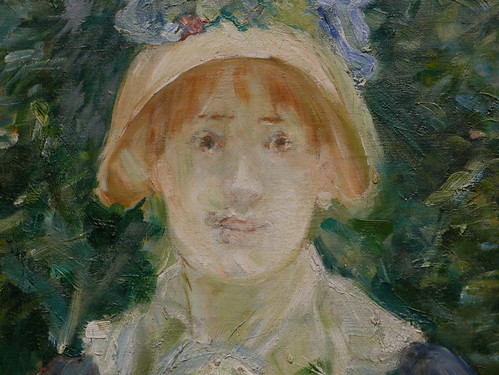
The painting detail is from "Woman in a Garden" by Berthe Morisot, photographed at the Art Institute of Chicago.

"WHOEVER possesses PIETY, HONESTY, TEMPERANCE, GRATITUDE, PRUDENCE, TRUTH, CHASTITY, SINCERITY...is entitled to Advance six numbers toward the Mansion of Happiness."

"WHOEVER gets into a PASSION must be taken to the water and have a ducking to cool him... WHOEVER posses[ses] AUDACITY, CRUELTY, IMMODESTY, or INGRATITUDE, must return to his former situation till his turn comes to spin again, and not even think of HAPPINESS, much less partake of it."

So read the rules of the board game The Mansion of Happiness.


From Wikipedia:
The Mansion Of Happiness was designed by George Fox, a children's author and game designer in England. The first edition, printed in gold ink "containing real gold" using one copper plate engraving and black ink using a second copper plate engraving, produced a few hundred copies. Water coloring was used to complete the game board, making a brilliant, colorful, and expensive product fit for the nobility. Later in 1800, a second edition was printed, probably for rich but common folk. Only one copper plate was used to print black ink and no water coloring was used....

The popularity of The Mansion of Happiness and similar moralistic board games was challenged in the last decades of the 19th century when the focus of games became materialistic and competitive capitalistic behavior.... ...The Game of Playing Department Store, for instance, being the player who carefully spent his money accumulating the most goods in a department store. Bulls and Bears: The Great Wall St. Game promised players they would feel like "speculators, bankers, and brokers"....

"An ethical way to continue teaching Wallace, Hayes-Brady suggested, would be to rigorously study the latent misogyny in his work, for what it can tell us about 'the texture of the world Wallace lived in.'"

"She spent the last stretch of her speech demonstrating exactly how that might be done, rigging a blacklight to an excerpt from Brief Interviews [with Hideous Men] and forensically analyzing the stains — say, the double-silencing of its female protagonist, whose rape is described solely by a man, to another female character who is never heard in the text. You could also, Hayes-Brady suggested, defuse and enhance Wallace’s work by studying him in tandem with thematically similar works by writers he influenced, like Porochista Khakpour and Zadie Smith. I thought these concepts were compelling, and mostly persuasive, but then I would think that, as would everyone else in the room. Hayes-Brady’s talk gave us exactly what we wanted; perhaps what many of us came to Normal to find: a cogent and nuanced permission structure within which to a) continue reading Wallace (none of us were ever going to stop doing this, anyway) and b) justify our continued reading to others — others who, like anyone with a political conviction in 2018, are fundamentally unpersuadable, and who either way wouldn’t take well to being accused of neoliberalist sympathies."

From "Academics Explain David Foster Wallace to Me/A report from the 5th-annual David Foster Wallace Conference, where the author’s most devoted readers are wondering how to approach him in 2018" by Daniel Kolitz. Explaining what's so bad about DFW the man, Kolitz writes:
Wallace taught at ISU for nearly a decade; he wrote almost all his major works there, including the 1996 behemoth Infinite Jest. He also liked to sleep with his students, was abusive to his girlfriend at the time, the writer Mary Karr (whom he’d tried to push from a moving car not long before moving to Illinois in the summer of 1993, and also once hurled a coffee table at), committed statutory rape while away on book tour (or at least told a friend he did), and wrote to his friend Jonathan Franzen to say that he sometimes thought he was “put on earth to put his penis in as many vaginas as possible.”
The essay title "Academics Explain David Foster Wallace to Me" is a play on the famous essay by Deirdre Coyle, "Men Recommend David Foster Wallace to Me."

That reminds me of an obligation that's been hanging over my head all year. Remember, back in January, I wrote:

"It was in stark contrast to the treatment Vice President Mike Pence received on attending 'Hamilton' in 2016, when he was 'booed like crazy.'"

HuffPo informs us, in "Hillary Clinton Showed Up To Watch ‘Hello, Dolly!’ And Bette Midler Couldn’t Cope."


I see no evidence in the article that supports the proposition "Bette Midler Couldn't Cope" and there's something about that locution — the form as well as the substance — that really annoys me. I'm not sure if I'm just really tired of websites that try to sound like overexcited teenage girls or if I'm still feeling uneasy about a language usage controversy that was big in the 1960s: Whether you can use "cope" without "with [something]."

Researching this old usage question, I learned that one meaning of "cope" (now obsolete) is to sew up the mouth of a ferret (which was done to keep them from biting rabbits they were driving from their holes). The word, with this meaning, was then used figuratively. For example (from the OED):
1601 J. Deacon & J. Walker Dialogicall Disc. Spirits & Diuels 214 It shall not be amisse to cope vp your lips a little....

1672 J. Eachard Mr. Hobbs's State Nature Considered 126 Roger has a vocal instrument..called a mouth, and being not muzled, gagged, or cop'd..May stretch it out as wide as he please.
"Cope" also has a meaning in falconry (to cut back the beak and talons) and in architecture (to cover with coping).

But the "cope" we're talking about in "Bette Midler Couldn't Cope" comes from "coup" in the sense of "coup d'etat" or "coup de grace," which means to deliver a blow. To cope was to compete in a well-matched physical fight, and that became figurative, as in "His nature was too gentle to cope with the bold and fiercer temper of his brother" (1847).

The usage without "with" — meaning "To manage, deal (competently) with, a situation or problem" — is traced back to 1934. You can see that it was originally intended to be jocose:
1934 E. Bowen Cat Jumps 248 Angela rang the bell wildly for someone to come and cope.
1955 Ess. in Crit. 5 62 More confidence might be placed in the writer did we not find on the same page a typical shift of tone to this, on Romeo and Juliet: ‘the kids get involved in a lively way, but then they cannot cope.’
1958 I. J. C. Brown Words in our Time 41 ‘She suffers from copelessness.’ I have heard this said of an unsatisfactory employee. The use of cope as a verb by itself to describe dealing with all kinds of situations is a recent usage. In my youth we tried, or were told to try, to cope with this or that problem. We were not required to cope in general.
I'm still trying to cope with cope in general.

"We looked at pictures of women with reconstructed breasts as well as photos of people who’d chosen to go flat."

"The photos of the reconstructed breasts didn’t resonate with me. We talked about it, and I told him that I couldn’t imagine not being able to feel him touching me. I worried the loss of sensation would leave me feeling disconnected from both him and my body.... Honestly, his support surprised me at first. Our culture puts so much emphasis on how much men are supposed to love women’s breasts, I worried he might not be sexually fulfilled.... Not having breasts gives me a sense of freedom I never knew I wanted. In some ways it feels like a new level of womanhood. I’ve grown into this person who isn’t defined by her breasts and that is really powerful. Then there are the practical things like I healed from my surgery quickly and was able to get back to living my life. And the little things, like I’ve got no more breast sweat and I no longer have to worry about whether or not they are hanging out of my shirt! Plus, I can go from a hot summer day into an air-conditioned store and my nipples aren’t don’t show!"

From an interview at The Daily Beast with Emily Hopper, a 32-year-old breast-cancer survivor.

ADDED: "aren't don't"... it's in the quote, so I won't correct it.

"A woman leaned back towards me and — I’m sorry — I coughed because her coat overwhelmed me with lavender and book."

"Some of the smells I can’t place. There’s one that smells a bit like burning cardboard but which my memory is constantly scraping itself to put a name to. There is sileage and rotting meat everywhere. I feel like a farm has gone off in my nose. To write this I’m breathing through my mouth because if I try my nose I can’t concentrate on the screen: fresh emulsion paint, lemons, urban snow, something acrid, something earthy. I’m not near any of this stuff. What’s my brain doing? Is it trying to recalibrate, or is it just telling me this is what I can smell?... I’m sorry, supermarket. I can’t eat your pizza. It tastes of donkey and blood and eggshell and leather jacket. Don’t sue me. I know it’s not true and it’s just my brain interpreting...."

From "I’m having my sense of smell switched back on, and it feels like a farm went off in my nose" by Jason Caplin (at Medium).

"Yes, for the head of a network you’re some good kisser... Well, this has been great. Thanks... I’ve got to go now."

Said the writer-actress Illeana Douglas to Les Moonves, at the end of this incident (described by Ronan Farrow in "Les Moonves and CBS Face Allegations of Sexual Misconduct/Six women accuse the C.E.O. of harassment and intimidation, and dozens more describe abuse at his company" (The New Yorker)):
When Douglas met with Moonves at his office, she began to raise concerns about the “Queens” script, but Moonves, she recalled, cut her off. “He interrupts me to ask me am I single,” she said. Douglas, whose nearly decade-long relationship with Scorsese was coming to an end, was caught off guard. “I didn’t know what to say at that point,” she told me. “I was, like, ‘I’m single, yes, no, maybe.’ ” She began talking about the script, but Moonves interjected, asking to kiss her. According to Douglas, he said that they didn’t have to tell her manager: “It’ll just be between you and me. Come on, you’re not some nubile virgin.”

As Douglas attempted to turn the focus back to work, Moonves, she said, grabbed her. “In a millisecond, he’s got one arm over me, pinning me,” she said. Moonves was “violently kissing” her, holding her down on the couch with her arms above her head. “What it feels like to have someone hold you down—you can’t breathe, you can’t move,” she said. “The physicality of it was horrendous.” She recalled lying limp and unresponsive beneath him. “You sort of black out,” she told me. “You think, How long is this going to go on? I was just looking at this nice picture of his family and his kids. I couldn’t get him off me.” She said it was only when Moonves, aroused, pulled up her skirt and began to thrust against her that her fear overcame her paralysis. She told herself that she had to do something to stop him. “At that point, you’re a trapped animal,” she told me. “Your life is flashing before your eyes.” Moonves, in what Douglas assumed was an effort to be seductive, paused and asked, “So, what do you think?” Douglas told me, “My decision was to get out of it by joking my way out, so he feels flattered.”

July 27, 2018

At the Late Night Cafe...

... you can talk all night.