November 30, 2021

"I remember that day well" — the day Roe was decided — "because it was also the day when former president Lyndon B. Johnson died."

"I was one of the editors of the Michigan Daily, the student newspaper at the University of Michigan, and we had a passionate argument that went late into the evening over which should be our lead story. Should it be legalized abortion across the nation? Or the man who sent tens of thousands of young Americans to die in the Vietnam War? Most of the female editors saw the historic importance of Roe and understood the impact it would have on women’s lives. Most of the male editors — myself included, I confess — could not see past Vietnam and pushed hard for LBJ. We won, sort of: The paper ended up stripping Johnson’s death across the top of the front page and putting the Roe decision right beneath it, still above the fold, with a boldface two-line headline. For history’s sake, I thought that was the right call. I was spectacularly wrong. Johnson was indeed a towering figure, but he’d been long out of office and had to die at some point anyway. Roe was like a bolt from the blue, and with it the nation took a giant stride toward treating women as full and equal citizens under the law. The decision’s impact continues to this day — but perhaps not for many days longer."


I was a student there at the time, so I know I read that edition of the Michigan Daily. I didn't follow the Supreme Court, and I remember being completely surprised that the Court would do something so dramatic, to change so much about our experience of life. 

Isn't it interesting that the editors split by sex — everyone dominated by the  importance of sovereignty over one's own body?

As for the assertion in today's headline — who knows? Will overruling Roe "tear the country apart"? More than it's already torn apart? We may find out. I think it will help the Democratic Party, but you don't hear Democrats expressing hope for this gift of overruling.

"[Elizabeth] Holmes became teary-eyed on the stand as she described dropping out of Stanford University, in part, because she had been raped."

"Shortly after, she said, she struck up a relationship with Balwani, who would go on to become a Theranos executive. 'He said that I was safe now that I had met him,' she said. Holmes had met Balwani the summer before starting at Stanford. She was 18, and he is about two decades older. Balwani had a specific idea of how to make her into a good entrepreneur, Holmes testified, including her eating only certain foods that would make her 'pure' and give her energy for the company, not sleeping much and having a “very disciplined and intense lifestyle.' When she failed to live up to his expectations, Holmes said, Balwani would yell at her and sometimes force her to have sex with him when she didn’t want to, because 'he would say to me that he wanted me to know that he still loved me.' In Holmes’s first days testifying, she stuck to her defense that she was acting in good faith while she ran the start-up and said that she trusted staffers when they told her things were going well in the lab and with the business...."

The top-rated comment over there: "Holmes is a sociopath who thinks she's smarter than everyone else. She conned her investors, her board and her customers, and now she's trying to con the jury."

Random movie watched yesterday: The Luis Bunuel version of "Robinson Crusoe" from 1954.

I know Bunuel from "The Discreet Charm of the Bourgeoisie" (1972) and "Belle de Jour" (1967) and I wondered what he did with "Robinson Crusoe." I'll just say he had a very long career with many stages and quote the NYT obituary (1983) — "an iconoclast, moralist, and revolutionary who was a leader of avant-garde surrealism in his youth and a dominant international movie director half a century later." 

The entire "Robinson Crusoe" film is on YouTube. I ran into it on the Criterion Channel, but here's the whole thing, and I'll just clip out the one 4-minute section that I think is most distinctive, which happens when he's been alone for a very long time and before he has any thought that he'll ever see anyone again. His dog Rex has just died. "Now, truly alone, starved for the sound of a voice, any voice":


Here's the full text of the book. Have you read it? Recently? I don't think I have, though I do remember reading 2 of Daniel Defoe's  novels: "A Journal of the Plague Year" and "Moll Flanders." From his Wikipedia page
Defoe was a prolific and versatile writer, producing more than three hundred works—books, pamphlets, and journals — on diverse topics, including politics, crime, religion, marriage, psychology, and the supernatural. He was also a pioneer of business journalism and economic journalism.... In Defoe's early childhood, he experienced some of the most unusual occurrences in English history: in 1665, 70,000 were killed by the Great Plague of London, and the next year, the Great Fire of London left only Defoe's and two other houses standing in his neighbourhood.... Defoe died on 24 April 1731, probably while in hiding from his creditors. He was often in debtors' prison. The cause of his death was labelled as lethargy....

"We have always been trying to strike the right balance between enforcement, rehabilitation and prevention."

"I would rather have people who are going to shoot up do it in a safe and secure venue as opposed to a McDonald’s bathroom, an alleyway or a subway staircase."

Said Manhattan district attorney Cyrus R. Vance Jr., quoted in "Supervised Injection Sites for Drug Users to Open in New York City/The Manhattan facilities will provide clean needles, administer medication to reverse overdoses and provide users with options for addiction treatment" (NYT).

"Everybody learned a lot this year, and I just want to make sure there’s absolutely nothing that could ever be considered as insulting to Chinese culture."

"We look at everything through the lens of diversity, equity and inclusion. That’s the way of the future."

Dancers and choreographers of Asian descent say the revisions to “Nutcracker” are long overdue. Ma Cong, resident choreographer of Tulsa Ballet, said he was confused when he first saw “Nutcracker” productions featuring exaggerated makeup and stereotypical costumes. Ma, who grew up in China, recalled thinking, “That is not Chinese.” 
For reference, here's the Chinese dance — "Tea" — as it was performed by the Bolshoi Ballet in 2018:

November 29, 2021

Sunrise — 7:00.

IMG_8440D 

Talk about whatever you like in the comments, and if you're doing some shopping, remember the Althouse portal to Amazon. Thanks!

"Though it’s the film’s quieter absurdities – like its glorious shot of Crawford, sheathed in platinum sequins, descending a curved staircase while she scowls at a plate of cold, congealed steak – that tickle me more than its chaotic, cacophonous climaxes."

From "Mommie Dearest at 40: the derided camp classic that deserves a closer look/Faye Dunaway’s all-guns-blazing performance as Joan Crawford is one of many reasons why the reviled biodrama is not the disaster many have labelled it" by Guy Lodge (The Guardian).

Yes, it has been 40 years, and I rewatched it for the first time this week. Not because I noticed it's the 40 year anniversary but because it's in a collection of Frank Perry movies on the Criterion Channel, and I'd just watched one of them — "Diary of a Mad Housewife" — for reasons discussed in a November 9th post. And I'd watched another — "The Swimmer" — back in 2018, discussed here. Frank Perry is a strange director. All 3 of these movies have a heightened surreality. They're all heavily focused on an awfully unpleasant central character who's jammed right up in your face for 2 hours. 

There are 2 more Frank Perry movies collected at Criterion — "David and Lisa" (which I saw sometime in the 1960s and have never rewatched) and "Man on a Swing" (a 1974 movie that I don't think I'd ever noticed before).

Have you got anything to say about Frank Perry? If you know him at all, which of these movies is your opinion based on? If it's "Mommie Dearest," do you agree — as I do! — that these are the best 6 1/2 minutes in the movie?

George yawns as Paul invents "Get Back" out of thin air.

"But what Biden knows, after three-plus decades of being politically left for dead, is that nothing’s over just because a bunch of unnamed staffers who spend too much time reading polls say it’s over."

"He knows from experience that the more monolithic and reflexive the popular wisdom, the more likely it will be proved wrong. Does Biden run again? Personally, I’ve always thought he was most likely a one-term, stabilizing president, and I don’t really believe he has made up his mind to seek another term. But it’s early yet, and I’m pretty sure Biden won’t be spooked into accepting everybody else’s idea of political reality."

From "Panicked Democrats are ready to shove Biden aside. Again" by Matt Bai (WaPo).

Elon Musk "became a bright antithesis to Russian capitalism, a guide on how you can get rich in the right way and how you can spend the money you earned in the right way."

"The Russian environment could not produce this cultlike figure. And it is an easy import because Musk is not associated with some Wall Street billionaire, he is not a native American and he engages with Russia. So he is not perceived as a stranger, and this image is important to a stratum of people who are in need of one."

Said Alexey Firsov, founder of the Platforma sociological research and consulting firm, quoted in "Memes, merchandise and Mars cocktails: Russia’s mania for Elon Musk has no bounds" (WaPo).

And there's this, from a 29-year-old Moscow bartender who attracted the attention of SpaceX by applying for the job of bartending on its mission to Mars: "Probably the decisive thing that inspired me to follow Musk is when he said that you shouldn’t be afraid of failure. I think, here in Russia, if you make one mistake, it follows you. His view seems to be that if you make a mistake, you get experience and learn from it and won’t make it again. I think it’s unique for people in Russia."

In Russia, we're told, people love wearing Elon Musk imagery on their shirts:

"There are two pronouns: he and she. Our language is beautiful. And two pronouns are appropriate."

Said the French first lady, Brigitte Macron, quoted in "In a Nonbinary Pronoun, France Sees a U.S. Attack on the Republic/When a French dictionary included the gender-nonspecific 'iel' for the first time, a virulent reaction erupted over 'wokisme' exported from American universities" (NYT).
Lilian Delhomme, 24, a gender-nonconforming student of international affairs at the University of Paris 8 who has been using the pronoun “iel” for about a year, was appalled by Ms. Macron’s statement. 
“This for me was very violent,” Mx. Delhomme said in an interview. “Coming from the first lady, from a woman, from a French teacher, from someone whose relationship went against many societal norms, it made me lose hope.”
Mx. Delhomme was referring to the fact that the relationship between Ms. Macron, 68, and Mr. Macron, 43, began in high school when he was a teenager and she was his drama teacher, married with three children....
That's a nice example of going on the offense, but I wonder if the French who are outraged about the invention of ungendered pronouns might also reject the "many societal norms" that stand in the way of a sexual relationship between a teenaged student and his high school teacher. I don't know. I am not French. I don't have my finger on the pulse of the French. 

But, from afar, I empathize with the sentiment "Our language is beautiful." It is true of French and it is true of English, though awful writing and speech is possible in both languages, and it's hard to speak beautifully of the desire to control the growth of the language. There are always many extra words, and who could you trust to pare away the extra words?

One answer is: The dictionary! I remember when some people would eschew any word that wasn't "in the dictionary." 

ADDED: If you object to adding weird words, why would you say "wokeisme"? I detect eepocreeezeee.

"As South Koreans enter the living-with-corona phase of the pandemic, some are easing back into social life by visiting public spaces where they can be alone and do very little."

"Nothing is the new something in South Korea as people desperately seek refuge from the pressures of living as functioning adults in a global pandemic in a high-stress and fast-paced society with soaring real estate prices and often-grueling work schedules. At a Space Out Competition this year, competitors sought to achieve the lowest heart rate possible while sitting in a 'healing forest' on the southern island of Jeju....Spacing out is known in Korean as 'hitting mung,' a slang usage of the word 'mung' to describe a state of being totally zoned out.... With the weather change this fall, now popular are the terms 'forest mung' and 'foliage mung,' meaning spacing out while looking at trees or foliage. There’s 'fire mung,' or spacing out while watching logs burn, and 'water mung,' being meditative near bodies of water.... On Ganghwa Island, off South Korea’s west coast, a cafe named Mung Hit also offers no-activity relaxation areas. In one section is a single chair facing a mirror for anyone who wants to sit and stare. There are nooks for meditating, reading, sitting by a pond or the garden, or enjoying mountain views. No pets or children are allowed.... '"Hitting mung" is a concept of emptying your heart and your brain so that you can fill them with new ideas and thoughts. We opened because we wanted to create a space for people to do just that'...."

November 28, 2021

Sunrise — 7:11, 7:17.

I took this picture at 7:11: 

IMG_8431D 

And Meade took this picture — I'm in it — at 7:17:

IMG_9205 

Talk about anything you want in the comments. And please think of supporting this blog by doing your shopping through the Althouse portal to Amazon, which is always right there in the sidebar. Thanks!

"In many years of working as a travel writer — which I’ve often thought of as working the awe beat — I’ve come to understand that awe cannot be easily choreographed."

"Some of the times I have experienced awe: An hour of avalanches rumbling down the south face of Annapurna under a full moon. Fork lightning strobing across the empty deck of a cargo ship on Lake Victoria. An eagle hovering 20 feet above my shoulder in the Chilean tundra. These... transcendental moments... relied on serendipity...  Some occasions, by contrast, when I didn’t feel awe: gorilla tracking in Uganda, seeing the Mona Lisa at the Louvre amid a jostling crowd of people taking photos of it with their mobile phones, every safari I’ve ever been on.... Space tourism belongs to this subset of ostensibly awesome experiences that often feel anticlimactic precisely because they come with a promise of awe factored in... The sense of surprise that is arguably the most vital precondition for experiencing awe will have been watered down by the months of forethought and demystification.... It’s the difference between joining a 20-strong organized tour to see the Northern Lights and, say, camping alone in some Scandinavian wilderness and being roused from your tent by the aurora’s spectral green ripples illuminating the canvas.... 'The best way to access this everyday awe is by allowing yourself to wander, to avoid following a schedule each moment of the day. We didn’t evolve to feel awe about hurtling through space.'"


When have you experienced the sublime? Was it planned? Was it in a group? Did you pay for it? If it was planned, paid for, and in a group, did you really feel it, or did you fake it? What if other people murmuring about the sublimity they paid for punctured your sublimity? What if it left you cold, what if it felt like nothing? But you paid $450,000! 

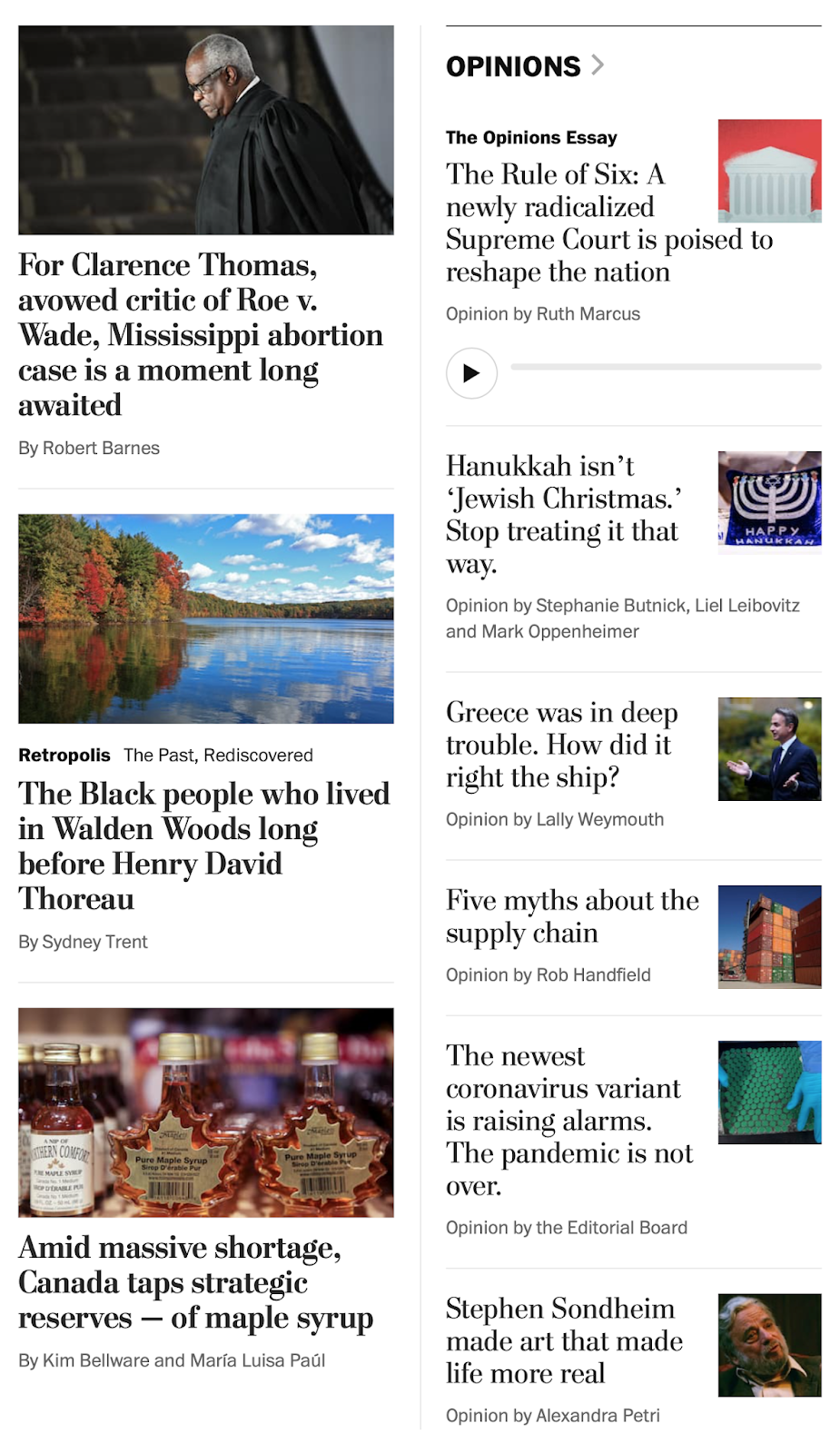
I'm pulled into the upper right hand corner of The Washington Post — so dangerous, so syrup-drenched.

Here's that corner (9 items):

It's an omakase breakfast — omakase, not omicron — the selections entrusted to the illustrious mainstream newspaper. I will update this post, course by course. 

1. "For Clarence Thomas, avowed critic of Roe v. Wade, Mississippi abortion case a moment long awaited" by Robert Barnes. There's oral argument in the big abortion case this Wednesday, and, we're told, Thomas receives "unprecedented deference" these days — because of all his new colleagues, who "think like him," and because there's a new method of asking questions at oral argument, and not only does he speak now, he goes first, and no one cuts him off. They let him finish "his low-key inquiries." Thomas has repeatedly written separate opinions to say that Roe ought to be overruled. "Thomas’s idiosyncratic views and his resistance to compromise still make him the justice most likely to write a solo opinion," writes Barnes. But what's to prevent these new Justices, who may genuinely respect him, from curing that loneliness? Asking that question, I thought of the adage, "Any man more right than his neighbors constitutes a majority of one already." And then I realized I'm talking about the person named in the next headline down, Henry David Thoreau.

2. "The Black people who lived in Walden Woods long before Henry David Thoreau": "'Down the road, on the right hand, on Brister’s Hill lived Brister Freeman, ‘a handy Negro,’ slave of Squire Cummings once... With him dwelt Fenda, his hospitable wife, who told fortunes, yet pleasantly – large, round, and black, blacker than any of the children of night, such a dusky orb as never rose on Concord before or since,' Thoreau wrote in 'Walden.'"

3. "Amid massive shortage, Canada taps strategic reserves — of maple syrup": "Petroleum stockpiles aren’t the only strategic reserves being tapped this season amid concerns of supply shortages and sky-high prices." There's a Canadian federation that, we're told, gets called "the OPEC of maple syrup." The shortage seems to have mostly to do with people cooking more pancakes and such on account of the lockdown, but there's also stress to the maple trees from climate change, so make sure to keep worrying about climate change. It affects pancakes!

4. "The Rule of Six: A newly radicalized Supreme Court is poised to reshape the nation" by Ruth Marcus. The conservatives are no longer just looking for a 5th vote. With 6, it's like "an heir and spare." They can afford to lose one. No more need to cajole that last one, the fussed-over "swing" voter. And Marcus tells WaPo readers to be be afraid, be very afraid.

5. "Hanukkah isn’t ‘Jewish Christmas.’ Stop treating it that way. No need to include our holiday in the winter extravaganza of commercialization, thanks." Sample sentence, representing the tone and message of the entire piece: "No Jew has ever gazed longingly at a 12-foot inflatable reindeer and wished in her heart she had an equally large Moses to display in front of her house."

6. "Greece was in deep trouble. How did it right the ship? Prime Minister Kyriakos Mitsotakis on the arrival of migrants — and tech companies." An interview with the prime minister. Highlights: "We should agree in principle that no country has a right to weaponize migrants. . . . We won’t let people come in as they please." About criminalizing “fake news”: "What we are doing is very measured and very valid."

7. "Five myths about the supply chain/No, self-driving trucks wouldn’t fix all our problems." "Much of today’s mess was caused by relying on extremely fragile — and extremely long — supply lines. Ohno would have shuddered at the thought that his ideas were being applied in this manner." Oh no! Taiichi Ohno originated the concept of just-in-time delivery.

8. "The newest coronavirus variant is raising alarms. The pandemic is not over." "It will take time to determine if the variant is more transmissible than delta, or more virulent, but it is a worrisome development." Won't there always be a new variant so that we will always be told we don't know enough yet and we will need, once again, to err on the side of safety? This feels like a treadmill that we can never step off.

9. "Stephen Sondheim made art that made life more real" by Alexandra Petri. A song "can’t be too clever, and it can’t be too dull. It has to land on your ear as a surprise. If it contains jokes, they have to rhyme. (If it contains rhymes, words that are spelled differently are funnier, Sondheim thought, than words that are spelled the same.)... The song has to take the character singing it somewhere. It has to be essential to the show. 'If you can take the song out,' Sondheim said, 'and it doesn’t leave a hole, then the song’s not necessary.'... Life also exists in time. You cannot stop it and start it and go back and hope to make yourself better understood. You must express yourself in the moments allotted and make yourself heard and choose what to say." 

If I hadn't committed to reading every one of those 9 stories, the ones I would have read would be: 1, 2, and 9. And I would have blogged all 3. 

Having read all the stories, I rank their bloggability, for me, beginning with: 1, 9, 2. Then, there's a big drop off. There's something I'd wanted to say that 8 gave me the chance to say, so I'll put 8 next. I'd put 3 dead last, because I don't really want to blog about the syrup supply, though it would shoot to the top if I had a "syrup" tag (and I might create a "syrup" tag, but it will take a while to add it retrospectively, and it's only interesting if it collects a lot of old things, which it will, more than 10). I put 4 next to last, because it's obvious to me what it will be from the headline and the author, and I don't need more of that. Third from last is 5, which is unnecessary holiday fluff, and I didn't like the insinuation that I was "treating" Hanukkah in any particular way. That leaves 6 in dead center. The Greek Prime Minister. I had to force myself to read that, but he was concise and hard core — quotable.

Oops, I forgot the supply chain. I know it's important, but it's not my thing. I put Greek Prime Minister at what I called "dead center" and in 5th place, so let's put 7 in 6th place. 

Final ranking: 1, 9, 2, 8, 6, 7, 5, 4, 3.

ADDED: I have now made the tag "syrup." Click. It's pretty exciting. 

"Audience members were treated to author Haruki Murakami serving as a disc jockey while playing the works of jazz great Stan Getz and talking about his music."

"Murakami played records from his own extensive collection during a session held Nov. 13 at the Waseda International House of Literature in Tokyo.... In the shadows of his spectacular and extensive musical career, Getz continued to suffer from alcoholism and drug addiction his entire life. 'Music is there like an independent form of life unto itself,' Murakami said. 'It keeps evolving even if it lives in a host who is so messed up.'"

From "Murakami spins best of Stan Getz while he talks about jazz great" (The Asahi Shimbun).

A reader sent me that link, and I greatly enjoyed reading it here at my computer with access to Spotify to listen to, notably, “Corcovado” from “Getz/Gilberto."

 
I made a bookmark for The Asahi Shimbum, where I was pleased to see that the biggest front-page item was "Pigeons figure the odds to perch where safety is assured"...
The unusual sight of 30 or so pigeons perched on the rooftop of a parked car on a road in central Tokyo, rather than an adjacent small park, seemed like an unlikely place to congregate. But in fact it made perfect sense.... It turns out that pigeons take two factors into account when they pick where to perch, according to Shigeru Watanabe, professor emeritus of animal behavior at Keio University who won... the Ig Nobel award, which honors “achievements that first make people laugh and then make them think,” for showing that pigeons can distinguish between paintings by Picasso and Monet by showing 10 pictures of each to them.
I who was lost and lonely/Believing life was only/A bitter tragic joke, have found with you, the meaning of existence, oh my love....