Showing posts with label T.C. Boyle. Show all posts

October 31, 2022

"Your story 'Princess' reimagines the fairy tale 'Goldilocks and the Three Bears' as a contemporary home invasion."

The New Yorker interviews T. Coraghessan Boyle.

(You can listen to the author read the story on "The Writer's Voice" podcast. I listened twice (and also read the story).)

Boyle says he just happened into a true tale in which "a girl came into [a] house in the middle of the night, turned on the lights, flushed the toilet, and fell asleep in the back bedroom until the police were summoned to remove her.... Who was this girl? What did she want? Why didn’t she take anything? And what was with the barbecued ribs she brought with her?"

August 18, 2018

"There was a dragonfly perched on the rail, a single bolt of electric color like a driven blue nail, and beneath it..."

"... a built-in shelf aflame with the spines of the books Marco had been collecting—Soul on Ice, Ficciones, Cat’s Cradle, Trout Fishing in America, Steppenwolf—and a Coleman lantern in a shade of green so deep it cut a hole through the wall. The books were incandescent, burning from the inside out. She picked one up almost at random, for the color and the feel of it, and she opened it on words that tacked across the page like ships on a poisoned sea. She couldn’t make sense of them, didn’t want to, hated in that instant the whole idea of books, literature, stories—because stories weren’t true, were they?... and she stroked the familiar object in her hand as if it were a cat or a pet rabbit, stroked it until the paper became fur and the living warmth of it penetrated her fingertips....  And then she was down out of the tree, barefoot in the biting leaves, scattering an armload of books like glossy seeds... With a sweep of her instep, she interred the books beneath the clawlike leaves.... New books, with fiercer colors and truer stories, would sprout up to replace the tattered ones, a whole living library growing out of the duff beneath the tree, free books, books for the taking, books you could pluck like berries. Or something like that...."

From "Drop City" by T.C. Boyle, the novel I'm reading this week. The story takes place in 1970, and the "she" in that paragraph is, as you might guess, on LSD.

Points if you, like me, have read all 5 of the books named — Soul on Ice, Ficciones, Cat’s Cradle, Trout Fishing in America, Steppenwolf — and if you did, it almost goes without saying that you read them circa 1970. Did you ever try to read while on LSD? If so, I'll just guess you like that description of picking up a book almost at random, for the color and the feel of it, and seeing words that tacked across the page like ships on a poisoned sea and stroking it as if it were a cat or a pet rabbit... until the paper became fur and the living warmth penetrates the fingertips.

IN THE COMMENTS: cathy said:
If books fit so well in a specific culture and time, I could see where planting them as an offering could work to give birth to a new phase of writing. Also this makes me remember I grabbed a Brautigan book and Whole Earth Catalogue to read for the few days I spent in jail when I was busted for hash. Knew Cleaver a bit, he reformed. He had a benefactress paying his rent in Berkeley but then he got evicted because he had so much junk in his front yard.

May 2, 2018

“I think mayonnaise—actually, sorry, this is stupid, this is crazy"/"Not at all"/"I think mayonnaise has a complex kind of relation to the sublime."

"And I think emulsion does generally. It’s something about that intermediary—I don’t know—place, between being solid and being a liquid, that has a weird relation to the sublime, in the sense that the sublimity of it is in the indefinable nature of it"/"It’s liminal also"/"It’s liminal, and it connects to the body in a certain way"/"You have to shake it up. You have to put the energy into it to get it into that state"/"Anyway... mostly I just don’t fucking like it."

From "Fred Moten’s Radical Critique of the Present" in The New Yorker. Moten, the first speaker in the dialogue above, is a poet, critic, theorist, and NYU professor. He has a book of essays titled "Stolen Life." Here's a quote from it:
"Black studies is a dehiscence at the heart of the institution on its edge; its broken, coded documents sanction walking in another world while passing through this one, graphically disordering the administered scarcity from which black studies flows as wealth."
The New Yorker saves us the trouble of looking up "dehiscence" by telling us it's "a surgical complication in which a wound ruptures along a surgical incision." But I still feel compelled to look up "liminal." I mean, I kind of know the word, but why are these 2 men so easily agreeing on the liminality of mayonnaise?!

The OED gives this as the first meaning: "That has the lowest amount necessary to produce a particular effect; minimal; insignificant." Sample quote (from T.C. Boyle): "The liminal smile, the coy arch of the eyebrows."

Second meaning: "Characterized by being on a boundary or threshold, esp. by being transitional or intermediate between two states, situations, etc." Sample quote: "Airports are places of waiting and uncertainty—liminal, indeterminate spaces, caught between one world and another." Yeah, that's kind of like mayonnaise. I mean, if you're going through airport security and you've got mayonnaise, do you have to limit yourself 3 ounces and put it in the see-through, quart-size bag?

Third meaning: "Cultural Anthropol. Of or relating to a transitional or intermediate state between culturally defined stages of a person's life, esp. as marked by a ritual or rite of passage; characterized by liminality." That's limited to cultural anthropology, and while I'm prepared to riff on the cultural anthropology of mayonnaise...


... the definition does specify "stages of a person's life," and there's no personification of mayonnaise... is there?

May 4, 2017

"And thats why i post infrequently. Unless it is about Van Morrison."

Wrote D in the comments to the post about Stephen Colbert's lame effort to back out of his "cock holster" remark. D says:
I visit this blog everyday for the reasons espoused by many others already re: how the hostess find/pulls alot of interesting takes on the day's news articles. You can then find interesting tangents / new knowledge / stuff added by the many many commentators. Many with varied skills and knowledge bases whatever their political leans. Today, one of the posts has to do with a crazy scottish surfer. Comments then pulled towards using drones in search and rescue to reduce costs. And latest on towing insurance etc Ok that isnt everyones cup of tea, but that post will (i estimate) get 1/8 of this post And this post is about some guy and another guy who get paid lots o money to act in front of cameras, and they are riffing off what one guy said, a few nights ago, to show he's edgy. They are not capable of running search amd rescue operations. If people stop paying attention - including the # of comments on a top blog - hmm maybe the edgy guy becomes less important in the grand scheme of things. Might not get gigs in front of congress The posts today - the congress vote, the surfer, the army photographer, and the immigration post esp. - those posts deserve more comments than this fluff. IMHO. And thats why i post infrequently. Unless it is about Van Morrison.
Have I blogged about Van Morrison?! I guess I have. There was the time, back in December 2008, when I took some photographs in the snowy, foggy cemetery...

Winter cemetery

...  and the car radio just happened to be playing Van Morrison rendition of the old song "That's Life." (And the time I referred back to that old post.) And I've talked about the recording "Gloria" a few times:

1.  Way back in March 2004, before the posts had titles:

February 9, 2015

"The ego, faced with the prospect of its own dissolution, becomes hypervigilant, withdrawing its investment in the world and other people."

"It is striking that a single psychedelic experience — an intervention that [the neuuroscientist named Robin] Carhart-Harris calls 'shaking the snow globe' — should have the power to alter these patterns in a lasting way."

From "The Trip Treatment/Research into psychedelics, shut down for decades, is now yielding exciting results," by Michael Pollan. Great article. Read the whole thing.

I've been listening to the podcast version of the article, and the word "hypervigilant" is the one I remembered to search for the quote I wanted to blog. I was interested to see that The New Yorker has only ever used the word hypervigilant/hyper-vigilant 21 times.  (There was a time when The New Yorker was punctilious about consistency and would have stuck to one spelling of a word!) Here's an assortment:

MARCH 17, 2014: "The band, more New Wave than punk, hadn’t started yet, and the only thing to look at onstage was the opening band, whose members were packing up their equipment while hypervigilant girls in vampire makeup and torn fish-net stockings washed around them in a human tide that ebbed and flowed on the waves of music crashing through the speakers."

JUNE 17, 2013: "Caffeine prevents our focus from becoming too diffuse; it instead hones our attention in a hyper-vigilant fashion."

MARCH 29, 2013: "Following a first scare... some people... pay closer attention to how their body feels. Hypervigilance leads them to notice more symptoms—is that a new tingle?—and become more alarmed."

OCTOBER 24, 2011: "Carrie [Mathison, the character on 'Homeland'] lives by the cherished motto of the hypervigilant, 'Just because you’re paranoid doesn’t mean they’re not trying to kill you,' without suspecting for a moment that it’s excessive or the wrong way to look at things."

AUGUST 8, 2011: "'You can only be hyper-vigilant for so long,' the special-operations officer said. 'Did bin Laden go to sleep every night thinking, The next night they’re coming? Of course not. Maybe for the first year or two. But not now.'"

DECEMBER 13, 2010: "These symptoms he tells me in a matter-of-fact voice. In this way, the husband shifts to the wife the puzzle of what to make of such things, if anything; like certain emotions, too raw to be defined, this kind of information can be transferred only to another, the caring and hyper-vigilant spouse."

FEBRUARY 2, 2009: "Just as nervous fliers may think they can keep a plane in the air by being hypervigilant, many of us think we can keep Obama safe by watching him every second; in a way, it was reassuring not to see too much of him on the journey—it meant that he was O.K., that we didn’t have to worry about him."

October 5, 2013

"The professorial dictum has always been to write what you know, but I say write what you don’t know and find something out."

Says T.C. Boyle, with this specific example of his approach to story writing. He'd heard of about an incident in which a man and his wife came home drunk after a party, and the man "crept back out, dressed all in black and donning a black ski mask... climb[ed] up the side of a cabin belonging to a single woman and peep[ed] through the second-story window."
Unfortunately for him (and fortunately for me) he was discovered and unmasked and the repercussions began to play themselves out. Now, I don’t know the people involved in that incident and I don’t want to know them. All I want, from that story or any other, is to hear a single resonant bar of truth or mystery or what-if-ness so I can hum it back and play a riff on it.
Key line: I don’t want to know them.

February 6, 2009

"We are both architects in a way. We both deal with structure, we are both artists, and we are both egomaniacs. I have worn a cape."

"There is where we end."

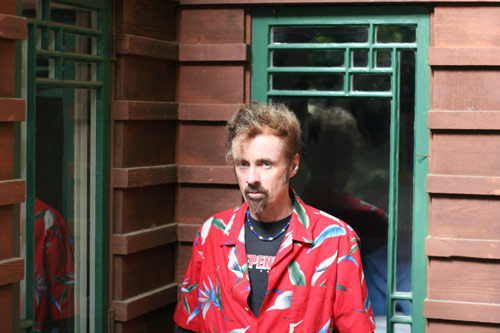
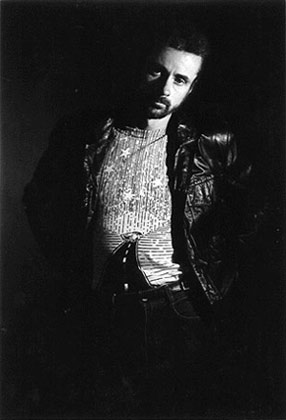
Says T.C. Boyle about Frank Lloyd Wright, the subject of his new novel. Boyle actually lives in a Wright house, the George C. Stewart House in Montecito. Here's a photo of the house, and looking closely at the windows, I believe this portrait of Boyle at his website shows a detail of the house. Here's another portrait of Boyle from his website. I think it's interestingly phallic.

ADDED: If you buy the book — "The Women" — using this link, you will be making a contribution to this blog (without paying extra).

July 29, 2006

Drive talk.

Driving across the continent this week, I listened to the satellite radio for hours and hours. Around Madison, I stay with the music channels most of the time, but on this long trip, I needed the talk channels to keep me going. And there's only so much news I can take, and I gravitated to non-news talk shows. My heart always lifted when "This American Life" came on, as it does more than once a day on the XM Public Radio channel. I also got through long stretches of highway listening to interviews with artists. On one of the comedy channels, there was a long, absorbing session with Carlos Mencia, who's really smart as well as funny. Then there was a great hour with a musician whose name I can't recall, one of The Pacers -- not Sonny Burgess. He had memories of Sun Studio in the golden days and so much heart, so much love for rockabilly music. (Don't you love rockabilly music?) And then there was a Public Radio interview that I stumbled into the end of and then heard on repeat from the beginning.

It was T.C. Boyle, whose crushingly depressive quote bugged me the other day. Some blogger criticized that post for making everything political, even though all that bothered me was the repulsive pessimism, and it occurred to me later that the blogger who criticized me -- he's linked in the linked post -- was not only ridiculously hypocritical -- he was the one seeing politics everywhere -- but he had also made an embarrassing concession about the political vision of the left: It feels like depression.

Anyway, on the radio, T.C. Boyle didn't seem like a depressing guy at all. He seemed perfectly energized, bubbling with ideas. In fact, he reminded me of blogging. He said he got his ideas from reading the newspaper, finding some little thing that touched off his thinking and taking it from there.

What reminded me that I wanted to say I really like Boyle is seeing this NYT review of "Talk Talk," the book I heard him talking about on the radio.
These jubilant portrayals of the loathsome and the lunkheaded have earned Boyle a reputation as a satirist, but the truth is more complicated. His outsize attack may at first glance appear surreal and excessive. In fact, this is 21st-century naturalism. Boyle depicts his whirling, pestilential world like an amused, not unaffectionate Hieronymus Bosch, graphically detailing the 31 flavors of greed.

He doesn’t remake the thriller in “Talk Talk” — that’s a tall and probably superfluous order. But without being too explicit, let’s say that he does engineer an ending unusual for a genre in which writers tend to administer justice like Antonin Scalia, displaying little sympathy for the criminal element. More than 20 years ago, in the story “Greasy Lake,” Boyle wrote, “There was a time when courtesy and winning ways went out of style, when it was good to be bad, when you cultivated decadence like a taste.” With T. C. Boyle, thankfully, such times have never gone out of fashion. No one writes better about the wages of American sin. Or, if not wages exactly, sin purchased on credit, and that probably stolen.
Hey, wait a second! How did Scalia get into the review?! And talk about seeing politics everywhere!

ADDED: You can buy a download of the interview with Boyle here.

July 20, 2006

"Do you really think anything is ever going to get better as long as there are 6.2 billion people?"

"Don’t you see that the wars we are fighting now are for resources? It’s just going to get worse; it’s utterly tragic and I have no solution. I’ve been writing about this for a long time.”

I want to like novelists. Really, I do. For example, T.C. Boyle. I read him sometimes. That is to say: I subordinate my mind to his and let his thoughts become my thoughts. But then I read quotes like this, and it sets me to wondering all over again about this practice of reading novels. They're written by novelists, you know.

ADDED: Roy thinks I'm objecting to Boyle's politics. He specializes in calling me an idiot, in numerous posts, but he never seems to begin to understand my writing. Here, he comes to the defense of writers. But do writers even want to be defended by a man who is such a poor reader?

March 8, 2004

Drop City ... Gloria. I drove in to work this morning listening to an NPR interview with T.C. Boyle, who talked about being really a rock star at heart, forced to be a writer for lack of musical talent. (Hey, that's the way I feel about being a law professor! At least there's a live audience.)
[I]n Drop City, the Van Morrison song "Mystic Eyes" is used to underscore the novel's central conflict between a hippie commune in Alaska and the locals they incense.

I'm going to read that. Me, I liked the early Van Morrison, before his name was known, and he was just Them. I bought the first Them single when it came out ("Here Comes the Night"). It wasn't quite the sort of thing I liked at the time, but it was close enough, and it was clearly good. "Gloria" was even better.

So let me say something about "Gloria," which relates to the single best moment of musical performance I ever witnessed live. It was the mid-1970s, in Greenwich Village, in a small music club that was called The Metropolitan (or something close to that). We had gone to see the folk duo Happy and Artie Traum, whom we liked a lot at the time--this is a good folky album--and were dismayed to see that there was an opening act, and it was just some poet who was going to do a reading. That didn't seem right, and I came close to leaving and coming back later so I wouldn't have some idiot's poetry inflicted on me. Well, the poet was Patti Smith, and there was a guitarist sitting in a chair behind her, sort of aimlessly, quietly noodling, while she recited her poetry in the singsongish way typical of beatnik poets. At some point, it became more like singing, and then, somewhere down the line, with the participation of the guitarist, it became "Gloria." That was the coolest thing ever. A version of her Gloria, appears on the album pictured here. I have that album in a frame on my living room wall.