When it comes to 1/6 and those who were at the Capitol, there is no middle ground. That playbook is not new. "Either you are with us, or you are with the terrorists" was the rigidly binary choice which President George W. Bush presented to Americans and the world when addressing Congress shortly after the 9/11 attack. With that framework in place, anything short of unquestioning support for the Bush/Cheney administration and all of its policies was, by definition, tantamount to providing aid and comfort to the terrorists and their allies. There was no middle ground, no third option, no such thing as ambivalence or reluctance: all of that uncertainty or doubt, insisted the new war president, was to be understood as standing with the terrorists.
Showing posts with label Eldridge Cleaver. Show all posts
Showing posts with label Eldridge Cleaver. Show all posts
October 17, 2021
In my day the expression was: "If you're not part of the solution, you're part of the problem."
That coercive line of reasoning has morphed into something even harsher, as explained by Glenn Greenwald in "Civil Liberties Are Being Trampled by Exploiting 'Insurrection' Fears. Congress's 1/6 Committee May Be the Worst Abuse Yet. Following the 9/11 script, objections to government overreach in the name of 1/6 are demonized as sympathy for terrorists. But government abuses pose the greater threat":


May 25, 2020
"The historian Grace Vicary has argued that codpieces were, in a sense, the P.P.E. of their day, born as a means of containing a disease..."
"... in this case syphilis, which was then sweeping through Europe. Treating the French pox, as it was known, called for 'a whole galaxy of herbs, minerals, syrups, and decoctions,' Vicary writes, applied directly in 'a variety of messy unguents and poultices.' If you wanted to protect your fancy wardrobe from stains, the reasoning goes, you would do well to isolate the whole package in an oversized box. Plus, Renaissance men carried a lot of junk on their belts—this was the era that gave us the 'swashbuckler,' after all—and a bit of padding around the crotch would help insulate them 'from bumps and friction.'... [T]he codpiece, designed for discretion, became... a rigid contrivance... 'a permanent erection'.... As early as the fifteen-eighties, Michel de Montaigne had written off the accessory as 'empty and useless,' puzzling, 'What was the meaning of that ridiculous part of the breeches worn by our fathers?'... In the nineteen-sixties, Eldridge Cleaver, a leader of the Black Panther Party, used the profits from his prison memoir to design a pair of pants with a large, 'sock-like codpiece' built in. 'We’ve been castrated in clothing,' Cleaver told the press, 'and my pants open up new vistas. I’m against penis binding.'"
From "Brief History of the Codpiece, the Personal Protection for Renaissance Equipment" (The New Yorker).

That's "Portrait of Charles V with a Dog" by Jakob Seisenegger (1532). Charles V didn't like it and had Titian paint another version of it, which you can see at the link. The Seisenegger has a more prominent codpiece, and it's a sharper image. I prefer it.
From "Brief History of the Codpiece, the Personal Protection for Renaissance Equipment" (The New Yorker).
That's "Portrait of Charles V with a Dog" by Jakob Seisenegger (1532). Charles V didn't like it and had Titian paint another version of it, which you can see at the link. The Seisenegger has a more prominent codpiece, and it's a sharper image. I prefer it.
August 18, 2018
"There was a dragonfly perched on the rail, a single bolt of electric color like a driven blue nail, and beneath it..."
"... a built-in shelf aflame with the spines of the books Marco had been collecting—Soul on Ice, Ficciones, Cat’s Cradle, Trout Fishing in America, Steppenwolf—and a Coleman lantern in a shade of green so deep it cut a hole through the wall. The books were incandescent, burning from the inside out. She picked one up almost at random, for the color and the feel of it, and she opened it on words that tacked across the page like ships on a poisoned sea. She couldn’t make sense of them, didn’t want to, hated in that instant the whole idea of books, literature, stories—because stories weren’t true, were they?... and she stroked the familiar object in her hand as if it were a cat or a pet rabbit, stroked it until the paper became fur and the living warmth of it penetrated her fingertips.... And then she was down out of the tree, barefoot in the biting leaves, scattering an armload of books like glossy seeds... With a sweep of her instep, she interred the books beneath the clawlike leaves.... New books, with fiercer colors and truer stories, would sprout up to replace the tattered ones, a whole living library growing out of the duff beneath the tree, free books, books for the taking, books you could pluck like berries. Or something like that...."
From "Drop City" by T.C. Boyle, the novel I'm reading this week. The story takes place in 1970, and the "she" in that paragraph is, as you might guess, on LSD.
Points if you, like me, have read all 5 of the books named — Soul on Ice, Ficciones, Cat’s Cradle, Trout Fishing in America, Steppenwolf — and if you did, it almost goes without saying that you read them circa 1970. Did you ever try to read while on LSD? If so, I'll just guess you like that description of picking up a book almost at random, for the color and the feel of it, and seeing words that tacked across the page like ships on a poisoned sea and stroking it as if it were a cat or a pet rabbit... until the paper became fur and the living warmth penetrates the fingertips.
IN THE COMMENTS: cathy said:
From "Drop City" by T.C. Boyle, the novel I'm reading this week. The story takes place in 1970, and the "she" in that paragraph is, as you might guess, on LSD.
Points if you, like me, have read all 5 of the books named — Soul on Ice, Ficciones, Cat’s Cradle, Trout Fishing in America, Steppenwolf — and if you did, it almost goes without saying that you read them circa 1970. Did you ever try to read while on LSD? If so, I'll just guess you like that description of picking up a book almost at random, for the color and the feel of it, and seeing words that tacked across the page like ships on a poisoned sea and stroking it as if it were a cat or a pet rabbit... until the paper became fur and the living warmth penetrates the fingertips.
IN THE COMMENTS: cathy said:
If books fit so well in a specific culture and time, I could see where planting them as an offering could work to give birth to a new phase of writing. Also this makes me remember I grabbed a Brautigan book and Whole Earth Catalogue to read for the few days I spent in jail when I was busted for hash. Knew Cleaver a bit, he reformed. He had a benefactress paying his rent in Berkeley but then he got evicted because he had so much junk in his front yard.
November 16, 2017
The New Yorker's David Remnick writes "Brownmiller’s treatment of the Emmett Till case reads today as morally oblivious...."
That's in "The Weinstein Moment and the Trump Presidency/The producer and other powerful men are facing repercussions for their alleged abusive behavior. Will the President?," a short essay that begins with a section on Susan Brownmiller's extremely influential 1975 book "Against Our Will: Men, Women, and Rape." Brownmiller's memorable thesis is summed up by Remnick:
But Remnick needs to lodge one complaint against Brownmiller, because attacking Trump is one thing and seeming oblivious about race is another. Remnick has to put this distance between himself and Susan Brownmiller:
“Man’s discovery that his genitalia could serve as a weapon to generate fear,” she wrote, “must rank as one of the most important discoveries of prehistoric times, along with the use of fire and the first crude stone axe.” Sexual coercion, and the threat of its possibility, in the street, in the workplace, and in the home, she found, is less a matter of frenzied lust than a deliberate exercise of physical power, a declaration of superiority “designed to intimidate and inspire fear.”Remnick has great respect for Brownmiller's thinking, which he finds useful in attacking Trump, even though Trump used words to entice us into voting for him not genitalia as a weapon.
But Remnick needs to lodge one complaint against Brownmiller, because attacking Trump is one thing and seeming oblivious about race is another. Remnick has to put this distance between himself and Susan Brownmiller:
Some of her arguments, particularly those pertaining to race, met with strong and convincing resistance from such critics as Angela Davis—Brownmiller’s treatment of the Emmett Till case reads today as morally oblivious—yet “Against Our Will” remains an important prod to our understanding of the social order.Man, if I were editor of The New Yorker, I'd be frantically looking for some word other than "prod." It's too soon after the talk of "genitalia... as a weapon" to be aiming anything phallic at the reader.
But here's why I'm writing this post.

July 4, 2012
Don't Do It!
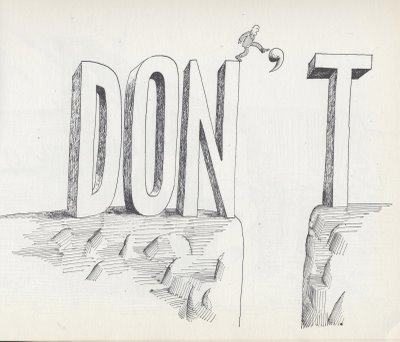
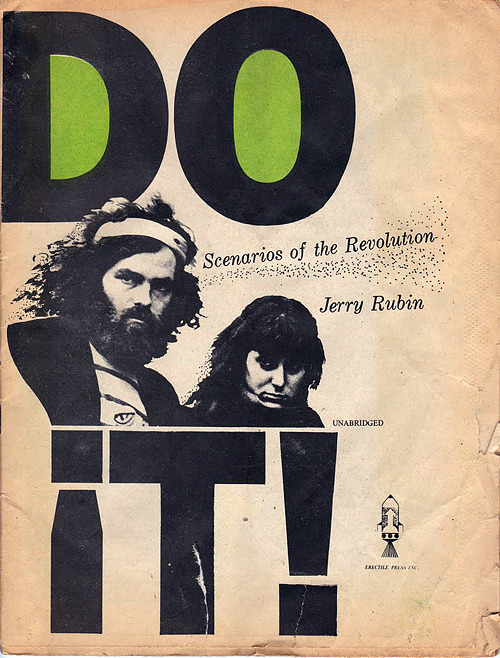
The "Do It!" image came via Meade who saw it at Magnificent Ruin and IM'd it to me, where it appeared in my iChat window right under the Saul Steinberg "Don't," which I'd IM'd to him after he IM'd me this Saul Steinberg "No!," which he'd IM'd to me because of my first post of the day, quoting Bob Dylan, asking about that carried-in-arms daughter who always told her father "no," which I blogged about because Meade had started singing "Tears of Rage," a song that mentions Independence Day, which it is, and which — fittingly — embodies the spirit embodied in "Do It!"
"DO IT!: Scenarios of the Revolution," is a book by Jerry Rubin — Introduction by Eldridge Cleaver — which you can buy at that Amazon link. That's the Simon & Schuster publication, but in the poster image above, we see the tiny logo — in the lower right-hand corner — for a different publisher: Erectile Press. Erectile Press?! Maybe that was the hard-cover edition.
UPDATE, 11/16/17: I'm adding a tag and seeing the "Do It!" image is gone. I tried to use the "Wayback Machine" to recover it, but could not. Sorry! Sad to see this post go to ruin. They did call that place Magnificent Ruin. I could have preserved the image if I'd handled it differently. Ah, well...
October 30, 2011
Matt Yglesias says "Let Children Vote."
The notion is: they probably won't, but the ones who do would probably "come from an unusually dedicated and informed sub-set of American teenagers."
Matt himself is, despite appearances, already old enough to vote. His idea reminds me of one of my earliest political opinions. It was 1960. I was 9. I said: "If kids could vote, it would be a landslide for Nixon." It seemed so unfair! If only kids could vote.
Speaking of unfairness, the voting age changed from 21 to 18 in the year I turned 21. It was 1972, my first chance to vote for President, and suddenly all the 18 and up kids could vote too. Of course, I voted for McGovern. Now, to be realistic, if the voting age had been 18 all along, 1972 would still have been my first presidential vote. I was only 17 in 1968. It was so unfair. But I was able to inform my unduly conventional parents about my (unusually dedicated!) support for Eldridge Cleaver. Peace and Freedom!
Oh, I know what you're thinking. How did she get from Nixon to Cleaver in 8 years? It's called teenage.
Matt himself is, despite appearances, already old enough to vote. His idea reminds me of one of my earliest political opinions. It was 1960. I was 9. I said: "If kids could vote, it would be a landslide for Nixon." It seemed so unfair! If only kids could vote.
Speaking of unfairness, the voting age changed from 21 to 18 in the year I turned 21. It was 1972, my first chance to vote for President, and suddenly all the 18 and up kids could vote too. Of course, I voted for McGovern. Now, to be realistic, if the voting age had been 18 all along, 1972 would still have been my first presidential vote. I was only 17 in 1968. It was so unfair. But I was able to inform my unduly conventional parents about my (unusually dedicated!) support for Eldridge Cleaver. Peace and Freedom!
Oh, I know what you're thinking. How did she get from Nixon to Cleaver in 8 years? It's called teenage.
June 24, 2006
"Turn off your mind, relax, float downstream."
Luc Sante reviews Robert Greenfield's new biography of Timothy Leary:
Read the whole review. The plot of Leary's life is convoluted. At one point, he's in Algiers, in the care of Eldridge Cleaver. ("It was a new experience for me to be dependent on a strong, variable, sexually restless, charismatic leader who was insanely erratic. I usually played that role myself.") But it's this that makes me want to read the book:
He was initially known as an expert on personality assessment, but, while on a sojourn in Mexico the following year, he was introduced to psilocybin mushrooms, and the experience was so transformative that psychedelics promptly became the central force in his life, his research and his teaching....Teachers involving their students in spiritual exercises? Now, that is outrageous. But he lost his position as a Harvard professor soon enough.
It wasn't long before any pretense to scientific detachment fell away and controlled experiments were chucked in favor of missionary zeal and contempt for all mundane exigencies. Chaotic tripping parties ensued, involving students, under "spiritual" or "philosophical" pretexts.
[T]he psychedelic caravan picked up the Hitchcock siblings, Peggy, Billy and Tommy, heirs to the Mellon fortune, and through them acquired the use of a fabulous rambling house and huge estate in Millbrook, N.Y. This became the headquarters of Leary and gang for the better part of five years, a period filled with endless parties, epiphanies and breakdowns, emotional dramas of all sizes.... It was also at Millbrook that Leary, [Richard] Alpert and Ralph Metzner wrote "The Psychedelic Experience" (1964), which contained the injunction to "turn off your mind, relax, float downstream," appropriated two years later by John Lennon for "Tomorrow Never Knows," the last song on "Revolver."...Oh, that's painful to read! We Baby Boomers were steeped in this stuff -- whether we took LSD or not. I think it had much more impact than the SDS material that also soddened my generation.
[H]e had no interest in politics. He called student activists "young men with menopausal minds" and suggested that LSD could stand for "Let the State Disintegrate." But by 1968, his slogans were so poised between derangement and Madison Avenue that they could pass for visionary; "Everyone should start their own nation," he uttered, just days after Martin Luther King's assassination. It was awfully hard to tell charlatans from prophets at the time, and besides, the denatured, anti-intellectual language that dominated discourse then (and is still with us, in a New Age guise) had been rolling off Leary's tongue since before he had ingested a single microgram of lysergic acid: people engaged in emotional "games"; all the world's bad stuff was a "system"; the state of being clued-in was "consciousness," and so on.
Read the whole review. The plot of Leary's life is convoluted. At one point, he's in Algiers, in the care of Eldridge Cleaver. ("It was a new experience for me to be dependent on a strong, variable, sexually restless, charismatic leader who was insanely erratic. I usually played that role myself.") But it's this that makes me want to read the book:
[T]he book provides a crash course in several aspects of 60's culture: its often gaseous rhetoric, its reliance on mahatmas and soothsayers, its endless bail-fund benefits and sometimes dubious appeals to conscience, its thriving population of informers, its contribution to the well-being of lawyers, its candyland expectations and obstinate denials of reality, its fatal avoidance of critical thinking, its squalid death by its own hand. That still leaves many meritorious elements largely outside Leary's sphere: civil rights, the antiwar movement, music and art, the impulse toward communitarianism, to name a few. In part because of Leary, however, ideals and delusions were encouraged to interbreed, their living progeny being avid consumerism and toothless dissent.Turn off your mind, relax, float downstream....
Subscribe to:
Posts (Atom)


 Posts
Posts


