Showing posts with label Roald Dahl. Show all posts

October 3, 2023

"In all four films, the stories’ characters recite Dahl’s texts on camera from beginning to end (with certain modifications) while enacting the events that they describe amid dazzlingly elaborate stagecraft..."

"... that reveals its own artifices and the sort of exquisitely confectionery décor and costumes that are a hallmark of Anderson’s refined art. (Dahl himself comes in as a character, too, played by Ralph Fiennes.) The four stories are, essentially, dramatized audiobooks, something like music videos for literature. The characters deliver their narration into the camera, addressing viewers head on, and then, with deft timing and theatrical precision, turn their heads (or even just shift their eyes) to address one another."

Writes Richard Brody in "Wes Anderson’s Roald Dahl Quartet Abounds in Audacious Artifice and Stinging Political Critique/Four new short films make clear how crucial the author’s work has been in the development of Anderson’s art" (The New Yorker).

I've watched the longest of the 4, "The Wonderful Story of Henry Sugar," and recommend it. Of course, I must watch it at least once more. There's far too much going on to fully take in the first time around. And I did not realize I was hearing the entire Dahl text. I need to watch again with the full benefit of that knowledge. 

March 7, 2023

"I’ve warned my publishers that if they later on so much as change a single comma in one of my books, they will never see another word from me. Never! Ever!"

"When I am gone, if that happens, then I’ll wish mighty Thor knocks hard on their heads with his Mjolnir. Or I will send the ‘enormous crocodile’ to gobble them up." 

Said Roald Dahl, quoted in "Roald Dahl promised to set a crocodile on anyone who changed his words" (London Times).


This is from a recorded conversation he had with the artist Francis Bacon in 1982.

March 5, 2023

"It was only later in the 19th century, with the Romantic cult of the author and the rise of academic textual scholarship, that the notion of a sacrosanct authorial vision began to take hold."

"But even then, such standards tended to apply only to established authors. The most common English editions of many 19th-century French novels were still heavily bowdlerized.... In comparison with the familiar sanitized versions, Dumas’s original ['Three Musketeers'] is an obscure, slightly seedy French romance...  The question we should be asking ourselves is not whether it is ever reasonable [to make changes] but who should be able to do so — and in what spirit and with what purpose.... In the Dahl case... it was a company treating Dahl’s beloved creations as if they were merely its assets....  I, for one, do not believe that philistines should be allowed to buy up authors’ estates and convert their works into 'Star Wars'-style franchises, as Netflix now seems to be doing, having purchased the Roald Dahl Story Company...."
 
Writes Matthew Walther, the editor of a Catholic literary journal, in "The Truth About the ‘Censorship’ of Roald Dahl" (NYT).

"'The Crabfish' (known also as 'The Sea Crabb'), an English folk song dating back to the mid-1800s about a man who places a crab into a chamber pot..."

"... unbeknownst to his wife, who later uses the pot without looking, and is attacked by the crab. Over the years, sanitized versions of the song were released in which a lobster or crab grabs the wife by the nose instead of by the genitals or that imply the location of the wounds by censoring the rhyming word in the second couplet. For instance, 'Children, children, bring the looking glass / Come and see the crayfish that bit your mother's a-face' (arse)."

From the Wikipedia article "Expurgation," which I'm reading this morning because I'm listening to the new Chris Rock special (on Netflix) and, in an effort to blog it, relying on a sanitized WaPo article and using the word "expurgations/expurgation/expurgate" for the first time in the 19-year history of this blog.

Elsewhere in Wikipedia, there's a whole article on "The Crabfish," complete with full lyrics, which, first, I'm very happy to see after suffering through numerous YouTube renderings of the expurgated song:

February 19, 2023

"Many of the changes to Dahl’s books seem minor: 'I’d knock her flat' becomes the much more diplomatic 'I’d give her a right talking to,' for instance."

"'You saucy beast!' becomes 'You trickster!' Other changes are just patronising. The Witches once imagined a woman 'working as a cashier in a supermarket or typing letters for a businessman.' Now she might be 'working as a top scientist or running a business.' Are there no women cashiers now? Rather than going  white as a shee,' the Queen’s maid in The BFG now goes 'still as a statue.' Dahl can’t even poke fun at a tortoise any more. In Esio Trot, tortoises can only read backwards because they are 'very backwards creatures.' How rude! Now they can only read backwards ... just because. And when Boggis, Bunce and Bean set out on their tractors to destroy the foxes’ home once and for all in Fantastic Mr Fox, the animals once noted in terror that 'The machines were black. They were murderous, brutal-looking monsters.' The tractors are no longer black, just in case a fox was being racist."

Writes Laura Hackett, in "Censoring Roald Dahl? I’ll be keeping my original copies/The author’s books have been edited for fear of offending. Kids should be allowed to read them in their full, nasty, colourful glory" (London Times).

I already blogged about this travesty yesterday. I'm blogging again because this has new examples of the awful wreckage.

February 18, 2023

"Augustus Gloop now ‘enormous’ instead of ‘fat’, Mrs Twit no longer ‘ugly’ and Oompa Loompas are gender neutral."

"Roald Dahl books rewritten to remove language deemed offensive" (The Guardian).
Hundreds of changes were made to the original text – and some passages not written by Dahl have been added.... 
In The Witches, a paragraph explaining that witches are bald beneath their wigs ends with the new line: “There are plenty of other reasons why women might wear wigs and there is certainly nothing wrong with that.... 
References to “female” characters have disappeared. Miss Trunchbull in Matilda, once a “most formidable female”, is now a “most formidable woman”....

December 3, 2022

"He made sure I was aware that he was taking me to one of the finest Italian restaurants in New York. He knew the owner..."

"... who was John Huston’s father-in-law. He was acquainted with just about everybody. And he was interested in everything. He spoke of paintings and antique furniture and the joys of the English countryside. He was as charming that evening as he had been rude the first time we met. I remember his taking a sip of wine and looking at me for a long moment through the candlelight. 'I would rather be dead than fat,' he said."

Wrote Patricia Neal — the actress and Roald Dahl's first wife —  about her first date with Dahl, quoted in "Making It Big/In Roald Dahl’s stories, cruelty begets cruelty, children grow large, adults grow small, and everyone is trapped in a fun house of dirty, depthless mirrors"  (NYRB).

November 18, 2020

"For as long as there have been stages and screens, disability and disfigurement have been used as visual shorthand for evildoing..."

"... a nod to the audience that a character was a baddie to be feared. But disability rights advocates say this amounts not just to lazy storytelling but stereotyping, further marginalizing an already stigmatized community that is rarely represented onscreen." 


Other examples given in the article: "The Joker. Lord Voldemort. All manner of scarred Bond villains and superhero antagonists. Dr. Poison. Freddy Krueger. The Phantom of the Opera. Shakespeare’s hunchbacked, butcherous Richard the Third." 

Yes, but — speaking of hunchbacks — the greatest disabled literary and movie character is a hero, "The Hunchback of Notre Dame":


Here's Anne Hathaway's apology:

August 9, 2020

Come with me, and I will make you fishers of the sun.

IMG_8900

I wanted to get the text of the Jesus quote right so I could transform it for the post title. Of course, there are many translations of Matthew 4:19, but the one I wanted was "Come with me, and I will make you fishers of men."

I couldn't find it. Translations that ended with "I will make you fishers of men" began with "Follow me" or "Come ye after me." Translations that began with "Come with me" had clumsy endings: "Come with me! I will teach you how to bring in people instead of fish," "Come with me. The work I will give you will be to catch people,"  and — I am not kidding — "Come with me. I’ll make a new kind of fisherman out of you. I’ll show you how to catch men and women instead of perch and bass."

The most fascinating part of this research project came at the beginning, when I started to search "Come with me...." Google guessed that I wanted "Come with me, and you'll be in a world of pure imagination...."


As long as I'm googling, I search for Willy Wonka is like Jesus. Of course, people have talked about that on the internet. One answer:
Jesus is not like Willy Wonka. Our God is not a God who delights in keeping people in the dark, only to pull the rug out from under them in the last minute and deny them the rewards he promised. He is not a miser looking to withhold blessings on a technicality.

Instead, God delights in saving his people. Jesus says that he “came to seek and to save the lost” (Luke 19:10). That is why he came to earth, to save us from our sins. If he didn’t want to save us, he would not have come in the first place. Jesus is not a cheat. He is not a swindler. He is not an inhumane monster. Nothing could be further from the truth.

September 15, 2017

Bucket news.

1. "An 'improvised explosive device' was detonated on a Tube train in south-west London during Friday's rush hour, Scotland Yard has confirmed... Eighteeen people have been taken to hospital mostly with burn injuries.... Pictures show a white bucket on fire inside a supermarket bag, with wires trailing on to the carriage floor" (BBC).

2. "A Norfolk school that advised teachers to provide buckets for pupils to vomit in during lessons has backtracked, telling parents that 'genuinely unwell' children will receive proper treatment... The bucket guidance surfaced in a document given to teachers at the start of the year at Great Yarmouth Charter academy.... 'We all know children say things like that to get out of work. You never pretend to be ill to get out of work because we expect you to work through it. If you feel sick we will give you a bucket. If you vomit – no problem! You’ve got your bucket. That’s probably all your body wanted – to vomit. If you are really ill we will make sure you get all the attention you need,' the document said'" (The Guardian).

3. "If Roald Dahl had his way, his eponymous 'Charlie and the Chocolate Factory' hero would have been black, the author's widow revealed. Liccy Dahl said that when her husband first wrote the golden ticket-hunting character of Charlie Bucket in the 1960s, 'he wrote about a little black boy.' 'I don't know why (it was changed). It's a great pity,' Dahl told BBC Radio 4 Wednesday" (NY Daily News).

4. "Prince Harry watched on as school children got soaked during a visit to a conservation project that aims to teach youngsters to value the countryside.... An instructor threw a bucket of water over one shelter as children sat inside it to test whether it was waterproof, and there were shrieks and giggles from the children as water poured through a hole in the roof and drenched them. As children clambered out of the den Harry shook the instructor’s hand and said 'that’s cruel!' One of the children quipped 'we survived'" (Daily Mail).

5. "An ex-fugitive builder who held a complaining labourer in position as his compatriot colleague chopped his ear with a trowel was sued on Thursday.... 'I was working at the ground floor. The colleague was carrying a bucket full of cement from the upper floor. Some of the cement was falling from the bucket onto me. I begged him to carry the bucket with care and walk down slowly. He refused to listen to me. He went up and returned with the builder who immediately seized me. He hit my face with a trowel...'" (The Gulf Today).

6. "[Hillary] Clinton has little doubt that Assange was working with the Russians. 'I think he is part nihilist, part anarchist, part exhibitionist, part opportunist, who is either actually on the payroll of the Kremlin or in some way supporting their propaganda objectives, because of his resentment toward the United States, toward Europe,' she said. 'He’s like a lot of the voices that we’re hearing now, which are expressing appreciation for the macho authoritarianism of a Putin. And they claim to be acting in furtherance of transparency, except they never go after the Kremlin or people on that side of the political ledger.' She said she put Assange and Edward Snowden, who leaked extensive details of N.S.A. surveillance programs, 'in the same bucket—they both end up serving the strategic goals of Putin.' She said that, despite Snowden’s insistence that he remains an independent actor, it was 'no accident he ended up in Moscow'" (The New Yorker).

7."Two Nova Scotians have been charged criminally in unrelated horrific animal death cases — a man who allegedly drowned a litter of kittens in a bucket, and a woman who allegedly left a dog to die in an abandoned car.... 'It's what we refer to as breathlessness — so when an animal is drowned, it's basically the worst sensation you can ever come across is you know you're about to die,' [said Jo-Anne Landsburg, chief provincial inspector for the Nova Scotia SPCA]" (Guelph Today).

8. "How This Woman Retired at Age 32 — and Says You Can Too.... After graduating from the University of Chicago's law school, [Anita Dhake] decided she would work hard until she paid off her debt and saved enough to retire as soon as possible. She did the math, and that meant quitting once she had saved 25 years' worth of living expenses, which she would keep relatively low. She wouldn't have a fancy car or house, but would make up for it with the personal freedom and energy to check off her personal bucket list" (Popsugar).

September 13, 2016

100 years ago today: Roald Dahl was born.

My son John reminds me... with quotes from his 1990 obituary.
The key to his success, he frequently said, was to conspire with children against adults.

"It's the path to their affections," he said in an interview earlier this year with the London newspaper The Independent. "It may be simplistic, but it is the way. Parents and schoolteachers are the enemy. The adult is the enemy of the child because of the awful process of civilizing this thing that when it is born is an animal with no manners, no moral sense at all."

August 30, 2014

"A lost chapter of Charlie and the Chocolate Factory, deemed too wild, subversive and insufficiently moral... has been published for the first time."

"In the chapter Charlie Bucket – accompanied by his mother, not his sprightly grandfather – and the other children are led into the Vanilla Fudge Room, where they face the sinister prospect of the Pounding and Cutting Room."
"In the centre of the room there was an actual mountain, a colossal jagged mountain as high as a five-storey building, and the whole thing was made of pale-brown, creamy, vanilla fudge," the chapter reads. "All the way up the sides of the mountain, hundreds of men were working away with picks and drills, hacking great hunks of fudge out of the mountainside...  As the huge hunks of fudge were pried loose, they went tumbling and bouncing down the mountain and when they reached the bottom they were picked up by cranes with grab-buckets, and the cranes dumped the fudge into open wagons."...

August 9, 2014

Maybe girls will buy it if it's pink...


That's Penguin's new cover for the Roald Dahl classic "Charlie and the Chocolate Factory," as seen at "The five worst book covers ever." The other 4 are so much less bad that it's scarcely worth pretending this is a real listicle (even if writing a listicle were something worth aspiring to).

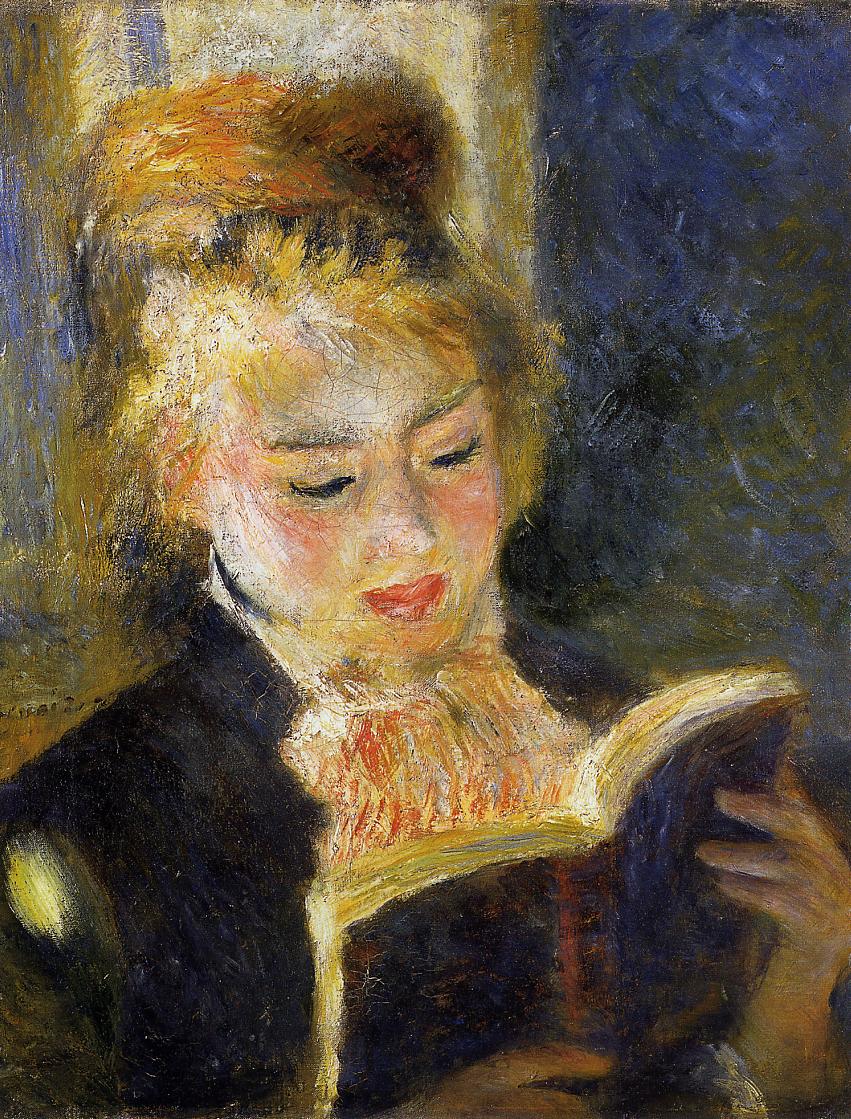
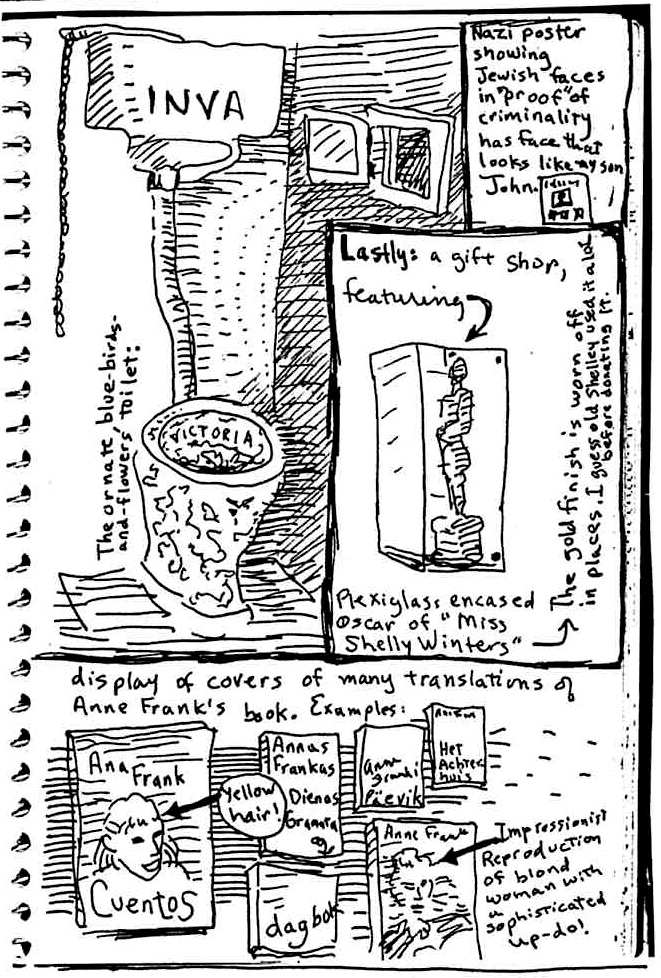
The worst book covers I ever saw were on display at the Anne Frank house in Amsterdam, where I traveled in 1993. This was in the days before digital photography when I traveled without a camera in what I consider my "Get Me a Table Without Flies, Harry" period. On page 33 of what I call my "Amsterdam Notebooks" — at the bottom of the second image — I wrote and sketched about the various copies of the diary, translated into many different languages, with the Spanish version — "Cuentos" — featuring a smiling blonde girl and the French version reproducing an 1877 Renoir portrait of a rosy-skinned blonde woman in the most absurdly comfortable, cossetted circumstances imaginable:

November 4, 2009

Wes Anderson's stop-action animation movie.


Ha ha. Stop-action, not computer 3D crap, which I hate. George Clooney, Meryl Streep, Bill Murray. Roald Dahl. 91% on the Tomatometer. Let's go!

October 25, 2008

"Harsh, noteless, enormous noise, a growling, low-pitched, screaming sound … drain[s] out like a sob lasting fully a minute."

Roald Dahl described the pain of an axed beech tree, heard by "The Sound Machine." For some reason, we're fascinated by this question whether plants feel pain.
Almost 30 years ago, the trippy flower-power film The Secret Life of Plants claimed pot plants could read minds, cabbages were easily annoyed and a cactus could learn the Japanese alphabet. Then just last year, a parliamentary panel of philosophers, lawyers, geneticists and theologians in Switzerland, charged with devising new rules for genetic testing, published a treatise on preserving the "dignity of plants". Its edicts included that it was "morally impermissible" to decapitate a wildflower by the roadside without rational reason.

But while such fanciful claims continue to take root at the margins, scientists in Australia and abroad are quietly discovering plants are more sophisticated and complex than the wildest imaginings. Plants can navigate a maze, trade food for sex, sniff out and hunt down prey, use cost-benefit analysis, learn from past experiences and recognise friend from foe.
Ha ha. I enjoyed reading this article, especially after listening to the entire book "The Botany of Desire" last night while I slept. Ah, but did I understand it?

I woke during the chapter on marijuana, having slept through the apple tree, the tulip, and the potato. Michael Pollan was talking about a passage in Aldous Huxley's "The Doors of Perception." Here's that passage:
[T]hat very morning... I looked down by chance, and went on passionately staring by choice, at my own crossed legs. Those folds in the trousers - what a labyrinth of endlessly significant complexity! And the texture of the gray flannel - how rich, how deeply, mysteriously sumptuous! And here they were again, in Botticelli's picture.

... Draperies, as I had now discovered, are much more than devices for the introduction of non-representational forms into naturalistic paintings and sculptures. What the rest of us see only under the influence of mescalin, the artist is congenitally equipped to see all the time. His perception is not limited to what is biologically or socially useful. A little of the knowledge belonging to Mind at Large oozes past the reducing valve of brain and ego, into his consciousness. It is a knowledge of the intrinsic significance of every existent. For the artist as for the mescalin taker draperies are living hieroglyphs that stand in some peculiarly expressive way for the unfathomable mystery of pure being. More even than the chair, though less perhaps than those wholly supernatural flowers, the folds of my gray flannel trousers were charged with "is-ness." To what they owed this privileged status, I cannot say....

"This is how one ought to see," I kept saying as I looked down at my trousers....
And here's a little clip from "The Secret Life of Plants":


What is this post about? Ha ha. I always hated questions like that on the reading portion of the SAT. Does the test still have questions like that? Here, let me construct one for you.

What is the blogger's thesis in this post?
Plants and people are weird.
It's important to pay attention to things.
Art is better than science.
Just say no to drugs.
The human mind needs weeding.
pollcode.com free polls

July 7, 2004

Old TV gets the high art treatment.

In amongst the fancy fare playing at UW's Cinemateque this summer (like "The Five Obstructions") are some old TV shows. (Via The Capital Times.)(All shows are free.)

On July 30, they are showing two episodes of "Twilight Zone" along with two episodes of "Way Out." It looks like each "Twilight Zone" will be preceded by a "Way Out," the way the shows used to run on Friday nights in 1961. How well I remember completely loving "Twilight Zone" and watching the lesser "Way Out" to get a larger dose of Twilight-Zonishness on Fridays, often in the context of sleepovers and slumber parties. I never realized until just now, from the Cinemateque website, that Roald Dahl hosted "Way Out"!

On July 23, you can watch an "archival print" of the "Toody's Paradise" episode "Car 54, Where Are You?" with original ads for Tide detergent, Camay soap, and Gleem toothpaste. If I remember correctly, Camay "creams your skin while you wash," and Gleem has "Gardol" which is represented by an "invisible shield" of clear glass/plastic that protects the announcer when a golfer hits a golf ball into into it. I can't remember a thing about old Tide commercials, which I think is because I was in a state of hypnosis, caused by the whirly orange and yellow packaging. I remain incapable of buying any other laundry detergent.