Wrote the French novelist Michel Houellebecq, quoted on page one of "No Kids: 40 Good Reasons Not To Be A Mother,"* by Corinne Maier, which I found out about reading a Guardian article titled "'It's the breaking of a taboo': the parents who regret having children/It’s tiring, often boring – and can mean a return to more traditional roles. Why some mothers (and fathers) feel they made a mistake."
The Guardian article lists some chapter titles: "Kids Are The Death Knell Of The Couple"; "Your Kid Will Always Disappoint You"; "Wanting To Reproduce Yourself At Any Cost Is The Pinnacle Of Banality."
Lots more at the link. The article isn't mostly about Maier. It's more about women talking to each other on social media about regretting motherhood.
By the way, Houellebecq's quote felt wrong to me not for what it said about children, but for using the term "dwarf."
_________________________
* That must be the title in the U.K. The book as I'm seeing it on Amazon, is "No Kids: 40 Good Reasons Not to Have Children." Is it that we in the United States are more upset by attacks on motherhood or is it that they're hoping to sell the book to men as well?
Showing posts with label Houellebecq. Show all posts
Showing posts with label Houellebecq. Show all posts
February 11, 2017


September 7, 2015
"Is he Islamophobic? 'Yes, probably. One can be afraid,' he replies."
"I ask him again: you’re probably Islamophobic? 'Probably, yes, but the word phobia means fear rather than hatred,' he says. What is he afraid of? 'That it all goes wrong in the west; you could say that it’s already going wrong.' Does he mean terrorism? He nods. Some might say that’s a tiny percentage of people, I begin ... 'Yes, but maybe very few people can have a strong effect. It’s often the most resolute minorities that make history.'"
From a Guardian article titled "Michel Houellebecq: ‘Am I Islamophobic? Probably, yes'/Michel Houellebecq is the ageing enfant terrible of French literature. His new book imagines a France ruled by Islamists and he has been under 24-hour police protection since the Charlie Hebdo attack. Does he really hate women and Muslims or is he just a twisted provocateur?"
Here's the part about women:
From a Guardian article titled "Michel Houellebecq: ‘Am I Islamophobic? Probably, yes'/Michel Houellebecq is the ageing enfant terrible of French literature. His new book imagines a France ruled by Islamists and he has been under 24-hour police protection since the Charlie Hebdo attack. Does he really hate women and Muslims or is he just a twisted provocateur?"
Here's the part about women:
Some French media have asked if the novel’s title ["Submission"] really refers to the position of women.... Houellebecq had originally thought feminists would take issue with it. “In fact, they haven’t taken it that badly,” he says. “That’s why people are unpredictable.”
Why does he think the issue of women in the novel hasn’t sparked a bigger response? “I don’t know. It’s possible that in truth there aren’t really that many feminists.” Is he a feminist? “No, no.” A misogynist, as has been levelled against him? “No, no, not that either,” he says. “But it’s possible that feminism has slightly disappeared from women too ... It’s been a long time since I’ve seen anyone expressing a feminist opinion. I can’t remember the last time. In France, anyway.”
January 31, 2015
"[T]ake what’s happening now and imagine what would happen if it kept on happening. That’s what satirists do."
"Jonathan Swift saw that the English were treating the Irish as animals; what if they took the next natural step and ate their babies? Orwell, with less humor, imagined what would happen if life in Britain remained, for forty years, at the depressed level of the BBC cafeteria as it was in 1948, and added some Stalinist accessories. Huxley, in 'Brave New World,' took the logic of a hedonistic and scientific society to its farthest outcome, a place where pleasure would be all and passion unknown...."
Writes Adam Gopnik (dealing mostly with Michel Houellebecq’s "Soumission," a satire about Muslims getting elected in France and imposing Sharia law, with the collaboration of the French élite).
Writes Adam Gopnik (dealing mostly with Michel Houellebecq’s "Soumission," a satire about Muslims getting elected in France and imposing Sharia law, with the collaboration of the French élite).
Like most satirists worth reading, Houellebecq is a conservative. “I show the disasters produced by the liberalization of values,” he has said. Satire depends on comparing the crazy place we’re going to with the implicitly sane place we left behind. That’s why satirists are often nostalgists, like Tom Wolfe, who longs for the wild and crazy American past, or Evelyn Waugh, with his ascendant American vulgarians and his idealized lost Catholic aristocracy....But...
The next thing is just never likely to be the same thing. The fun of satire is to think what would happen if nothing happens to stop what is happening. But that’s not what happens.
January 16, 2015
"Right after the French Revolution, France abrogated its old laws making blasphemy a crime—and so Charlie Hebdo’s blasphemous depictions of Muhammad are not a crime."
"At the same time, France’s press laws, which date to the late nineteenth century, make it a crime to 'provoke discrimination, hatred, or violence toward a person or group of persons because of their origin or belonging to a particular ethnicity, nation, race, or religion.' In other words, you can ridicule the prophet, but you cannot incite hatred toward his followers. To take two more examples, the actress Brigitte Bardot was convicted and fined for having written, in 2006, about France’s Muslims, 'We are tired of being led around by the nose by this population that is destroying our country.' Meanwhile, the writer Michel Houellebecq (whose new novel was featured in the issue of Charlie Hebdo that came out just before the attack) was brought up on charges, but acquitted, for having said in an interview that Islam 'is the stupidest religion.' Bardot was clearly directing hostility toward Muslim people, and was thus found guilty, while Houellebecq was criticizing their religion, which is blasphemous, but not a crime, in France."
From the New Yorker article "Why French Law Treats Dieudonné and Charlie Hebdo Differently."
From the New Yorker article "Why French Law Treats Dieudonné and Charlie Hebdo Differently."
January 7, 2015
"Masked gunmen opened fire in the offices of a French satirical newspaper on Wednesday in Paris... as many as 12 people... killed and 10 wounded."
The NYT conveys a police report.
Why attack a satirical newspaper? What was your first thought there?
ADDED: "[V]ideo, recorded by the French journalist Martin Boudot from a nearby rooftop as shots were fired — and the attackers shouted 'Allahu Akbar'... posted... by French state television":
Why attack a satirical newspaper? What was your first thought there?
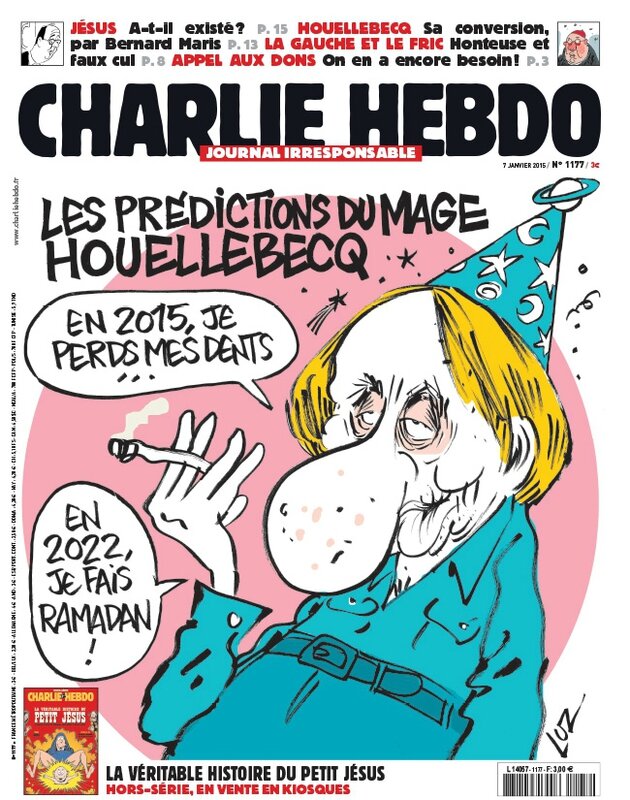
[The satirical weekly] Charlie Hebdo has been attacked in the past for satirizing Islam and the Prophet Muhammad. Its offices were firebombed in 2011 after publishing a cartoon of the prophet on its cover promising “100 lashes if you don’t die laughing!”"Ramandan" is a typo in The New York Times. Here's what the Charlie Hebdo cover looks like, with: "En 2022, je fais Ramadan!"
The cover of the newspaper on Wednesday featured a caricature of Michel Houellebecq, a controversial novelist whose sixth novel, “Submission,” predicts a future France run by Muslims, in which women forsake Western dress and polygamy is introduced. On the cover, Mr. Houellebecq is depicted as a wizard and smoking a cigarette. “In 2022, I will do Ramandan,” he is shown saying.
Charlie Hebdo, which prides itself on skewering a wide range of targets with garish cartoons and incendiary headlines, has long been vulnerable at its Right Bank headquarters, where it has weathered a firebombing, a lobby shoot-out and now a massacre.Yes, you can see on that cover: "Jésus/A-t-il existé?" Maybe it was Christians with the Kalashnikovs.
The journal is part of a venerable tradition in France, deploying satire and insolence to take on politicians and the police, bankers and religions of all kinds, including this week a mock debate about whether Jesus existed or not.
ADDED: "[V]ideo, recorded by the French journalist Martin Boudot from a nearby rooftop as shots were fired — and the attackers shouted 'Allahu Akbar'... posted... by French state television":
Subscribe to:
Posts (Atom)


 Posts
Posts