Half of a caption for one of the pictures in "2014 National Geographic Photo Contest, Part II."
The other half is: "Kinik, the district of Manisa in Turkey, is a well known place for dried tomatoes."
October 27, 2014


October 26, 2014



"Two expressions that became especially popular with CBS News brass, [Sharyl Attkisson] says, were 'incremental' and 'piling on.'"
"These are code for 'excuses for stories they really don’t want, even as we observe that developments on stories they like are aired in the tiniest of increments.'..."
The administration, with the full cooperation of the media, has successfully turned “Benghazi” into a word associated with nutters, like “Roswell” or “grassy knoll,” but Attkisson notes that “the truth is that most of the damaging information came from Obama administration insiders. From government documents. From sources who were outraged by their own government’s behavior and what they viewed as a coverup.”...
She notes that the program, which under previous hosts Dan Rather, Katie Couric and Bob Schieffer largely gave her free rein, became so hostile to real reporting that investigative journalist Armen Keteyian and his producer Keith Summa asked for their unit to be taken off the program’s budget (so they could pitch stories to other CBS News programs), then Summa left the network entirely.
When Attkisson had an exclusive, on-camera interview lined up with Nakoula Basseley Nakoula, the YouTube filmmaker Hillary Clinton blamed for the Benghazi attacks, CBS News president Rhodes nixed the idea: “That’s kind of old news, isn’t it?” he said.

If lone-wolf terrorists are "idiots who are sitting in their tighty-whities, in their mother's basements" — as the editor of Islamic Monthly called them — is there anything American Muslims should do about them?
On "Meet the Press" this morning, Chuck Todd asked Arsalan Iftikhar, senior editor at Islamic Monthly, about "the role of the American Muslim community" in dealing with the problem of the so-called "lone-wolf" terrorist, those "people that are self-radicalizing," perhaps "newcomers into the Islamic communities": "What's the role of the leadership in these Islamic communities to identify perhaps people that are joining, converting, but not for the right reasons?"
Iftikhar said:
Todd does not ask if perhaps there is something active the Muslim community might do to draw these loner-losers to the positive, constructive version of Islam. Todd just accepts Iftikar's distancing — "Well, I understand that" — and moves on to a different question, asking whether the problem is the responsibility of media:
American Muslims or Arabs are impugned after an attack like this, he says, stereotyping the rest of us as bigots who lump everyone together.
Iftikhar said:
Well, Chuck, I think it's important to keep in mind when you're talking about groups like ISIS, that we're not talking about the X Men or the Transformers here. We're not dealing with Wolverines or Optimus Primes. Essentially, we're dealing with loner idiots who are sitting in their tighty-whities, in their mother's basements, playing Call of Duty on their XBox Four, who are disenfranchised, disengaged from the rest of the community.Which I guess means: There is no role. These loners are loners. Picture them as stereotypical American idiots. They're not in the American/Canadian Muslim community in the first place, and if we saw them coming, we'd throw them out.
I mean, if you look at Michael Zehaf-Bibeau, the shooter in Ottawa, he was actually thrown out of a mosque in British Columbia, similar to the Boston Marathon bombing suspects who were once thrown out of a Boston mosque. So in terms of community policing, the Muslim community in the United States and Canada has done a remarkable job....
Todd does not ask if perhaps there is something active the Muslim community might do to draw these loner-losers to the positive, constructive version of Islam. Todd just accepts Iftikar's distancing — "Well, I understand that" — and moves on to a different question, asking whether the problem is the responsibility of media:
So is this a media issue? Does it become the more attention attacks like this get, does it end up actually serving perversely to convince more of these mentally-deranged folks to say, "Hey, I'm going to use this perverted ideology as a way to get more attention for my attack"?Iftikar turns this question into another way to defend the reputation of his community from the criminals who operate under the same brand name:
Yeah, you know, whenever American Muslims or Arabs are impugned after an attack like this, it helps to serve the agenda of these organizations to say, "See, America is at war with Muslims." But the fact of the matter is that there are over seven million American Muslims that live here peacefully. Five out of the last 12 Nobel Peace Prize winners, including this year's, Malala Yousafzai, are Muslims. And so, you know, sadly, when you look at the narrative media-wise in terms of listening to all of this negative, extremist, violent narratives that we're dealing with. And that's what we have to push back against.And that's all Iftikar is asked. He had his anodyne talking point, distancing himself and defending the reputation of his religious community — a community defined to exclude anyone who adopts a violent ideology. But why is there not also a proactive effort to win co-religionists away from their hateful interpretations? Perhaps he thinks it unwise or dangerous to allow anyone to see any reason to see those terrible people as anywhere nearly within the scope of things that are his problem.
American Muslims or Arabs are impugned after an attack like this, he says, stereotyping the rest of us as bigots who lump everyone together.
ESPN's sports-writing metaphor makes it impossible to understand the incident it is writing about.
"MSU irked by Wolverines' slight... extinguish the flames... dumping gasoline... on the ropes... parting shot... Throwing the stake down in our backyard... Michigan players planted a stake on the Spartan Stadium turf... 'It just felt like we needed to put a stake in them at that point'... defeating Michigan State was like beating his 'little brother'... 'The little brother stuff, all the disrespect...'... 'Throwing the stake down in our backyard out here and coming out there like they're all that. That got shoved up... It got shoved in the last minute and a half'... Michigan coach Brady Hoke said he was aware that something might have happened with his players before the game... Cook said seeing Michigan players plant a 'dagger' on the field fueled him early in the game...."
What the hell happened? Was an actual stake or dagger involved at some point? "Put a stake in them" seems to refer to the method of killing a vampire, but "throwing the stake down" sounds like a failed attempt to say "throwing down the gauntlet." As for "planting a 'dagger,'" I googled "how to kill a vampire" to see if a dagger was an alternative approach — as if that would help me understand the article — and I was amused — as I tried to understand the sports talk in terms of vampires — an effort to explain vampire-slaying in terms of sports:
ADDED: This article makes it clear:
What the hell happened? Was an actual stake or dagger involved at some point? "Put a stake in them" seems to refer to the method of killing a vampire, but "throwing the stake down" sounds like a failed attempt to say "throwing down the gauntlet." As for "planting a 'dagger,'" I googled "how to kill a vampire" to see if a dagger was an alternative approach — as if that would help me understand the article — and I was amused — as I tried to understand the sports talk in terms of vampires — an effort to explain vampire-slaying in terms of sports:
If you think of monsters in terms of sports, vampires are those great offensive players who can always score, but are pretty crappy defenders. Sure, their speed and strength give them a big advantage, but the truth about vampires is they are too used to overpowering their opponent with their offensive capabilities that very few have spent much time learning to defend themselves.Yeah, stick a fork or knife in that analogy, it's done.
Knowing this, the key to killing a vampire using a wooden stake is to strike first. Yes, that means playing offense against the offensive powerhouse, but in this game of life and death, you only need to score once.
Okay, enough with the sports analogy....
ADDED: This article makes it clear:
Right before the opening kickoff, U-M junior linebacker Joe Bolden stabbed a tent spike into the field of Spartan Stadium. U-M head coach Brady Hoke issued a statement on the incident on Sunday, stating the stake was used during a Friday night meeting as a motivational tool and a team leader elected to bring it on the field.
The stake ultimately turned into a motivational tool for MSU, instead of U-M.
“Everyone saw when they ran out and stuck the dagger on our grass and disrespected us right out of the gate,” junior quarterback Connor Cook said. “We weren’t having that.”
MSU certainly was fired up immediately after the incident, driving down the field on the opening possession to take a lead they would never surrender.
The Doctors Without Borders nurse who didn't like the way the U.S. authorities treated her upon arrival at Newark Liberty International Airport.
Kaci Hickox tells the story from her perspective, and it's getting a lot of attention. I'd like to hear the story told from the perspective of the authorities who are said to have treated her with not just an abundance of caution but with disrespect and outright abuse. You should read the whole thing, but I'll quote the part that made me wonder what really happened:
Four hours after I landed at the airport, an official approached me with a forehead scanner. My cheeks were flushed, I was upset at being held with no explanation. The scanner recorded my temperature as 101.Why — before the blood test results — would the doctor feel her neck with his bare hands? What is the protocol? Either we're swinging from one extreme to another on how much to isolate people who've been in the proximity of ebola, or different officials and health-care workers have different ideas about the degree of isolation. Health-care workers have a personal self-interest in remaining free citizens, and they may lean — like Dr. Craig Spencer — toward feeling confident that as long as they don't have a fever they can go about the city — bowling, etc. — like anybody else. Others — those with political accountability/vulnerability — lean toward the crowd-pleasing Theater of Extreme Precaution.
The female officer looked smug. “You have a fever now,” she said.
I explained that an oral thermometer would be more accurate and that the forehead scanner was recording an elevated temperature because I was flushed and upset....
Eight police cars escorted me to the University Hospital in Newark. Sirens blared, lights flashed. Again, I wondered what I had done wrong....
The infectious disease and emergency department doctors took my temperature and other vitals and looked puzzled. “Your temperature is 98.6,” they said. “You don't have a fever but we were told you had a fever.”
After my temperature was recorded as 98.6 on the oral thermometer, the doctor decided to see what the forehead scanner records. It read 101. The doctor felts [sic] my neck and looked at the temperature again. “There’s no way you have a fever,” he said. “Your face is just flushed.”
Saturday night at the theater.
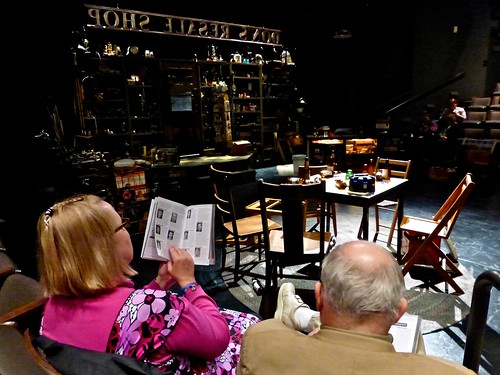
Last night in Spring Green, Wisconsin.
ADDED: Here's a review of the play, with some photos that show what the cast looked like in that set.
October 25, 2014

Goodbye to Jack Bruce.
The Cream bassist has died, at the age of 71.
Here's an hour of him showing you how to play the bass:
Here's an hour of him showing you how to play the bass:
Did Chris Christie react to the charge that he was using his power as chair of the Republican Governors Association to undercut Scott Walker's reelection bid?
"The RGA, chaired by Gov. Christie (R-N.J.), has been under pressure in recent days to do more to help Walker, a tea party favorite who rocketed to political stardom after he curbed bargaining rights for most public workers in his state. The Weekly Standard reported Thursday that there were brewing suspicions on the right that Christie, as RGA chairman, has been “undercutting” Walker, his potential rival for the 2016 Republican presidential nomination."
That's from a Washington Post article noting that the Republican Governors Association has just put another $1 million into ads for Scott Walker's reelection. The headline of the article puts the emphasis on Walker's state of mind — "RGA puts additional $1 million into Wisconsin ad buys as Walker frets" — but I think Christie's is the more interesting mind about which to speculate.
Walker is trying to get reelected and the polls show a close race. That's a mundane objective reality. The subjective matter of how that feels to him — whether he "frets" — is dumb in the same way that it's dumb for reporters to ask, say, a person whose house is burning down "How do you feel?" The answer is already known: How do you think I feel? There's nothing about the subjective aspect of the story that isn't inherent in the objective aspect of the story.
But what's going on in The Mind of Chris Christie? That's where the subjective part of the story is complex and speculation-ripe.
Here's the above-referenced Weekly Standard article: "Does Chris Christie Have Scott Walker's Back?"
I like the verb "fret," and use it a lot, probably mostly to make a person seem fussy and overly inward. But searching this blog to find how I've used "fret," I see the first thing that comes up is a fond tribute to an old Kinks song: "Don't You Fret." And there's a reference to the famous line from "MacBeth": "Life's but a walking shadow, a poor player/That struts and frets his hour upon the stage/And then is heard no more: it is a tale/Told by an idiot, full of sound and fury/Signifying nothing." And, remember, MacBeth was already king when he said that. Chris Christie, on the other hand, is only the Thane of New Jersey.
That's from a Washington Post article noting that the Republican Governors Association has just put another $1 million into ads for Scott Walker's reelection. The headline of the article puts the emphasis on Walker's state of mind — "RGA puts additional $1 million into Wisconsin ad buys as Walker frets" — but I think Christie's is the more interesting mind about which to speculate.
Walker is trying to get reelected and the polls show a close race. That's a mundane objective reality. The subjective matter of how that feels to him — whether he "frets" — is dumb in the same way that it's dumb for reporters to ask, say, a person whose house is burning down "How do you feel?" The answer is already known: How do you think I feel? There's nothing about the subjective aspect of the story that isn't inherent in the objective aspect of the story.
But what's going on in The Mind of Chris Christie? That's where the subjective part of the story is complex and speculation-ripe.
Here's the above-referenced Weekly Standard article: "Does Chris Christie Have Scott Walker's Back?"
"The Center for Public Integrity reported Thursday that Walker and his backers spent nearly $6.1 million on ads through Monday, while Burke and her supporters ran nearly $6.6 million," the AP reported on Thursday. On Sunday, Walker told the Washington Post's Robert Costa: "We are always looking for more help. Our main help has to be the RGA." But according to the Center for Public Integrity, the Republican Governors Association has spent $5.9 million on TV ads in Michigan, where Governor Rick Snyder is up for reelection, and just $801,000 on TV ads in Wisconsin.ADDED: Writing this post made me want to look the word "fret" up in the OED. The original meaning is to eat, to devour, referring to the behavior of nonhuman animals. It still has that meaning in the sense of a small animal — like a worm or a moth — consuming or wearing away something by gnawing at it. The figurative usage is very old, the passions and various irritants consume or wear away at a person's mind. Nathaniel Hawthorne wrote: "So many curiosities drive one crazy, and fret one's heart to death." The intransitive use — "To distress oneself with constant thoughts of regret or discontent; to vex oneself, chafe, worry" — is also very old, going back to 1551, first in a translation of Thomas More's "Utopia": "He..so fret so fumed & chafed at it."
Why would the RGA spend more on Rick Snyder than Scott Walker?...
I like the verb "fret," and use it a lot, probably mostly to make a person seem fussy and overly inward. But searching this blog to find how I've used "fret," I see the first thing that comes up is a fond tribute to an old Kinks song: "Don't You Fret." And there's a reference to the famous line from "MacBeth": "Life's but a walking shadow, a poor player/That struts and frets his hour upon the stage/And then is heard no more: it is a tale/Told by an idiot, full of sound and fury/Signifying nothing." And, remember, MacBeth was already king when he said that. Chris Christie, on the other hand, is only the Thane of New Jersey.

Should young women — in their 20s, with no children — be permitted to have the ultimate in birth control...
... sterilization?
The American College of Obstetricians and Gynecologists weighed in on the topic last year with an updated policy statement on the benefits and risks of sterilization. The statement concludes that it's both a safe and effective means of permanent birth control. "Women who have completed their childbearing are candidates for sterilization," it says — without elaborating on what, precisely, that means. Does it refer to women who have already had a child, or several, and have now decided they're done? Or could that category also include an 18-year-old woman who has determined she's "completed" before ever getting started?Via Metafilter, where somebody says:
A major area of focus for ACOG, and the OB-GYNs it seeks to counsel, is the question of regret....
Kinda don't get why this is so controversial - there's nothing like the same sort of outrage over guys getting their tubes tied, even if they do it young.And somebody responds:
(I joke, of course I know that endemic sexism is why.)
I think it's worth saying out loud, nevertheless: the patriarchy values women primarily on the basis of their ability to rear children and provide sexual pleasure to men. A young woman wanting her tubes tied is explicitly refusing to cooperate with her assigned role, and that is not looked kindly upon by the men who take it upon themselves to regulate women's bodies.Should young minds be making such permanent decisions? Here's a BBC article "Is 25 the new cut-off point for adulthood?"
"Neuroscience has made these massive advances where we now don't think that things just stop at a certain age, that actually there's evidence of brain development well into early twenties and that actually the time at which things stop is much later than we first thought," says [child psychologist Laverne] Antrobus.One usually sees this sort of expert opinion in the context of discussions of criminal sentencing, but it sprang to my mind as I read about a woman "explicitly refusing to cooperate with her assigned role" and resisting "the men who take it upon themselves to regulate women's bodies." That sounds as though it might be a somewhat immature way of thinking about your personal life, a temporary stage that you might develop beyond. But the decision to have a child is also permanent, and we completely accept young minds making that decision, and tubal ligation can be reversed (and IVF is also still possible).
"He's a hero to me... He's a fantastic humanitarian and that is how people should think of him."
"He wanted to be a doctor without borders from when he was a kid. It's all he wanted to do.... He didn't just want to be a doctor, he wanted to be a doctor without borders."
Craig Spencer's uncle is distressed to hear criticism of his heroically humanitarian nephew, who went to great lengths to do good, but also did some meaningless little things — riding the subway, going bowling — that he could so easily have avoided.
Craig Spencer's uncle is distressed to hear criticism of his heroically humanitarian nephew, who went to great lengths to do good, but also did some meaningless little things — riding the subway, going bowling — that he could so easily have avoided.
Megan Silberberger "heard the gunshots first and she came in running... She just grabbed his arm...."
Silberberger is the heroic young teacher who began to stop the Seattle school shooter, Jaylen Fryberg, and then came the shot that killed him.
At the Daily Kos, there's this headline: "Young, petite, UNARMED, female teacher stopped today's school shooter."
Fryberg shot himself in the end. That's what stopped him. It sounds as though Silberberger even tried to prevent that.
CORRECTION: Originally, I referred to Silberberger as "first-grade" teacher. I misread "first-year" to mean first-grade. In law school, "first-year" means the first year of school for the students, but I can see that the linked article was referring to the teacher's level of experience.
At the Daily Kos, there's this headline: "Young, petite, UNARMED, female teacher stopped today's school shooter."
Fryberg shot himself in the end. That's what stopped him. It sounds as though Silberberger even tried to prevent that.
CORRECTION: Originally, I referred to Silberberger as "first-grade" teacher. I misread "first-year" to mean first-grade. In law school, "first-year" means the first year of school for the students, but I can see that the linked article was referring to the teacher's level of experience.
Subscribe to:
Posts (Atom)


 Posts
Posts


