buy a platform bed. And marvel at the power of seven, as each bed is named according to one of the seven dwarves and one of the seven deadly sins. (I voted for Grumpy Confirmation, because I'm a sucker for furniture that I think would help me do more reading.)
UPDATE: As Jeremy notes in the comments, that should have been "sacraments." Hmmm.... what does that say about me?
FURTHER UPDATE: And I had the wrong link ... to the photo from the top of the previous post, an apparent bed of ferns! You know, Nina has commented that I "never" post at night. I think this may show why!
May 25, 2004


The American Idol finale.
Well, I found that all quite ugly and boring. I thought it was just mean to show over and over that the judges preferred Fantasia, especially when Simon criticized Diana for the unbelievability of the words of the damned song they forced her to sing! And there is a limit to how much credit Fantasia deserves for the fact that Summertime is a beautiful song. Frankly, I thought there was a lot of weird yelling, a lot of lame judicial pimping, and a lot of insanely inappropriate gospel choir embellishment. And that horrid song, "I Believe"? That's the kind of song that makes me never want to hear music again. I really don't care who wins, and I really don't want to hear the ridiculous assertions people are going to make if Diana wins. But I'll just say, I think, if Diana wins--and she probably will--it will be because they generated sympathy by being mean to her and undermined their credibility by gushing over Fantasia. The worst remark was Simon's saying that Fantasia is the best of all American Idol contestants: there are quite a few Clay Aiken fans who should hit the ceiling over that and even some sensible, rational Kelly and Ruben fans who can take offense. Even the old Frenchie fans can get mad. And they may all express it tonight by voting for Diana. I do think Fantasia is the better of the two, but I don't think she sang very nicely tonight. But there is one thing I'd like to say about the show tonight and that is that I got a big laugh when it seemed as though the show was all over and they announced momentously: here's Paul Anka--as if we cared. And then this leathery orange being emerged and croaked "My Way." The hell?
The peony conversation.
The trees in my neighborhood darken all the yards and lead good gardeners to indulge heavily in ferns and other groundcover instead of flowers and vegetables and grass. What might, without the trees, have been lawn looks like this:

Once a new homebuyer sent her gardener over to my door to ask me to let her come into my yard and cut some branches off one of my backyard trees so she could plant a "sun garden." I was understanding up to a point, but then I said "these are wooded lots" (here in this neighborhood she had chosen instead of the sunny, treeless suburbs) so maybe she should plant a garden that does well in the shade. The gardener got quite snippy and started lecturing me about the law and asserting that she had a legal right to cut back the trees in her yard. One of the benefits of being a lawyer is that when someone decides to lecture you about law, it doesn't take you any time at all to decide that person is an ass. I didn't say, "You're lecturing me about law? I'm a law professor!" I just said, "You want to assert your legal rights. Fine. So do I. You can't cut any branches off my tree." I love the way she was so wrapped up in getting what she wanted and using any argument that she reminded me to stick to my own preferences and not do her any favors. And: great way to make a good impression as a new neighbor.
But that was an anomaly. Most homeowners here in University Heights work within the beautiful shadiness. A neighbor two houses down has this neatly kept arrangment with stone rabbit:

And my next-door neighbor has a yard full of shade-loving flowers, with the peonies beginning their days of glory. As I take this picture, the neighbor's mother comes out and talks to me and as we talk about peonies she almost remembers some lines about peonies by Keats and--elsewhere--Danny Kaye:

I say I'm going to put some of these pictures on my website, and I'll find those peony quotes and put them up as well, and I give her my blog address. The Keats poem is Ode on Melancholy:
And the Danny Kaye lines? Here you see one of his songs was "The Peony Bush." But I can't find the lyrics, so you'll have to buy the album, which seems to be a nice big collection of comic songs.
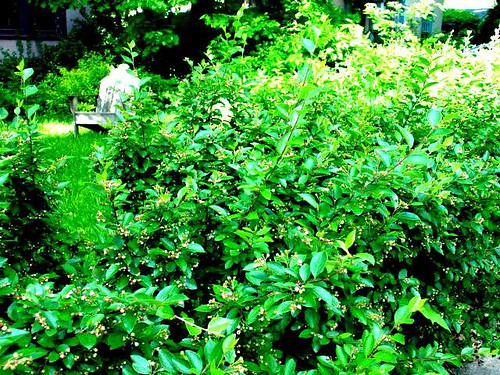
Anyway, I arrive at my own yard and see my overgrown oleaster hedge in bloom with its teeny-tiny, very un-peony-like flowers:
UPDATE, written in 2015: Back then, I wrote "I can't find the lyrics," not even anticipating that one day I'd be able to link to an audio track of the song. Here.
Once a new homebuyer sent her gardener over to my door to ask me to let her come into my yard and cut some branches off one of my backyard trees so she could plant a "sun garden." I was understanding up to a point, but then I said "these are wooded lots" (here in this neighborhood she had chosen instead of the sunny, treeless suburbs) so maybe she should plant a garden that does well in the shade. The gardener got quite snippy and started lecturing me about the law and asserting that she had a legal right to cut back the trees in her yard. One of the benefits of being a lawyer is that when someone decides to lecture you about law, it doesn't take you any time at all to decide that person is an ass. I didn't say, "You're lecturing me about law? I'm a law professor!" I just said, "You want to assert your legal rights. Fine. So do I. You can't cut any branches off my tree." I love the way she was so wrapped up in getting what she wanted and using any argument that she reminded me to stick to my own preferences and not do her any favors. And: great way to make a good impression as a new neighbor.
But that was an anomaly. Most homeowners here in University Heights work within the beautiful shadiness. A neighbor two houses down has this neatly kept arrangment with stone rabbit:
And my next-door neighbor has a yard full of shade-loving flowers, with the peonies beginning their days of glory. As I take this picture, the neighbor's mother comes out and talks to me and as we talk about peonies she almost remembers some lines about peonies by Keats and--elsewhere--Danny Kaye:
I say I'm going to put some of these pictures on my website, and I'll find those peony quotes and put them up as well, and I give her my blog address. The Keats poem is Ode on Melancholy:
But when the melancholy fit shall fall
Sudden from heaven like a weeping cloud,
That fosters the droop-headed flowers all,
And hides the green hill in an April shroud;
Then glut thy sorrow on a morning rose,
Or on the rainbow of the salt sand-wave,
Or on the wealth of globed peonies;
Or if thy mistress some rich anger shows,
Imprison her soft hand, and let her rave,
And feed deep, deep upon her peerless eyes.
And the Danny Kaye lines? Here you see one of his songs was "The Peony Bush." But I can't find the lyrics, so you'll have to buy the album, which seems to be a nice big collection of comic songs.
Anyway, I arrive at my own yard and see my overgrown oleaster hedge in bloom with its teeny-tiny, very un-peony-like flowers:
UPDATE, written in 2015: Back then, I wrote "I can't find the lyrics," not even anticipating that one day I'd be able to link to an audio track of the song. Here.
Mammary government.
After the Janet Jackson nipple hoopla, it's nice to see the Brits having their own little media nipple problem. The Guardian reports:
1. The Janet Jackson nipple exposure was in much better taste because it connected the viewer's sexual interest to actual adult sexuality, whereas the EU ad exploits the viewer's interest in sex by showing a breast in a context that isn't sexual at all.
2. Portraying the voter as a suckling infant and government as the mother's breast really says something about the European conception of government!
For free-loving Eurocrats, an image of a breastfeeding baby seemed the perfect way to promote the joy of voting in the European elections.I just have two things to say about this (other than that's a jarring use of the word "axed.")
But a glimpse of an exposed nipple in the soft-focus advertisement has proved too much for flustered British censors to bear: the image has been cut from the production before it could outrage cinemagoers across the UK.
The new EU states made no objection to the uncut version, a montage of images depicting people making choices, including an opening shot of a baby deciding which nipple to feed from.
Prudish British censors felt differently. While the British Board of Film Classification gave the short film a "U" certificate, the Cinema Advertising Association ordered that the nipple must go.
In an edited version approved for British audiences, the baby's hand at first obscures the nipple, while a second brief shot of the child's mouth closing around the nipple has been completely axed.
1. The Janet Jackson nipple exposure was in much better taste because it connected the viewer's sexual interest to actual adult sexuality, whereas the EU ad exploits the viewer's interest in sex by showing a breast in a context that isn't sexual at all.
2. Portraying the voter as a suckling infant and government as the mother's breast really says something about the European conception of government!
Thumping global warming sermonette.
Is "The Day After Tomorrow" going to be worth seeing? Here's the Film Threat review. Bottom line:
Hmmmm.... who talks like that--"usherette," "thinking cap"? And find me a theater (or theatre) where the speakers don't just line the wall, they somehow manage to align it. (It was crooked.) I'm sorry, I can't trust this guy, even though he had the "funnest" time. The more gigantically, in-your-face fun a movie tries to be, especially if it relies on a "thumping soundtrack," the less fun it is for me. Oh, and CGI makes me ill. And an environmental sermonette? No, thanks.
Speaking of global warming ... when I went looking for a law school teaching job 20 years ago, I actually took global warming into account. I ruled out the south because I genuinely believed that within a few years the south would be impossibly hot and the north would become what the south had been. That's what I kept hearing. That's what the sermonettes circa 1983 were preaching! Meanwhile, it's May 25 and it wasn't even 50 degrees when I left the house this morning.
“The Day after Tomorrow” is cinema at its loudest, biggest, most spectacular and funnest. Having said that, it has to be seen in a theatre – one with a good set of speakers aligning the wall and a nice elongated screen – otherwise you won’t experience the full effect of the thumping soundtrack. If you’re the type that doesn’t mind leaving your thinking cap with the usherette before the show, you’re going to have one hell of a time, and get an economical ‘environmental’ sermon as well.
Hmmmm.... who talks like that--"usherette," "thinking cap"? And find me a theater (or theatre) where the speakers don't just line the wall, they somehow manage to align it. (It was crooked.) I'm sorry, I can't trust this guy, even though he had the "funnest" time. The more gigantically, in-your-face fun a movie tries to be, especially if it relies on a "thumping soundtrack," the less fun it is for me. Oh, and CGI makes me ill. And an environmental sermonette? No, thanks.
Speaking of global warming ... when I went looking for a law school teaching job 20 years ago, I actually took global warming into account. I ruled out the south because I genuinely believed that within a few years the south would be impossibly hot and the north would become what the south had been. That's what I kept hearing. That's what the sermonettes circa 1983 were preaching! Meanwhile, it's May 25 and it wasn't even 50 degrees when I left the house this morning.
Don't forget your "I Believe" bingo card...
...for tonight's big American Idol finale. (Explained here in the Television Without Pity Idol Speculation thread.)
About those movies....
Tonya's talking about my profile: she hasn't read any of my favorite books and she hasn't seen any of my movies. She thinks I may even have made up a fake title in "Grave of the Fireflies." And she thinks the profile function would be a good way to find a boyfriend ... except that clicking on my movie links either gets you only me or gets a bunch of 18 to 21 year old guys. Guys younger than my sons. Guys who like geocaching, which actually sounds like fun but about which Tonya says "What the hell is that? Is Mark into some freaky stuff?" I think we can safely say Googling is not one of Tonya's interests.
If I wanted to use my profile to search for boyfriends, would I come up with this as a list of favorite movies? Note that it looks like I have a taste for madmen (My Dinner With Andre, Aguirre the Wrath of God, Crumb, 32 Short Films About Glenn Gould, Dr. Strangelove) or maybe just geeks (Fast Cheap & Out of Control), or lovable old clowns (Limelight, It's a Gift), and I am a feisty outcast (Grey Gardens, The Nights of Cabiria) who enjoys immersing myself in the saddest movie ever made (The Grave of the Fireflies).
Several of those movies make it part of the way into my heart with music: My Dinner With Andre, Crumb, 32 Short Films About Glenn Gould, Fast Cheap & Out of Control, Limelight, The Nights of Cabiria. To a lesser extent: Aguirre the Wrath of God, Dr. Strangelove.
Several of them affect me because they are about a person profoundly dedicated to art: My Dinner With Andre, Crumb, 32 Short Films About Glenn Gould, Limelight.
Three of them are about war, but very different aspects of war, all very moving in different ways: Aguirre the Wrath of God (delusional conquest in the jungle, looking for an unknown city, attacked by an unseen enemy), Dr. Strangelove (horrible, hilarious mistakes and nuclear weapons), The Grave of the Fireflies (the struggle to survive in the aftermath of firebombing and defeat).
Anyway, those really are my movies. (If I wanted to seem more serious than I really am, I wouldn't blog about American Idol all the time.) Of Tonya's recent favorite movies, I also love Election and Memento. (A couple other movies I love that are Memento-like are Fight Club, 12 Monkeys, and The Matrix.)
Tonya mentions Wonder Boys, but I have to steer clear of that because I loathe Michael Douglas. Why don't you like Michael Douglas, you might ask, but the question really should be: What is it about everything else you don't like that reminds you of Michael Douglas?
Politics and "the testosteroned."
After writing that last entry, I was struck by this Andrew Sullivan statement:
Last night, after Bush's big speech, I listened to some of the analysis, flipping back and forth over the cable news channels (avoiding commercials), and the one comment I kept hearing is that Bush needed to put something in his speech to engage women, and he didn't. Dick Morris leaned on this point. He (or someone else) seemed to think there needs to be special woman-friendly material, something warm and emotional. Maybe some anecdotes about an Iraqi child at school or an Iraqi mother who smiled because of some damn thing we did?
Speaking for myself, but maybe reflecting a few conversations I've had with other women, I just think there are many enjoyable aspects to life, and soaking up political material has a place, but not a huge place. Politicians can't get more of my attention by blabbing about those other aspects of life, though. And I'm annoyed when they waste my time and try my patience by thinking they can appeal to me with such tripe. It's not necessarily that women don't care about the traditional hardcore political issues like war and the economy, just that they are not as interested in spending time going over and over it. Enjoying politics as an avocation is different from caring about the actual political issues.
I've certainly noticed that I get the most traffic on this blog when I've written about a political issue and get linked by another blog that is much more political overall than mine is (e.g., Instapundit). But usually if I say something about politics, I'm speaking as more of a distanced observer of human nature and human folly. I'm interested in the way language is used in politics, because I like to analyze how it affects the human mind and because there is so much humor to be found. And I'm certainly interested enough in human nature to want to contemplate whether I would feel quite differently about all of this if only I was--in Sullivan's slightly inaccurate locution--"testosteroned."
So "for some reason, political opinion sites (and magazines) always skew toward the testosteroned." What is the reason? Well, of course, there's reason not to speculate about the reason. You can't do it without seeming sexist. Sullivan is perhaps well-advised to say "for some reason" and leave it at that. But if I had to speculate, I'd say that men might generally enjoy the feeling of being inside the big conflict, being in the game, and women generally experience politics as stress and discord. I don't think it's that women are more emotional than men, but that different emotions are being felt. I'm a big advocate of reason and think reason is a bridge between the (positions stereotypically associated with the) sexes. Both are concerned about problems and would like to find solutions. Some people feel stimulated by the fight itself and some feel moved to avoid conflict, but all want solutions.
Josh Marshall has just done a survey of his readers. It's an interesting contrast with mine. First off, the similarities. Josh's readers are 81 percent male; mine are 85 percent male. This is no big surprise: for some reason, political opinion sites (and magazines) always skew toward the testosteroned....
Last night, after Bush's big speech, I listened to some of the analysis, flipping back and forth over the cable news channels (avoiding commercials), and the one comment I kept hearing is that Bush needed to put something in his speech to engage women, and he didn't. Dick Morris leaned on this point. He (or someone else) seemed to think there needs to be special woman-friendly material, something warm and emotional. Maybe some anecdotes about an Iraqi child at school or an Iraqi mother who smiled because of some damn thing we did?
Speaking for myself, but maybe reflecting a few conversations I've had with other women, I just think there are many enjoyable aspects to life, and soaking up political material has a place, but not a huge place. Politicians can't get more of my attention by blabbing about those other aspects of life, though. And I'm annoyed when they waste my time and try my patience by thinking they can appeal to me with such tripe. It's not necessarily that women don't care about the traditional hardcore political issues like war and the economy, just that they are not as interested in spending time going over and over it. Enjoying politics as an avocation is different from caring about the actual political issues.
I've certainly noticed that I get the most traffic on this blog when I've written about a political issue and get linked by another blog that is much more political overall than mine is (e.g., Instapundit). But usually if I say something about politics, I'm speaking as more of a distanced observer of human nature and human folly. I'm interested in the way language is used in politics, because I like to analyze how it affects the human mind and because there is so much humor to be found. And I'm certainly interested enough in human nature to want to contemplate whether I would feel quite differently about all of this if only I was--in Sullivan's slightly inaccurate locution--"testosteroned."
So "for some reason, political opinion sites (and magazines) always skew toward the testosteroned." What is the reason? Well, of course, there's reason not to speculate about the reason. You can't do it without seeming sexist. Sullivan is perhaps well-advised to say "for some reason" and leave it at that. But if I had to speculate, I'd say that men might generally enjoy the feeling of being inside the big conflict, being in the game, and women generally experience politics as stress and discord. I don't think it's that women are more emotional than men, but that different emotions are being felt. I'm a big advocate of reason and think reason is a bridge between the (positions stereotypically associated with the) sexes. Both are concerned about problems and would like to find solutions. Some people feel stimulated by the fight itself and some feel moved to avoid conflict, but all want solutions.
Avoiding the greedy grasp of Presidential politics.
On an interior page of the paper NYT, this front page article ("Campaign Ads Are Under Fire for Inaccuracy") continues alongside this article ("Chance of Delayed Nomination Vexes Boston"). The problem of unfair advertising is getting worse, and the annoyance of having a convention in your town is also getting a lot worse, both because of 9/11 precautions and because you notice it a lot more if it doesn't even accomplish a nomination. Boston, which is hosting the Democratic convention that Kerry might manipulate into a nonnominating event, is undertaking some fairly extreme measures:
You can't ignore a convention taking over your city, but why not ignore those ads, which are obviously not a good way to get information? The fact that all that money is spent is a good indication that ads work, even though, you would think, Americans are pretty savvy about advertising and its distortions. The NYT interviews some experts:
Well, that's all very depressing, and obviously the vaunted campaign finance reform does nothing to solve these problems. I usually only watch the ads if I want to make fun of them, but I suppose I need to worry that they will affect me subliminally--or beyond subliminally!--even if I think I am completely above their influence. I don't know if I want everyone to skip commercials the way I do, since I appreciate all the free media that is supported by advertisers who are only participating because they do manage to influence people. And, more seriously, I don't think you can clean up the world and purify the processes that influence public opinion. The world would be entirely different if people were forming their political opinions based entirely on true information and rational thought. If people were already elevated to that pure state, the issues that politicians today use to promote themselves probably wouldn't even exist. So I'm not going to wring my hands too much about all the money, the pointless conventions, and the horrible advertisements. It's all part of the messy, complicated world we must live in and can find our own little ways to enjoy. Personally, I'm going to avert my eyes from the vast load of crap that the money is spent on, and try to figure a few things out from the news, and make a decision sometime in late October about who would make the better President.
Convention organizers recently announced that North Station, one of the city's main commuter rail terminals, will be closed convention week and that miles of busy Interstate 93 will be shut down during evening hours.... Many Boston commuters have said they will take the week off, while others plan to car pool or telecommute. Bars and restaurants near the convention site expect to prosper, but other nearby businesses were considering closing for the week -- even before Kerry's possible convention strategy became public.
The FleetCenter presents special security challenges because of its proximity to North Station, overhead rail lines and the tunnels of the newly completed Big Dig highway project.
Although [Mayor] Menino's office had projected the convention would bring $154 million to the city, two recent studies concluded that the loss of worker productivity and tourism traffic, combined with the cancellation of other events, has turned the gathering into a net loss for Boston.'
You can't ignore a convention taking over your city, but why not ignore those ads, which are obviously not a good way to get information? The fact that all that money is spent is a good indication that ads work, even though, you would think, Americans are pretty savvy about advertising and its distortions. The NYT interviews some experts:
"Even people who don't think there is much information in these ads and say they don't learn anything from them tell us they believe factoids they could only have gotten from these ads, and they're wrong," said Brooks Jackson, director of Factcheck.org, an Annenberg Public Policy Center Web site that vets political advertisements for accuracy. "It's beyond subliminal — it's something else I haven't come up with a name for."
This month the Annenberg Center, at the University of Pennsylvania, released a poll of voters in battleground states that found many believed misleading statements made in the advertisements....
Kenneth M. Goldstein, an associate professor of political science at the University of Wisconsin, said it was to be expected that the campaigns would take liberties, and that with both Mr. Kerry and Mr. Bush flush with cash, there was plenty of time for them to answer each other's claims.
"Politics is about putting your best foot forward and putting the other person in the worst light," Mr. Goldstein said. "Do we expect someone who's advertising to say, `You know, I really don't want to put this person's record in the worst light because that's not fair'?"
In the end, Mr. Jackson of Factcheck.org said, all that can be done is to continue to vet commercials for accuracy and try to set the record straight as publicly as possible. That, he said, is an occasionally thankless task:
"I've had consultants tell me, `Your ad ... runs once, my ad runs many times; who's going to win?'"
Well, that's all very depressing, and obviously the vaunted campaign finance reform does nothing to solve these problems. I usually only watch the ads if I want to make fun of them, but I suppose I need to worry that they will affect me subliminally--or beyond subliminally!--even if I think I am completely above their influence. I don't know if I want everyone to skip commercials the way I do, since I appreciate all the free media that is supported by advertisers who are only participating because they do manage to influence people. And, more seriously, I don't think you can clean up the world and purify the processes that influence public opinion. The world would be entirely different if people were forming their political opinions based entirely on true information and rational thought. If people were already elevated to that pure state, the issues that politicians today use to promote themselves probably wouldn't even exist. So I'm not going to wring my hands too much about all the money, the pointless conventions, and the horrible advertisements. It's all part of the messy, complicated world we must live in and can find our own little ways to enjoy. Personally, I'm going to avert my eyes from the vast load of crap that the money is spent on, and try to figure a few things out from the news, and make a decision sometime in late October about who would make the better President.
May 24, 2004
Gay marriage and the coming singles backlash.
Gregg Easterbrook, in this TNR article, anticipates a backlash against gay marriage coming from single persons:
Easterbrook still supports gay marriage, he's just urging less reliance on the argument that gay persons deserve the various financial benefits available to married persons. But is he really right that singles will complain? He seems to think they are likely to make a lot of noise because they are such a huge group, but they haven't complained much so far about the benefits given to the married, and the sheer size of the group compared to the number of homosexuals who want to get married means that the cost of new benefits will be spread out so much that it won't be noticed. And even aside from that, why assume that the cost of the new benefits won't be offset by savings elsewhere? Even if gay married persons receive some new benefits, they may become happier, more stable, more productive citizens so that the net effect on the community is positive.
[F]or every gay or lesbian pair who weds, winning benefits, a couple of single people must be taxed more to fund these benefits. Benefits can't just be demanded; someone must provide them. Marriage benefits for gays and lesbians will not come from the pockets of those in traditional one-man-one-woman unions. The benefits will come from the pockets of the single....
A utilitarian might care more about the denial of privileges to the unmarried, than to gays who wish to wed, simply because the numbers in the former category are so much larger. At any rate, complaints from the single seem the next logical progression of this debate, and complaints from the single are going to be hard to rebut.
Easterbrook still supports gay marriage, he's just urging less reliance on the argument that gay persons deserve the various financial benefits available to married persons. But is he really right that singles will complain? He seems to think they are likely to make a lot of noise because they are such a huge group, but they haven't complained much so far about the benefits given to the married, and the sheer size of the group compared to the number of homosexuals who want to get married means that the cost of new benefits will be spread out so much that it won't be noticed. And even aside from that, why assume that the cost of the new benefits won't be offset by savings elsewhere? Even if gay married persons receive some new benefits, they may become happier, more stable, more productive citizens so that the net effect on the community is positive.
Bloggers and the literary agent who is trying to reach them.
The New Yorker has a piece about a literary agent, Kate Lee, who searches for bloggers to represent. In this search, she spends an hour a day reading blogs. (An hour!) The hitch is, they have to be willing to produce books:
Isn’t it just possible that people who blog blog precisely because they like this literary form? It’s not as if the idea of writing a book wouldn’t occur to a person without the prodding of a literary agent.
MORE: And I love the assumption that writing a book would be more time consuming. You can write a 365 page book in a year if you write a page a day. Don't you think the bloggers who impressed Lee were writing at least a page a day? It seems to me that the bloggers she contacted who didn't want to write books were genuinely interested in writing blogs, writing time-stamped entries that immediately reach out to the whole world. I'll bet the really good bloggers are generally much more "up" and energetic than your average novelist. A blogger has to leave entries every day, and the entries have to be good enough to make people want to come back. I have a sneaking suspicion a good percentage of novelists have long unproductive spells and are among the least up people around. And finally, if Lee really is interested in bloggers, why doesn't she have a more positive attitude toward blogging? I mean, aside from the fact that there is no role for the agent in blogging.
Sometimes she writes to a blogger only to get the e-mail equivalent of a blank stare. The pseudonymous author of The Minor Fall, The Major Lift was particularly unreceptive. “What am I going to write a book about?” he replied. …
[W]hile she loves her bloggers, and has faith in them, it can be difficult to get them to be productive. “They all have day jobs,” she pointed out. Writing anything longer than a blog post is a commitment they don’t always seem up for.
Isn’t it just possible that people who blog blog precisely because they like this literary form? It’s not as if the idea of writing a book wouldn’t occur to a person without the prodding of a literary agent.
MORE: And I love the assumption that writing a book would be more time consuming. You can write a 365 page book in a year if you write a page a day. Don't you think the bloggers who impressed Lee were writing at least a page a day? It seems to me that the bloggers she contacted who didn't want to write books were genuinely interested in writing blogs, writing time-stamped entries that immediately reach out to the whole world. I'll bet the really good bloggers are generally much more "up" and energetic than your average novelist. A blogger has to leave entries every day, and the entries have to be good enough to make people want to come back. I have a sneaking suspicion a good percentage of novelists have long unproductive spells and are among the least up people around. And finally, if Lee really is interested in bloggers, why doesn't she have a more positive attitude toward blogging? I mean, aside from the fact that there is no role for the agent in blogging.
The self-Googling vice becomes a virtue.
The Corner links to this article, which advises people to self-Google every day to monitor their own reputations. It used to be considered egotistical to Google your own name, but now people who have been careful to maintain their own modesty can go right ahead and self-Google because it has been recast as a virtue of sorts. One must guard against slander.
A problem I have doing this is that my first name, being annoyingly plain (annoyingly plain), is used to great excess as a middle name. So even though I've never run across another Ann Althouse, there are enough (blank) Ann Althouses to gum up the self-Googling. That said, I always rather enjoy re-encountering Lydia Ann Althouse who appears in this 1861 case.
That was pretty feisty of her.
And here's a discussion I'd never seen before. It's amusing to see that a bunch of people found something I wrote a while back funny.
But actually, it's too much trouble to wade through most of this stuff. Maybe it's better to stick with the low tech practice of just worrying about what people might be saying about you!
A problem I have doing this is that my first name, being annoyingly plain (annoyingly plain), is used to great excess as a middle name. So even though I've never run across another Ann Althouse, there are enough (blank) Ann Althouses to gum up the self-Googling. That said, I always rather enjoy re-encountering Lydia Ann Althouse who appears in this 1861 case.
Commonwealth vs. Lydia Ann Althouse — Assault and battery, on complaint of John Hinkle, Jr., of Richland township. The defendant is the wife of Mathias Althouse, whose name also appears in the report of the proceedings of this term. The prosecutor is the constable of Richland township, and having an execution in his hands against Mr. Althouse, went to where he lived to levy on some of the property, when it was claimed by the defendant as hers. The constable being disposed to disregard her claim, she assaulted and beat him – and hence this complaint. The goods, were however seized, and sold by the constable, and a civil suit is now pending by the defendant against the constable for damages therefrom. This prosecution for assault and battery was now settled by the parties, and a nol pros. entered. Gilkyson for Commonwealth.
That was pretty feisty of her.
And here's a discussion I'd never seen before. It's amusing to see that a bunch of people found something I wrote a while back funny.
But actually, it's too much trouble to wade through most of this stuff. Maybe it's better to stick with the low tech practice of just worrying about what people might be saying about you!
Monday in Madison.
I'm going with alliterative titles now whenever possible, because my alliterative title over the weekend snagged me a couple of key links and produced the second highest traffic I've ever gotten for a single post.
It's a gloomy Monday morning in Madison, with the temperature not yet up to 50 degrees. At least a new, albeit miniature, semester is beginning, a three-week intersession. That means there will be a few more people around, and the in-house snack bar has reopened. Normally, at this time of year, I'd look forward to a jaunt down State Street for a mellow work session in one of the cafés, and the snack bar wouldn't be important. But the weather has been not just cold but threatening. So I will hole up in my office today and do some writing of an academic, not bloggy, kind and grade a segment of exams.
Nothing in the news or at the links I normally check in the morning is inspiring me to write something here at the moment, so I will get to work and maybe come back later.
May 23, 2004
Sopranos! Look out for the glass! Kumquats!
What a truly great episode of The Sopranos! I just have a completely off to the side remark. When Tony was watching TV, the movie was It's a Gift, which is officially one of my favorite movies (see my profile). "Look out for the glass, Mr. Muckle!" "Where are my kumquats?"
Tagliatelle Bolognese ... with tornado.
I don't spend much time cooking, and I normally go to great lengths to avoid setting foot in a grocery store, but when I saw this recipe in the NYT Magazine today, I tore out the page, got in my car, drove to the store, bought all the ingredients on the list, drove home, and immediately put together the meat sauce. As I was checking out with the ingredients and some extra bottles of red wine, the young man behind me in line said, "I want go to your party." So now the sauce is almost done--it needs to cook for 3 hours--and the pasta water is coming to a boil. If there is one food I love it's Bolognese meat sauce. For many years, I've used the recipe in this book. I'm not really looking to replace that fine, fine recipe, but ... YIKES!! The tornado warning just went off!!! Ah, don't worry about me .... I'm well positioned near my basement door and ready to seek shelter if I see some significant wind activity from this vantage point. I'm not going to the basement yet though. Because I'm still hungry.... and I fully intend to eat some pasta if it's the last thing I do.
UPDATE: I'm still alive. The tornado warning is over. And the old recipe is still the best. The new one is fine, but if you want to invest three hours in sauce-making, go with Marcella Hazan's recipe.
UPDATE: I'm still alive. The tornado warning is over. And the old recipe is still the best. The new one is fine, but if you want to invest three hours in sauce-making, go with Marcella Hazan's recipe.
Convention drama, convention cliché.
William Safire, the former speechwriter, displayed some speechwriter vanity on Meet the Press when he was asked about Kerry's proposal to refrain from accepting the Democratic nomination at the convention. Safire said it would be "the stupidest move that John Kerry could possibly make." Why? His whole point was: could you imagine leaving out the classic applause line "I accept the nomination," which has been written into the candidates' speeches for 200 years? So that's the real issue: how to write the speech? (Actually a truly arrogant speechwriter would believe there were plenty of elegant ways to draw cheers and applause while refraining from actual acceptance.)
But is it even true that there have been 200 years of conventions culminating in candidates proclaiming "I accept"? According to William Kristol, on Fox News Sunday, before FDR went to a convention in 1932 to accept, the convention would take place and a delegation would travel to the candidate to tell him that he had been nominated weeks later. 200 years, 70 years--how accurate do we have to be? But, really, it seems to me that the key date is 1968, when the lesson was learned that you've got to have a disciplined convention that frames and flatters the candidate, not a real-life event of any kind. The convention is a big advertisement, and, in that setting, it's become a tradition to make the statement "I accept" feel like a dramatic climax, even though it is really a big, boring cliché.
So can you imagine a convention without that big dramatic moment? I'll answer Safire's question. Yes, I could live without that phoney climax. I'd miss my chance to quip from the sofa, "Wouldn't it be funny if he said no?" But I'd survive. In fact, I'd like to see the entire convention eliminated. It's just a big show, and it's not even an entertaining show. Please credit $14 million dollars to the U.S. Treasury and get off my television!
Subscribe to:
Posts (Atom)


 Posts


