May 9, 2016


"A 2001 statue of a kneeling Adolf Hitler sold for a record $17.2 million at a Christie's auction in New York."
"Facebook workers routinely suppressed news stories of interest to conservative readers from the social network’s influential 'trending' news section..."
"... according to a former journalist who worked on the project," Gizmodo reports.
This individual says that workers prevented stories about the right-wing CPAC gathering, Mitt Romney, Rand Paul, and other conservative topics from appearing in the highly-influential section, even though they were organically trending among the site’s users.
Several former Facebook “news curators,” as they were known internally, also told Gizmodo that they were instructed to artificially “inject” selected stories into the trending news module, even if they weren’t popular enough to warrant inclusion—or in some cases weren’t trending at all....
These new allegations emerged after Gizmodo last week revealed details about the inner workings of Facebook’s trending news team—a small group of young journalists, primarily educated at Ivy League or private East Coast universities, who curate the “trending” module on the upper-right-hand corner of the site....
"I may take a swipe at you myself," says the teacher, Mr. Pomfritt, walking into the classroom....
... just as Milton Armitage (Warren Beatty) is telling Dobie "I'll kill ya":
From my all-time favorite TV show "The Many Loves of Dobie Gillis." What kind of teacher could insult the kids like that. Oh, I loved Mr. Pomfritt — along with Maynard and Thalia and Dobie and the rest. And I'm sad to see that the actor who played him, William Schallert, has died (at the age of 93). He was also Patty Duke's father, and "Star Trek" fans know him as Nilz Baris, the under secretary in charge of agricultural affairs for the United Federation of Planets in “The Trouble With Tribbles.”
From my all-time favorite TV show "The Many Loves of Dobie Gillis." What kind of teacher could insult the kids like that. Oh, I loved Mr. Pomfritt — along with Maynard and Thalia and Dobie and the rest. And I'm sad to see that the actor who played him, William Schallert, has died (at the age of 93). He was also Patty Duke's father, and "Star Trek" fans know him as Nilz Baris, the under secretary in charge of agricultural affairs for the United Federation of Planets in “The Trouble With Tribbles.”
So much for the transit of Mercury.
Clouds are more powerful than the sun...
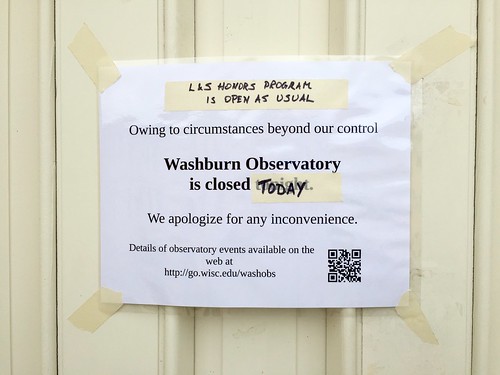
... from our point of view which did not include, as we had hoped, a safe glimpse of the tiny speck that's making its journey right now.

... from our point of view which did not include, as we had hoped, a safe glimpse of the tiny speck that's making its journey right now.
Germans take over our coffee and doughnuts.
JAB Holding Company — after buying up Peet’s Coffee & Tea, Stumptown Coffee Roasters, Caribou Coffee, and Keurig Green Mountain (not to mention Einstein Brothers Bagels) — takes over Krispy Kreme.
ADDED: Speaking of Germans and doughnuts:
ADDED: Speaking of Germans and doughnuts:
There is a misconception that [President John F.] Kennedy made a risible error by saying Ich bin ein Berliner. By using the indefinite article "ein," he supposedly changed the meaning of the sentence from "I am a citizen of Berlin" to "I am a jelly doughnut."
The indefinite article is omitted in German when speaking of an individual's profession or residence but is still used when speaking in a figurative sense. Since the President was not literally from Berlin but declaring his solidarity with its citizens, "Ich bin ein Berliner" was the only way to express what he wanted to say.
"North Carolina has filed a lawsuit against the U.S. Justice Department to defend House Bill 2, a law that bans individuals from using public bathrooms that do not correspond with their biological sex..."
"The move is in response to a letter the Justice Department sent last week warning Gov. Pat McCrory that the law is in violation of the Civil Rights Act and giving him until Monday to 'remedy the situation.'"
The state's lawsuit calls the Justice Department's position a "radical reinterpretation of Title VII of the Civil Rights Act" and "a baseless and blatant overreach."... North Carolina could lose a lot of federal money for failing to comply with the Justice Department -- potentially hundreds of millions of dollars for its universities alone.
"I’m Voting Trump, Warts and all."
Writes Bobby Jindal.
My question: What is the original of the phrase "warts and all"? It's quite literal, based on Oliver Cromwell's instructions to his portrait painter in 1660:
No one knows how close that is to whatever instructions Cromwell gave to Lely, but Walpole's version inevitably got shortened, and by 1824, it had become: "Paint me as I am, warts and all!"
There's something beautiful about a person saying show me how I really am, warts and all that's missing when the phrase is aimed at someone else, as is the case with Bobby Jindal. To say "warts and all" about yourself is to liberate the other person to see and to tell what is true. The way Jindal used it, it means: He's ugly in many ways, but I still accept him. I guess there's a touch of liberation in that. It's saying: Come on, we can support Trump, even though he is, in many ways, ugly. It invites others into realism, into seeing the world as it is.
And here's the idealized Lely portrait of Charles II.

The funniest thing about it is: He's still ugly, even with his face back there in the shadows. But: nice gams!
By the way, "gams" originally referred to thin, unlovely legs. One of the earliest examples from 1789 (G. Parker Life's Painter): "If a man has bow legs, he has queer gams, gams being cant for legs." "Gams" has the etymon in Italia "gamba," which we know from viola da gamba.
My question: What is the original of the phrase "warts and all"? It's quite literal, based on Oliver Cromwell's instructions to his portrait painter in 1660:
[Sir Peter] Lely's painting style was, as was usual at the time, intended to flatter the sitter. Royalty in particular expected portraits to show them in the best possible light, if not to be outright fanciful. Lely's painting of Charles II shows what was expected of a painting of a head of state in the 17th century. It emphasizes the shapely royal calves - a prized fashion feature at that time.As Horace Walpole wrote in "Anecdotes of Painting in England" in 1764 — a century later — Cromwell was reported to have said: "Mr Lely, I desire you would use all your skill to paint my picture truly like me, and not flatter me at all; but remark all these roughnesses, pimples, warts and everything as you see me, otherwise I will never pay a farthing for it."
Cromwell did have a preference for being portrayed as a gentleman of military bearing, but was well-known as being opposed to all forms of personal vanity. This 'puritan Roundhead' versus 'dashing Cavalier' shorthand is often used to denote the differences in style of the two opposing camps in the English Commonwealth and subsequent Restoration. It is entirely plausible that he would have issued a 'warts and all' instruction when being painted and it is unlikely that Lely would have modified his style and produced the 'warts and all' portrait of Cromwell unless someone told him to.
No one knows how close that is to whatever instructions Cromwell gave to Lely, but Walpole's version inevitably got shortened, and by 1824, it had become: "Paint me as I am, warts and all!"
There's something beautiful about a person saying show me how I really am, warts and all that's missing when the phrase is aimed at someone else, as is the case with Bobby Jindal. To say "warts and all" about yourself is to liberate the other person to see and to tell what is true. The way Jindal used it, it means: He's ugly in many ways, but I still accept him. I guess there's a touch of liberation in that. It's saying: Come on, we can support Trump, even though he is, in many ways, ugly. It invites others into realism, into seeing the world as it is.
And here's the idealized Lely portrait of Charles II.
The funniest thing about it is: He's still ugly, even with his face back there in the shadows. But: nice gams!
By the way, "gams" originally referred to thin, unlovely legs. One of the earliest examples from 1789 (G. Parker Life's Painter): "If a man has bow legs, he has queer gams, gams being cant for legs." "Gams" has the etymon in Italia "gamba," which we know from viola da gamba.
"Harvard wants secretive male clubs to go co-ed. All-female groups are being punished in their wake."
WaPo observes.
The unexpected consequence of the penalties, then, is to prevent women from associating under their gender as well...Why would that be an "unexpected consequence"? How dumb could Harvard possibly be? Obviously, it was expected. The usual adjective is "unintended."
... prompting all-female groups to ask the administration to consider them in a different vein from their all-male counterparts.So, once Harvard has made the big change and set up incentives to pressure private institutions to abandon their single-sex tradition, it's now supposed to adopt sex discrimination itself and remove the pressure on the all-female institutions?
“Basking in the praise of the national press for its efforts to make all-male final clubs go co-ed, Harvard has left out an important piece of the story: female final clubs,” three female students wrote in an op-ed for the Harvard Crimson. They argued that while women would remain disenfranchised within the hierarchies of historically male clubs, the act of making historically female clubs go co-ed would effectively cause them to “die out,” as they lack the resources to compete.
The students further accused Harvard of pushing for “hasty, symbolic victories” as a “form of damage control” following negative media attention on final clubs. “The support systems, safe spaces, and alumnae networks the women’s clubs have been striving to build will disappear,” they wrote. “That strikes us as a tremendous waste, and an ironic one, given Harvard’s stated goals.”...
What Trump has taught us.
Via Power Line, here's the venerable historian Paul Johnson talking up Donald Trump. Some of this is disturbingly extreme...
Johnson's key point — the part that I agree with — is that it is heartening, in view of the dangers of political correctness that someone has succeeded by being "vulgar, abusive, nasty, rude, boorish and outrageous," and "saying what he thinks and, more important, teaching Americans how to think for themselves again."
I especially like the idea that Trump is teaching us that it works to speak forthrightly about what we think. That might not be true. It might work only for Trump — maybe he has some weird communication genius — but I hope people can absorb and process the lesson and make it work for themselves.
I had a dream about Trump a while back. It may have been part of this dream I told you about on August 3, 2015. This part of the dream isn't in that description, but it's the part I've remembered and thought about over these past 8 months: I thanked him, effusively, for teaching us to have the courage to speak freely.
This is a lesson that works for everyone, whether they share Trump's positions or not. And yet I can see that Trump is teaching the opposite lesson as well — that you can be hated for what you say and that if you say anything that can be called racist/sexist/xeonophobic and people decide to box you into that characterization, that's how they will think of you from then on, and they will spread the word that you are toxic and you require exclusion. But that is why political correctness is so dangerous and why punching through it would be such a benefit.
No one could be a bigger contrast to the spineless, pusillanimous and underdeserving Barack Obama, who has never done a thing for himself and is entirely the creation of reverse discrimination. The fact that he was elected President–not once, but twice–shows how deep-set the rot is and how far along the road to national impotence the country has traveled.... but Johnson has been putting strong opinions in stark language since long before Donald Trump gave us all a stunning lesson in clear, impudent speech. Maybe Johnson loves Trump because Johnson sees himself in Trump.
Johnson's key point — the part that I agree with — is that it is heartening, in view of the dangers of political correctness that someone has succeeded by being "vulgar, abusive, nasty, rude, boorish and outrageous," and "saying what he thinks and, more important, teaching Americans how to think for themselves again."
I especially like the idea that Trump is teaching us that it works to speak forthrightly about what we think. That might not be true. It might work only for Trump — maybe he has some weird communication genius — but I hope people can absorb and process the lesson and make it work for themselves.
I had a dream about Trump a while back. It may have been part of this dream I told you about on August 3, 2015. This part of the dream isn't in that description, but it's the part I've remembered and thought about over these past 8 months: I thanked him, effusively, for teaching us to have the courage to speak freely.
This is a lesson that works for everyone, whether they share Trump's positions or not. And yet I can see that Trump is teaching the opposite lesson as well — that you can be hated for what you say and that if you say anything that can be called racist/sexist/xeonophobic and people decide to box you into that characterization, that's how they will think of you from then on, and they will spread the word that you are toxic and you require exclusion. But that is why political correctness is so dangerous and why punching through it would be such a benefit.
"On Monday, May 9, the planet Mercury will make a rare transit of the sun..."
"... and... the University of Wisconsin–Madison Department of Astronomy will open Washburn Observatory to the public for safe viewing of the event."

That's a picture I took of the observatory a while back, on a cloudy day. But today's not cloudy, or there would be no viewing of the transit.
A telescope is necessary to see Mercury’s small disk against the large backdrop of the sun. It would take about 150 Mercury disks to span a solar diameter, [says Jim Lattis, director of UW Space Place]...
“Aiming a telescope or binoculars at the sun is a dangerous operation, requiring special equipment and techniques, and therefore best left to skilled observers. A full-aperture solar filter properly fitted to the front of the telescope is a good way to observe this event, but make sure no finder telescopes or other devices are exposed to the direct sunlight. It is possible to project the image of the sun formed by a telescope or binoculars onto a screen, and the image projected on the screen is safe to observe. However, there is still a serious hazard in the intense beam of sunlight, which can cause instantaneous eye damage and even start fires. Moreover, many telescopes and binoculars will be damaged by the intense heat, while finder telescopes and sights present further dangers. Do not look directly at the sun without appropriate filters, and do not point optical equipment at the sun unless you know exactly what you are doing.”Washburn Observatory is at 1401 Observatory Drive, here in Madison, and it's open now and until2 p.m. today.
That's a picture I took of the observatory a while back, on a cloudy day. But today's not cloudy, or there would be no viewing of the transit.
May 8, 2016
At the Sunday café...
... just a few pictures from yesterday in the Arboretum...

That one's from Meade, as I was walking away. Later, we got caught together in a reflection...
I took that one — of an odd spike of the artificial in what was mostly trees...

... and flowers...

... at their prettiest.
That one's from Meade, as I was walking away. Later, we got caught together in a reflection...
I took that one — of an odd spike of the artificial in what was mostly trees...
... and flowers...
... at their prettiest.
Sarah Palin: "I think Paul Ryan is about to be Cantored — as in Eric Cantor."
That was in answer to a question from Jake Tapper, just now, on his Sunday show, about what she thought of Paul Ryan's statement — after saying he would support the GOP nominee — that he was not yet ready to support Donald Trump.
She continued: "His political career is over, because he has so disrespected the will of the people. As the leader of the GOP — the convention, certainly — he is to remain neutral and for him to already come out and say who he will not support was not a wise decision of his."
To be clear, Ryan's statement was: "I'm just not ready to do that at this point. I'm not there right now." Is it fair to paraphrase that as saying "who he will not support"? The inaccurate word is "will." If she'd said "who he does not support," she'd be fine.
But "about to be Cantored" is the memorable language. Very harsh. Maybe you also jumped at "His political career is over." What happened to her political career?
She continued: "His political career is over, because he has so disrespected the will of the people. As the leader of the GOP — the convention, certainly — he is to remain neutral and for him to already come out and say who he will not support was not a wise decision of his."
To be clear, Ryan's statement was: "I'm just not ready to do that at this point. I'm not there right now." Is it fair to paraphrase that as saying "who he will not support"? The inaccurate word is "will." If she'd said "who he does not support," she'd be fine.
But "about to be Cantored" is the memorable language. Very harsh. Maybe you also jumped at "His political career is over." What happened to her political career?
How I made a Walt Whitman essay from 1856-57 look as though it was the talk of the internet yesterday.
I'm not referring to "Manly Health and Training," the set of essays, published under a pseudonym and revealed to the world last month, a genuinely a newsworthy matter, which really did belong on Memeorandum, the website that — through some mysterious automated process — presents a one-page picture of what articles and items are getting linked to and discussed.
I'm talking about "An American Primer," a long known, long available essay by Walt Whitman, which was reprinted in the April 1904 issue of The Atlantic. It's about one of my favorite topics, blunt speech — blunt speech, as opposed "delicate lady-words" and "gloved gentlemen words." Whitman — touting America and liberty — comes out for "coarseness, directness, live epithets, expletives, words of opprobrium, resistance." I love that sort of thing, and I think most of America — not the elite, not the civility bullshitters, but most of America — loves it.
So I was moved to blog about it yesterday, after I ran across it by chance, not in anything current, but in an old acrostic puzzle in the New York Times archive, way back in October 2011. I don't think anyone else was looking at "An American Primer" yesterday and getting excited about it and linking to the old April 1904 issue of The Atlantic.
But it popped up on Memerandum:

I guess it was a slow Saturday. But thanks, Memeorandum. Thanks for weighting me however much that was in your algorithm. And thanks for nudging whomever you may have nudged to see what all the buzz is about, whatever it was that Walt Whitman wrote back in 1856-57. I know what it was. I read the whole 6,000-word essay. Out loud. To Meade. And we talked about it for a long time, connected it to the Donald Trump phenomenon, etc. etc. So there were the 2 of us. But I just find it so delightful to think that — via the magic of Memeorandum — somebody else got the idea that "An American Primer" was the thing to talk about and got to reading and talking about it too.
And then there's the little corner of the internet that was my blog last night, and maybe — without the nudge of Memeorandum's absurdly false impression that "An American Primer" was a Topic of the Day — you read it or at least the snippet of it that I posted, and maybe you were hanging out at Althouse on Saturday night, talking with other people about the distaste for delicate lady-words and gloved-gentlemen words and a love for epithets, expletives, and words of opprobrium.
There was BDNYC, who said: "Unreadable." And kentuckyliz, who said: "I found it quite readable once I found the sweet spot in my bifocals." And Paul Zrimsek, who said: "I am yuge, I contain multitudes." And traditionalguy:
I'm talking about "An American Primer," a long known, long available essay by Walt Whitman, which was reprinted in the April 1904 issue of The Atlantic. It's about one of my favorite topics, blunt speech — blunt speech, as opposed "delicate lady-words" and "gloved gentlemen words." Whitman — touting America and liberty — comes out for "coarseness, directness, live epithets, expletives, words of opprobrium, resistance." I love that sort of thing, and I think most of America — not the elite, not the civility bullshitters, but most of America — loves it.
So I was moved to blog about it yesterday, after I ran across it by chance, not in anything current, but in an old acrostic puzzle in the New York Times archive, way back in October 2011. I don't think anyone else was looking at "An American Primer" yesterday and getting excited about it and linking to the old April 1904 issue of The Atlantic.
But it popped up on Memerandum:
I guess it was a slow Saturday. But thanks, Memeorandum. Thanks for weighting me however much that was in your algorithm. And thanks for nudging whomever you may have nudged to see what all the buzz is about, whatever it was that Walt Whitman wrote back in 1856-57. I know what it was. I read the whole 6,000-word essay. Out loud. To Meade. And we talked about it for a long time, connected it to the Donald Trump phenomenon, etc. etc. So there were the 2 of us. But I just find it so delightful to think that — via the magic of Memeorandum — somebody else got the idea that "An American Primer" was the thing to talk about and got to reading and talking about it too.
And then there's the little corner of the internet that was my blog last night, and maybe — without the nudge of Memeorandum's absurdly false impression that "An American Primer" was a Topic of the Day — you read it or at least the snippet of it that I posted, and maybe you were hanging out at Althouse on Saturday night, talking with other people about the distaste for delicate lady-words and gloved-gentlemen words and a love for epithets, expletives, and words of opprobrium.
There was BDNYC, who said: "Unreadable." And kentuckyliz, who said: "I found it quite readable once I found the sweet spot in my bifocals." And Paul Zrimsek, who said: "I am yuge, I contain multitudes." And traditionalguy:
Whitman spoke like an earlier version of Trump because Whitman was also giving voice to an implacable will to be strong and free men. That is what made America Great the first time.IN THE COMMENTS: Ngtrains said: "Robert Morse? how about Samuel?" And I said: "Mm. Yeah. Should I fix that for him. Robert Morse... was he the actor in 'How To Succeed in Business Without Really Trying'?" I look it up. And it's just so damned Trumpian....
It started with Andrew Jackson defeating the murderous British in the West to save the Mississippi River Valley, and then took off with Robert Fulton building his steamboats and DeWit Clinton building his canal locks to go over the Niagara Escarpment at Lockport, NY to complete a transportation circle from New York City to the Great lakes and then down the Mighty Mississippi to New Orleans. And which soon saw Robert Morse building his single wire telegraph to carry the news.
Trump is a messenger and a builder. And nobody cares if he says bad words in his battle to make America Great Again.
"So, awaiting final toxicology, it has now been reported in the New York Times that Prince was toxic. I can relate. I was toxic too."
Everyone's relating to Prince, including actress and children's book author Jamie Lee Curtis.
Meanwhile, "I Was Prince’s Private Chef":
Meanwhile, "I Was Prince’s Private Chef":
I cooked teriyaki salmon like I used to make for myself all the time (with that Soy Vey assist!) with grilled asparagus on the side, plus a hot-and-sour soup that I’d literally never made before and a coconut sorbet with fresh mango for dessert. It was terrifying.Literally.
The assistant had warned me that Prince eats like a bird, but he finished everything and asked for seconds.... A few days later I was en route to a wedding in Vegas when Prince’s assistant called and said, “You got the job but you can’t split it, he only wants you. You have to be on call 24-7. Oh and by the way – he’s nocturnal. And you start tonight. Ryan Seacrest is coming to dinner.”The pressure is unfathomable.
Subscribe to:
Posts (Atom)


 Posts
Posts


