I am stunned! So soon after Kate Spade, a cultural icon who seemed to embody joy in life and simple happiness. Similarly, I associate Bourdain with the power to seize upon life and exuberantly suck the marrow of pleasure out of everything. What is the darkness on the other side of the face we loved because we saw vistas of happiness?
What happened? I'd rather believe it was one of those accidental deaths by hanging. Perhaps he had some terrible ailment that led him to declare the end to life. I hate thinking that a man who exemplified energetic pleasure-seeking was actually not enjoying himself at all.
"[Kate Spade] ads had the confidence and charm of a Wes Anderson film, a few years before Rushmore made his style instantly recognizable. They’d taken a love of WASP-y Americana and merged it with a winking downtown irony, in a formula that brands like J.Crew and Tory Burch would later emulate with great success. In retrospect, it’s hard to appreciate how cool those simple handbags were.... Everything about that year in my life felt vivid, even though I only worked in retail and went to college. I lived a few blocks north of the store, in an apartment with two rooms and no bathroom sink. Outside of the shop, life might have been chaotic, but inside, everything was calm and under control. I loved going to work and was never bored, even when it was just me and Julia, my store manager, listening to Joni Mitchell and eating peppermints while we waited for customers...."
And I once lived in a NYC apartment that had no bathroom sink. (There was a big, claw-footed bathtub, and leaning over it to wash hands or brush teeth became the norm. And I must have put in my contact lenses there. That's the hardest thing to picture. I guess I put the rubber plug in the drain and went for it.)
"... and even the sarcastic humor of her brother-in-law David Spade during his “Saturday Night Live” heyday. The company’s calling card was unabashed optimism."
Robin Givhan writes (in WaPo) about how Kate Spade's designs (handbags, etc.) were so nice at "a time when much of the highbrow fashion industry was fixated on minimalism and the washed-out, dour aesthetic known as heroin chic."
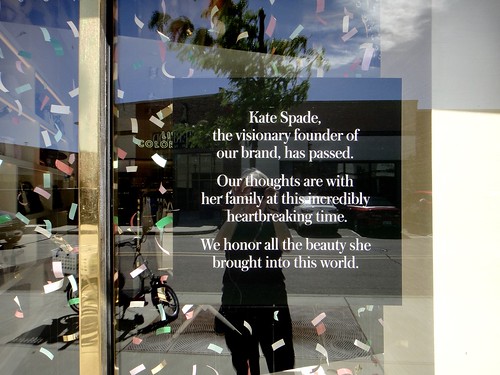
And then Kate Spade killed herself. Was the fashion always a facade, some desperate grasping to climb out of horrible darkness? Were the women who wore "heroin chic" happier than those who went for Kate Spade's clear colors and happy shapes?
It's interesting to think of these questions after blogging about Miss America's effort to get away from "outward appearance." What are other people really like on the inside? Well, the inside is private. We get to choose how much access to give to our inner selves, and to show what's on the inside, we need to let it out — by actions and gestures and by words but also by how we look. We've got to wear something, and we can choose to reveal what we are inside through what we wear, but we don't have to tell the straightforward truth.
You can wear yellow-and-white polka dots when you are gloomy and nothing but black when you're doing just fine.
This made me think of the Teri Garr character in "Afterhours":
"The designer Kate Spade, who created an accessories empire and whose handbags became a status symbol and a token of sophisticated adulthood for American women, was found dead on Tuesday. One of the first of a powerful wave of American female designers in the 1990s, Ms. Spade built a brand on the appeal of clothes and accessories that made women smile. Her cheerful lack of restraint and bright prints struck a chord with her consumers, many of them cosmopolitan women in the early stages of their careers. She embodied her own aesthetic, with her proto-1960s bouffant, nerd glasses and playful grin....." (NYT)
I am a participant in the Amazon Services LLC Associates Program, an affiliate advertising program designed to provide a means for me to earn fees by linking to Amazon.com and affiliated sites.
Encourage Althouse by making a donation:
Make a 1-time donation or set up a monthly donation of any amount you choose:




 Posts
Posts


