Showing posts with label Jim Webb. Show all posts

December 24, 2022

"If I go looking for something I usually don’t find it. In fact, I never find it. I walk into things intuitively when I’m most likely not looking for anything...."

"Obscure artists, obscure songs. There’s a song by Jimmy Webb that Frank Sinatra recorded called, 'Whatever Happened to Christmas,' I think he recorded it in the 60s, but I just discovered it...."

Said Bob Dylan, recently.


Questions for discussion:

1. What's the use of looking for something? You'll have better luck walking intuitively while not actually looking. That is, don't look where you're going. That's exactly what doesn't work.

2. Frank Sinatra is hardly an "obscure artist," but there are many recordings of Frank Sinatra singing an obscure song. What's your favorite obscure Frank Sinatra song?

3. Even Jimmy Webb is not obscure, but how many songs has he written, and what percentage of them are non-obscure? But don't talk about them. Talk about a Jimmy Webb obscurity.

4. Whatever happened to Christmas? Remember how love was all around? Whatever happened to you?

5. What have you found, Bob Dylan style, by walking into it intuitively? 

December 26, 2015

"Clinton talked at this last DNC debate about her failure as Secretary of State as if she was successful," Facebooks Jim Webb...

... because that's where he's speaking from now, not the debate stage anymore.
While she held that office, the U.S. spent about $2 billion backing the Libyan uprising against Qadaffi. The uprising, which was part of the Arab Spring, led directly to Qaddafi being removed from power and killed by rebel forces in 2011. Now some 2,000 ISIS terrorists have established a foothold in Libya. Sophisticated weapons from Qaddafi's arsenal—including up to 15,000 man-portable, surface-to-air missiles have apparently fallen into the hands of radical Islamists throughout the region. For a Secretary of State (and a Presidential administration) this is foreign policy leadership at its worst.
ADDED: Here's a report on the debate. Hillary was asked "How much responsibility do you bear for the chaos" in Libya.

AND: There's some talk about Webb maybe having the idea of running as an independent. Since he never got any traction as a Democratic Party candidate, it's hard to take this seriously. I assume he wants to be a voice, and we are reading his Facebook post. If he were to say he was an independent candidate, would that amplify his voice and boost his stature and credibility? He's just a voice, either way. To me, your credibility is better if you present yourself as what you really are.

October 17, 2015

"I even turned around to Bernie Sanders at one point and said, ‘Bernie, say my name, will you? Say my name.'"

"In that kind of environment, I was either going to be Mr. Angry or I was going to be a potted plant. That was the only way to try to get into the conversation," said Jim Webb, complaining about the "rigged" debate.

I love the "say my name" business. So "Breaking Bad"...

July 18, 2015

"Hillary is outdone in first major Iowa test as Bernie Sanders calls for a 'revolution' and Martin O'Malley has some Clinton partisans on their feet – and she talks mostly about HERSELF."

The headline at The Daily Mail, covering an event that I watched live on C-SPAN last night. Meade and I were not in the same location, and he texted me that Hillary was on C-SPAN. Here's the (slightly expurgated) texting that followed:
meade: Hillary live on cspan/Now Martin Omalley

althouse: Missed h/O sounds like he's seeing the speech for the first time

meade: Same thought/The energy is waiting for Bernie/O's S's whistle/O has an impressive forehead

althouse: The i voted for you refrain worked on me
O'Malley ends his speech with a repeated line, "I voted for you," which you're asked to picture yourself saying that to your grandchildren someone who asks you who you voted for in 2016. Intellectually, I find it corny, but physically, I repeatedly got chills, even after my mind told my body to cut that out. Next up is Bernie Sanders:
meade: Bernmentum/Revolution!/I'm mad as hell and I'm not going to take it anymore

althouse: Angry old man

meade: White man

althouse: Not working on me/Too yell-y

meade: Plus he obviously wants to tax you more/Enough taxes will never be enough/We are coming for your wealth/You greedy person you

althouse: Going back to the Hillary part on line/Very wooden

meade: Don't stop thinking about/Socialism/Jim Webb -- token military/We need to be more like Germany

althouse: H attacks walker

meade: Jim Webb is obviously running for vice president/Webb is putting Iowa communistdemocrats to sleep

althouse: Hilary's delivery is so harsh. Not persuasive/Watching Webb now

meade: She had to compete with harsh angry old Bernie who was persuasive/Webb seems anti Obama

althouse: Wow. No applause at all/He pauses to dead silence

meade... He's bombing/Bombing Iowa

althouse: He's not really a democrat

meade: FDR gets his biggest applause
Webb ended his speech by observing that he'd finished without consuming all his time. I guess the speechwriters allowed time for the applause lines. Awkward! Then there's meeting and greeting in the crowd. (It was the Iowa Democratic Party's annual Hall of Fame dinner (whatever that is).) All the candidates were out there on the floor mingling... except Hillary:
meade: Where the hell is hill?

althouse: She stalked off as quickly as she could. Right after speech. It was weird. Her heart isn't in it. She wants to be unopposed

meade: She came back/Huma made her/But her feelings are hurt/Again/I'm starting to get depressed for Dems/Oh!/Lincoln Chafee!
ADDED: Here's C-SPAN's video of the whole 3-hour event. Scroll to the middle to get to the part with the candidates, beginning with Lincoln Chafee whom both Meade and I missed. Scroll to 2 hours and 45 minutes to get to the milling around part. Bernie dominates. People crowd around him and want to meet him. The camera backs up and we see the surly Webb, getting interviewed by one reporter. The awkwardness of it is painful to watch. The camera pans around and eventually we find O'Malley and Chaffee. Lots of attention to O'Malley. I'm watching half an hour of this, seeing everyone but Hillary. But where is Hillary? Meade wrote, "She came back/Huma made her," but I never see her. What I saw — what I was referring to when I said "She stalked off as quickly as she could" — was the end of her speech, 1 hour and 50 minutes into the recording.

June 24, 2015

Of all the presidential candidates, Democrat Jim Webb comes closest to accepting the Confederate battle flag.

Here's his statement on Facebook:
This is an emotional time and we all need to think through these issues with a care that recognizes the need for change but also respects the complicated history of the Civil War. The Confederate Battle Flag has wrongly been used for racist and other purposes in recent decades. It should not be used in any way as a political symbol that divides us.

But we should also remember that honorable Americans fought on both sides in the Civil War, including slave holders in the Union Army from states such as Missouri, Kentucky, Maryland and Delaware, and that many non-slave holders fought for the South. It was in recognition of the character of soldiers on both sides that the federal government authorized the construction of the Confederate Memorial 100 years ago, on the grounds of Arlington National Cemetery.

This is a time for us to come together, and to recognize once more that our complex multicultural society is founded on the principle of mutual respect.
Mother Jones has this background on Webb:
In his 2004 book Born Fighting, a popular history of Scots-Irish immigrants in the United States, Webb complained that present-day attacks on the Confederacy and the Confederate flag were part of "the Nazification of the Confederacy." The book included a lengthy attack on post-Civil War Reconstruction policies, and Webb claimed that the federal government "raped the region" during this period. The passage was repeated in his memoir, published in 2014.

"The entire region has been colonized from the outside, impoverishing basic infrastructure such as schools and roads while the banking system and corporate ownership sent revenues from Southern labor to the communities of the north," he wrote in his memoir. The damage done, he contended, "in some measure validated much of the resentment expressed toward the Yankee and his minions."...

Webb's longtime strategist, Dave "Mudcat" Saunders, is an even more ardent fan and defender of the Confederacy. As the New Yorker reported in 2008, Saunders "sleeps under a Rebel-flag quilt, and when challenged on such matters he has invited his inquisitors to 'kiss my Rebel ass'—his way of making the point that when Democrats are drawn into culture battles by prissy liberal sensitivities they usually lose the larger war." Saunders is currently advising Webb on his potential presidential campaign.

October 3, 2012

"Even hedged regrets are welcome, but the irony is that a Senator who says the parties need to work more together..."

"... will have as his main legacy the most partisan and polarizing legislation of modern times."
Had [Jim Webb] or any one of the 60 Democrats insisted that the Administration get Republican votes, or drop the bill's worst provisions, history would have been very different.

A second irony is that Democrats only had those 60 Senate votes because of a series of improbable and corrupt events. Mr. Webb won his race by a hair in 2006 after incumbent George Allen stupidly uttered the word "macaca," and the media portrayed him as racist. Alaska's Ted Stevens lost his seat in 2008 by 3,724 votes after he was convicted eight days before the election in a trial in which the Justice Department withheld crucial evidence. He was later exonerated. And Al Franken, who was trailing on Election Day, managed to steal the Minnesota recount in 2008 by 312 votes from a hapless Norm Coleman....
History... had you remembered those 3 incidents and the fact that all 3 were required to produce the 60 votes that allowed the Democrats to inflict Obamacare on us?

February 9, 2011

"Senator Jim Webb, Democrat of Virginia, has decided not to run for re-election..."

"...  avoiding a blockbuster rematch with the man he beat in 2006, George Allen, and giving Senate Republicans another opportunity to help them reclaim the majority."

Care to speculate on why Webb won't put up with a second electoral encounter with Allen?  Or should I say why he doesn't feel enough affinity for Senate Democrats to want to help them keep their numbers up?

July 2, 2008

Barack Obama "is supposed to be the tonic for the culture wars of the 60s."

But, Maureen Dowd says, "it’s Obama who seems trapped, sucked back into yesteryear" (i.e., Vietnam):
Wes Clark joined the growing ranks of troublesome Obama associates when he meowed that just “riding in a fighter plane and getting shot down” is not a qualification to be president. He made McCain sound like a drone aircraft....

Another renowned Marine grunt in Vietnam, Democratic Senator Jim Webb, chimed in on MSNBC, advising flyboy McCain to “calm down” on his promotion of his military service, saying we need to “get the politics out of the military.”
Calm down? The only point of saying that is to piss off McCain. There's nothing more irritating than being told to calm down. And McCain hadn't flamed up over Clark. Get the politics out of the military? It's Clark and Webb who are injecting all the politics into the military right now. Webb is pissing me off. I don't know how McCain can resist taking the bait. Do the Obama people have someone who can be even more annoying than Webb on this subject? They seem to be wheeling out the military men one after the other. Clark didn't do the trick, so up comes Webb. Can they top Webb?

Anyway, Dowd's point is that Obama wants to get us out of Iraq, but he can't even get us out of Vietnam.

ADDED: Instapundit links to this post, calls attention to Obama's "I can’t have fun anymore, it’s not allowed," and quotes Enigmaticore from our comments section:
I still cannot fathom what the thinking is with the Democrats on this one.

It's like they want to have this election fought on questions of character, patriotism, self-sacrifice, and integrity. Oh, and with the attack on McCain for having voted for confirmation of Ginsburg and other liberal judges, of bipartisanship.

This is playing out as if McCain has a mole inside the strategy sessions of the Democrats, guiding them to fight the campaign exactly where their candidate is weakest and their opponent is strongest.

Do they really want people, going into the 4th of July holiday, to be concentrating on the service and sacrifices of John McCain? Really?

May 30, 2008

Ezra Klein tries to figure out a way for the Democrats to secure their masculinity.

It's not through Jim Webb:
Democrats can't out-tough the GOP. It's possible that James Webb can do it. But he's sui generis; a Democrat who can win at politics when played under Republican rules. Democrats love those candidates, because they think of presidential elections as an away game, and they're endlessly hunting for the candidate who plays best under those conditions.
What then are the Democratic "rules"? Or what's the Democratic "home game"? Ezra mixes the metaphor. Sports don't have different rules at different stadiums. But he doesn't even go on to try to discern the rules or the conditions at the home stadium. He moves on to Obama-promotion:
His policies -- particularly his domestic policies -- have not been half as innovative as his politics. But his willingness to double down on opposition to the gas tax holiday, to battle back on negotiating with dictators, to respond to attacks by pressing the point, has been genuinely exciting. And though he has been confident and even aggressive in all of this, he has not been "tough."
And he disses Kerry:
He has not pretended to go shooting, or driven on to Jay Leno's show on Harley. He's essentially been making his own rules.
So can you figure out what Ezra wants to say about masculinity as played by Democratic rules in Democratic stadiums? He titles his post "The Politics of Masculinity," and I think his real point may be that Democrats shouldn't try to compensate for what appears to be inadequate masculinity, but try to find where he says that:
To be clear, this isn't a commentary on Webb.
Well, then be clear. What is it a commentary on?
But the argument for his elevation to the national ticket -- which is to say, to become one of the faces of the party -- is about the electoral benefit of a hyper masculine, effortlessly tough, culturally conservative (seeming) candidate who can win back those Reagan Democrats and white males.
I'd love to have a private, confidential conversation with Webb about what he thinks about the way his party perceives him as some sort of walking bucket of extra testosterone.
As I wrote the other day, I don't think the Democratic Party should be orienting itself towards reknitting that particular coalition.
Knitting! Only a Democrat would talk about knitting masculinity.
I think there are other, more plausible, paths to a majority coalition; paths that are more durable because they aren't so candidate-specific, and that could create a political model better for progressivism and for broad participation in electoral politics.
That's the last sentence of his essay! Come on, Ezra! Real men don't use semicolons. And more than that: Say what you have to say. Don't pussyfoot around. I think you mean:

We are the Mommy Party. Let's own it. Let's do it! The home game is knitting and cooking and putting bandaids on booboos. Be forthright about it. That's more masculine than driving a Harley or a tank or carrying a gun and a dead duck and nominating a bucket of testosterone for VP.

IN THE COMMENTS: George quotes a part of the essay that I left out:
"He [Webb] is the daywalker, combining a progressive's positions with a southern militarist's affectations."

A 'daywalker' is a vampire.

What does that sentence mean?
UWS guy said:
I thought the daywalker line was pretty hip. It also made Webb sound even more bad-ass.
Chip Ahoy said:
I find Ezra Klein nearly incomprehensible and in possession of a disordered mind. And yet his readers apparently 'get' him. One said he understood the metaphor of daywalkers, then elaborated incomprehensibly.
Newscaper says:
This is hilarious IMO. It doesn't mean what Klein, Mr. [wannabe] Hip thinks it does. The other comment here was right in that by making a semi-obscure (by mainstream stds) pop culture reference to Blade -- the vampire comics and Snipes films, he was trying to sound cool and edgy.

What a dipshit -- he actually botched the metaphor.

A "daywalker" is a vampire who can survive in sunlight and fully mingle with normal people and pass as one. But he's still a vampire.

Sounds like Klein is saying the Dems in general are the vampires who can't stand exposure in the light of day (see other commenter's correct 'prog' vs 'lib' observation), and admitting the Dems are treacherous, blood-sucking parasites -- yep, sounds about right :)

But, one might interject, "But wait, the daywalker Blade IS the good guy in the stories," to which I reply that Blade is only the good guy because he has turned *against* the evil of the other vampires, opposing their agenda rather than advancing it.

Klein's metaphor so totally bites him in the ass, by inadvertently being approriate in a way that is 180 out of synch with his intentions in using it.

January 25, 2007

"We have to have the stomach to finish the task."

Dick Cheney faces down Wolf Blitzer:
BLITZER: Here's what Jim Webb, Senator from Virginia, said in his Democratic response last night. He said:

"The President took us into the war recklessly. We are now, as a nation, held hostage to the predictable and predicted disarray that has followed."

And it's not just Jim Webb, it's some of your good Republican friends in the Senate and the House, are now seriously questioning your credibility because of the blunders, of the failures. All right, Gordon Smith --

CHENEY: Wolf, Wolf, I simply don't accept the premise of your question. I just think it's hogwash. Remember --

BLITZER: What, that there were no blunders? The President himself says there were blunders --

CHENEY: Remember, remember me -- remember with me what happened in Afghanistan. The United States was actively involved in Afghanistan in the '80s supporting the effort against the Soviets. The Mujahideen prevailed, everybody walked away. And in Afghanistan, within relatively short order, the Taliban came to power, they created a safe haven for al Qaeda, training camps were established where some 20,000 terrorists trained in the late '90s. And out of that, out of Afghanistan, because we walked away and ignored it, we had the attack on the USS Cole, the attack on the embassies in East Africa, and 9/11, where the people trained and planned in Afghanistan for that attack and killed 3,000 Americans. That is what happens when we walk away from a situation like that in the Middle East.

Now you might have been able to do that before 9/11. But after 9/11, we learned that we have a vested interest in what happens on the ground in the Middle East. Now, if you are going to walk away from Iraq today and say, well, gee, it's too tough, we can't complete the task, we just are going to quit, you'll create exactly that same kind of situation again.

Now, the critics have not suggested a policy. They haven't put anything in place. All they want to do, all they've recommended is to redeploy or to withdraw our forces. The fact is, we can complete the task in Iraq. We're going to do it. We've got Petraeus -- General Petraeus taking over. It is a good strategy. It will work. But we have to have the stomach to finish the task.

BLITZER: What if the Senate passes a resolution saying, this is not a good idea. Will that stop you?

CHENEY: It won't stop us, and it would be, I think detrimental from the standpoint of the troops, as General Petraeus said yesterday. He was asked by Joe Lieberman, among others, in his testimony, about this notion that somehow the Senate could vote overwhelmingly for him, send him on his new assignment, and then pass a resolution at the same time and say, but we don't agree with the mission you've been given.

BLITZER: So you're moving forward no matter what the consequences?

CHENEY: We are moving forward. We are moving forward. The Congress has control over the purse strings. They have the right, obviously, if they want, to cut off funding. But in terms of this effort, the President has made his decision. We've consulted extensively with them. We'll continue to consult with the Congress. But the fact of the matter is, we need to get the job done. I think General Petraeus can do it. I think our troops can do it. And I think it's far too soon for the talking heads on television to conclude that it's impossible to do, it's not going to work, it can't possibly succeed.

November 13, 2006

"The sad fate of George Allen's A-list advisers."

From TNR. Poor Ed Gillespie:
[CHRIS MATTHEWS: Let me ask you this. The macaca thing, I think that's what started all this. ...

How do you explain that? Coming up with a word used as an anti-black term in North Africa years ago. ... He just made up a word that we know can be traced back to North Africa where his mother came from? Do you believe that, that he just made up the word macaca out of nowhere?

GILLESPIE: Well I know that he calls his finance director Jabba. I don't know why, and I don't know where that comes from.

MATTHEWS: Jabba the Hut.
Poor Mary Matalin:
TUCKER CARLSON: Wait a second, Mary. ... [T]he Allen campaign has beat Jim Webb over the head with this piece he wrote. ...

MATALIN: ... [W]hat was offensive about that was the language that was used. You know me, Tucker--I am no raving feminist here. But any man that ever says, in any context, or professes to know something about any woman's horny dreams, is not somebody that I want representing me or even in the same room with me.
Ouch.

November 11, 2006

Remember, the Democrats have a special obligation to please people like me.

Seeing the letters to the editor today, I realize I missed David Brooks's column "The Middle Muscles In" (which I think you'll be able to get to during TimesSelect free access week):
On Tuesday, 47 percent of the voters were self-described moderates, according to exit polls, and they asserted their power by voting for the Democrats in landslide proportions....

Their disaffection with the G.O.P. was not philosophical. It was about competence and accountability....

So voters kicked out Republicans but did not swing to the left. For the most part they exchanged moderate Republicans for conservative Democrats. It was a great day for the centrist Joe Lieberman, who defeated the scion of the Daily Kos net roots, Ned Lamont. It was a great day for anti-abortion Democrats like Bob Casey and probably for pro-gun Democrats like Jim Webb. It was a great day for conservative Democrats like Heath Shuler in North Carolina and Brad Ellsworth in Indiana....

Realignments are achieved by parties that define big new approaches to problems (see F.D.R.’s Commonwealth Club speech), and neither party has done that yet. In the meantime, if I were a Democrat I’d be like Lee Hamilton, the former Indiana congressman and serial commission member. The country is hungering for leaders like him: open-minded, unassuming centrists who are interested in government more than politics. If the Democrats are smart, this could be the beginning of a new Hamiltonian age.
I said it back here:
If [the Democrats] win because they found moderates to run in key districts, I think they'll have a special obligation to please people like me. I'm going to hold them to the bargain.
Go ahead, lefty bloggers. Throw a fit. Curse me out again. You know it makes you mad because it's true.

November 8, 2006

What happened last night?

Waking up this morning in my quiet hotel room, I realize how insanely hard it was to try to watch the election returns at that blogger party at Tryst. The notion that we were in some way bringing you the news is utterly absurd. We were struggling to watch it -- hear it -- on TV, something you could do not only more directly -- that's always the case -- but also more easily. To be on camera, under the lights, in the middle of a whirl of activity, expected to perform on cue the way you ordinarily perform naturally in the privacy of your home... oh no! The obvious analogy is to a porno movie!

But now, able to read the news in this calm setting, I see in a glance what I was struggling to see all night:
Democrats seized control of the House of Representatives and defeated at least four Republican senators yesterday, riding a wave of voter discontent with President Bush and the war in Iraq.

But the fate of the Senate remained in doubt this morning, as races for Republican-held seats in Montana and Virginia remained too close to call as Election Day turned into the day after. Democrats would need both seats to win control of the Senate as well.

In Montana, Senator Conrad Burns, a Republican, was trailing Jim Tester, a Democrat, by a narrow margin. The race in Virginia — between another Republican incumbent, Senator George Allen, and Jim Webb, his Democratic challenger — was so close that some officials said it would have to be resolved by a recount.

That prospect could mean prolonged uncertainty over control of the Senate, since a recount can be requested only after the results are officially certified on Nov. 27th, according to the state board of elections. Last year a recount in the race for Attorney General was not resolved until Dec. 21.

But the Democrats’ victory in the House — overcoming a legendarily efficient White House political machine — represented a dramatic turnaround in the fortunes of the party and signaled a sea change in the political dynamics in Washington after a dozen years in which Republicans controlled Congress for all but a brief period.
That's through the eyes of Adam Nagourney. He's seeing drama. I love the way the Democratic victories count extra because there was a "legendarily efficient White House political machine" artificially boosting the Republican side. When the Republicans win -- don't you know? -- it's not because people actually want them to win, but because they have devious ways of jacking up the numbers. That way, if Democrats win even a modest margin, it's a dramatic turnaround, a sea change.

Perhaps it is better to party -- as on an Oscar night -- because the dribble-out of information is so slow. You want to be there, witnessing the news as it becomes available, even though you could read it in a few seconds the next day, but there's just not that much to see. Better to enrich the experience with a lively real-life room that minimizes your screen-staring time. I was there for 8 hours trying and failing to watch the news. I felt overwhelmed by the strange visual noise of two dozen bloggers hunched over laptops under looming, multiple, high-definition Wolf Blitzers striding alongside walls of blue supergraphics. My reaction was to move into the imagery. I couldn't think and analyze. Not at all. I dealt in pictures.

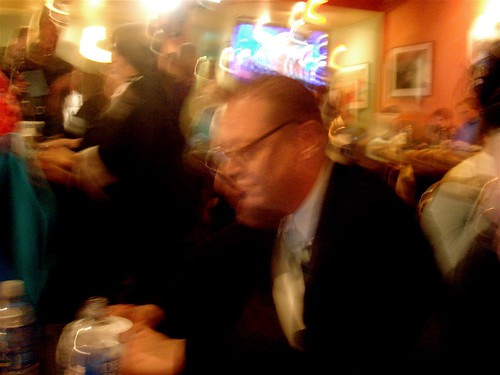
The crazy mix of dark and bright lighting blurred many of my photographs, giving them an expressionistic quality -- very James Ensor -- that reminds me now of how painterly my brain got last night:

Alex and Nick, blurred

TRex, blurred

To answer your question: I had only two small glasses of red wine.

Some folks were collecting Cosmopolitans while others -- notably Jeralyn Merritt here -- kept their writer's minds cooly centered in Language World:
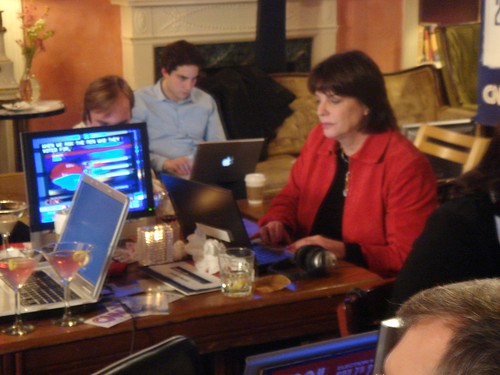
Jeralynn is super-calm

I know. You're thinking: Who are the foreheads? The left-most forehead is Atrios -- Duncan Black -- who seems like a sweet guy. I had a little conversation with him in which I told him he reminded me of Madison blogger Jeremy Freese and that comedian Tom Bodett. Duncan didn't know who either of those guys were. The Easter-Islandish forehead in the lower right corner? I can't tell you who that is. If that's you, claim your forehead. Otherwise it's the Forehead of the Unknown Blogger. And lord knows what fervid thoughts roil therein.

And who are the blurry guys, you may ask. Picture 1 is Alex Pareene of Wonkette, wearing his "no Wonkette" T-shirt and waving a filtered cigarette about, and Nick Gillespie, of Reason Magazine and Hit & Run, who entertained me with his opinions, like about how there are only a small handful of cities left in America that are not culturally defunct. Madison, Wisconsin was culturally vital once, back around 1968. But since then and forever into the future, nothing. Picture 2 is TRex, who wrote about me on his blog -- Firedoglake -- after I blogged a (clear) picture of him last night. He said:
Ann Althouse came by a few minutes ago and took photos of me and John Amato. Amato was nice to her. I just growled under my breath and kept typing.
Ha ha. That's what I expected from half the bloggers: just growling and keeping on typing. It was actually surprising how un-socially-awkward most bloggers are. But thanks to TRex for embodying the stereotype I'd had in mind.

November 6, 2006

"The most sophisticated right-wing reactionary to run on a Democratic ticket since Grover Cleveland."

It's Jim Webb!
Webb's trick is to adapt this history of white folk to the categories of contemporary multiculturalism. He turns liberalism's assumptions of ethnic grievance and victimization to the service of people who, in more conventional accounts, have themselves been seen as the victimizers. Webb rails against "the wielders of cultural power such as Hollywood, academia, and major media [who] chip away at the core principles that have defined the traditions and history of [Scots-Irish] people." And now his people are fighting back. "In a society obsessed with multicultural jealousies, those who cannot articulate their ethnic origins are doomed to a form of social and political isolation. My culture needs to rediscover itself, and in doing so to regain its power to shape the direction of America." Using diversity dogma to put the white man back on top--it is a marvelous inversion...

[T]he use of multiculturalism to advance the ethnic interests of white people, and the use of warrior rhetoric to discredit the Bush administration's war--might be extremely valuable to Democrats, if they knew what they were doing.

But that's never a safe bet. Webb's right-wing populism and the liberalism of today's Democratic party make for an abrasive fit...
Yes... but isn't that a good thing? I find myself rooting for Webb. I want to see what he will do to the Democrats, who are so deeply invested right now in what he might do for them.

November 5, 2006

"The most miserable, neurotic and obsessive collection of individuals he had ever met."

That's a description of the students at Georgetown Law School, attributed to Jim Webb (the Democratic candidate for Senator in Virginia). Here's the TimesSelect link to the David Brooks column where I found that.

It's a good column, describing Webb's attitudes:
He began to see an America riven by a social divide. On the one side were people like himself: tough, independent, hard-working traditionalists who know how to shoot, fight and endure; and on the other side were what he has at various times called the “drug-drenched,” “sex-enshrined” narcissists, who cower in their parochial elite enclaves and pass judgment on everybody else.

Webb named his son after Robert E. Lee, and wrote a book, “Born Fighting,” which is a full-throated defense of “Rednecks. Trailer-park trash. Racists. Cannon fodder. My ancestors. My people. Me.”...

“For the last 50 years,” he wrote in “Born Fighting,” “the Left has been doing everything in its power to sue them, legislate against their interests, mock them in the media, isolate them as idiosyncratic, and publicly humiliate their traditions. ...”

Jewish culture produces a lot of lawyers, Webb has argued, but Scots-Irish culture produces fighters, and he has spent his life defending the interests and values of these manly, individualistic, brawling populists. He’s criticized affirmative action and women in combat. He at one time opposed the Vietnam memorial, which seemed to rebuke the warrior virtues. “Watching the white phallus that is the Washington Monument piercing the air like a bayonet, you feel uplifted,” he said. But the “degrading ditch” of the Vietnam memorial seemed to do no such thing.
So why is Webb running as a Democrat?

Can you imagine how the Democrats would rake him over the coals for saying these things if he'd happened to run as a Republican? "Degrading ditch" as the opposite of a phallus? A "white phallus," no less. And you know what color the "degrading ditch" is. I don't have to spell out what they'd be saying about him. "My people"... "racists." Yeeze! And all those "miserable, neurotic" folks at Georgetown...

You might guess he chose to run as a Democrat precisely because if he'd run as a Republican, the Democrats would have destroyed him with material like this. But what's the next step? What happens if he wins? Per Brooks:
So the Democratic Congressional delegation that convenes next year will be different from the ones we’ve seen. It will feature ideologically and culturally diverse people who cannot be silenced or reduced to lockstep party loyalists...

[W]e may be about to learn if the party of Nancy Pelosi can make room for the Jim Webbs of the world. We’ve already learned that the party of George Bush and Tom DeLay did a terrible job making room for its own mavericks and moderates.
I can already hear the true-blue Democratic bloggers yelling: No fair! You see that we're about to win so you're staking your claim to our victory.

November 2, 2006

Fiction and politics.

In the Virginia Senate race, George Allen wanted us to see his opponent Jim Webb as some sort of deviant because of some images and characters he'd put in his novels. This inspires Victor Davis Hanson to muse about fiction and politics:
In this age of global, instant and technologically sophisticated communications, we are often left bewildered over what is true and what is made up. Cute postmodern sophistries asserting that ''there are no facts'' only make our confusion worse.

When Reuters published doctored photos from the recent war in Lebanon, unknowingly or not, they were disseminating computer-enhanced graphic art. That dark smoky sky over Beirut was not real photography. Recent journalistic exposés of the Iraqi war, such as Bob Woodward's State of Denial, might have been mistaken for histories. They aren't, since their footnotes reference the reader to anonymous sources that can't be verified.

And the problem isn't just that we are led to believe a film or book must be ''true'' when it is sometimes not. It's also that we often deliberately want to make something real that was never intended to be. Fury arose recently over the fictionalized docudrama ''The Path to 9/11.'' The charge was that it was not an accurate rendition of history, even though ABC issued multiple warnings of its fictionalized nature across our television screens.

And now we are supposed to believe that an imaginary story - and that is what a novel is - must be an accurate moral litmus test of its creator?
Hanson raises the question only to drop it. And he frames the question to make it more likely that we'll drop it too.

I wouldn't ask whether a novel is "an accurate moral litmus test" of its author, but whether it is useful evidence relevant to a question we want to think about. In the case of a political candidate who has written a novel, it might give us something to take into account even though it's not a specific and accurate test.

George Allen had an idea about the way to use his opponent's novels, but it wasn't a very good idea. The material wasn't strong enough to persuade us to think ill of Webb. In fact, it improved my opinion of Webb to learn that he'd written respectable novels and to see that he was an intelligent and thoughtful person who'd taken the time to think through his military experiences in the artist's mode. It also made me notice his military experience. And Allen ended up looking bad for extracting the sexy parts and making arguments that those passages did not support.

But we might imagine another case where a political candidate wrote novels that were quite bad and revealed shallow thinking and morbid obsessions and the opponent made crisp, fair arguments that helped us think about what kind of a person the author is.

We need to become adept at dealing with different kinds of materials, none of which are entirely true. Even an undoctored photograph frames a shot and represents the photographer's decision about what to include and exclude. Even a fully professional history or journalistic report structures the presentation and imposes editorial choice. We have wake up and think actively about how the creator of any image or text is trying to influence us, whether it's presented as fact, fiction, or something in between. And anything anyone makes says something about the person who made it. The trick is to get good at evaluating what it means and to become equally sensitive at detecting the distortions and manipulations of those who try to tell you how to evaluate it.

October 29, 2006

''The military was forced to pay a human cost for the country's caution..."

"... and then paid again with its prestige when some labeled the inevitable results of such limited activity 'military incompetence.' '' said Jim Webb, the Virginia Senate candidate.

But he didn't say that recently. That's a quote from a fascinating February 28, 1988 article that I found in the NYT archive. (You'll need TimesSelect for access.) Webb was Secretary of the Navy at the time.

I was looking for some more detail about what he'd said about women in the military and found it:
But Webb shattered his welcome at Annapolis in 1979 with a scathing article for Washingtonian magazine. Entitled ''Women Can't Fight,'' it was a traditionalist's diatribe against the admission three years earlier of women into the academy. The piece took a tone that could only offend women; he called Bancroft Hall, the school's single, mammoth dormitory, housing 300 women and 4,000 men, ''a horny woman's dream.''

''There is a place for women in our military, but not in combat,'' he wrote. ''And their presence at institutions dedicated to the preparation of men for combat command is poisoning that preparation.''

Webb's second novel, ''A Sense of Honor,'' set at Annapolis, stirred up more turmoil. It decried the Naval Academy's emasculation and defended the old style of masculine indoctrination and hazing that Webb and his classmates had known....

Webb's views on women came up in his confirmation hearings for the reserve affairs position, and, during his tenure as secretary, the Navy has been harshly criticized by Pentagon review boards for pervasive patterns of sexual harassment and discrimination.
But perhaps more significant than that is his thinking about the use of military force:
["Fields of Fire"] is so intensely personal that one can't help but turn to it for an exegesis of its author. What emerges is a portrait of a man who views all military missions through the prism of Vietnam.

Without question, this is the case when Webb considers the Persian Gulf. For him, the frigates and destroyers in the Gulf sometimes resemble the tanks and foot soldiers that slogged into ambush in rice paddies and jungles of Vietnam. ''It is something that I think about all the time in the Persian Gulf,'' he said recently, ''where we are dangled around like a target before the next step.''...

The problem he recalled from Vietnam was that American forces were not given free rein to fight a war. ''The military was forced to pay a human cost for the country's caution,'' said Webb, ''and then paid again with its prestige when some labeled the inevitable results of such limited activity 'military incompetence.' '' Once again, in the Gulf, more than geopolitical interest was at stake. It was the prestige of the military. It was also youthful lives and limbs.

''I have really been struggling with this,'' Webb said one evening last fall. He was nursing a beer in a darkened Virginia restaurant near the Pentagon. ''The danger,'' he said, ''is that we commit our forces in an operational environment, and then become paralyzed by the political debate that follows.'' When the first oil tanker under escort hit a mine in July, Webb escalated his activities. In a set of memorandums to then Defense Secretary Weinberger, Webb called into question some of the fundamental premises of the Reagan Administration's Gulf policy....

Vietnam was not the only historical analogy he saw. He was also troubled by the parallels to Beirut - where he had worked as a journalist in October 1983, winning an Emmy award for ''The MacNeil/Lehrer Report'' on his coverage of the terrorist bombing of the Marine barracks there.

''In Vietnam, the problem was not setting clear enough goals, so that we could shape our policy in the early years, and know where we were going,'' said Webb. ''In Beirut, it was injecting a military force and then paralyzing it. You just couldn't change anything because the debate was so strong at the top.''
The danger is that we commit our forces in an operational environment, and then become paralyzed by the political debate that follows.

Webb is clearly a very smart guy with a lot of nerve and many years of experience thinking about the right questions.

October 26, 2006

Judging a candidate by his fiction writing.

George Allen attacks Jim Webb for the tawdriness in his novels. The stuff is rather awful, but it does seem lame to go after fiction. Politicians who dabble in fiction writing usually throw in sex scenes, and these things nearly always look ridiculous out of context. But do the desire to write a sex scene and the failure to do a very good job of it say anything about a person's competence as a legislator? Maybe there's a shred of information in there with all the salaciousness. And it does provide the occasion to remind us of other bad sex written by politicians, like that dreadful thing Scooter Libby wrote about bears.

ADDED: Jim Webb's writing career is clearly more substantial than the usual "[p]oliticians who dabble in fiction writing." And the line involving the father and son -- shown out of context at the link -- is not part of a sexually titillating scene as I discovered by going to Amazon and use the search-inside-the-book function to see the line in context. Click on the comments for more discussion.

UPDATE: Webb explains the scene:
"It's not a sexual act," Webb told [radio host Mark] Plotkin regarding the "Lost Soldiers" excerpt. "I actually saw this happen in a slum in Bangkok when I was there as a journalist."

"The duty of a writer is to illuminate his surroundings," he added.

Coincidentally, a Cambodian woman in Las Vegas is facing sexual assault charges for performing a similar act on her young son, according to an Oct. 14 report in the Las Vegas Review-Journal.

The article quotes an office manager for the Cambodian Association of America, who described the act as a sign of respect or love.

"It's an exception," Thira Srey told the Review-Journal of the practice. According to the report, the act is usually performed by a mother or caretaker on a child who is one year old or younger. In Webb's novel, the child is four years old.