... but which way will it fall? Away from or into the telephone wire that it's half stuck on right now? Kind of a physics question. I think it depends on whether the branch: A. rips off instantly or B. tears off over the course of a second or 2.
May 28, 2016


At the Green Grass Café...

... you can talk about whatever you like, such as the near-perfection of your lawn or your love of the color green.
ADDED: Meade made that lawn and keeps it mowed with a Fiskars Staysharp Max Reel Mower that he loves so much he's out there mowing the lawn every day.
"Fix law schools’ diversity problem, NOW!"
Says Instapundit, referring to intellectual diversity and quoting a Scott Rasmussen piece that cites a James Lindgren study that shows 82% of lawprofs are Democrats and 11% — that many?! — are Republican. "Fewer than half" — that many?! — "are Christian."
I passed on blogging that Rasmussen piece when I noticed it yesterday, but I'm blogging it today because of Instapundit's reaction, which might ring clear to blog readers but is utterly (and, I assume, deliberately) obtuse from my perspective within the law academy.
I passed on blogging that Rasmussen piece when I noticed it yesterday, but I'm blogging it today because of Instapundit's reaction, which might ring clear to blog readers but is utterly (and, I assume, deliberately) obtuse from my perspective within the law academy.
WWII "was fought among the wealthiest and most powerful of nations. Their civilizations had given the world great cities and magnificent art."
"Their thinkers had advanced ideas of justice and harmony and truth. And yet the war grew out of the same base instinct for domination or conquest that had caused conflicts among the simplest tribes, an old pattern amplified by new capabilities and without new constraints."
Said Barack Obama at Hiroshima. I'm extracting that line for those who think Obama failed to blame the aggressors in that war.
This is a very processed speech. You have to look for the ways in which he is criticizing other cultures. It's hidden in the high-flown abstraction. For example, I read this as a criticism of the Islamic terrorism of today:
Said Barack Obama at Hiroshima. I'm extracting that line for those who think Obama failed to blame the aggressors in that war.
This is a very processed speech. You have to look for the ways in which he is criticizing other cultures. It's hidden in the high-flown abstraction. For example, I read this as a criticism of the Islamic terrorism of today:
Every great religion promises a pathway to love and peace and righteousness, and yet no religion has been spared from believers who have claimed their faith as a license to kill.
There are 2 serious books out right now about a man trying to live like a particular nonhuman animal.
These are nonfiction books, and they are being taken seriously. I read about them in Joshua Rothman's article in The New Yorker, "The Metamorphosis/What is it like to be an animal?"
Two men — Thomas Thwaites and Charles Foster — independently conceived of their projects. Thwaites, an artist, tried to be a goat and wrote about it in "GoatMan: How I Took a Holiday from Being Human," and Foster, a veterinarian/lawyer/columnist, tried to be a fox and a badger and wrote about it in "Being a Beast."
These projects were entirely different from fictional efforts at inhabiting the existence of a nonhuman animal, such as Tolstoy's "Strider" (about a horse) and James Joyce's "Ulysses" (with a bit about a rat). As Rothman sums those up:
Rothman ends his essay like this:
Two men — Thomas Thwaites and Charles Foster — independently conceived of their projects. Thwaites, an artist, tried to be a goat and wrote about it in "GoatMan: How I Took a Holiday from Being Human," and Foster, a veterinarian/lawyer/columnist, tried to be a fox and a badger and wrote about it in "Being a Beast."
These projects were entirely different from fictional efforts at inhabiting the existence of a nonhuman animal, such as Tolstoy's "Strider" (about a horse) and James Joyce's "Ulysses" (with a bit about a rat). As Rothman sums those up:
In these pastoral and sensual portrayals of the animal self, different critiques of the human self are embedded. For Tolstoy, the problem with people is that they’re marooned in their egos. The clearheaded directness of animals is a remedy for that self-obsession. For Joyce, the problem is that people are sleepy, numb, and incurious. We could learn, he thinks, from animals’ eager sensuality. Tolstoy’s animals teach us to be good; Joyce’s teach us to be alive.What Thwaites and Foster were doing was different from that: They were using the animal not to understand humanity but as an escape from something they already believed about human beings. Thwaites finds "human personhood... stressful, absurd, and—worst of all—narcissistic" and wants to lose his ego. Foster finds human personhood dull and seeks a more vivid existence.
Rothman ends his essay like this:
There is an irony to these books: the more Thwaites and Foster try to change into animals, the more fully they become Thwaites and Foster. That’s not to say they never transform themselves... “Real, lasting change is possible,” Foster writes, “to our appetites, our fears, and our views,” and despite that change the self persists. This ability to endure through change is the miracle and mystery of selfhood. Rethinking who we are; dreaming up new ways of living; taking ourselves apart to build ourselves back up—for human beings, these activities are natural. They are our never-ending hunt.That is, thinking beyond what is natural and trying being what you are not is even more human than continuing your conventional ways. A nonhuman animal would never even think of such a project, let alone attempt to execute it. And, that's why these projects are, on their own terms, incoherent. You're never less like a nonhuman animal than when you are trying to be a nonhuman animal. Only a human being would do such a thing.
NPR quotes Hispanic lawmakers saying Hillary Clinton needs to pick a VP with "sizzle."
With "sizzle" apparently meaning Hispanic.
I found that embarrassing. I know I'm perceiving and expressing that from my identity as a member of a non-sizzling ethnic group, but why is that kind of talk not considered unacceptable ethnic stereotyping?
The 2 lawmakers, both from the Congressional Hispanic Caucus, both talked about "sizzle" and the only specific person they were referring to was Labor Secretary Tom Perez. This guy:
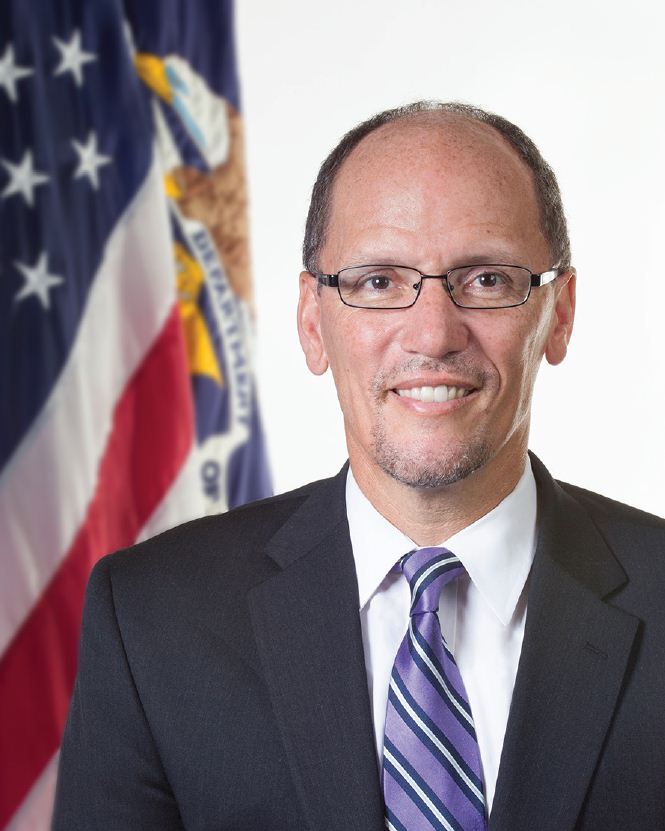
Nothing against the man, but there's no reason to look at him and think of "A hissing sound, esp. one produced by the action of frying or roasting; also, broiling heat." (That's the OED definition of "sizzle.")
I found that embarrassing. I know I'm perceiving and expressing that from my identity as a member of a non-sizzling ethnic group, but why is that kind of talk not considered unacceptable ethnic stereotyping?
The 2 lawmakers, both from the Congressional Hispanic Caucus, both talked about "sizzle" and the only specific person they were referring to was Labor Secretary Tom Perez. This guy:
Nothing against the man, but there's no reason to look at him and think of "A hissing sound, esp. one produced by the action of frying or roasting; also, broiling heat." (That's the OED definition of "sizzle.")
"[I]n countries like Germany, Switzerland, China, and Malaysia, smiling faces were rated as significantly more intelligent than non-smiling people."
"But in Japan, India, Iran, South Korea, and... Russia, the smiling faces were considered significantly less intelligent.... In countries such as India, Argentina, and the Maldives, meanwhile, smiling was associated with dishonesty...."
At the link — to "Why Some Cultures Frown on Smiling/Finally, an explanation for Bitchy Resting Face Nation" in The Atlantic — there are some charts arraying the countries from one extreme to the other.
I was explaining this out loud to Meade, and he sang: "If you smile at me, I will understand/'Cause that is something everybody everywhere except India does in the same language...."
At the link — to "Why Some Cultures Frown on Smiling/Finally, an explanation for Bitchy Resting Face Nation" in The Atlantic — there are some charts arraying the countries from one extreme to the other.
I was explaining this out loud to Meade, and he sang: "If you smile at me, I will understand/'Cause that is something everybody everywhere except India does in the same language...."
If you post a negative review of you doctor/dentist on Yelp, he might defend himself by revealing information about your case.
"One Washington state dentist turned the tables on a patient who blamed him for the loss of a molar: 'Due to your clenching and grinding habit, this is not the first molar tooth you have lost due to a fractured root,' he wrote. 'This tooth is no different.'"
WaPo reports.
WaPo reports.
Yelp has given ProPublica unprecedented access to its trove of public reviews -- more than 1.7 million in all -- allowing us to search them by keyword. Using a tool developed by the Department of Computer Science and Engineering at the NYU Tandon School of Engineering, we identified more than 3,500 one-star reviews (the lowest) in which patients mention privacy or HIPAA. In dozens of instances, responses to complaints about medical care turned into disputes over patient privacy....
Deven McGraw, the... deputy director of health information privacy [in the Office for Civil Rights within the U.S. Department of Health and Human Services], said health professionals responding to online reviews can speak generally about the way they treat patients but must have permission to discuss individual cases. Just because patients have rated their health provider publicly doesn’t give their health provider permission to rate them in return....
Christopher J. Scalia writes "Trump is a pragmatist, too. That’s the problem."
The son of Justice Scalia, who works at a PR firm in Washington, has this in The Washington Post:
“Whatever works” is the unofficial slogan of pragmatists. It also sounds a lot like Trump, who has promised to fix everything from health care to trade with China by making “great deals for this country.”...
Clinton invokes the term [pragmatism] to mean finding solutions based on her knowledge of, and her experience in, the political establishment. Trump, meanwhile, wants to tear down the establishment. In fact, because pragmatism implies impatience and frustration with the usual ways of doing business, it can involve breaking a system rather than working within it....
Obama, too, realizes that pragmatism doesn’t need to involve compromise. Perhaps the peak (or nadir) of the president’s pragmatism is his 2014 vow that he wouldn’t wait “for legislation in order to make sure that we’re providing Americans the kind of help that they need. I’ve got a pen, and I’ve got a phone.” The separation of powers is dusty dogma — git r done!...
[T]he word’s generally positive connotations could very well lend Trump that always-coveted air of gravitas, gilding his unpredictable and inconsistent ideas with a semblance of respectability and intellectual seriousness.ADDED: Reminds me of the way Justice Scalia used to take umbrage at Justice Breyer.
May 27, 2016
"Hinckley stocks up on cat food at PetSmart ($100 per visit); frequents Wendy’s, KFC, and Sweet Frog (he likes its yogurt)..."
"... and haunts used-record stores (recent purchases include David Bowie’s The Next Day). 'It can be boring at times,' he has said. Once, after seeing a Beatles cover band, Hinckley noted being turned off by Williamsburg’s 'conservative' crowd. At least one night per trip, Hinckley attends group therapy, including at a local chapter of the National Alliance on Mental Illness. His caseworker noted being 'floored' by Hinckley’s interest in the gatherings. 'It’s really refreshing to be in a group of people who aren’t completely out of their minds,' Hinckley once explained. 'Their mental-health problems are more like depression and anxiety. They can carry on regular conversations.' He described to a therapist how nicely he’d hit it off with one gentleman in particular: 'He’s my age. He has three cats. What else could I ask for?'"
Humanizing Hinckley — "How John Hinckley Lives Now."
The cat food is for the 2 dozen plus feral cats he feeds.
Humanizing Hinckley — "How John Hinckley Lives Now."
The cat food is for the 2 dozen plus feral cats he feeds.
"The populist uprisings on her left and her right seem almost designed to draw from Clinton a defense of the country itself..."
"... that its systems of aspiration and its commitment to civic duty are intact, that things are working. And yet, she has hesitated. Among voters doubt is deeply ingrained, and élites are broadly distrusted. Watching Clinton campaign this time I have often wondered, does she herself still believe? There is another way to put this, which is that the trouble for Hillary Clinton is not only that voters do not trust her. That only deepens and complicates her essential problem, which is that Americans do not trust."
The last lines of a New Yorker article by Benjamin Wallace-Wells titled "Does Hillary Clinton Still Believe?"
Worth clicking through if only for the photograph — of Hillary in 1992 with her father and mother. The difference in demeanor of the 2 parents toward their eminent daughter is almost humanizing.
The last lines of a New Yorker article by Benjamin Wallace-Wells titled "Does Hillary Clinton Still Believe?"
Worth clicking through if only for the photograph — of Hillary in 1992 with her father and mother. The difference in demeanor of the 2 parents toward their eminent daughter is almost humanizing.
"Chinese schoolkids climb a 2,625-foot cliffside ladder to get home."
"Every two weeks, when the students, ages 6 to 15, return from boarding school, they climb a chain of 17 bamboo ladders, secured to a sheer cliff face and leading some 2,625 feet up, according to reports. Locals say the ladders — which lead through treacherous terrain in the Liangshan Yi autonomous prefecture in Sichuan province — have been there nearly as long as the village...."
WaPo reports.
More here, with photos and video, in The Guardian:
WaPo reports.
More here, with photos and video, in The Guardian:
The photographs were taken by Chen Jie, an award-winning Beijing News photographer... “There is no doubt I was shocked by the scene I saw in front of me,” he wrote.... "It is very dangerous. You have to be 100% careful...If you have any kind of accident, you will fall straight into the abyss.”
"A constant stream of changes and scuffles are roiling Donald J. Trump’s campaign team..."
"... including the abrupt dismissal this week of his national political director. A sense of paranoia is growing among his campaign staff members, including some who have told associates they believe that their Trump Tower offices may be bugged," the NYT reports in "Donald Trump’s Campaign Stumbles as It Tries to Go Big."
My favorite part of this article is:
As long as I'm talking about Trump and dreams, here's Loudon Wainwright III with "I Had a Dream," which is about dreaming that Donald Trump is President:
I ran across that because I was looking for that quote from Donald Trump calling Bernie Sanders "a dream": "I'd love to debate Bernie, he's a dream."
My favorite part of this article is:
Asked for comment about his management style, and the current state of his campaign, Mr. Trump declined, criticizing the reporters writing this article. “You two wouldn’t know how to write a good story about me if you tried — dream on,” Mr. Trump said in an email relayed by his spokeswoman, Hope Hicks.The reporters in question are Ashley Parker and Maggie Haberman. Haberman has written 15 or so articles about Trump in the NYT in the last few days. Parker has written 5 or so. So I guess he has a basis for wanting to starve them of Trumpisms.
As long as I'm talking about Trump and dreams, here's Loudon Wainwright III with "I Had a Dream," which is about dreaming that Donald Trump is President:
I ran across that because I was looking for that quote from Donald Trump calling Bernie Sanders "a dream": "I'd love to debate Bernie, he's a dream."
"Elderly couple who cut wealthy neighbour's grass verge for 12 years given land in 'squatters' rights' ruling."
Adverse possession.... not in the U.S.... as you can tell by "verge."
"Women used warmer, gentler words in their status updates on Facebook compared to men, who were more likely to swear, express anger and use argumentative language..."
"... a study of 10 million postings released on Wednesday found."
The most commonly cited topics by women included words such as “wonderful,” “happy,” “birthday,” “daughter,” “baby,” “excited” and “thankful.” Women were more likely to discuss family and social life, relying on words that described positive emotions, such as “love,” and intensive adverbs, such as “sooo,” “sooooo,” and “ridiculously,” the study said.Of course, as I've observed enough over the years that some people call this the "Althouse rule": whatever is found to be true of the female will be presented as good. In this case, we get: "a male tendency toward objects and impersonal topics and a female tendency toward psychological and social processes." If the rule were flipped and the researchers felt the need to portray the male side as the good one, they could just as easily have written something like: a male tendency toward abstraction and principle and a female tendency toward emotionalism and pleasing others.
Men more frequently discussed topics related to money or work, and favored words tied to politics, sports, competition and activities, such as shooting guns or playing video games. Men commonly used words such as “freedom,” “liberty,” “win,” “lose,” “battle” and “enemy.”
“The differences were interpreted as reflecting a male tendency toward objects and impersonal topics and a female tendency toward psychological and social processes,” the report said.
Subscribe to:
Posts (Atom)


 Posts
Posts


