January 2, 2013

"A paparazzo hoping to get a picture of Justin Bieber in his Ferrari after the vehicle was pulled over by police in Los Angeles got struck and killed by an SUV instead."

"And as it turned out, the 18-year-old singer wasn't even in the sports car."

This seems to be an occasion for wheeling out that horrible old saying: He died doing what he loved. He thought he had Justin Bieber set up for a shot. The photographer was swelling with delight and then — blam — not from a Ferrari but an SUV. Let's hope he never knew what hit him — to coin a phrase — and never knew that Bieber wasn't even in that car. He died doing what he loved! He had his peak of paparazzi ecstasy and then... annihilation. A consummation. It's over.

But wait! Justin Bieber wants to speak:
"While I was not present nor directly involved with this tragic accident, my thoughts and prayers are with the family of the victim... Hopefully this tragedy will finally inspire meaningful legislation and whatever other necessary steps to protect the lives and safety of celebrities, police officers, innocent public bystanders, and the photographers themselves."
Oh, Justin. Not every screw-up is an argument for legislation. Putting "meaningful" in front of "legislation" is itself meaningful, but what does it mean? 1. It means meaninglessness, an empty existential cry in the face of helplessness. 2. It means I would like to soothe myself with the fantasy that if the right laws had been in place, the bad thing that just happened would not have happened. 3. It means that we can express meaning through laws, that laws work as expression, quite aside from whether they have any effect on the bad things we would like to call bad.

Now, should we also get on Bieber's case for calling what happened a "tragedy"?
Tragedy (Ancient Greek: τραγῳδία, tragōidia, "he-goat-song") is a form of drama based on human suffering that invokes in its audience an accompanying catharsis or pleasure in the viewing....
Pedants love to say that the word "tragedy" is misused, but I think we may have encountered a correct use of the word. That correct usage seems out of place with the rest of the statement, with its angst about prayer, inspiration, and meaning. One suspects Bieber bumbled into saying something he wouldn't have meant to say. It's meaning without a mind that meant it. We witness human suffering and feel... good!

ADDED: The more apt term is poetic justice — "a literary device in which virtue is ultimately rewarded or vice punished, often in modern literature by an ironic twist of fate intimately related to the character's own conduct." The key is the self-contained logic of the story. It makes sense. There should be no call for legislation to find meaning. The meaning is already there. What happened is exactly right: poetic justice. The Wikipedia page I just linked has some examples, and since we were just talking about Wile E. Coyote, I enjoyed seeing him first on the list of poetic justice in TV and film: "Wile E. Coyote always sets traps for Road Runner, only to end up in the traps themselves." The phrase "hoist with his own petard" expresses the concept. Did you know it's from "Hamlet":
"For 'tis the sport to have the engineer / Hoist with his own petard." (Shakespeare, Hamlet (III.iv.226).)
And did you know (again, from Wikipedia):
During the late 17th century, critics pursuing a neo-classical standard would criticize William Shakespeare in favor of Ben Jonson precisely on the grounds that Shakespeare's characters change during the course of the play.... When Restoration comedy, in particular, flouted poetic justice by rewarding libertines and punishing dull-witted moralists, there was a backlash in favor of drama, in particular, of more strict moral correspondence.

"Bitter ending for Montee Ball, who's bottled up by Stanford after break..."

"'Now I’m done,' he said in a somber UW locker room, 'so this stings a little bit more but I’m really looking forward to seeing this team be here next year.'"

"The Dirty Etymology of 9 Everyday Words."

"Oops, you just said: Pig’s vagina..."

Yes, yes, I know, fiscal cliff jumped back from.

We'd gone off, we were told yesterday, but somehow, from mid-air, we scrambled back. We were Wile E. Coyote out off the cliff, suspended, despite gravity, but unlike Wile E. Coyote, we already knew it, we'd been obsessing and blabbing about it for weeks. Unlike Wile E. Coyote, we didn't stay up because of ignorance of where we were and realization of where we were didn't make us plummet. We were somehow able to get back on the cliff, and it was exactly as if we'd never gone off the cliff.

It's almost as if there was never a cliff!

"Through this twilight universe Daisy began to move again with the season..."

"... suddenly she was again keeping half a dozen dates a day with half a dozen men, and drowsing asleep at dawn with the beads and chiffon of an evening dress tangled among dying orchids on the floor beside her bed."

We're sticking to sentences, here in our "Gatsby" project. I won't pretend not to know that Daisy is the main female character in the book, but for the purposes of this project, I'm disregarding what we know about her and where she might be in the plot line when this sentence appears. I'd like to follow a rule that excludes all extrinsic evidence, but the phrase "this twilight universe" shows why that rule may be too severe. Nevertheless, I'm going to stick with the no-extrinsic-evidence rule, and accept "this twilight universe" as a mystery. Daisy has been up to something in what is now being referred to as "this twilight universe," and there's something poignant about encountering someone — a flower-named woman — in a mysterious place where she has moved before and is beginning to move again.

January 1, 2013

The Clinton clot plot thickens... or thins... with anti-coagulants.

So we were just talking about the oddities of the Clinton clot story. We noted that no sooner was it said that Hillary Clinton would testify, as Secretary of State, on the Benghazi attack, than there came an announcement that Hillary Clinton had entered the hospital with a blood clot. The coincidence raised suspicions of an effort to engineer an evasion of this testimony.

And we weren't told where the clot was, which is a crucial bit of information when assessing how serious this health scare is. Clinton had recently suffered a head injury, which makes one think the new problem would also be located in the head, but she'd also had a blood clot in her leg years ago, which makes that alternative seem plausible. If the clot were in the leg, withholding that information suggests a strategic choice to incline the public to view the problem as  more serious than it really was.

Later, Clinton's doctors released a statement saying that the clot was in a vein inside her skull, and that she's "making excellent progress" and likely to "make a full recovery." The Washington Post repeats the information that she's being treated with anticoagulants. You may remember that the analysis I discussed at that first link contained the assertion that "anticoagulation is never given to persons with clots around the brain." But that WaPo story says: "The conventional treatment is an anticoagulant drug for at least six months."

I know some of my readers are doctors. Can you help us out with that inconsistency about the anticoagulants? [ADDED: Here's what Dr. Pogo says. And here's some useful detail. I think the crucial distinction is whether the clot is in the brain or in the space between the brain and the skull.]

And, by the way, I've gotten some pushback in email and on the web, saying that it was "shameful" and "appalling" for me to tie Clinton's health problems to a possible intent to avoid testifying about Benghazi. Let me tell you that a core motivation to my blogging — and I've been going at this for 9 years now — is to stand tough against people who try to cut off debate with this kind of shaming. So I'm glad that this performance of outrage was directed at me. I know it when I see it, and it fires me up. You want silence? You want backing down? You want me not to dare say a thing like that? That's how you want to control political debate in the United States? Thanks for reminding me once again how deeply I hate that and for giving me an (easy) opportunity to model courage for the more timid people out there who are cowed by the fear of shaming.

ADDED: Here's something I would dearly love to do with this blog: I want to make it so that emotive, intimidating outrage like that backfires. I want people to learn that they can't get away with empty assertions like "I am aghast" or "You are despicable." You have to give reasons for what you think. Even if you really feel those feelings. And, of course, many of these hack writers don't actually feel the feelings they scribble about. They just don't want to have to talk about the actual issue. They want to make it something that everyone feels they'd better not talk about. But that should be a loud signal: We need to talk about it!

And let's get back to basics: What we need to talk about is Benghazi.

Chief Justice Roberts informs Congress that the federal judiciary is scraping by on a mere $7 billion a year.

$7 billion! Why, if that were one person's entire fortune, he'd only be #50 on the Forbes list of richest Americans. He'd only just butt ahead of Charles Butt.

The Chief stressed the bargain we the people are getting:
“Yes,” he went on, “for each citizen’s tax dollar, only two-tenths of one penny goes toward funding the entire third branch of government!”

In the report, Chief Justice Roberts said the judiciary was doing what it could to cut costs in rent, salaries and computer services...

The federal courts went to great lengths last year in trying circumstances, notably after Hurricane Sandy. “As just one example,” he said, “the United States District Court for the Southern District of New York conducted emergency hearings in Lower Manhattan the day after the storm hit, working in a building without heat or hot water that was only sparsely lit by gas-fueled emergency generators.” Though Chief Justice Roberts did not say so, the Supreme Court also showed fortitude the day the storm hit, hearing arguments when the rest of official Washington was closed.
I could think of quite a few ways to economize on the federal courts — things Congress could do. The courts are forced to handle the cases that fall within their jurisdiction, but Congress could target litigation-generating laws for repeal.

ADDED: Another way to increase that "two-tenths of one penny" proportion would be to reduce spending on things that are not the judiciary.

Electronic devices on planes are dangerous...

... but not for the reason the FAA seems to want you to believe.
If progress [toward changing the rules] is slow, there will eventually be an episode on a plane in which someone is seriously harmed as a result of a device being on during takeoff. But it won’t be because the device is interfering with the plane’s systems. Instead, it will be because one passenger harms another, believing they are protecting the plane from a Kindle, which produces fewer electromagnetic emissions than a calculator.

"Baby break for Village 'bomb' gal/Brings life as cops find instruments of death."

A NY Post headline.

Bomb gal. That's rich. Not since "tot mom"...

At the New Morning Café...

Untitled

... so happy just to see you smile/underneath the sky of blue...

"Craigslist sperm donor forced to pay child support to lesbian couple - despite giving up parental rights to the baby BEFORE she was born."

How sympathetic are you to this man's argument?

Why should the father of a child ever be allowed to contract out of responsibility for it? If he is, why shouldn't the state control the extent to which this is permitted? Whatever you think of the mother, what about the child?

"DM, thank you for providing the map of Canberra. Were it not for that..."

"... I would have had trouble reconciling the city's layout with a man impaled on a bedpost."

A comment at The Daily Mail has the distinction of being the first thing that made me laugh out loud in 2013. (Please forgive me!)

"Under the agreement, tax rates would jump to 39.6 percent from 35 percent for individual incomes over $400,000 and couples over $450,000..."

"... while tax deductions and credits would start phasing out on incomes as low as $250,000, a clear win for President Obama, who campaigned on higher taxes for the wealthy."

Is that a "clear win"? Good lord, whatever happens, the NYT will spin it as a win for Obama. I thought his number was $250,000 for couples, and now, it's way up at $450,000. That should be called a clear compromise. How hard it must be for the Republicans to compromise, when even clear compromises are declared clear wins for the other side.

"Every Friday five crates of oranges and lemons arrived from a fruiterer in New York..."

"... every Monday these same oranges and lemons left his back door in a pyramid of pulpless halves."

I warned you I was going to do this. Come on. Play along. (And, no, I wasn't thinking about Andy Kaufman when I dreamed this up. It was all a riff on that Baz Luhrmann trailer for the new "Great Gatsby" movie.)

So, now, let's talk about oranges and lemons. The phrase "oranges and lemons" appears twice in the sentence, unchanged, even as the oranges and lemons themselves are changed. That's the whole action of the sentence, the transformation of oranges and lemons in one form into oranges and lemons in another form. Here they are on Friday, in crates, and here they are on Monday in "a pyramid." That is, they have become, in that alluded-to time period  — the weekend — a pile of garbage. But the pile is called "a pyramid," A pyramid! We're called upon to think of the grand erections of pharaohs, in comparison to crates from the lowly little character with the silly-sounding occupation "fruiterer."

Are the crates even stacked up? There's the absurd and obviously false notion that the fruit has been improved by whatever it was that went on in that house over the weekend. That absurdity calls upon us to think about the people who arrived and left, the people who ate all that fruit. But of course, they didn't eat it. They drank it. The pulp was extracted for use in alcoholic mixtures, and if the fruit emerged from the weekend as "pulpless halves," then, we may infer, so did the people. We don't hesitate to keep calling them human, yet we see the inaptness of calling the mere rinds "lemons and oranges." Even if you could conceptualize the big pile of rinds as a pyramid, you'd easily perceive it as garbage. Since that perception is easy, we have energy left to think about what is more difficult. Who are these people?

The History of Abkhazia.

"According to The Georgian Chronicles, the first inhabitants of what is now Abkhazia and the whole western Georgia were Egrosians, the descedants of Egros son of Togarmah, grandson of Japhet, son of Noah, who came from the land known as Arian-Kartli."


"... Abkhazia was conquered by Mithridates VI Eupator of Pontus between c. 110 and 63 BC, and then taken by the Roman commander Pompey."

"[T]he kingdoms of Abkhazia and Georgia [were united] into a single Georgian feudal state... reach[ing] the apex of its strength and prestige under the queen Tamar (1184–1213)."

"Towards the end of the 17th century, the principality of Abkhazia broke up into several fiefdoms, depriving many areas of any centralized authority. The region became a theatre of widespread slave trade and piracy. "

"In the Russian revolution of 1905, most Abkhaz remained largely loyal to the Russian rule, while Georgians tended to oppose it. As a reward for their allegiance, tsar Nicholas II officially forgave the Abkhaz for their opposition in the 19th century and removed their status of a 'guilty people' in 1907."

"On 24 October 2008 the railroad bridge of Shamgon-Tagiloni, connecting the city of Zugdidi in Georgia with the Abkhazian Gali district (populated mainly by Georgians) was destroyed. According to Georgian and French sources it was done by Russian army; Abkhazian sources maintained it was a Georgian diversion."

***

And so begins the new year project on this blog, which is to proceed, alphabetically, through the 206 countries of the world, and to read the "History of" page in Wikipedia. The idea is to have had it go through our head, at least once, something of what happened in each place. It is fitting that we start with Abkhazia, which may be an unfamiliar name. Much has happened there! It's touching to see that, to confront one's own persistent, nagging ignorance. But we are all fortunate to have woken up again this morning, still a human being on Planet Earth, and I want to perform a ritual — for the next 206 days — of adding a slight glimmer of awareness of those other human beings who live or who have lived over the long expanses of time and place.

***

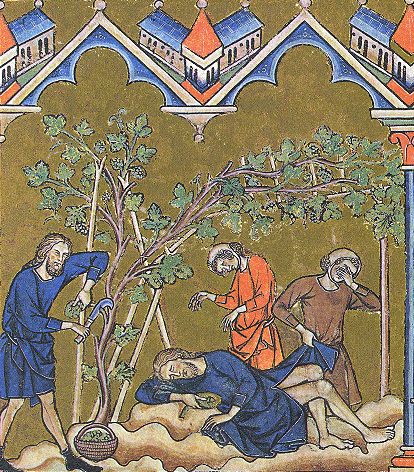
It's apt that we encounter Noah on New Year's Day, Noah being our earliest example of an individual overindulging in alcohol.


ADDED: I found a nice Flicker stream of photos from Abkhazia. I recommend beginning here — at Stalin's bathroom — and then clicking to the "newer"/"older" button to see more.

Happy New Year!

Are you up early, like me, or are you sleeping off last night's festivities? Personally, I don't get too revved up about the shift from one year-number to the next one. I think we live in days, and when life is good, normal days are the best, and the truth is, we live in days:


But if our lives are to have meaning, don't we need to knit those days together?


If we should take account on an annual basis — to put the Ann in annual — why should it be on this outwardly imposed occasion, this flip of the calendar from December to January?


"Yeah, I can get with that!"