Writes Nona Willis Aronowitz in "I Still Believe in the Power of Sexual Freedom" (NYT). The words that follow "neither did this new strain of feminism" are so convoluted and abstruse that I almost ended the quote with the Robin Morgan quote. But consider whether Robin Morgan said it better than anyone else as you read Willis Aronowitz's effort to say it was wrong. I'm beginning with the very next sentence, and quoting without ellipsis, because I want you to experience how weirdly impenetrable it is. Sorry to bias you, but I'm begging for help. I'm struggling to read it:
Showing posts with label Nona Willis Aronowitz. Show all posts
Showing posts with label Nona Willis Aronowitz. Show all posts
August 17, 2022
"As the righteous energy of #MeToo fades into a more ambiguous debate, we’ve reached a point where it’s become obvious that consent and figuring out what you don’t want..."
"... is just not enough. What does it mean to go beyond consent and discover what you do want?... Understanding our authentic desires has long been hopelessly stymied by politics.... 'Every woman here knows in her gut,' wrote the writer and anti-porn feminist Robin Morgan in 1978, 'that the emphasis on genital sexuality, objectification, promiscuity, emotional noninvolvement and coarse invulnerability was the male style and that we, as women, placed greater trust in love, sensuality, humor, tenderness, commitment.'
If male-centered ideas about sex hardly encouraged self-actualization, neither did this new strain of feminism."


August 9, 2022
"One lesson of feminism, surely, is that being like other women, rather than a shining unfettered exception, isn’t such a terrible thing."
Writes Michelle Goldberg reacting to this line in a 1981 essay by Nona Willis Aronowitz: "I secretly wanted monogamy, that I was just like every other woman who wanted to tie her man down."
The Goldberg column is titled "When Sexual Liberation Is Oppressive" (NYT).
She's bringing up a 1981 essay by Nona Willis Aronowitz, because Willis Aronowitz quoted herself in her new book "Bad Sex: Truth, Pleasure and an Unfinished Revolution."
Willis Aronowitz is the daughter of Ellen Willis, who was — as Goldberg puts it — a "pro-sex feminist writer."
Don't you have to choose what to put first, sex or feminism? If you set out to put them on equal footing, what do you get? I must be a feminist and I must be pro-sex.
March 7, 2019
"The collection contains Dworkin’s more outrageous assertions, the ones that repelled me as a young woman and concerned critics like my mom and other pro-sex feminists..."
"... that men need to forgo their 'precious erections' and 'make love as women do together.' That pornography 'incarnates male supremacy' and is 'the DNA of male dominance.' That all intercourse, while not literally rape, violates the integrity of a woman’s body, that women who want it are 'experiencing pleasure in their own inferiority.' What women really want, she argues, is 'a more diffuse and tender sexuality.' (Speak for yourself!) Her lens was dark as hell: 'We are very close to death,' she said in a speech about rape. 'All women are.'... In many ways, my views about feminism were shaped by the disagreement about the role of sex in women’s liberation, which morphed into the 'sex wars' of the late 1970s and 1980s — the 'anti-sex' feminists on one side, the 'pro-sex' feminists on the other... With the right to sexual pleasure safely a tenet of modern feminism, [Dworkin's] writing ... galvanizes me to dispense with likeability and embrace indignation.... Next to the vacant, rah-rah version of sex positivity I grew up with in the ’90s, Dworkin’s rage seems downright clear-eyed.... Last Days at Hot Slit is a mirror for what I’ve been afraid of for years: being defiant, being ugly, being unloved by men, even being unloved by other feminists like Andrea Dworkin."
From "Sex, Lies, and Andrea Dworkin" by Nona Willis Aronowitz (New York Magazine).
From "Sex, Lies, and Andrea Dworkin" by Nona Willis Aronowitz (New York Magazine).
February 17, 2019
"Dana Densmore, a founding member of the separatist group Cell 16, took issue with the idea that sex was a basic human need."
"In 1968 in a journal appropriately titled 'No More Fun and Games,' she wrote that 'guerrillas' had important things to do and couldn’t be sidetracked by sex, which was 'inconvenient, time-consuming, energy-draining and irrelevant.' Romantic love was a problem, too. Ti-Grace Atkinson, a radical feminist philosopher, positioned it as the enemy of independence and insecurity. 'What is love but need?' she wrote in 1968. 'What is love but fear?' Other early feminists weren’t against romance in a perfect world, but they reasoned that until conditions improved, heterosexual love was too tied to marriage and societal expectations of what it meant to be feminine. Shulamith Firestone, in her classic 1970 manifesto 'The Dialectic of Sex,' saw romance as 'a cultural tool of male power to keep women from knowing their conditions.'.... 'Why has all joy and excitement been concentrated, driven into one narrow, difficult-to-find alley of human experience?' Firestone wrote."
Writes Nona Willis Aronowitz in "Don’t Let Sex Distract You From the Revolution/Maybe the Second Wave celibates were on to something" (NYT). It's just by chance that crossed my bloggability line on the same day as the WaPo article "How Lady Gaga convinced me to give up dating — and finish my book" (link goes to my blog post) — other than that the newspapers might have been influenced by Valentine's Day.
Nona Willis Aronowitz, who is 34 years old, is the daughter of the radical feminist Ellen Willis, so take that into account. It's interesting to hear a relatively young person make sense of what the older generation had to say, and I'm struck by the shortsightedness of what she has to say about her own generation:
Writes Nona Willis Aronowitz in "Don’t Let Sex Distract You From the Revolution/Maybe the Second Wave celibates were on to something" (NYT). It's just by chance that crossed my bloggability line on the same day as the WaPo article "How Lady Gaga convinced me to give up dating — and finish my book" (link goes to my blog post) — other than that the newspapers might have been influenced by Valentine's Day.
Nona Willis Aronowitz, who is 34 years old, is the daughter of the radical feminist Ellen Willis, so take that into account. It's interesting to hear a relatively young person make sense of what the older generation had to say, and I'm struck by the shortsightedness of what she has to say about her own generation:
Ultimately, the pro-sex feminists won out. In this moment of feminist resurgence, no one is suggesting we stop having sex....Ultimately? There is no ultimately. Life goes on. And there is another generation after you. If you can see that "Maybe the Second Wave celibates were on to something," why are you confident that the war is over and the "pro-sex feminists" have won? Isn't the label "pro-sex" a little hollow and too proud of itself?
February 17, 2018
"To the extent that there is a generational divide, it may have to do with the fact that many older women are still wary about the internet, which leads them to not only miss the context of a longstanding feminist internet tradition of ironic misandry..."
"... but also to overlook the more nuanced chatter happening among younger women on social media and digital sites.... And yet most of the disagreement has to do with age-old ideas about sex, power and the function of social movements...
Writes Nona Willis Aronowitz in "The Feminist Pursuit of Good Sex" (NYT). Aronowitz is the daughter of Ellen Willis, "who in a 1981 essay in The Village Voice asked a question that now looms over #MeToo 40 years later: 'Is the Women’s Movement Pro-Sex?'"
Aronowitz says:
If only we could be more nuanced, maybe we could meet in the middle. But everybody's always only seeing the lack of nuance on the other side. You get the self-flatterer imperiously telling other people to compromise. But Aronowitz seems to be more of an onlooker, trying to mediate. I look at Memorandum's River and see there's no significant internet talk about her column. I look at the NYT's own "most-emailed," "most viewed," and even "recommended for you" lists and don't find it. Even with "Good Sex" in the title, it's not getting traction.
From the Wikipedia article on Ellen Willis:
The question are feminists pro-sex? becomes — with nuance —are feminists pro-good-sex? The easy answer then is yes, but we're left with the difficult question is how to find good sex when her own daughter edits out Ellen Willis's word "lust"?
ADDED: To be fair, Aronowitz does, in her first paragraph, call herself "lusty," but she's speaking of herself in the past and "before I’d learned much about feminism." She was, she says, "fascinated by what we now call the 1970s 'golden era' of pornography... Being a lusty, modern woman, I was enthralled."
But "lusty" doesn't mean "lustful." It means merry and cheerful or hearty and vigorous. "The Turk... gave him two or three lusty kicks on the seat of honour," wrote Edmund Burke in his memoir.
The word that means "Full of, imbued with, or characterized by, lust or unlawful desires; pertaining to, marked by, or manifesting sensual desire; libidinous" (OED) is "lustful."
Writes Nona Willis Aronowitz in "The Feminist Pursuit of Good Sex" (NYT). Aronowitz is the daughter of Ellen Willis, "who in a 1981 essay in The Village Voice asked a question that now looms over #MeToo 40 years later: 'Is the Women’s Movement Pro-Sex?'"
Aronowitz says:
My connection to this complex intellectual heritage is at the heart of why I find the prevailing narrative about #MeToo’s generational split baffling and harmful. Here’s how the story goes: Older critics, flattened into “Second Wave feminist has-beens,” are accusing the movement of becoming increasingly anti-sex, anti-agency and anti-nuance. Younger women, also known as “Twitter feminists,” are accusing these critics of being bitter establishmentarians, unable to cede ground to new ideas. They’re both wrong, but so is this tired mothers-and-daughters framing, which threatens to derail substantive debate in favor of a catfight narrative.I note the assertion that both sides are missing nuance. The older women think the younger ones are "increasingly anti-sex, anti-agency and anti-nuance." And the younger ones think the older ones don't follow "the more nuanced chatter" of the internet so they don't grok "the feminist internet tradition of ironic misandry."
If only we could be more nuanced, maybe we could meet in the middle. But everybody's always only seeing the lack of nuance on the other side. You get the self-flatterer imperiously telling other people to compromise. But Aronowitz seems to be more of an onlooker, trying to mediate. I look at Memorandum's River and see there's no significant internet talk about her column. I look at the NYT's own "most-emailed," "most viewed," and even "recommended for you" lists and don't find it. Even with "Good Sex" in the title, it's not getting traction.
From the Wikipedia article on Ellen Willis:
Willis was known for her feminist politics and was a member of New York Radical Women and subsequently co-founder in early 1969 with Shulamith Firestone of the radical feminist group Redstockings.... Starting in 1979, Willis wrote a number of essays that were highly critical of anti-pornography feminism, criticizing it for what she saw as its sexual puritanism and moral authoritarianism, as well as its threat to free speech. These essays were among the earliest expressions of feminist opposition to the anti-pornography movement in what became known as the feminist sex wars. Her 1981 essay, Lust Horizons: Is the Women's Movement Pro-Sex? is the origin of the term, "pro-sex feminism."Is anyone celebrating the seriousness of pleasure anymore? Even Nona Willis-Aronowitz — seemingly dedicated to her mother's legacy — left off the "Lust Horizons" part of the title of that 1981 essay. She calls it simply "Is the Women’s Movement Pro-Sex?" — perhaps because few readers get the reference to "Lost Horizon" these days...
Willis was the first popular music critic for The New Yorker, between 1968 and 1975... In 2011, the first collection of Willis’s music reviews and essays, Out of the Vinyl Deeps (University of Minnesota Press), arrived. It was edited by her daughter Nona Willis-Aronowitz. Ellen Willis "celebrated the seriousness of pleasure and relished the pleasure of thinking seriously," a review in The New York Times said.
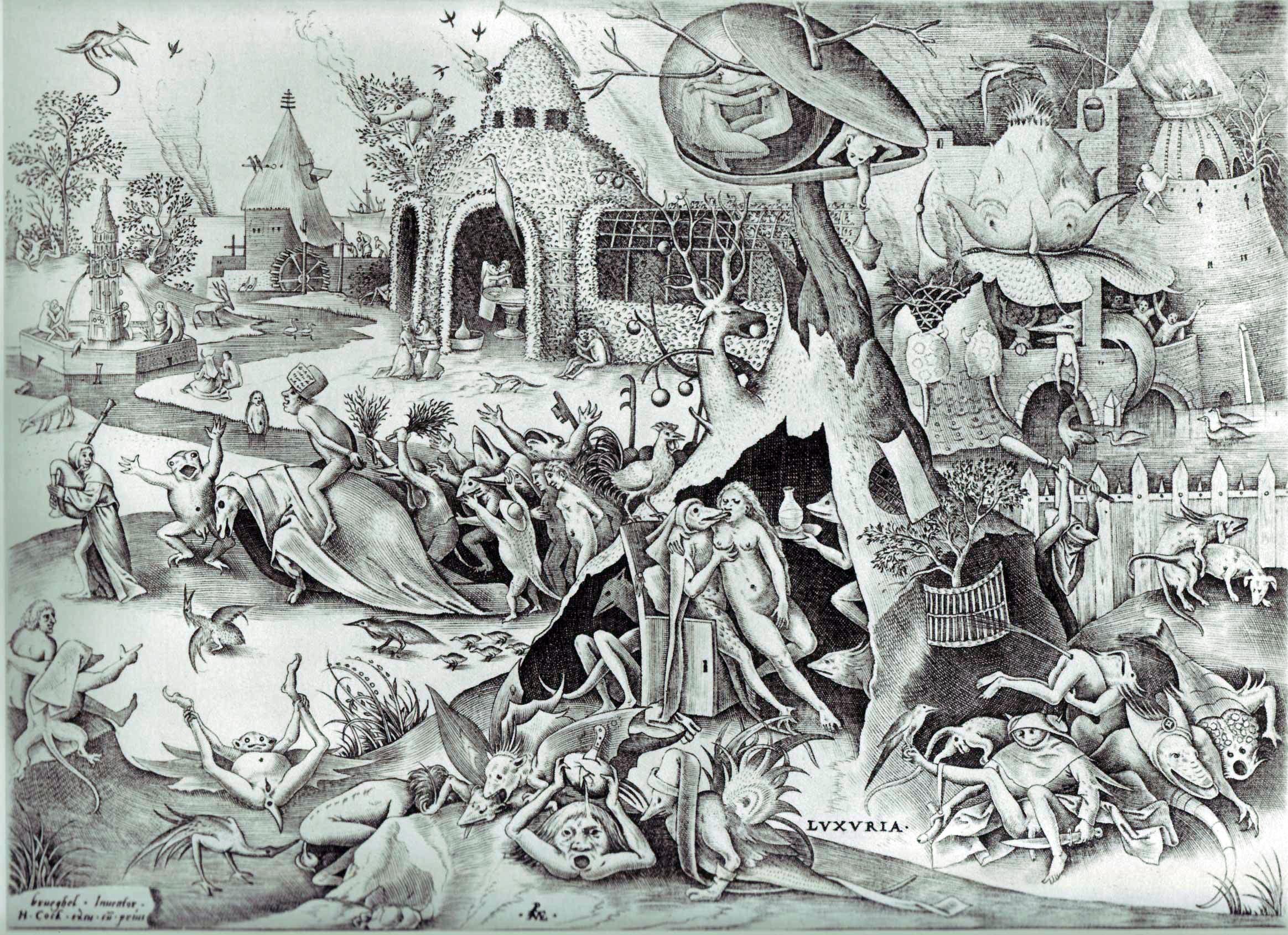
... but I think it's because "lust" — a popular and positive word in the 1970s — has become ugly again — returned to its stature as one of "The 7 Deadly Sins"....

The question are feminists pro-sex? becomes — with nuance —are feminists pro-good-sex? The easy answer then is yes, but we're left with the difficult question is how to find good sex when her own daughter edits out Ellen Willis's word "lust"?
ADDED: To be fair, Aronowitz does, in her first paragraph, call herself "lusty," but she's speaking of herself in the past and "before I’d learned much about feminism." She was, she says, "fascinated by what we now call the 1970s 'golden era' of pornography... Being a lusty, modern woman, I was enthralled."
But "lusty" doesn't mean "lustful." It means merry and cheerful or hearty and vigorous. "The Turk... gave him two or three lusty kicks on the seat of honour," wrote Edmund Burke in his memoir.
The word that means "Full of, imbued with, or characterized by, lust or unlawful desires; pertaining to, marked by, or manifesting sensual desire; libidinous" (OED) is "lustful."
Subscribe to:
Comments (Atom)


 Posts
Posts


