From "The Mary Wollstonecraft Monument in London Is Bad Kitsch Feminism" Jerry Saltz (New York Magazine). For more on the specific sculpture, listen to yesterday's podcast or read — and look at the pictures in — this post of mine. Saltz calls the sculpture "solemn, shallow, feebleminded, and homely" — and "a whirl of metal with a naked genie popping out of the top — strangely and inappropriately ejaculatory."
Showing posts with label Jerry Saltz. Show all posts
Showing posts with label Jerry Saltz. Show all posts
November 12, 2020
"Shall I be mean about British art? Okay. Realism and literature haunts almost all British art."
"I surmise that the capacious feel for language, narrative, and drama that seems to be inculcated in the British brain causes a lot of British art to fall into clever commentary, agitprop, or academicism — or be pulled back into realism. Great Britain’s is a primarily literary art; this doesn’t work well visually. I further surmise that abstraction is not foremost in the British mind. So much for my silly xenophobia. The real answer for why most public sculpture is bad — and why this keeps happening with art, much architecture, and too many governments — is bureaucracy and populism and the rule of the common denominator, a need to not offend, to please, to be liked (at least by the people making the choice), to be popular, and to not change. It defaults to the 'traditional values' of whatever white hegemony dominated that culture 150 years ago — at the apex of American and European colonialism. When it comes to public sculpture, this usually means hackneyed figurative art that claims to signify or represent an idea or person but really only represents lazy and regressive ideas."


March 26, 2019
Is it foolish to think this painting of union workers killing strikebreakers expresses something about homosexuality?
I'm reading ""Modern Art Critic Assumes 1939 Painting Is All About Homophobia. It's About Murderous Union Thugs."/Paul Cadmus's Herrin Massacre is 'The Painting Our Art Critic Can't Stop Thinking About.' If only he'd thought harder" by Robby Soave (in Reason).
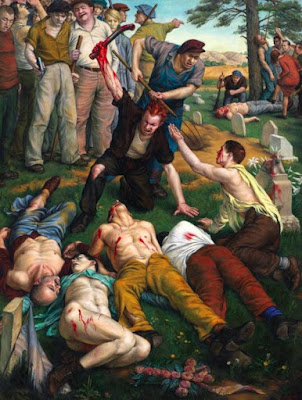
The art critic, a Pulitzer Prize winner, is Jerry Saltz. To be fair, he's looking at a painting that was included in a show called "The Young and Evil," which is (as Saltz puts it) "on the homosexual body in America as rendered by gay and bisexual artists from 1929 to 1957." Saltz is clear that "The actual event pictured was a 1922 massacre of strikebreakers by laborers that left 23 dead in an Illinois mining town." I don't think Saltz is confused about what the painting depicts and why the murders happened. It's just that it's a painting by a man who was gay (or bisexual), and it highlights male bodies, and it was included in the "Young and Evil" show. Saltz doesn't say the actual murders had to do with homophobia. He only says it shows "American violence, secular fundamentalism, crazed crowds, execution, martyrdom, the starvation of the spirit, and a complete lack of amazing grace."
Who knows what Cadmus really intended to express? Cadmus was commissioned by Life Magazine, but he got to pick the historical moment he depicted. He could have chosen this scene because he thought of it as a picture of some other kind of murder, and he could have chosen in because, as Soave concedes, it let him paint a bunch of beautiful reclining male bodies in a state of physical extremity. Who know what is in the artist's mind? And any viewer of the painting can meditate on these things without being a fool. Soave would like to forefront union thuggery, but Saltz doesn't have to, and the people who put the "Young and Evil" show together also obviously didn't.
Let's think about all the great historical paintings that hang in museums. Are they really about the specific event they depict or are they often about something else entirely? And where does the reality lie? In the mind of the dead artist? The painting matters and is on the wall now because it has some capacity to live in our own minds. And there are so many murder scenes in paintings that are, it seems to me, really about fleshly sensuality. And that includes some of those Crucifixion paintings.
The Herrin massacre had nothing to do with homophobia; it was a labor dispute that ended with union workers massacring a bunch of people who had been hired to replace them....Gay content? By that standard, all the paintings of the Crucifixion have gay content.
This is a fascinating chapter in the history of American labor, and one that we don't often revisit. For modern progressives, unions are generally the good guys—an important branch in the tree of intersectionality. (Though they occasionally cause trouble. Trump attracted some union support.) Cadmus reminds us that they could be thuggish; in his painting, he portrays the unionists as ugly, sullen, drunken, murderous brutes.
It's not that the painting is devoid of gay content—the victims are shirtless and ripped—but to portray it as an obvious metaphor for anti-gay violence is to insert modern grievances where they don't belong....

The art critic, a Pulitzer Prize winner, is Jerry Saltz. To be fair, he's looking at a painting that was included in a show called "The Young and Evil," which is (as Saltz puts it) "on the homosexual body in America as rendered by gay and bisexual artists from 1929 to 1957." Saltz is clear that "The actual event pictured was a 1922 massacre of strikebreakers by laborers that left 23 dead in an Illinois mining town." I don't think Saltz is confused about what the painting depicts and why the murders happened. It's just that it's a painting by a man who was gay (or bisexual), and it highlights male bodies, and it was included in the "Young and Evil" show. Saltz doesn't say the actual murders had to do with homophobia. He only says it shows "American violence, secular fundamentalism, crazed crowds, execution, martyrdom, the starvation of the spirit, and a complete lack of amazing grace."
Who knows what Cadmus really intended to express? Cadmus was commissioned by Life Magazine, but he got to pick the historical moment he depicted. He could have chosen this scene because he thought of it as a picture of some other kind of murder, and he could have chosen in because, as Soave concedes, it let him paint a bunch of beautiful reclining male bodies in a state of physical extremity. Who know what is in the artist's mind? And any viewer of the painting can meditate on these things without being a fool. Soave would like to forefront union thuggery, but Saltz doesn't have to, and the people who put the "Young and Evil" show together also obviously didn't.
Let's think about all the great historical paintings that hang in museums. Are they really about the specific event they depict or are they often about something else entirely? And where does the reality lie? In the mind of the dead artist? The painting matters and is on the wall now because it has some capacity to live in our own minds. And there are so many murder scenes in paintings that are, it seems to me, really about fleshly sensuality. And that includes some of those Crucifixion paintings.
Subscribe to:
Posts (Atom)


 Posts
Posts


