
... continues beyond the door onto the wall and around the corner.
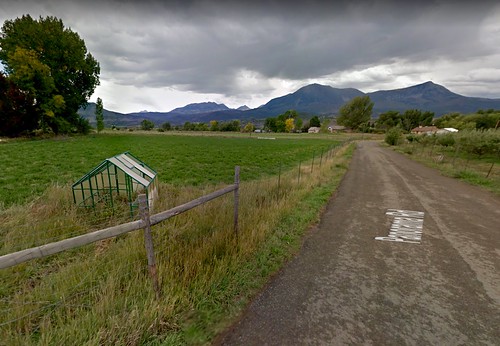
I framed the image from a Google street view in Alicante, Spain.



A writer with a playlist of culture heroes must also have a list of the undeserving, the fake, and the fallen, and [Michael Robbins, in "Equipment for Living: On Poetry and Pop Music."] does not disappoint us. He writes of the poet James Wright, “It is easy to feel that, if fetal alcohol syndrome could write poetry, it would write this poetry.” He suggests that Robert Hass “has made a career out of flattering middlebrow sensibilities with cheap mystery.” Of Charles Simic: “If the worst are full of passionate intensity, Simic would seem to be in the clear.”I don't know what you think of that writing in Smith's tribute to Shepard, but I think there are about 13 contractions in that short essay. If I were in the mood to imitate Smith's lofty, arty style, I'd blithely, slyly drift from talking about contractions of the 2-words-are-one-word type to an earnest metaphor involving the contractions of childbirth. But I'm just about never in that mood. I'm more in the mood to look up "the sleeping lion of Lucerne" and see if I can get it in Google Street View.
He calls Simon and Garfunkel’s “The Sound of Silence” “wimpy crap.” He says that Patti Smith’s memoir “Just Kids” is “highly acclaimed despite her apparent belief that serious writing is principally a matter of avoiding contractions.” His reaction to Neil Young’s memoir is “It’s depressing to learn that one of your heroes writes like a composition student aiming for the earnest tone of a public service announcement.”


In the early hours of Sunday (3:45 a.m.), July 23, 1967, Detroit police officers raided the unlicensed weekend drinking club in the office of the United Community League for Civic Action, above the Economy Printing Company, at 9125 12th Street. They expected a few revelers inside, but instead found a party of 82 blacks celebrating the return of two local GIs from the Vietnam War. The police decided to arrest everyone present. While they were arranging for transportation, a sizable crowd of onlookers gathered on the street. Later, in a memoir, Walter Scott III, a doorman whose father was running the raided blind pig, took responsibility for starting the riot by inciting the crowd and throwing a bottle at a police officer.


A sign outside the cemetery asks people not to mow. City officials want to keep the native wildflowers and prairie grasses on the graves like they would have been during the Civil War. The area is an official designated natural area and the municipality wants to keep it that way. But a Veterans group thinks the vegetation shows neglect. In April WISN 12 News reported on how The Sons of Union Veterans of the Civil War is suing the city for not taking care of the graves.Here's an article from back in April about the lawsuit:
Under Wisconsin law, veterans' graves must "receive proper and decent care" from cemetery owners. The lawsuit filed in Waukesha County Circuit Court Tuesday is seeking a declaratory judgment on whether the way Muskego is caring for the cemetery is proper and decent....
"We'd like them to clean it up and honor these veterans' graves. [Homer Clark and Jonathan W. Smiley] died in battle. Their bodies were embalmed and shipped back home and buried there and we believe this is a desecration of their graves," [said Bob Koenecke, [leader of the Wind Lake chapter of Sons of Union Veterans]....
Muskego has never mowed the grass at the cemetery since taking it over in the mid-1960s; the land is considered a natural area that features Big Bluestem Prairie Grass, Indiangrass, Culver's Root, White Wild Indigo and Shooting Star wildflowers, Muskego city forester Tom Zagar said. To move the plants to another green area in the city would not be the same because it's a remnant prairie and not reconstructed prairie....
"It's unfortunate that they couldn't understand the important context of the historic vegetation around them. To wear the uniform was a tribute, the guns were a tribute, (and) we felt the plants were a tribute," [Muskego city forester Tom] Zagar said.


 quite randomly. I'm intending to look around, but it's uncanny how often I love the very first thing I see.


 Posts


