Showing posts with label Bob Dole. Show all posts

April 27, 2023

I'm thinking of quoting one of the Bobs — Dole or Dylan — for the title of this post I've been trying all morning to write.

Bob Dole:

Where's the outrage?

Bob Dylan:

An’ here I sit so patiently
Waiting to find out what price
You have to pay to get out of
Going through all these things twice

March 6, 2020

Trump is 73, the same age Bob Dole was in 1996, when he was treated as absurdly old, and Trump's Democratic opponents are 4 or 5 years older than that.

Do you remember the age issue as it was presented in 1996?


Bill Clinton handled that elegantly, skirting outright ageism and attacking the ideas as old.

A NYT column "Still Running/Is Age-Bashing Any Way to Beat Bob Dole?" from May 5, 1996 noted that indirect approach — "coded partisan formulations" — but also the direct attacks:
[T]he old-guy bashing of Mr. Dole in political cartoons and late-night comedy routines has reached an intensity that makes the jokes about Ronald Reagan in the 1980's seem like gentle kidding. Dole age jokes ("Dole is 96") are now as much a part of popular culture as gibes at Madonna's impending motherhood, and sometimes as mean-spirited.

"Bob Dole is calling himself an optimist," David Letterman said in a recent monologue. "I understand this because a lot of people would look at a glass as half empty. Bob Dole looks at the glass and says, 'What a great place to put my teeth.' "

May 1, 2018

How can you ask "Where's the outrage?" without harking back to Bob Dole.

I'm seeing an opinion piece in The Washington Post with the headline "Trump was outrageous in Michigan. So where’s the outrage?" and it doesn't mention Bob Dole, who used to be famous for asking "Where's the outrage?" Answer Bob Dole first, and then it might make sense to ask the question about Trump.

On October 25, 1996:
So they gathered up their FBI files, they took them down to the White House, and there they've been. They say, "Oh, nobody looks at these. We just brought them over to see what the boxes look like," you know, whatever. And what happens? Where's the outrage in the media? Where's the outrage? There's no outrage. There's no outrage.
And October 26, 1996:
.... A lot of you people in the audience may not know about there are FBI files. That doesn't mean you've done anything wrong. You have an FBI file. What about the 900 people, innocent people, just because they're Republicans, had their files taken away [audio gap]. They tricked the FBI. They tricked the Secret Service. They took them to the White House, and then they said, oh, nobody ever looked at them. We just brought them down here, I guess, to look at the boxes. Well, I know that Mrs. Yeutter's file was in that group. Here's one right here. Nice innocent person. Her only crime was being a Republican. Now, that will not happen in a Dole White House. That is an outrage. That is an outrage.... How long do you think the American people are going to take it? Wake up, America. Wake up, America! Wake up, America!...  What would happen if any Republican president would have done two of these things? Why, there'd be outrage all across America. There would be outrage....
But we have a Republican President now, so where's the outrage? There's plenty of it in the media, but media people want more, because we have a Republican President now. But the people are sleeping through it. Wake up, America! Wake up, America! Why won't America wake up, WaPo wonders. America is sleeping because it has outrage fatigue. I'm too tired myself to do anything more at this point than show you my Google search results:
ADDED: Here's Howard Fineman in Newsweek on November 3, 1996:
Last week [Dole] was King Lear in a Brooks Brothers suit. Old grudges surfaced, and new ones. His predicament was the liberal media's fault. "The country belongs to the people, not The New York Times,'' he thundered in Dallas. Democrats were "rushing'' immigrants with criminal backgrounds onto the voter rolls. "They want to get them ready for Election Day,'' Dole said. Society was at fault for ignoring the ever-lengthening list of ethical and legal questions surrounding Clinton. "Where's the outrage in America?'' Dole demanded in Houston. "Where's the outrage?''
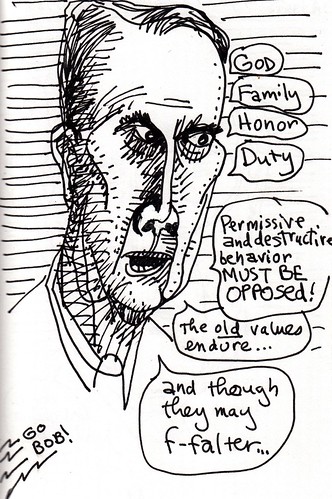
December 7, 2016

"Former Senator Bob Dole, acting as a foreign agent for the government of Taiwan..."

"... worked behind the scenes over the past six months to establish high-level contact between Taiwanese officials and President-elect Donald J. Trump’s staff, an outreach effort that culminated last week in an unorthodox telephone call between Mr. Trump and Taiwan’s president."

First sentence of NYT article "Bob Dole Worked Behind the Scenes on Trump-Taiwan Call."

June 26, 2016

The return of the Pelikan.

"Wonderful chunky bottle. I shall be keeping it long after the ink has been drunk."

Says a commenter at the Amazon page for No-Shellac India Black Fountain Pen Ink, and it does look good, judging from the bottle.

But it's a touchy business, looking for a serious, dark black ink that will work in a fountain pen. I'm seeing a wellspring of positive opinion for Noodler's Black Waterproof Fountain Pen Ink. And then there's Pelikan Drawing Ink, #518 Black Fount India, which calls out to me because of that name, Pelikan, which that's what got me searching for ink in the first place: I was thinking about that Pelikan fountain pen that I lost 30 years ago.

I'd used that pen to take notes and doodle in the margins throughout law school, 1978-1981....

Image-9F961AEC3E1911D9

Maybe I wouldn't have scored so high on so many law school exams if I hadn't inscribed my scattered thoughts with such powerful ink. If I'd written in Bic ball-point or Flair felt-tip like so many others, maybe I wouldn't have been able to launch myself into lawprofessordom.

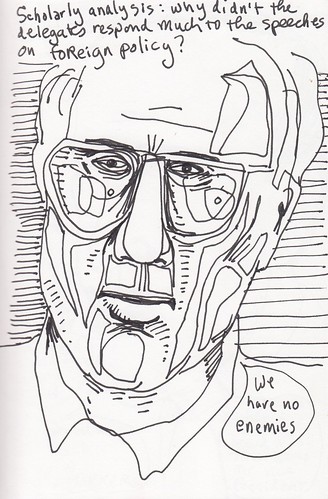
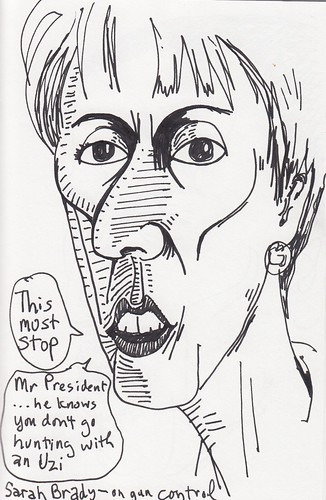
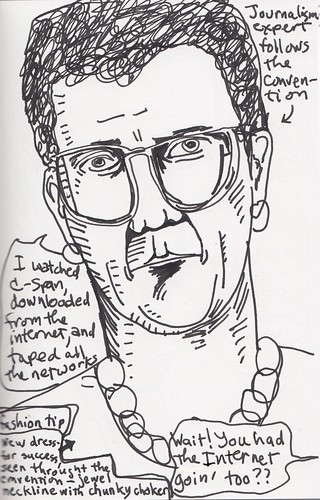
Admitting I'd lost that empowering Pelikan, I went to the University Bookstore, which had a glass case full of pens. I chose a Mont Blanc pen that (like the old Pelikan) had a 14k gold nib. It never flowed quite the same way, but for a while it handled the thick India ink. It got me through Amsterdam. And it worked for the 1996 political conventions:

Scan 45Scan 42
Scan 44Scan 43

Those were different times. Different... and the same. An expert could observe that the delegates didn't respond much to foreign policy because "We have no enemies." An interviewer could be surprised that a journalism expert watched not only C-SPAN and the networks, but had the Internet going too. And yet Democrats were railing about guns in terms of military-style weapons and the only decent use being hunting, and Republicans wanted to intone a list of traditional values.

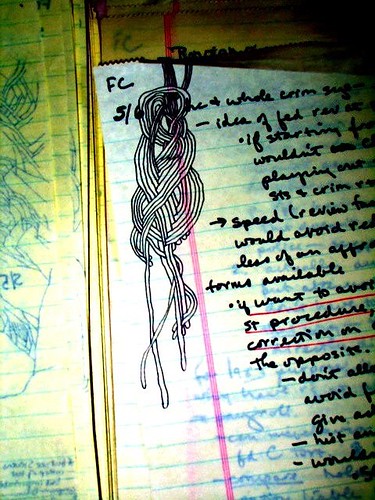
But the Mont Blanc got draggy after a few years of India ink. The whole point of the fountain pen was to transcend friction while leaving a super-solid line, to make it as easy as possible for you your hand and, simultaneously, your eyes. I wanted that feeling of ease. I wanted the Pelikan I had in law school! I switched to disposable India ink felt-tip pens. Those scraped over the surface of the paper in such a horrible cloddy way that it pains me to look at the notebooks I made with them, like this image of a bust of Voltaire, seen at the Louvre (and blogged before, with complaints about the pen):


I'd forgotten — and that old post reminds me — that I did later buy another Pelikan pen and then, immediately lost it. It was hard not to believe it would turn up, and then, gradually to shift into thinking I only deserved a good fountain pen if I could find that one, which is surely somewhere in the house. Then I got to blogging and digital photography and paid less and less attention to not drawing as a problem.

And yet, today, I was walking along the lake path — my favorite walk — thinking about leaving lawprofessordom — Altexit — and thoughts of the Pelikan returned to my mind. Why shouldn't I buy a new Pelikan? It's easy enough to find on Amazon. No need to go peering into glass cases minded by sales clerks who don't really want to talk about 14k gold nibs and fountain India with someone who cares too much about such things. I ordered the pen. I ordered the ink. I've got plenty of incomplete notebooks.

October 5, 2015

Obama bombed a hospital.

Where is the outrage?

ADDED: At the link, which goes to my son John's Facebook page, I said: "Imagine if Bush had done this." And John said: "We don't have to imagine..." and linked to a NYT article from 2008: "Evidence Points to Civilian Toll in Afghan Raid."

From Amy Davidson at The New Yorker: "Five Questions About the Bombing of a Hospital in Kunduz":
What did the Afghan forces want us to bomb? This is the fundamental issue: Was the hospital the target, or was the target something or someone “in the vicinity”?...
Why didn’t the bombing stop? It went on for an hour, in multiple waves, although [Doctors Without Borders, which runs the hospital] has said that it immediately called contacts in Afghanistan, Washington, D.C., and wherever else it could think of—it is used to operating in war zones, and has the phone numbers for calls like that—to try to get the attack stopped. Who was on the other end of the line? Did those interlocutors make further calls, to Afghans or Americans? General Campbell, asked by reporters if the Pentagon knew about the calls, said that it was a question for investigators. But, in this instance, the matter of communications gets to questions larger than logistics, such as... Do we understand our allies’ motives and priorities in Afghanistan?
ALSO: My phrase "Where is the outrage?" sounds like a stock phrase with a particular reference point, but what? Meade says it's from the 1996 presidential campaign. Bob Dole said it:
Sounding like a crusader, Bob Dole implored his audiences today to ''rise up'' against the nation's news organizations, which he said were protecting the Clinton Administration, and be outraged that President Clinton had, in Mr. Dole's words, violated the public trust....

Listing a string of questionable practices by the Administration, including accepting what he called laundered cash from foreigners and obtaining confidential F.B.I. files, Mr. Dole demanded repeatedly in Houston earlier in the day, ''Where is the outrage?''

Appearing at downtown performing arts center, where he stood before a giant mural depicting the glory days of the Lone Star State, Mr. Dole continued: ''Can you imagine former President Bush doing one of those things? No! And you never imagine Bob Dole doing one of those things either. So where's the outrage? Where's the outrage? When will the voters start to focus?''

September 18, 2015

Using makeup to create the look that you've been up all night engaging in dissolute behavior.

"It’s a look you get from being out all night, sweating — without looking too undone."
To achieve that perennial party-girl look, Nars kept skin clean of foundation and concealer, instead opting for a touch of greasy shine at the eyes, cheekbones and under the eyes. (“Vaseline is the best,” he said.) With a touch of shadow, he added some darkness under the eyes for a messy, day-after makeup effect....
This is the sort of thing that keeps coming back because it's something only young people can do, and anything "young" will always seem like an option. It made me think of the big "heroin chic" trend of the mid-90s ("a look... characterized by... dark circles underneath the eyes... emaciated features and androgyny... a reaction against the 'healthy' and vibrant look of models such as Cindy Crawford and Claudia Schiffer.") I was already reading the NYT, so I searched the NYT archive for "heroin chic" and came up with a Maureen Dowd column from 1996 — from the height of the presidential campaign:
In this fast-paced, channel-surfing, gigabyte blur of a world, Bob Dole wants to slow things down. Way down.... Mr. Dole presents himself as the avatar of a better time, a time of moral rectitude, unlocked doors, clean movies and Glenn Miller...

[H]e decried ''Pulp Fiction,'' though he hasn't seen it, and ''Trainspotting,'' though he hasn't seen it, for encouraging ''the romance of heroin." ''A fascination with risk and death,'' he said, denouncing heroin chic. ''The attraction of self-destruction -- if you can believe it.''
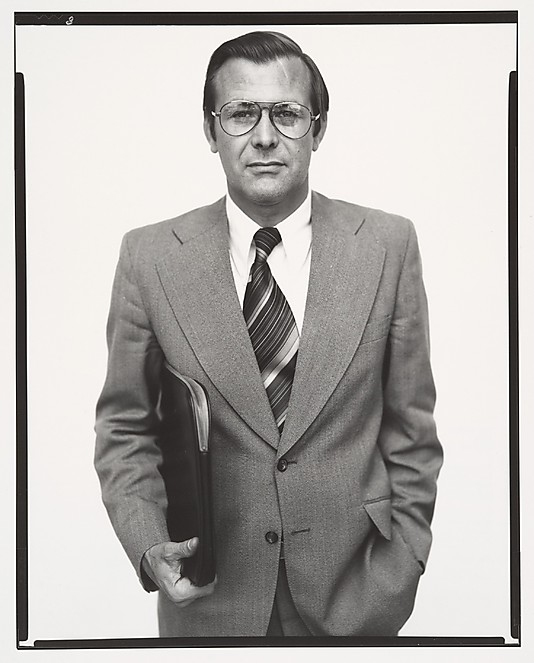
Dole was portrayed at the time as hopelessly old, a veritable corpse. Oddly, it's 19 years later, and the man is still alive (and joking about running for President).

ADDED: I'm seeing a connection between this and the earlier post today quoting 70s-era feminist Susan Brownmiller cautioning women about drinking too much and getting "trapped in sex situations."

November 4, 2014

Greg Orman explains the clown/clown car distinction to Bob Dole.

"I want to assure you that this is not true" — that Orman did not call the 91-year-old Kansan patriarch a clown — "and is not my opinion of you in any way, shape or form. My reference to a 'clown car' was commenting on the near-endless number of political supporters of Senator [Pat] Roberts who have piled out of Washington to support him, none of whom I think are clowns. I certainly wasn't calling you - or any of the others supporting Senator Roberts - a 'clown.'"

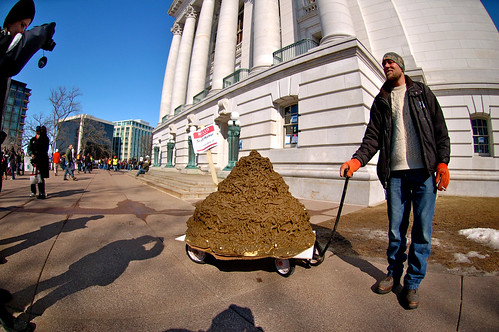
For some reason, this makes me want to show you this photo I took back in March 2011:

DSC_0084

Originally blogged under the title: "Everybody wants to take a photo of a man wheeling the large pile of shit that has a 'Hello My Name Is Scott Walker' sign stuck in it." I'm thinking of saying something like: There, it's clear that the man means to say, Scott Walker is shit. He's not simply a man riding in on a shit wagon. He is a pile of shit, being wheeled around on a small vehicle that may or may not be specifically purposed as a shit wagon. And even if that were a shit wagon, it wouldn't mean that if any given person were to take a ride on the shit wagon, that would make him shit. When you take a hay ride on a hay wagon, that doesn't make you hay.

But then, who rides in a clown car other than clowns? And what makes a car a clown car aside from its being full of clowns? There's no specifically purposed vehicle known as a clown car. It's just a Volkswagen Beetle or some other such small car.

Now, I do get Orman's point. "Clown car" was a funny way to refer to a seemingly endless supply of surrogates that the GOP sent into Kansas to help Roberts, and there is something ludicrous about a candidate who depends too heavily on surrogates. So there's deniability. But, come on, Orman called Bob Dole a clown.  He handed Roberts a gift there, he knows it, and he had to walk it back. Ludicrously.

IN THE COMMENTS: CWJ said "Althouse, The candidate's name is Greg Orman not Gary." Corrected. Thanks. I must have confused him with Gary Oldman.


AND: Rejham said: "'Greg Orman, not Gary.' Ha! Gary Orman was great on Laugh-in though..." Oh, yeah. Gary Owens...

May 18, 2014

"The Clintons are now saying how dare you bring up health and age, and they were doing it with abandon in 1996."

Said Karl Rove, referring to how the GOP candidate Bob Dole was treated. But all of Rove's examples are sneaky references to age, like choosing photos of Dole looking particularly old or calling his speech "tired, old, worn-out rhetoric." That's not bringing up health and age "with abandon."

Where's the direct statement from "the Clintons" saying Bob Dole is old? I know that was the message at the time, and it was, in fact, very successfully conveyed.

Rove needs to be accurate or he just makes himself an easy target. Maybe he's drawing fire on purpose here, but he's got a good point to make, and then he overstates it and looks like a liar. Is that something he's in control of — looking like a liar even when he's essentially telling the truth — or is that something he does with abandon?

May 13, 2014

"Karl Rove has deceived the country for years, but there are no words for this level of lying... [Hillary] is 100 per cent. Period."

A Hillary spokesperson reacts to Karl Rove's planting of doubts about the soundness of Hillary's brain. Here's what Rove said:
"Thirty days in the hospital? And when she reappears, she’s wearing glasses that are only for people who have traumatic brain injury? We need to know what’s up with that."
I notice how overstated the reaction is — "no words for this level of lying"? What part is the lie? Was Rove wrong about the number of days in the hospital? (I think he was.) Clearly, she came out wearing some special glasses. Was Rove wrong in his characterization of the glasses? (Maybe not.) Certainly, it's fair to state that the public (and the prospective donors) need accurate facts about a presidential candidate's health. That is always demanded, and we've been misled by candidates in the past. (I'm thinking of Paul Tsongas.)

The overreaction makes me suspicious that there really is a problem. I don't like this how-dare-you-even-ask attitude. It makes me skeptical. But I do understand the alternative explanation: Stir up the base with stimulating outrage and a reminder that one ought to hate Karl Rove.

Here's a 1992 column by William Safire, puzzling over the case of Paul Tsongas:

January 16, 2014

Political locution of the week: "continuity election."

NYT columnist Charles M. Blow uses the term "continuity election" 3 times in his new column, which I've discussed at length in the previous post. On first use, he says:
There are two kinds of presidential elections: change elections and continuity elections. For many of those who see 2016 as a change election, finding an anti-Obama may seem quite appealing, and Christie fits that bill in style and tone.
Obama is "polished and professorial," while Christie is "brash and blunt." Blow doesn't mention it, but Obama's key word in 2008 was "change" (along with "hope") and a lot of people who thought George W. Bush was brash and blunt felt good about the idea of undoing the Bushiness with Obama-style politesse. Enough yang. We need yin. For 2016, do we need yang again? Do we want another "change election"? Or is more yin the thing? That would be a "continuity election."

June 12, 2013

"[I]t’s time to move beyond the political style of the baby boom generation."

"This is a style... that is highly moralistic and personal, dividing people between who is good and who is bad."

That's David Brooks on October 19, 2006, paraphrasing Obama and encouraging him to run for President. It's a paraphrase of what Obama wrote in the then-just-out "Audacity of Hope" and something he'd said to Brooks in an interview.

Look at the contradiction even in those 2 sentences that Brooks put together to promote Obama. Obama would like to "move beyond" the politics that divides people into good and bad, even as he draws a line of division and portrays the Baby Boomers as bad.

I'm searching the text of "The Audacity of Hope" to see what Obama wrote about Baby Boomers. There are 2 mentions. First, at page 50:

May 26, 2013

What Bob Dole thinks of Barack Obama.

"He's a great... golfer. Very articulate, I think. As a president, he lacks communication skills with his own party, let alone the Republican Party.."

That was on "Fox News Sunday" today. I've repunctuated the quote to convey the humor that comes across in the audio.

September 16, 2012

The dance craze says Obama will win.

Last time we had a dance craze like Gangnam Style — check out Psy in Times Square — it was 1996:
In the United States, the song, and its corresponding Macarena dance, became popular during the same week as the 1996 Democratic National Convention. The song was frequently played between activities, and large groups of delegates and other attendants would be seen doing the Macarena dance. The song and dance became such a part of the convention that Vice President Al Gore, having a reputation for stiffness, made a joke about doing the Macarena dance during his speech. He asked, "Would you like to see my Macarena dance?" He remained motionless for a few seconds, then asked, "Would you like to see it again?"
I tried to find that Gore thing on YouTube, but I only found this:


When the Macarena was the craze, the President was reelected. He beat Bob Dole, whose tagline was "Where's the outrage?" And the answer was "Heeeeey Macarena AAAhAA!" The Democrats danced their way through the convention, and the old man asking for outrage was so out of step with the times.

August 21, 2012

When's the last time the worse looking of the 2 major party candidates won the Presidency?

A question I raise in the comments to this morning's body fat post.

Here's a list of all the candidates through American history. I'd say the answer to my question is 1976. But Jimmy Carter had a big smile that people responded to, and Ford had reached the presidency via Richard Nixon, who was quite unattractive, and people saw Nixon through Ford. That is, I could wriggle out of conceding that the "last time" was as recently as 1976. But what's the point? We get stopped at the next notch, 1972. Nixon was distinctly less pretty than George McGovern. Nixon was also less pretty than Hubert Humphrey in 1968, not that Humphrey was at all cute. 1964 was also a clear case of the uglier guy winning, LBJ being perhaps the ugliest President ever, and Barry Goldwater looking quite good. One more step back and we get to 1960, the strongest case I remember seeing beauty boosting a candidate across the line. And everyone talked about it (and still talks about it).

It's interesting that after that 1960 beauty contest, we got our spate of the uglier candidate winning. Why? The ugliest man ascended to the Presidency after the assassination of the handsome idol, and it was not odd that he was elected shortly thereafter. It took almost 20 years for us to revert to choosing the handsomer man, but ever since — more than 3 decades — we've chosen beauty.

This year, the GOP has made a strong choice in the beauty contest. It's not clear who's handsomer. Of course, it's clear if we average in the VP component, but the VP beauty boost is an iffy proposition. It didn't work — at least not enough — for John McCain or John Kerry. But I'm thinking if only Gerald Ford had picked someone prettier than Bob Dole....

August 22, 2004

The return of Bob Dole.

No sooner does the Boston Globe invoke the name of Bob Dole in a carefully constructed editorial against the Swift Boat Veterans than the old man himself rises up and speaks for himself--in a few short devastating words:
"One day he's saying that we were shooting civilians, cutting off their ears, cutting off their heads, throwing away his medals or his ribbons," Dole said. "The next day he's standing there, 'I want to be president because I'm a Vietnam veteran. "Maybe he should apologize to all the other 2.5 million veterans who served. He wasn't the only one in Vietnam," said Dole, whose World War II wounds left him without the use of his right arm. Dole added: "And here's, you know, a good guy, a good friend. I respect his record. But three Purple Hearts and never bled that I know of. I mean, they're all superficial wounds. Three Purple Hearts and you're out."

What is to stop this story from being the central story of the Presidential campaign? The Kerry camp has relied heavily on expressing indignation and outrage that the issue ever was raised, on pointing to old questions about Bush's military record, and on fussing over who connected to the ad is connected to someone with a connection to Bush, but this hardly seems capable of pulling the candidate out of the quicksand. It's distressing that the candidate did not take this foreseeable problem seriously. Dole's remarks today (on "Late Edition") included the fact that he warned Kerry that he was going "too far" with his use of Vietnam. How could the Kerry people have blinded themselves to the risks they were taking? 

UPDATE: Thanks to Instapundit and Lucianne.com for linking. They both answer that last question of mine the same way ("Groupthink"/"Koolaid will do that"). I have some additional comments on Kerry's response to the ads here.