 Write about whatever you like in the comments. I really missed comments yesterday! So glad to have them back. I know readers are still there, but it really means something to me to see your words.
"a mind is not really a house, but's a close alternative, sort of an alt-house"
Write about whatever you like in the comments. I really missed comments yesterday! So glad to have them back. I know readers are still there, but it really means something to me to see your words.

 Posts
Posts
Posts
Posts


170 comments:
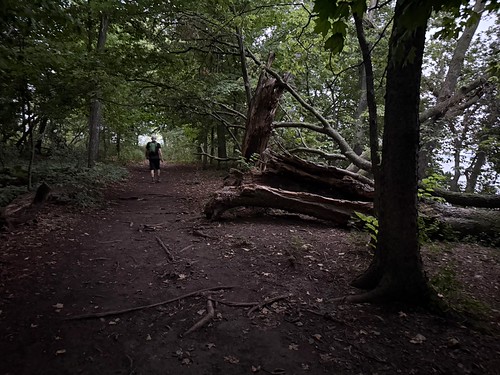
That downed tree -- here in the Ann Arbor area, there are a mess of them from storms that came thru the area yesterday mid-day. Power still out in many places.
We've still got a lot of fallen timber lining the streets here from the nasty storm a few weeks ago, and some side streets blocked by downed wires.
Re comments, it's funny how much their absence, and my inability to make them, affect my mood.
Taking our Labor Day week in Santa Fe, off to the desert tomorrow. Even drove by the Santa Fe burning man, Zozobra. Lots of people and alcohol. Like Madison. Now they project faces on him as he screams in agony as he burns. I guess a Spanish thing. The Name means Mr. Gloom.
I’m three miles north of the Detroit city limit. The weather was scary for about two days but it’s perfect now.
In Santa Fe there is a Loretta Chapel where some nuns prayed a Novia in 1877 and an unknown man came and built a spiral staircase to the choir with pegs and no nails and left without payment, and they assumed he was St Joseph the Carpenter. This leads to Sidney Poitier and the Lillies of the Field movie which was filmed in Tucson at a ranch owned by Linda Rhondstadt’s father in 1963. Her grandfather Federico Ronstadt had a huge ranch in the area.
Greatest Western? Shane followed by The Outlaw Josey Wales
Linda Ronstadt and Jerry Brown had a well-known romantic relationship in the late 1970s, when Brown was governor of California and Ronstadt was one of the biggest singers in the country. They dated for several years but never married.
Jerry Browns Great Grandfather had a 4 square mile ranch 75 miles north of Sacramento in 1877. So old ranch money gets you somewhere.
Do you remember when Althouse deliberately turned off comments? Pepperidge Farms does.
One of the best movie lines ever. Captain Terrell referring to Josey Wales: “Not a hard man to track. Leaves dead men wherever he goes.”
“Political Junkie said...
Greatest Western? Shane followed by The Outlaw Josey Wales“
You have to do that by categories, there is no best. Overall I think “The Searchers” does it all, but there are epics, “How the West Was Won.” For modern ones, “The Magnificent Seven”. And of course “The Ballad of Buster Scruggs.” Wales was good for the poor grittiness. There was a lot of good tv, Bonanza, Rawhide, Paladin, Maverick.
"Greatest Western? Shane followed by The Outlaw Josey Wales"
I agree 100% with Shane, a beautiful, meaningful film. The next greatest would be The Good, The Bad, and The Ugly. Clint, Lee Van Cleef, and Eli Wallach in an epic with so many great lines and quips.
"When it's time to shoot, shoot. Don't talk."
"There are two kinds of spurs in the world: Those that come in through the door, and those that come in through the window."
"Sorry, Shorty."
I have my eye on the pacific ocean .
https://zoom.earth/maps/satellite/
I"m enjoying another blog discussing how pickup truck drivers give the "truck wave" to other pickup trucks, but over the road drivers with serious trucks only acknowledge certain types of trucks.
Seems a little cloudy - a little dreary. But then summer is gone in a couple weeks. And then its hello fall. or "Autumn" to pompous assholes.
Greatest Western? You make the call. But I can tell two that aren't. McCabe and Mrs. Miller and The Searchers. One is a Western for people who don't like westerns. And the other - the Searchers - is hyped because its about "Racism".
If I had to choose, maybe "My darling Clementine" by Ford. Or the "the far country" with jimmy stewart. Or...the Good bad the ugly. Or... I could name 10 others.
Rio.Bravo, Near the climax, Stumpy brings the dynamite. Wayne has Martin’s Dude throw the sticks while Wayne shoots them in midair. The exchange is:
Chance: “Can you throw?”
Dude: “Near as far as you can shoot.”
Chance: “We’ll find out.”
Best western? My favorites are "High Noon" and "Stagecoach".
Since I enjoyed "Thin Red Line" and "From here to eternity" by James Jones, I'm currently reading "Some came running". Like "Eternity" its a monster of a novel. Jones really loved to sling the words. I don't could've gotten through "Eternity" without listening to it on audio. And the same is true of "Some came running".
Jones was a bit of a tragic figure. "The greatest generation ever". In the army in 39 and wounded on Guadacanal and also where he caught malaria. Best selling author in 52, then dead in 1977 after a battle with heart disease. Too many cigs, cigars, and booze.
Unlike "Hem" he wasn't a alcoholic, just a heavy drinker. A victim of the glamorization of smoking and booze. And bad medical advice. When his french doctor first diagnoised (sic) heart disase he recommened Jones cut back his drinking and smoking to a "healthy level" aka 1 bottle of wine at lunch and dinner and 6 cigars a day!
"Some came running" is good novel but its nothing like the movie. And God do the characters drink. Even the women who are supposed to be the "sober" "responsible" ones are tossing back 3 martinis or 3 beers every meal.
“the Searchers - is hyped because its about "Racism".”
According to a film site:
“ Lucy Edwards, the older sister, is abducted during the Comanche raid and later killed. The film strongly implies she was sexually assaulted, though it is not shown or stated explicitly.
Debbie Edwards, the younger girl, is taken alive and kept for years among the Comanche. When Ethan finally finds her, she is living with Scar’s band and is presented as one of Scar’s wives/captives.”
I don’t know if the racism is to Amerinds or against.
Once you know anything about 19th century weaponry then “The Searchers”’ is a non-starter. The fight at the river takes place not long after the Civil War. The ranchers should be using cap and ball revolvers, Spencer carbines, Henry rifles, Winchester model 1866 rifles (which use brass receivers and.not the blued steel of the 1873 model), and breech loading cavalry carbines like the Smith or the Sharps. In the River fight Jeffrey Hunter uses a revolver not commercially available until after 1873., and John Wayne uses a Winchester model 1894 which was not commercially available until — I’ll let you guess.
Well if the left can't kill children, they can always return to the usual party platform of abusing them for kinks:
https://roanoke.com/news/state-regional/crime-courts/article_3f6392f7-639a-50a8-9fd8-5e7d09ea99e4.html
Hey KKKakkk- is there anyone on your side who ISN'T a child molester/rapist/terrorist/(child)murder/pedophile/grifter???
The Searchers is all about John Wayne wanting to kill "Debbie" at the end because she'd become "an Injun" and then changing his mind. Racism is why the elite are always "hyping it".
Its why it was made in the late 50s. Its all part of Hollywoods desire to attack racism and push for civil rights. First it was "Why are we against those nice Hispanics?" then it was "Why are we against those nice Asians?" and finally "What about the blacks?"
Nothing wrong with attacking racism. But it doesn't make it a great western - let alone the best one.
“ Once you know anything about 19th century weaponry then “The Searchers”’ is a non-starter.”
Yes, true, and Clint Eastwood put .45 long cartridges in an 1851 colt navy revolver in his movie, which was a powder and ball pistol. So movie prop men are not smart, meh.
At the heart of "The Searchers" is race war. Comanche v. Whites. That's only part of the Western story. A small part.
Pretty much every good western had Walter Brennan in it.
Ok RC apply your filters, but the Searchers was a great movie.
I enjoy High Noon. Coop and Grace Kelly. But complete crap as history. No western town would've cowered behind closed doors to let some thugs kill the sherrif and take over the town. All those guy back then were Civil war vets, or they'd fought the Indians.
When Jesse James and the Younger Gang tried to rob a bank in some small town they got shot to hell by the locals.
I think the author of the screenplay was thinking of Joe McCarthy and Brooklyn.
"Do you remember when Althouse deliberately turned off comments? Pepperidge Farms does."
Have to admit, crossed my mind.
I have come to respect and admire John Ford movies a great deal more in my old age. One of his underknown westerns is a movie called Wagon Master.
https://en.wikipedia.org/wiki/Wagon_Master
It's about a couple of cowhands hired to lead a wagon train of Mormons to Utah. An excellent movie with all the elements of Ford's best films.
My favorite role for Walter Brennan was “Sgt. York” where he was the TN preacher who sang “Old Time Religon” and guided York to Gods.
"Do you remember when Althouse deliberately turned off comments? Pepperidge Farms does."
A soul who has been in crisis does not benefit from torment.
Favorite Westerns:
Tombstone
For a Few Dollars More
Favorite westerns: duel in the sun and the big country. Gregory peck in Both— the baddie in duel, but back to his usual honorable persona in the big country.
I also love any Jimmy stewart western, with his horse Pie. The man who shot liberty valence is stupendous.
Shout out to whichever commenter recommended That Thing You Do the other night. Great movie! Thanks !
Walter Brennan's squeaky voice came from a dose of mustard gas he received in France, WWI. He dabbled in real estate before turning to acting.
For more modern ones, The Unforgiven. Any top 5 list has to have at least 3 Eastwood movies.
Favorite Josey Wales lines:
'...Josey Wales: That's how it goes. When I get to likin' someone, they ain't around long.
Chief Lone Watie: I notice when you get to DIS-likin' someone they ain't around for long, neither.
James Jones spent at least some time recovering at the Kennedy General Hospital in Memphis, which he called Luxor in his fiction.
Some of the redneck bars he drank in were still around in the early ;70s I think.
A good movie tells a story you want to hear of a few people in an arc of time and place.
Yeah, movies rarely use the correct weapons in Westerns. Its just six guns with mettalic bullets and winchesters - shootin the same. And of course, its all smokeless powder. 1855, 1865, 1875, 1885 - it was all the same to Hollywood.
I have a DVD of Unforgiven. I basically watch Richard Harris and Gene hackman and skip the rest. I wish guys like Hackman and McQueen had done more westerns. Now, i understand why Steve McQueen didn't do more Westerns, he'd already done a TV Western and wanted to branch out. But those two guy were naturals.
Old Rivers
Walter Brennan
How old was I when I first seen Old Rivers?
I can't remember when he weren't around
Well, that old fella did a heap of work
Spent his whole life walking plowed ground
He had a one-room shack not far from us and
Well, we was about as poor as him
He had one old mule he called Midnight
And I'd trailed along after them
He used to plow them rows
Straight and deep
And I'd come along there behind
A-bustin' up clods with my own bare feet
Old Rivers was a friend of mine
The sun'd get high and
That mule would work
And Old Rivers'd finally say, "Whoa!"
He'd wipe his brow
And lean back on the reins
And talk about a place he was gonna go
He'd say, one of these days
I'm gonna climb that mountain
Walk up there among them clouds
Where the cotton's high
And the corn's a-growin'
And there ain't no fields to plow
I got a letter today from the folks back home and
They all find crops is dry
Down at the end mom said, "Son
You know Old Rivers died."
Sittin' here now in this new-plowed earth
Trying to find me a little shade
With the sun beatin' down
'Cross the fields I see
That mule, old Rivers and me
Now, one of these days
I'm gonna climb that mountain
Walk up there among them clouds
Where the cotton's high
And the corn's a-growin'
And there ain't no fields to plow
With the sun beating down
Across the fields I see
That mule
Old Rivers
And me
Western Michigan was robbed!
That was disappointing.
It's going to be a long season for Big Blue if they're storming the field after beating a MAC opponent. By one point.
On a play they never should've had.
Ride the high country and the wild Bunch. Sam Peckinpah.
Anything titled "Once Upon A Time in __________" is usually pretty good.
Boise state gave Oregon a scare. Pretty good for playing No. 2 in their house.
Don’t know how the question came up, but the answer is Once Upon a Time in the West. Henry Fonda plays against type as the most sinister baddie ever, with Charles Bronson and Jason Robards as the (sort of) good guys, and Claudia Cardinale for decoration.
My Top 10 westerns
Stagecoach (1939)
The Gold Rush (1925)
She Wore a Yellow Ribbon (1949)
Rio Bravo (1959)
Fort Apache (1948)
Unforgiven (1992)
Support Your Local Gunfighter (1971)
Dead Man (1995)
My Darling Clementine (1946)
High Noon (1952)
Donovan’s Reef (1963) I've just realized recently that this is my favorite John Ford movie. It's an idiosyncratic pick to be sure, but I actually think this movie (the last he did in collaboration with John Wayne) is the sum of his art. It continues and deepens and expounds many of the themes and ideas Ford has always been interested in. It is, I think, the happiest John Ford movie, a movie that was released in 1963, which of course is the year Kennedy was shot, and American innocence was lost. Obviously Ford created this film before that event, and so it is Ford at his most optimistic and hopeful. It is, I think, the gentlest, and most subtle, of all the Ford works. I've watched it four times now, and it improves upon each watching. Knowing what is coming up just deepens my enjoyment for when the moment happens. "Here it comes," I say to myself, and then I enjoy the moment all over again. It's a childish pleasure to be sure, but I find as I get older these are the movies I like the most, the ones I can return to and relive. I watch Donovan's Reef and I feel this is the way life should be.
Ford often gets credit for creating a genre of cinema that is unique to America and our history. A "John Ford western," we say. Westerns were around way before Ford, of course, going back to the silent era, but Ford makes us see them and appreciate them in a new way. Ford inspired Japanese filmmakers to make samurai films, to speak about what it means to be a samurai. What Ford is interested in, it seems to me, is what it means to be a man--specifically, a man who goes to war. Ford made his cavalry trilogy because he was interested in the idea of using war to civilize the wild west. He was interested in the idea of men civilizing other dangerous men by force, to make the world safe for women.
Donovan's Reef is Ford's peace movie. It's set in "the wild" (Tahiti), but here people are much more peaceful and happy then they are in "civilization" (Boston). Ford has flipped everything around. John Wayne has gone native, and he's happy.
This movie is so peaceful and happy, it seems to me to be an American version of an Ozu movie. In fact I do not think it is stretching things too far to suggest that this movie was inspired by Ozu, specifically his last movie, An Autumn Afternoon, released in 1962. There is a bit in that movie about old Japanese soldiers reminiscing about the war. That would be, of course, the war with us. They are remembering it rather wistfully, but you can tell that they are enjoying peace. And Ford in turn reminisces about the war, too, and he too enjoys the peace. So this may be a homage to Ozu (the simple island music of Donovan's Reef reminds me of Ozu, too). Ford even throws in a couple of Japanese women dressed in kimonos.
Ford thinks violence is fun. Not killing, Ford is never light on the subject of killing. But he is always light on the subject of fistfights. "Fistfights good, killing bad," is, I think, Ford's worldview. Donovan's Reef, Ford's peace movie, has two rather massive fistfight scenes. Fistfights in Ford movies almost always take place among allies. You fight and then you are friends again. And you enjoy the fight. This is an entirely romanticized view of fistfights. I don't know if you've ever been in a fistfight. I have, I got two black eyes one time, looked like a damn raccoon. And I can tell you that Ford's view on fistfights is rather ridiculous. In fact, the first time I saw Donovan's Reef, I was rather confused about Lee Marvin's character, who I thought was the antagonist. They set him up as the antagonist, and then he's the buddy. Confused me.
The antagonist is a woman (Elizabeth Allen). Ford tried this once before, in The Quiet Man. It's okay in that movie. It’s brilliant here. Allen is wonderful opposite Wayne. She holds her own, and she's a good sport. She suffers a lot of ass jokes. Wayne puts a hand on her ass to put her in a canoe, she falls out of a car onto her ass, and then Wayne spanks her on the ass. Watching her lose her dignity over and over is amusing. Their love affair seems full of awareness and interest in one another. It's believable. You can even argue that she is the protagonist, because it is Allen's character who has the greatest arc in the film. Wayne doesn't change at all. The Wayne-Allen conflict is our main interest in the film, and it is through this conflict that Ford gets into all the things he wants to talk about, which is race and class and sex and religion. But all of it is indirect, you can enjoy the movie as a light romantic diversion, with slapstick comedy thrown in.
One thing Ford is brilliant at doing is casting small comic roles in his movies. In his cavalry movies he uses Victor McLaglen, this big Irish bruiser who looks like he's been in some fights. He's so perfect I thought Ford must have found him in a bar somewhere. Ford is a genius at this. In Donovan's Reef, the character I love the most is probably the Boston lawyer. "As usual, when there's some dirt to be done you hire me." That guy kills me.
The "dirt," in this case, is proving that a man is getting it on with a native girl. Ford's brilliance lies in his indirectness. This is subtle because Donovan's Reef, on the surface, appears very simple and direct (like John Wayne himself). But when Ford wants to make a movie about Nazis, he makes it about Indians (Stagecoach). And when he wants to make a movie about racism, he uses Indians, too (The Searchers). Or in this case, Polynesian Indians.
Ford tackles the race issue more subtly and more beautifully than he has done before. It's not just interracial sex, but interracial kids. They are, of course, cute as hell. And Ford does a marvelous thing, I think, with a subtle moment. Elizabeth Allen says, "I met the cutest little half-castes" and Jack Warden (who is the father) does not say anything, but you know it hits him. Anyway, you can watch this movie and not even get that Ford is speaking volumes about race, that's how subtle and indirect he is. But the upshot is this movie is deeper and far more interesting than, say, Guess Who's Coming to Dinner?
Another character, cartoonish, maybe offensive to many people, I was offended once but now I like the guy, is a Chinese man who was educated at Amherst, and is proud of it, and proud of the English he speaks. There is a joke that the Chinese on the island love to play the slot machine in John Wayne's bar, a slot machine that has never worked. Wayne's got signs up (in Chinese, upside-down) saying the damn thing doesn't work, and they keep playing anyway. So the Chinese man says, "I will speak to them in their barbaric tongue." This is over-broad, I think, but Ford is saying something interesting here about how our culture is not that great (he is often critical of the American obsession with money), and he reserves his respect for other, simpler cultures. So he lightly mocks this guy for wanting to be American and high-class. It's a movie, I think, about knowing your own culture, or perhaps finding your own culture, your own place.
Ford makes warrior movies but he prefers, I think, the idea of peace. Peace with your family, and respecting the tradition of your people. Specifically Ford is big on the idea of religion and following its path. Wayne asks one of the French nuns, "Would you accept some fish from a sinner?" Yet Ford is amused by men who go off the path. One of the things that irks John Wayne about Lee Marvin's character is that he's not just a bigamist, he's a quadramist, got four wives in various ports, and he adds a fifth one before the movie's over. Wayne's also irked that Marvin's character got him engaged to a hootchie-cootchie girl. I'm not sure what that means exactly but it's a nice way to put it. And I like the Christmas celebration in the church with the leaky roof and the rain is just pouring down on Lee Marvin's head, punishing him for all those wives, and he just stands there and takes it.
It's a low-key movie, humorous and gentle, and beautiful, really. You might enjoy it. I liked it a lot the first time I saw it, and now I love the darn thing.
"Greatest Western" and nobody's mentioned Blazing Saddles?
Sad.
"Westerns were around way before Ford, of course, going back to the silent era"
Not to nitpick, but Ford's first feature was a 1917 western, 12 years before the first sound picture. It's probably safe to say that John Ford is the father of the American western movie.
High Noon. Rawhide. Frankie Lane aka Francesco Paolo LoVecchio just proves when you want someone whose Western you get go Italiano. Cf: Dino who another Western star or Leone.
“ Knowing what is coming up just deepens my enjoyment for when the moment happens. "Here it comes," I say to myself, and then I enjoy the moment all over again. It's a childish pleasure to be sure, but I find as I get older these are the movies I like the most, the ones I can return to and relive. I watch Donovan's Reef and I feel this is the way life should be.”
I feel the same way about Boy on a Dolphin, and that moment when a soaking wet Sophia Loren emerges from the sea.
While that tag, whose name shall go unmentioned (out of an abundance of caution) ...had control of this blog, I found out the tag's favorite song is "Enjoy the Silence" by Depeche Mode.
We are dealing with one sophisticated anomaly, ladies and gentleman.
A theory by one the worlds preeminent tags scholar, holds that it would be possible to say the tag's name as long as it is on an open thread/sunrise post.
I would advice against freelancing yet untried methods to study/bring back the now dormant tag, not only because we lack the laboratory conditions necessary to control the tag, should it reawaken and materialize in the form of a facehugger. The last thing we want is to go Wuhan with the lives of our precious commenters.
However, having said that, I would encourage, all of us to find out as much as we can, should that tag --place name here-- come back for another attempt at a coup d'état. Information is worth it's weight in Trump bitcoins.
I like Donovan's Reef too. It represents Ford's idea of a color blind paradise. Everyone' s Catholic - but the native religion is respected and the former Navy men- who've fought to defend the island - are given places of honor but do work for the community (except for Lee Marvin).
Its a nice dream, and maybe it doesn't seem too crazy in a small pacific island paradise. Its a fun movie, because its a fantasy and doesn't pretend otherwise, and the cast is incredibly talented.
Can't leave out Tom Mix, the true Father of American Westerns.
Unforgiven, The Good, the Bad, and the Ugly, Outlaw Jose Wales, High Noon. This is my list, mostly because these I could watch again and again. I can’t make it through most westerns a first time.
I don’t know if he was the father of the Western but he was the archetype of the Hollywood cowboy hero. He died near Florence Arizona. when he lost control of his car in a wash. He had a heavy suitcase full of cash and jewelry which hit him on the back of his head and killed him. There’s a memorial there which is pretty interesting to visit.
Oh! Little Big Man! I’ve wanted to rewatch this again for years and it’s been impossible. I suppose with the right streaming source, but I don’t know much about that.
We think of the Western as being about the past but when Westerns were first being filmed they were about a frontier that was still within living memory - and, in some places, still visibly present.
I met an old guy in California a long time ago. He was a ranch hand in the 1920s. Whenever the movie people needed cowboys they’d round up a lot of guys like him. He was on a lot of Western movies as an extra, met a lot of the old film stars.
Not one of you has mentioned a Tom Mix movie as a top Western.
John Ford would laugh his ass off at all this pseudo intellectual Bullshit.
A real intellectual has entered the chat. We bow to your superior knowledge.
But you’re right about Ford, he was a dud at interviews. He wasn’t going to help out the interviewer when it came to talking about movies. But that doesn’t mean he didn’t put a lot of thought into his movie making.
The Kennedy Center Board, totaly appointed by our stupid president, incapable of doing routine maintenance on the building it runs, wants to blame everyone but itself for the single piece of fallen ceiling, The fix is simple and does not require a complete building closure
So Spaghetti Westerns have made it to the top of famous Western movies?
To save my soul I can't get a date,
Baby's got it tuned on channel eight.
Now Wyatt Earp and the Big Cheyenne
They're comin' thru the T.V. shootin up the land.
Ah... um... my baby loves the Western movies.
My baby loves the Western movies,
Bam, bam, shoot 'em up Pow.
Is McKenna's Gold a Western?
Sorry. Not sorry. This is America today.....
🌴 Josh Lekach 🌴
@JoshLekach
·
17h
Guys chill. She only killed her three kids. It's not like she said "nigger" or anything
https://x.com/JoshLekach/status/2096268657974300753?s=20
Stagecoach, Pale Rider, Shane, The Ballad of Buster Scruggs…3:10 to Tuma hon mention…
Perhaps the query “Can a person change their sex?” needs to be included in the voir dire. It’d be indicative of any potential juror’s grip on reality.
Lots of great movie suggestions here. Is there a tag for such threads? Perhaps too much to manage after the fact.
Yuma
“hanuman_prodigious_leaper said...
Is McKenna's Gold a Western?”
Yes, but the only reason anybody watches it is Julie Newmar’s skinny dipping scene.
Fun fact. Tom Mix was a personal friend of Wyatt Earp — yes, that Wyatt Earp — and he and silent film cowboy star William S. Hart were among the pallbearers at Earp’s funeral in January 1929.
The basic problem with putting the federal government in charge of federal election security is that it makes it a lot easier for bad actors in the federal government to scam an election.
I'm sympathetic to the federalist idea that states ought to be in charge of federal election security, not the federal government. And I say this despite the massive fraud that is occurring in blue states. In particular, the state of California.
What I really like is Trump's idea to clamp down on the use of the federal mail system to commit fraud. There is no question in my mind that the federal mails is something the federal government has sovereignty over. And California just flooding the world with mail-in ballots is an obvious and despicable attempt to commit fraud. (See also the welfare fraud in California).
Blue states were responsible for this anti-democratic horseshit that was struck down 9-0 by the Supremes. Not to mention the 88 felony prosecutions, and the obvious attempt to hijack a federal election.
It's entirely possible that the fraudulent election of 2020 wasn't done by Democrats here in our country, but by China, who hacked our voting rolls.
Over a period of years starting during the 2020 election cycle, the People’s Republic of China carried out what is believed to be the largest compromise of election data in history—resulting in China’s illicit acquisition of 220 million U.S. voter files.
For A Few Dollars More is my favorite spaghetti Western, the other ones are amoral. This one has a moral center plus ot’s funny and has several great gun fights.
Another fun fact: Originally Newmarket was only supposed to be topless, but at the last minute she decided to do the scene in the traditional attire of a skinny dipping individual. It is claimed that neither the director nor any member of the camera crew objected. ;-)
New at, not Newmarket.
And autocorrect strikes a second time.
States are in charge of the "time, place, and manner" of U.S. elections. But there is no question that the federal government is in charge of the federal mail system. And is also in charge of guarding us from foreign threats.
I note also that the same party who is fighting election security, is rather notorious for its lax attitude towards border security. The Democrats might think its more "democratic" to have people illegally cross our border and illegally vote in our elections. I do not agree.
“… I know readers are still there, but it really means something to me to see your words.”. Your commenters are an amazing bunch. Thanks from this humble long-time lurker.
…yes I’ve come to believe the replacement theory strategy had been set in motion with the expectation of a Hillary! victory. It would have meant the corrupt judiciary getting backstopped by her Supremes appointments. I think the exceptionally shocked reactions from her teams were due to the knowledge the fix was in except that it wasn’t…why they chose not to retreat after that loss is a mystery to me, perhaps nothing more than the major actors weren’t getting any younger but they were getting more arrogant? certainly the insurrection bs and the trump felony accusations and delegitimizing were a result of the confidence gained from the Biden steal….I suppose it’s still happening, as any of the rules and laws and wildly popular legislation to clamp down on widespread voter fraud suffer defeat…
[start virtual italics]I"m enjoying another blog discussing how pickup truck drivers give the "truck wave" to other pickup trucks, but over the road drivers with serious trucks only acknowledge certain types of trucks.[end virtual italics]
One of the great joys of childhood during cross-country trips was to use our hands to imitate yanking the horn on long-trip truckers to try and get them to honk at us! It was so fun, as a youngster. We'd keep count as one of those games people used to play in long-distance OTR travel. (Maybe people still do, but I suspect it's not as widespread, what with electronic devices and all.)
Many years later, in my early forties with a toddler in tow, we once were driving on the interstate around Chicago when we heard a big truck honking away. Looking over, I realized it was my best friend's father, a lifelong cross-country trucker, trying to get our attention. (He knew about that story about my loving trucks honking as a child, because as kid I'd lived next door.)
I felt like a kid again! It was wonderful. But I mean, what the heck are the odds of that?!? We didn't even live in the Chicago area.
He died right after my dad in 2024. The last time I saw him alive before that, he was still telling that story, may he RIP.
Shane vs. Open Range. I agree that Shane is a great movie. Open Range with Costner and Duvall is very good, too. But they are told from opposite perspectives. In one, the homesteaders are the good guys, and in the other, they are destroyers of tradition and the good, simple life. Watch both and think about how propaganda can change your reasoning.
Julie Newmar insured her legs for $10 million (except in cases of theft). And she was one of the Seven Brides for Seven Brothers
Ultimate Sci-Fi Babe
(nice clip but it omits both her Satan work and her robot)
JES said...
"I"m enjoying another blog discussing how pickup truck drivers give the "truck wave" to other pickup trucks, but over the road drivers with serious trucks only acknowledge certain types of trucks."
Jeep wave, Corvette wave, motorcycle wave, all things to do while driving. Low-cost camaraderie.
While working in senior care, I brought in a copy of Open Range for a client who spent his days watching Gunsmoke reruns - not bad stuff, but outcomes were never surprising. Open Range brought him to tears. Great story, great acting.
I’m putting Dances with Wolves at the top if my list, too…
…some acclaimed period dramas don’t age well, dated to their eras, infected by the culture at the time of production. DWW is one of the rarities that improved with age, elements that felt hokey at the time of release became classic, timeless storytelling referenced again and again…
Colin Kaepernick made millions of Nike. Nike lost $230 billion in market cap. Makes me smile.
Julie Newmar as the devil.
“Do you remember when Althouse deliberately turned off comments? Pepperidge Farms does”
…the self-described free speech advocate sure does enjoy her censorship and the creative language she makes up to justify it…
Whoops! Not Open Range, a great movie in its own right, but Broken Trail, also with Robert Duvall. Long enough to be a miniseries but I enjoy watching it in one go.
Big 10 referees are and have been the worst of any conference in the country. A collection of Angel Hernandez’s. Reminds me of the 1972 Olympic basketball finals where the Rooskies were given three chances to win.
…way back when espn was about sports they wrote a long piece about the draft and the college to pro transition. With QBs the pro game is faster, defenses bigger, faster, more talented so it is difficult for coaches to predict which top college QBs will succeed at the nfl level. Time again we see brilliant college QBs wash out quickly, not able to handle the pace. They get upset by sophisticated speedy defenses, hang on to the ball too long, give up on the play too quickly. Pick your favourite white guy from college his fans wailed about when he lost his job. I follow the Patriots and they picked their share. Kaepernick is guilty of all the sins, giving up on the play too early the most unforgivable. His fans don’t know enough to let it go…
Julie Newmar as a robot.
I loved Westerns growing up! I watched so many (mostly on a black and white TV; my parents didn't adopt color TV until well into the '70s). I'm enjoying all the mentions of titles I enjoyed.
Even more, though, since I was such a reader, I enjoyed Western fiction. My paternal grandfather, an immigrant from Yorkshire, England, was fascinated by the American West until the day that he died. He had full paperback collections of Louis L'Amour and Zane Gray. I would work my way through them when we visited during the summer or over Christmas vacation. I really hoped to inherit them, but alas, didn't.
He also had some Max Brand and Elmer Kelton, but only a few, not a full set.
Grandpa was a quirky guy. In addition to the American West, his hobbies included hunting, fishing, marksmanship, singing in church choir, and woodworking (he was excellent). He once built an entire, large pipe organ in a separate room in their basement. Grandma sold it to a church after he died, much to the chagrin of the three sons (my dad and two brothers).
I have no idea where they thought they would put it, given the homes they had at the time that he died. I personally loved the idea of it being in church. For all I know, it still is.
He also built grandfather and grandmother clocks (not from kits). Now, I do have one of those, and so does my brother. Family treasure.
You didn't dare tell my Grandpa that you'd do something later. He'd go down the basement and whip out a "round tuit" (a thick disc with the letters TUIT carved or burnt into it) and make you help stain and varnish it.
"Humperdink said...
One of the best movie lines ever. Captain Terrell referring to Josey Wales: “Not a hard man to track. Leaves dead men wherever he goes.”
"Aggie said...
Favorite Josey Wales lines:
'...Josey Wales: That's how it goes. When I get to likin' someone, they ain't around long.
Chief Lone Watie: I notice when you get to DIS-likin' someone they ain't around for long, neither."
My favorite Josey Wales line ''Dying Aint' Much of A Livin', Boy''
Stagecoach, Shane, Magnificent Seven, Open Range. Pure Westerns. There's others I like but they're about something else. e. g. The Searchers (racism); Clint Eastwood movies, The Man Who Shot Liberty Valance (rise of the Karens).
I just posted this comment on its thread of origin. But that is two days back, now, and I hope some people will read it, so I am also moving it here.
I see a couple comments addressed to me. Dunno if anyone will be coming back to this post. The "copycat" case can probably keep many busy with their forecasts of doom and damnation caused by anyone who doesn't agree with them. Over 200 comments so far.
@bagoh2o -- The Clancy case is very different from an alcoholic driving recklessly and killing. It isn't just the drugs that make this case unlike the scenario you described -- it's also how much she attacked herself. A woman who kills her children and tries pretty seriously to kill herself is not acting with anything that I would consider premeditation.
Oh, she may have meditated on it for a couple months. But she has no history of harming anyone, or behaving recklessly, that I am aware of. What she ended up doing, after telling her mother that she was no longer herself and that she had lost her old self permanently -- one of the most revealing facts in this case, for me -- what she ended up doing was trying to obliterate herself from the human race and life of any form. She killed her offspring. She tried to kill herself and only half succeeded.
That these are the choices and behaviors of an evil mastermind who worked out a devious plan does not cover this accurately, IMO. And that 11-1 near-verdict from the people who saw her and heard all about her shows it did not cover the situation accurately for them, either.
For those on this board who condemn her and see in her a symbol of deteriorating western civilization, I think you are in error. The medical "experts" with the credentials who kept prescribing ever-more and ever-different mindbenders for her.... well, they would be my candidate for our social destruction and one which we need to address. Covid already showed us some of this. They do not know anywhere near as much as they think they do. But they are sure ready to condemn anyone who differs in his views.
Those who say an acquittal in this trial would have let Clancy go scot-free -- this woman will never live a day scot-free for the rest of her life. Which I tend to doubt will reach its natural ending; but who's to say.
The third child may have overloaded Lindsay's mental and emotional capacities to a dangerous point. That's my guess as to how this awful cycle came into being. She coped, and she seemed happy to her mother, but it wasn't long before she was overwhelmed. Perhaps she needed the autonomy and security of her job and its space that was hers and just hers..... and then she couldn't go back to them. Her mind and emotions continued to eat up the former Lindsay Clancy and she tried to escape that, but failed. She was somehow driven to believe there was only one way out. That she contrived to take it.....
That's not a person acting rationally, premeditatedly, and sanely; not in my book. Maybe there is a better purpose for the rest of her life than we are imagining right now. In any event, I personally could not throw the switch on her. Let Leland do it.
Hey Kai Akker, stop with the personal attacks. I’ve never said she should be found guilty asshole. But you came here to lie about me. You are a dumb jackass.
Kai said: “For those on this board who condemn her and see in her a symbol of deteriorating western civilization, I think you are in error.”
Western civilization is deteriorating because we have removed God from all areas of our lives. When there is a spiritual void in our lives, other gods fill it and they have, beginning with Evile Devile. Clancy heard voice(s). Where did they come from?
“ Clancy heard voice(s). Where did they come from”
Kai Akker makes up positions he believes others have. He can’t tell you where they came from.
Kai Akker - you are no expert. just opinions - and poorly reasoned and emoted. Logic of a leftist.
It was an awesome overnight thread about great movies until Kai Akker came to demand we talk about him lying about us. Great job.
If you shut down all our public schools and instead required kids to be educated solely by watching and rewatching John Ford westerns until high school, everything currently wrong with this country would be completely fixed and we would be living in Donovan's Reef for real. "Cowboy code" is more important to the character of this country than the Declaration of Independence or the Constitution.
Saint Croix at 1136 - Very nice post.
Trump the pro-environment President.
https://www.dailysignal.com/2026/09/05/epa-treats-plastic-waste-energy-manufacturing-resource/
Dallasite here - Drive around on weekends checking out neighborhoods, downtown, etc.
Amazing to me the number of people on a warm Saturday afternoon walking around the area where JFK was assassinated.
You see people on the street pointing up to the 6th floor.
I wonder...is it just in a world of 8 billionish people there will be a percentage of tourists checking it out, or did something terrible happen that irrevocably transformed America, and in a bad way.
I think had I been alive then, I would have been a JFK fan. I can see being sad, disillusioned for a long, long time.
*“Clancy heard voice(s). Where did they come from”*
As I posted here recently:
*Seriously, though. If everything is a hallucination, as expressed here by learned British neuroscientist and professor Anil Seth, the word “hallucination” needs to be… rehabilitated.*
Meaning that everything we see and experience is ultimately projected onto our internal “Plato's cave” movie screen for us to view. These can be real hallucinations generated by the mind de novo out of nowhere, or memories recalled from within, or emotions or thoughts (also within), or sensory input (ostensibly derived from the “external world”).
They all appear on that movie screen in much the same form, without much in the way of authentication as to where (which source) they come from.
——
That's what I posted before. Adding a bit onto that: That's where Clancy's “voices” came from: from the speech-writing centers of her brain. But because such things are experienced welling-up in the mind from below consciousness, many imagine such “insights” come from another place—“another world” as artists oftentimes put it.
As I told my schizophrenic brother-in-law many years back: Hearing voices in your mind isn't unusual or a problem. Believing them is.
"Her children pushed her over the edge"
If that were an approved excuse for murder - the human race would have died out a long time ago.
I've never approved of the "Insanity excuse"
Go check out RealClearPolitics for Peggy Noonan's article on 9/11. Nice one from Peggy.
Once a "burden" has been relieved, a person can be their true self. For some, the "burden" of millions. For others, the "burden" of one, a baby, a fetus, a technical term-of-art. Imagine a world without a criminal code, a world with a Pro-Choice religion, without accountability. A world of Automaton Intelligence, slaves, and master controllers. Just imagine.
The justice system isn't just a credibility contest about whether a defendant deserves sympathy. It's also the mechanism by which society determines fault and consequence when someone has done something catastrophic. Three children are dead, by Clancy's own hands. That's not a detail to be weighed against her "level of relative privilege" or her paid leave; it's the entire reason a courtroom exists in the first place.
You can hold both truths at once: that postpartum psychosis is real, under-researched, and horrifyingly mishandled by our medical system, and that the state has a legitimate obligation to establish culpability when three defenseless children are killed. Prosecutors are supposed to test a defendant's claims against the evidence. This is not evidence of misogyny, this is simple due process. Sympathy for Clancy's illness doesn't require pretending the deaths themselves don't demand accountability. The nuance about her mental state is fair. The nuance-free leap to and therefore judging her at all is the real scandal is not.
I was sympathetic to the insanity defense, but I think the defense failed to affirm it. I was sympathetic because there seems to be clear signs she sought help. My problem is that after checking herself into mental health care, there are no records that she admitted to ideations of self harm or harming the children. Had she admitted those things, and they released her, then I would agree the medical professionals failed her.
Those arguments were used in Andrea Yates trial. Rusty Yates was told not to leave his wife alone with their children, because she had been diagnosed previously with postpartum depression. Her first trial she was convicted of murder. That conviction was tossed on appeal because one of the medical professionals was found to have lied on the stand. Andrea was retried and found not guilty due to insanity.
What I take issue with in the Clancy case is the claims she didn’t do it. Lindsey Clancy killed her children. Nobody else did. Her and lawyers admit as much in the civil lawsuit she is bringing against medical professionals. Blaming others for her heinous act deserves scorn. It is the only thing about the case I really care about, the notion others are guilty of her acts is horrible.
Trump's approval drops among Republicans ahead of midterms, new poll shows ~ USA Today
"An NBC News Decision Desk survey conducted from Aug. 20 to Sept. 1 found a near 10 percentage point drop among Republicans who say they "strongly approve" of the president's job performance. In polling conducted in March and April, 52% of Republicans said they strongly approved of the president's performance, compared to 31% who said they somewhat approve. Now, 41% of Republicans said they strongly approve, and those who somewhat approve have jumped to 39%.
The results, unveiled by the network's star data expert Steve Kornacki, found that Trump's overall approval rating landed at 36% – marking a record NBC polling low this term. That's also close to a low of 33% in a Reuters poll released last month."
The only polls that matter are in Maine, Michigan, Ohio, Iowa, Texas and Alaska
Good morning sunshines.
Bernie Sanders (D) is a fraud, a phony, a hypocrite millionaire, an economic illiterate, and loathsome communist.
NBC = LOL.
Bernie Sanders’ entire brand is pushing DSA-style democratic socialist policies. After 30+ years in Congress, he has almost zero major legislation to his name. That’s why he’s out campaigning for candidates with DSA aligned politics. He excels at mobilization, but struggles to actually pass the transformative agenda he champions.
"The Nazification of the so‑called “pro-Palestine” movement is no exaggeration. Large segments of this conglomerate have turned what should be a moral cause into an exceptionally hateful, racist, antisemitic, homophobic, and toxic ecosystem of low‑information activists, journalists, academics, and online personalities."
ya don't say?
Bot-o-Matic(D)
Fraud Millionaire Bernie is right up your bunghole.
33% of registered voters approved of Trump’s performance ~ Reuters
One could ask what's wrong with them? But that would be a rhetorical question.
The level of incompetence and corruption within the Trump administration is unparalleled, while Trump himself displays the traits of a deeply damaged and morally bankrupt individual. That so many people continue to support him defies both logic and reason. According to Politico most Republican nominees are asking that Trump be kept well away from their state during the campaign.
Kai Akker said...
For those on this board who condemn her and see in her a symbol of deteriorating western civilization, I think you are in error. The medical "experts" with the credentials who kept prescribing ever-more and ever-different mindbenders for her.... well, they would be my candidate for our social destruction and one which we need to address. Covid already showed us some of this. They do not know anywhere near as much as they think they do. But they are sure ready to condemn anyone who differs in his views.
What kind of society are you going to create with this?
Just think 1 year into the future where all someone has to do to get away with killing all of their kids is to get a few prescriptions from several different doctors and complain about life being tough.
You don't seem to give a shit about children. Glossing over the fact that this demon looked 3 children in the eyes for several minutes each while she strangled them is shortsighted.
The United States made a unique choice in the world by placing the needs of children over the needs of adults. We should not be rolling that back.
Every murderer is "insane." "Insane" in this case means detrimental to a free high trust society.
We need this type of Leadership running al 50 states.
Indefinitely Extended Excursion™️ said...
Trump's approval drops among Republicans ahead of midterms, new poll shows ~ USA Today
Intelligent people recognize that your polls are bullshit.
You can keep flogging polls that are always wrong 3 months before the election.
People above 85 IQ aren't going to fall for it.
The silent Althousian with whose end-of-life care I'm doing my best to assist is enjoying visits from a number of friends and relatives - and today, the church choir with whom he used to sing. They'll sing his and his wife's favorite hymns for them.
At first, his wife and I were concerned about how much these visits take out of him. But ultimately we realized that he really is enjoying them, and for what else, after all, would he be saving himself?
The Clancy episode is truly horrific and heartbreaking. It is tragic at every level.
Wrecking on Clancy does little. She will marinate in her own personal hell for the rest of her life.
The true vulgarity of this affair is the supporters, enablers and social media whores. Such people are truly corrosive to a compassionate and just society. They deserve every bit of scorn and ridicule because a high-functioning society cannot exist if they are too many.
This is Trump and the Republican Party’s “special envoy” tasked with bringing about an end to Putin’s war of aggression- exactly who they wanted because this Republican administration is on the side of Russia and Putin.
"Trump’s special envoy Steve Witkoff tells Vladimir Putin, whose invading army has killed hundreds of thousands of people, raped and pillaged while waging the largest and bloodiest war on European soil since World War II, “when we retire, we’ll have all these incredible stories and memories, and yours will be right at the top of it all.”https://x.com/Kremlinpool_RIA/status/2096296876370755637?s=20
I tawt I taw a man in shorts.
I did! I did!
I did taw a man in shorts!
Catastrophic Anthropogenic Immigration Reform
Witkoff and Kushner are a disaster — if Rubio was leading these talks, it would be a different story. Trump is terrified of the electoral optics of Rubio going on record with his patent hostility to Russia.
𝘐𝘯𝘵𝘦𝘭𝘭𝘪𝘨𝘦𝘯𝘵 𝘱𝘦𝘰𝘱𝘭𝘦 𝘳𝘦𝘤𝘰𝘨𝘯𝘪𝘻𝘦 𝘵𝘩𝘢𝘵 𝘺𝘰𝘶𝘳 𝘱𝘰𝘭𝘭𝘴 𝘢𝘳𝘦 𝘣𝘶𝘭𝘭𝘴𝘩𝘪𝘵. 𝘠𝘰𝘶 𝘤𝘢𝘯 𝘬𝘦𝘦𝘱 𝘧𝘭𝘰𝘨𝘨𝘪𝘯𝘨 𝘱𝘰𝘭𝘭𝘴 𝘵𝘩𝘢𝘵 𝘢𝘳𝘦 𝘢𝘭𝘸𝘢𝘺𝘴 𝘸𝘳𝘰𝘯𝘨 3 𝘮𝘰𝘯𝘵𝘩𝘴 𝘣𝘦𝘧𝘰𝘳𝘦 𝘵𝘩𝘦 𝘦𝘭𝘦𝘤𝘵𝘪𝘰𝘯.
What's disconcerting is that 72% of Republicans think he is going a good job. If this is a good job, how absolutely horrific must a bad job be?
Clancy wasn't claiming to hear voices until after she had killed the children. There's suspicion that she and her lawyers added that detail to make a not guilty by reason of insanity plea more likely. She felt a compulsion to kill her children, but her team may have felt that saying she heard a voice would make their case more convincing.
If I'd been on the jury, I probably would have gone with the majority, but I wouldn't have been satisfied or happy about it, feeling that she shouldn't just be pronounced cured and released in a few months.
Thumps way Up for what TosaGuy said... @9:27
Back to normal -- when only my comments can't get through.
People get tired of any politician after 5-6 years in office. They forget the achievements and exaggerate the current failings. I'd like to think that if Trump avoided his recent missteps his ratings would be higher, but probably not. In any case, the polls usually give Democrats higher numbers, and as noted above, the only real poll is the one in November.
"Little Big Man"? The book and sequel were better than the movie.
It's funny, stuck on western movies, that nobody mentioned Lonesome Dove, the one-time series. Or Yellowstone, another multi-year series. Somebody mentioned Steve McQueen in WDoA, but nobody mentioned Nevada Smith, which was quite an epic drama.
"My favorite Josey Wales line ''Dying Aint' Much of A Livin', Boy''"
"Doing right ain't got no end."
Agree, Lem @ 9:41.
“I think had I been alive then, I would have been a JFK fan. I can see being sad, disillusioned for a long, long time.”
I’m 80 years old and I was alive then. I was a junior in high school. I assure you of three things, first, that many, many people who had voted for Dick Nixon in November 1960 were fans of his by November 1963 (my parents among them). Second, the White House press corps was well aware of his affairs, but only the ones with Marilyn Monroe and mob-connected Judith Exner managed to leak out. Third, that even the hardest core Republican was appalled at his assassination. The contrast with hard core Democrats lamenting that Trump survived Butler is eye-opening. Sixty-three years later the contrast between Republican behavior after Kennedy’s death and Democrats after Butler confirms that I’m politically allied with the decent, normal people in this country.
IEE(D) and the corrupt left machine are a disaster.
The poll I find interesting is the one that shows the generic Republican vote two points above the generic Democrat vote among likely voters. That never happens!
TosaGuy said...
The Clancy episode is truly horrific and heartbreaking. It is tragic at every level.
Wrecking on Clancy does little. She will marinate in her own personal hell for the rest of her life.
And her last act can be a positive lesson for society.
If a man rapes or kills their own children like this they are generally killed by the prisoners in prison if they aren't executed. Most men are executed for these crimes.
Every man knows that if they end up in prison for killing their children they are likely dead one way or another and prison is just a way to drag it out.
She can be strangled with exercise bands publicly so that women can be treated equally.
Any woman that thinks this is OK will get the message loud and clear it is not OK to kill your children. They can move to Afghanistan. Children are raped and murdered as a national pass time. These people do not belong in a decent country.
“Those who say an acquittal in this trial would have let Clancy go scot-free -- this woman will never live a day scot-free for the rest of her life.”
To Kai Akker and others who have expressed this sentiment, are you lying to us or are you lying to yourselves?
Anybody got a hold of the lone holdout juror that saved America yet ?
That guy (the NY Post says it's a guy) should get something named after him. At the very least.
The Searchers. Worth watching for Vistavision and Monument Valley alone.
The lone juror saved America, and saved woman-kind. Women are not bloc acts of Pro-Choice devoid of dignity and agency.
𝘛𝘩𝘦 𝘱𝘰𝘭𝘭 𝘐 𝘧𝘪𝘯𝘥 𝘪𝘯𝘵𝘦𝘳𝘦𝘴𝘵𝘪𝘯𝘨 𝘪𝘴 𝘵𝘩𝘦 𝘰𝘯𝘦 𝘵𝘩𝘢𝘵 𝘴𝘩𝘰𝘸𝘴 𝘵𝘩𝘦 𝘨𝘦𝘯𝘦𝘳𝘪𝘤 𝘙𝘦𝘱𝘶𝘣𝘭𝘪𝘤𝘢𝘯 𝘷𝘰𝘵𝘦 𝘵𝘸𝘰 𝘱𝘰𝘪𝘯𝘵𝘴 𝘢𝘣𝘰𝘷𝘦 𝘵𝘩𝘦 𝘨𝘦𝘯𝘦𝘳𝘪𝘤 𝘋𝘦𝘮𝘰𝘤𝘳𝘢𝘵 𝘷𝘰𝘵𝘦 𝘢𝘮𝘰𝘯𝘨 𝘭𝘪𝘬𝘦𝘭𝘺 𝘷𝘰𝘵𝘦𝘳𝘴.
The real surprise for me is to observe how many have fallen quickly in line with his views and are prepared to enable his whims. Trump is no genius and wouldn’t be able to act as he does without substantial support of many Americans.
I agree with the other the de times that Clancy must be punished and the lone juror is a hero.
But as an individual person, the most positive outlet for me is towards the pro-Clancy mob. These are the people that amplify what Clancy stands for and it needs to be isolated.
When a man entertains abortive ideation, a lunatic, insane, we send him to Planned Perphood. When a woman entertains abortive ideation, a lunatic, insane, we send her to Planned Perphood. Abortive ideation should only be entertained coincidental to acts of affirmative self-defense. Just imagine how Mao, free from the "burden" of millions, would contribute to mitigate the progress of like-minded. Hitler, an artist, an environmentalist, a vegetarian, a liberal, too.
Madison-born William Lawrence is running for Congress in Michigan and is in trouble for past tweets. He's wiping his history and resigned from the DSA a few months back. Has it been established by now that "activists" are usually people who get in trouble for their past tweets?
“Trump is no genius”
You keep saying that — and it may even be true. But next to the Dumbocrats he looks like the reincarnation of Albert Einstein.
Will Penny
Paint Yor Wagon
Monte Walsh
Something else I read on Instapundit. What Republicans AfD learning from focus groups is that it is difficult to use the Democrats’ own words against them. Few in the focus groups believe anyone could possibly really mean what the Democrat candidates have written and said in the past.
Well, here in Virginia we learned that Spanberger meant every batsh*t crazy word she ever said or wrote, and then some. (Not being a racist Democrat I voted for Winsome Sears.)
And of course Julie Newmar as Catwoman:
https://www.bing.com/images/search?q=julie+newmar+catwoman&form=HDRSC3&first=1
CC, JSM
I agree Big Mike. For all the mistakes being made by Republicans and some silly things said by Trump; I believe the Democrats are who they say they are and will do the dangerous things they want to do. We can see this in California, Massachusetts, Seattle, Chicago, and yes Virginia.
thanks Po Junk
*That's not a person acting rationally, premeditatedly*
Bullshit. She sent her husband off on errands and then strangled her kids one-by-one while he was gone.
Keep defending the bitch. It says a lot more about you then it does the rest of us.
--- Just think 1 year into the future where all someone has to do to get away with killing all of their kids is to get a few prescriptions from several different doctors and complain about life being tough. [Achilles]
Each case is unique, though, Achilles. Jurors can see through most BS and someone trying to duplicate these details will automatically come under greater scrutiny for motivations, plotting, dissembling.
Susan Smith was the mother who drowned her two or three children in the car after one of her boyfriends had rejected her. She had some negative elements in her background that might have elicited sympathy, and IIRC the defense tried. But she was convicted nonetheless.
Jurors can distinguish many details and evaluate testimony pretty well, it's well-known. I think that 11-1 vote tells something significant about how a group of citizens gathered randomly together judged this case, this woman, these details.
I do not agree with you that all murderers are insane. I think, in fact, that is quite rare. This is the point at which I think the medications worked brutally against Clancy. They can all too easily turn a person into someone very different from the person he or she had been previously. The medications, especially if working across one another, can leverage the issues, conflicts, or deterioration that has already begun in the personality, and leverage them into something you've never seen from that person before.
white left females - the real Nazis.
Post a Comment
Please use the comments forum to respond to the post. Don't fight with each other. Be substantive... or interesting... or funny. Comments should go up immediately... unless you're commenting on a post older than 4 days. Then you have to wait for us to moderate you through. It's also possible to get shunted into spam by the machine. We try to keep an eye on that and release the miscaught good stuff. We do delete some comments, but not for viewpoint... for bad faith. Also: No italics, even briefly. Use asterisks for emphasis. And don't play with the format by changing fonts or using boldface or all caps. Never include more than one extra line break between paragraphs.