May 19, 2013

At the Red Tree Café...

Untitled

... it's getting late, so come on in here.

ADDED: I'm really not sure whether I took this photo or Meade did. It comes right around the point where he took the camera away from me.

Bob Woodward: "I think you have to kind of step back and say what’s the theory of governing here."

"And the theory is, it seems, oh, there are investigations of the IRS so we can’t interfere."
There is this leak investigation of the AP, so we can’t get involved. Oh, there is an investigation of Benghazi, so we’re not responsible. The President and the executive branch need to govern on a daily basis and you can’t purchase immunity from governing....

But some institutions have a no-surprise rule, which is you need to make sure the person at the top, who is the president in this case, he is constitutionally responsible for the whole executive branch, to be told about things that are going on that are bad. And you can’t kind of say, oh, that happened last year and they’re investigating. You need to stop the bad things right away.

The Althouse Amazon portal: easy-to-use, one-dial, heavy-duty, batteries not required (thus, not included).

By using the Althouse portal, you can buy things you want and – while paying nothing extra – make a contribution to this blog. We notice. We appreciate it. And only if it somehow doesn't get scrubbed from your talking points will we know it's you.

From the May 17, 2013 to May 18, 2013 Amazon Associates Report:
Orbit 91213 One-Dial Garden Hose Digital Water Timer

"Look, I can't speak to the law here. The law is irrelevant. The activity was outrageous and inexcusable."

The Weekly Standard has this clip of Obama aide Dan Pfeiffer this morning on ABC's "This Week," asked whether the IRS's actions were illegal:


Drudge links to this in a top-left headline reading "Law is irrelevant," which appears above the main headline: "'IRRELEVANT' WHERE OBAMA WAS DURING BENGHAZI," which links to another Weekly Standard clip of Pfeiffer — appearing, also this morning, on "Fox News Sunday" — saying "I don't remember what room the president was in on that night, and that's a largely irrelevant fact":


The double use of the word "irrelevant" seems significant, but let's notice the difference between the 2 usages.

In talking about Benghazi, the interviewer, Chris Wallace, is trying to extract a specific fact about the events, a fact that has not yet come out and that Pfeiffer might know. Pfeiffer blows out a tirade of truly irrelevant verbiage to distract us from the question asked, including the notion that the fact isn't important. Who cares where the physical body of Obama was as long as he was "in touch"?

For the birds.

The phrase "for the birds" — originally, "strictly for the birds" (I guess the strictures broke down over time) — is defined by the (unlinkable) Oxford English Dictionary to mean "trivial, worthless; appealing only to gullible people." This isn't such an old expression, according to the OED, which finds its first print appearance in  J. D. Salinger's "Catcher in the Rye," published in 1951: "‘Since 1888 we have been moulding boys into splendid, clear-thinking young men.’ Strictly for the birds."

But the 1957 book "American Speech" tells us about its use in speech, which goes back to 1942:
In 1942, when I entered the U.S. Army..the disparaging term that's for the birds was in common use among officers and enlisted men... The metaphor alludes to birds eating droppings from horses and cattle.
So "for the birds" is a way of saying "shit"!

This is especially amazing to me this morning as I'm pursuing a bird theme this morning, but I'd gone off-theme in the previous post to talk about Maureen Dowd's column and encountered the expression "sad sack" and learned for the first time that it's a short version of the WWII military slang "sad sack of shit."

How many more common expressions have a hidden shit theme dating back to World War II? If I encounter another one this morning by accident, it's going to feel cosmic. And don't tell me "cosmic" WWII slang for Coincidence Of Shit Metaphors In Combat.

"The onetime messiah seems like a sad sack, trying to bounce back from a blistering array of sins that are not even his fault."

Obama's in trouble, and Maureen Dowd is trying to help. I think. But lamely describing lameness? What's the solution?
The president should try candid; wistful and petulant aren’t getting him anywhere. The Republicans who are putting partisan gain above solving the country’s problems deserve a smackdown.
Oh, please. That deserve-a-smackdown sentence is typical of what Obama's been saying for months. It's the very "wistful and petulant" that's not "getting him anywhere." And saying that a smackdown is deserved is perfectly passive. There's no solution there.

Is "try candid" a solution? It's very funny to say "try candid." Try. See if it works, because that other thing you've been doing hasn't worked. Candid is another means to an end, to be tried after dissembling has failed. Try it. For what end? Obviously not for its own sake or you wouldn't say try.  The end must be partisan gain. Or... no, partisan gain is that terrible end sought by Republicans. Democrats are about solving the country’s problems.

How much attention does Maureen Dowd pay to her writing? I suspect that she giddily spins out colorful sentences. She's got a knack. But then she doesn't look at them critically. For example, that sentence I put in the post title:
The onetime messiah seems like a sad sack, trying to bounce back from a blistering array of sins that are not even his fault.
Speaking of a blistering array...  that's quite an array of images. And what's a blistering array? It's like the rays of the sun got into array and caused a second-degree sunburn. But the oldest meaning of the word "array" is military — soldiers lined up for battle. It's not really anything that sins do.
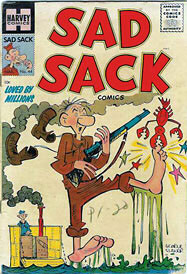
But Sad Sack has a military connotation to some of us who remember the old comic book character:


Sad Sack was "an otherwise unnamed, lowly private experiencing some of the absurdities and humiliations of military life. The title was a euphemistic shortening of the military slang 'sad sack of shit,' common during WWII."

I doubt if Dowd meant to associate Obama with a sack of shit, but she asks us to picture this sack bouncing. Bouncing back from an array of sins. So the sins are arrayed in military formation — perhaps in the sun, with second-degree sunburns — and the sack of shit (which was once a messiah) is trying to bounce, as if bouncing is a good response to an organized military attack.

Seems like a sad sack, trying to bounce back... I take it that's an accidental rhyme, just one more lump dingleberry of evidence that Dowd doesn't look critically at her writing, but it's possible, considering her reference to Obama's statement that "he dreams of 'going Bulworth,' a reference to the Warren Beatty movie in which a depressed and fading Democratic senator from California starts rapping, speaking with politically incorrect candor and dating Halle Berry." Seems like a sad sack, trying to bounce back... that could be a line in a rap. But no, it's an unintentional rhyme. Just as throwing Halle Berry into that riff about Bulworth unintentionally imputes an adultery component to Obama's Dreams From Warren Beatty.

"Hummingbird on the Left."

"Huitzilopochtli, Aztec God of Sun and War."
Huitzilopochtli's name is a combination of two Nahuatl (or Aztecan) words, huitzilin, meaning hummingbird, and opochtli, which means left — the god's name translates literally as "Hummingbird on the Left." This resulted in Huitzilopochtli often being depicted as a blue- or green-colored hummingbird or as a warrior whose armor and helmet were made of hummingbird features....
More here:
Huitzilopochtli's mother was Coatlicue, and his father was a ball of feathers....

His sister, Coyolxauhqui, tried to kill their mother because she became pregnant in a shameful way (by a ball of feathers). Her offspring, Huitzilopochtli, learned of this plan while still in the womb, and before it was put into action, sprang from his mother's womb fully grown and fully armed. He then killed his sister Coyolxauhqui and many of his 400 brothers. He tossed his sister's head into the sky, where it became the moon, so that his mother would be comforted in seeing her daughter in the sky every night. He threw his other brothers and sisters into the sky, where they became the stars.

"You know you’ve built a pretty good robot when nature itself has been fooled."

"And a group of robotics researchers at the University of Maryland got that compliment last month, when their robotic bird, dubbed 'Robo Raven' was attacked by a hawk."

"Since the time of the pharaohs, Egyptians have raised nets every autumn along the Mediterranean, to capture golden orioles, nightingales and corncrakes..."

"... as they wing their way south for the winter. It's an ancient tradition, but in recent years the custom has gotten out of hand."
A few scattered nets along the coast have metastasized into a nearly impenetrable wall of traps, stretching almost without break from the Gaza strip in the east to the Libyan border in the west. Conservative estimates set the annual death toll of migratory birds in this area at 10 million, but others say it is probably an order of magnitude more.

In some areas, especially near Libya, the birds are caught for subsistence, by people who currently have no other way to feed themselves, but the vast majority, perhaps eighty percent of the birds trapped, are sold in markets as a pricey delicacy or hocked to high-end restaurants in Cairo for up to five euros for each slight songbird.

"Seven cardinals but no hawks? Come on!"

"What the State Birds Should Be."
This has been the most depressing post I have ever put together. Three robins but no blue jay? Seven cardinals but no owls or hawks? Five filthy mockingbirds? This is what we pay taxes for, folks.

Obama "is deeply concerned both that his office... never violate its primary duty to abide by the Constitution’s checks and balances..."

"... and that he nonetheless exercise those powers to the limit as needed to protect the nation and its people."

Says Harvard lawprof Laurence Tribe, quoted in a Washington Post article amusingly titled "President Obama exercises a fluid grip on the levers of power."

"Hectored by flies, whooping cranes still struggling in Wisconsin."

"A swarm of black flies at the Necedah National Wildlife Refuge appears to be the best explanation for why endangered whooping cranes are abandoning their nests, but the pesky insects might not be the only reason the birds are struggling in Wisconsin."

May 18, 2013

Pay attention.

At the Magnolia Café...

Untitled

... settle in for the evening.

"For months, the Tea Party cases sat on the desk of a lone specialist, who used 'political sounding' criteria — words like 'patriots,' 'we the people' — as a way to search efficiently..."

"... through the flood of applications for groups that might not quality for exemptions, according to the I.R.S. inspector general. 'Triage,' the agency’s acting chief described it."

The NYT looks into the "understaffed Cincinnati outpost" of the IRS based on "interviews with current and former employees and with lawyers who dealt with them, along with a review of I.R.S. documents" and portrays them as confused and "alienated from the broader I.R.S. culture."

"Heh, great stuff, Althouse. Cf. Derrida on Nietzsche's umbrella."

Says Yashu, in the comments on "The word 'umbrella' appears exactly once in Obama's 'Dreams From My Father.'" And that was after I'd read rhhardin, commenting on "Sigmund Freud on the meaning of the umbrella": "Derrida in Spurs on the umbrella that Nietzsche wrote he had forgotten."

I'm spurred to read "Spurs," but "Spurs" is not an ebook, so I'm off the hook. Still, here's some text visible in Google books. Derrida is playing with the the possible meaning(s) of "I have forgotten my umbrella," found (in quotation marks) in Nietzche's unpublished manuscripts. Excerpt:
The umbrella's symbolic figure is well-known, or supposedly so. Take, for example, the hermaphroditic spur of a phallus which is modestly enfolded in its veils, an organ which is at once aggressive and apotropaic, threatening and/or threatened. One doesn't just happen onto an unwonted object of this sort in a sewing-machine on a castration table. 
"Unwonted" is not a typo. Unlike "unwanted," it's not commonly heard/seen. It means: "not commonly heard, seen, practised." So says the OED, which tells us that Charlotte Brontë used "unwonted" in "Jane Eyre": "Difficulties in habituating myself to new rules and unwonted tasks." Are there umbrellas in "Jane Eyre"?
I jumped up, took my muff and umbrella, and hastened into the inn-passage: a man was standing by the open door, and in the lamp-lit street I dimly saw a one-horse conveyance....
The Freudian symbolism is too blatant to need pointing out. The umbrella, the man, and the horse. And the muff, the inn-passage, and the open door. That's more than dimly seen.

"Apotropaic" is also unusual. The OED says it's "Having or reputed to have the power of averting evil influence or ill luck" and gives this earliest example from the 1883 Encyclopedia Brittanica:
The sacrifice of the ‘October horse’ in the Campus Martius..had also a naturalistic and apotropaic character.
Wikipedia says the "October horse was an animal sacrifice to Mars carried out on October 15, coinciding with the end of the agricultural and military campaigning season." There were chariot races and "the right-hand horse of the winning team was transfixed by a spear, then sacrificed." So did the ancient Romans have umbrellas? Yes. They were used by women and "effeminate men." Used against the sun, of course. How much Latin do you need to see the "umbra" in "umbrella" and to know we're talking about shade.

We law folk know "umbra" from the "penumbras" in "specific guarantees in the Bill of Rights [that] have penumbras, formed by emanations from those guarantees that help give them life and substance," a very glaring phrase written by Justice William O. Douglas, trying to explain how in the lamp-lit street he dimly saw the right of privacy.

But it was really Oliver Wendell Holmes, Jr. who got that word started in its U.S. law usage, the OED tells us: "The use of the penumbra metaphor in American jurisprudence appears to date from the late 19th cent. and is associated with Oliver Wendell Holmes (1841–1935), legal scholar and Associate Justice of the U.S. Supreme Court."
1873   O. W. Holmes in Amer. Law. Rev. 7 654   It is better to have a line drawn somewhere in the penumbra between darkness and light, than to remain in uncertainty.
I suspect no one will ever Heh-great-stuff-Althouse-Cf. me again. Here I am, writing expectantly, hoping for the circle to finally close, as it did for young Obama, crying over his father's grave, when he realized that the masculine needed to be leavened with femininity and that who he was, what he cared about, was no longer just a matter of intellect or obligation, no longer a construct of words, and then it started to rain and suddenly his brother Bernard was squatting beside him, sheltering him with a bent-up old umbrella. 

"Are you ready for me to read it?" Meade asks, and I say, "It needs one more thing, and I don't know what it is."

People who live in the city are apparently so frazzled...

... that there need to be articles explaining the information that it's relaxing to take a walk in the park. 

A walk in the park is a cliché that signifies an extremely easy activity. If you don't know a walk in the park is relaxing, how on earth do these city people survive in the hectic, harried environment I keep reading about?

Sigmund Freud on the meaning of the umbrella.

We've been talking about Obama and umbrellas this morning — here, here, and here — and, as noted, I bought the Kindle version of Freud's "Interpretation of Dreams" so I could search for "umbrella," which I remembered as a famous Freudian symbol.
All elongated objects, sticks, tree-trunks, umbrellas (on account of the opening, which might be likened to an erection), all sharp and elongated weapons, knives, daggers, and pikes, represent the male member...

Small boxes, chests, cupboards, and ovens correspond to the female organ; also cavities, ships, and all kinds of vessels.
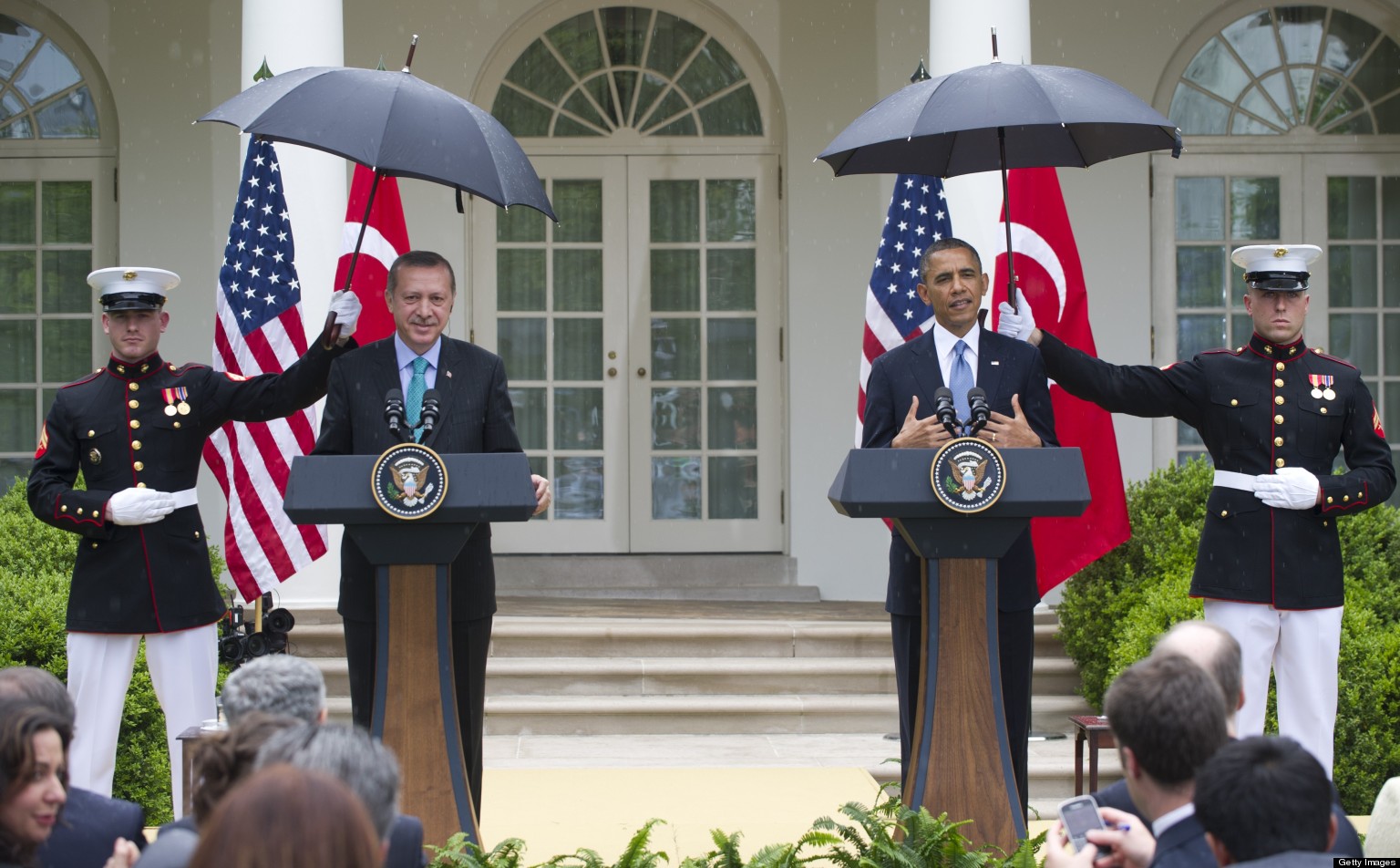
What then would Freud say about Obama's writing a book called "Dreams From My Father" in which he depicts a scene (perhaps concocted for dramatic effect) in which he is crying in the rain between the small boxes that are the graves of his father and grandfather and his brother is suddenly there holding an opened umbrella? To ask that question is already to see the answer.

And what would Freud say about the scene that has seized the public imagination — #1 on The Washington Post's most popular list — "Obama puts Marines on umbrella duty, irking conservatives"?


To ask the question is to see the answer! Indeed, to ask the question is to see innumerable phallic symbols in the photograph. Here, inspect this huge enlargement. Oh, my! It's a world of wonder. The shape of those windowed doors! Obama's 2-thumbs-up gesture. The lectern stands. The microphones. The medals. The arrows in the claws of the eagles on the seals. The umbrellas, one more erect than the other.

According to the WaPo article, the U.S. military might believe that umbrellas are effeminate. Dr. Freud says no, no absolutely not. They are quite masculine, especially when erect. Getting a rigidly erect male to hold erect umbrella over you and another rigidly erect male to hold another albeit slightly less erect umbrella over a world leader? It's the most masculine image ever seen!

It's no wonder the President's detractors are irked. In the Freudian analysis, we know the source of the anxiety that motivates them to drag him down with assertions that umbrellas are not manly.

The word "umbrella" appears exactly once in Obama's "Dreams From My Father."

I'm searching the text, because I've been thinking, this morning, about the fascination with Obama's interaction with the Marine and the umbrella, and that set me looking into umbrellas as a famously Freudian symbol, and I was struck by the meaningfulness — in that Freudian context — of Obama's book title "Dreams From My Father."

Now, I'm astounded to see that the umbrella figures importantly in the book — and it is even an umbrella held over him by another man (his younger brother Bernard). This happens at the end of what is the most dramatic scene in the book, on the last page of the final chapter. Obama, in Africa, falls to the ground between the graves of his father and his grandfather and cries.  He's crying about a lack of "a faith that wasn’t new, that wasn’t black or white or Christian or Muslim but that pulsed in the heart of the first African village and the first Kansas homestead—a faith in other people."
And for lack of faith you clung to both too much and too little of your past. Too much of its rigidness, its suspicions, its male cruelties
He expresses the idea that their "male cruelties" should have been moderated by more of "the laughter in Granny’s voice, the pleasures of company while herding the goats, the murmur of the market, the stories around the fire... Words of encouragement. An embrace. A strong, true love." That is, the over-masculinity should have been mixed with more feminine things, things that "could make up for a lack of airplanes or rifles." There's a theory of gender here: "you could never forge yourself into a whole man by leaving those things behind."

"I think he's crude, I think he's medieval, and I don't want an elderly gentleman from Vienna with an umbrella inflicting his dreams upon me."

"I don't have the dreams that he discusses in his books. I don't see umbrellas in my dreams. Or balloons."

So said Vladimir Nabokov, in 1966, answering the question "Mr. Nabokov, would you tell us why it is that you detest Dr. Freud?" I'm reading this now after writing the last post, about the symbolism of Obama and the Marine-held umbrella. The post ends:
If umbrella-holding conveys a message of unmanliness, it is a vivid image of impotence. It's a symbol.
Umbrellas are a famously Freudian symbol, and I was going to embellish that last post with some stray erudition. But the post was already too long. (Too long!!) And here was Nabokov, taking a swipe at the elderly gentleman from Vienna way back in 1966.

Interestingly, Nabokov is also talking about something else that was a topic in the Obama-and-the-umbrella post:
I'm not a good speaker, you see. When I start to speak, I have immediately four or five lines of thought — sort of roads, you know, trails going various ways. And I have to decide which trail I'm going to follow, and while I decide this, hawing and hemming begins, and it may be very upsetting because I hear it myself. I can never understand those limpid, fluid speakers, as my father was, who just deliver perfect phrases, beautifully built, with an aphorism here, you know, and a metaphor there. I can't do it. I have to think it out; I have to take a pencil; I have to write it down laboriously; have it before me. I do things like that. It's probably psychological. I can imagine what old Freud would have said, whom I heartily detest, as my readers know by now.
Ah! What would Freud have said about Obama's endless uh-ing?

Nevertheless, I am downloading Freud's "Interpretation of Dreams." I want it in my Kindle, alongside, among other things, Obama's — ahem — "Dreams From My Father."