January 24, 2004

If blogging is the way your mind looks on the web, then going back and rereading one’s miscellaneous back entries ought to give a person some new insight into their own minds. After ten days of blogging I decided to take account, not of my soul, but of the names I had managed to drop.

Total names dropped (not counting journalists other than Diane Sawyer, but counting fictional characters): 100.

Major categories:
Human movie personalities: 16%
Current political figures: 14%
Human TV personalities: 12%
Artists: 11%
Writers (fiction writers & public intellectual types): 11%
Fictional characters (other than puppets): 9%
5% in each of these categories:
Singers.
Historical figures.
Fashion people/royalty.
Puppets!
Things to write in an obituary for a photographer:
•His images were calculated to shock, often featuring tall, blond, sometimes naked women in heels, perhaps illuminated by headlights or trapped in a dark alley. ...

•"Helmut was very clear that he liked a big girl and blond girl, in an impeccable suit and high heels," said Anna Wintour, the editor in chief of Vogue. ...

•At 18, … he was forced to flee the Nazis, eventually arriving in Singapore, where, he wrote, he became a gigolo. ...
Info in “The Arts” article but not in the obituary in the same issue of the NYT:

•In one 1973 series of photos, [his wife] was portrayed as Hitler wearing a cropped mustache with model Jerry Hall posing as Eva Braun.

Helmut Newton, at age 83, left the Chateau Marmont Hotel and crashed his Cadillac into a wall across the street with sufficient force to kill himself. Both articles in the Times say that he “lost control” of the car.
More about Captain Kangaroo, Bob Keeshan, from the NYT obituary. He started out in show business with the job of seating children in the audience--the Peanut Gallery--for "The Howdy Doody Show." When he did "Captain Kangaroo," he had no studio audience. Asked why, he expressed his concern for the children watching at home:
"The children should never be excluded from what I am doing and should never have the feeling of being part of an audience."
How sensitive that was to the feelings of a child! I remember watching "The Howdy Doody Show" and feeling left out of the Peanut Gallery. Who were those children? How did they get there? Was there something that made some children "Peanuts" that allowed them into the wonderful television world, while I was left stranded on the other side of the screen--screened out? Mr. Rogers followed the same intuition.

Strangely, shows for nonchildren--Oprah, Letterman, MTV's Spring Break--go on the assumption that an audience tends to make the home viewer feel more included. Perhaps that's because nonchildren understand how to get out of the house and into the audience and can therefore project themselves into the audience, which they know is composed of people like them. They have shaken off the feeling that the people on TV are a different breed--they aren't Peanuts, just people like me getting out of the house.

It's funny that back in the 1950s, the kids on TV were Peanuts, while now, we name the people at home after foodstuffs: Couch Potatoes.

Back to Keeshan: He was elevated from audience-seating to a character role on "The Howdy Doody Show," in 1948. He was

"Clarabell, a clown who said nary a word but who jumped around the stage a lot and, to the delight of the members of the Peanut Gallery, frequently sprayed [the show's host Buffalo Bob] Smith in the nose with his seltzer bottle.

Buffalo Bob fired Keeshan/Clarabell because he thought he was trying to form a union! That was in 1950, a couple years before I was in a position to be watching the show, so the Clarabell I remember was Keeshan's replacement. (I remember Clarabell as the best-loved character on the show (along with Flub-a-Dub). I could never understand why Doody got top billing.)

Keeshan got started with "Captain Kangaroo" (which was originally called "Tinker's Workshop"), in 1954. I may very well have watched the first episode and believe I remember the original title.

To play Captain Kangaroo, Mr. Keeshan had to catch the 4:20 a.m. train from Babylon, on Long Island, to be at CBS by 6. He lived in constant fear of oversleeping and employed three alarm clocks plus a phone service. He never missed a broadcast.

In the beginning, he would do "Captain Kangaroo" live twice a day, an 8 a.m. broadcast for the East Coast and then, after a break of less than a minute, a repeat of the whole show for the Midwest.

Ah, the travails of live television! Those guys were heroes!
It's nice to see Ryan Lizza's new campaign journal in The New Republic. His take on Wesley Clark's campaign is particularly pithy:
The crowds at Clark's events also seem to skew further left than I expected. Recently he's campaigned with Michael Moore and received the endorsement of George McGovern. I think two things explain this. One, as a newcomer to the party, he overestimates how liberal Democrats really are. He still has a slightly caricatured view of his new home, and so he doesn't realize how silly he sounds when he calls Michael Moore "a great American leader," as he did in the debate. The other reason is more straightforward. He's still being attacked for voting for Republicans and praising George W. Bush, and so he's constantly having to demonstrate his liberal credentials.

Newcomerishness is an especially damaging problem when your campaign is premised on depth of experience.

January 23, 2004

It was a bit "peculiar" of Al Sharpton to say he was "unilaterally opposed" to states' rights, as Robert Garcia Tagorda notes.

Surely, he meant to drag up the word "unequivocally" from the old memory bank of cliches. If Flaubert were still keeping his "Dictionary of Received Ideas," there would be an entry:
Opposed. Always add "unequivocally."
Oh, and:
Action. When referring to the government, assert that it shouldn't be taken "unilaterally."
Investment schemes. Gawker writes:
He got married and bought an apartment on the Lower East Side and THEN wrote a massive New York Times article about it. (Isn't that sort of like purchasing stock and then telling everyone to buy it?)
Thinking about Spalding Gray.
2Blowhards write about rethinking reading habits (from A&L Daily):

• I'm always in the middle of a half dozen books. Often I finish none of them. This doesn't bother me -- it's part of how I like conducting my reading and writing life, dammit. …

•I own a ton of books I'll never read, and that's OK with me. I enjoy having them around. Some I wouldn't read all the way through even if I had the time. They're there for reference, for grazing through, and for company….

•So far as nonfiction goes, I see no reason not to consider websurfing the equal of plowing through a nonfiction book. If you're interested in a topic, a website -- or a bunch of websites, since there's no reason to stop at one -- can be as good as a book. …

It's funny how one is always thinking, I need to read more, envisioning oneself in the living room armchair, under the reading light, reading a classy literary novel or a scholarly history book. Why not just credit yourself with all the reading you really are doing all day long, reading websites, parts of books, stray signage, etc.?

It's a bit like people who think they should exercise more, then they just buy a pedometer, see how much walking they really are doing around the house, at work, and in stores, thereby solving the whole problem. I think it would be possible to design a readometer, perhaps as part of reading glasses, that would recognize the distinctive eye movements of reading and convert that into the number of books read, like a pedometer's miles walked.

There's no equivalent solution for doing too much of something, like eating too much. No way to prove to yourself that you really are eating less.
Professor Yin thinks Dean (at the debate) looked like Tom Cruise in "Top Gun."
Timothy Noah watched Dean's Sawyer interview:
Seeing Dean beg for mercy over what was merely an untelegenic display of enthusiasm called to mind the last scene in One Flew Over the Cuckoo's Nest, when Chief Bromden finds McMurphy, and he's been lobotomized, all rebellion and mischief sucked out of him, and you don't know whether to rage or weep.
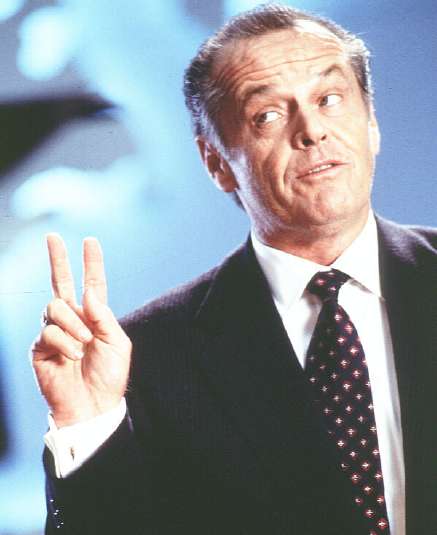
Dean as Nicholson? Nicholson did make a good President.
Captain Kangaroo--Bob Keeshan--has died. So long!

Though, as a kangaroo, he was well suited to jumping, he never jumped the shark.

I remember the show from the 1950s, not the later color version. We had to take in on faith that Mr. Greenjeans was wearing green jeans, back then. I could never understand why Bunny Rabbit was so mean.
I watched the debate last night. I even TiVo'd it and a segment of commentary following it. But I did not watch Howard Dean and his wife being smarmed up to by Diane Sawyer. I resist the Sawyer nuzzle-fest. So I just read about it in the NYT.
"Look, I'm not a perfect person, I've got plenty of warts," Dr. Dean said between coughing spasms and sips from a mug of hot water at the Lebanon forum, where he received numerous ovations. "I say things that get me in trouble. I wear suits that are cheap. But I say what I think, and I believe what I say, and I'm willing to say things that are not popular, but that ordinary people know are right.

"In other words," he added, "I lead with my heart and not my head."
Is that a good explanation? I know he's sick. (He looked pretty ill or very tired at the debate.) But if the concern is that we think he's angry, why would we be reassured to hear that he's going to act from emotion, without thinking it through?
"He just doesn't get that angry," Mrs. Dean, 50, told Ms. Sawyer ... "I mean, he doesn't. You know, he just, he's very kind, very considerate, and, it just doesn't happen."....

And Mrs. Dean, who skipped an afternoon of house calls and paperwork to film the "Primetime" interview Thursday, may come to New Hampshire this weekend — despite Dr. Dean's repeated assurances that he would not use his politically uninterested wife as a prop on the trail.

"Do you feel like a prop, dear?"
I love that question! It's a brainteaser. Is yes more like no or is no more like yes?
Following Edwards's garbling of the Defense of Marriage Act, Al Sharpton took the first opportunity to push back:
Well, let me say something about the Defense of Marriage Act. I am unilaterally opposed to any civil or human right being left to states' rights. That is a dangerous precedent.
How can candidates think they will succeed with fuzzed-up federalism, when the first thing many people think of when told that a matter ought to be left to the states is segregation and resistance to civil rights?
The issue of gay marriage is taking an oversized role in thinking about who ought to be President. This is an issue that needs to ripen over time, and it is quite unfortunate that everyone needs to suddenly take a position. The candidates know they have to finesse it, and one move is to say, as John Edwards did in the debate last night (transcript here), that the decision ought to be left to the states. Of course, traditionally, marriage has been left to the states, but what do you do about the federal Defense of Marriage Act, which debate moderator Brit Hume had asked him about:
[T]he Defense of Marriage Act, as I understand it -- you're right, I wasn't there when it was passed -- but as I understand it, it would have taken away that power. And I think that's wrong. That power should not be taken away from the states.
Can you get away with finessing the gay marriage issue by failing to understand the Defense of Marriage Act (or pretending to)? Hume came back with the right follow-up question:
HUME: Does not the Defense of Marriage Act specifically say that the court rulings in one state, which might, for example, recognize a gay marriage, may not be imposed on another state? In other words, doesn't the Defense of Marriage go to the very position which you yourself take?

EDWARDS: No, the Defense of Marriage -- first of all, I wasn't in the Congress, I don't claim to be an expert on this. But as I understand the Defense of Marriage Act, it would take away the power of some states to choose whether they would recognize or not recognize gay marriages. That's my understanding of it.

"I don't claim to be an expert on this"? Come on! Edwards is a lawyer and a senator, and he's claiming a reasonably short federal statute is beyond his comprehension? Or is he claiming he's never bothered to try to understand it, even though he knows gay marriage is a key issue in the campaign and he means to get by with the leave-it-to-the-states angle?

"That's my understanding of it"? "I wasn't in the Congress"? How can that be enough?

January 22, 2004

Thanks to Iowa lawprof Tung Yin for linking to me! Nice to find another lawprof willing to opine about American Idol.
Writing about surrealism and coincidence makes me want to say something about my favorite movie, "My Dinner With Andre." Googling in search of the screenplay--hey, nice tribute to Year of the Monkey, Google--I ran across Lane's Shrine to "My Dinner With Andre." I approve of the idea, but, jeez, Lane, that background! That nearly set off a migraine.

I can't find a screenplay to link to. But there's a memorable discussion of Andre Gregory's collection of the surrealist journal Minotaur, made 40 years earlier, which he had opened to a page with the handprints of three surrealists named Andre. Wallace Shawn cannot accept Andre's belief that the journal was somehow made for him.

If you've never seen this film you should, even though you might hate it. I bought the DVD, but it is absolutely the lowest quality DVD. It really shouldn't be sold in this form. Somewhere in those 59 Amazon customer reviews is one from me ("from Madison, Wisconsin") complaining about this. If you've ever felt annoyed that a movie you care about hasn't been released on DVD, remember that it is much worse when they do this, because there seems to be little hope of getting something better later. It does have scene access, but with only nine scenes. The chapter titles--"soup," "soup finished," "entree," "dinner conversation continues," "entree ends"--are almost good for a laugh, a bitter scoff, perhaps.
Paul Auster's new book, by the way, is Oracle Night, and you can hear him discuss it (on Fresh Air).
Two of my favorite painters are Victor Brauner and Yves Tanguy. I had never heard of either until the first time I saw and was completely enchanted by a painting of his in a Museum of Modern Art. I saw Tanguy's painting "Fear" at the Museum of Modern Art in New York in the 1960s. I saw Brauner's "Snake Dancer" at the Museum of Modern Art in Paris in the 1980s. I was interested to learn that they were roommates for a while, but then in no mood to think coincidences were cool after reading this:
That year he moved to Paris, lived briefly with Tanguy, and painted a number of works featuring distorted human figures with mutilated eyes. Some of these paintings, dated as early as 1931, proved gruesomely prophetic when he lost his own eye in a scuffle in 1938.
Here's a better description of the incident (from an article, linked today at Arts & Letters Daily, that is really about the new Paul Auster novel):
On 28 August, 1938, the Romanian painter, Victor Brauner, lost his left eye when he was struck by a glass thrown by fellow surrealist Oscar Dominguez. Such violence was not uncommon at parties attended by the surrealist group, but what distinguished this episode was the fact that it seemed to fulfil a prophecy, begun seven years before when Brauner painted the first of a series of canvases (Self-Portrait with a Plucked Eye), in which he was depicted as having suffered various injuries, all affecting the left eye.

In one, Brauner’s eye has disappeared; in another, it seems to have melted and is running down his cheek; in yet another, the eyeball has shattered in its socket. The surrealists made much of the incident, claiming it proved the magical, premonitory power of art and, though Brauner himself played it down, he is best-known, even now, as the painter who foresaw his own partial blinding.
Go, Cliff!

I could care less about golf. That would be if my nephew weren't on the PGA tour. So I will be frequently checking the live leaderboard.
Thanks to UCLA lawprof Stephen Bainbridge for linking to this site. I especially like being mentioned right below a post about Delaware, my home state.

I sometimes wonder whether my interest in constitutional law, and specifically federalism, did not originate from my early education in Delaware schools, where we studied Delaware history and were instilled with a sense that Delaware was special because it was the first state to ratify the Constitution. I can still remember frequently singing the state song "Our Delaware," which includes a pledge of "Faith" to the "beloved" state. The song has a verse for each county--there are only three--and some strange lyrics for a kid to contemplate, like:
Dear old Sussex visions linger,
Of the holly and the pine,
Of Henlopen's Jeweled finger,
Flashing out across the brine
So, what is this image? Cape Henlopen is basically giving the Atlantic Ocean the finger?

I grew older only to learn that no one outside of Delaware cared if Delaware was the first state. The distinguishing thing about Delaware to lawyers is that that is where all the corporations are from. "Oh you're from Delaware? I didn't know any human beings were from there," is a wisecrack I've heard more than once.