There are many ways to have fun watching the election returns, and one way it to place some bets. I've told you about the bet Meade and I have about the Wisconsin gubernatorial election, but yesterday I came up with another topic for betting. Predict an upset. This led to some boring discussion of what counts as an upset, and I came up with the boring idea that it's an upset if a candidate with a predicted 58% chance of winning loses. By this standard, in the Senate races, there can be no upset in Kansas, but all the other races have a predicted winner whose loss would be an upset.
So pick an upset to bet on. I picked Scott Brown to beat Jeanne Shaheen in New Hampshire, and Meade picked Thom Tillis to beat Kay Hagan in North Carolina.
Showing posts sorted by relevance for query upset. Sort by date Show all posts
Showing posts sorted by relevance for query upset. Sort by date Show all posts
November 3, 2014


July 16, 2008
Yesterday, "The Daily Show" and Rush Limbaugh ran with the same joke about the Obama cartoon.
Rush Limbaugh:
ADDED: Maybe the 2 comedians ripped off Instapundit.
Obama and his team are upset over a cartoon on the cover of The New Yorker, a leftist publication, that makes him look like a Muslim, that makes his wife look like a terrorist Muslim, that has the American flag burning in the fireplace, under the portrait of Osama Bin Laden in the Oval Office. The Obama campaign and The Messiah himself were said to be very, very upset over this. Let me ask you a question. Who is it that gets upset over cartoons? Muslims. (Gasping) Dawn's in there saying, "He didn't say that." Yes, I did, I'll say it again. (laughing) I just love tweaking these people. Who is it that gets upset over stupid cartoons? Muslims, intolerant Muslims.The "Daily Show" clip is 5:39 long — and quite good all the way through — but the relevant joke is at 3:10:
Obama's camp initially agreed that the cartoon was tasteless and offensive.' Really? You know what your response should have been? It's very easy. Here. Let me put the statement out for you: Barack Obama is in no way upset about the cartoon that depicts him as a Muslim extremist, because you know who gets upset about cartoons? Muslim extremists! Of which Obama is not. It's just a #*!&ing cartoon!Rush did it first. The "Daily Show" did it better, however. It was better to say "Muslim extremists" and not just "Muslims." Rush's joke has an added layer of Rushisms. He has to pause to call The New Yorker a "leftist publication." And he has to step back and find it amusing that he's so outrageous for saying what others will not dare to say. But basically, it's the same joke and a pretty good one.
ADDED: Maybe the 2 comedians ripped off Instapundit.
April 16, 2012
Potential "upset" in the Wisconsin recall race.
From a Journal Sentinel column titled "John Doe probe looms over Walker's recall election":
Republican activists will be upset if Milwaukee prosecutors file complaints against additional Walker aides before [the recall election on] June 5, arguing that the Democratic district attorney would be trying to influence the election."Upset" is a funny word. Did you know that it originally meant "Set up, erected, raised up" (OED)? How did it get... upset? I think the origin is in the stomach. The meaning "Physically disordered" is "said esp. of the stomach." It seems to be the same "up" we find in "throw up" and "upchuck"!
But Democrats will be equally upset if charges wait until after the election, especially if Walker wins. Likewise, Republicans would accuse [Milwaukee County District Attorney John] Chisholm of trying to use the courts to tar the governor coming out of the recall race.
June 11, 2026
Are you "upset" or just unsettled?
I'm reading "Are You 'Triggered' or Just Upset? This popular term is often misused, experts say, which may cause more harm than good" (NYT).
When people use the term trigger instead to refer to everyday things that incite annoyance or offense, they run the risk of conflating traumatic experiences or mental health struggles with everyday challenges, several experts said.... Using triggered to describe negative everyday experiences may also cause people to misinterpret discomfort as danger. They may start to think that bothersome experiences or everyday challenges are harmful, rather than seeing them as opportunities for learning and growth, Dr. Needle said....
Sometimes, the word trigger can also be used sarcastically or dismissively, Dr. Needle said — as in, “Oh, you’re just triggered” — to minimize someone’s legitimate negative reaction to a comment or action. “It is basically a way of saying your response is a ‘you problem,’ a sign of weakness or oversensitivity, rather than acknowledging that something genuinely hurtful was said or done,” she said.
I love the name Dr. Needle. She's a clinical psychologist, Rachel Needle.
The headline suggests that the word "upset" is a good substitute for "triggered" when you're not talking about having a flashback to a trauma. But isn't "upset" also pretty dramatic, if we take the dying metaphor seriously? Have you been knocked over, capsized, overturned?
I've noticed recently that political writers are turning to the word "unsettling." There was the very conspicuous NYT headline: "Several Women Who Dated Graham Platner Recall 'Unsettling' Behavior."
April 1, 2025
"This is America showing itself because it was never in you in the first place. So why am I upset that you're upending something..."
"... that was never in you in the first place? I'm not saying that we shouldn't be upset. We definitely should be upset. But why are we-- we can't be upset at people that it was never in them in the first place to even care about somebody else."
Said a black woman, heard in episode 857 of "This American Life," "Museum of Now."
Said a black woman, heard in episode 857 of "This American Life," "Museum of Now."
She is commenting on the removal of the 2-block-long, 50-foot-tall words, "Black Lives Matter," that had been set in concrete in a street near the White House.
Prompted by the question, "Is this more honest, actually, that they actually are ripping this up?," we hear her struggling in real time to understand why the de-installation of the motto wasn't upsetting her or wasn't upsetting her that much.
One might say the original installation was propaganda and pandering. Jackhammering it out of there said something accidental and authentic.
July 11, 2024
Conservatives upset?
I'm reading "White House roasted for saying Biden will give a ‘big boy press conference’: ‘Potty training next?’/Conservatives upset by ‘unbecoming’ joke in Monday’s White House briefing" (Independent).
Today's the big press conference that the White House referred to as “big boy press conference.” I would think that joke would upset Biden supporters. The idea of the press conference is, ostensibly, to give Biden another chance to prove he has the ability to serve as President. To tack a silly name onto the event is to undercut his effort. People can't stop saying "big boy press conference." Aren't conservatives just laughing?
July 8, 2016
5 Dallas police officers shot dead by snipers at a Black Lives Matter rally.
7 other police shot, plus 2 civilians.
The Dallas police chief, David O. Brown, said the gunman who was killed had “said he was upset at Black Lives Matter, said he was upset about the recent police shootings. The suspect said he was upset at white people; the suspect said he wanted to kill white people.” He was especially upset at white police officers, said Chief Brown.... who is black....My link goes to the NYT which posits that this incident has "injected a volatile new dimension into the anguished debate over racial disparities in American criminal justice." That is, these murderers undercut Black Lives Matter by complicating the victims-and-brutes presentation.
“There has been a vicious, calculated and despicable attack on law enforcement,” President Obama told reporters Friday morning in Warsaw....
April 11, 2026
"Mr. Trump projected sang-froid about it all on Friday. 'I don’t mind anything having to do with Epstein,'"
"But he was talking about it again because of something his wife chose to do. Was he upset that she had single-handedly thrust this story that had so bedeviled him back onto front pages around the globe? 'No,' he said. 'I never get upset.' He said that after he watched Mrs. Trump’s statement, he thought to himself: 'She had a right to talk about it, because the fake news covers her so inaccurately. Would I have done it that way?' the president mused. 'Perhaps not, perhaps, I don’t know.'"
Writes Shawn McCreesh, in "Trump Says First Lady ‘Had a Right’ to Talk About Epstein/President Trump said in an interview that he had known his wife wanted to address rumors about the late sex offender at some point, but that he had not known exactly what she would say" (NYT).
Writes Shawn McCreesh, in "Trump Says First Lady ‘Had a Right’ to Talk About Epstein/President Trump said in an interview that he had known his wife wanted to address rumors about the late sex offender at some point, but that he had not known exactly what she would say" (NYT).
My search of the NYT archive included a term that wasn't in the article: Ungaro. I was looking, as I usually do, for elite media coverage of a story I am seeing in lowlier media, which I generally eschew. In this case, that would be things like "Amanda Ungaro Arrived in the U.S. on Jeffrey Epstein's Plane at 17 — Now She's Going After Melania Trump From Brazil" (Yahoo!news). I guess you can say I'm just seeing one of those things the NYT deems not "fit to print."
Anyway... I enjoy Shawn McCreesh's writing at the NYT. I love the coverage of Trump's enigmatic responses. "I never get upset" — what a perfect answer to the question whether you are upset. It can't be true, but one appreciates the sang-froid.
Great word, sang-froid. Lord Byron used it in Don Juan:
In the mean time, cross-legg'd, with great sang-froid,Among the scorching ruins he sat smoking
Tobacco on a little carpet....
August 27, 2013
"Why are Feminists Judging Miley Cyrus?"
Asks Rush Limbaugh.
But back to the main question: Obviously, our culture is deeply confused about young people and sexuality. It's not just feminists.
UPDATE: Miley toys with the confusion.
I thought we didn't have the right to judge somebody else's morality, and I thought we didn't have a right to comment.... Why does this upset these "progressive" women?...Speaking of questions... what's this Not a cat/It's gotta be a dog?
Feminists. Women who proudly think of themselves as independent, don't need a man for any reason whatsoever, don't need a relationship for any reason whatsoever -- a sperm bank is all you need and a dog -- are the ones who are upset about it. (Not a cat. It's gotta be a dog.) Miley Cyrus, do I think she's being...? (interruption) Oh, do the upset feminazis think she's being subservient to men by doing this? It's [an] interesting question....
Because they're the ones who told us, "Little girls are gonna have sex. You can't stop it. So introduce them to Planned Parenthood, introduce them to condoms, introduce them to cigarettes afterwards on the nightstand, introduce 'em to rooms in your house instead of the backseat of the car." Yeah. Why are they upset about it? It's an interesting question.
But back to the main question: Obviously, our culture is deeply confused about young people and sexuality. It's not just feminists.
UPDATE: Miley toys with the confusion.
March 15, 2016
"Can Bernie Sanders Pull Off An Upset In Ohio?"
Asks Nate Silver, comparing Ohio to Michigan (the state where Sanders pulled off an upset last week, an upset that Silver failed to predict).
[T]he demographic model gives Sanders a 42 percent chance of winning Ohio, much better than the 3 percent chance that our “polls-only” forecast gives to him.As for Illinois — Clinton's original home state — "the polls have been all over the place, with recent surveys showing everything from a 42-point lead for Clinton to a 2-point lead for Sanders."
Our weighted polling average has Clinton up by 7 points there, and the demographic model is largely in agreement, forecasting a 9-point win for Clinton.In the southern states, North Carolina and Florida, the forecast is a blowout for Clinton, so "[i]f Sanders were to win or come close... it would be an even bigger upset than Michigan."
July 13, 2008
So here's the new New Yorker cover.

Get it?
Obama says:
"I have no response to that."The campaign adds:
The New Yorker may think, as one of their staff explained to us, that their cover is a satirical lampoon of the caricature Senator Obama's right-wing critics have tried to create. But most readers will see it as tasteless and offensive.
And we agree.
The artist is Barry Blitt, and I have to say that I think the cover is a hilarious spoof of the fears and lies about Obama. Michelle and Barack are in the Oval Office, doing a celebratory fist bump. There's an Osama Bin Laden portrait on the wall and a burning flag in the fireplace. He's a Muslim and she's a revolutionary. Of course, Obama has to push it aside and can scarcely laugh about it.
Or, maybe, I don't know... maybe it would work to laugh. He's been awfully uptight about things lately. And laughing conveys the instant recognition that it's absurd. Why be surly about it? McCain's supposed to be the cranky guy...
IN THE COMMENTS: ricpic says:
Fears and lies my foot!It's that last line that's making me frontpage this.
The dead on truth about these two America haters.
Congrats Blitt.
And congrats to the Hillary camp inside The New Yorker.
ADDED: Taylor Marsh asks whether The New Yorker would treat John McCain the same way:
Picture a drawing showing a very old man in a wheelchair, his hospital gown adorned with medals... babe of a wife pushing him, as his first wife wipes drool off of McCain's mouth... while Cindy McCain stops to open packages from Chanel. No, I didn't think so either.
Wait. Who's the "babe of a wife" if not Cindy? I don't get the specifics, but I see the point. I think it would be out of bounds because it would be so unappealing. The New Yorker doesn't put drooling disabled persons on the cover. And the Michelle and Barack image has a transgressive, radical chic edge to it, that I suspect excites the magazine's audience.
IN THE COMMENTS: Christopher Althouse Cohen said (about Obama):
He's always been dead serious about everything. Has he ever said anything funny?Perhaps not. Did you notice how unamused he looked in that interview in which his daughters were so lighthearted? Remember when he got pissy about Maureen Dowd saying that his ears stick out? ("I just want to put you on notice... I was teased relentlessly when I was a kid about my big ears.") His supporters may picture him bringing a youthful spirit into the White House, but look at him. He's actually quite stodgy and censorious. Turn off that television.
Now, this will constitute the "turning the page" that people seem to want so badly, since George Bush likes to joke around. The George Bush page was pushing the envelope. (Is that a mixed metaphor?) I still can't get my mind around the picture of him saying "Goodbye from the world's biggest polluter" and then "punch[ing] the air while grinning widely, as the rest of those present including Gordon Brown and Nicolas Sarkozy looked on in shock."
Victoria writes:
[Obama] doesn't poke fun at himself, doesn't use a light touch in his speeches, doesn't seem relaxed at the podium EVER.Blake said:
It's gotten so that I wonder how he will acquit himself at the annual Smith Dinner....
I can't imagine, simply cannot for a second imagine Obama making fun of his background, his race, or mention his pastor and his rants during the Al Smith dinner.
What a dour, touchy time we will have, if he's elected.
Nah. He'll be the Margaret Dumont to our Marx Brothers.Good point! He'll be great fun for the comedians. He's a perfect straight man.
He'll have a terrible time, tho'.
Paco Wové said:
When I saw it, I rolled my eyes and thought, Oh, God, it's the New Yorker trying to be all transgressive again....
Oh, yeah, remember all the mileage they got out of this:
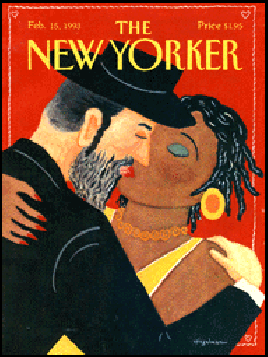
From an interview with Spiegelman:
Q: [O]nyour controversial 1993 Valentine's Day New Yorker cover in which, during the conflict between Hasidim and African Americans in Brooklyn, you portray a Hasidic man and a black woman embracing. Values and worlds colliding, meeting.
AS: It didn't come as a shock to me that this got people to sit up and take notice. I'm interested in visual signs...
Q: How does that apply to the New Yorker cover?
AS: The signs are highly recognizable. The sign for Hasid is clear and unavoidable, without the usual anti-Semitic physiognomy that goes with it. The sign for African-American woman is equally unavoidable, without entering into Aunt Jemima stereotypes or anything of the kind. Then there's this other sign that has to do with the Valentine's Card-the kiss, the field of red with the lacy decoration around it, all of it weaving together separate meanings. The irony is you have these two groups that are at each other's throats at each other's lips instead. That's supposed to conjure up carnality and yet Valentine's Day, the image of Valentine's Day, isn't about carnality but a kind of benign romantic love. All those things course through this image and the impossibility of it is what's so entertaining for me. What got people most upset that week was not other magazines with the usual S&M imagery-chains and whips, leather and hurt-but something quite benign on the surface, playing with signs. Reverend Dougherty, a representative of the black community in Crown Heights, was very upset I used a black woman: one more time, he said, a white man was oppressing a black woman. Why didn't I have a black man and a Hasidic woman, he asked on the radio. Maybe he's a good reverend, I don't know, but he's a rotten art director. A Hasidic man is a lot easier to recognize than a woman with a handkerchief on her head. In terms of visual signs you've got one thing that works and one thing that doesn't. Even more important, I answered him, if I had used a black man and Hasidic woman, you'd be complaining I was once again showing the black man as a rapist and defiler of white woman. This shows me the problem has nothing to do with the signs being shown but the reverberation of those signs in people's heads. The same thing happened in op-ed articles. There was an op-ed in the New York Times in which a woman who was very upset about the New Yorker cover writes about the Jew's lascivious lips. Another person, equally upset in the Washington Post, described the Jew's prim lips. Now you know I can't draw lips that are simultaneously lascivious and prim; I'm limited.
Q: Sure you can.
AS: I did. I just drew lips.
Speaking of reading the signs, and back to the comments, George says:
He's wearing a dress.
She's in pants.
And if you hold the cover up to a mirror, it reads 'Rekroy Wen' which means "Kill Whitey" in Tshivenda, the language of Barack's homeland.
The cover date "July 21" is the anniversary of the founding the KIPRP, the Kenyan Islamic People's Revolutionary Party.
He's also crushing the throat of a bald eagle.
Wake up, America!!
December 30, 2016
Is President Trump going to adhere to the presidential tradition of press conferences?
Here's a transcript of Hugh Hewitt's conversation with Sean Spicer, who will be the new White House Press Secretary. They're talking about whether President Trump will have the same kind of press conferences we've seen from past presidents, which Hewitt characterized as "regular" and "energetic."
I had to stop and check to see what the tradition of press conferences really is. Has it been distinct and consistent? Here's a piece from the White House Historical Association. Woodrow Wilson started the practice of press conferences, and all of his successors (so far) have used it.
Calvin Coolidge considered it "rather necessary to the carrying on of our republican institution that the people should have a fairly accurate report of what the president is trying to do." Fairly accurate. Trying to do.
JFK — who's right in the middle of the line of men that begins with Wilson and ends with Obama — gave the first live, televised press conferences. Up until Eisenhower, the sessions were not even on the record, and the President retained the power to rewrite his quotes. When Truman said "I think the greatest asset that the Kremlin has is Senator McCarthy," the reporters helped him see that the quote was too exciting and they even assisted him in mushing it up into: "The greatest asset that the Kremlin has is the partisan attempt in the Senate to sabotage the bipartisan foreign policy of the United States."
JFK made the televised press conference into something that served his agenda and suited his particular gifts and desired image. Later Presidents accepted Kennedy's approach but also adapted it. George H. W. Bush introduced the joint press conference with world leaders. Obama has often substituted interviews with one chosen reporter. In his first 2 years, Obama did 21 Kennedy-style press conferences to a roomful of reporters and 269 of those one-on-one encounters.
With that background on presidential press conferences, let's get back to Hewitt and Spicer:
I had to stop and check to see what the tradition of press conferences really is. Has it been distinct and consistent? Here's a piece from the White House Historical Association. Woodrow Wilson started the practice of press conferences, and all of his successors (so far) have used it.
Calvin Coolidge considered it "rather necessary to the carrying on of our republican institution that the people should have a fairly accurate report of what the president is trying to do." Fairly accurate. Trying to do.
JFK — who's right in the middle of the line of men that begins with Wilson and ends with Obama — gave the first live, televised press conferences. Up until Eisenhower, the sessions were not even on the record, and the President retained the power to rewrite his quotes. When Truman said "I think the greatest asset that the Kremlin has is Senator McCarthy," the reporters helped him see that the quote was too exciting and they even assisted him in mushing it up into: "The greatest asset that the Kremlin has is the partisan attempt in the Senate to sabotage the bipartisan foreign policy of the United States."
JFK made the televised press conference into something that served his agenda and suited his particular gifts and desired image. Later Presidents accepted Kennedy's approach but also adapted it. George H. W. Bush introduced the joint press conference with world leaders. Obama has often substituted interviews with one chosen reporter. In his first 2 years, Obama did 21 Kennedy-style press conferences to a roomful of reporters and 269 of those one-on-one encounters.
With that background on presidential press conferences, let's get back to Hewitt and Spicer:
August 1, 2012
"Here we go – upset brewing in Wisconsin Rep Senate Primary?"
The candidate who would be upset is Tommy Thompson... but if you want to upset him, you need to pick one. There are 2 potential upsetters.
Give Wisconsin conservatives some advice. Let's say they want a not-Tommy. What's the scenario for getting the not-Tommy votes to go to one place — to Hovde/Neumann?
Give Wisconsin conservatives some advice. Let's say they want a not-Tommy. What's the scenario for getting the not-Tommy votes to go to one place — to Hovde/Neumann?
November 27, 2019
Outrebounded.
A strange word — blogged long ago — reappears today, in "Duke, the Nation’s No. 1 Team, Loses to Unranked Stephen F. Austin" (NYT)("the biggest upset in the N.C.A.A. in 15 seasons").
I don't really understand how the Lumberjacks won. I'm not a basketball person. But I see that they "were outrebounded, outassisted and outshot by Duke." And I am a language person, and "outrebounded" jumped right out at me as I know it did the last time I saw it, in March 2015, when I wrote "Outré basketball commentary of the day":
I don't really understand how the Lumberjacks won. I'm not a basketball person. But I see that they "were outrebounded, outassisted and outshot by Duke." And I am a language person, and "outrebounded" jumped right out at me as I know it did the last time I saw it, in March 2015, when I wrote "Outré basketball commentary of the day":
I'm not much of a sports person... [especially]...basketball. I want the Badgers to win everything, of course, but I'm a complete outsider to basketball.
So I have my outré commentary. 5 days ago, I called it "the indoor game with unusually large people — men in silky skorts — in a cramped, squeaky place." 2 days ago, I commented on the chairs:
October 20, 2016
Where do Hillary Clinton and Donald Trump want to see the Supreme Court "take the country"?
At last night's debate, the moderator, Chris Wallace, chose to make the first question about the Supreme Court. This perked me up. It's what I've concentrated my attention on for the past 35 years, and we've got an open seat and maybe 2 or even 4 seats that may open up in the next presidential term. What I remember from watching the debate last night is that both candidates were absolutely awful. Now that I've slept on it and have access to the transcript, I want to double-check my own opinion. So come along with me and judge for yourself.
Wallace observed that the topic of the Supreme Court had yet to be discussed at a debate in any depth, and he wanted to "drill down." Going to Clinton first, Wallace said:
Clinton goes first:
Wallace observed that the topic of the Supreme Court had yet to be discussed at a debate in any depth, and he wanted to "drill down." Going to Clinton first, Wallace said:
[W]here do you want to see the court take the country?The idea that the Court is in the lead taking us somewhere is all wrong, but no one is going to point that out.
And secondly, what’s your view on how the constitution should be interpreted? Do the founders' words mean what they say or is it a living document to be applied flexibly, according to changing circumstances?That's a simple way to prompt the candidates to talk about interpretive methodology, and it's an invitation to bungle, because candidates don't really want to get stuck at either end of those seemingly opposite positions. (I say "seemingly," because you can say that the founder's words meant that this is a living document to be applied flexibly, according to changing circumstances.)
Clinton goes first:
You know, I think when we talk about the Supreme Court, it really raises the central issue in this election. Namely, what kind of country are we going to be? What kind of opportunities will we provide for our citizens? What kind of rights will Americans have? And I feel strongly that the Supreme Court needs to stand on the side of the American people. Not on the side of the powerful corporations and the wealthy.I was already loudly arguing with her. The side? The Supreme Court isn't supposed to take sides. She's blatantly saying she wants a Court that doesn't act like a court but gets on one side. Her Court is a Court that ought to have to recuse itself constantly.
August 9, 2017
Did Google women stay home from work because they were upset over the Damore memo?
I'm seeing this purported fact in right-wing media, with the usual mockery, but I'm skeptical. I'll just say that before doing my research. I'll update soon.
UPDATE 1: First stop, Twitchy, where the headline is "NPR: Women at Google were so upset over memo citing biological differences they skipped work" and there are snarky tweets like "Women at Google defy stereotype by getting super-emotional and calling in sick over a man saying something they don't like." And "Emotional women skipped work because they were triggered by a memo that suggested that women are generally more emotional." The snark practically writes itself, because NPR really did tweet: "A former Google software engineer says some women at the company skipped work today, upset by the leaked memo." One thing is obvious: The NPR cocoon is embarrassingly cozy if it didn't see what an easy straight line it was offering to people who support Dalmore and think he made some good points in his memo.
UPDATE 2: NPR's tweet linked to an NPR article titled "Google Reportedly Fires Employee Who Slammed Diversity Efforts." The relevant material is:
Why did NPR speak with Kelly Ellis and why did NPR not talk to any of the women whose actions and emotions it is portraying? If I had to guess, I'd say it's because Ellis said something that NPR believed fit very nicely into the story it wanted to tell, and it either didn't bother to check more deeply or it tried and couldn't find these women but still thought the idea was too good not to use. Again, NPR is in a cocoon if it didn't see how this fact/"fact" would be used by those who want to say there's no real problem of gender discrimination in the tech industry.
I'd like to see something more than Ellis's statement to support this notion that Google women stayed home because they were "uncomfortable," but I do just want to note that Ellis gave support for my hypothesis that Damore is a scapegoat. She said his memo wasn't that different from what she saw "being shared on internal message boards and other different internal forums" when she worked at Google (which was more than 3 years ago).
UPDATE 3: I can't find anything else, and until I do — help me out if you can — I'm going to answer my question in the post title: No. It's a myth, an urban legend. I'll just front-page something I said in the comments in response to Matthew Sablan:
UPDATE 1: First stop, Twitchy, where the headline is "NPR: Women at Google were so upset over memo citing biological differences they skipped work" and there are snarky tweets like "Women at Google defy stereotype by getting super-emotional and calling in sick over a man saying something they don't like." And "Emotional women skipped work because they were triggered by a memo that suggested that women are generally more emotional." The snark practically writes itself, because NPR really did tweet: "A former Google software engineer says some women at the company skipped work today, upset by the leaked memo." One thing is obvious: The NPR cocoon is embarrassingly cozy if it didn't see what an easy straight line it was offering to people who support Dalmore and think he made some good points in his memo.
UPDATE 2: NPR's tweet linked to an NPR article titled "Google Reportedly Fires Employee Who Slammed Diversity Efforts." The relevant material is:
Another software engineer who used to work for Google, Kelly Ellis, says some women who still work at the company stayed home Monday because the memo made them "uncomfortable going back to work."I wonder how Kelly Ellis knows what women in her former workplace did and why they did it. Is Kelly Ellis involved in the prospective lawsuit discussed in the previous post? We're told "Ellis said she left Google in 2014 after she was sexually harassed." ("Ellis said" — we don't know what really happened and are not told about the litigation status of this claim.)
Why did NPR speak with Kelly Ellis and why did NPR not talk to any of the women whose actions and emotions it is portraying? If I had to guess, I'd say it's because Ellis said something that NPR believed fit very nicely into the story it wanted to tell, and it either didn't bother to check more deeply or it tried and couldn't find these women but still thought the idea was too good not to use. Again, NPR is in a cocoon if it didn't see how this fact/"fact" would be used by those who want to say there's no real problem of gender discrimination in the tech industry.
I'd like to see something more than Ellis's statement to support this notion that Google women stayed home because they were "uncomfortable," but I do just want to note that Ellis gave support for my hypothesis that Damore is a scapegoat. She said his memo wasn't that different from what she saw "being shared on internal message boards and other different internal forums" when she worked at Google (which was more than 3 years ago).
UPDATE 3: I can't find anything else, and until I do — help me out if you can — I'm going to answer my question in the post title: No. It's a myth, an urban legend. I'll just front-page something I said in the comments in response to Matthew Sablan:
In NPR's defense, they're quoting/paraphrasing an ex-Google employee. So, they didn't come up with the idea on their own, just reporting what a source told them.I said:
Why does that woman count as a source? NPR is responsible for accepting her as the sole source -- sole reported source -- of a fact about which she doesn't have first-hand knowledge. The source also has a pre-existing dispute with Google. Whether her claim of sexual harassment is true or not, she is hostile to Google and her interests are not even the same as the interests of the women whose actions and feelings she is purporting to know and express accurately.
The source bailed out of Google, so it might serve her interests to portray Google as a place other women will want to get away from, but those other women are still employed at Google, and they may not want to be seen that way. They may understand that staying out of work makes them look too emotional and safe-space-seeking.
You need to be skeptical about things that fit your template. Those who are accepting this report at face value and using it to support the idea that women really are emotional and ill-suited to a high-pressure workplace are engaging in the same kind of cocoonish behavior that we're seeing from NPR.
March 2, 2007
Last night at the University of Wisconsin Law School.
Here's what happened at my law school last night, at an event I avoided:
I don't know what the actual quotes were, and the repetition of the purported quotations from the email is giving them the aura of reality. Even if they are true, however, anyone who thinks about how teaching works ought to be able to imagine how there might be some pedagogical context in which those words would be said by the professor, perhaps phrasing a hypothetical or characterizing the thoughts of another person. Obviously, it would help to have an accurate report to counterweight the email (which I don't think was intended to go out to the press).
ADDED: Today's Badger Herald also has this letter from Gerald Cox. CORRECTION: I think these are in fact 3 separate responses to a column on the subject by Gerald Cox (which would explain why the paragraphs don't fit together too well!):
MORE: Here's the Milwaukee Journal Sentinel's coverage of last night's event. Excerpt:
NOTE: I've deleted the student names that originally appeared here. I didn't like using the students' names, and only had them because they were in the newspaper article I was commenting on. Obviously, the names are still available in the linked newspaper articles.
An emotionally charged group of hundreds of students, faculty and community members met Thursday night to address a University of Wisconsin professor’s statements about the Hmong community.Kaplan's version of the story has never been presented, strangely enough. The quotes are obviously cruelly torn from the teaching context. It is irrational to think that a law professor would assert things like this as a matter of belief. Kaplan isn't a racist, but anyone ought to know that a real racist who is clever enough to be a law professor would express himself subtly, not by bursting out with racist comments (unless he's lost his mind).
Law professor Leonard Kaplan made several statements during his Feb. 15 class that offended a group of students, who were coined the “Magnificent Seven” by those in attendance at the forum.
According to an e-mail sent to several law and Hmong students, Kaplan spoke for 10 minutes using “racist and inappropriate” remarks, allegedly saying, “Hmong men have no talent other than to kill,” and “all second-generation Hmong end up in gangs and other criminal activity,” among other comments.
I don't know what the actual quotes were, and the repetition of the purported quotations from the email is giving them the aura of reality. Even if they are true, however, anyone who thinks about how teaching works ought to be able to imagine how there might be some pedagogical context in which those words would be said by the professor, perhaps phrasing a hypothetical or characterizing the thoughts of another person. Obviously, it would help to have an accurate report to counterweight the email (which I don't think was intended to go out to the press).
Jane Hamilton-Merritt, an author and Nobel Peace Prize nominee known for her writings on Hmong culture, flew in from Connecticut for the forum.As you can see, some people here at the law school believed this event would not focus on what happened in the classroom. You can detect a plan for healing, closure, and positivity.
Originally aimed at addressing cultural acceptance of Hmong people, the discussion shifted focus almost entirely to Kaplan’s controversial comments.
“No matter what we all think is offensive, we’re not going to leave here with anyone ‘winning,’” said UW law student [name deleted], who was in Kaplan’s lecture. “I think the reality is the remarks, … if you agree or not, have been very damaging to the particular students and an entire population.”[Name deleted] thus acknowledged the effect on the students, something that could conceivably be done without needing to get the facts straight or understanding why Kaplan said whatever it is he did. I imagine that [name deleted] believed this was a path toward closure.
With the initial goal of the meeting to be generally about Hmong cultural ignorance, [UW law professor Jane] Larson said Kaplan felt being in the room himself would change the nature of the discussion....But with such a large group assembled and some students very upset, how could you realistically expect them all to sit passively for Hamilton-Merritt's healthful lesson?
UW undergraduate [name deleted] said he regretted Kaplan did not take the opportunity to explain his comments.
“We fully support all research with the marketplace of ideas, but we believe [what Kaplan said] extends far beyond the bounds of academic freedom,” [name deleted] said. “We respectfully request a public repeal and apology, and a (diversity) committee dedicated to faculty and staff.”What?! Procedural rules failed to keep the meeting on track? Who could have predicted that a student would try to refocus things on a matter of pressing, passionate concern? Wouldn't you have thought that someone who was "nominated for a Nobel Prize" and who flew in from the east coast would inspire awed silence?
[Name deleted] then turned to Law School Dean Ken Davis personally, breaking the meeting’s procedural rules, before being cut off by the forum’s moderator.
Davis told the large crowd he hopes to continue the education of his faculty and staff."Continue the education of his faculty and staff"? So it's reeducation time for all of us -- even though whatever it was that Kaplan said seems to be a complete anomaly and says nothing about the rest of us? Personally, I would never choose to approach a racial theme in class by stirring things up with exaggerated statements, and I find it hard to understand why Kaplan did whatever he did. As you know from my recent column, I support traditional law school teaching, but there are some people here who go for innovation. Innovation could lead a teacher to do things that distress the students and unleash difficult emotions. I would suppose that it would be the deepest concern about racism that would take a professor down this path.
“Sometimes we stumble, but we try to learn and try to move forward,” Davis said. “Within the Law School community, this will not be the end to learn about the wonderful community within our state.”
Law student [named deleted] said he was hoping for more of an open forum where both sides were represented, adding several students may plan a “counter-forum.” He said he thinks Kaplan’s comments were conveyed as “bold and obviously untrue” and should be a part of the law education process.Don't you love the voice of reason?
“Every law professor offends their students — that’s their style,” [name deleted] said. “The last thing I’d want is to have professors treading on thin ice because they’re afraid of offending people.”
Several students from Kaplan’s class gave their accounts of the incident in question.
[Name deleted], who was in class when Kaplan made his comments about the Hmong community, said she was outraged and upset she didn’t immediately respond to the comments in class.The law professors want you to speak in class. The presentation is usually designed to create an occasion for speaking. Why not go in the next day and speak up? Kaplan's class is ongoing. There are endless opportunities. Did you ever get the impression that Kaplan was trying to close down discussion as opposed to stimulating it? When does a teacher stimulate discussion so much that instead of speaking in class, you choose to go outside of the class?
“When I heard these comments, I was disturbed, shocked and angry at Kaplan and at myself for not speaking up, and at my classmates,” [name deleted] said.
[Name deleted], who was in Kaplan’s class and first circulated mass e-mails to gather support, said she has been inundated with e-mails from both hate and support mail from around the country.This is a classic example of the behavior of email. I can see how a student might feel too confused or intimidated to speak in class and might then send out an email as a way to process what happened and get ready perhaps to go back to class and engage with the teacher in a good way. But once something this inflammatory is in email, it escapes. It goes viral. It takes on a life of its own:
[Name deleted], who is in the class but did not attend lecture Feb. 15, met with Kaplan regarding the comments."The fact he believed his statements to be true"? And how did you come to be in possession of that "fact"?
“We all genuinely believe that he is sorry we are hurt,” [name deleted] said. “What came as a shock, an injury and an insult was the fact he believed his statements to be true. He was not willing to repeal his statements.”
ADDED: Today's Badger Herald also has this letter from Gerald Cox. CORRECTION: I think these are in fact 3 separate responses to a column on the subject by Gerald Cox (which would explain why the paragraphs don't fit together too well!):
I was in the class, this is all being taken out of context. If anything he was supporting Hmongs and criticizing Wisconsin failure in incorporating them into Northern WI society. Look at all the talk this has stirred! If anything he’s remarks helped bring light to a situation. He is not a racist and his remarks were not racist.Cultural difference is quite the petard.
I’ve had Kaplan for a few courses and he is not a racist, and these remarks were completely taken out of context. The initial email describing Kaplan’s comments removed the context and intentionally led readers to conclude that Kaplan believes all Hmong are criminals and gangters which is obviously not something Kaplan believes. I feel bad that the student was offended but this student should publicly apologize to Kaplan for clearly misrepresenting his beliefs, the context of the discussion, and ignoring the fact that his effort to integrate cultural differences into the legal process class was designed to argue that the law should be more sensitive to cultural differences.
Especially as a professor, he should not be using terrible, ridiculous, ignorant stereotypes to prove his little point because you know what, to some, it is a terrible, ridiculous, and ignorant way of making a point. That’s not to say Kaplan’s a racist, but just because he isn’t a racist doesn’t mean he didn’t make ignorant, racist remarks. People make mistakes, he made a mistake, he should apologize, the Hmong student should not have to apologize for being offended (that suggestion just has no merit) and everybody should just learn and move on.
MORE: Here's the Milwaukee Journal Sentinel's coverage of last night's event. Excerpt:
The students, who would not elaborate on what Kaplan had said, said in the beginning that their main goal was for faculty and students to be educated about the Hmong community and culture. But two of the students later broke down in tears as they talked angrily about the way Kaplan and the administration had responded to their concerns, with one student telling the crowd, "You have alienated us."So this is how the quotes came to be quoted. Did no one record the class?
The fallout began when law student [name deleted], a Hmong who grew up in Eau Claire, circulated an e-mail among a dozen classmates accusing Kaplan of making "racist" comments during a class that focused on the intersection of culture and the law. [Name deleted] was not in class that day; she compiled the remarks from others.
Kaplan, who has refused the students' request to apologize publicly, did not show up at the forum even though he was expected to.Expected to by whom? The faculty knew he wasn't going to be there.
For his part, law school Dean Kenneth Davis, who has overseen the fallout of the incident, which has not involved disciplinary action of Kaplan, would not comment, saying only that he was committed to moving forward with efforts to improve cultural understanding among faculty and students.The idea of the meeting really was that there was some way to go forward without needing to know what happened. But people care about the truth. I understand the impulse to say: Whatever happened, happened. Let's emphasize the positive and talk about the good things we can do in the future. But the human mind doesn't work that way. We want to understand the world we're in as we think about what to do about it.
So it was no surprise when, toward the end of the forum, a woman in the audience drew applause when she complained:
"I'm left not knowing what happened. But I'm supposed to engage in a dialogue about it? . . . I'm left hanging."
[Name deleted] said Thursday night that her e-mail "wasn't well-informed" but "the remarks have had a damaging impact."Ah! The tragedy of the viral email.
The students who were in Kaplan's class said they met with him to voice their anger and that he dismissed their opinions. They said that he apologized for hurting their feelings, but he stood by the comments he made in class.Whatever they were!
However, law students were still upset by his remarks.Whatever they were!
[Name deleted], a law student who is not in Kaplan's class, said she had been part of the discussions with the administration and was upset by the outcome. "Every corner we've turned, we've been dismissed by the faculty and our peers at the law school," she said.This is a terrible tragedy. I'm sure these students really are suffering, and I'm sure Kaplan, who was teaching about cultural difference, cares about this suffering. Contemplate whether his silence is benevolent forbearance.
She also said: "We feel so intensely alone. We have not gone to class. We have worked eight hours a day. We don't sleep very well. I want everyone to know you have alienated us."
[Name deleted], who was not in the class but was part of the discussion with Kaplan, broke down in tears while talking about the meeting. She said that she told Kaplan, "I know these things you said about Hmong people aren't true."
NOTE: I've deleted the student names that originally appeared here. I didn't like using the students' names, and only had them because they were in the newspaper article I was commenting on. Obviously, the names are still available in the linked newspaper articles.
April 26, 2008
Did Bill Moyers act as Jeremiah Wright's PR agent or did he ask some good journalistic questions?
I watched last night's episode of "Bill Moyers Journal," dealing with Trinity United Church of Christ and Jeremiah Wright.
The introduction emphasized the good works of the church — its ministry to the poor and sick — but the positivity got a little hard to take at this point:
The first candidate for a hard question is "So, when Trinity Church says it is unashamedly black and unapologetically Christian, is it embracing a race-based theology?"
Wright answers:
Wright concludes:
Wright must feel cozily comfortable sitting across the table from this puffball. Wright starts listing the non-black ethnic groups that attend the church, and Moyers moves on to the blandest question in the world, "What does the church service on Sunday morning mean in general to the black community?"
The second candidate for a hard question comes a little later. Moyers says:
Wright hits the softball and says that the prophets "were saying that God was in fact, if you look at the damning, condemning, if you look at Deuteronomy, it talks about blessings and curses, how God doesn't bless everything." He goes on for a bit about the things "God doesn't bless" — which is to say, the things God damns — and Moyers finally breaks in with a question about Wright's notorious "God damn America." The PBS website transcribes the question this way:
Moyers plays a long chunk of the sermon that ends "God damn America," and asks "What did you mean when you said that?"
Wright answers that governments can deviate from the will of God and says "you are made in the image of God, you're not made in the image of any particular government." What should follow is a statement about the degree of allegiance people owe to their country, but Wright jumps to an invocation of free speech: "We have the freedom here in this country to talk about that publicly, whereas some other places, you're dead if say the wrong thing about your government."
At this point, Moyers could follow up either with a question about the allegiance religious people owe to a country they think has deviated from the will of God or a question about how, while it's true that Americans have free speech, free speech includes criticizing the things people say. But Moyers observes, inanely: "Well, you can be almost crucified for saying what you've said here in this country." Moyers extends his heartfelt sympathy to Wright for the suffering — the suffering of Christ! — he's endured over mere words.
Wright accepts the comforting: "That's true. That's true. But you can be crucified, you can be crucified publicly, you can be crucified by corporate-owned media." You know, you could be nailed to a cross or you could be lambasted in the media. The corporate-owned media. (Getting criticized on independent blogs may not quite equate with crucifixion. Maybe we bloggers correspond to mere flogging or piercing with thorns.)
Wright brings up Martin Luther King, Jr.:
Moyers notes: "Lyndon Johnson was furious at that," and lets Wright deliver a mini-sermon about King's efforts on behalf of the poor, which concludes: "That part of King is not talked about because we want to keep that away from the public eye, and the public memory, and it's been 40 years now." Talk about it then! It's a free country. What I'm seeing in that conclusion is a whiff of left-wing politics, but Moyers does nothing here to follow up about what lies beneath that statement or God damn America. Instead, Moyers shifts to the problem that Americans have with hearing their country criticized:
Wright says we're miseducated because "after every revolution, the winners of that revolution write down what the revolution was about so that their children can learn it, whether it's true or not." Americans believe a "myth" about our country, so he's seen as "desecrating what we hold sacred."
Wheeling out big words, Wright says Americans don't understand "etymology" — "condemn, D-E-M-N, D-A-M-N" — and they don't understand "hermeneutic" — "the window from which you're looking is your hermeneutic."
At this point, Wright is going back to the subject Moyers tried to show him the path out of. Wright says "I've been framed" — and he means that as an intellectual joke. You know your "hermeneutic" is your window frame, and you've looked him through it. You've "framed" him. He gets carried away here, and Moyers lets him go, probably because he thinks it's good for Wright to dazzle PBS viewers by talking like an intellectual. But it's a messy rant:
Can Moyers probe? Help us out here, Bill. The obvious question is: Are you saying that God blesses the hijackers, that they were righteous in God's eyes? At this point, we get a long segment from the sermon. It's not a "sound bite." It goes on and on, and it's awful. His words are terrible, and the cheering from the congregation is sickening.
Moyers asks:
Wright:
Moyers lobs him another softball: "What do you think they wanted to communicate?"
Wright:
Wright:
But no, puffball Bill, asks Wright to tell us about the feelings of his wounded congregation: "What can you tell me about what's happened at the church since this controversy broke?" Wright informs us that they are "very upset." They should be upset to see themselves cheering and nodding at Wright's vicious words.
Moyers invites him to talk about death threats. There have been death threats. Of course, those are wrong, but Moyers is missing the opportunity to push Wright about the things that he is not owning up to. Wheel in the faceless bad people to distract us.
And here's the next question, which is most emphatically not a tough journalistic question: "Did you ever imagine that you would come to personify the black anger that so many whites fear?"
Rather insanely, Moyers goes back to the music theme: "I think of how important music is to your church at times like this, that's intentional isn't it?" Wright proceeds to lecture about music. The word "suicide" appears in the lecture and Moyers perks up: "What is it you said about suicide?" Singing the blues is soothing to black people, Wright says, and Moyers uses this as a cue to give Wright yet another chance to tell Americans how much we've hurt him: "So what blues are you singing right now?" He says "what man meant for evil, God meant for good," and Moyers leads him into a mini-sermon about finding the good in a bad situation. Wright thinks that it was good that Obama had to give that "very powerful speech" about race.
The mention of Obama gives Moyers a chance to ask what might be a hard question — it would be the fifth candidate: "In the 20 years that you've been your pastor, have you ever heard him repeat any of your controversial statements as his opinion?"
Wright:
Wright picks up Moyers's "had to say" cue:
Moyers has no follow-up question. He goes on to: "What does it say to you that millions Americans, according to polls, still think Barack Obama is a Muslim?" Answer: "corporate media and miseducation or misinformation or disinformation." And the final question is about how "[o]ur denomination, the United Church of Christ has called for a sacred conversation on race in America." This is a warm, fuzzy question. Wright rambles through an answer and we reach the end of the show.
Do you think Moyers asked hard questions? He started to six times, by my count, but I think it's quite clear that he was there to support Wright and give him a comfy setting and words of encouragement and sympathy.
ADDED: Protein Wisdom has some extended analysis. I especially appreciate this:
AND: Cjsmith defends God and Psalm 137, and to that I say that I'm not trying to say what the Psalm really means, only what it sounds like Wright is saying. I do think Smith underplays the line "Blessed are they who dash your baby's brains against a rock." Even if the speaker is not God — and I don't assume it is — to say something is "blessed" is to say that God blesses it. So I think it is an expression of the belief that God is well pleased when those who have reason to feel vengeful take their revenge even on an innocent baby.
The introduction emphasized the good works of the church — its ministry to the poor and sick — but the positivity got a little hard to take at this point:
Trinity has long had strong ties with the African roots of its faith. Parishioners are asked to respect what they call the Black Value System, to rededicate themselves to God, the black family, and the black community, reinforcing the motto that they are "Unashamedly Black and Unapologetically Christian."Nothing about the "Disavowal of the Pursuit of “Middleclassness'" that people find troubling. I'm suspicious. Let's look at the transcript of the interview and see if Moyers simply acted as Wright's PR agent or if he asked some hard, journalistic questions.
The first candidate for a hard question is "So, when Trinity Church says it is unashamedly black and unapologetically Christian, is it embracing a race-based theology?"
Wright answers:
No, it is not. It is embracing Christianity without giving up Africanity. A lotta the missionaries were going to other countries assuming that our culture is superior, that you have no culture. And to be a Christian, you must be like us. Right now, you can go to Ghana, Nigeria, Senegal, and see Christians in 140-degree weather. They have to have on a tie. Because that's what it means to be a Christian. Well, it's that kind of assuming that our culture, "We have the only sacred music. You must sing our music. You must use a pipe organ. You cannot use your instrument." It's that kind of assumption that in the field of missions, people say, "You know what? We're doing this wrong. We need to take Christ and leave culture at home. We need to learn the culture of people into which we're moving, and preach the methods of Jesus Christ using the culture that we are a part of." Well, the same thing happened with Christians in this country when they said, "You know what? Because those same missionaries who went south, they didn't let us sing gospel music." That was not sacred —Wright is going on about music, which no one who's worried about what is happening at Trinity Church is going to be upset about. Moyers doesn't press him with harder questions, but prompts him to keep running in this easy direction by saying "They were singin' the great Anglican hymns." Wright takes the encouragement. There's another long paragraph in the transcript about music, followed by a paragraph that generalizes to the level of "culture."
Wright concludes:
God has diverse culture, God has — and we're proud of who we are because that's the statement the congregation was making, not a race-based theology.Moyers doesn't press him with any evidence that the church has a race-based ideology. He just makes a vague reference to the things outsiders have been saying: "So, God is not, contrary to some of the rumors that have been circulated about Trinity, God is not exclusively or totally identified with just the black community?" That question is framed in a way that makes it easy to say no: exclusively, totally... Were we not supposed to notice that? The church could be rabidly racial about Christianity 99% of the time and the answer to the question would still be no.
Wright must feel cozily comfortable sitting across the table from this puffball. Wright starts listing the non-black ethnic groups that attend the church, and Moyers moves on to the blandest question in the world, "What does the church service on Sunday morning mean in general to the black community?"
The second candidate for a hard question comes a little later. Moyers says:
Lots of controversy about black liberation theology. As I understand it, black liberation theology reads the [B]ible through the experience of people who have suffered, and who then are able to say to themselves that we read the [B]ible differently, because we have struggled, than those do who have not struggled. Is that a fair bumper sticker of liberation theology?Moyers doesn't just sit back and let Wright filibuster here. There's some back-and-forth, but let's examine it:
REVEREND WRIGHT: I think that's a fair bumper sticker. I think that the terms "liberation theology" or "black liberation theology" cause more problems and red flags for people who don't understand it.Moyers jumped right in to cue Wright to explain liberation theology in an easy way. Wright takes the cue and recounts the oppression of the Jews in the Biblical stories. Moyers prompts him to talk about the prophets who "hated the waywardness of Israel," who "were calling Israel out of love back to justice, not damning Israel." Here, Moyers is playing PR agent, setting up the opportunity for Wright to explain his anti-American statements. And the subject of liberation theology is left in the dust! We are given no substance about what liberation theology has meant in modern political movements and nothing to help us think about whether membership in Wright's church has something to do with extremist left-wing politics.
BILL MOYERS: When I hear the word "black liberation theology" being the interpretation of scripture from the oppressed, I think well, that's the Jewish story--
REVEREND WRIGHT: Exactly, exactly.
Wright hits the softball and says that the prophets "were saying that God was in fact, if you look at the damning, condemning, if you look at Deuteronomy, it talks about blessings and curses, how God doesn't bless everything." He goes on for a bit about the things "God doesn't bless" — which is to say, the things God damns — and Moyers finally breaks in with a question about Wright's notorious "God damn America." The PBS website transcribes the question this way:
One of the most controversial sermons that you preach is the sermon you preach that ended up being that sound bite about Goddamn America.So, Moyers has incorporated the the standard defense — it's just a sound bite — into what can be our third candidate for a hard question.
Moyers plays a long chunk of the sermon that ends "God damn America," and asks "What did you mean when you said that?"
Wright answers that governments can deviate from the will of God and says "you are made in the image of God, you're not made in the image of any particular government." What should follow is a statement about the degree of allegiance people owe to their country, but Wright jumps to an invocation of free speech: "We have the freedom here in this country to talk about that publicly, whereas some other places, you're dead if say the wrong thing about your government."
At this point, Moyers could follow up either with a question about the allegiance religious people owe to a country they think has deviated from the will of God or a question about how, while it's true that Americans have free speech, free speech includes criticizing the things people say. But Moyers observes, inanely: "Well, you can be almost crucified for saying what you've said here in this country." Moyers extends his heartfelt sympathy to Wright for the suffering — the suffering of Christ! — he's endured over mere words.
Wright accepts the comforting: "That's true. That's true. But you can be crucified, you can be crucified publicly, you can be crucified by corporate-owned media." You know, you could be nailed to a cross or you could be lambasted in the media. The corporate-owned media. (Getting criticized on independent blogs may not quite equate with crucifixion. Maybe we bloggers correspond to mere flogging or piercing with thorns.)
Wright brings up Martin Luther King, Jr.:
Dr. King, of course, was vilified. And most of us forget that after he was assassinated, but the year before he was assassinated, April 4th, 1967 at the Riverside Church, he talked about racism, militarism and capitalism. He became vilified. He got ostracized not only by the majority of Americans in the press; he got vilified by his own community. They thought he had overstepped his bounds. He was no longer talking about civil rights and being able to sit down at lunch counters that he should not talk about things like the war in Vietnam.King entered the political fray, and people debated politics. Some people agreed with him and some didn't, but he was a powerful voice in important political debates. He wasn't above the debate, but part of it, and people argued with him. What is wrong with that?
Moyers notes: "Lyndon Johnson was furious at that," and lets Wright deliver a mini-sermon about King's efforts on behalf of the poor, which concludes: "That part of King is not talked about because we want to keep that away from the public eye, and the public memory, and it's been 40 years now." Talk about it then! It's a free country. What I'm seeing in that conclusion is a whiff of left-wing politics, but Moyers does nothing here to follow up about what lies beneath that statement or God damn America. Instead, Moyers shifts to the problem that Americans have with hearing their country criticized:
What is your notion of why so many Americans seem not to want to hear the full Monty...(The full Monty?)
... they don't want to seem to acknowledge that a nation capable of greatness is also capable of cruelty?Eh. Moyers signals that he's absolved Wright and wants to move on to the more fun topic of what's wrong with those terrible Americans who want to crucify him.
Wright says we're miseducated because "after every revolution, the winners of that revolution write down what the revolution was about so that their children can learn it, whether it's true or not." Americans believe a "myth" about our country, so he's seen as "desecrating what we hold sacred."
Wheeling out big words, Wright says Americans don't understand "etymology" — "condemn, D-E-M-N, D-A-M-N" — and they don't understand "hermeneutic" — "the window from which you're looking is your hermeneutic."
At this point, Wright is going back to the subject Moyers tried to show him the path out of. Wright says "I've been framed" — and he means that as an intellectual joke. You know your "hermeneutic" is your window frame, and you've looked him through it. You've "framed" him. He gets carried away here, and Moyers lets him go, probably because he thinks it's good for Wright to dazzle PBS viewers by talking like an intellectual. But it's a messy rant:
This whole thing has been framed through this window, there's another world out here that I'm not looking at or taking into account, it gives you a perspective that — that is-- that is informed by and limited by your hermeneutic. Dr. James Cone put it this way. The God of the people who riding on the decks of the slave ship is not the God of the people who are riding underneath the decks as slaves in chains. If the God you're praying to, "Bless our slavery" is not the God to whom these people are praying, saying, "God, get us out of slavery." And it's not like Notre Dame playing Michigan. You're saying flip a coin; hope God blesses the winning team, no. That the perception of God who allows slavery, who allows rape, who allows misogyny, who allows sodomy, who allows murder of a people, lynching, that's not the God of the people being lynched and sodomized and raped, and carried away into a foreign country. Same thing you find in Psalm 137. That those people who are carried away into slavery have a very different concept of what it means to be the people of God than the ones who carried them away.Moyers helps out by bringing back the easy old music theme:
And they say, "How can we sing the song of the Lord of a foreign land?"The fourth candidate for a hard question is implied by this statement: "That chapter [Psalm 137] ends up with some very brutal words. You used them in one of your sermons." Wright understands the question to call for an explanation of his post-9/11 speech. He speaks first of his pain over 9/11 and explains the thinking behind his sermon:
I had to preach. They came to church wanting to know where is God in this. And so, I had to show them using that Psalm 137, how the people who were carried away into slavery were very angry, very bitter, moved and in their anger from wanting revenge against the armies that had carried them away to slavery, to the babies. That Psalm ends up sayin' "Let's kill the baby-let's bash their heads against the stone." So, now you move from revolt and revulsion as to what has happened to you, to you want revenge. You move from anger with the military to taking it out on the innocents. You wanna kill babies. That's what's going on in Psalm 137. And that's exactly where we are. We want revenge. They wanted revenge. God doesn't wanna leave you there, however. God wants redemption. God wants wholeness. And that's the context, the biblical context I used to try to get people sitting again, in that sanctuary on that Sunday following 9/11, who wanted to know where is God in this? What is God saying? What is God saying? Because I want revenge.I think he's saying that the Psalm — God speaking? — is saying that people who have suffered want revenge and feel motivated to do terrible things. But he's really held himself open to a terrible interpretation — and calling it my "hermeneutic" isn't going to help. "What is God saying? What is God saying? Because I want revenge." What is Wright saying? That's going to sound to a lot of people as though he's saying 9/11 was God's revenge on America. He quotes the Psalm: "Blessed are they who dash your baby's brains against a rock." Well, now, it really sounds as though he's saying that God blesses the 9/11 hijackers! God damns America and God blesses the hijackers? Wright has not backed down. He's stepped up.
Can Moyers probe? Help us out here, Bill. The obvious question is: Are you saying that God blesses the hijackers, that they were righteous in God's eyes? At this point, we get a long segment from the sermon. It's not a "sound bite." It goes on and on, and it's awful. His words are terrible, and the cheering from the congregation is sickening.
Moyers asks:
You preached that sermon on the Sunday after 9-11 -- almost 7 years ago. When people saw the sound bites from it this year, they were upset because you seemed to be blaming America. Did you somehow fail to communicate?Well, I just listened to it — not merely with sound bites — and I'm upset, and I certainly think Wright was blaming America. Did you somehow fail to communicate? A tougher way to put it would be: It sounds to me like you were blaming America; did you somehow not mean what you said?
Wright:
The persons who have heard the entire sermon understand the communication perfectly. What is not the failure to communicate is when something is taken like a sound bite for a political purpose and put constantly over and over again, looped in the face of the public.Oh, spare me. The "sound bite" defense outrages me after listening to the long clip. This is eely wriggling off the hook. Own up to what you said!
That's not a failure to communicate. Those who are doing that are communicating exactly what they wanna do, which is to paint me as some sort of fanatic or as the learned journalist from the New York Times called me, a "wack-a-doodle."Oh, this is the sound bite from the interview that was making the rounds the day before the show aired! Amazing!
It's to paint me as something. Something's wrong with me. There's nothing wrong with this country. There's -its policies. We're perfect. We-our hands are free. Our hands have no blood on them. That's not a failure to communicate. The message that is being communicated by the sound bites is exactly what those pushing those sound bites want to communicate.Spare me. He blamed America for 9/11. It's right there in the long version!
Moyers lobs him another softball: "What do you think they wanted to communicate?"
Wright:
I think they wanted to communicate that I am- unpatriotic, that I am un-American, that I am filled with hate speech, that I have a cult at Trinity United Church of Christ.That's what it looked like on the clip I just watched. It didn't take any mysterious, corporate "they." You said it! Moyers lets him go on, saying the "sound bite" was "unfair... unjust... untrue" and attributing "very devious reasons" to the media. Moyers musters a probe: "Such as?"
Wright:
To put an element of fear and hatred and to stir up the anxiety of American who still don't know the African-American church, know nothing about the prophetic theology of the African-American experience, who know nothing about the black church, who don't even know how we got a black church.What would a good journalist ask at this point? I'd ask: Why are you saying they would do that? What are the "devious reasons"? You're saying the media who reported what you said, who showed a clip of you speaking, wanted to foment racism in this country?
But no, puffball Bill, asks Wright to tell us about the feelings of his wounded congregation: "What can you tell me about what's happened at the church since this controversy broke?" Wright informs us that they are "very upset." They should be upset to see themselves cheering and nodding at Wright's vicious words.
Our members know that this is what the media is doing. And our members know they're only doing it because of the political campaign.It's funny how Wright attacks Americans for our lack of self-criticism, when he and, by his report, his congregation are utterly devoid of self-criticism. Blame the media. Blame corporations. Do you ever do anything wrong?
Moyers invites him to talk about death threats. There have been death threats. Of course, those are wrong, but Moyers is missing the opportunity to push Wright about the things that he is not owning up to. Wheel in the faceless bad people to distract us.
And here's the next question, which is most emphatically not a tough journalistic question: "Did you ever imagine that you would come to personify the black anger that so many whites fear?"
No. I did not. I have been preaching as I've been preaching since I was ordained 41 years ago.But the sermon we just saw was full of anger. The fact that you've been preaching for a long time is no assurance that you are not angry and bent on stirring up anger in the people who look to you for inspiration. Moyers blandly and lamely implies that "many whites" are racists and have wrongly fixated on Wright as the personification of the things they irrationally fear. Again the faceless bad people are a convenient distraction. Why can't we talk about the actual sermons and what they mean?
Rather insanely, Moyers goes back to the music theme: "I think of how important music is to your church at times like this, that's intentional isn't it?" Wright proceeds to lecture about music. The word "suicide" appears in the lecture and Moyers perks up: "What is it you said about suicide?" Singing the blues is soothing to black people, Wright says, and Moyers uses this as a cue to give Wright yet another chance to tell Americans how much we've hurt him: "So what blues are you singing right now?" He says "what man meant for evil, God meant for good," and Moyers leads him into a mini-sermon about finding the good in a bad situation. Wright thinks that it was good that Obama had to give that "very powerful speech" about race.
The mention of Obama gives Moyers a chance to ask what might be a hard question — it would be the fifth candidate: "In the 20 years that you've been your pastor, have you ever heard him repeat any of your controversial statements as his opinion?"
Wright:
No. No. No. Absolutely not. I don't talk to him about politics. And so here at a political event, he goes out as a politician and says what he has to say as a politician. I continue to be a pastor who speaks to the people of god about the things of God.Moyers follows up: "in that speech at Philadelphia, had to say" — had to say! — "some hard things about you. How, how did it go down with you when you heard Barack Obama say those things?"
Wright picks up Moyers's "had to say" cue:
He's a politician, I'm a pastor. We speak to two different audiences. And he says what he has to say as a politician. I say what I have to say as a pastor. Those are two different worlds. I do what I do. He does what politicians doIn the sixth candidate for a hard question, Moyers asks Wright about his "long complicated" relationship with Louis Farrakhan. Wright praises Farrakhan for helping people "change their lives for the better." "People listen" when Farrakhan speaks, he says.
Moyers has no follow-up question. He goes on to: "What does it say to you that millions Americans, according to polls, still think Barack Obama is a Muslim?" Answer: "corporate media and miseducation or misinformation or disinformation." And the final question is about how "[o]ur denomination, the United Church of Christ has called for a sacred conversation on race in America." This is a warm, fuzzy question. Wright rambles through an answer and we reach the end of the show.
Do you think Moyers asked hard questions? He started to six times, by my count, but I think it's quite clear that he was there to support Wright and give him a comfy setting and words of encouragement and sympathy.
ADDED: Protein Wisdom has some extended analysis. I especially appreciate this:
If Moyers had any journalistic integrity he might have gone beyond a bumper-sticker understanding of Black Liberation Theology and asked about the underlying Marxist frame work of liberation theologies in general....AND: Excellent commentary from vbspurs:
... Wright’s characterization [of himself as acting in the religious sphere while Obama acts as a politician] is essentially false, given that Black Liberation Theology – and liberation theology generally – is at its core a religious casting of Leftist political activism, and that this is precisely what appealed to Obama about Wright and TUCC.
It was astoundingly condenscending, and very off-putting to see a man who feels he's been railroaded, when it is merely his own words which did him in....
No, Reverend. You're going to have to understand what you said is wrong, and moreover, you've caused a lot of damage to your acolyte, Senator Obama.
When minority leaders are caught with their pants down, they ask that the topic of race be "at last" explored.
This is their way of saying that what their words would be more fully understood if people (namely, the white "power structure") understood their struggle and tears better.
Sorry. Not only have we been exploring this topic in earnest for 40 years now, but this isn't going to be another time when all you do to justify your hateful words is to cry racism.
AND: Cjsmith defends God and Psalm 137, and to that I say that I'm not trying to say what the Psalm really means, only what it sounds like Wright is saying. I do think Smith underplays the line "Blessed are they who dash your baby's brains against a rock." Even if the speaker is not God — and I don't assume it is — to say something is "blessed" is to say that God blesses it. So I think it is an expression of the belief that God is well pleased when those who have reason to feel vengeful take their revenge even on an innocent baby.
December 9, 2016
And I thought this poor girl was mistreated by the original NYT headline!
By "original," I mean the one I saw when I wrote the post yesterday: "How would you like to be the one person photographed to appear under the headline 'Political Divide on Campuses Hardens After Trump’s Victory'?" I said:
If we keep reading, do we ever encounter support for the proposition that it's the Trump fans who are demanding safe spaces?
There's a video from the woman in the first photo, Amanda Delekta, and she's talking about going to a biology class that began with the teacher saying she couldn't respect anyone who voted for Trump. Delekta only says there should be mutual respect within the shared space of the classroom, not that anything like a "safe space" must be provided.
There's the conclusory sentence:
Is this the fake news I've been hearing about?
I keep reading this long article, which is by Anemona Hartocollis, and I'm not finding anything to support the headline. Way down in the text there's this:
By the way, Makki raised an interesting point that could have been further examined: People can be hated because of things they can't hide (like your race if you have a very dark or very light skin color) and because of things they can hide (like your race if you have a medium skin tone or your beliefs and opinions or your sexual orientation). But I wouldn't assume that it's easier when the attribute can be hidden. It's different to have a choice whether to be out and proud or to hide.
When it comes to political opinions, you can keep them to yourself, and the ballot is nicely secret. That left a lot of people hiding their support for Trump. Trump haters made it socially if not physically dangerous to openly support Trump, and so they laid the groundwork for the shock that came on election night.
Do you want political opinion to be out where you can see it and talk about it? Or do you want people to withhold their opinions? It seems to me that Delekta was saying: Let's have it out in the open. Let's have that marketplace ideas. We can be together. That's the opposite of a demand for a safe space.
And it seems that Makki is saying that she feels vulnerable because of things about her that she can't hide, even though she is choosing to wear religious garb. Is she saying because of her beliefs — which are inside her head — she feels threatened by what she uses her head to imagine is in Delekta's head? Where does all that get you? To a demand that everyone repress whatever they can because a few things — like very dark skin color — cannot be repressed?
I wish the article had explored some of these depths! Why not invite Delekta and Makki to sit down together and talk and see where they go instead of inducing one to talk about the other behind her back?
I had to laugh at this grim-faced young woman in her shadowy Ann Arbor bedroom, embodying post-election trauma for the NYT.But click on the link to the article, and you'll see — at least if you're going there this minute — that the headline has become "On Campus, Trump Fans Say They Need ‘Safe Spaces.'" Now, the grim-faced young woman who let the NYT photographer into her bedroom looks like a big whiner who demanded a safe space! And she's the one who chided others for getting coddled:
Oddly enough, this person was pro-Trump. She started out "ecstatic"....
But her mood of celebration quickly faded when students held an evening vigil on campus — to mourn the results — and her biology teacher suspended class on the assumption, Ms. Delekta said, that students would be too upset to focus.
She was outraged. “Nobody has died,” Ms. Delekta said. “The United States has not died. Democracy is more alive than ever. Simply put, the American people voted and Trump won.”
She circulated an online petition and accused the university president of catering to the liberal majority by suggesting that “their ideology was superior to the ideology of their peers,” as she put it, when he sent out an email publicizing the vigil and listing counseling resources for students upset by the election. Three days later, she was invited to meet with the president in his office.Quite aside from the distinct disservice to this particular 20-year-old individual, why is the new headline connecting the demand for "safe spaces" to the pro-Trump side? The first 5 paragraphs are about how Trump opponents were acting out grief and how the university administration was proactively offering psychological support (not "safe spaces," but counseling).
“I was completely shocked that he even read the letter,” she said. “That was definitely a new thing. It was very exciting.”
If we keep reading, do we ever encounter support for the proposition that it's the Trump fans who are demanding safe spaces?
There's a video from the woman in the first photo, Amanda Delekta, and she's talking about going to a biology class that began with the teacher saying she couldn't respect anyone who voted for Trump. Delekta only says there should be mutual respect within the shared space of the classroom, not that anything like a "safe space" must be provided.
There's the conclusory sentence:
Conservative students who voted for Mr. Trump say that even though their candidate won, their views are not respected. Some are adopting the language of the left, saying they need a “safe space” to express their opinions — a twist resented by left-leaning protesters."Safe space" is in quotes, but who is quoted? Where has this happened? And have "left-leaning protesters" really expressed resentment over this demand that I'm not sure has even been made?
Is this the fake news I've been hearing about?
I keep reading this long article, which is by Anemona Hartocollis, and I'm not finding anything to support the headline. Way down in the text there's this:
Ibtihal Makki, a self-confident senior in a pink hijab who is studying biopsychology and neuroscience and is chairwoman of a student government diversity committee, objected to conservatives on campus saying they needed safe spaces to express their views.
“To turn around and say that they need safe spaces after their candidate won I think is ironic and hypocritical,” Ms. Makki said.So it's hearsay from Makki?
In the past, she added, conservatives did not understand the need for safe spaces, “because they never needed it, because they don’t have any of the identities that made them feel that way.”
White conservatives like Ms. Delekta...Delekta is white? More hearsay. Does Delekta self-identify as white?
... Ms. Makki said, are not as vulnerable as someone with dark skin or who is wearing a hijab, because she cannot be identified as a conservative by any outward signs.Okay, I get that Makki called Deletka a hypocrite, but did she have access to some quote from Deletka that isn't in the article or did the NYT reporter paraphrase Deletka's comments in a way that introduced the term "safe space" and elicited a reaction that got Makki to say what the reporter wanted said? These are very young people, Makki and Deletka, and it's wrong to use them to say something the reporter has decided ought to be said. If that's what happened, this is fake news.
By the way, Makki raised an interesting point that could have been further examined: People can be hated because of things they can't hide (like your race if you have a very dark or very light skin color) and because of things they can hide (like your race if you have a medium skin tone or your beliefs and opinions or your sexual orientation). But I wouldn't assume that it's easier when the attribute can be hidden. It's different to have a choice whether to be out and proud or to hide.
When it comes to political opinions, you can keep them to yourself, and the ballot is nicely secret. That left a lot of people hiding their support for Trump. Trump haters made it socially if not physically dangerous to openly support Trump, and so they laid the groundwork for the shock that came on election night.
Do you want political opinion to be out where you can see it and talk about it? Or do you want people to withhold their opinions? It seems to me that Delekta was saying: Let's have it out in the open. Let's have that marketplace ideas. We can be together. That's the opposite of a demand for a safe space.
And it seems that Makki is saying that she feels vulnerable because of things about her that she can't hide, even though she is choosing to wear religious garb. Is she saying because of her beliefs — which are inside her head — she feels threatened by what she uses her head to imagine is in Delekta's head? Where does all that get you? To a demand that everyone repress whatever they can because a few things — like very dark skin color — cannot be repressed?
I wish the article had explored some of these depths! Why not invite Delekta and Makki to sit down together and talk and see where they go instead of inducing one to talk about the other behind her back?
April 3, 2015
What the Democrats' fund-raising over the Indiana RFRA looks like:

Why those 3? It makes me wonder how Scott Walker handled it. On Charlie Sykes's radio show on Wednesday he said:
I just think this is people who are chronically looking for ways to be upset about things instead of really looking what it is. I believe in protecting religious freedoms. It’s inherent in our state’s constitution. Heck, it’s inherent in our U.S. Constitution, and again, Wisconsin, we’ve done it, and we’re stronger for it.
Subscribe to:
Posts (Atom)


 Posts
Posts


