October 17, 2016
"Any able-bodied person who owns a gun should take that gun and spend the evening driving around town looking for anything white lurking in alleyways."
Rule #2 for how to go trick-or-treating in the Churchill, Canada, where thousands of polar bears arrive in the fall, hungry from fasting and waiting for the ice they need to get out into Hudson's Bay and start hunting for seals.


"Let me say for the billionth time: Reporters don't root for a side. Period."
Chris Cillizza tweets.
Saying it more times doesn't make it more believable. Saying "Period" doesn't end the discussion.
Wouldn't it be weird if it did?
ADDED: I can see how a serious, ethical journalist might have a complicated relationship with the feeling of "rooting" for something. Journalism gets important and exciting when terrible things happen, so a journalist might detect himself "rooting" for the Category 5 hurricane to hit Miami or for a second jetliner to crash into the World Trade Center or for terrible allegations about a beloved pop star to grow more and more undeniable or for an assassination to inspire multiple copycats. These are shameful feelings warranting vigorous repression.
Saying it more times doesn't make it more believable. Saying "Period" doesn't end the discussion.
Wouldn't it be weird if it did?
ADDED: I can see how a serious, ethical journalist might have a complicated relationship with the feeling of "rooting" for something. Journalism gets important and exciting when terrible things happen, so a journalist might detect himself "rooting" for the Category 5 hurricane to hit Miami or for a second jetliner to crash into the World Trade Center or for terrible allegations about a beloved pop star to grow more and more undeniable or for an assassination to inspire multiple copycats. These are shameful feelings warranting vigorous repression.
Harvard classics professor who teaches a course on Bob Dylan gets vindication from Bob Dylan's winning the Nobel Prize.
The NYT has an article on Richard F. Thomas, "who has been gently teased by colleagues for teaching a freshman seminar about Bob Dylan."
I agree. We were talking about something like that yesterday, and I was saying I didn't have any kind of feeling of wanting to know Bob Dylan personally. The Bob Dylan that matters to me comes through the art. That's the direct experience. No reason to want to go around that to get somewhere else when you're already here.
Well, I really like Professor Thomas and his Virgil-and-Ovid comparisons. I'm not going to criticize him. But seeing this article made me think the Nobel Prize is going to motivate and justify a lot of other teachers to build courses around Bob Dylan, to speak about him in lofty tones, and to impose him on the young. I'm picturing a lot of aging, self-indulgent professors devising their Bob Dylan courses....
You’ve been with the professors/And they’ve all liked your looks/With great lawyers you have/Discussed lepers and crooks/You’ve been through all of/F. Scott Fitzgerald’s books...
... and thinking that's not what Bob Dylan means.
ADDED: Here's Thomas's article "The Classical Dylan." Excerpt:
Mr. Thomas uses the course, simply called “Bob Dylan,” to put the artist in context of not just popular culture of the last half-century, but the tradition of classical poets like Virgil and Homer....I like that Thomas has never met Bob Dylan and doesn't see much need or even value to talking to him: "Whatever I asked him, he wouldn’t tell me. Dylan is very careful at controlling what he gets asked."
There’s a stanza that goes: “I’m gonna spare the defeated — I’m gonna speak to the crowd/… I’m goin’ to teach peace to the conquered/I’m gonna tame the proud.” That’s pretty much a direct quote of lines spoken in the “Aeneid” by the ghost of Aeneas’s father, Anchises, who he sees in the underworld, and who basically says to him: “Other people will make sculpture. Your art, your job as a Roman, is to ‘spare defeated peoples, tame the proud.’”...
[H]e’s like Virgil or Ovid: someone who came late enough in the tradition and has enough tradition behind him — T. S. Eliot wrote about this — that he can control it and also be part of it, recreating and refreshing it.I don’t see any difference between a poet like Catullus or Virgil and Bob Dylan. I think they are doing the same things. It has to do with control of language, connecting of lyrics and melodies. That’s what makes it timeless....
I agree. We were talking about something like that yesterday, and I was saying I didn't have any kind of feeling of wanting to know Bob Dylan personally. The Bob Dylan that matters to me comes through the art. That's the direct experience. No reason to want to go around that to get somewhere else when you're already here.
Well, I really like Professor Thomas and his Virgil-and-Ovid comparisons. I'm not going to criticize him. But seeing this article made me think the Nobel Prize is going to motivate and justify a lot of other teachers to build courses around Bob Dylan, to speak about him in lofty tones, and to impose him on the young. I'm picturing a lot of aging, self-indulgent professors devising their Bob Dylan courses....
You’ve been with the professors/And they’ve all liked your looks/With great lawyers you have/Discussed lepers and crooks/You’ve been through all of/F. Scott Fitzgerald’s books...
... and thinking that's not what Bob Dylan means.
ADDED: Here's Thomas's article "The Classical Dylan." Excerpt:
Like Dylan, Virgil was accused of plagiarism. There is an anecdote in Suetonius’ Life of Virgil 46 on the poet’s response to the critics’ charge of plagiarizing Homer: “Why don’t they try the same thefts? They’ll find out it’s easier to snatch Hercules’ club from him than a single line from Homer.” Dylan successfully stole three from Virgil, embracing T. S. Eliot’s maxim “immature poets imitate; mature poets steal.” Poems that are layered with intertexts reveal depths of meaning through our recognition of those texts as we import other contexts that work together with new images, metaphors, and other poetic or musical effects. That is true of Virgil, Dante, Milton, and as we saw, it was true of “Lonesome Day Blues” and much else on Love and Theft. This way of writing indeed seems to be particularly a feature of the mature Dylan, starting with Time Out Of Mind. In his December 5th, 2004, 60 Minutes interview he says of “It’s Alright, Ma,” “I don’t know how I got to write those songs.” When asked if he can still write like that he replies that he cannot: “I did it once, and I can do other things now. But, I can’t do that.”
October 16, 2016
Why the extra love for an animal that seems like a person?
"A beloved black bear that won hearts after he was spotted walking around New Jersey on two legs, earning him the name Pedals, is believed to have been killed by a bow hunter."
I can understand the empathy for hunted animals. But who are these people who imagine themselves on the high ground when they are showing favor to the bear who seems special because he walks upright, like a person? That seems more like bias against the bears who don't seem human. Why should an animal have to appeal to our self-love to get respect? We should respect all animals, cute and ugly, whether they remind us of ourselves or not.
ADDED: Now, I do see the argument that the hunter should not have chosen to shoot this particular bear if he knew that there were human beings that loved it. On the other hand, I could see targeting the bear because it was suffering. But what if the hunter knew the bear was loved by humans but thought those particular humans deserved a slap in the face because they were morally benighted to love the appearance of humanity in a bear that was suffering?
A Facebook page created for the famous bear... announced Pedals’ death Friday....But it was bear season, and according to the Department of Environmental Protection, the hunt is "designed to maintain the bear populations and enhance public safety." The animal was fair game, and its walking on 2 legs was not some sort of evolution of a higher being but the result of some injury to its forelegs. What endears the bear to sentimental humans was probably, for the bear, suffering.
“The hunter who has wanted him dead for nearly 3 years had the satisfaction of putting an arrow through him, bragging at the station,” read the Facebook post, which sparked anger and sadness among some of the page’s 22,000 fans.
I can understand the empathy for hunted animals. But who are these people who imagine themselves on the high ground when they are showing favor to the bear who seems special because he walks upright, like a person? That seems more like bias against the bears who don't seem human. Why should an animal have to appeal to our self-love to get respect? We should respect all animals, cute and ugly, whether they remind us of ourselves or not.
ADDED: Now, I do see the argument that the hunter should not have chosen to shoot this particular bear if he knew that there were human beings that loved it. On the other hand, I could see targeting the bear because it was suffering. But what if the hunter knew the bear was loved by humans but thought those particular humans deserved a slap in the face because they were morally benighted to love the appearance of humanity in a bear that was suffering?
On the Sunday morning shows, a lot of people who don't like Trump were offering Trump advice.
I can't believe any of it was good advice — unless it was good advice offered on the theory that Trump wouldn't trust them to give him good advice, so he might do the opposite. Everyone, it seemed, was telling Trump that he needs to stop defending himself against all the mud slung his way. He should stick to the real issues, you see, and not get distracted. So: Let everyone hit him and not fight back?
I'll just give one example. I watch all the shows, and it was getting to the point where we were laughing at the repetition of the don't-get-distracted advice from people who were obviously not Trump proponents. This one was on "Fox News Sunday," with Bret Baier questioning the Democratic strategist Joe Trippi.
ADDED: Trippi seems to assume that the only way for Trump to defend himself is to "go after" the women. Even though Trump's opponent has a record of attacking women who made sexual allegations against her husband, Trump could stress the unfairness of dropping these stories so late in the process. And there might be a way to connect this to the Rolling Stone trial that's starting tomorrow. Allegations can be false and the process can be unfair. That could inspire some empathy for the pugnacious billionaire. Who knows?
I'll just give one example. I watch all the shows, and it was getting to the point where we were laughing at the repetition of the don't-get-distracted advice from people who were obviously not Trump proponents. This one was on "Fox News Sunday," with Bret Baier questioning the Democratic strategist Joe Trippi.
BAIER: You know, Joe, you saw Mike Pence. He's been answering these questions about the allegations.Earlier on the show, Baier had interviewed Pence and referred to "the accusations" and "nine women with these allegations." He never said the word "sex" or "sexual assault" or "groping." We were supposed to know what he was talking about and (I guess) appreciate that he wasn't so crass as to mention sex.
I didn't go down the road too far, but, I mean, you have to think he's wincing on some of these answers or some of this campaigning about the accusers.Trippi is just one example of that. It's like a memo went out: If Trump wants to win he needs to leave those accusers alone. Don't respond. But Trippi doesn't want Trump to win.
JOE TRIPPI, FOX NEWS CONTRIBUTOR: Well, he has to be because part of the whole problem, the difference in the polling numbers, is women. And they've moved away from Trump, even groups that tend to be Republican with women. Moderate Republican women are moving away. And so, this isn't how you get them back. They're gettable because they've been voting Republican all these years. So, and they’ve got arguments. But the argument isn't to go after the accusers. So, I think this is a -- that's what I think is going to be interesting about this debate. Is that the Donald Trump that shows up that goes after the accusers and keeps giving Clinton this advantage or does he try to reach out to them? That's what I think is going to be the key.
ADDED: Trippi seems to assume that the only way for Trump to defend himself is to "go after" the women. Even though Trump's opponent has a record of attacking women who made sexual allegations against her husband, Trump could stress the unfairness of dropping these stories so late in the process. And there might be a way to connect this to the Rolling Stone trial that's starting tomorrow. Allegations can be false and the process can be unfair. That could inspire some empathy for the pugnacious billionaire. Who knows?
The absence of Hillary yard signs.
Photographed today, a few blocks from where I live in Madison, Wisconsin:
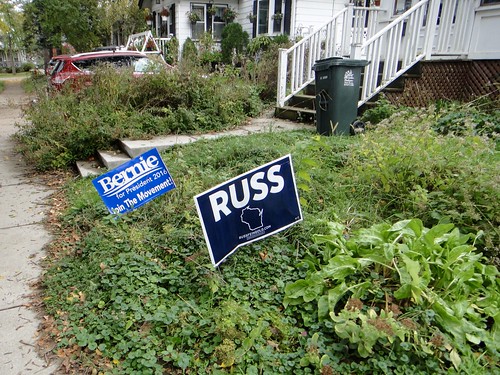
Most houses have no yard signs, but where I did see signs — on what was a 4-mile walk through various neighborhoods — they were signs for Russ Feingold (the Democratic Party candidate for the U.S. Senate) or for Marc Pocan (the Democrat running for reelection in our congressional district). There were almost no Hillary signs.
Were there any Trump signs? Of course not. But I did see a Trump sign in Madison yesterday. Somewhere on the East Side — which is the more left-wing side of town, so the sign must infuriate some people. We took an hour-long drive the other day — up around Devils Lake — and we did see Trump signs there, including one sign that said "Trump the Bitch." Imagine putting that in your yard!
Most houses have no yard signs, but where I did see signs — on what was a 4-mile walk through various neighborhoods — they were signs for Russ Feingold (the Democratic Party candidate for the U.S. Senate) or for Marc Pocan (the Democrat running for reelection in our congressional district). There were almost no Hillary signs.
Were there any Trump signs? Of course not. But I did see a Trump sign in Madison yesterday. Somewhere on the East Side — which is the more left-wing side of town, so the sign must infuriate some people. We took an hour-long drive the other day — up around Devils Lake — and we did see Trump signs there, including one sign that said "Trump the Bitch." Imagine putting that in your yard!
“Watched 'Saturday Night Live' hit job on me. Time to retire the boring and unfunny show."
"Alec Baldwin portrayal stinks. Media rigging election!"
Tweeted Donald Trump.
Unfunny? Judge for yourself:
We laughed a lot. Baldwin's impersonation of Trump certainly doesn't stink. Obviously, "SNL" is on the Clinton side politically, but why not laugh at yourself? And remember when Trump was on the show? That was last November, blogged here. They did a good job with him then, I think. But of course, back then, they probably didn't think he'd end up as the nominee... or they thought that if he was the nominee, Hillary would easily trounce him. Now, they must see the need to contribute to the effort to destroy him, and yet I thought the cold open (the embedded clip) was pretty gentle and mostly funny because it was silly — Trump looming in the background and moving around in the town hall debate.
Tweeted Donald Trump.
Unfunny? Judge for yourself:
We laughed a lot. Baldwin's impersonation of Trump certainly doesn't stink. Obviously, "SNL" is on the Clinton side politically, but why not laugh at yourself? And remember when Trump was on the show? That was last November, blogged here. They did a good job with him then, I think. But of course, back then, they probably didn't think he'd end up as the nominee... or they thought that if he was the nominee, Hillary would easily trounce him. Now, they must see the need to contribute to the effort to destroy him, and yet I thought the cold open (the embedded clip) was pretty gentle and mostly funny because it was silly — Trump looming in the background and moving around in the town hall debate.
"Donald Trump has lost little support since the first presidential debate, despite days of damaging news stories about his treatment of women, according to a new poll."
"Hillary Clinton leads Trump 47 percent to 43 percent among likely voters in a four-way race, according to the latest ABC News/Washington Post national poll."
That's Politico, putting in rather bland terms something that ought to be powerfully alarming to those who cannot abide even the risk that Trump could win the presidency. Why isn't he losing by a lot more? What explains his pesky resiliency?
As for Trump, the battering he's taking is epic, but he still survives.
Oh, sorry. That's just something I channel-surfed into on TV yesterday. It flashed back on me somehow.
Godzilla is a monster, causing endless destruction, but when he goes down losing, you get this crazy empathy for him. Am I saying Trump is a monster? Trump is like a monster, tromping through the built-up structures of American politics. How can he be stopped? Nothing seems to work. He keeps going. Yes, but in the end, he'll go down. Afterwards, you'll remember and think oddly fondly of him, and the characters who defeated him won't have your heart. Unlike a dead movie monster, Trump will still be a live human being, doing... whatever. The movie monster, even though killed in the movie, manages — if we've loved him — to get brought back to life for the sequels and remakes. But Trump will be around, and we'll want to see him again. His relentless, unstoppable rampage was so perversely rousing and even, for some, endearing.
Writing this makes me remember that Scott Adams has been talking about Trump's campaign as a movie. Adams saw Trump as the protagonist in a non-monster movie:
And what's missing from Adams's movie analysis is the monster hero. We want his rampaged stopped, we expect the closure that comes with killing him, and our deep psychic connection to the monster comes not as he wins but as he dies. Look how profound and exalted it is when Godzilla dies:
That's Politico, putting in rather bland terms something that ought to be powerfully alarming to those who cannot abide even the risk that Trump could win the presidency. Why isn't he losing by a lot more? What explains his pesky resiliency?
Nearly 70 percent say they believe that Trump has “made unwanted sexual advances toward women,” a stunning number that comes after the publication of lewd comments the now-Republican nominee made on a hot mic in 2005, and amid allegations by several women who say he touched them inappropriately. (Trump has said his comments were just "locker room talk" and denies the groping accusations.)And yet, she's only got 4 points on him. She must be truly loathed. I know she wants to win, but imagine winning like that, knowing you are not wanted.
And a majority of registered voters -- 55 percent -- say that Trump's treatment of women is a legitimate issue, version 42 percent who say it wasn't. Similarly, most voters aren't buying Trump's apology for the 2005 video -- 57 percent of registered voters say it was insincere, and only 40 percent agree it sounded like "typical locker room talk by men."
Just 30 percent of registered voters say Trump has a “strong moral character,” versus 45 percent for Clinton. Only 34 percent view Trump as honest and trustworthy, down from 42 percent in last month’s survey. And just 34 percent say Trump has the right temperament to be president, while 59 percent say Clinton does.
As for Trump, the battering he's taking is epic, but he still survives.
Oh, sorry. That's just something I channel-surfed into on TV yesterday. It flashed back on me somehow.
Godzilla is a monster, causing endless destruction, but when he goes down losing, you get this crazy empathy for him. Am I saying Trump is a monster? Trump is like a monster, tromping through the built-up structures of American politics. How can he be stopped? Nothing seems to work. He keeps going. Yes, but in the end, he'll go down. Afterwards, you'll remember and think oddly fondly of him, and the characters who defeated him won't have your heart. Unlike a dead movie monster, Trump will still be a live human being, doing... whatever. The movie monster, even though killed in the movie, manages — if we've loved him — to get brought back to life for the sequels and remakes. But Trump will be around, and we'll want to see him again. His relentless, unstoppable rampage was so perversely rousing and even, for some, endearing.
Writing this makes me remember that Scott Adams has been talking about Trump's campaign as a movie. Adams saw Trump as the protagonist in a non-monster movie:
He explains that in the first act of a movie, "something unexpected [happens] that changes somebody's life trajectory" -- like deciding to run for president. In the second act, "you would see your protagonist overcoming a number of smaller hurdles," ending with the discovery of a seemingly unsolvable problem. In the third act, the protagonist grows or changes in order to solve the unsolvable problem.With that template, Adams predicts Trump will win the election. The protagonist solves his problem in the movie, and that could happen in real live because
He... wrote [last October]: "Once we recognize the movie form, we root for the hero, automatically. We have been trained by Hollywood to do that. You can’t turn it off in your mind. You can’t ignore it. If a candidate can wrap his or her personal story into a three-act form, that is the highest level of persuasion."So this is the idea that movies have trained our minds to identify the hero and root for him, especially as his problems become insurmountable. Within that template, everything bad that happens to Trump is good, because it sets up the profoundly satisfying emotional reward. The audience/voters could make him win, because deeply, psychically we want the hero to win. But it's one thing to watch and feel satisfaction when the hero overcomes all the obstacles. It's another to get up off the couch and translate your deep desires into the real-world action of voting.
"The idea of the third-act problem usually involves a character flaw of your hero," he explained [in mid-August]. "It is a problem that they specifically can't solve because of a character defect. They're afraid of something, they can't forgive, they've been a liar all their life until now... That's what makes it a good movie, we like to see people change in some positive way. That's what makes us feel good. Because in the real world we don't see it happen, hardly ever."
And what's missing from Adams's movie analysis is the monster hero. We want his rampaged stopped, we expect the closure that comes with killing him, and our deep psychic connection to the monster comes not as he wins but as he dies. Look how profound and exalted it is when Godzilla dies:
"It seems to me if you can speak, you're at a liability in the Democratic Party anymore. It seems to me you've all become heartless technocrats."
"It seems to me that you forget that... we have never as a party moved this nation by 14-point position papers and 9-point programs. It seems that when we got involved in the civil rights movement... nobody asked Martin Luther King what his legislative agenda was. He marched to change attitudes. When the women's movement started, it had not moved with a constitutional amendment. They marched to change attitudes. And this party better understand full well that it's about time that we change our attitude and we begin to change the attitudes of Americans about what their responsibilities are to the poor, about what their responsibilities are to other people, and about what our responsibility in the world is, and that requires changing attitudes. But... I promise you'll see my 15-point plans and 19-point position papers and... you'll be able to make a judg[ment] about whether... I know more about economic policy. But ultimately... this country needs a leader, and leaders change attitudes about people, and it's the ironic twist that in the wake of Ronald Reagan that the only one thing he knew how to do was the one thing that is now being... the currency of which is in fact now being devalued so much."
That's something Joe Biden said in 1987 (when he was running for President). I quoted that back in August 2008, relating it to Barack Obama. I imagined Obama hearing Biden's remarks and seeing his path to the presidency, seeing how he might be the one who could, like Ronald Reagan and Martin Luther King, use the power of speech to change attitudes.
The reason I'm dragging this up out of the archive this morning is I'm noticing how Biden's idea also applies to Trump. Maybe Trump too heard Biden's idea and saw that the presidency is achieved through speech — emotionally rousing speech that changes attitudes.
Of course, there are many possible attitudes. Which way are you going to change the attitudes? And what attitudes will be inspired in response to how that attitude looks in the people you inspire? In Trump's case, the response to the attitude he inspired turned a lot of people back to the kind of Democratic Party candidate Biden was speaking against — the flat, dull speaker with the 14-point position papers and 9-point programs.
Talk about an ironic twist.
That's something Joe Biden said in 1987 (when he was running for President). I quoted that back in August 2008, relating it to Barack Obama. I imagined Obama hearing Biden's remarks and seeing his path to the presidency, seeing how he might be the one who could, like Ronald Reagan and Martin Luther King, use the power of speech to change attitudes.
The reason I'm dragging this up out of the archive this morning is I'm noticing how Biden's idea also applies to Trump. Maybe Trump too heard Biden's idea and saw that the presidency is achieved through speech — emotionally rousing speech that changes attitudes.
Of course, there are many possible attitudes. Which way are you going to change the attitudes? And what attitudes will be inspired in response to how that attitude looks in the people you inspire? In Trump's case, the response to the attitude he inspired turned a lot of people back to the kind of Democratic Party candidate Biden was speaking against — the flat, dull speaker with the 14-point position papers and 9-point programs.
Talk about an ironic twist.
October 15, 2016
"The Most Important WikiLeaks Revelation Isn’t About Hillary Clinton."
"What John Podesta’s emails from 2008 reveal about the way power works in the Democratic Party," by David Dayen in The New Republic. (Podesta was a co-chair of Obama’s transition team.)
"The BBC has admitted mistaking footage of a 'third rate' Bob Dylan impersonator for the singer in a report about his Nobel Prize award."
"Instead of using stock footage of the artist singing his hits on the BBC's Six O'Clock News, a young producer at the corporation mistook a tribute act for the folk legend...."
An inside source said: "It looks like they asked someone who didn't really know much about Dylan to find footage for the report. Perhaps when you're in your 20s one old rock star looks pretty much like another. But anyone editing the package should have known something was wrong. Dylan's voice isn't exactly smooth, but this guy sounded like someone strangling a cat!"
Why not Evan McMullin?
"Evan McMullin’s Moonshot White House Bid Has Utah’s Attention" (NYT).
"How Evan McMullin Could Win Utah And The Presidency/It’s unlikely, but far from impossible" (FiveThirtyEight).
I don't have the option of voting for Evan McMullin. The ballot I'll be marking here in Wisconsin looks like this:

3 of those names I'm completely unfamiliar with. Anyway... we could write in McMullin.
"How Evan McMullin Could Win Utah And The Presidency/It’s unlikely, but far from impossible" (FiveThirtyEight).
I don't have the option of voting for Evan McMullin. The ballot I'll be marking here in Wisconsin looks like this:
3 of those names I'm completely unfamiliar with. Anyway... we could write in McMullin.
Rock corner.
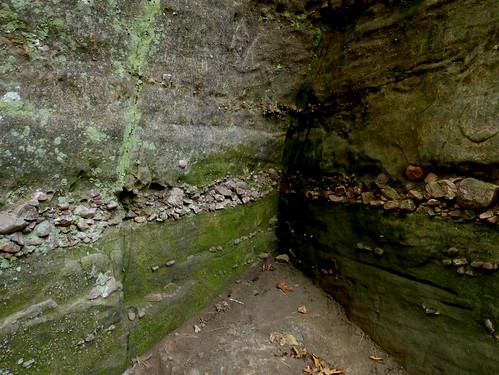
Photographed yesterday, at Parfrey's Glen.
I like the way it looks like a cake with a slice cut out, complete with a layer of filling. How did that layer of broken-up rock get in there?
Norway will not give Finland a mountain for its birthday.
It's Finland's 100th birthday next year, and there has been a social media campaign to get Norway to give Finland the summit of Halti mountain, which is already partly in Finland, with the summit just 66 feet inside of Norway. It would hardly change the border at all to redraw the map to put the summit on the Finnish side.
Fortunately or unfortunately, the Norwegian constitution bars giving up any territory and the Norwegian Prime Minister Erna Solberg said no to the cute birthday idea.
I made a screen grab from Google maps:

Fortunately or unfortunately, the Norwegian constitution bars giving up any territory and the Norwegian Prime Minister Erna Solberg said no to the cute birthday idea.
I made a screen grab from Google maps:
Subscribe to:
Posts (Atom)


 Posts
Posts


