Showing posts with label Lessig. Show all posts

February 11, 2024

"Four years ago, months before Trump launched his stolen-election conspiracy, Lessig and Seligman devised a class at Harvard law school: Wargaming 2020."

"They looked at whether it would be possible to hack the presidential election and send the losing candidate to the White House. Their conclusion was that American democracy had dodged a bullet. 'We discovered that Trump didn’t really understand what he could have done,' Lessig says. 'There were obvious moves he and his team could have made, but they didn’t take them.' The insurrection on 6 January 2021 was tragic in its loss of life, but as a method of overturning the election it was the 'dumbest thing they could have possibly done. No court would ever allow the election to be decided by force of bayonets.'..."

From "How to steal a US election: Harvard’s Lawrence Lessig on Trump’s new threat/Law professor’s new book offers a stark warning about loopholes that could let Republicans overturn the election" (The Guardian).

1. If physically taking over the building is an incredibly dumb way to try to steal the election, that's a reason to infer that there was no intent to steal. It would make more sense to say that Trump thought that a big demonstration would motivate Congress to undertake some additional process that would determine whether the votes had been accurately counted and that might legitimately change the outcome.

2. If it's obvious that different moves can be made to steal the election, why is it supposed to be so outlandish for Trump to have questioned whether the Democrats stole the election? Maybe they made some of those "obvious moves."

3. Is it too much to ask for some nonpartisan assurance that American elections are not stolen? I like the idea of a book called "How to Steal a Presidential Election" (commission-earned link), but is it just about how Trump might steal the election or does it take threats from all sides seriously? I can't believe that only Trump is tempted to cheat and that only his stupidity saved us last time. Surely, some cheating has gone on throughout American history, and democracy is always under attack, whether the orange man is afoot or finally, at long last, out of our hair.

4. It's not anti-democratic to be suspicious that what purports to be the result of a democratic process could be wrong. Lessig himself is expressing that suspicion. 

ADDED: There's an old saying: It takes a thief to catch a thief. That's why they have to teach theft at Harvard Law School.

October 17, 2017

Lawrence Lessig tells us the 5-step procedure for getting Hillary to be President, and none of the steps are "????"

But you probably already know what these steps are. They're just so unlikely that they're obviously not going to happen:
If number 1: If Trump is definitively found to have colluded directly with Russia, he would be forced to resign or be impeached.

If number 2: If Trump is removed, Vice President Mike Pence would become president.

If number 3: If Pence becomes president, he should resign too, given that he benefited from the same help from Mother Russia.

If number 4: If Pence resigns before appointing a vice president, Ryan would become president.

If number 5: If Ryan becomes president, he should do the right thing and choose Clinton for vice president. Then he should resign.
I'm quoting the paraphrasing at Newsweek, by Julia Glum. I don't like the wording at #1, "If Trump is definitively found to have colluded directly with Russia...." That makes it sound as though he's already been found to have colluded with Russia (just not "definitively" or "directly").

And I hate the jocose use of the term "Mother Russia." I know that female personification of the country exists in Russian history — originally in an anti-Bolshevik context...


Glum's use of the phrase feels like some stray sexist taunting — as if Trump and Pence are mama's boys.

Here's the Lessig original, at Medium. It doesn't have the wording that bothers me. Step 1 is:
What if there were a conspiracy?

This “if” has got to be specified very precisely. The question is not whether Trump obstructed justice, or is guilty of tax evasion, or has violated the Emoluments Clause or done any other act justifying impeachment. The “if” here is quite specific: It relates explicitly to the validity of the election. The question I’m asking here is what should happen if Trump conspired with a foreign government to get elected?
Lessig doesn't even say "colluded with." He says "conspired with." Step 1 is a huge "if," and Lessig isn't implying (as I read this) that we're already part of the way toward finding a conspiracy. I'd say that so much time and effort have been put into looking for collusion/conspiracy that we're pretty far along toward saying definitively that there wasn't one.

But I think something else is missing here, something that is key toward establishing points #3 and #5. Was the participation of Russia what caused Hillary Clinton to fall as short as she did in the Electoral College? If only Trump conspired, but Trump won because of his open message to the voters and Hillary Clinton's shortcomings, then we're missing a causation element that would be needed to reject Pence and Ryan and to persuade Ryan that the "right thing" would be to give the presidency to Hillary. Lessig says:
By hypothesis, we’re assuming the office was effectively stolen from the legitimate winner by a criminal and treasonous act of the (previous) leader of Ryan’s own party.
No. Even if we knew that Trump conspired with Russia to get Russia to do some things like spread disinformation in social media, we wouldn't know that without that, Hillary would have won.

I don't think the things Russia is said to have done were enough to shift the Electoral College victory from Hillary to Trump. So, let's say Step 1 is satisfied. Okay: Impeach Trump. But unless you can establish that without that conspiracy, the people would have elected Hillary, you haven't shown why the people aren't entitled to have Pence as their President, and you haven't shown why Ryan would step down and why he would bring in the defeated candidate from the other party.

I know it's hard for Lessig and many others to believe that the people preferred Trump — the man and his policies — to Hillary Clinton — the woman and her policies — but that's what I think happened, and it would be very hard to make me believe that something the Russians did tipped that preference.

Professor Lessig, you need a causation element. 

April 30, 2017

On not being Facebook's "you."

Facebook assumes you use Facebook to keep in touch with family and friends by displaying yourself a nice person, a person with friends and family who loves smiling faces and romping doggies. We have this very modern, pushing-the-envelope form of communication, but it wants customers in the billions, so it has to picture The Customer as a pretty conventional person. It talks to this person as "you," and being on the receiving end of that "you," I often feel insulted. Like this morning:


IN THE COMMENTS: Fernandinande said:
Strongly worded letter follows.

I don't like the way the tip of the dog's ear extends into the white border of his picture. I also don't like the fact that a different dog is in front of that picture.
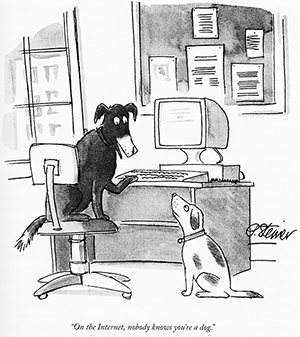
LOL. But I like the implication that the dog is on Facebook sharing dog pictures. It's a fantastic representation of how Facebook undermines the beauty of the internet as expressed in the classic cartoon:


By the way, that cartoon has its own Wikipedia page. Excerpt:
Peter Steiner, a cartoonist and contributor to The New Yorker since 1979, said the cartoon initially did not get a lot of attention. Later it took on a life of its own, and that he felt similar to the person who created the "smiley face". In fact, Steiner was not that interested in the Internet when he drew the cartoon, and although he did have an online account, he recalled attaching no "profound" meaning to the cartoon; it was just something he drew in the manner of a "make-up-a-caption" cartoon....

The cartoon symbolizes an understanding of Internet privacy that stresses the ability of users to send and receive messages in general anonymity. Lawrence Lessig suggests "no one knows" because Internet protocols do not force users to identify themselves; although local access points such as a user's university may, this information is privately held by the local access point and is not an intrinsic part of the Internet transaction.....

November 2, 2015

"Good. You just can't run for president based on a fantasy that there's only one issue that matters."

"In the real world, there's no way around the fact that the president has to deal with multiple issues every day, and the people won't accept a president who doesn't take the whole job seriously."

Says my son John, commenting on the news that Lawrence Lessig has dropped out of the presidential race. The reason Lessig gives is not, however, that people won't accept a candidate with a single-issue campaign, but that he never became well-known enough, and he blames the Democratic Party for excluding him from the debates.

But I wouldn't criticize the Party for failing to open up the debates for the purpose of helping advocates of single issues. And my reason is precisely what John is talking about: I don't take this person seriously as a real candidate.

September 9, 2015

"Lessig says he grew up a church-going 'right-wing lunatic Republican' and entered Trinity College at the University of Cambridge as a 'libertarian theist' in his early 20s."

"One year studying philosophy soon snowballed into three, and Lessig left England 'no longer much of a theist' despite the school’s Christian name and heritage. 'He came back a different person,' Lessig’s sister Leslie told Wired in 2001. 'His views of politics, religion, and his career had totally flipped.' Lessig has been vague on his personal faith in public interviews ever since."

From "5 faith facts about Lawrence Lessig: long shot, freedom fighter" in The Washington Post, under bullet-point 2: "He lost his faith in England." Later in the piece, it says: "Lessig may be mum on his own faith, but...."

What's up with "mum" and "vague"? Maybe "mum" and "vague" is a religion. Not all the mum-n-vaguers are atheists. No need to jump to the conclusion that Lessig is another one of the in-the-closet atheists who decline to participate in the public image of atheism, which is rather irritating and hostile and could stand some dilution.

ADDED: Grew up in "a church-going 'right-wing lunatic Republican'" what?  WaPo could use some editing. Presumably it's "family," but it could be "city." (He grew up in Williamsport, Pennsylvania.) Why would a candidate for President talk about his family/community with language like "right-wing lunatic Republican"? It's so divisive and abrasive. Maybe I was wrong to think that if he came out as an atheist, he'd mellow the existing atheist brand.

AND: Dialogue at Meadhouse.
MEADE (after reading the post): You say you lost your faith, but that's not where it's at.

ME: I was thinking about Bob Dylan too. I was thinking: "It's something I learned over in England."

MEADE (singing): You say you lost your faith, but that's not where it's at. You had no faith to lose, and you know it.

September 6, 2015

Harvard lawprof Lawrence Lessig announces he's running for President. "This stalemate, partisan platform of American politics in Washington right now doesn't work."

"And we have to find a way to elevate the debate to focus on the changes that would actually get us a government that could work again, that is not captured by the tiniest fraction of the 1 percent who fund campaigns and make it impossible for our government.... And also dealing with crazy way we have political gerrymandering where politicians pick the voters rather than the voters pick the politicians."

This morning on "This Week" (the Sunday show with George Stephanopoulos):
STEPHANOPOULOS: So, campaign finance reform, voting rights reform?... And you're saying that if you run, if you are running, if you win, if you become president and you pass that platform, you'll resign.

LESSIG: That's right. 
Reminds me of when Howard Stern ran for Governor of New York.  He said he'd fix 3 things and then resign. (His 3 things were: "pass the death penalty, let road crews work only at night, stagger highway tolls to prevent traffic jams.")

To me, this fix-something-and-quit idea reveals that the person is using the candidacy to promote the issue, getting leverage from the media's priority on covering candidates. But Stephanopoulos says: "That puts a lot of weight on who your vice president is."

September 8, 2014

"So yes, according to the Senate, Scott Brown isn’t a 'lobbyist.' But I submit to anyone else in the world..."

"... a former Senator joining a 'law and lobbying firm' to help with Wall St’s 'business and governmental affairs' is to make him a lobbyist. Because to anyone else in the world, when you sell your influence to affect 'business and governmental affairs,' you are a lobbyist."

Professor Lessig stands by his use of the word "lobbyist" in response to a stern demand from Scott Brown's campaign manager that he retract his statement. 

February 6, 2014

The famous lawprof Larry Lessig is walking across New Hampshire in the wrong kind of pants and it's a story in The New Republic because...

... well, you'll have to read a long way into this article to figure out why, and it's not the cause of knowing better than to wear jeans when hiking in cold, wet weather.

Wasn't there some old lady that was walking across America one time, for peace or something like that? And then there was Forrest Gump, running across America, getting to the end, then turning around and running the other way, and gathering followers, even though he had no message? Or was a happy face T-shirt the message? I don't know, but there's no way I'm sitting through that movie again to try to find out.

But I will try to read this TNR thing. Scanning to paragraph 7:
And so, while the New Hampshire Rebellion is patterned after the exploits of “Granny D,” the octogenarian campaign-finance-reform activist who walked the length of country in 1999...
Yes, that's the old lady I just mentioned. Granny D. Campaign finance reform? I'd forgotten. But she was noticed. Because she was old, and she was walking. The whole length of the country. Lessig is reasonably young, and he's only doing a 2-week, 185-mile walk. But he's famous, and he's savvy about getting publicity.
... Swartz is its real inspiration. Lessig sometimes calls the march “Aaron’s walk” and timed it to begin on the one-year anniversary of Swartz’s death. “That event radicalized me,” Lessig tells me. “It’s pushed me over an edge, a certain kind of edge.”
Pushed over the edge, by a young man who went over the edge into suicide.

Walking is a grand old way of spreading a message and gathering followers. It's the Jesus method. Imagine Jesus augmented with tweeting and TED talks and all the other mechanisms of modern media.

January 12, 2013

"Prosecutor as bully."

Lawrence Lessig on the suicide of Aaron Swartz (which we've already been talking about here). Lessig was Swartz's friend and — for a time — his lawyer:
From the beginning, the government worked as hard as it could to characterize what Aaron did in the most extreme and absurd way. The “property” Aaron had “stolen,” we were told, was worth “millions of dollars” — with the hint, and then the suggestion, that his aim must have been to profit from his crime. But anyone who says that there is money to be made in a stash of ACADEMIC ARTICLES is either an idiot or a liar. It was clear what this was not, yet our government continued to push as if it had caught the 9/11 terrorists red-handed.

October 1, 2010

Lawrence Lessig on that Facebook movie that we all have to see.

It's been a long time since we've had a movie in that category, don't you think? (Remember when Pauline Kael single-handedly forced everyone to sit through "Last Tango in Paris" and believe this was the movie we'd talk about for as long as human civilization endured?)

Lessig says:
[Aaron] Sorkin crafted dialogue for an as-yet-not-evolved species of humans—ordinary people, here students, who talk perpetually with the wit and brilliance of George Bernard Shaw or Bertrand Russell. (I’m a Harvard professor. Trust me: The students don’t speak this language.) With that script, and with a massive hand from the film’s director, David Fincher, he helped steer an intelligent, beautiful, and compelling film through to completion. You will see this movie, and you should. As a film, visually and rhythmically, and as a story, dramatically, the work earns its place in the history of the field.

But as a story about Facebook, it is deeply, deeply flawed....
The total and absolute absurdity of the world where the engines of a federal lawsuit get cranked up to adjudicate the hurt feelings (because “our idea was stolen!”) of entitled Harvard undergraduates is completely missed by Sorkin. We can’t know enough from the film to know whether there was actually any substantial legal claim here. Sorkin has been upfront about the fact that there are fabrications aplenty lacing the story. But from the story as told, we certainly know enough to know that any legal system that would allow these kids to extort $65 million from the most successful business this century should be ashamed of itself. Did Zuckerberg breach his contract? Maybe, for which the damages are more like $650, not $65 million. Did he steal a trade secret. Absolutely not. Did he steal any other “property”? Absolutely not—the code for Facebook was his, and the “idea” of a social network is not a patent. It wasn’t justice that gave the twins $65 million; it was the fear of a random and inefficient system of law. That system is a tax on innovation and creativity. That tax is the real villain here, not the innovator it burdened.
But great movies about law really do shape what people think about law and that affects what law means. How many will read and understand Lessig's pushback?

ADDED: Here's the famous Pauline Kael review — the most famous movie review of all time that we will think about for as long as there are movie reviews:
This is a movie people will be arguing about, I think, for as long as there are movies. They’ll argue about how it is intended, as they argue again now about The Dance of Death. It is a movie you can’t get out of your system...

May 14, 2010

It's the hotly anticipated Glenn Greenwald vs. Lawrence Lessig showdown!

The 2 have been fighting harshly in writing — see the "links mentioned" here — and now we can see them battle it out in real time:


ADDED: You can skip the first 9 minutes unless you want to hear: 1. 2 men murmur about civility or 2. Lessig's paper-shuffling that sounds like buildings being demolished.

June 13, 2008

"This was a private file server, like a private room, hacked by a litigant with a vendetta."

Lessig thinks that accessing Judge Kozinski's on-line porn stash was an invasion of privacy "perfectly" analogous to entering his house through a badly locked window and looking through his belongings:
The site was not "on the web" in the sense of a site open and inviting anyone to come in. It had a robots.txt file to indicate its contents were not to be indexed. That someone got in is testimony to the fact that security -- everywhere -- is imperfect....
In the comments, after a challenge — "I'm sorry, but there's no way that typing a URL into a web browser is analogous to jiggling a lock for 30 seconds" — Lessig backs away from the idea that the analogy is perfect:
I don't accept that this is a "public place" just because the public can easily get to it. But I'm also not arguing that someone should be treated as a trespasser because he or she wanders through a directory structure. My only point is that it was plain beyond doubt that this was not intended as a public place where anyone was invited to come and browse. Norms of privacy should therefore apply.
Another commenter — James Nightshade — pushes back:
Robots.txt is a voluntary access control mechanism, but it does not prevent resources from being "on the Web" in any sense. The document describing the robots.txt standard refers specifically to web robots. Robots.txt was not intended to apply to interactive web browsers. It is roughly analogous to a sign one might find beside a residential street: "No trucks except for deliveries." The street is still a part of the road network, even if some vehicles are asked not to visit.

Another example is the form I'm typing this into. It has an accompanying CAPTCHA form to identify robotic spam submissions. Blocking these robots doesn't effectively take the submission form off the Web. If one wants to avoid public access to a Web resource, there are access control mechanisms which can do that. Passwords are one example; robots.txt is not an example.
I'm not buying the analogy, but I get it that Lessig is trying to promote privacy on the web. Or not on the web. Whatever. I have a lot of trouble seeing what the "disgruntled litigant" did as "hacking" or trespassing.

Seems to me, when you're on line, you can poke around as much as you want and look at anything you can click to. Isn't that what most of us think? That's how we behave on line. In the physical world, we know we can't just go anywhere we can physically get to. Forget badly locked window. We won't even pull open an unlocked screen door to a house. I was going to say a "private building," which assumed the answer to the question about privacy, but that ordinary usage — public/building — shows that we have a deeply embedded expectation about privacy.

But Lessig's idea about privacy on the web is something I'd never even heard of. Lessig, of course, knows that. He prefaces his analogy with: "Cyberspace is weird and obscure to many people. So let's translate all this a bit." Are we just at the beginning of forming our expectations of privacy on line, or have we already decided we are free to look wherever we can go?

IN THE COMMENTS: MCG notes: "Alex Kozinski provided public links into his "stuff/" directory in the past." He points to this email Kozinski sent for publication on a high-profile blog. Kozinski thus eagerly invited the whole world into his back pages.