From "Sally Mann, in Her Golden Hour, Faces Fresh Culture Wars/One of America’s finest memoirists, in photos and in prose, is at the peak of her powers in 'Art Work'— and wondering if her pictures will survive" (NYT)(free-access link, so you can see some of her photos, not the seized photos, and read the whole story).
September 10, 2025
"In January, the Texas police entered a group exhibition at the Modern Art Museum of Fort Worth that featured [Sally] Mann, and they seized several photos from the 'Immediate Family' series..."
From "Sally Mann, in Her Golden Hour, Faces Fresh Culture Wars/One of America’s finest memoirists, in photos and in prose, is at the peak of her powers in 'Art Work'— and wondering if her pictures will survive" (NYT)(free-access link, so you can see some of her photos, not the seized photos, and read the whole story).
July 13, 2024
"You studied semiotics in college. I’m curious if that also shapes the way you think of narrative...."
Sarah Larson asks Ira Glass, in "Ira Glass Hears It All/Three decades into 'This American Life,' the host thinks the show is doing some of its best work yet—even if he’s still jealous of 'The Daily'" (The New. Yorker).
For me, the most important book was “S/Z,” by Roland Barthes, where he takes apart a short story by Balzac phrase by phrase, paragraph by paragraph. What he’s interested in is, How does this story get its hooks into you? Why do you read to the next paragraph? Why do you care? And that feeling that you get at the end of a really good story, where you just feel, like, Ahh!—what produces that? And he names a bunch of mechanisms that, once you know them, you can create yourself.
April 10, 2022
"The day after his mother died in 1977, Barthes began writing reflections of her death on small strips of paper. The collection of 330 cards..."
"... was published... as 'Mourning Diary.'... Note by note, he attempted to record and make sense of his mother’s passing in a collection of reflections accumulated into a postulation of a book. In one of his earliest entries, he notes how after someone dies, the future itself gives way to a sort of unhinged manufacturing of time he refers to as 'futuromania.'"
From "A memoir of loss, in encyclopedia entries/When my mother died, I struggled to untangle grief, time and memory" by Kristin Keane (WaPo).
Her memoir is called "An Encyclopedia of Bending Time." I would rule out reading any author who puts words together like this: "a collection of reflections accumulated into a postulation." It's close to the way rap music sounds to me, except for "accumulated." Try again, with "accumulation," and you might achieve something with intentional rhymomania.
June 22, 2019
"How Change Happens, Sunstein tells us, 'reflects decades of thinking.' This is another way of saying that it repeats decades of writing."
From "The Sameness of Cass Sunstein/His books keep pushing the same technocratic fixes. But today’s most pressing questions cannot be depoliticized" by Aaron Timms (The New Republic), which as you can tell from the subtitle, goes on to find more substantive problems than chatty repetition.
What does "Like an unstuck Mallarmé" mean? I had to look it up. Here (from "Blocked/Why do writers stop writing?" (The New Yorker, 2004)):
After the English Romantics, the next group of writers known for not writing were the French Symbolists. Mallarmé, “the Hamlet of writing,” as Roland Barthes called him, published some sixty poems in thirty-six years. Rimbaud, notoriously, gave up poetry at the age of nineteen. In the next generation, Paul Valéry wrote some poetry and prose in his early twenties and then took twenty years off, to study his mental processes. Under prodding from friends, he finally returned to publishing verse and in six years produced the three thin volumes that secured his fame. Then he gave up again. These fastidious Frenchmen, when they described the difficulties of writing, did not talk, like Wordsworth and Coleridge, about a metaphysical problem, or even a psychological problem. To them, the problem was with language: how to get past its vague, cliché-crammed character and arrive at the actual nature of experience. They needed a scalpel, they felt, and they were given a mallet.So you get what Timms is saying about Sunstein.
July 3, 2018
The brown spot.
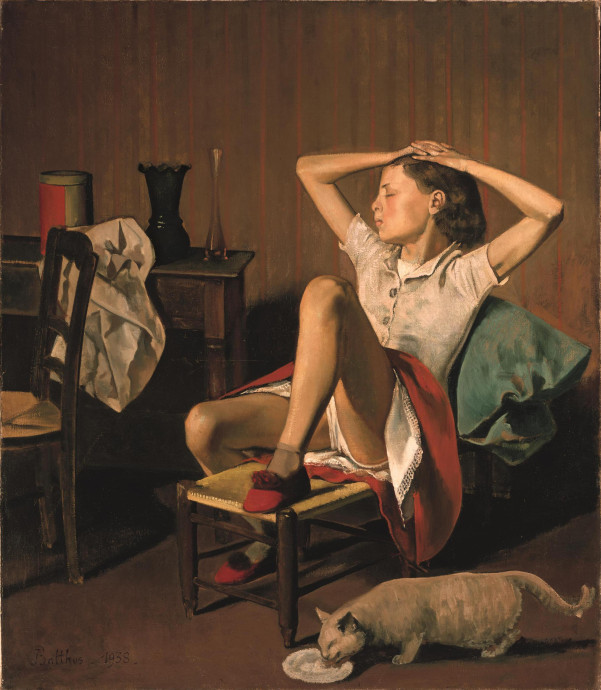
I recently discussed [the Balthus painting] Thérèse Dreaming with an older woman, an architect and former museum conservator. She told me that one thing she disliked about the painting was the brown spot on the girl’s underwear, which guided the viewer’s attention in a way that felt manipulative. I wasn’t sure if she was bothered by the brownness of the spot—with its possible menstrual or scatological connotations—or just the spot’s function as a focal point that drew one in, that narrowed one’s attention (like the punctum of a photograph, in Roland Barthes’s phrase—the point of interest, “that accident which pricks me”). Whatever the case, I was highly skeptical—in fact, in complete denial. I had looked carefully at the painting and had never noticed a brown spot. The whole thing struck me as absurd. The spot, I told myself, must be a projection of her imagination onto the painting.Here's the painting...
Feeling unsettled, however, about my own dismissiveness, I returned again to the Met and to Thérèse Dreaming. This time, I saw it, a sort of brown triangular shadow across the bottom of the girl’s panties and the slip of her skirt. I had been wrong after all about the absence of the spot. Still, it remained for me a rather incidental detail. I experienced no “prick”; it did not draw me in; it barely registered at all. Certainly I did not feel that I had been manipulated by Balthus.

... seen previously on this blog, last December, in "The Metropolitan Museum of Art declines to remove a painting that is — according to a petition — 'undeniably romanticizing the sexualization of a child.'"
ADDED: What's great about the painting is that it makes you aware of your own mind: What is it about this painting that is making me uneasy — that's making think strange things that I don't ordinarily think?
You study the painting. You try to find what the artist did to inspire these sensations. You may think: It can't be me. It must be the artist.
That's what so interesting about people like that architect lady who decided it was the brown spot.
You might wonder: Is this artist a genius for doing what he did to me with this image? Or is there something about me?!!
And perhaps you get to this sort of reasoning: He must be a great artist or there's something wrong with me. So then... he's doing it, and that's so wrong of him! Punish him! You must punish him so that I may go free and get back to my comfortable life!
But art should make you uncomfortable, and it would be wrong to help you find your way back.