You try it. Gaze. Stare into the face...

The change is at the heart of a re-engineering of the National Security Council’s role under its new leader, Lt. Gen. H. R. McMaster, and reflects Mr. Trump’s belief that the N.S.C. should focus less on military operations and tactics and more on strategic issues. A guiding precept for the president and his team is that the balance of power in the world has shifted against American interests, and that General McMaster should focus on developing foreign and economic policy options in concert with the Pentagon, State Department and other agencies to respond to that challenge....
“In defense of the Obama administration, every single time we went to the president and asked for something more, we eventually got it, though we often had to jump through a lot of hoops,” said Andrew Exum, a former Army Ranger who held a senior position at the Defense Department under Mr. Obama. “The episode that took the cake was toward the end of the administration, when we literally had cabinet secretaries debating the movement of three helicopters from Iraq to Syria.”
A rhetorical version of dodge ball is a favored tactic for nominees regardless of where they stand on the political spectrum. It has been employed successfully by a liberal like Ruth Bader Ginsburg and by a conservative like Clarence Thomas. John G. Roberts Jr., at the 2005 Senate hearing on his nomination as chief justice, famously likened his role to that of an umpire calling balls and strikes, a disinterested neutral force....Maybe this is news to someone, but Supreme Court nominees have learned to say the same stock things and to reveal nothing. The only interest is whether the nominee looks the part, sounds intelligent (while saying basically nothing), seems earnest but relaxed, and shows a little humor or personality. But not too much!


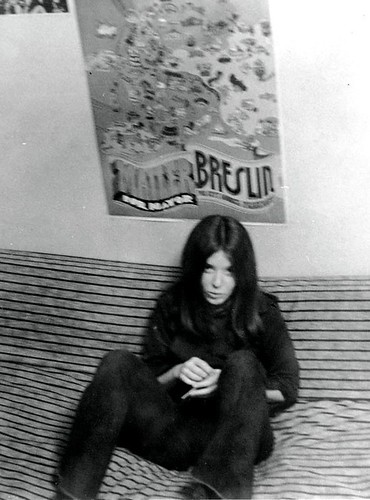
With prose that was savagely funny, deceptively simple and poorly imitated, Mr. Breslin created his own distinct rhythm in the hurly-burly music of newspapers. Here, for example, is how he described Clifton Pollard, the man who dug President John F. Kennedy’s grave, in a celebrated Herald Tribune column from 1963 that sent legions of journalists to find their “gravedigger”:This is me, in 1970, sitting under a Mailer/Breslin poster:
“Pollard is forty-two. He is a slim man with a mustache who was born in Pittsburgh and served as a private in the 352nd Engineers battalion in Burma in World War II. He is an equipment operator, grade 10, which means he gets $3.01 an hour. One of the last to serve John Fitzgerald Kennedy, who was the thirty-fifth President of this country, was a working man who earns $3.01 an hour and said it was an honor to dig the grave.”
And here is how he described what motivated Breslin the writer: “Rage is the only quality which has kept me, or anybody I have ever studied, writing columns for newspapers.”
His running mate for City Council president was the columnist Jimmy Breslin, who suspected the worst from the very beginning: that Mr. Mailer was serious....I love the random resonances of blogging: Ezra Pound just came up 2 days ago. Poets. Poetry. I love it all. Even the "lofty oratorical perch." Reminds me of that famous Samuel Johnson line: "Sir, a fish's preaching is like a dog's walking on his hind legs. It is not done well; but you are surprised to find it done at all."
Mr. Breslin recently recalled Mr. Mailer’s arguing brilliantly at Brooklyn College that the minds of white and black children would grow best if they were together in the same classrooms. One student interrupted: “We had a lot of snow in Queens last year and it didn’t get removed,” he said. “What would you do about it?” To which Mr. Mailer, abruptly dislodged from his lofty oratorical perch, replied that he would melt the snow by urinating on it.
Mr. Mailer’s political nadir was a campaign rally at the Village Gate nightclub where he vilified his own supporters as “spoiled pigs.” Mr. Breslin left the rally early. He later told a friend, “I found out I was running with Ezra Pound.” Mr. Breslin was referring not to Pound’s poetry, but to his insanity.
Mr. Mailer’s “left-conservative” platform called for a monorail, a ban on private cars in Manhattan and a monthly “Sweet Sunday” on which vehicles would be barred from city streets, rails or airspace altogether. He championed self-determination — the city itself would secede and become the 51st state. Individual neighborhoods would be empowered to govern according to their own prerogatives, which could range from compulsory free love to mandatory church attendance.

As easy it was to tell black from whiteBut it's all lost to the distant past. I'm not 19 anymore. Norman's gone. Jimmy's gone. The is-he-insane blustery assemblage of masculinity isn't a satirical mayoral candidate but President of the United States. And there's no newspaper columnist to give a damn about.
It was all that easy to tell wrong from right....
How many a year has passed and gone
And many a gamble has been lost and won
And many a road taken by many a friend
And each one I’ve never seen again
I wish, I wish, I wish in vain
That we could sit simply in that room again....
Rolling Stone magazine wrote, "Rock & roll guitar starts here." The record is an early instance of the complete rock-and-roll package: youthful subject matter; a small, guitar-driven combo; clear diction; and an atmosphere of unrelenting excitement. The lyrics describe a man driving a V8 Ford chasing his unfaithful girlfriend in her Cadillac Coupe DeVille.What's more rock-and-roll than clear diction? I think if you have great lyrics, you'll do clear diction. That's something about Bob Dylan too: You could always understand the words (maybe not what they really meant, but you could hear the words). If you have lyrics like "On the ship, I dream she there/I smell the rose that's in her hair," you might prefer to mush them into unintelligibility.
“Nadine (Is That You?)” is the Technicolor remake of “Maybelline,” another chase after another woman, but with a cawing saxophone and super-charged language. “I was campaign shouting like a Southern diplomat”? You have the rest of your life -- write one phrase that damn good. There’s probably no better musical advertisement for marriage than the footloose “You Never Can Tell,” about two dumb, wedded New Orleans kids who live happily ever after, shimming and canoodling and subsisting on “TV dinners and ginger ale” (kept in their “coolerator,” Berry will have you know). But best of all, there’s “Promised Land,” in which Chuck skedaddles from Norfolk to L.A. in 2:24 and along the way seems to address every promise of American life and how to get by after it’s broken.4. NYT: "15 Essential Chuck Berry Songs." Spotify playlist. One song is “Too Much Monkey Business” (1956):
No one before Mr. Berry thought to write a pop song about the headaches of paying bills or losing your change in a pay phone. In his 1987 autobiography, he wrote that the lyrics were “meant to describe most of the kinds of hassles a person encounters in everyday life.” The chugging, rapid-fire vocal delivery would inspire Mr. Dylan’s breakthrough word salad “Subterranean Homesick Blues,” and when Mr. Berry won the first PEN New England Song Lyrics of Literary Excellence Award in 2012, Mr. Dylan sent a congratulatory note saying, “That’s what too much monkey business will get ya.”5. Heavy: "Chuck Berry Top Hits: Best Songs to Remember Him By."
In 1963’s “Memphis, Tennessee,” the lyrics describe a man speaking to an operator trying to get in contact with a girl, Marie, who lives in “Memphis, Tennessee.”6. Billboard: "Chuck Berry Didn't Invent Rock n' Roll, But He Turned It Into an Attitude That Changed the World."
It tells a surprisingly complex tale, with the audience being lead to believe that Marie is the man’s girlfriend, only for it to be revealed that she is actually his daughter, with it being implied that the man’s ex-wife took Marie away.
As for his songwriting, Berry eschewed generic emotional confessions and instead focused on crafting short stories with his lyrics. His songwriting style -- economical, vivid and enveloping -- influenced everyone from Paul McCartney to Ray Davies to Brian Wilson and set the course for rock to favor the short and sweet instead of the poetic and verbose. That's just not something his contemporaries were pioneering -- Little Richard's lyrics were brilliant nonsense, Bo Diddley's were stream of consciousness poetry, and Elvis Presley didn't write his own material. So Berry's introduction of storytelling into rock can't be overstated, particularly since that's what helped the genre stand out from straight pop in its first few decades.7. Campus News: "Giants of pop owe it all to Chuck Berry."
John Lennon once said, “In the’50s, when people were just singing virtually about nothing, he was writing social-comment songs; he was writing all kinds of songs with incredible meter to the lyrics, which influenced Dylan and me and many other people.”...
Berry... sued Lennon for pilfering his lyrics for The Beatles’ “Come Together”… and won that case, too. (It was settled out of court.)
See, the LSAT is a speed bump.... The LSAT was rough. The logic games that make up its most infamous section are real killers... Studying was grueling, repetitive and at times mind-numbingly boring, adjectives that happen to have quite a bit of overlap with the way some lawyers would describe their jobs.As if law schools should set up a barrier so that only the grinds get in! That's not the diverse and exciting classroom experience we're looking for. And if being a lawyer is so terrible, what does it matter what kind of a barrier to entry we set up?
And remember, studying for the LSAT creates a lot of angst — but so will being a lawyer, if being a lawyer isn’t for you.But that's the question: Who is it for? Green seems to be saying that being a lawyer is for people who put up with a lot of grueling, boring angst and that taking the LSAT is evidence that you do. But Green is talking about studying for the LSAT, not merely taking it — studying and studying hard. That may be something that boring, grind-y strivers do, but it's not necessary. I don't remember studying hard for the LSAT, and I scored in the top percentile. I know other people who can say that too. So the LSAT doesn't really measure for this quality Green assumes is key to being a happy lawyer. And I'm sure that many people who concentrated on taking the GRE are also capable of knuckling down to some hard work.
While living in neighboring Dallas County, she registered to vote before the 2012 election, checking a box on the registration form that certified that she was a United States citizen. After voting in 2012 and 2014, she moved to Fort Worth’s Tarrant County in 2015, where she registered to vote again — this time, ticking the box that indicated she was not a citizen.When she told the truth, she was not able to register.
When her registration was rejected, she called elections officials, telling them that she had voted in Dallas. Told that people who checked the noncitizen box were ineligible to vote, she reapplied, this time indicating that she was a citizen.Finally, the authorities took notice and she was prosecuted. It took all those steps for her to trigger a consequence. That is, if she'd just checked the "citizen" box all along, she'd have gotten away with it. (Like so many others?) And we're invited to feel sorry for her because she's facing punishment:
Her punishment may be unprecedented for an offense that often draws a minimal sentence or probation.... The case resonates in a polarized political environment where some are convinced that immigrants threaten to upend the nation’s shared values more than they continue its long history of accepting and assimilating outsiders. Ms. Ortega’s lawyers say they believe the severity of the sentence stems from the furor over immigration and false claims about voter fraud raised by Donald J. Trump’s nationalistic presidential campaign.....Baseless? If you believe that, you'd have to think that all noncitizens should just be told to go ahead and vote by simply checking the "citizen" box when they register. How is Ortega a scapegoat? She made herself conspicuous. Her only argument is that she'd have gotten away with it if she'd kept a lower profile.
Ms. Ortega’s lawyers are casting her as a scapegoat. The case, they say, was manufactured to prop up Mr. Trump’s baseless voter-fraud claims....
On Feb. 10, opening day for the erotic thriller “Fifty Shades Darker,” Mr. Trump tweeted, “@MrsVanessaTrump took/dragged me to see the new 50 shades movie and I am the only guy in an otherwise packed theater.”First, can't people think of some variations on "two hours of my life I’ll never get back"? It should be embarrassing to roll out that old line again. If you're so boring that you'd say that, I have no confidence that you'd have done anything of value with that 2 hours you lost, so the phrase collapses in upon itself.
“It’s two hours of my life I’ll never get back,” he said.











 Posts
Posts


