Scalia लेबल असलेली पोस्ट दाखवित आहे. सर्व पोस्ट्‍स दर्शवा

२६ ऑगस्ट, २०२५

"Notwithstanding the Supreme Court’s rulings on First Amendment protections, the Court has never held that American Flag desecration conducted in a manner that is likely to incite imminent lawless action..."

"... or that is an action amounting to 'fighting words' is constitutionally protected. See Texas v. Johnson, 491 U.S. 397, 408-10 (1989). My Administration will act to restore respect and sanctity to the American Flag and prosecute those who incite violence or otherwise violate our laws while desecrating this symbol of our country, to the fullest extent permissible under any available authority.... The Attorney General shall prioritize the enforcement to the fullest extent possible of our Nation’s criminal and civil laws against acts of American Flag desecration that violate applicable, content-neutral laws, while causing harm unrelated to expression, consistent with the First Amendment...."

From President Trump's executive order, "Prosecuting Burning of the American Flag."

Does that violate the First Amendment even though it explicitly limits itself to what is "consistent with the First Amendment"?


I feel like rereading the dissent:

४ जून, २०२४

"It depends on what the meaning of the word 'is' is."

Bill Clinton famously explained, defending himself for having said under oath that "there's nothing going on between" him and Monica Lewinsky. He continued: "if 'is' means is and never has been, that is not—that is one thing. If it means there is none, that was a completely true statement."

I'm reminded of the ballsy precision of Clinton's defense as I read the NYT live reporting from Day 1 of the Hunter Biden trial:

[Abbe] Lowell, Hunter Biden's lawyer... implies that the present tense of the question about drug use on the form to buy a gun — the verb “is” — means the government must prove Biden was getting high at the exact time he bought the gun.

It's called the Rule of Lenity.

Let me quote a SCOTUSblog piece from 2016, "The Court after Scalia: The Rule of Lenity":

३ मे, २०२३

"Going home after a long day, I cannot help but observe that those of my colleagues who were protesting so vigorously that the Court’s judgment today will do it irreparable harm..."

"... have spared no pains – in a veritable blizzard of separate dissents – to assist that result. Even to the point of footnote 4 in Ruth’s offering (I call it the Al Sharpton footnote), alleging on the basis of press reports 'obstacles to voting disproportionately encountered by black voters.' I am the last person to complain that dissents should not be thorough and hard-hitting (though it would be nice to have them somewhat consolidated). But before vigorously dissenting (or, come to think of it, at any other time) I have never urged the majority of my colleagues to alter their honest view of the case because of the potential 'damage to the Court.' I just thought I would observe the incongruity. Good night. Sincerely, Nino."

Wrote Justice Scalia to the rest of the Supreme Court on December 12, 2000, quoted in a CNN article by Joan Biskupic, "New documents show how Sandra Day O’Connor helped George W. Bush win the 2000 election."

To paraphrase: I'm all for vigorous dissents — I do them myself — but I dissent to tell the truth as I see it, and you just did it to say we ought shrink from the truth. Ha!

ADDED: That headline is terrible.  The article is about how Sandra Day O’Connor kept Chief Justice Rehnquist from having a majority for deciding the case the same way on a different legal theory. Either way Bush would win, so she didn't "help him win."

३ नोव्हेंबर, २०२२

"One topic that the no one brought up at Monday’s Supreme Court oral argument on affirmative action was mismatch."

"Of the six conservative justices, not one was willing to bring up the research that suggests that students who receive an affirmative action leg up are actually made worse off by that supposed benefit. I think I know why: When Justice Scalia brought it up (very inartfully) at the 2015 oral argument in Fisher v. University of Texas, he got clobbered for it in the media. The last thing they wanted was a media frenzy like the one Scalia had to endure."

Writes Gail Heriot (Instapundit).

I'm posting this for discussion. I haven't studied the very long transcript and can't say for sure that any given thing was not discussed. And I wouldn't assume I know the reason why something wasn't said.

Here's my contemporaneous discussion of Scalia's clumsy use of the "mismatch" idea. Scalia speculated that classes at the higher ranked schools might be "too fast" for some students who would be better off at "slower-track schools."

I said, "By pointing at the mismatch argument crudely, Scalia gave supporters of affirmative action a lavish gift."

२७ जून, २०२२

"In the end, the [School] District’s case hinges on the need to generate conflict between an individual’s rights under the Free Exercise and Free Speech Clauses and its own Establishment Clause duties..."

"... and then develop some explanation why one of these Clauses in the First Amendment should '"trum[p]"' the other two. But the project falters badly. Not only does the District fail to offer a sound reason to prefer one constitutional guarantee over another. It cannot even show that they are at odds. In truth, there is no conflict between the constitutional commands before us. There is only the 'mere shadow' of a conflict, a false choice premised on a misconstruction of the Establishment Clause. And in no world may a government entity’s concerns about phantom constitutional violations justify actual violations of an individual’s First Amendment rights. Respect for religious expressions is indispensable to life in a free and diverse Republic—whether those expressions take place in a sanctuary or on a [football] field, and whether they manifest through the spoken word or a bowed head. Here, a government entity sought to punish an individual for engaging in a brief, quiet, personal religious observance doubly protected by the Free Exercise and Free Speech Clauses of the First Amendment. And the only meaningful justification the government offered for its reprisal rested on a mistaken view that it had a duty to ferret out and suppress religious observances even as it allows comparable secular speech. The Constitution neither mandates nor tolerates that kind of discrimination."

From Kennedy v. Bremerton School District, announced just now, written by Justice Gorsuch and joined by the 5 Justices most likely to join Gorsuch.

३१ मे, २०२२

"Justice Scalia... could not have been clearer in the closing passage of Heller that 'the problem of handgun violence in this country' is serious..."

"... and that the Constitution leaves the government with 'a variety of tools for combating that problem, including some measures regulating handguns.' Heller merely established the constitutional baseline that the government may not disarm citizens in their homes. The opinion expressly recognized 'presumptively lawful' regulations such as 'laws imposing conditions and qualifications on the commercial sale of arms,' as well as bans on carrying weapons in 'sensitive places,' like schools, and it noted with approval the 'historical tradition of prohibiting the carrying of "dangerous and unusual weapons."' Heller also recognized the immense public interest in 'prohibitions on the possession of firearms by felons and the mentally ill.'... Heller [does not] prohibit giving law enforcement officers more effective tools and greater resources to disarm people who have proved themselves to be violent or mentally ill, as long as due process is observed.... Most of the obstacles to gun regulations are political and policy based, not legal; it’s laws that never get enacted, rather than ones that are struck down, because of an unduly expansive reading of Heller.... As the nation enters yet another agonizing conversation about gun regulation in the wake of the Uvalde tragedy, all sides should focus on the value judgments and empirical assumptions at the heart of the policy debate, and they should take moral ownership of their positions."

१४ डिसेंबर, २०२१

Did Governor Hochul go too far using religion in her health-policy rhetoric?

Yesterday we were talking about Justice Gorsuch's dissenting opinion in Dr. A v. Kathy Hochul. In finding a right to a religious exemption from a vaccine mandate in New York, he focused on Governor Hochul's statements using religion to justify the mandate and to criticize opponents of the mandate.

I was particularly struck by what Governor Hochul said when she attended a service at the Christian Cultural Center in Brooklyn on September 26, 2021: "All of you, yes, I know you’re vaccinated, you’re the smart ones, but you know there’s people out there who aren’t listening to God and what God wants. You know who they are." I wanted to read more of that speech and see how much Hochul used religion to deliver a health/politics message. 

Here's the transcript of that speech. It might be worth keeping in mind that the Christian Cultural Center is evangelical, the litigants who want a religious exemption are Catholic (with their own interpretation of what opposition to abortion requires), and Hochul comes from a Catholic family (but is pro-choice on abortion).

Here's the excerpt, showing the most religious parts of the speech:
I am humbled and just as Reverend Bernard and First Lady Karen were called to the ministry to leave their lives and serve way back in 1979 I feel that God has tapped me on the shoulder as well because everything I have done in life has been because of the Grace of God leading me to that place and now God has asked me to serve humbly as your servant, as your Governor, and yes it is the first female governor.... Thank God for President Joe Biden. He sent money to us to help people... Get this money out to the people... God let you survive this pandemic because he wants you to do great things someday. He let you live through this when so many other people did not and that is also your responsibility. But how do we keep more people alive? We are not through this pandemic. I wished we were but I prayed a lot to God during this time and you know what - God did answer our prayers. He made the smartest men and women, the scientists, the doctors, the researchers - he made them come up with a vaccine. That is from God to us and we must say, thank you, God. Thank you. And I wear my 'vaccinated' necklace all the time to say I'm vaccinated. All of you, yes, I know you're vaccinated, you're the smart ones, but you know there's people out there who aren't listening to God and what God wants. You know who they are. I need you to be my apostles. I need you to go out and talk about it and say, we owe this to each other. We love each other. Jesus taught us to love one another and how do you show that love but to care about each other enough to say, please get the vaccine because I love you and I want you to live... I will use the inspiration of God in my life and fight for you every single day as your governor and beyond....

Some people think political office holders ought to get religion out of their rhetoric entirely, but that is an extreme position, and it's not followed. 

Others, notably Justice Scalia, celebrate the use of religion in speeches by political figures: The politicians are expressing themselves and should feel free to use religion. They're not requiring others to follow their religion, and it's fine for them to have a religious reason for adopting a policies and to speak openly about that rather than to sanitize it out of the public discourse.

The Gorsuch opinion held Hochul's statements against her because she declared what is orthodox in religion and impugned the religious position of those who wanted an exemption. She said they hadn't listened to and understood God. 

One problem with politicians using religion in their rhetoric is that it can cheapen religion. Who believes what Hochul said to the Christian Cultural Center congregation was sincere?! Does she believe God tapped her on the shoulder and made her Governor? Does she believe God made the scientists come up with the vaccine? It was — as it looks to me from halfway across the country — insipid pablum for a megachurch full of African-American Brooklynites. It's patronizing. 

You know there's people out there who aren't listening to God and what God wants. You know who they are. Give me a break!

१७ मार्च, २०२१

"The Equality Act... explicitly overrides the Religious Freedom Restoration Act (RFRA), which prohibits the federal government from 'substantially burdening' individuals’ exercise of religion..."

"... unless it is for a 'compelling government interest.' While enacted in 1993 with overwhelming bipartisan support, the RFRA in recent years has been most loudly championed by social conservatives. LGBTQ and civil liberties advocates say the RFRA has been used to allow discrimination. The Equality Act matches Americans’ fast-moving rejection of discrimination based on gender identity and sexual orientation. More than 6 in 10 Americans say business owners should not be allowed to refuse services to LGBTQ people on the basis of religion."

WaPo reports in "Equality Act is creating a historic face-off between religious exemptions and LGBTQ rights." 

WaPo wants to assure you that RFRA something only social conservatives cherish, but that is history rewritten. RFRA was a reaction to the 1990 case Employment Division v. Smith, which was written by Antonin Scalia, who articulated the strong, clear position that the Constitution does not require religion-based exemptions to laws that are written to be neutral and generally applicable. The dissenting opinions in that case were by the liberal Justices Brennan, Marshall, and Blackmun.

As I wrote on this blog a few years ago:

The RFRA bill was sponsored in the House by Congressman Chuck Schumer and in the Senate by Teddy Kennedy. (Each had a GOP co-sponsor). The Democrats controlled Congress, but the Republicans all voted for it too (with the sole exception of Jesse Helms).

From the NYT article in 1993 when President Bill Clinton signed RFRA into law:
President Clinton hailed the new law at the signing ceremony, saying that it held government "to a very high level of proof before it interferes with someone's free exercise of religion."...

President Clinton voiced wonder today at this alliance of forces that are often at odds across religious or ideological lines. "The power of God is such that even in the legislative process miracles can happen," he said.

It's absurd that it's so easy to forget what progressives valued in RFRA and why the liberal Justices dissented in Smith. It was about the rights of minorities. But there are minorities and there are minorities. You can't favor them all. RFRA chose religious minorities. The Equality Act favors gender identity and sexual orientation minorities. 

Scalia's Smith allowed Congress to shift back and forth like that. It merely said that legislatures can get away with laws that don't discriminate against religion, that it doesn't have to favor religion. RFRA is just a statute — even if Clinton pronounced it the work of God Himself — and it only takes a statute to change it. The requirement of religious exemptions could have been found in the Constitution's Free Exercise Clause, but the conservative Court did not see it.

९ जानेवारी, २०२१

"Pickles has a comfortable relationship with nihilism.... 'I grew up in the punk-rock scene,' he said. 'And Trump was like punk rock. It’s, like, anti-establishment.'"

"He attended the University of Florida, where he was an English major and a liberal. 'I’ve taken basket weaving and read about the Black prison experience,' he said, with a snicker. (In his shop, Fat Enzo’s, murals of Mark Twain and Hunter S. Thompson share wall space with Huey Long.) He explained that after his father died, in 2015, he sought out new male camaraderie. The Proud Boys filled a vacuum. He claims to have joined not because they are a hate group (as designated by the Southern Poverty Law Center) but because 'they were seeking something.' He said, 'I came to the realization that Trump was awesome, and that I had been brainwashed.' From right-wing podcasts and YouTube, he said, he has learned that 'the pandemic is a scam,' and that 'we live in an inverted dictatorship run by the Deep State and globalists.'"  


The headline goes for alliteration: Palm... Proud... Putsch... Pickles... purveyor... punk.

I've written about the word "putsch" before. Do you remember the day it hit the news? It was June 26, 2015, the day the Supreme Court issue its opinion on same sex marriage, Obergefell v. Hodges. I wrote about it here:
Justice Scalia expresses astonishment at "the hubris reflected in today’s judicial Putsch." A "Putsch" is "An attempt to overthrow a government, esp. by violent means; an insurrection or coup d'état." That's the OED. "Hubris" is "o’erweening pride; and pride, we know, goeth before a fall." That's Scalia himself.

I think Scalia capitalized "Putsch" because he intended to write it as a German word and it's capitalized in German. But it's an English word, with, as noted above, an entry in the OED. The New Yorker has it capitalized in the headline and the word does not appear in the body of the article, so I don't know if The New Yorker would go with the Scaliaesque capitalization. As for meaning, "putsch" is correctly used. A synonym for "insurrection" is what the headline writer intended. 

Whether the participants indeed had insurrection in their mind is another matter, to be examined in articles like this, interviewing particular individuals like Pickles about what they thought they were doing and what they were able to gather about what other people had in mind. 

Pickles seems confused and disturbed by the craziness and the out-of-control escalation: "It happened in the moment. There was just so much momentum. We felt compelled to storm the Capitol. There’s nothing rational about it when you’re caught up in something like that."

Remember when Trump — asked to tell the Proud Boys to "stand down" — said "Proud Boys, stand back and stand by"?

ADDED: Here's a Wikipedia article, "Punk Ideologies." Nihilism is on the list along with anarchism, animal rights and veganism, apoliticism, Christianity, conservatism, feminism, Hare Krishna, Islam, liberalism, libertarianism, neo-Nazism, situationism, socialism, and "straight edge." 

१४ ऑक्टोबर, २०२०

"Justices Scalia and Thomas disagreed often enough that my friend, Judge Melissa Parr, teaches a class called Scalia Versus Thomas..."/"Well, I’ll wait till the movie comes out."

From "Amy Coney Barrett Senate Confirmation Hearing Day 2 Transcript." 

Lindsey Graham made a joke. The class title — "Scalia Versus Thomas" — must have reminded him of all those movie titles — like "Godzilla vs. Rodan." 

Jokes are telling. Isn't it interesting that they're all gathered to grill Barrett on her judicial methods, the question on the floor is "People say that you’re a female Scalia. What would you say?," she's trying to explicate the details, and the pushback is something that translates to: Hey, keep it simple for us dummies and low-attention folk. You're getting into the weeds

Here's her full answer leading up to Graham's joke. It's not even long:

२७ सप्टेंबर, २०२०

"I clerked for Justice Scalia more 20 years ago, but the lessons I learned still resonate. His judicial philosophy is mine too. A judge must apply the law as written."

"Judges are not policymakers and they must be resolute and setting aside any policy views they might hold. The president has asked me to become the ninth justice. And as it happens, I’m used to being in a group of nine, my family. Our family includes me, my husband Jesse, Emma, Vivian, Tess, John Peter, Liam, Juliet and Benjamin. Vivian and John Peter, as the president said, were born in Haiti and they came to us five years apart when they were very young. And the most revealing fact about Benjamin, our youngest, is that his brothers and sisters unreservedly identify him as their favorite sibling. Our children obviously make our life very full. While I am a judge, I’m better known back home as a room parent, carpool driver and birthday party planner. When schools went remote last spring, I tried on another hat, Jesse and I became co-principals of the Barrett E-learning Academy.... Our children are my greatest joy, even though they deprived me of any reasonable amount of sleep. I couldn’t manage this very full life without the unwavering support of my husband Jesse, at the start of our marriage, I imagined that we would run our household as partners, as it has turned out. Jesse does far more than his share of the work. To my chagrin, I learned at dinner recently that my children consider him to be the better cook. For 21 years, Jesse has asked me every single morning what he can do for me that day. And though I almost always say, 'Nothing,' he still finds ways to take things off my plate. And that’s not because he has a lot of free time, he has a busy law practice. It’s because he is a superb and generous husband.And I am very fortunate. Jesse and I have a life full of relationships, not only with our children, but with siblings, friends and fearless babysitters...."

Said Amy Coney Barrett (transcript).

२६ सप्टेंबर, २०२०

"Regardless of what you or I may think of the circumstances of this nomination, [Amy Coney] Barrett is highly qualified to serve on the Supreme Court."

"I disagree with much of her judicial philosophy and expect to disagree with many, maybe even most of her future votes and opinions. Yet despite this disagreement, I know her to be a brilliant and conscientious lawyer who will analyze and decide cases in good faith, applying the jurisprudential principles to which she is committed. Those are the basic criteria for being a good justice. Barrett meets and exceeds them. I got to know Barrett more than 20 years ago when we clerked at the Supreme Court during the 1998-99 term. Of the thirty-some clerks that year... Barrett stood out. Measured subjectively and unscientifically by pure legal acumen, she was one of the two strongest lawyers. The other was Jenny Martinez, now dean of the Stanford Law School. When assigned to work on an extremely complex, difficult case, especially one involving a hard-to-comprehend statutory scheme, I would first go to Barrett to explain it to me. Then I would go to Martinez to tell me what I should think about it."

Writes Harvard lawprof Noah Feldman (at Bloomberg). I don't really believe Feldman needed Barrett to explain anything or Martinez to know what to think. The discussion of the 2 women is not really about Feldman's help-seeking but about 2 different approaches to statutory interpretation. Barrett (clerking for Scalia) found the meaning in the text "without reference to legislative history or the aims and context of the statute," and  Martinez (clerking for Breyer) would "pragmatically engag[e] the question of what a statute is actually trying to do."

Feldman also vouches for Barrett's character:
To add to her merits, Barrett is a sincere, lovely person. I never heard her utter a word that wasn’t thoughtful and kind — including in the heat of real disagreement about important subjects. She will be an ideal colleague. I don’t really believe in “judicial temperament,” because some of the greatest justices were irascible, difficult and mercurial. But if you do believe in an ideal judicial temperament of calm and decorum, rest assured that Barrett has it.
Reading between the lines, I see a recommendation to the Democratic Senators that they adopt a temperament of calm and decorum — and not because civility is good but because incivility will bite them in the ass. I presume the sincere and lovely Amy will have her 7 children lined up right behind her. Feldman is trying to bestow permission on the Democratic Senators to be very kindly toward Barrett, even though the RBG mourners are screaming for blood.

ADDED: Maybe you, like me, were irritated by the phrase "what a statute is actually trying to do." A statute has no mind. It is not trying to do anything. Human beings have minds and they wrote the statute. What legislators were trying to do when they wrote it includes what they could have put in the text and did not. Their legitimate power does not extend to things they'd also want but neglected or chose not to put in the text that was voted on. Feldman makes it sound more sophisticated for a judge to supply what was left out of the text, but the Scalia position on that is that it's illegitimate for judges to enforce what they imagine the legislators were "actually trying to do."

१८ सप्टेंबर, २०२०

Ruth Bader Ginsburg has died!

I just heard it announced on Fox News.

ADDED: "Justice Ruth Bader Ginsburg, Champion Of Gender Equality, Dies At 87" (NPR).

AND: What a grand figure in the history of American constitutional law! How tenaciously she hung onto life. I remember where I was when I heard that President Clinton had nominated her. I was truly thrilled to have a second woman on the Supreme Court, and I followed her writing so closely over the years. What a giant!

ALSO:

१७ जून, २०२०

Should have?

I'm giving this my "Althouse the pedant" tag, so stop now if you don't like where this is going. I'm reading the headline at The Washington Post, "Why Scalia should have loved the Supreme Court’s Title VII decision."

The man is dead. There's NOTHING he should have done.

Why not say "Why Scalia would have loved the Supreme Court’s Title VII decision"? I think I know why. The article is by George Conway. It's in WaPo. I'm going to say: They don't want to concede that Scalia would have joined the majority in this case, that he would have stuck to his principles (and that this case was truly an instance where these principles dictated the outcome the majority reached).

१५ जून, २०२०

"Today, we must decide whether an employer can fire someone simply for being homosexual or transgender."

"The answer is clear. An employer who fires an individual for being homosexual or transgender fires that person for traits or actions it would not have questioned in members of a different sex. Sex plays a necessary and undisguisable role in the decision, exactly what Title VII forbid.

Writes Justice Gorsuch, and Chief Justice Roberts is with the majority as well.

The answer is clear, because we've got 2 of the conservative justices joining the liberals. Nice work!

I'm reading the live blogging at SCOTUSblog.

Here's the PDF of the opinion. 172 pages. SCOTUSblog explains:
Alito has a long dissent with at least 4 appendixes, Appendix D is full of images of government forms....

kavanaugh [dissenting] ends with: "Notwithstanding my concern about the Court’s transgression of the Constitution’s separation of powers, it is appropriate to acknowledge the important victory achieved today by gay and lesbian Americans. Millions of gay and lesbian Americans have worked hard for many decades to achieve equal treatment in fact and in law. They have exhibited extraordinary vision, tenacity, and grit—battling often steep odds in the legislative and judicial arenas, not to mention in their daily lives. They have advanced powerful policy arguments and can take pride in today’s result. Under the Constitution’s separation of powers, however, I believe that it was Congress’s role, not this Court’s, to amend Title VII. I therefore must respectfully dissent from the Court's judgement. "
ADDED: From Alito's dissenting opinion, we see how much everyone pays obeisance to Justice Scalia:
The Court tries to convince readers that it is merely enforcing the terms of the statute, but  that is preposterous. Even as understood today, the concept of discrimination because of “sex” is different from discrimination because of “sexual orientation” or “gender identity.” And in any event, our duty is to interpret statutory terms to “mean what they conveyed to reasonable people at the time they were written.” A. Scalia & B. Garner, Reading Law: The Interpretation of Legal Texts 16 (2012) (emphasis added). If every single living American had been surveyed in 1964, it would have been hard to find any who thought that discrimination because of sex meant discrimination because of sexual orientation––not to mention gender identity, a concept that was essentially unknown at the time.

The Court attempts to pass off its decision as the inevitable product of the textualist school of statutory interpretation championed by our late colleague Justice Scalia, but no one should be fooled. The Court’s opinion is like a pirate ship. It sails under a textualist flag, but what it actually represents is a theory of statutory interpretation that Justice Scalia excoriated––the theory that courts should “update” old statutes so that they better reflect the current values of society. See A. Scalia, A Matter of Interpretation 22 (1997). If the Court finds it appropriate to adopt this theory, it should own up to what it is doing.

Many will applaud today’s decision because they agree on policy grounds with the Court’s updating of Title VII. But the question in these cases is not whether discrimination because of sexual orientation or gender identity should be outlawed. The question is whether Congress did that in 1964.
I understand your argument, but right now, I am busy applauding.

ALSO: This does help Trump, of course.

PLUS: Here's something from the Gorsuch majority opinion:
By discriminating against homosexuals, the employer intentionally penalizes men for being attracted to men and women for being attracted to women. By discriminating against transgender persons, the employer unavoidably discriminates against persons with one sex identified at birth and another today. Any way you slice it, the employer intentionally refuses to hire applicants in part because of the affected individuals’ sex, even if it never learns any applicant’s sex....

We agree that homosexuality and transgender status are distinct concepts from sex. But, as we’ve seen, discrimination based on homosexuality or transgender status necessarily entails discrimination based on sex; the first cannot happen without the second. Nor is there any such thing as a “canon of donut holes,” in which Congress’s failure to speak directly to a specific case that falls within a more general statutory rule creates a tacit exception. Instead, when Congress chooses not to include any exceptions to a broad rule, courts apply the broad rule. And that is exactly how this Court has always approached Title VII. “Sexual harassment” is conceptually distinct from sex discrimination, but it can fall within Title VII’s sweep. Oncale, 523 U. S., at 79–80. Same with “motherhood discrimination.” See Phillips, 400 U. S., at 544. Would the employers have us reverse those cases on the theory that Congress could have spoken to those problems more specifically? Of course not. As enacted, Title VII prohibits all forms of discrimination because of sex, however they may manifest themselves or whatever other labels might attach to them.

२९ जून, २०१९

"AGE 24/'Atlas Shrugged'/BY AYN RAND/'Marvel at the profundity of its objectivist themes — then, in a few years, marvel at your naivete."

From "Books for the ages/The best books to read at every age, from 1 to 100" (WaPo).

The book that caught my eye and that I downloaded from Kindle is the one chosen for age 92:
“Nothing to be Frightened Of”
BY JULIAN BARNES

Don’t avoid the big questions of life and death and faith: Tackle them straight on with help from some of the greatest thinkers.
The one chosen for my age, 68, is something I've already read, “The Year of Magical Thinking” by Joan Didion ("Grief can make you feel like you’re losing your mind. That’s normal").

And, no, I've never read "Atlas Shrugged." I tried a little, but I have to like the sentences. I'm a sentences reader.

That reminds me, I wanted to recommend this Malcolm Gladwell podcast that has a lot to say about the kind of people who are slow readers:
The Tortoise and the Hare

A weird speech by Antonin Scalia, a visit with the some serious legal tortoises, and a testy exchange with the experts at the Law School Admissions Council prompts Malcolm to formulate his Grand Unified Theory for fixing higher education.
Gladwell is himself a "tortoise" — a slow reader — and he doesn't like the way his kind are disadvantaged on the LSAT.

A "tortoise"-type reader is not going to do well with "Atlas Shrugged"!

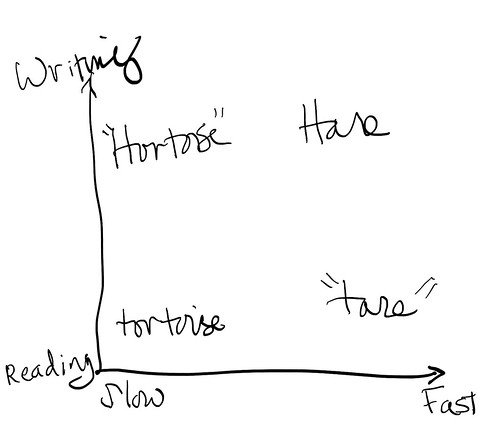
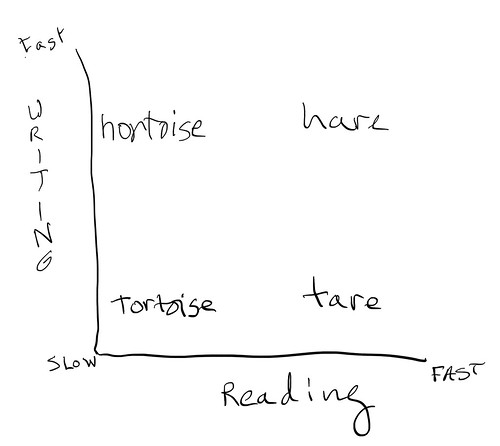
By the way, Gladwell talks about the condition of being a slow reader and a fast writer. I have that too. It's why blogging works well for me. I can find and isolate the sentences I find rich and readable — slowly readable — and I can flow very quickly writing about them. In this light, you can see that this tortoise/hare thing is not binary. There may be tortoises and hares, but there are also "hortoises" and "tares." If it's just tortoises and hares, it might be easy to say, yeah, it's just that some people are smarter than others. But if you see reading and writing (or reading and analyzing) as separate axes, with fast to slow on both, people are more complexly differently abled. Diagram to come....

ADDED: Oh, no, no, no... my idea of a diagram with axes and quadrants is defective. I had to try to draw it to see the problem!

fullsizeoutput_3066

Reading does not progress to writing the way slow progresses to fast. Please suggest a way I can draw this idea!

AND: Allison explained the solution and, with her help, I easily got it right:

fullsizeoutput_3068

२५ जानेवारी, २०१९

The Turtle House.


That's The Turtle house by Kurt Völtzke at El Gouna (Red Sea, Egypt), which I'm seeing this morning at the Wikipedia article "Cultural depictions of turtles." I got there because, after blogging about the Green Reaper, I went looking for other government-designed mascots. I'd thought of Smokey the Bear on my own, but that's the one that seems to make us think that the government should be in the mascot-designing business. I found a WaPo article from 2014, "It’s (almost) Smokey Bear’s birthday. Here are some other decidedly less iconic government mascots." There I discovered a Federal Trade Commission atrocity called Dewie the E-Turtle, which was supposed to teach us about protecting our privacy on the internet. That got my attention because I believed the green thing in this photograph was Dewey:


I was wrong about that. The green thing is actually BAC, a creation of the Department of Agriculture. He's a bacterium, which explains the other mascot, which is Thermy, who's there to bully you into overcooking your meat. But I'm only figuring that out now, after I've become entranced by "The Cultural Depiction of Turtles." I love Wikipedia.

१९ नोव्हेंबर, २०१८

"Trump Makes Risqué Joke About Antonin Scalia's Widow Having 9 Kids During Medal of Freedom Ceremony."

That's how People puts it, because why not take what shots you can at Trump, even if unsettles the good feelings of honoring a deceased hero?


Why not take shots?

1. How else are people going to notice how much sex there is in the remarks "You were very busy, wow. Wow" and "I always knew I liked him" (spoken to a woman who gave birth to 9 children)?

2. It's Scalia. Like Trump, he's someone you're supposed to take shots at whenever you can.

3. Because calls for civility, like Silberman's "DECORUM!" are always bullshit. Silberman's not going for DECORUM! himself as he yells DECORUM! at Trump.

By the way, who is Steve Silberman? I clicked through to his Twitter page and saw that he's the author of "NeuroTribes: The Legacy of Autism and the Future of Neurodiversity." That made me wonder what NeuroTribe Trump belongs to.

Here's the NYT review of "NeuroTribes." It seems to be only about autism, not some notion that there's a neurotribe for each of us. Too bad!

३१ जुलै, २०१८

"I disagreed with most of what he said, but he said it in such a charming, amusing way. And if truth be told, if I had my choice of dissenters when I was writing for the court..."

"... it would be Justice Scalia, because he was so smart, and he would home in on all the soft spots, and then I could fix up my majority opinion. Sometimes it was like a Ping-Pong game between us."

Said Ruth Bader Ginsburg, speaking on stage, after a performance of "The Originalist," an off-Broadway play about Justice Scalia, the NYT reports.
For all his bellicosity, the Scalia in “The Originalist” is also a charmer, balancing his ursine ferocity with a thoughtful quietude. Justice Ginsburg, who is 85 and figures in the play only as an offstage presence (“I love Ruth Ginsburg,” Scalia says), painted the real Scalia as a considerate and mischievous colleague who, from the time they were appellate judges together in the 1980s, was not above whispering in her ear or passing her a note to crack her up.

“Scalia was a very good writer, and he did labor over his opinions,” she said. “Both of us did. And sometimes he would come to my chambers, to tell me I had made a grammatical error.” The crowd roared. “I would sometimes tell him his opinion was so strident he would be more persuasive if he toned it down.” A pause, because she knows how to deliver a line. Then: “He never took that advice.”

१८ जुलै, २०१८

Treason talk.

Let's look back before this week, to "treason" as it has appeared within the lifetime of this blog. In chronological order:

April 27, 2005: Discussing the "blood" metaphor in constitutional law, I quoted Article III: "The Congress shall have Power to declare the Punishment of Treason, but no Attainder of Treason shall work Corruption of Blood, or Forfeiture except during the Life of the Person attainted."

May 28, 2006: I wrote about the protest singer Phil Ochs declaring the Vietnam War over:
So do your duty, boys, and join with pride
Serve your country in her suicide
Find the flags so you can wave goodbye
But just before the end even treason might be worth a try
This country is too young to die
I declare the war is over
It's over, it's over
July 1, 2006: "The editors of The Los Angeles Times and The New York Times explain how they decide when to publish a secret... Baquet and Keller have written a lengthy defense of their behavior, behavior that they know has been severely criticized, even called 'treason.'"

September 20, 2006: "To me, that's treason. I call it treason against rock-and-roll, because rock is the antithesis of politics. Rock should never be in bed with politics," said Alice Cooper, indicting rock stars who were telling people to vote for John Kerry.

August 3, 2007: Markos Moulitsas says that in 2002, "Dissent against the president was considered treason."

August 11, 2007: A 9/11 truther criticizes me for declining to debate him, which he took to mean that I know I'm "complicit in covering up mass murder and high treason."

May 12, 2008: A scholar assures us that the Muslim world would view Obama, the son of a Muslim father, as guilty of apostasy, which has "connotations of rebellion and treason," which is considered "worse than murder."

September 12, 2011: I'm live-blogging a debate in which "treason" is thrown around casually: "Perry stands by his 'almost treasonous' remark, referring to the use of the Federal Reserve for political purposes... Huntsman accuses Perry of treason for saying we can't secure the border."

May 8, 2012: "Isn't it funny, this 'treason' incident?" Mitt Romney, running for President, failed to chide a woman who asked whether Obama should be tried for treason. I brought up (as I did today), the 1964 book "None Dare Call It Treason." I also quoted the casual use of "treason" by Chief Justice John Marshall  Cohens v. Virginia to refer to doing something unconstitutional. ("We have no more right to decline the exercise of jurisdiction which is given than to usurp that which is not given. The one or the other would be treason to the Constitution.") And a commenter brought up an even more venerable use of the word, Patrick Henry's "If this be treason, make the most of it." That made me say: "The country was founded on treason. We celebrate the treason we like."

Also on May 8, 2012: "Obama supporters who express outrage over the use of the word 'treason' seem to think the word means nothing but to the crime defined in law — as if the woman Romney talked to wanted Obama tried and executed. It's as if people who say 'property is theft' are freakishly insisting that property owners be prosecuted for larceny. Think of all the words we use that have more specific legal meanings that do not apply: This job is murder... The rape of the land... Slave to love..."

June 17, 2013: Edward Snowden explains why he left the country: " [T]he US Government... immediately and predictably destroyed any possibility of a fair trial at home, openly declaring me guilty of treason and that the disclosure of secret, criminal, and even unconstitutional acts is an unforgivable crime. That's not justice, and it would be foolish to volunteer yourself to it if you can do more good outside of prison than in it."

July 26, 2013: From a post about the death penalty: "Here's the 2008 U.S. Supreme Court case, Kennedy v. Louisiana, which found the death penalty for rape (even rape of a child) to be unconstitutional cruel and unusual punishment. No one has been executed in the U.S. for a crime other than murder since the 1960s, though the Kennedy case leaves open the possibility of capital punishment 'for other non-homicide crimes, ranging from drug-trafficking to treason.'"

April 22, 2014 : Above the Law had hyperventilated, "Justice Scalia Literally Encourages People To Commit Treason," and I punctured it, saying Scalia was just giving his usual speech about the Constitution, which is always subject to the right of revolution explained in the Declaration of Independence. I bring up Patrick Henry's "If this be treason, make the most of it."

February 23, 2015: "'Edward Snowden couldn't be here for some treason,' said Neil Patrick Harris, the Oscars host, when the documentary about him won an award." I said: "I liked the joke, because of its language precision and because it seemed at least a tad risky in the context of Hollywood celebrating itself."

February 29, 2016: Trump hesitated to "unequivocally condemn David Duke and say that you want his vote or that of other white supremacists in this election" after Duke it would be "treason to your heritage" for a white person not to vote for Trump.

October 14, 2016: "Great literature is simply language charged with meaning to the utmost possible degree," said Ezra Pound, who was charged with treason in WWII. He was disaffected after WWI, moved to Italy, felt inspired by Mussolini, and went on the radio criticizing the U.S., FDR, and the Jews.

December 21, 2016: I quoted the official course description for "The Problem of Whiteness," a course offered in the African Cultural Studies department of my university, the University of Wisconsin–Madison: "In this class, we will ask what an ethical white identity entails, what it means to be #woke, and consider the journal Race Traitor’s motto, 'treason to whiteness is loyalty to humanity.'"

January 16, 2017: I quote someone talking about Chelsea Manning: "He is a member of the military who knowingly committed treason. His, or her, gender status has nothing to do with his conviction for treason."

February 10, 2017: I quoted Trump (before his election) talking about Edward Snowden: "I think he's a total traitor and I would deal with him harshly," "And if I were president, Putin would give him over," and "Snowden is a spy who should be executed." I wondered: "But maybe you think Trump will end up looking good forefronting the iniquity of treason."

February 7, 2018: Trump had used the word "treasonous" to describe the Democrats who didn't applaud during his State of the Union Address. Yeah, it was a joke, but: "He's President and in the position of enforcing the law, and from that position punching down. He really should not be joking about treason. And I get that he's punching back, and that's his style. But people aren't just idiots if they feel afraid of a President who isn't continually assuring us that he's aware of his profound responsibilities."

April 17, 2018: I quoted Neil Gorsuch, concurring — and voting with the liberals ‚ in a case about immigration: "Vague laws invite arbitrary power. Before the Revolu­tion, the crime of treason in English law was so capa­ciously construed that the mere expression of disfavored opinions could invite transportation or death. The founders cited the crown’s abuse of 'pretended' crimes like this as one of their reasons for revolution. See Declaration of Independence ¶21."

May 4, 2018: A conservative commentator sarcastically said he was "waiting for the Left to scream treason" over John Kerry's "quiet play to save Iran deal with foreign leaders."

July 17, 2017: I quoted Byron York: "Would it have been appropriate for the Trump campaign to try to find the [Clinton] emails?... What if an intelligence operative from a friendly country got them and offered them? And what about an unfriendly country? Would there be a scale, from standard oppo research on one end to treason on the other, depending on how the emails were acquired?"