reference to the Gatsby project लेबल असलेली पोस्ट दाखवित आहे. सर्व पोस्ट्‍स दर्शवा

२५ जुलै, २०२५

"And let me just put it to you with startling bluntness is President Trump Gatsby or Tom?"

"And I'll let you kind of imagine why I've even posed that question — because it's infused with new money, anti-establishmentism, and a motto — Make America Great Again — that to my mind borrows from — whether it means to or not — one of the great lines in Gatsby, which is when Gatsby says to Nick, 'You can't repeat the past? Of course you can.' I mean, what is MAGA other than a pleading to reclaim a past that's so central to this book?"/"It's a very interesting question of, I mean, with Trump, is this old money or new money? What elite does he or doesn't he belong to? And certainly his own mythology is that he's been, and I think our colleagues have written a lot about this, about his sense of outsiderness, his sense of the Manhattan elite, the Manhattan establishment, the fancy know-it-alls and eggheads who he was, you know, desperate for a long time to join, who always sort of rebuffed him, or went to his parties, but didn't necessarily accept him into their midst...."

That happens almost half an hour into "100 Years of ‘The Great Gatsby,'" today's episode of the NYT "Daily" podcast. That's Michael Barbaro asking the question and then A.O. Scott answering. 

It's mostly a solid discussion of the novel and not political... though there's also this near the end:

१६ एप्रिल, २०२५

I remember a blog post from December 6, 2021 titled "I remember...."

I remember it began: "I remember something made me read this old blog post of mine, from 2013, when I had a little project going where I'd take one sentence from 'The Great Gatsby' and present it for discussion.... The sentence of the day was 'I remember the fur coats of the girls returning from Miss This-or-That’s and the chatter of frozen breath and the hands waving overhead as we caught sight of old acquaintances, and the matchings of invitations: 'Are you going to the Ordways'? the Herseys'? the Schultzes'?' and the long green tickets clasped tight in our gloved hands.'"

I'm looking back at that post because I just did a search of my archive for "Brainard," because I'm reading a new article in The New Yorker, by Joshua Rothman, "What Do You Remember? The more you explore your own past, the more you find there" and it begins: "Last year, for my birthday, my wife gave me a copy of 'I Remember,' an unusual memoir by the artist Joe Brainard. It’s a tidy little book, less than two hundred pages long, made entirely from short, often single-sentence paragraphs beginning with the words 'I remember.'"

Writing about that "Gatsby" sentence, I'd said: "Things remembered: fur coats, chatter, hands waving, matchings of invitations, and long green tickets. These remembered things give the reader a sense of the incompletely delineated human beings.... This is a mass of faceless humanity, cluttered with hands, waving and clasping.... " And a commenter, gadfly, said: "Althouse is doing her Joe Brainard, 'I Remember' schtick - but she can't top the master." He quoted Brainard's book, and it was obviously my kind of thing — very sentence-y. I immediately read it. I'll read it again, now that I'm reminded of it.

But what is Joshua Rothman saying about it?

१९ फेब्रुवारी, २०२२

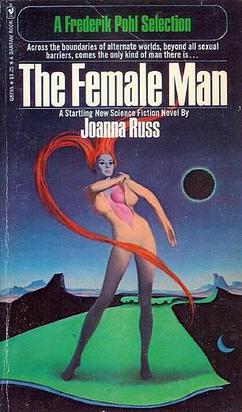
Feminist book cover from 1975.

This amused me:

Wikipedia tells us: 

The Female Man... was originally written in 1970 and first published in 1975 by Bantam Books. [Joanna] Russ was an avid feminist.... The novel follows the lives of four women living in parallel worlds that differ in time and place. When they cross over to each other's worlds, their different views on gender roles startle each other's preexisting notions of womanhood. In the end...

Spoiler alert!

... their encounters influence them to evaluate their lives and shape their ideas of what it means to be a woman. The character Joanna calls herself the “female man” because she believes that she must forget her identity as a woman in order to be respected (p. 5). She states that “there is one and only one way to possess that in which we are defective … Become it” (p. 139). Her metaphorical transformation refers to her decision to seek equality by rejecting women's dependence on men.

Metaphorical transformation. But the book cover seems to depict the physical peeling away of the female form. The browser is enticed to imagine something surgical.

Now, why was I reading that? I became interested in the word "munch" because I encountered an author who kept using the word "munch" as a replacement for "eat." I wondered if I had ever even once — in the entire 18-year history of this blog — used the word "munch." 

A search of my archive turned up 7 posts — 5 of which have "munch" in the sense of  the artist Edvard "The Scream" Munch. 

One is a stray reference to the Girl Scout cookie Thank U Berry Munch. (I'm imagining an Obama inner monologue, there's a reference to marijuana, and so there's a nudge to think about "the munchies.") 

The 7th post was part of my "Gatsby" project: "I know many of you don't like or don't get the 'Gatsby' project, in which we isolate and munch on a single, possibly turgid, sentence from 'The Great Gatsby,' more or less every day around here on the Althouse blog."

Why "munch" there? There's no actual eating. It's an eating metaphor, really a chewing metaphor. Indeed, the dictionary definition of "munch" stresses the the chewing — the mouth action — and not anything further along in the digestive process: "To eat (food) with a continuous and noticeable chewing action; to eat eagerly and audibly, or with evident enjoyment; to make a snack of." 

That's from the OED — where I go to get my definitions, mainly because I love the lists of historical examples and where I found one that ended with the title that got me to that book cover:

a1425 (▸c1385) G. Chaucer Troilus & Criseyde (1987) i. 914 Some wold monche [v.rr. muchche, mucche, muche, meche] her brede alon, lying in bed and make hem for to grone....

1600 W. Shakespeare Midsummer Night's Dream iv. i. 31 I could mounch your good dry Oates.

1905 Baroness Orczy Scarlet Pimpernel xviii. 172 She partook of this frugal breakfast with hearty appetite. Thoughts crowded thick and fast in her mind as she munched her grapes.

1975 J. Russ Female Man 175 Munched chips, crackers, saltsticks, what-not.

१६ फेब्रुवारी, २०१९

"It was that deep worry that lives in the base of the skull of every resident of Park Avenue south of Ninety-sixth Street—a black youth, tall, rangy, wearing white sneakers."

From Kindle location 320 in Tom Wolfe's "The Bonfire of the Vanities," this is the second entry in The "Bonfire" Project, where we talk about one short passage of continuous text:
All at once Sherman was aware of a figure approaching him on the sidewalk, in the wet black shadows of the town houses and the trees. Even from fifty feet away, in the darkness, he could tell. It was that deep worry that lives in the base of the skull of every resident of Park Avenue south of Ninety-sixth Street—a black youth, tall, rangy, wearing white sneakers. Now he was forty feet away, thirty-five. Sherman stared at him. Well, let him come! I’m not budging! It’s my territory! I’m not giving way for any street punks!

The black youth suddenly made a ninety-degree turn and cut straight across the street to the sidewalk on the other side. The feeble yellow of a sodium-vapor streetlight reflected for an instant on his face as he checked Sherman out.

He had crossed over! What a stroke of luck!

Not once did it dawn on Sherman McCoy that what the boy had seen was a thirty-eight-year-old white man, soaking wet, dressed in some sort of military-looking raincoat full of straps and buckles, holding a violently lurching animal in his arms, staring, bug-eyed, and talking to himself.
This is sort of like the old "Gatsby" project, but, for reasons previously discussed, it can't be just one sentence out of context, examined purely as a sentence. I'm giving you more text and permission to use what you know from the rest of the reading — I know some of you are reading along with me — but you need to concentrate on what's going on in the chosen text.

A few thoughts of mine:

१४ फेब्रुवारी, २०१९

"Who in the name of God would bring a half-eaten eight-ounce jar of Hellmann’s mayonnaise to a public meeting?"

A few days ago, I was talking about a problem that Kamala Harris has as she runs for President:
She's too much of a prosecutor to win the love of a minority group Democrats need to turn out if they're going to beat Mr. Criminal Justice Reform Donald Trump.
Shouting Thomas started off a comment with...
The job of a prosecutor is to put black guys in jail, as noted in "Bonfire of the Vanities."...
I said:
Thanks for reminding me of that book, which I've been meaning to read.

१२ फेब्रुवारी, २०१९

At the Ratsby Café...


... She must have broken her rule against drinking that night, for when she arrived she was stupid with liquor and unable to understand that the ambulance had already gone to Flushing.

The answer to a very old question is: 9.

In the comments to the previous post — "Things to do with cigarettes," which looked at some fabulous vintage ads for a long forgotten cigarette brand, Murad — Laslo Spatula was inspired to rewrite some of the sentences that were part of my old "Gatsby" project (where I'd take a sentence from "The Great Gatsby" and we'd talk about it out of context).

So Laslo was posting things like:
"A tray of cocktails floated at us through the twilight, and we sat down at a table with the two girls in yellow and three men, each one smoking a Murad."
Here's the old post from "Gatsby" project, where you see the original sentence from the novel was: "A tray of cocktails floated at us through the twilight, and we sat down at a table with the two girls in yellow and three men, each one introduced to us as Mr. Mumble."

The first commenter on that post asks "How many times does the word 'yellow' come up in a search of 'The Great Gatsby'?"

Within the half hour, I give him my answer: 24. And that makes me want to count the rest of the colors. Is yellow the dominant "Gatsby" color? What's most likely to beat it? The other primary colors. Using the search function in Kindle, I found 22 appearances of "blue," but...
Red can't be counted via Kindle, which includes the letters "red" within other words, like "declared," "considered," and "incredulously."
I proceeded to the rest of the colors:
Purple: 0
Orange: 4
Brown: 7
Black: only 13 (very surprising)
White: 50 (the book is racist!)
Green: 19
Pink: 6
Lavender: 6
Seeing that old post today, I wondered if the Kindle software had changed since then (January 2013). And yes, it had! I got my answer. 9!

Only 9 for "red." Surprisingly low considering 24 for "yellow" and 22 for blue. Was F. Scott Fitzgerald aversive to red for some reason? There are 19 "red"s in "The Last Tycoon" and 25 in "Tender Is the Night," so the avoidance of red seems to be "Gatsby" specific.

There are only 9, so I will quote them all for you, and let's think about how "red" was used and why it was used sparingly:

1. "I bought a dozen volumes on banking and credit and investment securities, and they stood on my shelf in red and gold like new money from the mint, promising to unfold the shining secrets that only Midas and Morgan and Mæcenas knew."

2. "Their house was even more elaborate than I expected, a cheerful red-and-white Georgian Colonial mansion, overlooking the bay."

3. "Already it was deep summer on roadhouse roofs and in front of wayside garages, where new red gas-pumps sat out in pools of light, and when I reached my estate at West Egg I ran the car under its shed and sat for a while on an abandoned grass roller in the yard."

4. "The sister, Catherine, was a slender, worldly girl of about thirty, with a solid, sticky bob of red hair, and a complexion powdered milky white."

5. "One of the girls in yellow was playing the piano, and beside her stood a tall, red-haired young lady from a famous chorus, engaged in song."

6. "We passed Port Roosevelt, where there was a glimpse of red-belted ocean-going ships, and sped along a cobbled slum lined with the dark, undeserted saloons of the faded-gilt nineteen-hundreds."

7. "I had on a new plaid skirt also that blew a little in the wind, and whenever this happened the red, white, and blue banners in front of all the houses stretched out stiff and said tut-tut-tut-tut, in a disapproving way."

8. "She asked me if I was going to the Red Cross and make bandages."

9. "There was a faint, barely perceptible movement of the water as the fresh flow from one end urged its way toward the drain at the other. With little ripples that were hardly the shadows of waves, the laden mattress moved irregularly down the pool. A small gust of wind that scarcely corrugated the surface was enough to disturb its accidental course with its accidental burden. The touch of a cluster of leaves revolved it slowly, tracing, like the leg of transit, a thin red circle in the water."

We see red in various objects in ##1 (money), 2 (a mansion), 3 (gas pumps), 6 (ships), 7 (the American flag) and twice — ##4 and 5 — in women's hair. #8, as part of a proper name, might deserve little attention, but it is about blood and points to #9, the really important one, which really is blood, though the word "blood" doesn't appear.

Spoiler alert... it's Gatsby's blood. He's shot dead in the swimming pool. The "mattress" is the flotation device he's lying on, and we learn of his death in that 9th appearance of "red" — "a thin red circle in the water." It's just color and geometry. You figure out that it's blood.

That distancing contrasts with the one appearance of the word "blood" in "The Great Gatsby":
The other car, the one going toward New York, came to rest a hundred yards beyond, and its driver hurried back to where Myrtle Wilson, her life violently extinguished, knelt in the road and mingled her thick dark blood with the dust. 
No use of the tightly hoarded word "red" is expended on Myrtle. Her blood is "dark blood" — as it mixes not with water but with dust.

Such are the colors of "Gatsby," and a long-unfinished count is completed. The answer is: 9.

I imagine the first commenter cranking me up again and asking "How many times does the word 'nine' come up in a search of 'The Great Gatsby'?"

The answer is 6, and every single one is the time of day.

१२ मे, २०१८

Maybe I'm weird, but here's something you can do that might be fun.

Go to Goodreads and search for a book you really like, scroll down to "community reviews," and select the filter "1 star." You might get boring non-reviews, like "I hated this book so much that I can't even talk about why." I saw that on a book I loved. It doesn't matter which one.

But I was looking for reviews of the book I'm reading now — "Men Without Women" by Haruki Murakami — which I'm immensely enjoying, and I stumbled into the "1 star" filter. Someone who goes by "Jack" wrote:
This review didn't begin so negatively because I hate the author and the kind of person who's attracted to his style; on the contrary, I've read his entire oeuvre, more or less, and enjoyed a decent majority of his works. The criticisms of Murakami's style are well-known at this point: he has a bag of narrative or aesthetic tricks, and there isn't a single thing in one of his stories he hasn't repeated somewhere else....

He's a casual read, uncomplicated but mostly superficially pleasing, like the bland emotionless sexual encounters in 95% of everything he writes. There's only so many times one can read about a relatively handsome Japanese man, in his late-thirties or maybe middle-age, who likes jazz and cooking and being a milquetoast zombie at once content and uneasy with his vapid life, without thinking that maybe Murakami isn't writing about some aspect of the human condition, or the plight of men, or something like that: maybe he's just putting himself into every novel, adding a weird dream or two, a cat, some sort of mundane fantastical event that goes unexplained, and repeating until the publishers phone up and say it's time for him to make them more money.

I became interested in Murakami's writing as a teenager because I was a big manga and JRPG nerd, and wanted to continue obsessing over Japan while gaining some sort of literary foothold that put me above the unwashed nerdy masses. He was an easy read while channeling an ineffable sensibility, and he was big into Anglo-American culture so I could understand most of his references. I might reread The Wind-Up Bird Chronicle sometime down the line and discover that there's still a lot in Murakami's style I enjoy.

For the most part, I can only conclude I've outgrown him. He didn't change; I did. By that line of thinking, maybe I shouldn't be making a value judgment of his work, if I've just come to a change of taste, right? Well, no. His prose is clunky at best, profoundly meaningless at its most infuriating. This is still a pretty bad short story collection, but if you like it, you're in luck! You'll like everything Murakami's ever written right up until the moment you realise you hate him. 
Ha ha. That was well written, and I don't think it will hurt my enjoyment of Murakami's writing... until (I guess) the moment I realize I hate him.

Why am I reading that book? Is it because of the incels in the news or the men-without-women amongst the commenters of this blog? No. There were 2 things:

First, I read a Murakami book last September. As described in a post titled "A song about singing off key," I was clicking around aimlessly and happened onto "15 sights that make Tokyo so fascinating" (HuffPo), and #7 was the Murakami novel "Norwegian Wood" ("For millions of readers around the world who've never been to Japan, it's been a way for them to experience in some small way, Japan's capital of the past").

Second, a reader familiar with my "Gatsby project" emailed to say, "I’m reading Murakami’s 'What I talk about when I talk about running.' I came to one paragraph (see attached) which made me think of you and which you might enjoy."

Here's the paragraph:
One other project I’m involved in now is translating Scott Fitzgerald’s The Great Gatsby, and things are going well. I’ve finished the first draft and am revising the second. I’m taking my time, going over each line carefully, and as I do so the translation gets smoother and I’m better able to render Fitzgerald’s prose into more natural Japanese. It’s a little strange, perhaps, to make this claim at such a late date, but Gatsby really is an outstanding novel. I never get tired of it, no matter how many times I read it. It’s the kind of literature that nourishes you as you read, and every time I do I’m struck by something new, and experience a fresh reaction to it. I find it amazing how such a young writer, only twenty-nine at the time, could grasp— so insightfully, so equitably, and so warmly— the realities of life. How was this possible? The more I think about it, and the more I read the novel, the more mysterious it all is.
I can't imagine translating Gatsby, because the sentences are so weird. Do you translate literally to preserve the weirdness, or do you make it sound natural and idiomatic so people won't say you don't know how to translate, or can you find similar ways to be weird that fit the translated-to language?

And if you're thinking of fighting my opinion that the Gatsby sentences are weird, please click on the "Gatsby project" link above. Each post is about exactly one sentence — such as "A tray of cocktails floated at us through the twilight, and we sat down at a table with the two girls in yellow and three men, each one introduced to us as Mr. Mumble."

When I heard about the Murakami translation of "Gatsby," my heart leapt but only for a half-second. I can't read Japanese! I almost studied Japanese long ago, and nothing prevents me from studying it or anything else even now. But it made me want to read Murakami again, and "Men Without Women" seemed to be the most recent fiction. I started in on that. After reading 5 of the 8 stories, I put the nonfiction "What I Talk About When I Talk About Running" in my Kindle too. Don't want to overload on fiction. And the 5th story was really great.

By the way — "Men Without Women" is also the title of a story collection by Ernest Hemingway. "What We Talk About When We Talk About Love" is a story collection by Raymond Carver. And, obviously, "Norwegian Wood" is a Beatles song.

From the 5th story:
“Mr. Kino, you’re not the type who would willingly do something wrong. I know that very well. But there are times in this world when it’s not enough just not to do the wrong thing. Some people use that blank space as a kind of loophole. Do you understand what I’m saying?”

१९ जानेवारी, २०१७

"We don't want your tiny hands/Anywhere near our underpants/We don't want your tiny hands/Anywhere near our underpants..."

A very minimal anti-Trump song by Fiona Apple gets an article of its own in The New York Times.

ADDED: I was glad to have a chance once again to use my underpants tag.  I hadn't used it since March 1st of last year. Oddly enough, the post was about Trump. I was linking to something in the NYT, something tragically titled "Inside the Clinton Team’s Plan to Defeat Donald Trump":
“They’ll flip their top, and they’ll flip their panties...” read the subject line of a recent news release from Emily’s List, a group that works to elect Democratic women who support abortion rights. The quote came from comments Mr. Trump made about women on “The Howard Stern Show” in the 1990s, unearthed by BuzzFeed last month.

Those types of comments, spoken by Mr. Trump over the years as he served as a tabloid regular and reality TV star, could help Mrs. Clinton excite suburban women and young women who have been ambivalent or antagonistic toward her candidacy....
The excited suburban and young women will need to content themselves with the women's march. Apple's tiny-hands-underpants song is intended to be chanted by the marching women.

Before that, there was a Jeb Bush interview in February 2015:
When Hannity said he had one more question, Jeb said "boxers." (Bill Clinton's answer to the famously inappropriate question, by the way, was "Usually briefs. I can't believe she did that." Obama's answer was:  "I don't answer those humiliating questions. But whichever one it is, I look good in 'em.")
And remember that sculpture of a man stumbling about in his underpants that disturbed the women of Wellesley College?

And all the posts about Anthony Weiner's underpants? And references to the underpants gnomes? There was the underpants bomber.

And there was the time The Gatsby Project — should I bring back The Gatsby Project? — got to a sentence with underpants:
The prolonged and tumultuous argument that ended by herding us into that room eludes me, though I have a sharp physical memory that, in the course of it, my underwear kept climbing like a damp snake around my legs and intermittent beads of sweat raced cool across my back.
And "Hey, look! It's my giant underpants!"


ALSO: I do want to give Fiona Apple credit for inventing a new chant. "We don't want your tiny hands/Anywhere near our underpants" really is chantable. I'd like to see marches with new chants. I'm really tired of the continual repurposing of: 1. "What do we want?/X!/When do we want it?/Now!" and "Hey, hey, ho, ho/X has got to go." (The Wisconsin protests of 2011 were notable for their distinctive chants: "What's Disgusting?/Union busting" and "This is what democracy looks like.")

२६ ऑगस्ट, २०१५

The NYT description of NYC in August quotes "The Great Gatsby."

From "New York Today: Empty City":
But in the winding-down of summer, the city moves at a slower pace, and the lazy days of August can be quite pleasant.

Or, as F. Scott Fitzgerald wrote in "The Great Gatsby":

"I love New York on summer afternoons when every one’s away. There’s something very sensuous about it — overripe, as if all sorts of funny fruits were going to fall into your hands."
Did we ever do that sentence in the old Gatsby project? Oh, it's 2 sentences, and we only read one sentence at a time, but it's the second sentence, the one with the fruits, that's asking for it. If we did, I'm sure we didn't take it to mean simply that summer in the city is lazy and pleasant.

So, yes, we did read that sentence, back on March 2, 2013, and I see that I did throw the first sentence in for context:
You should know that ["There’s something very sensuous about it"] refers to "New York on summer afternoons when every one’s away." That's New York City, of course, not the whole state. People in New York mean New York City when they say "New York." They call the state "New York State" if it's ever worth talking about....

What kind of sensuous, overripe, funny fruits are falling into your hands... wherever you are when "every one's away"?
In the comments, Sydney said, "New York City must have been a hell hole in the summer before air conditioning," and I said, enlarging the context:
Yeah, the sentence is from a passage in which the problem is no a/c. Some characters want to go to the movies and others want to just drive around, which seems to be a way of being out and catching some breeze.

Also, this sentence is very close to one of the favorite "Gatsby" project sentences, the one known for short as "hot whips of panic."...
There's less overripe, falling, funny fruit when air-conditioning is everywhere every where.

Anyway, in the end, the conversation orbited around Harvey Keitel's balls (after kentuckyliz brought up the old famous-for-male-nudity movie "The Piano").

१५ फेब्रुवारी, २०१५

"The remaining subclauses of this clause 15 are to be read subject to this proviso and to the fundamental matters agreed in clauses 2-5 above."

From a list of "50 of the most absurdly hilarious lines" demonstrating "the sheer enormity of terribleness encased in" "50 Shades of Grey," which sounds like it's got a fair amount of contract law in it and isn't quite as horribly bad as people seem to like to assure us it is. Not that I'm going to do a new Gatsby-project-like series on "50 Shades of Grey," even though 28% of you said I should:


These poll results are quite puzzling. "No" only gets 40%, so "yes" has 60%, but it's split between 3 options, with "50 Shades of Grey" getting the most and yet much less than doing nothing and less than the combined — and equally split — option for something other than "50 Shades of Grey." I should have included more subclauses, provisos, and fundamental matters.

Then, I got the idea of trying to find 50 sentences from this blog that would (appear to) demonstrate the sheer enormity of its terrible absurd badness, because that's a game you could play with any writer's work, including the work of Wm. Steven Humphrey, the writer of that "50 Terrible Lines" list, who begins with the sentence, "It still shocks the crap out of me when I realize how many people are still unfamiliar with the sheer enormity of terribleness encased in E.L. James absolutely awful book."

Oh, still? Really? Crap has been shocked out of you over some unspecified period of time that we should care about? And you wrote "still shocks... people are still...." That's "still... still..." Humphrey, you twit! You pose condescendingly and scoff at people who might only be enjoying some textual candy, and you repeat the word "still" in your opening shot?

You know, in the "Gatsby" project, many of those "Great Gatsby" sentences, isolated from context, looked pretty absurd, but we had confidence in the author and we didn't feel hostile to him for his success. We were on his side. We could take those sentences and play, really have some fun. There was no point in getting snobby or condescending, even when it seemed objectively ludicrous like: "The prolonged and tumultuous argument that ended by herding us into that room eludes me, though I have a sharp physical memory that, in the course of it, my underwear kept climbing like a damp snake around my legs and intermittent beads of sweat raced cool across my back."

१३ फेब्रुवारी, २०१५

"Madison feminists urge boycott of Fifty Shades of Grey."

Noted.

Why should you have to boycott it? Isn't it better just not to want to see it?

IN THE COMMENTS: mccullough said:
I guess this means no "50 Shades of Gray" project like the "Gatsby" project on Althouse.
The "Gatsby" project was things like this. One sentence from the work, isolated for discussion in contextless isolation. I loved that project. Did you? Vote, and I just might do it.

Should I do a new series like the "Gatsby" project?


pollcode.com free polls

८ फेब्रुवारी, २०१५

If you sing "John Henry" as many times as Bob Dylan did, you'd have written "Blowin' in the Wind."

I'm reading the full transcript of Bob Dylan's long, rambling speech at that MusiCares event).
[My] songs didn't come out of thin air. I didn't just make them up out of whole cloth.... It all came out of traditional music: traditional folk music, traditional rock 'n' roll and traditional big-band swing orchestra music.

I learned lyrics and how to write them from listening to folk songs. And I played them, and I met other people that played them back when nobody was doing it. Sang nothing but these folk songs, and they gave me the code for everything that's fair game, that everything belongs to everyone.

For three or four years all I listened to were folk standards. I went to sleep singing folk songs. I sang them everywhere, clubs, parties, bars, coffeehouses, fields, festivals. And I met other singers along the way who did the same thing and we just learned songs from each other. I could learn one song and sing it next in an hour if I'd heard it just once.

If you sang "John Henry" as many times as me -- "John Henry was a steel-driving man / Died with a hammer in his hand / John Henry said a man ain't nothin' but a man / Before I let that steam drill drive me down / I'll die with that hammer in my hand."

If you had sung that song as many times as I did, you'd have written "How many roads must a man walk down?" too.
And if you'd've sung Big Bill Broonzy's "Key to the Highway" — "I've got a key to the highway / I'm booked and I'm bound to go / Gonna leave here runnin' because walking is most too slow" — you'd have written "Georgia Sam he had a bloody nose/Welfare Department they wouldn’t give him no clothes/He asked poor Howard where can I go/Howard said there’s only one place I know/Sam said tell me quick man I got to run/Howard just pointed with his gun/And said that way down on Highway 61."

And "Sail Away Ladies" — "Ain't no use sit 'n cry / You'll be an angel by and by / Sail away, ladies, sail away" — would get you to "Boots of Spanish Leather" — "I'm sailing away my own true love...." And "Roll the Cotton Down" — "Ten dollars a day is a white man's pay / A dollar a day is the black man's pay" — "If you sang that song as many times as me, you'd be writing 'I ain't gonna work on Maggie's farm no more,' too."

So there's the formula. Sing a lot of folk songs, sing enough, until they take a new form and you've got your songs, your Bob Dylan songs. Or, I take it, sing enough Bob Dylan songs, over and over, and out of those will emerge your songs.

Only songs work that way, where you internalize someone else's words so deeply that you develop an instinct for words that yields up new words that count as your words. You can't do that with writing, can you? Maybe with poetry, memorizing it and reciting it over and over. But if you want to write prose, what can you do? You could try the Hunter S. Thompson method:
He used to type out pages from “The Great Gatsby,” just to get the feeling, he said, of what it was like to write that way, and Fitzgerald’s novel was continually on his mind while he was working on “Fear and Loathing in Las Vegas”....
"You’ve been through all of F. Scott Fitzgerald’s books," Bob Dylan sang much more than once, but I don't see how you could ever catch onto an instinct to write like F. Scott Fitzgerald by reading all his books (like The Thin Man) or typing out particular pages (like Hunter S. Thompson) or fixating on individual sentences (as we did here on the blog in the old Gatsby project). I think the language you use to write prose is the language of speech, and you picked that up in a way that was even more fundamental and tradition-based than all those folk songs Bob Dylan had to sing to get to his own songs.

You used to be so amused/At Napoleon in rags and the language that he used...

१० जानेवारी, २०१५

Suddenly, 10 things.

1. The blog has a theme today. This is something that happens sometimes, and at the point when I notice I use my "blog has a theme today" tag and — if I'm in the mood — I try to construct a 10-item list on that theme. As the post title indicates, the theme is: "sudden."

2. "Three gunmen, who have been hired to assassinate the President, hold a family hostage while waiting for their target. Interesting B film which focuses on psychopathic killer well-portrayed against type by Frank Sinatra." It's titled "Suddenly," and you can watch it in its hour-and-15-minute entirety here.

3. In the phrase "all of a sudden" (or "all of the sudden"), "sudden" is a noun. But we never use the noun in any other context. It's hard even to try to do that, even though it's obvious that the noun means something that is sudden. I challenge you! (By the way, I grew up around people who used the less common "all of the sudden," and it took me a long time to accept the dominance of "all of a sudden.")

4. Good writers should know that "suddenly" is a cheeseball word. One of Elmore Leonard's 10 rules of writing is "Never use the words 'suddenly' or 'all hell broke loose.'" I agree but would make an exception for intentional and delightful cheesiness, as in: "Why do birds suddenly appear/Every time you walk near?"


5. Hearing that, Meade suddenly says "Hey, don't forget, Bissage named his blog Suddenly Bissage." Bissage was a dearly beloved commenter on this blog who disappeared one day, when the uncooperative dear became uncooperative. I've tried to call him back: "Come back, Bissage. We're counting oranges again. Remember? 42. 42. 42..." To no avail.

6. Analyzing sentences in "The Great Gatsby" — the old "Gatsby project" — there was a day, a couple years ago, when we lit upon: "Through this twilight universe Daisy began to move again with the season, suddenly she was again keeping half a dozen dates a day with half a dozen men, and drowsing asleep at dawn with the beads and chiffon of an evening dress tangled among dying orchids on the floor beside her bed." About that "suddenly," I said: "This lone female is suddenly joined by numerous men. Though the unnamed men never get definition as individuals, they presumably get one-on-one dates with her, since the numbers match up: half a dozen dates a day with half a dozen men. This is the kind of 'dating' one associates with a prostitute." What would Elmore say about that? I'm inclined to justify anything in "The Great Gatsby" as exactly what it has to be, so I want to say that the "suddenly" is hilarious, but why? Perhaps because it's absurd — 6 men popping up in a sequence on each day within a season of days. Presumably, those men and more are always there, seeking dates with Daisy. It's her whimsical option — exercised suddenly — to accept the dates and put them in sequence, 6 per day, day after day. It's an endless flow, not sudden at all. The suddenness is in Daisy's waking up again in this twilight universe.

7. "Sudden death" — to refer to a method of tie-breaking — goes back to 1834, according to the OED, which found the quote: "‘Which’, said he, ‘is it to be—two out of three, as at Newmarket, or the first toss to decide?’ ‘Sudden death’, said I, ‘and there will soon be an end of it.’" Wikipedia has a page on the topic, with specific details on 16 different sports/games and: "Sudden death may instead be called sudden victory to avoid the mention of death, particularly in sports with a high risk of physical injury. This variant became one of announcer Curt Gowdy's idiosyncrasies in 1971 when the AFC divisional championship game between the Kansas City Chiefs and Miami Dolphins went into overtime." Ha. That didn't catch on. If you're that anxious about someone getting hurt, why are you watching?

8. Meade laughs at something he wrote in the comments to "We vomit on all these people who suddenly say they are our friends": "I wish that for just one time you could stand inside my shoes/And just for that one moment I could be you/Yes, I wish that for just one time you could stand inside my shoes/You'd know what a drag it is to have vomit in your shoes." And my response to that — because I'm working on this list here — is to do a word search for "suddenly" at bobdylan.com. One of the great ones comes up — "It's Alright Ma, I'm Only Bleeding":
You lose yourself, you reappear
You suddenly find you got nothing to fear
Alone you stand with nobody near
When a trembling distant voice, unclear
Startles your sleeping ears to hear
That somebody thinks they really found you
9. Sudden infant death syndrome. To be distinguished — we hope! — from infanticide. "The misdiagnosis of infanticide as SIDS 'happens all over... A lot of doctors and police don't know how to handle it. They don't take it as seriously as they should.'" Said Jamie Talan, co-author of "The Death of Innocents: A True Story of Murder, Medicine and High-Stakes Science." That book is from 1997. That's a controversy that seems to have melted away.

10. This is a 10-point list so we must stop here. Did I miss something you were hoping for? "Suddenly Susan"? "Suddenly Seymour"? "Suddenly, Last Summer"?

१४ डिसेंबर, २०१३

"And for those of you who've been emailing me asking me why I didn't do more with the Screwtape Letters, more like Gatsby..."

"... my answer to that is that the lack of interest in the question asked in this post shows why that project doesn't fly. The Gatsby project flew. It turned on minds that accepted the turn-on and took off."

The last line of my comment explaining why I have yet to fulfill what may seem to be a promise to complete an assignment I really only gave myself.

And this post gets not only a Gatsby project tag, but also a written strangely early in the morning tag.

It's okay if you don't volunteer to sit for my outside-of-law-school exams. I have plenty of exams written by nonvolunteers that I am duty-bound to read. This post is about a duty I felt I had to write the answer to my own exam, which I only gave because I wanted to write that answer. But if the question inspired no one else, then I tend to think that my answer would only have seemed weird or annoying or — the worst — unreadable.

Or is that the worst? The devil nags me to ask. The devil says: Wouldn't it be a fascinating new project to write a blog called "Unreadable Things"?

१५ ऑक्टोबर, २०१३

Notes on success from 2 Scotts — Adams and Fitzgerald — and one Bob.

"In hindsight, it looks as if the projects that I was most passionate about were also the ones that worked. But objectively, my passion level moved with my success. Success caused passion more than passion caused success."

Writes Scott Adams, who followed his passion and invested in a restaurant that failed, then started drawing a comic strip — "Dilbert" — as "just one of many get-rich schemes I was willing to try" and became passionate about cartooning as it began to make him rich.

So Adams advises us not to take the advice "Follow your passion." Then he moves on to rejecting the advice that one ought to have goals. What you need is a system.

That's a pretty amusing column at the link, and I see it's adapted from a book that's coming out next week — "How to Fail at Almost Everything and Still Win Big."

***

There are only 2 Bob Dylan songs that use the word "success" and they are both on the same album which is probably the album that made the deepest impression on my mind when I was a malleable teenager, "Bringing It All Back Home":

1. "She knows there’s no success like failure/And that failure’s no success at all."

2. "Get dressed, get blessed/Try to be a success/Please her, please him, buy gifts/Don’t steal, don’t lift/Twenty years of schoolin’/And they put you on the day shift...."

Naturally, after 12 years of schoolin', I went to art school. After 16 years of schoolin' and 5 years unschooling, I went to law school. There's a "Bringing It All Back Home" "Highway 61" song with the word "lawyers":
You’ve been with the professors
And they’ve all liked your looks
With great lawyers you have
Discussed lepers and crooks
You’ve been through all of
F. Scott Fitzgerald’s books
You’re very well read
It’s well known...
After 19 years of schoolin', it took 20 years of professing — looks liked or not — to get to blogging, which included, inter alia, The Gatsby Project, which never officially ended, so here's another sentence:
If personality is an unbroken series of successful gestures, then there was something gorgeous about him, some heightened sensitivity to the promises of life, as if he were related to one of those intricate machines that register earthquakes ten thousand miles away.

११ ऑक्टोबर, २०१३

"The Screwtape Letters" is not an egg salad sandwich.

In yesterday's Boardwalk Café, Saint Croix said:
I should have said this in the Scalia post — the devil made me not do it — but one of the interesting things about The Screwtape Letters is the insight that a devil is simply an angel with free will.

Thus if you believe in an afterlife — and an overwhelming number of people believe in an afterlife — you should acknowledge devils. They are simply angels who are in rebellion with God. Which God allows, because God believes in free will for humanity.

What a fantastic book The Screwtape Letters is.

I would pay money for Althouse to blog that book!
Pay money to get me to blog about something? That's been done... to get me to eat an egg salad sandwich. I'd written a post — back in 2005 — listing "10 things I've never done," and #2 was "Eaten egg salad, devilled eggs, or cold hard-boiled eggs" — hmm, interesting second appearance of the Devil in this post! — and somehow that led to my saying you'd have to pay me $200 to eat an egg salad sandwich, and some commenters got together and collected $200 and PayPal'd it to me, and I blogged — vlogged! — The Eating of the Egg Salad Sandwich.

But I didn't want to eat an egg salad sandwich. Reading the "Screwtape Letters" is something I would like to do. I read it years ago — and I'm old so that "years ago" in the history of Althouse is almost half a century ago — but I'd like to read it again, especially with the ability to blog it and the context of Scalia's recent remarks about it.

So I added it to my Kindle. You can add it too: here. And if you use that link, you'll be sending me a little money (without paying more). If you like this blog, you can funnel money to me by entering Amazon through the Althouse portal and buying something, anything, at some point before clicking away. But to get me to blog on specific topics, you could attempt the Egg Salad Method. That might work for some things — bloggable, vloggable things, for the right price. You could also just ask, as Saint Croix did, and it might work, if I'm interested enough. This blog is all and only about what interests me.

So I bought "The Screwtape Letters" and read a few pages last night. Here's the first thing I highlighted, and I'll put it here out of context, because you know that I like isolating sentences from their context — so sue me — for the purposes of discussion. That's what we did last winter with The Gatsby Project, which actually has one post that got the "egg salad" tag. It was the post with the "salads of harlequin designs." Remember?

I'm not saying these "Screwtape Letters" posts will only be isolated sentences in the manner of The Gatsby Project. But I am getting us started with this sentence, as the devil Screwtape advises his nephew devil on how to screw with some human being, referred to as "the patient":
"By the very act of arguing, you awake the patient’s reason; and once it is awake, who can foresee the result?"

२८ सप्टेंबर, २०१३

"Back in Paris, friends asked if I'd met someone new and assumed I must have fallen in love."

"But the reason I was so radiant was that I'd decided to be celibate."

Does celibacy make you "radiant" because you decided to undertake it? Will radiance not ensue if celibacy simply befalls you?

Was she really "radiant"?

"Radiant" is a funny word, lobbed automatically at brides, and therefore suspicion-provoking when aimed at the celibate woman.

"Radiant" means — according to the unlinkable OED — "Sending out rays of light; shining brightly" or "Of the eyes, a look, etc.: bright or beaming (as with joy or love). Of a person, esp. a young woman or bride: giving off an aura of joyfulness or health; glowingly happy." Amongst the OED quotes is one from a book that we once reveled in here at the Althouse blog, "The Great Gatsby":
1925   F. S. Fitzgerald Great Gatsby vi. 132   Perhaps some unbelievable guest would arrive, a person infinitely rare and to be marvelled at, some authentically radiant young girl.
Authentically. Oh! There's that adverb. Celibate sounds so pure. But authentically? Who on earth knows when she has achieved authenticity... especially in the radiancy department. Those auras must emanate from real joy.

९ जुलै, २०१३

Some writer over at The Atlantic intrudes on my "Gatsby project" territory.

You remember the old Gatsby project, where I'd isolate one sentence from "The Great Gatsby" and deal with it as complete in itself — a narrative arc, a container of meaning enough, a jumping off point for wild ideation. Some of us got so wrapped up in it that we find it hard to leave a room without yelling "Ewing!"

So here comes The Atlantic isolating a "Great Gatsby" paragraph and proclaiming it "The Most Dazzling Paragraph of The Great Gatsby" — on the authority of a writer named Susan Choi. One sentence isn't sufficient. She has to go with a whole paragraph. And it's not enough just to look deeply at that one thing. There has to be a proclamation that it is the best of all the paragraphs, and that just makes me want to open my hulking cabinets full of Gatsby sentences and begin throwing them, one by one, before you — sentences of little pig sausages and hot whips of panic and warm human magic, until a tray of cocktails floats at us through the twilight, and suddenly, the eyes of the editors at The Atlantic leak isolated and unpunctual tears.

६ मे, २०१३

"Al Gore made $200 million. Good for him!"

Said Meade. Acknowledging that I got the reference, I said, "But he didn't do it alone..."

Meade has his computer screen open to Drudge, the right 2/3 of which looks like this right now:


It's all about smiles, as the dolphin in the lower right corner makes clear. Meade says, "Wow, George P. Bush looks like Nixon," and I say, "And Obama too... strangely." The Gore smile is waxen. For all I know the pic is of a wax depiction of the GoreBot, the ManBearPig we've come to dread.

Meanwhile, there's Leo, our new Gatsby, apparently "vibrantly alive." The word "vibrant" appears only once in "The Great Gatsby":
He felt their presence all about the house, pervading the air with the shades and echoes of still vibrant emotions.
I think you know what to do with that sentence. And if not, my belief in the harmony of the universe — or the mystical shades and echoes of pink dolphins or the reliability of the Althouse commentariat — tells me that betamax3000 will show you the way.