posters লেবেলটি সহ পোস্টগুলি দেখানো হচ্ছে৷ সকল পোস্ট দেখান

৬ জুন, ২০২৫

"I divorced him 10 times the first year of our marriage, getting a lawyer and everything and 13 times the second year."

"He’d plead literally on his hands knees, 'Please forgive me, I don’t know why I did it, give me another chance.'"

Said Mara Corday, about Richard Long, quoted in "Mara Corday, Starlet of Monster Movies and Magazines, Dies at 95/She appeared in Playboy and sci-fi films in the 1950s. Later, in Clint Eastwood’s 'Sudden Impact,' she was a hostage until he uttered five famous words" (NYT).

Wow! I love this poster:


And go ahead, make my day:

৩ মার্চ, ২০২৫

Things that get my "Trump's masculinity" tag.

Shopping at the Galleria in Houston, Texas

I didn't take this interesting photograph, but the person who did doesn't want to be named. The location is the Galleria in Houston, Texas. Closeup:

IMG_0680 (1)

The size and positioning of the eagle make me uneasy. Does the eagle have large talons?

২৫ অক্টোবর, ২০২৪

All this likening of Trump to Hitler has got me looking back to my 2011 posts, when Wisconsinites likened Governor Scott Walker to Hitler.

From March 19, 2011: "Scott Walker is like Hitler because 'he doesn't do nice things'" (the quote is from a young protester, in a video interview by Meade). 

From February 17, 2011: "Scott Walker compared to Hitler" (with video of Meade questioning a woman who is carrying a sign portraying showing Walker with a Hitler mustache).

Also from February 17, 2011: "I asked the woman if she thought Scott Walker was like Hitler, and she said 'Yes.' So I said, 'Are you saying that you think fascism could come to America,' and she said, 'It's what's happening.'" Here's the photo I took of the woman — hiding her face — and the Walker-as-Hitler poster:

P1060646

১১ এপ্রিল, ২০২৪

"This is my home!"/"I had a home in Palestine too."

I'm watching the video at "'Please leave!' A Jewish UC Berkeley dean confronts pro-Palestinian activist at his home" (L.A. Times).

The headline says "his home," but it is the home of the law school dean Erwin Chemerinsky and his wife Catherine Fisk, who is a law professor. It is their home, and is Fisk who physically engages with the person the headline calls a "pro-Palestinian activist." The "activist" is a law student, one of a large group of law students who were assembled — outdoors — for a dinner. The activist student — Malak Afaneh — is female, which may explain why it was Fisk who took the lead in attempting to oust the student from the premises. It's a very disturbing video, with the student standing her ground and calmly claiming a First Amendment right, and Fisk staunchly asserting "This is my home." 
 

১৭ ফেব্রুয়ারি, ২০২৪

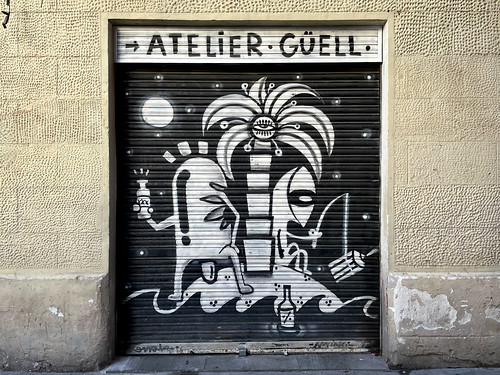
In an alley next to the Palace Güell in Barcelona, Spain...

Photo by Chris in Barcelona, Spain

... my son Chris photographs that mural and this poster....

Photo by Chris in Barcelona, Spain

A closer look:

২ ফেব্রুয়ারি, ২০২৪

"Holy Week constitutes precisely the expression of a Christ away from the codes of male power."

"The Christ we love, before whom we prostrate ourselves and who is our example, does not look like an All Blacks rugby forward."

Said the columnist Chapu Apaolaza, quoted in "'Homoerotic Christ' on posters for Holy Week divides Spain/Artist defends painting used for Easter celebrations in Seville" (London Times).

From the artist, Salustiano García: "Those who see something dirty in the painting are only projecting their own internal dirt on to the image.... [They display] a lack of culture, of not knowing anything, of never having been in a museum or a church, because I haven’t invented any element that appears in the painting."

২ জানুয়ারি, ২০২৪

"I told him he must treat the political audience as one coming, not to see an etching, but a poster. He must, therefore, have streaks of blue, yellow, and red to catch the eye, and eliminate all fine lines and soft colors."

Said Theodore Roosevelt, recounting a conversation he'd had with presidential candidate William Howard Taft, quoted in "Theodore Rex."

I earn a commission if you use that link, which goes to Amazon. I'm just finishing the book this morning. It's the second in a trilogy. Volume 1, "The Rise of Theodore Roosevelt," is much more fun to read, and I think that says something about how impoverished we are for staring constantly at the presidency.

Seen from the perspective of a President, we, "the political audience," are stupefyingly shallow, come to see "a poster," not "an etching," looking for garish colors and bright lines.

ODDLY ENOUGH: I've already blogged about a Taft campaign poster, here.

১৪ ডিসেম্বর, ২০২৩

"He who doesn't work, doesn't eat.


Soviet poster issued in Uzbekistan, 1920.

From the Wikipedia article, "He who does not work, neither shall he eat," which I'm reading this morning because Wikipedia linked to it under "See also" at the bottom of its article "No such thing as a free lunch," which, you can see in the previous post, came up in the context of trying to understand the Russian word "khalyava."

I started this new post to show you that excellent propaganda artwork, and let me quote a bit from the "He who does not work" entry:

১০ জুলাই, ২০২৩

"On a continuum of good vs. evil, Zuckerberg is probably less evil than Elon. I don't like Zuckerberg, but Elon is a disgusting bottom dweller. I hope this is the nail in Twitter's coffin."

This is the top rated comment at the WaPo article "What we love and hate about Threads, Meta’s new Twitter clone/Threads may be the first Twitter alternative that really matters because it’s built on top of Instagram’s existing base of billions of users."

And it's a better answer to the question of what to "love and hate about Threads" than anything in the article, which suggests we ought to love Threads because it's easy to get on it via your Instagram account (which millions did without realizing that they can't delete their Threads account without deleting their Instagram account). 

Anyway, for me, the key thing to like (or "love") would be good, readable writing (and part of readability is the absence of visual clutter). But Threads won't let me look at it as a web page, and I won't accept the app without seeing that it's something I want. It's what people used to call a pig in a poke. Or, in some countries, a cat in a bag. At least with Twitter, I can see the pig/cat. 

And didn't Thoreau say, "Beware of enterprises requiring new apps"?

But let's think about that comment (in the post title). It states the "lesser of 2 evils" principle. I understand that in an election, but is this a lesser-of-2-evils situation? We don't need to choose one or the other. We can reject both.

Now, I'm reading the Wikipedia article "Lesser of two evils principle":

In Nicomachean Ethics, Aristotle writes: "For the lesser evil can be seen in comparison with the greater evil as a good, since this lesser evil is preferable to the greater one, and whatever preferable is good". The modern formulation was popularized by Thomas à Kempis' devotional book The Imitation of Christ written in early 15th century.

In part IV of his Ethics, Spinoza states the following maxim: 
Proposition 65: "According to the guidance of reason, of two things which are good, we shall follow the greater good, and of two evils, follow the less."

I'm sure these wise men all realized that there are circumstances where you can choose neither. For example, I abstained in the last election, and I endorse abstention as an option and argue with those who say you're doing something wrong if you refuse to vote. 

I get diverted into the Wikipedia article "False dilemma." The best thing about that article is this cool poster from 1910:


ADDED: I'm just noticing that the scales held aloft by the Chief Justice embody the principle of the lesser of 2 evils. There are just 2 options, and the weightier one ought to win.

AND: At least the Justice is considering legal arguments as the 2 options and choosing between the entities who are the parties in the lawsuit. By contrast, in the WaPo commenter's formulation, the 2 options are 2 human beings — Zuckerberg and Musk. We're not expected to understand the substance of what we'd be getting if we chose Threads or Twitter. That's too hard and too sober for us, the social media people, who gravitate toward decisions that are personified and inflated with scary, emotive insinuations of evil.

২৪ এপ্রিল, ২০২৩

I'm getting a "How I Learned to Stop Worrying and Love the Bomb" vibe from this NYT headline.

"How Democrats Learned to Cast Aside Reservations and Embrace Biden 2024." 

I wish I had the skills to make a parody of this poster: 

   
Looking for that image, I stumbled across the wonderful Spanish and French posters for "Dr. Strangelove":


Have you stopped worrying about the bomb? I mean, have you cast aside reservations about the bomb? (And learned to love Joe Biden?)

১৬ ফেব্রুয়ারি, ২০২৩

There she was, staring out at the world as though from the beginning of time.

Wrote Raquel Welch, in "Raquel: Beyond the Cleavage."

R.I.P., Raquel Welch.

৫ অক্টোবর, ২০২২

Half Human.

I love that poster. It's for a 1955 Japanese film about the Abominable Snowman.

I ran across that just now researching the phrase "half human" as I was writing the previous post

Interesting things about the poster: woman in shorts in a snowy mountain environment, man more suitably dressed in a Tyrolean hat, vaguely indicated male genitalia on the Snowman.

ADDED: Joe Dante explains "Half Human":


What the whole thing if you dare: here.

২৬ ডিসেম্বর, ২০২১

"In the past decade, millions of Pakistanis have been caught up in the religious fervor of an anti-blasphemy campaign..."

"... launched after a liberal politician named Salman Taseer was assassinated by his own bodyguard for his denunciation of the harsh legal punishment of a Christian peasant woman accused of blasphemy. The anti-blasphemy group built a cult around the bodyguard, Mumtaz Qadri. After he was hanged for murder in 2016, they declared him a martyr for Islam, built a shrine near the capital, Islamabad, and formed a new political party, Tehrik-e-Labbaik Pakistan... Labbaik’s leaders have repeatedly declared that they do not condone violence, yet they also preach that blasphemers deserve to die, and their crusade has inspired incidents of murder and arson. At a college campus in northwest Pakistan, a secular student was accused of blasphemy and beaten to death by classmates in 2017. A few days before the Sialkot attack, a mob burned down a police station in the northwest after officials refused to hand over a prisoner accused of blasphemy."

From "The mob killing of a factory manager in Pakistan comes amid surge in anti-blasphemy violence/This religious crusade is rapidly gaining popular support and could threaten the country’s stability" (WaPo). The factory manager, "preparing to repaint the walls for a visiting delegation, had taken down some religious posters that praised the prophet Muhammad and tossed them in the trash," and "several hundred workers chased him onto the factory roof and then dragged him into the yard, where they beat, stoned and kicked him to death, then set his crumpled corpse on fire."

১৩ আগস্ট, ২০২১

"Right, I love floating heads. Some of my favorite posters are floating heads."

"I’ve spent a good deal of time talking to people about where the design comes from. There’s a 1908 [William Howard] Taft; they show up in Lyndon Johnson for Senate posters, one shows up in 1940, and then by 1944 and on, they sort of become the wave, and in the 1950s, and up to about 1968, floating heads—I mean, no collar at all, just totally floating heads—are everywhere. And then they just disappear. The working theory right now is that jobbers just decided to do it that way. It wasn’t a grand design-school concept."

From "THE ART HISTORY OF PRESIDENTIAL CAMPAIGN POSTERS/Against the backdrop of the 2020 US presidential election, historian Hal Wert takes us through the artistic and political evolution of American campaign posters, from their origin in 1844 to the present. In an interview with Quarterly editor Gillian Jakab, Wert highlights an array of landmark posters and the artists who made them" (Gagosian). 

 I got there as I was researching posters from around 1900 that were characterized by Andrew Cuomo as trying "to communicate their whole platform on one piece of paper." I like the old-time-y posters that do that, but it would be wrong to think that extremely simple posters weren't around back then. I mean, this Taft poster is hilariously simple (and fantastic):

"Why does this poster exist?"


The question in the post title comes from "The 8 Weirdest Unsolved Andrew Cuomo Mysteries" (New York Magazine). The article considers the poster a mystery that remains unsolved even though Cuomo gave an explanation back when he introduced the poster in July 2020: 

"I love history. I love poster art. Poster art is something they did in the early 1900s, late 1800s, when they had to communicate their whole platform on one piece of paper. Over the past few years I’ve done my own posters that capture that feeling. I did a new one for what we went through with COVID and I think the general shape is familiar to you. We went up the mountain, we curved the mountain, we came down the other side and these are little telltale signs that, to me, represent what was going on."

What "early 1900s, late 1800s" posters did he have in mind? I found this one:

And I wanted to show you this one too, even though it's not trying "to communicate their whole platform on one piece of paper":

৮ অক্টোবর, ২০২০

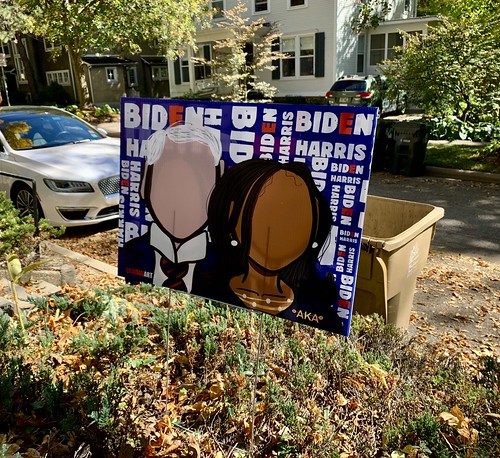
Really bad Biden/Harris sign I've been seeing around Madison.

IMG_0497

It's so awful! The facelessness, the man in back, the messy hair for her, and his hair doesn't look like Biden's at all! It seems more like Bill Clinton. And why is the man in back? It reminds me of all those pictures of Biden sniffing women's hair. 

২০ আগস্ট, ২০২০

Kathy Griffin dabbles in fat shaming, and one of her followers serves up an impressively well-drawn poster of "The White Couple From St. Louis."


UPDATE: I can't believe I omitted the "men in shorts" tag. Fixed.

২ জুলাই, ২০২০

"These iconoclasts appeared on the Capitol Square to cover over the hate graffiti inspired by the fire bombers, looters, and window smashers."

"Their target was the WI Veterans Museum on W. Mifflin Street, which had been vandalized by the Free Yeshua Musa/Mayor Satya anarchists. The message of this motley group ran counter to the anarchists who toppled the statues of Freedom Fighter Hans Christian Heg, who gave his life fighting slavery and secession, and of Miss Forward, exemplar of strong womanhood 20 years before female suffragism. Or the beatdown of State Sen. Tim Carpenter, D-Milwaukee. Or the fire bombing of the City County Building.... Let’s just say the small gaggle of contrarians who posted signs declaring 'We Support Our Madison Police' were confronted with F-bombers worthy... As soon as the signs supporting police went up, many were torn down...."

Writes David Blaska, about his counter-protest activities in downtown Madison. Photos at the link.

২২ জুন, ২০২০

১৭ জুন, ২০২০

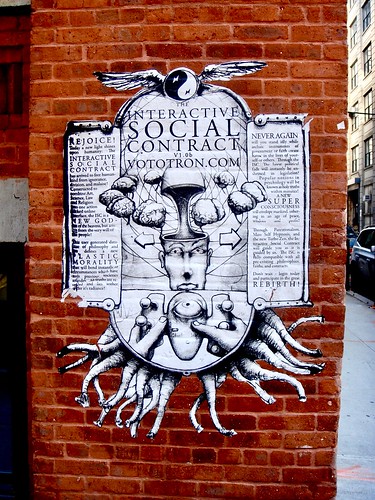
The Interactive Social Contract.

1522762833_a11307dbe2_o

That's a photograph I took in Brooklyn in October 2007. Just ran across it as I was searching (unsuccessfully) for a post about something that happened to me around that time. That caught my eye. It was right next to this...

Breaking wave

One of my New York photos. What is it? I can see what it's not. It's not a wave breaking on a beach.

Anyway, I thought perhaps the Interactive Social Contract from 2007 could speak to us in this famously screwed up year, 2020.