Lenin লেবেলটি সহ পোস্টগুলি দেখানো হচ্ছে৷ সকল পোস্ট দেখান

১৪ ডিসেম্বর, ২০২৩

"He who doesn't work, doesn't eat.


Soviet poster issued in Uzbekistan, 1920.

From the Wikipedia article, "He who does not work, neither shall he eat," which I'm reading this morning because Wikipedia linked to it under "See also" at the bottom of its article "No such thing as a free lunch," which, you can see in the previous post, came up in the context of trying to understand the Russian word "khalyava."

I started this new post to show you that excellent propaganda artwork, and let me quote a bit from the "He who does not work" entry:

১ মে, ২০২৩

"ChatGPT doesn’t just get things wrong at times, it can fabricate information. Names and dates. Medical explanations."

"The plots of books. Internet addresses. Even historical events that never happened. When ChatGPT was recently asked how James Joyce and Vladimir Lenin first met — there is no evidence they ever did — this is how it responded: 'James Joyce and Vladimir Lenin met in Zurich, Switzerland in 1916. Both men were living in exile in Zurich during World War I. Joyce was a writer and Lenin was a revolutionary. They met at the Cafe Odéon, a popular gathering place for artists and intellectuals in Zurich.' Fabrications like these are common...."

From the comments over there: "It's interesting that the chatbot brought Lenin and Joyce together in Zurich, just as Tom Stoppard's play 'Travesties' imagined them both in the Zurich library during World War I. I'm guessing chatbots scrape their information from available fiction as well as non-fiction? And what we get is Webster's literal definition of travesty: 'a debased, distorted, or grossly inferior imitation.'"

Ha ha ha. Great comment. And I love the play "Travesties." Here's what I wrote in 2014 when we saw the play (twice!):

৭ অক্টোবর, ২০২২

"I’m usually wary of arguments that declining conditions are a catalyst to progress — contrary to the formulation often attributed to Vladimir Lenin, 'the worse, the better'..."

"... worse is usually just worse. I’m going to make an exception for Twitter, though. The best thing it could do for society would be to implode.... Twitter hooks people in much the same way slot machines do, with what experts call an 'intermittent reinforcement schedule.'... The company’s internal research has shown that Twitter’s algorithm amplifies right-wing accounts and news sources over left-wing ones. This dynamic will probably intensify quite a bit if Musk takes over. Musk has said that Twitter has 'a strong left bias,' and that he wants to undo permanent bans, except for spam accounts and those that explicitly call for violence. That suggests figures like Alex Jones, Steve Bannon and Marjorie Taylor Greene will be welcomed back. But as one of the people who texted Musk pointed out, returning banned right-wingers to Twitter will be a 'delicate game.'... An influx of Trumpists is not going to improve the vibe. Twitter can’t be saved. Maybe, if we’re lucky, it can be destroyed."

From Michelle Goldberg's "Here’s Hoping Elon Musk Destroys Twitter" (NYT).  

I didn't quote the beginning of the column, which says that Twitter, as it currently works, is a "hellsite." If it's already awful, when there's a repressive effort to make the place safe and welcoming, then there's already a bad "vibe." Why not embrace freedom, stop trying to control people, and see what happens — freedom for the sake of freedom, without an effort to "improve the vibe"?

Freedom is valuable in and of itself. Censorship is not. If Twitter couldn't make things better with censorship, even those who accept censorship as a means to an end should embrace freedom of speech. You don't need the end — a better vibe — to justify the means. The means and the end are one: freedom.

ADDED IN ANTICIPATION OF COMMENTS MAKING THIS POINT: The end pursued by the means of censorship was not "a better vibe." It was control for the sake of control. If so, the censors also had the unification of means and end: control.

২৭ এপ্রিল, ২০২২

"You think we imprison people on a whim? No, if you think our humanistic system capable of such a thing, that alone would justify your arrest."

Says a Stasi interrogator in the 2006 film "The Lives of Others." The "humanistic system" was East Germany.

I just watched for the first time, on the urging of my son John, who warned me that it was about to leave the Criterion Channel. John chose that movie as the best movie of 2006, noted on his blog about the best movies from 1920 to 2020.

William F. Buckley Jr. said it was "the best movie I ever saw."

The director, Florian Henckel von Donnersmarck, got the idea for the movie from Maxim Gorky's description of a conversation he had with Lenin about music:

And screwing up his eyes and chuckling, he added without mirth: But I can't listen to music often, it affects my nerves, it makes me want to say sweet nothings and pat the heads of people who, living in a filthy hell, can create such beauty. But today we mustn't pat anyone on the head or we'll get our hand bitten off; we've got to hit them on the heads, hit them without mercy, though in the ideal we are against doing any violence to people. Hm-hm—it's a hellishly difficult office!

In the movie, a character quotes Lenin — about Beethoven's "Appassionata" —"If I keep listening to it, I won't finish the revolution."

২৪ জানুয়ারি, ২০১৯

Is the Kamala Harris logo "the worst political graphic design job in a generation"?

Jonathan Last says it just might be.


So... is there anything worse? Or... what's so awful about it?

The question whether "For the People" is a good slogan is separate. Feel free to talk about that. But I'd like to encourage the discussion of the visual — the shape and placement of the letters, the colors, etc.

Last says:
It could be that Harris’s design team looked at the AOC poster and saw the earth-tones, heavy-text, and adjacent colors and thought that that was the secret of their success. And about those earth tones—they’re straight out of the 1970s and they’re a bad idea.

Pantone describes the ’70s palette consisting of “Harvest Gold” and “Rust.” In the 1970s, designers used these colors because they wanted to take viewers “back down to earth—solid, earthy colors to ground us during shakey economic times.”
Here's the AOC poster he's referring to (alongside another poster he compares it to):


ADDED: On the Kamala Harris logo, vertically down the center, it says "LIE."

২৬ আগস্ট, ২০১৭

"I think the tearing down of Confederate statues is something people are doing because they can't tear down Trump."

"It's like kicking the dog after a hard day working for a boss you hate," I said a few days ago.

And now here's a column in The Washington Post by Anne Applebaum:
Polish and Ukrainian statues [of Lenin] came down as the result of a revolutionary moment, a sudden break in the political situation. In the United States in 2017, we are living through what feels to many like a similar, though not entirely analogous, revolutionary moment. The election of Trump, the first American president in decades to use unapologetically racist language — starting with his insidious slur that Barack Obama was not American, moving on to his reference to Mexican “rapists” and continuing with his refusal to condemn neo-Nazis — has smashed the ordinary rhythms of American political life. Suddenly, in Trump’s America, a statue honoring a Confederate leader looks like not just a boring monument to the distant past but a living political statement about the present.
Suddenly!

Suddenly I see just how much that damned dog looks like that bastard I have to work for.

১৬ আগস্ট, ২০১৭

১০ আগস্ট, ২০১৭

"A 100-foot statue depicting a Chinese deity was covered with an enormous sheet this weekend in East Java Province, Indonesia..."

"... after Muslims threatened to tear the colossus down amid mounting ethnic and religious tensions across the country," the NYT reports.
The Islamist campaign against the statue, a depiction of the third-century general Guan Yu, who is worshiped as a god in several Chinese religions, began online and soon spread to the gates of a Chinese Confucian temple in Tuban, near the Java Sea coast, where the figure was erected last month.

On social media, Muslims assailed the statue as an “uncivilized” affront to Islam and the island’s “home people,” and a mob gathered this week outside the East Java legislature in the city of Surabaya to demand its destruction.
How did such a statue get erected in the first place? Here are the demographics of the province of East Java. Ethnicity:
Javanese (80%), Madurese (18%), Indian (10%), Chinese (2%)
Religion:
Islam (96.36%), Christianity (2.4%), Buddhism (0.6%), Hinduism (0.5%), Confucianism (0.1%), Kejawen also practised
Is it about wealth and foreign influence? The NYT article says Muslim Indonesians are afraid "that as Beijing becomes more dominant in the region — exerting financial and military influence — ethnic Chinese will profit at the expense of Muslims."

Look at the photograph of Guan Yu. The military general as god is holding a sword so huge that it's sticking out from under the enormous sheet. The Times quotes the Indonesia director for Human Rights Watch, who criticizes the Muslims for using a "hostile interpretation" of the Quran to argue that the statue shows "that China is dominating Indonesia." But why put up a statue other than to say something?

One of the Muslims who's opposing the statue is quoted saying: "Actually we can allow them to build the statue, just not as high as it was and it should be in the temple, not outside... We are tolerant."

Why didn't that argument get made before the huge thing went up? Reading about the Guan Yu statue made me remember writing about colossal statues in the past. From a post I wrote in 2014:
Let's realize that throughout history statuary has been used to intimidate people. What's all that ancient Egyptian sculpture about if not to cow people into abject submission?


Think of all the Lenin and Stalin statues. And how about Saddam Hussein's despicable "Victory Arch"?

That post wasn't about a big intimidating god-warrior like Guan Yu, but about a life-size sculpture of a man stumbling forward in his underpants. That sculpture — "Sleepwalker," by Tony Matelli — upset some Americans at Wellesley College. They didn't throw a big sheet over "Sleepwalker," but they did put orange safety cones and yellow "caution" tape around him.

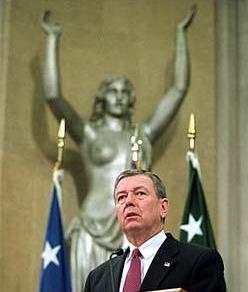
ADDED: Remember when the U.S. Department of Justice spent $8,000 on a big old drapery to cover the half-nude "Spirit of Justice" statue after photographers seemed too interested in framing Attorney General John Ashcroft with the looming breasts over his head?

১৩ অক্টোবর, ২০১৬

A glimpse of an atrocious hotel lobby in Gagra, Georgia (or is is Abkazia?) sends me back to "That Party at Lenny's."

Yikes. This is the worst hotel lobby I have ever seen featured in a article in the NYT.

Not only is there an old hairy-legged, black-sock-wearing man in shorts sitting on a depressing sofa, not only do limp draperies block the light, not only is there a set-up chess board with extra-large pieces... there's a huge statue — double life-sized — of Vladimir Lenin leaning forward intensely as if he's about to get up and kill you.

The article is about a place in Gagra which is in Georgia (or Abkhazia, "a quasi country whose existence only Russia and three other nations recognize"):

২৬ অক্টোবর, ২০১৫

Monuments and nonmonuments.

I feel like there's a theme today on the blog:

Monuments:
The Ukrainian Darth Vader Lenin

The big bronze head of Karl Marx 

"The monumental task of building California's bullet train will require punching 36 miles of tunnels..." (This quote looks so phallic — so rape-y —in the retrospect of late morning. And now the Karl Marx head on a plinth seems especially penile. And I guess everyone has already noticed that Darth Vader's helmet resembles the head of a penis.)
Nonmonuments:
As president: a comedian

The fruitless "bare branches" of China — millions of men who, without women, can produce no offspring

Gloria Steinem expresses her love for the nonhierarchical "talking circles" (outside of mud huts in India and amongst the Native Americans) and her distaste for "our monotheistic patriarchies and their ‘pyramid’ structures of authority from the top."

Ukraine sculptor transforms a statue of Lenin into Darth Vader.

"I wish to save the monuments of history. I’m trying to clean up the operating system and keep them on the hard drive of memory."

Said Alexander Milov, who shouldn't be considered a vandal, since his transformation preserves the statute, which was slated to be removed after the Ukrainian parliament passed a "de-Communisation" law.
"We are gathering all these statues – like Lenin – and we would like to make a park of forlorn heroes of the epoch,” says Milov. “I want to take the statues out of the central squares of cities and put them in a different place like Disneyland, where they can be visited. It seems to me that if these statues are destroyed, people coming after us will have no possibility to make conclusions for themselves as to whether people needed them or not."
That would be like Grutas Park in Lithuania, which we talked about here and here last winter. But Milov prefers to keep the statues where they are and to "turn them into characters from Soviet cartoons."

As for the Darth Vader Lenin: "I wanted to make a symbol of American pop culture which appears to be more durable than the Soviet ideal." Interestingly, aptly, he put a Wi-Fi router in its head.

By the way, in the second of the 2 linked posts from last winter, we talked about the controversy about whether some aesthetically pleasing statues on The Green Bridge (in Vilnius, Lithuania) should be relocated to Grutas Park. I expressed concern about moving high-quality sculpture that "was designed for a particular site" because it "is partly destroyed when it is moved, even though it is otherwise preserved," and I asked: "If something is artistically good, but a remnant of an earlier time that the people who control the place now wish to reject completely, what should they do?"

The bridge sculptures were removed this past July, to be replaced by flowers.

৩ এপ্রিল, ২০১৫

"We Love Lucy! Get Rid of this Statue."

A Facebook page devoted to ridding the Celoron, New York of the "frightening" statue of Lucille Ball.


We've talked about tearing down (or relocating) statues before, most recently in the context of communist propaganda, which might be good as sculpture per se but carries a message that the people of a particular place never wanted installed. Remember, you voted on it:


Now, the Lucy sculpture is different, because Lucy is not the symbol of a hated invader of Celoron, New York. She grew up there. They must love her. The Lucille Ball-Desi Arnaz Center is close by, and presumably they want Lucy lovers to make a pilgrimage. In that light, I think this statue is like the "Ecce Homo" painting in in the Sanctuary of Mercy church in Borja, Spain, the one no one came to see before it was rendered ludicrous by a well-meaning old lady:


It's a big tourist attraction these days, precisely because of its sublime badness. Perhaps this "We Love Lucy! Get Rid of this Statue" campaign is just a trick to get the hilarious image out there so the next time you're barreling across I-80, you'll take that little detour and get that Instagram selfie you know you'll want. You'll look much better than that aging American couple who, subjects of a half-assed NYT travel article, posed happily with statues of Lenin and Stalin in Lithuania.

I know what you're thinking: But wasn't Lucille Ball a communist?
As she had in her sworn testimony before the [House Un-American Activities Committee in 1953], Lucy insisted she knew nothing of politics in 1936 and registered as a Communist only to please her grandfather, Fred Hunt, who was a zealous Socialist....

[Lucy's mother] Mrs. Desiree E. Ball and [Lucy's brother] Fred H. Ball... both testified they had registered to vote communist in 1936 as the actress did to please “Grandpa.”...

“We’re lucky this happened to us in America, where newspapermen ask the questions,” Desi said. “In other countries they shoot first and ask the questions later.”

২৭ ফেব্রুয়ারি, ২০১৫

Stalin World.

Here's a documentary about the Lithuanian theme park Grutas Park — AKA "Stalin World" — which we were talking about this morning in connection with the ISIS destruction of ancient sculptures. Here we see Soviet era sculptures preserved in a tourist-attraction garden setting that many Lithuanians find quite offensive.


Thanks to Irene for pointing me there. And no thanks to the NYT for picturing 2 of the Grutas Park sculptures in a slide show about how aging Americans can absorb Euro-culture through the wonders of Airbnb.

ISIS endeavors to destroy the art of ancient Nineveh (AKA Mosul).

The efforts at destruction that you see at the beginning of this video are not as horrible as they look, for reasons that are explained half way through.

Watch out for the British expert who appears at 1:47. She thinks it's "pretty rotten for the people who actually live" in northern Iraq that so many of the original works of art have been transferred to Western museums — even as it's apparent that if those sculptures had been left in northern Iraq, they would now be sledgehammered to bits. Or does she — do we — think that if the artworks had been left in place, the history of Iraq would have played out on a different path, and the people who live there would have treasured and protected the world's artistic heritage? From the article at the link (to the British Channel 4 site):
The demolition squad of the Islamic State are following in the tradition of the Taliban who blew up the Buddhas at Bamyan, in Afghanistan, and the Malian jihadi group Ansar al Dine which destroyed mud tombs and ancient Islamic manuscripts in Timbuktu. They quote suras from the Koran that they say demand the destruction of idols and icons.

But iconoclasm isn't just a Salafi Islamic idea. In the 17th Century, puritans, under the rule of Oliver Cromwell, destroyed Catholic holy objects and art in Britain.

"We pulled down two mighty great angells, with wings, and divers other angells . . . and about a hundred chirubims and angells," wrote William Dowsing, Cromwell's chief wrecker, after leading his henchmen into Peterhouse college chapel in Cambridge in December 1643.
Iconoclasm. If you're inclined to reach back into history, you will, perhaps, find it everywhere. From the Wikipedia article "Iconoclasm," here are "The Sons of Liberty pulling down the statue of George III of the United Kingdom on Bowling Green (New York City), 1776":


And I can't look at that and not think about the statue of Saddam Hussein that our military tore down in Bagdhad in April 2003. And what of all those monumental statues of Vladimir Lenin that came in for destruction when the Soviet Union dissolved. Would you like to see them all removed?

I know there's at least one still standing, because the NYT, just a couple days ago, ran a story cooing over an aging American couple who are using Airbnb to live in various European cities and the slideshow features the man, dressed in shorts, like a child, and standing, like a child, knee-high to "this statue of Lenin in Lithuania." The hand of the smiling child-man reaches out to encircle the index finger of Soviet dictator. In another photo, the woman, in a short skirt, poses at the feet of a giant Stalin. This one too is "in Lithuania." We're told there's "a sculpture garden." Isn't that nice?

I need to do my own research to find out about "Grūtas Park (unofficially known as Stalin's World...)... a sculpture garden of Soviet-era statues and an exposition of other Soviet ideological relics from the times of the Lithuanian SSR."
Founded in 2001 by entrepreneur Viliumas Malinauskas, the park is located near Druskininkai, about 130 kilometres (81 mi) southwest of Vilnius, Lithuania.... Its establishment faced some fierce opposition, and its existence is still controversial.... The park also contains playgrounds, a mini-zoo and cafes, all containing relics of the Soviet era. On special occasions actors stage re-enactments of various Soviet-sponsored festivals.
So there's an alternative to iconoclasm.

২৮ জানুয়ারি, ২০১৫

"I first ran into the term 'Politically correct' in '67 in San Francisco. It was a leftist term then as now."

Writes John Henry in the comments to "Why Jonathan Chait thinks political correctness 'went into a long remission' and now has returned." Henry continues:
For example: "It is not politically correct to mention that the Viet Cong are murdering villagers who take US medical aid." It may have been factually correct, but since it harmed the cause, it was not "politically" correct to mention it.

I later, reading Lenin, found that he used something very like the term. For example: "It is not correct to say that people are dying of starvation in Moscow." He admitted that it was factually true but it should not be said because it made the party look bad.

When something is "politically incorrect", it generally is also factually correct.

I did not realize that the term ever went out of fashion.The concept certainly never has.
And then there was the time the U.S. Supreme Court Justice James Wilson said "This is not politically correct" back in 1793:
The states, rather than the people, for whose sakes the states exist, are frequently the objects which attract and arrest our principal attention.... Sentiments and expressions of this inaccurate kind prevail in our common, even in our convivial, language. Is a toast asked? "The United states," instead of the "People of the United states," is the toast given. This is not politically correct. The toast is meant to present to view the first great object in the Union: it presents only the second. It presents only the artificial person, instead of the natural persons who spoke it into existence. A state I cheerfully fully  admit, is the noblest work of Man. But, Man himself, free and honest, is, I speak as to this world, the noblest work of God.

১ সেপ্টেম্বর, ২০১৪

That was the biggest hunk of bait I've ever seen on this blog...

... the first comment, totally off topic and saying obscene things about the Christian religion. Admirably, you talked about what I'd invited you to talk about, Ted Cruz saying "Sadly, the state of the world is the Russian bear is encountering the Obama kitty cat."

Said troll arrived just as Meade and I were leaving to go to the theater, another drive out to Spring Green to the American Players Theater, this time to re-see "Travesties," that Tom Stoppard play that has Vladimir Lenin and James Joyce as characters and uses elements of Oscar Wilde's "The Importance of Being Earnest." We saw the Wilde play on Friday, dodging lightning. And that made the second viewing of "Travesties" more different from the first than most re-seeings. Re-seeings are always different though, in good ways. Anything I like enough to see a second time I prefer to see with the experience of having seen it before. The surprises are gone, and undistracted by predicting and looking for surprises, you notice everything that's been planted along the way to make the coming surprises surprising. It's at least different. Do you agree that it's better?

২২ আগস্ট, ২০১৪

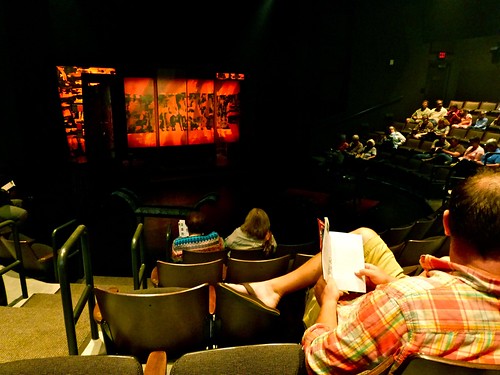
Before the performance...

Untitled

... of "Travesties" at the American Players Theater the other night. This play was so good — as a text and as a performance — that the next day I bought tickets to see it again. And I also bought tickets to see "The Importance of Being Earnest" a couple days before the second viewing of "Travesties." The 2 plays are related, and some of the actors play corresponding roles in the 2 plays. I'd seen "The Importance of Being Earnest" (in movie form) long ago, so I got the hang of the references, but not all the particularity. "Earnest" is playing in the outdoor theater at APT, "Travesties" indoors.

I was so taken with "Travesties" that I even bought the text. It's one of these plays about art, and I love art about art. What is art? I'm entranced by all sorts of blabbing on this subject, especially wrangling with the problem of art and politics — propaganda and all that — and "Travesties" has Vladimir Lenin as one of the characters. Lenin says things like:
Today, literature must become party literature. Down with non-partisan literature! Down with literary supermen! Literature must become a part of the common cause of the proletariat, a cog in the Social democratic mechanism. Publishing and distributing centres, bookshops and reading rooms, libraries and similar establishments must all be under party control. We want to establish and we shall establish a free press, free not simply from the police, but also from capital, from careerism, and what is more, free from bourgeois anarchist individualism!
Lenin actually wrote that. The playwright (Tom Stoppard) worked it into the script, which isn't all horrific blowharding like that, there's a lot of absurd banter and mistaken identity and various hijinks of a theatrical kind. Lenin is a minor character. James Joyce is more important, and the Dadaist Tristan Tzara.

Speaking of evil dictators — who never wear shorts and flip-flops, by the way — I got around to watching that 2004 movie "Downfall," you know, the raw material for all those Hitler parodies. It's heavy going, 156 minutes, mostly in the bunker. The familiar scene isn't the ending. It's quite close to the beginning.

২০ আগস্ট, ২০১৪

Spike Lee doesn't want "a riot." He wants an "uprising."


"Uprising" was the word that was used around here for the Wisconsin protests.

ADDED (the next morning): I was rushing out of the house as I posted this last night. (We went out to Spring Green to see the play "Travesties" (which includes, amongst the various characters, Lenin).) So I didn't have one extra minute to put a link on "Uprising" to the book "Uprising: How Wisconsin Renewed the Politics of Protest, from Madison to Wall Street." From the reviews at Amazon:
Reading this highly emotional and polemical account of the Wisconsin Act 10 controversy/crisis/uprising, the reader would never know that the "movement" Nichols writes about -- LOST!...

১৩ জুন, ২০১৪

"Polish town installs lime green statue of Lenin taking a leak."

"The statue replaces a more traditional sculpture of Lenin that was removed in 1989, following the fall of communism in Poland. The piece, dubbed the ‘Fountain of the Future,’ is designed to encourage debate...."

ADDED: I oppose, in addition to communism, tag proliferation, but this was the post that made me do what I'd resisted in the past, making a tag for Lenin. Having done so, I went back and added the tag to 11 old posts with the name Lenin and it's an interesting lot — including: