১০ সেপ্টেম্বর, ২০২৫
"We have to be vicious just like they are. It's the only thing they understand."
১৬ ফেব্রুয়ারী, ২০২৫
8 things about this Maureen Dowd column, "Who Will Stand Up to Trump at High Noon?"
1. The headline refers to a Western movie where "high noon" is the time for a shooting duel. To say "Who Will Stand Up to Trump at High Noon?" is to generate an image of shooting Trump. Even if Trump had not been shot (and targeted by a second assassination attempt), it is wrong to say something that either is or can be mistaken for an invitation to shoot the President!
৩ অক্টোবর, ২০২৪
NYT opinion columnist M. Gessen displays shockingly little concern for free-speech values...
I think we need a harm reduction philosophy of covering Trump and his party and the election. And these are some things to consider: One is to cut his or Vance’s mic when they start lying.
So not only is censorship the go-to remedy, but it's one-sided — openly one-sided.
And I know this is a hugely controversial idea, and it’s usually controversial because it will enable them to scream censorship, but there needs to be a philosophy of journalism that is oriented toward the public good.
That is, Gessen has thought through the censorship problem and determined that "harm reduction" or "the public good" supervenes the free flow of ideas to the people and allowing us to choose what we like. Gesson seems to object even to the speech that is objecting to the suppression of speech — to the "them" who "scream censorship."
When I talk to my students about it...
Gessen teaches journalism at the City University of New York.
I always say: Imagine that information is water and some of the water is poisoned.
How is speech like water? Speech comes from a human mind. And when is speech "information"? When it is truth? Poison is not water, but an additional substance tainting the water. Lies and mistakes in speech are not like poison in water. How would you go about purifying speech and turning it into "information"? The traditional American ideology is that the way to get to the truth is to have a free flow of words — a marketplace of ideas — and to let people read and hear and think and have their own discussions about what is true. How could you possibly know the truth in advance and deliver it to the people?
But Gessen pushes on with the analogy, which has been tested in the CUNY classroom:
And if you are tasked with conveying the water to the public...
So a censor is posited at the outset.
... it would be a crime for you to convey poisoned water.
The censor is presumed to have the capacity to tell truth from lies. And the government is visualized as having the power to criminalize speech.
And I think that political lies, lies in the public sphere, are just as poisonous to our politics as poisoned water is to humans. And if we think of ourselves as conveyors, as mediators, as media, who transport this information, this water, then we have this abiding responsibility to do something about it. We can’t just turn to one of the candidates and say, “I’d like to see you take a sip of that. And see what happens to you.”
So one idea is to turn off the microphone when the disfavored candidate is deemed to be lying. But that is not all. Gessen continues:
I think we also need to figure out ways to contextualize the candidates. Certainly, this two-minute-per-person debate format is not conducive to creating nuanced or contextualized pictures.
Ah! Nuance! Context! I have tags for "nuance" and "context." I love when that happens. A chime goes off in my blogger brain. But back to Gessen:
But what if we had a different format? What if journalists prepared fact-based reports to create context for the debate? Who said that the debate absolutely has to be broadcast live? If we have one person who is lying in the debate, maybe that’s not the best possible format.
If you increase the power of the journalists who are known to disfavor one of the candidates, why would that person agree to debate? There are so many other outlets for free speech. The water overflows its once-solid banks and floods where it will. Now where is your fantasy of control?
৮ জুলাই, ২০২৪
"The most basic part of gender identity is what I call our transcendent sense of gender. In a way that goes beyond language..."
Writes Jack Turban, a psychiatrist, in "Not Everyone Thinks About Gender the Same Way. Here’s One Way to Talk About It" (NYT).
৩০ জুন, ২০২৪
"Pride Month has always been about a political and progressive embrace of our rainbow of choices. But lately..."
Writes Amichai Lau-Lavie, leader and a co-founder of Lab/Shul, in "The Pride March Doesn’t Have a Place for Me" (NYT). Amichai Lau-Lavie "is the spiritual leader and a co-founder of Lab/Shul, an everybody-friendly, God-optional congregation in New York City."
৯ মে, ২০২৪
"Necheles notes that in [Stormy] Daniels’s book, she describes the early part of the encounter, writing that she made him her 'bitch.'"
From the NYT coverage of the the cross-examination in the Trump trial. Nechelles is Trump's lawyer, Susan Nechelles.
From an earlier point, there's more about this "complexity": "Stormy Daniels’s story of her sexual encounter with Trump is very nuanced and complex, and Daniels describes a lot of different types of motivations and a really conflicted approach to the whole episode.... Susan Necheles, I think, is going to attack her mixed motivations directly, making her seem as if she was lying about how much she wanted to have dinner with Trump in 2006, and how she understood the encounter."
১ জানুয়ারী, ২০২৪
"Law professors report with both awe and angst that A.I. apparently can earn B’s on law school assignments and even pass the bar exam."
Wrote Chief Justice John Roberts, quoted in "Chief Justice Roberts Sees Promise and Danger of A.I. in the Courts/In his year-end report, Chief Justice John G. Roberts Jr. focused on the new technology while steering clear of Supreme Court ethics and Donald J. Trump’s criminal cases" (NYT).
২৮ মে, ২০২৩
"Toxic masculinity. Fragile masculinity. Like most pop-sociological truisms that gain traction on social media, these are great buzzwords but they fail to grapple..."
Writes John Paul Brammer in "What’s the Deal With Men? In his new essay collection, 'The Male Gazed,' the writer and film critic Manuel Betancourt explores society’s portrayals of masculinity" (NYT).
৩ ফেব্রুয়ারী, ২০২৩
"[T]he gap between Covid-19 mortality and overall excess mortality has proved remarkably, and mystifyingly, persistent...."
Writes David Wallace-Wells, in "Why Are So Many Americans Dying Right Now?" (NYT).
[A]lmost every week for more than six months, the agency has calculated that total excess mortality was 50 percent larger than and often almost twice as large as the number of official Covid-19 deaths.... What are the hypotheses?
১৮ জানুয়ারী, ২০২৩
He knows you are, but what is he?
"Look, when there’s no need for your rhetoric not to be lazy, you land on lazy rhetoric. If you can carry the day — at least with those who you’re most worried about convincing — with little effort or logical consistency, why bother putting in the effort or assembling that consistency? If your target audience hasn’t even heard the nuances that undercut your point, why bother rebutting those nuances?"
Writes Philip Bump in "The impressively weak effort to ‘whatabout’ Biden’s classified documents" (WaPo).
৪ নভেম্বর, ২০২১
"Well, I wasn't expecting this: the Washington Post calls Trump 'nuanced.'"
Democrats went all-in on Donald Trump in Virginia this year — but the far more nuanced game played by the former president and his Republican allies appeared to be on track to carry the day late Tuesday in the commonwealth’s race for governor.…That's the first sentence of a WaPo article, "Youngkin’s balancing act with Trump pays off in Va. governor’s race."
১৮ মে, ২০২১
"Politics is the great generalizer... and literature the great particularizer, and not only are they in an inverse relationship to each other..."
"... they are in an antagonistic relationship. To politics, literature is decadent, soft, irrelevant, boring, wrongheaded, dull, something that makes no sense and that really oughtn’t to be. Why? Because the particularizing impulse is literature. How can you be an artist and renounce the nuance? But how can you be a politician and allow the nuance? As an artist the nuance is your task. Your task is not to simplify. Even should you choose to write in the simplest way, à la Hemingway, the task remains to impart the nuance, to elucidate the complication, to imply the contradiction. Not to erase the contradiction, not to deny the contradiction, but to see where, within the contradiction, lies the tormented human being. To allow for the chaos, to let it in. You must let it in. Otherwise you produce propaganda, if not for a political party, a political movement, then stupid propaganda for life itself—for life as it might itself prefer to be publicized.... Generalizing suffering: there is Communism. Particularizing suffering: there is literature."
From "I Married a Communist" by Philip Roth.
২৬ সেপ্টেম্বর, ২০২০
4 major museums have postponed a retrospective for a highly respected painter — Philip Guston — because some of the paintings have images of the KKK.
There's no reason to think Guston liked the Klan. It's for the viewer to gaze on these painterly cartoons...

... and wonder what the hell is this supposed to mean? or just to think hmmm, there's that or whatever you think in a museum... those bastions of white supremacy!
Maybe you think, yeah, this is all cute fun or mysterious ambiguity for elite white folks but it's all made possible by an unexamined sense that black people don't matter.
Okay, but maybe Guston meant to say that — to draw you in and then challenge you to confront your impulse to accept the KKK when it's painted and in a museum.
From the NYT article:
This week, the directors of those museums released a joint statement saying that they were “postponing the exhibition until a time at which we think that the powerful message of social and racial justice that is at the center of Philip Guston’s work can be more clearly interpreted.”...Nuance! I saw people in my town tear down a statue of a young man who died in battle fighting against slavery, and Godfrey is criticizing the museums for failing to credit the public with high-level discernment! Of course, it's irksome for museums to over-explain the works of art, but the museums are rightfully afraid of destructive attacks on the paintings. I know the official statement is that the works need to be presented more "clearly" — what? with lots of wall cards saying the artist opposed the KKK? — but the real motivation must be a fear of violence and destruction.
Darby English, a professor of art history at the University of Chicago and a former adjunct curator at the Museum of Modern Art, called the decision “cowardly” and “an insult to art and the public alike.”
And Mark Godfrey, a curator at Tate Modern in London who co-organized the exhibition, posted a searing statement on Instagram saying that the decision was “extremely patronizing” to audiences because it assumes that they are not able to understand and appreciate the nuance of Guston’s works.
৯ জুন, ২০২০
"Their argument, then, is not necessarily that we don't need police officers. It's..."
Ha. Yeah. Trump IS the destroyer of nuance.
I'm reading "Is 'Defund the Police' a massive political mistake?" by Chris Cillizza (CNN).
Liberals love to present themselves as the People of Nuance. But if you're going to do slogans and chants — and especially if you're going to do vandalism and looting — you're not doing nuance. And if your knee-jerk reaction for everything you do wrong is to flip it into ORANGE MAN BAD, you are not doing nuance.
I've been following this "nuance" theme since I started this blog in 2004. Remember how John Kerry was fawned over as the candidate of nuance, compared to that vicious dimwit George Bush?
৩০ এপ্রিল, ২০২০
"As an activist, it can be very easy to develop a black and white view of the world: things are clearly wrong or clearly right."
From "Alyssa Milano On Why She Still Supports Joe Biden & How She Would Advise Him About Tara Reade Allegations – Guest Column" (Deadline).
If "Donald Trump’s alleged sexual assaults were clearly wrong" — alleged — then why can't you say "Joe Biden’s alleged sexual assaults were clearly wrong"? It's black and white at the allegation level. But then, you didn't say "Brett Kavanaugh’s alleged actions." You said "Brett Kavanaugh’s actions." You can get out of the grayness whenever you want just by saying "alleged." I don't know what motivated you to give Trump the "alleged." Maybe some editor worried about a defamation lawsuit and inserted that after you wrote it.
Anyway, grayness. Yes, real life as grayness to it. Let's be mature and fair and realistic. But don't confuse the grayness that is the uncertainty about what happened with the grayness about whether something is right or wrong. Tara Reade alleges that Joe Biden did something that Alyssa Milano — and all those other Democratic women she names — should have absolutely no hesitation to say is clearly wrong. The grayness is at the level of evidence. Who should be believed?
What do you do when someone on your side, on whom you've staked your party's success, is accused? You want to believe your guy! That's one way out of the grayness, and that looks like the way you have chosen. Why not be black-and-white honest that's what you and Hillary Clinton, Kamala Harris, Stacey Abrams, Amy Klobuchar, Nancy Pelosi, and Elizabeth Warren are all doing?
You say "Black and white is easy," but it's not, because you are still choosing what to call black and white and you are still smudging it into gray to suit your political preferences. That looks black and white to me.
৩০ নভেম্বর, ২০১৯
The dawn run in the 35° rain.

2. It's built into this sunrise running project that some days will have more brilliance and pleasing comfort. You've got to value the full range, perhaps think of a morning like this in terms of "subtle nuance." I put that in quotes not for sarcasm but because I thought of the phrase at the time — I'm quoting my brain — and "subtle nuance" really did help me enjoy the experience. I thought of the analogy to human personalities: Today is an introvert.
3. My AirPods were dead, so I had to run — not in silence — in the sound — the subtle nuance sound — of nature. The raindrops were tiny and soundless. A little rustling wind. Some duck quacking. I think of the music as giving energy, making the run easier, but oddly enough, it was easier without the podded-in music. There was a mindless, timeless feeling. The songs mark out time and they have words that release old memories and draw me into elaborate ideas.
4. There was the sound of conversation — some, not all of the time. I mentioned the idea you see there in point #3, and Meade said something that made me say, "Thoughts meander like a restless wind..."
5. And then there was the sound of singing, not me, but Meade, not "Across the Universe," but "And I'm proud to be an American/Where at least I know I'm free/And I won't forget the men who died/Who gave that right to me...." I said, "Oh, no, you're going to blow my cover," meaning: Remember where you are and be discreet. In fact there was one other runner coming down the path. But don't worry, he said, she's wearing "ear tampons" (i.e., AirPods).
6. If you're going to sing "Proud to be an American," then you ought to sing "You Can't Always Get What You Want." And Meade sang out his version:
I saw her today at the convention7. No one heard that, no one but me, and we made it back to the car without getting our fair share of abuse.
A glass of Miller Lite in her hand
I knew she wanted to make a connection
At her feet was a socialist man
No, you can't always get Bernie Sanders
You can't always get sleepy Joe Biden
You can't always get Kamala Harris or Elizabeth Warren
But if you try sometime, you'll find
You get Donald Trump...
8. Driving home, we had to stop for turkeys — a dozen turkeys making their way across the road. What are they doing here? Why are they not eaten? I rolled down the car window and congratulated them: "Good work! You made it! Thumbs up!"
9. The turkeys survived Thanksgiving and their mindless crossing of the road, we survived the trip home from the sunrise run, and words are flowing out like endless rain, so I'll stop this list at 9.
৬ মে, ২০১৯
The things that went wrong on TV last night were better than anything that went right.

I don't give a damn about "Game of Thrones," and I don't even want to hear about why I should. But I do like the screwup of including a Starbucks cup.
Meanwhile, over on "American Idol" — which I do watch, and I don't need to hear about why I shouldn't — Katy Perry picked her butt:
When you forget your on live TV! 😂— CAITLIN (@KCCAITLIN_) May 6, 2019
You get that wedgie girl 😂💖 @katyperry @AmericanIdol
pic.twitter.com/Do3YaeACjt
They eliminated my favorite contestant, Jeremiah Lloyd Harmon. The voters didn't want him, and the judges — faced with two losers and with only one "save" to give — chose the other loser. It was obvious her performances were worse, but to save the boy and send home the girl and leave a final 5 with 4 males and only one female was apparently intolerable. And I think the show's effort to portray Jeremiah as rejected by his conservative parents because he's gay kind of backfired. His parents weren't public figures who deserved public scorn even if they were awful, but they were a lot nicer to him than the show wanted to make it look, as Jeremiah himself pointed out back when he was soaring in the competition (in early April):
১৯ মার্চ, ২০১৯
"20 years ago, if you saw something on TV that offended you and you wanted to let someone know, you would’ve had to get a pen and paper and write, 'Dear BBC, I’m bothered.'"
Said Ricky Gervais, interviewed in "Ricky Gervais on Provocation, Picking Targets and Outrage Culture" (NYT). I uncensored the "[expletive deleted]"s.
I like the quote because I have tags for nuance, irony, and conversation.
ADDED: I forgot my "normal" tag.
৩১ আগস্ট, ২০১৮
"The 'Mona Lisa' moment is a sense of despair at the impossibly crowded... room devoted to the Mona Lisa... a scene of pure chaos..."
From "This new museum doesn’t want Instagram or crowds. Does that make it elitist?" by Philip Kennicott, the art and architecture critic at WaPo. Kennicott isn't suggesting excluding the riffraff to make way for the thoughtful, nuanced people. That would be plainly elitist. His answer, befitting an architecture critic, is architecture — things like narrowing hallways to choke the flow of crowds.
This subject connects to something we were talking about 2 days ago, "‘Overtourism’ Worries Europe. How Much Did Technology Help Get Us There?" by Farhad Majoo (NYT).
The Farhad Majoo article clearly fit with my longterm interest in the problems of travel. I almost want to say the impossibility of travel. Museums are a subcategory of travel, since travelers often see the museums of the places they travel to, and in my personal experience, museums are at the top of what I've wanted to do when traveling. I see that Kennicott called museums "impossibly crowded," and maybe that was just hyperbole, but I think he's seeing what I'm seeing. The presence of other people changes the environment from the place you want to see, so the place you want to go no longer exists. Traveling there is literally impossible.
Is that elitist? I'd say, no. It's just aesthetically sensitive and aware. It's only elitist if you think your sensibilities justify excluding the people who don't mind the problems as they continue to crowd the places that you'd go to if they were virtually empty. If you cede these places to the other people, you're the opposite of an elitist. You're a populist.
And that reminds me of how I felt when Donald Trump won the election.
ADDED: When I went to Paris in the 90s, I didn't bring a camera. I had a sketchbook, and the comments to this post — exploring the idea of seeing the parts of the museum where the crowds don't — made me remember this page:
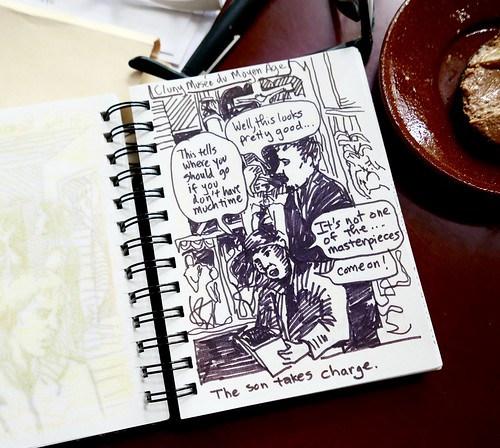
AND: Here's something I wrote in my Paris notebook that's quite relevant to this post. Transcribed verbatim: "I spent so much time today at the museum — walking all over the Louvre — there is so much here that you get numb, you don't care. If you had to travel from church to church to see each piece, it would mean much more. But as it is, you get to the point where you traipse along, casting your eyes about to see if anything really grabs you (oh, yeah, they're about to deliver a second axe chop to the neck of a saint who's not dead yet! That's cool — heh, heh. I saw some kids pointing this out — & aren't they on the same wave-length perhaps as the artist — in his time). One américain says, 'Let's skip this shit' & I don't think 'What a crass/ignorant little man!' I think 'I know exactly how you feel.' But much is good. I don't mean to slight it. It's just that one really doesn't prefer culture in one humongous globule! And yet in our modern world, great art has been globbed up in large Louvrish hunks, so this is the only way you can see it. For a normal look, you must look at the art of your own time, as the medievals viewed crosses and chalices in their own churches, localized and, not unimportantly, imbued with meaning: the beliefs that they shared with the art & artists themselves."
৫ মার্চ, ২০১৮
I'd love to discuss the new episode of "This American Life" — "Five Women."
I didn't listen to it carefully enough the first time, and I went back to the beginning to relisten and realized immediately how badly I had misunderstood the ideas that were being framed and presented. I was a little distracted the first time — cooking, pausing to talk to M, etc. — and I was also distorted by my own presumption that TAL would get in line with #MeToo dogma and believe the accusers and hate the man. But on second listen, I was shocked at how wrong I was and how much depth was present in the story. It's subtle. Are the women criticized for their behavior, their complicity, their cold pursuit of self-interest? In the end, I think, the real respect women deserve is to be seen as fully human, and that entails complexity. There's a lot going on here, and I would love to talk about it with people who have listened to the whole thing and listened carefully. Maybe the producers are afraid to cross the #MeToo dogmatists and they used ambiguity to fend off criticism, but I think they are genuinely dedicated to the art of radio and the full depth of humanity.