Obama the Candidate लेबल असलेली पोस्ट दाखवित आहे. सर्व पोस्ट्‍स दर्शवा

५ नोव्हेंबर, २०२५

"Mr. Mamdani later told an ally that he had confided in his fiancée, Rama Duwaji, that he didn’t really think he could win."

"The goal was to build a template for the kind of muscular leftist campaign that might one day crack the Democratic establishment’s hold. How that long-shot candidacy caught fire has been amply dissected by political observers here and in Washington. Mr. Mamdani foregrounded the city’s affordability crisis when rivals focused elsewhere, lapped them with viral social media videos and benefited from Democrats’ hunger for generational change.... Forget the New York conjured by political strategists, one future adviser, Zara Rahim, advised him over coffee last summer. Make a campaign about the actual New York City.... The campaign... hosted a series of events — a citywide scavenger hunt, a soccer tournament at Coney Island — that opponents laughed off as gimmicks but attracted thousands of supporters. Many later became part of an unmatched army of volunteers...."

Writes Nicholas Fandos, in "How Zohran Mamdani Beat Back New York’s Elite and Was Elected Mayor/The 34-year-old assemblyman won the Democratic primary by defying the city’s all-powerful establishment. He secured the mayoralty by delicately disarming it" (NYT).

People say Mamdani has never run anything, but remember when Obama was first running for President and they said that about him. Remember his answer? He's run something: He's run the campaign! Memorably hilarious. But wait a minute. Did Obama say that? I've spent the last hour looking for the quote. I've even found multiple examples of it, using 2 different AIs, which were quick to provide long quotes, quotes that didn't exist in the transcripts of the events that were named. My hypothesis at this point is that it's a false memory — an example of the Mandela effect. Obama may have said something that his opponents paraphrased into an argument that felt ludicrous, but he never made the argument that to run your political campaign for an executive position is relevant executive experience.

Anyway, good luck to Zohran Mamdani. He ran a fantastically successful campaign. One must hope he will also be successful running New York City.

३० ऑगस्ट, २०२५

"Trump’s team again defined classical broadly as all premodernist architectural styles, with roots in Greco-Roman antiquity..."

"... though art deco, which is on the list, is not typically considered traditional. The order defines 'traditional architecture' as Gothic, Pueblo Revival, Spanish Colonial, and Mediterranean styles historically rooted in parts of the United States. 'Designs diverging from classical architecture must convey the dignity, enterprise, vigor, and stability of the American government and command public respect,' the White House said in a fact sheet for the order, which also requires that Trump is notified when a building design deviates from the preferred style...."

From "Trump orders classical and traditional architecture for federal buildings" (Yahoo, passing along something from WaPo).

Justin Shubow, "the head of the National Civic Art Society [who] helped draft the order," taking the position that this wasn't a political issue, reminded WaPo about the time Barack Obama "accept[ed] the Democratic presidential nomination in 2008 in front of classical Greek backdrop. 'Whoever was stage-managing understood that this is how Americans think of the presidency. They do associate it with classical architecture.'"

I'd say that shows that it is a political issue. Obama was being political. It was not that he shared the ordinary American's taste for traditional architecture, but that he was trying to influence Americans to see him as belonging within the tradition that he and his handlers presumed they believed in. He wasn't elected yet, but, as we all saw at the time, he was acting as if he was already ensconced in the trappings of power.

२२ जानेवारी, २०२५

"She was spotted carrying books including The Iliad, a classic saga of male rage and refusal to accept defeat, on the campaign trail."

From "Who Is JD Vance’s Wife? Second Lady Usha Vance, Former Democrat, Steals the Inauguration Spotlight/Just after his swearing-in, Donald Trump joked that he 'would have chosen' Usha as VP—'the only one smarter than' JD Vance" (Vanity Fair).

A classic saga of male rage and refusal to accept defeat — that amused me. The boundaries of the manosphere are vast.

They say don't judge a book by its cover, but apparently it's fine to judge a person by the visible cover of any book they happen to be carrying. Remember back in May 2008 when candidate Barack Obama was photographed carrying "The Post-American World" by Fareed Zakaria? The NYT had just reviewed the book and said:
Zakaria’s is not another exercise in declinism. His point is not the demise of Gulliver, but the "rise of the rest.”...  The real problem, Zakaria argues, is the rise of China.... Authoritarian modernization just hums along. The Party’s message reads "Enrich yourselves, but leave the driving to us,” and most of 1.3 billion Chinese seem happy to comply — and to consume. With power safely lodged in the Politburo, China does not conform to the historical pattern of "first rich, then rowdy,” which led to Tokyo’s and Berlin’s imperialist careers.....

How did we read his reading? 

२९ मार्च, २०२४

It's a death trap, it's a suicide rap....

"Inside the hall, the three presidents sat in matching white armchairs and took the stage to strains of 'Born to Run' by Bruce Springsteen, the unofficial bard of the Democratic Party...."

I'm reading "4 Presidents, 2 Events and a Preview of Campaign Clashes to Come/President Biden raised $25 million at a Radio City Music Hall event, adding to his huge cash edge, after Donald Trump pushed his law-and-order message at a wake for a police officer killed on duty" (NYT).

Three Presidents were sitting in white armchairs before people who'd paid up to $500,000 apiece to sit in the audience in the most beautiful theater in the country. The comments over there are mostly about the fourth President. That guy, Mr. Trump, steals focus from everything.

Also stealing attention were the protesters at the 3-Presidents event. They were shouting "blood on your hands." Obama chided them: "You can’t just talk and not listen. That’s what the other side does." Seems to me protesters on Obama's side have interrupted more speeches than those on the other side. But it's subjective, and the old adage is as true as ever: All the assholes are over on the other side.

१३ जानेवारी, २०२४

When Obama won the Iowa caucuses in 2008 — "It felt then as if we were embracing modernity and inclusion, moving away from the image of John Wayne’s America."

"How could we have gone from such a hopeful moment to such a discordant one? Of course, every time there’s a movement, there’s a countermovement, where people feel that their place in the world is threatened.... Trump has played on that resentment.... Trump is a master at exploiting voters’ fears. I’m puzzled about why his devoted fans don’t mind his mean streak. He can gleefully, cruelly, brazenly make fun of disabilities in a way that had never been done in politics — President Biden’s stutter, John McCain’s injuries from being tortured, a Times reporter’s disability — and loyal Trump fans laugh. He calls Haley 'Birdbrain.'... Obama’s triumph in Iowa was about having faith in humanity. If Trump wins here, it will be about tearing down faith in humanity...."

Writes Maureen Dowd in her column this week, "Here Comes Trump, the Abominable Snowman" (NYT).

To repeat the question: "How could we have gone from such a hopeful moment to such a discordant one?" Does Dowd really believe it's all Trump's fault? Couldn't Obama himself have used his presidency more effectively and built American optimism? He promised hope, but why didn't he deliver more of it? Why did we end the Obama years with so much division and strife? Dowd puts no responsibility on Obama. It's all about the reactionaries — the countermovement that automatically follows any movement. It happens "every time." Dowd chooses to portray the American people as a machine, behaving mechanically — and perversely. And yet somehow it is Trump who is devoted to "tearing down faith in humanity." 

१८ ऑगस्ट, २०२०

In case you missed it...


I object to the use of children in politics but that was a lot better than this...


And this...


IN THE COMMENTS: Wince said:
Why weren't they shown taking a knee?
Simultaneously, Bob Boyd:
Were they all kneeling?
Which was exactly what Meade said here in real space.

The answer to Wince is: They were shown from the chest up, in the familiar coronavirus-y style of people Zooming from home. That's why it's so funny to ask "Were they all kneeling?"

१९ जुलै, २०२०

"It’s the diet version of the N-word, but as an African-American man, it’s something I deal with pretty frequently."

"If there’s a takeaway from the conversation, it is that Roger Stone gave an unvarnished look into what is in the heart of many Americans today."

Said Morris W. O’Kelly (of radio's "Mo’Kelly Show"), quoted in "Roger Stone Uses Racial Slur on Radio Show/Mr. Stone, while being questioned about the commutation of his sentence by President Trump, used a racial slur in referring to his interviewer, who is Black" (NYT).

The "diet version of the N-word" is "Negro," and Stone, in the middle of talking to O'Kelly, muttered something to the side. The beginning of the sentence was hard to make out, but it ended with "arguing with this Negro."
When Mr. O’Kelly asked him to repeat what he said, Mr. Stone let out a sigh, then remained silent for almost 40 seconds. Acting as if the connection had been severed, Mr. Stone vehemently denied that he used the slur. “I did not, you’re out of your mind,” Mr. Stone told the host.
Afterwards, O'Kelly said: “The only thing that I felt was true, honest and sincere that Roger Stone said was in that moment that he thought I was not listening. All of my professional accolades, all my professional bona fides went out the window because as far as he was concerned, he was talking and arguing with a Negro.”

Stone is ludicrously dishonest here. And no one should take solace in the fact that "Negro" was once the polite term. For background, read "When Did the Word Negro Become Taboo?," a 2010 Slate article dealing with a newly released statement Senator Harry Reid had made before the 2008 election, saying Barack Obama could win  because he was "light skinned" and had "no Negro dialect." That was 10 years ago, and people were calling on Reid to resign. I remember when "colored people" was the polite term (and so does the NAACP).

But it hardly even matters here, because even if Stone had muttered "arguing with this black man" or "arguing with this African-American man,"it would have been offensive. Do the interview, answer the questions. If you have a valid reason to object to the interviewer, go ahead and say it, but if your objection is that he's black, you're horribly wrong. Saying "arguing with this black man" is in the category of remarks like "It's like arguing with a 2-year-old" or "It's like talking to a wall." It's disrespectful even if the source of your irritation is not the race of your interlocutor. Add race, and it's a cruel insult. Make the racial word different from the normal words that decent people use in public speech, and you make yourself a pariah.

Stone paused for 40 seconds and denied that he said it. He knew it was wrong. If he knew it was wrong, and it's so obviously wrong, why did he say it? It's his secret thought but it just slipped out, because he lacks brain/mouth control? Or did he actually really want to hurt O'Kelly?

१ फेब्रुवारी, २०१९

"The more you learn about Kamala Harris, the more formidable she appears."

David Brooks is in love again.*
She is an amazing amalgam of different elements...
As opposed to amalgams of the same element. Why mess up your alliteration with a redundancy? And why not an amazing amalgam of elegant elements? Keep the alliteration at least.
... highly educated elite meritocrat, Oakland street fighter, crusading, rough-elbow prosecutor, canny machine pol and telegenic rhetorical brawler. She is also probably the toughest and most hard-nosed progressive on the scene right now....

She went to a prestigious school.... before going to law school, zooming up the political ladder and marrying a partner at a prestigious law firm. She is famously comfortable in rooms of the very wealthy.

But in deciding to work as a prosecutor — rather than going to a law firm — Harris was immersing herself in the gritty world the rest of the achievatrons were rising away from....
The rest of the achievatrons... like I guess the "partner at a prestigious law firm" she acquired as one of the achievements Brooks admires.
Harris was a beneficiary of the machine of the California political giant Willie Brown, who she briefly dated... but Harris made it clear at one forum that there is no way she’s going to bend if Brown or his allies try to influence her....

To beat Trump, I suspect Democrats will want unity. They won’t want somebody who essentially runs against the Democratic establishment (Bernie Sanders); they’ll want somebody who embodies it (Harris). They’ll want somebody who seems able to pulverize Trump in a debate (Harris)....
Seems!
Harris’s fearless, cut-the-crap rhetorical style will probably serve her well in this pugilistic political moment.
Probably!

Can anyone provide me with a good video clip demonstrating "Harris’s fearless, cut-the-crap rhetorical style," something that looks like it could "pulverize Trump in a debate"? I've never noticed anything like that. I hear a flat, bland style of speech. I mean, that's okay with me. I'm not looking for excitement. But if you're going to lavishly praise her rhetorical style and predict the pulverization of Trump, you need some evidence.

ADDED: I googled "fiery speech from kamala harris" and got this "Nobody is above the law" business, but it's Harris reading in a flat, nasal voice and frequently looking down and stumbling. Show me something where she's thinking on the spot and saying words that come straight from her head that show a "fearless, cut-the-crap rhetorical style" that could "pulverize Trump in a debate."

_____________________________

* I'm saying "again" because of the way Brooks gushed over Barack Obama in 2006. He famously said, "I remember distinctly an image of--we were sitting on his couches, and I was looking at his pant leg and his perfectly creased pant.... and I’m thinking, a) he’s going to be president and b) he’ll be a very good president." Notice that's a spoken quote. Brooks didn't write that in a column. The column he wrote at the time was "Run, Barack, Run." Here's how Brooks wrote about Obama:
[Barack Obama] notes that it’s time to move beyond the political style of the baby boom generation. This is a style... that is highly moralistic and personal, dividing people between who is good and who is bad.

Obama himself has a mentality formed by globalization, not the S.D.S. With his multiethnic family and his globe-spanning childhood, there is a little piece of everything in Obama. He is perpetually engaged in an internal discussion between different pieces of his hybrid self — Kenya with Harvard, Kansas with the South Side of Chicago — and he takes that conversation outward into the world....

He distrusts righteous anger and zeal. He does not demonize his opponents and tells audiences that he does not think George Bush is a bad man.

He has a compulsive tendency to see both sides of any issue.... During our talk... he kept returning to his mode, which is conversation, deliberation and reconciliation....

२९ ऑगस्ट, २०१८

"With the presidential election only 3 weeks away, John McCain faces a stark choice: Will he go down in history as a principled conservative who lost an election standing on his convictions? Or..."

"... will he go down as an opportunist who lost while bringing out the darkest elements in American politics?... After 8 disastrous years of Republican rule under George W. Bush, all of the tides of history point towards a Democratic victory on November 4th. Obama’s principle [sic] obstacle to the presidency has been whether a majority of Americans were ready to accept him as Commander in Chief... McCain’s campaign believed that their only chance was to change the subject from the economy and make Obama scary and unacceptable, a man who 'pals around with terrorists.' In the face of the vast economic crisis, that strategy appears to be failing, turning off moderates who want answers to their problems, even as it may be firing up the base. More disturbingly, McCain’s strategy is bringing out the dark underbelly of American politics — a strain of hate-filled nativism and racism that always lurks just below the surface of parts of the American political psyche. Historian Robert Hofstadter called it 'the paranoid style in American politics.' This strain is showing itself in increasingly angry crowds at Palin/McCain rallies which yell 'terrorist' and 'off with his head' about Obama. Even McCain himself appears to be taken aback by the virulence of his crowds’ reaction, partially defending Obama over the boos of his own supporters. Since it was the Palin/McCain campaign that had unleashed these forces with its implications that Obama was sympathetic to terrorism, John McCain has reached the point of political schizophrenia. John McCain is now at a crossroads. At this historical moment, he has virtually no path to win the presidency. The question is whether he will lose with honor or lose with disgrace. Will his legacy be like that of his Arizona Senatorial predecessor Barry Goldwater, who ran a campaign of conservative principal in a liberal year and lost in a landslide, only to see his principals [sic!] come to power 16 years in the form of Ronald Reagan? Or will his legacy be like some combination of Richard Nixon, Robert Dole and George Wallace, one of a man whom, in his overweening ambition for victory, took the low road and tapped the dark forces of American politics to his own everlasting shame and dishonor?"

From a HuffPo column published 3 weeks before the 2008 election. I thought it was interesting to read in the context of the McCain post mortem.

Those questions at the end make me want to ask: Is Trump the dark legacy of McCain?

९ जानेवारी, २०१८

"Look, I get it. Democrats have been traumatized by recent events, and one of the responses is..."

"... to throw up their hands and say, 'Fine then. If all voters care about is whether somebody puts on a good show, we’ll just come up with a celebrity of our own.' They look to the recent past and see a bunch of serious, experienced public servants with a deep understanding of policy who would have made fine presidents but who lost in part because they failed to light up the TV screen: Dukakis, Gore, Kerry, Hillary Clinton.... It’s true that Democrats have underappreciated the importance of charisma in presidential politics. But the answer to those electoral failures isn’t to stop caring about substance. It’s to find candidates who are both charismatic and serious, who would be able both to win and to do the job once they took office."

That's Paul Waldman in a WaPo op-ed, "Get a grip, people. Oprah should not run for president," which I find outright insulting to the person who may be the greatest American alive today. How is she not serious? Why the presumption that people who've gotten into politics early in life and hidden within the structures of government, cosseted by aides and advisers and beholden to contributors, are the serious people? Why is he treating Oprah as if she is all surface, no substance? Take 10 minutes to read her Wikipedia page and come back and tell me she's an unserious mass of charisma and nothing more!

Waldman goes on to say that Democrats can win without stooping to Oprah by finding another Bill Clinton or Barack Obama. Those guys were "fantastically compelling candidates who could also talk your ear off about policy" and who "knew how to work the political system, and they also knew how to sell." What's so deep and substantive about that? With great advisers, any candidate can work up positions on the policy issues of the day, and isn't that what Bill Clinton and Barack Obama did?

I notice Waldman didn't say Bill Clinton and Barack Obama got law degrees from elite schools and jumped into government from there. I don't need to say that's a bad way to equip yourself for the presidency to be able to say that's not the only way.

Incidentally, I was about to type "Oprah" and I accidentally typed "Obama." The "O" is a powerful first letter. We feel it deeply in a part of our brain we cannot look at and analyze. Speaking of emotion, Oprah is (per Wikipedia) "criticized for unleashing a confession culture, promoting controversial self-help ideas, and an emotion-centered approach." There is no other approach, people. We are emotion-centered whether we admit it or not.

And Oprah has been loved by America for a long, long time. Longer than Bill Clinton, longer than Barack Obama. Compare these signatures:


Did he not copy her?

६ ऑक्टोबर, २०१७

If Harvey Weinstein's sexual harassment problem was an open secret, why did Malia Obama intern for him?

The internship took place this year, I'm reading at "How Will Democrats Respond to the Harvey Weinstein Allegations?/The film mogul has been a major donor and fundraiser for Democratic causes and candidates, including Barack Obama, Hillary Clinton, and several possible 2020 candidates" (The Atlantic).

So I don't think her alliance with him and failure to speak out about him had anything to do with protecting Democrats in the 2016 election, but I can't understand why her people wouldn't say: Don't connect yourself to that man, because there's a big scandal about him that's going to blow up one day, and you want to protect your credibility on women's issues.

Perhaps one could intern with him and somehow remain sublimely out of the loop, but the position would have had to have been extremely well vetted, and her advisers would have known that even if she had no direct experience with Weinstein's corrupt modus operandi that it could hurt her.

People (like me, right now) will say you knew but you said nothing; you took personal advantage to further your career and you did not use your position of great cultural influence to help the women who were victimized in a system you were part of. 
Weinstein also raised money for President Barack Obama. In August 2011, Obama spoke at a $35,800 per guest dinner at Weinstein’s West Village home. In February 2012, Weinstein was one of several co-hosts for a $10,000 per plate fundraiser in New York City. Several months later, in August 2012, he hosted a $35,800 per head fundraiser at his home in Connecticut. In 2013, Obama was back at Weinstein’s house for another fundraiser, during which he praised Weinstein’s films. Malia Obama, Obama’s eldest daughter, interned for Weinstein this year. A spokesman for Obama declined to comment on the allegations.
Forget spokesmen. I want to hear from Barack Obama and from Malia Obama.

Here's some more info (in Bustle) about Malia's internship:
Malia's job at The Weinstein Co. was reportedly fairly common entry level work that consisted of the teen reading through unsolicited scripts sent into the office. Sorting through the "slush pile," as the voluminous mass is called, is draining, often unrewarding work, but that didn’t stop Weinstein from promoting meeting the First Daughter as a potential perk when auctioning off another internship for over $15,000 in February 2017. As The Hollywood Reporter reports, a memo advertising the internship said it was a once-in-a-lifetime opportunity to “learn all the ins and outs of the movie biz, and maybe even run into Malia Obama while you're at it."
He sold her. 

३ मे, २०१७

"A close mutual friend of the couple recalls Obama explaining that 'the lines are very clearly drawn. . . . If I am going out with a white woman, I have no standing here.'"

"And friends remember an awkward gathering at a summer house, where Obama and Jager engaged in a loud, messy fight on the subject for an entire afternoon. ('That’s wrong! That’s wrong! That’s not a reason,' they heard Sheila yell from their guest room, their arguments punctuated by bouts of makeup sex.) Obama cared for her, Garrow writes, 'yet he felt trapped between the woman he loved and the destiny he knew was his.'"

From "Before Michelle, Barack Obama asked another woman to marry him. Then politics got in the way/A massive new biography sheds light on the relationships, sacrifices and calculations that enabled the Obama presidency" (in The Washington Post), and article about the book that comes out next week, "Rising Star: The Making of Barack Obama."

२ मे, २०१७

Trump reaching out to Duterte and Kim Jong-un — isn't it like what Obama said in the CNN/YouTube debate of July 2007?

Here's Obama, saying "the notion that somehow not talking to countries is punishment to them... is ridiculous":


Transcript:

२७ डिसेंबर, २०१६

Axelrod got everything he wanted.

From the podcast with Obama:
OBAMA: And you know, part of the reasons that I think I've stayed sane in what has been this remarkable journey, and you've known me a long time and I think you'd confirm that I'm pretty much the same guy as I was when we started this thing.... [Y]ou know, success came late to me, notoriety came late. And it -- it made me realize that to the extent that I had been successful, it wasn't about me.  It was about certain forces out there and -- and me hitching my wagon to a broader spirit and a broader set of trends and a broader set of traditions. And so, when -- when we came up with the phrase Yes, We Can, which again, to give you credit I was a little skeptical of, it felt a little simplistic when we first started. But...

AXELROD: You didn't like the logo either, but that's -- that's a different discussion...

(CROSSTALK)

OBAMA: The logo I thought was a loser, it looked like the Pepsi logo and I thought...

AXELROD: That's what you said, that's...

OBAMA: ... that seems a little...

(CROSSTALK)

AXELROD: That's what you said, it became more iconic than the Apple insignia. So -- I'm glad we straightened this out...

OBAMA: But look, I...

AXELROD: I've gotten everything I wanted...

२ डिसेंबर, २०१६

Rush Limbaugh gives me a shout out and called something I said "astute" — but there was something about it he had to contradict... which makes me say something that might be even more astute.

On the show today:
Ann Althouse. She's from Wisconsin. She has a blog -- she's had it for a while -- and she wrote a blurb last night, a post, about two political science professors who have recently discovered the term "low-information voter" and sought to define it.
He was pointing at this post of mine from yesterday, where I criticized the professors for characterizing Trump voters as "low-information" voters. I said that Rush Limbaugh has used the term for years "to refer to the people who are accepting the view of the world presented in the mainstream media (which he sees as thoroughly biased in the liberal direction)."

I thought polisci professors ought to be informed about what's on Rush Limbaugh's show, and I made the wisecrack that if "you're writing about American politics," and you don't know what's on Rush's show, "then you yourself are low-information."

Rush said my observation was "very kind" and "astute," but as he went on, I could see that he didn't really agree with the way I'd defined the term I'd given him credit for coining. In fact, ironically, the definition he proceeded to give matched up pretty well with the polisci profs' definition!

The polisci profs —  Richard Fording and Sanford Schram — had said:
Low information voters are those who do not know certain basic facts about government and lack what psychologists call a “need for cognition.” Those with a high need for cognition have a positive attitude toward tasks that require reasoning and effortful thinking and are, therefore, more likely to invest the time and resources to do so when evaluating complex issues.
That part of their definition fits with what Rush said on his show today when he got very specific about what he meant by the term. He said he coined the term back in 2008:
There was a TIME Magazine story that literally said a voluminous number of Obama voters never followed the news. And I said, "Well, there you go!" (laughing) I mean, makes perfect sense. So low-information voters began as low-information voters. They don't know anything! They don't follow the news. They're pure addicts of pop culture... but they don't have the slightest knowledge of politics. And they haven't been taught much about it, and that's what low-information voters are....
So that's different from what I said, which was that they do listen to the news, but — in Rush's view — they don't get enough information because the mainstream news has so much liberal bias. Rush is actually pretty close to what Fording and Schram said, it's just that the professors looked at the people whose lack of information coincided with liking Trump and Rush was looking at the people whose lack of information coincided with liking Obama.

If you lack information but you vote, what is your vote based on? The professors said:
Our research finds that Trump has attracted a disproportionate (and unprecedented) number of “low-information voters” to his campaign. Furthermore, these voters are more likely to respond to emotional appeals — whether about the economy, immigration, Muslims, racial relations, sexism, and even hostility to the first African American U.S. president, Barack Obama. They are the ideal constituency for a candidate like Trump.
Now, Trump won. So did Obama. Maybe elections are won by whoever does best at reeling in the LIVs.

I wonder if Fording and Schram have applied their science to the 2008 election. If they did, maybe they would write that their research finds that Obama has attracted a disproportionate number of low-information voters. That's what the old TIME Magazine article seems to have said.

And then wouldn't it also be that those voters too were swayed by emotional appeals? Fording and Schram list some emotional issues they think may have worked to bring LIVs to Trump — "the economy, immigration, Muslims, racial relations, sexism, and even hostility to the first African American U.S. president, Barack Obama."

But you could make a comparable list of emotional issues that brought LIVs to Obama — hating the war, fearing climate change, and the thrill of the first African-American President.

११ नोव्हेंबर, २०१६

After Trump shockingly won Pennsylvania, we should remember that when Obama talked about "bitter clingers" back in 2008, he was talking about Pennsylvania.

Here's the Huffington Post article by Mayhill Fowler, originally published in April 2008, about a fundraising speech by the candidate Barack Obama. He was speaking in San Francisco, but he was talking about Pennsylvania. And Fowler describes Obama's interactions with people in town hall meetings in Pennsylvania:
In Harrisburg two weeks ago, one person called on by Obama chose not to ask a question. Instead a man who introduced himself as only Dennis told Obama, “Make a speech on patriotism because the Republican Party does not own the flag.” In Wilkes-Barre a few days later, Obama fielded a similar comment from a man who said, “I believe that this nation now has dangerously low levels of patriotism and national pride.... My question to you is How are we going to reestablish America’s reputation to Americans?” 
In other words: Can we make America great again?

At the link, you can read the full text and listen to the audio of what Obama said to the elite-donor types in San Francisco. I'll excerpt some of it and do some boldfacing. The idea is to understand how the Democrats lost Pennsylvania this year:

१८ ऑक्टोबर, २०१६

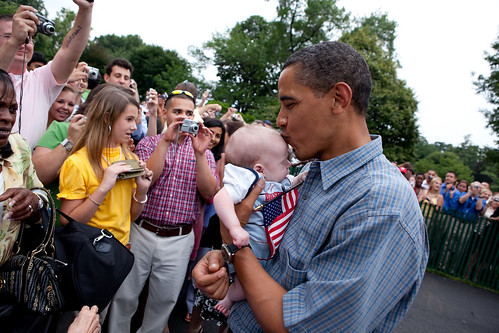
Kissing babies... it used to be the stereotypical politician's move.

But Trump ruined it:


Look: Obama did it so nicely:

P070409PS-0507

Just looking at that picture, I got chills and tears came to my eyes. That man is so lovely. I'm advance-missing him.

Is it time for politicians to stop with the kissing? Here's David Shears, a Brit looking at America, writing in 1961, "Is Baby Kissing Really Necessary?"
While blintz-eating and other epicurean forms of electioneering may swing the odd vote here and there, I very much doubt if baby-kissing cuts any political ice whatever. In this respect I agree with Mr. Arthur Levitt, the Democratic organization candidate for Mayor of New York, who sternly refused to kiss babies when he toured the Rockaways during the primary campaign. I refuse to believe this reserve had anything to do with his defeat. He was merely exercising every man's right to draw the line.
And in 1968, Nixon said: "I won't wear a silly hat, or kiss a lady or a baby. I won't ski down a hill or do any stunting like that—I'd look like a jerk."

Both those quotes are from a 2012 Mother Jones article: "Politicians Kissing Babies: A Short History/From Andrew Jackson to Barack Obama, a cheeky timeline of a revered and reviled American political custom."

As for "exercising every man's right to draw the line" — which referred to the politician's right not to kiss — How about the baby's right? The baby is used as a prop — an object — and has no option to exercise a right to kiss or not to kiss. There's no capacity to consent.

Are we to view baby-kissing as sexual now, because Trump reminds us of sexual intrusions (on adult women)? So now, babies must not be kissed, even if unlike Nixon, the politician thinks the kissing of babies will further his pursuit of power? It worked for Obama.

Ah, but the kissing of babies can't be considered sexual, because we have to kiss our own babies. How tragic to make people think that might be wrong. The problem is the use of children in politics. Just stop that... or minimize it. Be very careful. You can use children a little, but treat them with the utmost respect.

१६ ऑक्टोबर, २०१६

"It seems to me if you can speak, you're at a liability in the Democratic Party anymore. It seems to me you've all become heartless technocrats."

"It seems to me that you forget that... we have never as a party moved this nation by 14-point position papers and 9-point programs. It seems that when we got involved in the civil rights movement... nobody asked Martin Luther King what his legislative agenda was. He marched to change attitudes. When the women's movement started, it had not moved with a constitutional amendment. They marched to change attitudes. And this party better understand full well that it's about time that we change our attitude and we begin to change the attitudes of Americans about what their responsibilities are to the poor, about what their responsibilities are to other people, and about what our responsibility in the world is, and that requires changing attitudes. But... I promise you'll see my 15-point plans and 19-point position papers and...  you'll be able to make a judg[ment] about whether... I know more about economic policy. But ultimately... this country needs a leader, and leaders change attitudes about people, and it's the ironic twist that in the wake of Ronald Reagan that the only one thing he knew how to do was the one thing that is now being... the currency of which is in fact now being devalued so much."

That's something Joe Biden said in 1987 (when he was running for President). I quoted that back in August 2008, relating it to Barack Obama. I imagined Obama hearing Biden's remarks and seeing his path to the presidency, seeing how he might be the one who could, like Ronald Reagan and Martin Luther King, use the power of speech to change attitudes.

The reason I'm dragging this up out of the archive this morning is I'm noticing how Biden's idea also applies to Trump. Maybe Trump too heard Biden's idea and saw that the presidency is achieved through speech — emotionally rousing speech that changes attitudes.

Of course, there are many possible attitudes. Which way are you going to change the attitudes? And what attitudes will be inspired in response to how that attitude looks in the people you inspire? In Trump's case, the response to the attitude he inspired turned a lot of people back to the kind of Democratic Party candidate Biden was speaking against — the flat, dull speaker with the 14-point position papers and 9-point programs.

Talk about an ironic twist. 

३० जुलै, २०१६

Maureen Dowd's new column, "Thanks, Obama," is titled sarcastically.

It took me a moment to get past the photograph — Hillary encountering Obama and doing that awful gaping maw expression right into his face — and then I thought I was reading a column of genuine appreciation of the goodness of Barack Obama compared to Clinton and it took me a while to realize that the title — "Thanks, Obama" — was sarcastic.

Dowd goes back to 2008, when an Obama ad said: “Hillary Clinton. She’ll say anything and change nothing. It’s time to turn the page.” Dowd quips:
Evidently, President Obama folded the corner of that page over so he could go back to it later. Remarkably, he bought us our return ticket to the past, rolling out the red carpet for the restoration of the Clinton blurred-lines White House.

An army of idealistic young people had moved to Iowa in 2007 to help Obama beat seemingly impossible odds. But in this election, Bernie Sanders’s idealistic young people were cast as unrealistic dreamers who wanted free stuff or, according to Gloria Steinem, dates....

The president made his vote-for-Hillary-or-face-doom convention speech only 22 days after his F.B.I. director painted Hillary as reckless and untruthful.
He argued that there is no choice but to support Hillary against a “self-declared savior” like Donald Trump, perhaps forgetting that Obama was once hailed as such a messiah that Oprah introduced him in 2007 as “the one,” and it became his moniker.

In the end, Obama didn’t overthrow the Clinton machine. He enabled it.

It turns out, who we choose is not really about our souls. It’s just politics, man.
Aptly put. 

११ जुलै, २०१६

One answer to that question I asked yesterday is: Barack Obama has not been trying to bring racial harmony.

Instapundit linked to my post, in which I had said that before we can analyze whether Hillary Clinton or Donald Trump might succeed in healing racial divisions, we need to examine why Barack Obama has failed.

I don't give an answer in my post, but I fully expected to hear the answer: Barack Obama never intended to bring racial harmony. That is, he's only failed to achieve a goal the question assumed he had. That's not failure, that's success.

As Instapundit puts it, Obama was sold as a new hope for racial healing, but "it's not how he ruled" and: "President Chaos Umpire has no interest in racial healing."

I expected that. But I don't personally agree with it. It's a neat answer, a red-meat answer, but I think the situation is much more complex. I don't know who — if anyone — completely believed that Hope-poster Obama would magically solve all the racial problems in this country. Perhaps some people who didn't vote for Obama thought that now that we've elected a black President, everyone should stop talking about racial problems.

The problems are complicated, drawing them out makes them look worse, but some people think that looking at them is part of whatever progress could be made in solving them. And some people think those who are trying to expose problems are making them worse, and it would be better to stop talking about race altogether.