I know that at the time I thought I bet all the Presidents have had a weird obsession. I know because I said that in a podcast at the time.
John Adams लेबल असलेली पोस्ट दाखवित आहे. सर्व पोस्ट्स दर्शवा
John Adams लेबल असलेली पोस्ट दाखवित आहे. सर्व पोस्ट्स दर्शवा
१२ जुलै, २०२६
"We don’t need presidents who have weird obsessions."
Said Kamala Harris, back in October 2020, blogged at the time, here.
That post and podcast predated access to Grok, so I didn't have the chance to use this prompt: Accept the hypothesis that every U.S. President had a weird obsession and to list all the Presidents with their weird obsession. I did use it today, though. Some of my favorites:


२५ मे, २०२५
"I think the NYT has framed men as a problem. They're not thriving, they're not aspiring. We need to figure out what's wrong with them..."
"... maybe even empathize with them, because, after all, we do need them to function."
So I said, in the previous post. And one reason I said it was because I'd already opened a tab for a second article on the home page of the NYT today: "Where Have All My Deep Male Friendships Gone? I have many guy friends. Why don’t we hang out more?"
So I said, in the previous post. And one reason I said it was because I'd already opened a tab for a second article on the home page of the NYT today: "Where Have All My Deep Male Friendships Gone? I have many guy friends. Why don’t we hang out more?"
This is a long piece in the NYT Magazine, by Sam Graham-Felsen, and like the article discussed in the previous post, it assures us that there's nothing gay going on here: "I never had sexual feelings for Rob, but there was an intensity to our connection that can only be described as love. I thought about him all the time, and cared, deeply, about what he thought of me. We got jealous and mad at each other, and often argued like a bitter married couple — but eventually, like a successful married couple, we’d always find a way to talk things out."
Graham-Felsen has had many other close male friends — "nearly a dozen other dudes — dudes I spent thousands of accumulated hours with; dudes I shared my most shame-inducing secrets with; dudes I built incredibly intricate, ever-evolving inside jokes with; dudes I loved and needed, and who loved and needed me...."
But he doesn't have dudes like that anymore. Is that because he's older, and his contemporaries are absorbed in family and work, or is it because American men in general "are getting significantly worse at friendship"?
३ ऑगस्ट, २०२४
"The two candidates conveyed the customary air of indifference, neither saying anything publicly or appearing to lift a finger in his own behalf."
"Jefferson remained at Monticello, Adams at his farm, which he had lately taken to calling Stoneyfield, instead of Peacefield, perhaps feeling the new name was more in keeping with New England candor, or that it better defined the look of the political landscape at the moment."
From "John Adams" (p. 672) by David McCullough, describing the candidates' participation in the election campaign of 1800. (Commission earned.)
From "John Adams" (p. 672) by David McCullough, describing the candidates' participation in the election campaign of 1800. (Commission earned.)
३१ जुलै, २०२४
Laura Ingraham detects Trump's gender fluidity.
ADDED: As you can see a few posts down, I've been reading "John Adams" by David McCullough. After writing this post, I went out for a walk with my audiobook version and was stunned to hear a passage that fit with the topic of a President's gender fluidity. From pages 659-660, about the presidential campaign of 1800:Ingraham: What are your pronouns?
— Acyn (@Acyn) July 30, 2024
Trump: I don’t want pronouns
Ingraham: So, you’re fluid? pic.twitter.com/KjA8tZxpnw
Not satisfied that the old charges of monarchist and warmonger were sufficient, [the propagandist James] Callender called Adams a “repulsive pedant,” a “gross hypocrite,” and “in his private life, one of the most egregious fools upon the continent.” Adams was “that strange compound of ignorance and ferocity, of deceit and weakness,” a “hideous hermaphroditical character which has neither the force and firmness of a man, nor the gentleness and sensibility of a woman.”
"A peck of troubles in a large bundle of papers.... No company. No society. Idle, unmeaning ceremony."
Wrote John Adams, complaining about what it's like to be President of the United States, quoted in "John Adams" by David McCullough (page 638)(commission earned).
I've spent so much time in the last 20 years watching numerous characters seeking the presidency. It's a wholesome respite to read about someone who doesn't like it at all.
ADDED: On the subject of the President's security: "Told there had been an attempt to break into the President’s House and asked if a guard should be posted, Adams said no, lest a sentinel at the door lead people to think the situation worse than they knew" (page 603).
२० जून, २०२४
"When someone drones on about 'solidarity,' all I hear is, 'Get in line.' When there’s no room for dissent from the dissent..."
"...there’s no room for me. Color me an anti-fan of performative politics, particularly if it means I’d be part of the show that features bigots posing as bleeding hearts. Plus, all that earnestness! It brings out my ironic and impish side, inclined to correct typos on signage or foment some kind of peripheral debate. Every time someone at one of those encampments cried out 'Free Palestine' I’d be tempted to yell 'From Hamas!' I’d surely get kicked out of the group that wants to kick other people out.... I realize we live in a country born of protest and my attitude may seem vaguely un-American. Watching the rabble-rousers on HBO’s 'John Adams' during Covid lockdown, my first grumbly thought was, 'Stop whining and pay your taxes!' Reading about the Whiskey Rebellion made me think of drunken MAGA types sloganeering at a Trump rally about the glory of firearms...."
Writes Pamela Paul, in "Confessions of an Anti-Protester" (NYT)(free access link).

Writes Pamela Paul, in "Confessions of an Anti-Protester" (NYT)(free access link).
I share a lot of those feelings. I feel a sense of heightened individuality when I find myself in a crowd. And, like Paul, I've only participated in one political protest in my entire life, but I do rankle at "drunken MAGA types sloganeering at a Trump rally."
Drinking at a Trump rally? Where does she get that? I see the effort at humor after the mention of the Whiskey Rebellion, but I don't think there's drunkenness at Trump rallies. Maybe attend one and look around. You don't have to protest. You don't even need to support the candidate. Snake through the line and talk to people over the railings.
You may be surprised. They might be real human individuals, like you.
१७ जून, २०२४
"These officials declare that it is now unprofessional or reckless for lawyers to draw historical comparisons to show trials or..."
"... to question the motives or ethics underlying these cases. They warn lawyers not to 'sow distrust in the public for the courts where it does not belong.' Yet, many believe that there is an alarming threat to our legal system and that distrust is warranted in light of prosecutions like the one [against Trump] in Manhattan. ... [C]ritics of political prosecutions under the Crown and during the Adams Administrations were often threatened with disbarment or other legal actions for questioning the integrity or motives of judges or prosecutors. It is not enough to say 'well that was then and this is now.' The point is that the bar association also has a duty to protect the core rights that define our legal system, particularly the right of free speech."
Writes Jonathan Turley, in "Think twice? Bar group tells members it’s OK to criticize, but don’t dare call Trump conviction 'partisan'/Connecticut Bar Association makes chilling claim that calling the case one of political prosecution has 'no place in the public discourse'" (Fox News).
Writes Jonathan Turley, in "Think twice? Bar group tells members it’s OK to criticize, but don’t dare call Trump conviction 'partisan'/Connecticut Bar Association makes chilling claim that calling the case one of political prosecution has 'no place in the public discourse'" (Fox News).
२८ नोव्हेंबर, २०२३
"Might it make the new 'they' a little easier to handle if it were used with singular tense marking?"
Proposes John McWhorter, in "Knowing When ‘They’ Means One" (NYT).
I have often been asked by people over 35 or so, “Are we supposed to say ‘they want’ or ‘they wants’?” I always answer that the proper form is “they want,” but must it be?...
Under the current dispensation, “they want to trim the cat’s claws” can refer to an individual or more than one person. Context usually makes the meaning known, but surely it would make things a little clearer if we could use “they wants to trim the cat’s claws” when referring to just one person....
६ नोव्हेंबर, २०२२
"King Charles and Queen Camilla... occupy three bedrooms: one shared room and an individual private boudoir each."
"The arrangement has been hailed as a recipe for marital harmony: no recriminations about toast crumbs on the duvet or arguments over whether to invite the Jack Russell terriers aboard, and plenty of space to starfish. And it turns out that King Charles is a bedroom trendsetter. The latest YouGov sleep study reveals that one in five couples have switched to separate beds (or opted for sleep divorce, as it’s cheerily known), with women (41 per cent) more likely than men (33 per cent) to say they sleep better alone...."
From "Are you ‘sleep divorced’? Here’s why single beds are back" (London Times).
What, exactly, is a boudoir? I get it that there are 3 bedrooms, and like the idea of 3 connected rooms, which could work very well in a house to accommodate the varied sleep patterns of a married couple and also be usable as guest bedrooms, but what makes an extra bedroom into a "boudoir." That sounds exciting, but why?
१९ जानेवारी, २०२१
"Adams, the second US president and first to lose an election, simply refused to attend the inauguration ceremony of Thomas Jefferson in 1801, whose supporters had referred to Adams as 'hideous [and] hermaphroditical.'"
From "How many presidents have boycotted successors’ inauguration and who are they?/The 45th commander in chief is set to become only the fourth to skip the ceremonies" (The Independent).

ADDED: The last President to avoid his successor's inauguration was Andrew Johnson. Here's a picture of him:

Meade texted me that and said Johnson looks like George W. Bush. I said he looks like a combination of Nixon and William Shatner. Which is a pretty funny/terrifying idea for a President.
२५ नोव्हेंबर, २०१९
Sometimes God chooses cancer.
July 22, 2015: "Rick Perry just gave an epic speech raging against Donald Trump and comparing him to a 'cancer'" (Business Insider).
If you make it to the top, you're the chosen one, that time. As for John Adams, who prayed that a man like Trump would never occupy the White House (according to Perry), he must have been the chosen one in 1796 when he won the presidency, but being chosen once doesn't mean you'll be chosen twice, and he was not the chosen one when he ran for reelection in 1800. So even if you subscribe to this notion that the winner is necessarily the chosen one, it doesn't mean that "chosen one" Trump will win in 2020.
The plan is always a mystery until we see what happens.
"Let no one be mistaken - Donald Trump's candidacy is a cancer on conservatism, and it must be clearly diagnosed, excised and discarded," Perry said.... "It cannot be pacified or ignored, for it will destroy a set of principles that has lifted more people out of poverty than any force in the history of the civilized world - the cause of conservatism.... [M]ost telling to me is not Mr. Trump's bombast, his refusal to show any remorse for his comments about Senator McCain, but his admission that there is not a single time in his life that he sought the forgiveness of God... A man too arrogant, too self-absorbed, to seek God's forgiveness is precisely the type of leader John Adams prayed would never occupy the White House."November 25, 2019: "Rick Perry says Trump is the 'chosen one' sent 'to do great things'" (The Hill).
"God's used imperfect people all through history. King David wasn't perfect. Saul wasn't perfect. Solomon wasn't perfect,” Perry said in the clip. “And I actually gave the president a little-one pager on those Old Testament kings about a month ago and I shared it with him... I said, 'Mr. President, I know there are people that say you said you were the chosen one and I said, 'You were.’ I said, 'If you're a believing Christian, you understand God's plan for the people who rule and judge over us on this planet in our government.'"It's all in the plan, including cancer.
If you make it to the top, you're the chosen one, that time. As for John Adams, who prayed that a man like Trump would never occupy the White House (according to Perry), he must have been the chosen one in 1796 when he won the presidency, but being chosen once doesn't mean you'll be chosen twice, and he was not the chosen one when he ran for reelection in 1800. So even if you subscribe to this notion that the winner is necessarily the chosen one, it doesn't mean that "chosen one" Trump will win in 2020.
The plan is always a mystery until we see what happens.
२६ जून, २०१९
"Together with the right to vote, those who wrote our Constitution considered the right to trial by jury 'the heart and lungs, the mainspring and the center wheel' of our liberties, without which 'the body must die; the watch must run down; the government must become arbitrary.'"
"Letter from Clarendon to W. Pym (Jan. 27, 1766), in 1 Papers of John Adams 169 (R. Taylor ed. 1977). Just as the right to vote sought to preserve the people’s authority over their government’s executive and legislative functions, the right to a jury trial sought to preserve the people’s authority over its judicial functions. J. Adams, Diary Entry (Feb. 12, 1771), in 2 Diary and Autobiography of John Adams 3 (L. Butterfield ed. 1961); see also 2 J. Story, Commentaries on the Constitution §1779, pp. 540–541 (4th ed. 1873)."
Beautiful use of historical citation by Justice Neil Gorsuch, writing for the plurality in United States v. Haymond.
The heart and lungs, the mainspring and the center wheel...
I'd never seen that quote before. A 1766 letter from John Adams. I was so touched it made me cry!
ADDED: Here's the full "Earl of Clarendon to William Pym" letter, presented with this introduction:
Beautiful use of historical citation by Justice Neil Gorsuch, writing for the plurality in United States v. Haymond.
The heart and lungs, the mainspring and the center wheel...
I'd never seen that quote before. A 1766 letter from John Adams. I was so touched it made me cry!
ADDED: Here's the full "Earl of Clarendon to William Pym" letter, presented with this introduction:
In 1765, a London newspaper printed four letters on the Stamp Act crisis by an author writing under the pseudonym of William Pym. (The writer had actually mistaken John Pym’ s first name for William.) Pym’ s second letter was subsequently reprinted in a Boston newspaper. Adams, writing as the Earl of Clarendon, responded to Pym in three installments between January 13 and 27, 1766.AND: I've often seen the Supreme Court's reference to "the heart of liberty" (in Planned Parenthood v. Casey), but never before the heart and lungs of liberty.
Adams’ s response ranks among the most elegant and moving pieces that he ever wrote. He clearly enjoyed the fiction of writing an other-worldly debate between these two great statesmen of the English Civil War. His prose crackles with sarcasm as he mocks Pym for his apostacy [sic] from the principles of revolutionary republicanism. The theme of Clarendon’ s first letter is the unconstitutionality of juryless courts and taxation without consent. The second letter is a stirring defense of the spiritedness of American liberty and virtue against the doctrine of passive obedience. The third letter, one of the most literary pieces that Adams ever wrote, is a systematic explication of the “essentials and fundamentals” of the British constitution.
१५ एप्रिल, २०१९
"[C]redulous historians have championed Jefferson and Jackson as the creators of 'our mythic democracy' — in reality..."
"... a sham democracy driven by personal ambition, partisan corruption, and shameless pandering that disguised the powerful interests truly in charge [according to Nancy Isenberg and Andrew Burstein, in 'The Problem of Democracy: The Presidents Adams Confront the Cult of Personality']. The Adamses had the nerve to point out the chicanery of this racket, and for that, the authors argue, historians have dismissed them as out-of-touch, misanthropic stuffed shirts. Isenberg and Burstein want to recover and vindicate what they describe as a lost 'Adamsian' vision of a more elevated, virtuous, balanced, nonpartisan polity, so unlike the system that defeated them, the all-too-familiar forerunner of our own. By the Adamses’ standards, Trump is not an aberration. He is an exemplar of everything in our politics that they resisted in vain, especially the fraudulent party democracy that substitutes tribal loyalties and celebrity worship for informed debate. But this view of the past and the present is flawed, historically as well as politically. The Adamses were chiefly the victims not of undeserving charlatans but of their own political ineptitude. And the crisis that has given us Donald Trump has arisen not from the excesses of a party politics the Adamses despised, but from the deterioration of the parties over recent decades.... Trump is not a creature of the party politics pioneered by Jefferson and Jackson. He is its antithesis, a would-be strongman who captured the presidency by demonizing party politics as a sham. He will be stopped only if the Democrats can mount a reinvigorated, disciplined party opposition. In that struggle, the Adamsian tradition is at best useless and at worst a harmful distraction."
Writes Sean Wilentz in "The Problem With High-Minded Politics/John Adams and John Quincy Adams’s virtuous disdain for partisanship was at the root of their failures" (The Atlantic).
Writes Sean Wilentz in "The Problem With High-Minded Politics/John Adams and John Quincy Adams’s virtuous disdain for partisanship was at the root of their failures" (The Atlantic).
३० सप्टेंबर, २०१७
"What remains enthralling, though, are Millett’s close readings, her exposés of the naked emperors of the literary left."
"'After receiving his servant’s congratulations on his dazzling performance, Rojack proceeds calmly to the next floor and throws his wife’s body out of the window,' is Millett’s deadpan description of the aftermath of the hero’s sodomization of a maid in Mailer’s An American Dream. Millett then observes, 'The reader is given to understand that by murdering one woman and buggering another, Rojack became a "man."'"
Writes Judith Shulevitz in "Kate Millett: ‘Sexual Politics’ & Family Values" (New York Review of Books):
ADDED: The word "bugger" (for anal sex) is rare these days. Did you know the word is related to "Bulgarian"? From the Online Etymology Dictionary:
AND: Here's a William Safire column (from 1995) on the word "bugger," written after some Congressman said "We're here to nail the little bugger down" (and the "little bugger" was Bill Clinton). How disrespectful was it?
Writes Judith Shulevitz in "Kate Millett: ‘Sexual Politics’ & Family Values" (New York Review of Books):
For a glorious moment, this very bookish literary critic was the face of American feminism. The New York Times called her the “high priestess.” After “Prisoner of Sex” became the talk of the town—and the revered Harper’s editor Willie Morris was fired for publishing it—Mailer organized a riotous debate known as “Town Bloody Hall,” which was filmed by Chris Hegedus and D.A. Pennebaker and is now streamable. It was a circus, and it was Millett who set it in motion, even though she refused to show up. Mailer aimed a torrent of insults at the feminists who did agree to take the stage or appear in the audience, among them Greer, Diana Trilling, Susan Sontag, Betty Friedan, and Cynthia Ozick. They rolled their eyes and gave as good as they got—much better, in most cases—and the crowd roared with delight. Try to imagine a public clash of ideas being so joyously gladiatorial today.Here it is:
ADDED: The word "bugger" (for anal sex) is rare these days. Did you know the word is related to "Bulgarian"? From the Online Etymology Dictionary:
bugger (n.) "sodomite," 1550s, earlier "heretic" (mid-14c.), from Medieval Latin Bulgarus "a Bulgarian" (see Bulgaria), so called from bigoted notions of the sex lives of Eastern Orthodox Christians or of the sect of heretics that was prominent there 11c. Compare Old French bougre "Bulgarian," also "heretic; sodomite."The earliest use of "bugger" to express "annoyance, hatred, dismissal, etc.," is, according to the OED, in the diary John Adams, in 1779: "Dr. W[inship] told me of Tuckers rough tarry Speech, about me at the Navy Board.—I did not say much to him at first, but damn and buger my Eyes, I found him after a while as sociable as any Marble-head man."
bugger (v.) "to commit buggery with," 1590s, from bugger (n.)...
AND: Here's a William Safire column (from 1995) on the word "bugger," written after some Congressman said "We're here to nail the little bugger down" (and the "little bugger" was Bill Clinton). How disrespectful was it?
५ जून, २०१६
"So I guess the biggest takeaway is, yes, this election cycle is bizarre. But it's no more bizarre than the election in 1800..."
"... wherein Jefferson accused Adams of being a hermaphrodite and Adams responded by [spreading rumors] that Jefferson died, so Adams would be the only viable candidate. He was counting on news to travel slow! That, weirdly, gives me hope."
Said Lin-Manuel Miranda (creator of the very popular musical "Hamilton") in his Rolling Stone interview, which is also prominently quoted in Maureen Dowd's new column, "John Adams Was a Hermaphrodite?"
Dowd's column is mostly about Hillary's unlikability and Trump's wily fighting style. I'll just quote this, because it made me laugh (and it's arguably genitalia-related):
Said Lin-Manuel Miranda (creator of the very popular musical "Hamilton") in his Rolling Stone interview, which is also prominently quoted in Maureen Dowd's new column, "John Adams Was a Hermaphrodite?"
Dowd's column is mostly about Hillary's unlikability and Trump's wily fighting style. I'll just quote this, because it made me laugh (and it's arguably genitalia-related):
Trump speculated at his rally that Hillary might share sensitive information with her aide Huma Abedin who might share it with her husband, saying: “I know Anthony Weiner. I don’t want him knowing anything. And I never, ever want him to tweet me.”Anyway... did Jefferson say Adams was a hermaphrodite? I found this:
So, of course, Weiner tweated [sic] immediately and incoherently: “Wait, is he talking to me. I’ll hit that guy with so many rights, he’ll be begging for a left.”
Jefferson's camp accused President Adams of having a "hideous hermaphroditical character, which has neither the force and firmness of a man, nor the gentleness and sensibility of a woman."
In return, Adams' men called Vice President Jefferson "a mean-spirited, low-lived fellow, the son of a half-breed Indian squaw, sired by a Virginia mulatto father."
१९ ऑक्टोबर, २०१४
All the Presidents' Drinks.
Excerpts:
John Adams. Adams loved alcohol, starting almost every morning with a hard cider. Then porter beer, rum and copious amounts of Madeira....
Martin Van Buren. Drank so much whiskey that it earned him a nickname, “Blue Whiskey Van.” He also enjoyed something called Schiedam (a gin-like Dutch specialty unique to New York’s Hudson River Valley)....
Millard Fillmore. Fillmore rarely drank wine or served it to others. However, this lightweight once admitted to sampling enough old Madeira that he was “slightly fuddled.”...
Chester A. Arthur. When a representative of the Temperance movement tried to pressure Arthur into a no-liquor policy in the White House, he thundered: “Madam, I may be the president of the United States, but what I do with my private life is my own damned business!”...
१६ डिसेंबर, २०१३
"The People should never rise, without doing something to be remembered — something notable And striking."
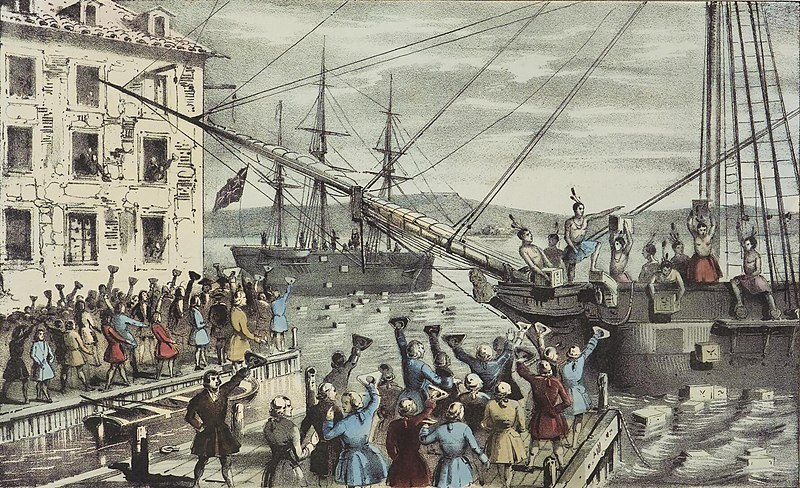
"Last Night 3 Cargoes of Bohea Tea were emptied into the Sea. This Morning a Man of War sails. This is the most magnificent Movement of all. There is a Dignity, a Majesty, a Sublimity, in this last Effort of the Patriots, that I greatly admire. The People should never rise, without doing something to be remembered — something notable And striking. This Destruction of the Tea is so bold, so daring, so firm, intrepid and inflexible, and it must have so important Consequences, and so lasting, that I cant but consider it as an Epocha in History."
So wrote John Adams in his diary.
Today is the 240th anniversary of the Boston Tea Party.
६ जुलै, २०१३
This is a post about the shade of meaning between "laconic" and "taciturn."
There really was a place called Laconia. It's where Sparta was. The OED says "laconic" means, first, "Characteristic of the Laconians; Spartan-like" and quotes John Adams:
१९ डिसेंबर, २०१२
Democrat, Democratic, Democratical.
Today, I encountered a word I'd never noticed before: "democratical." I was writing about the "common sense" meme and arrived at the Thomas Paine pamphlet "Common Sense" and John Adams's criticism of it as "so democratical, without any restraint or even an attempt at any equilibrium or counter poise, that it must produce confusion and every evil work."
The OED defines "democratical" to mean the same thing as "democratic," and it gives some usage examples going back to 1589 and continuing only to 1850:
The OED defines "democratical" to mean the same thing as "democratic," and it gives some usage examples going back to 1589 and continuing only to 1850:
Gun control and the "common sense" meme.
I got 19,300 results from a Google news search for "common sense" and "Sandy Hook."
To be fair, not all of the "common sense" is a characterization of gun regulation proposals. Here's "Parenting common sense and solace," for example. And here's one referring to "the common-sense procedures" that schools can put in place — and that in fact were in place at Sandy Hook Elementary School. But most of them seem to be about "common sense" gun control.
Why is "common sense" the meme of choice?
1. The massacre itself feels senseless, and we want things to make sense. Our fervent desire for sense about what happened in the past makes us amenable to related ideas for making sense. Politicians and policymakers step forward to fulfill/manipulate this need for meaning.
2. To say that this "sense" is "common" is to say: a. It's easy, relax, and see what is right in front of your eyes, and b. This conversation is over, and only weird/bad people are cluttering it with other ideas. "Common sense," by offering closure and comfort, seems well-meaning and helpful, but it is also manipulative and power-enhancing.
3. "Common sense" says: I'm moderate. I'm not about banning and confiscating guns, but doing a few modest things that will constrain the bad people of this world without burdening the good people (like you). In that, it's similar to "balanced approach," which is getting a workout in connection with the "fiscal cliff" negotiations. Those who want more taxes — only for the bad guys, not for you! — want to look sensible and moderate. It's those other people who are unbalanced.
4. "Common sense" is a quintessentially American frame of mind. It was the title of the pamphlet Thomas Paine wrote in 1775, stirring up revolutionary fervor. It was completely incendiary and treasonous. And it led to quite a bit of gun violence.
To be fair, not all of the "common sense" is a characterization of gun regulation proposals. Here's "Parenting common sense and solace," for example. And here's one referring to "the common-sense procedures" that schools can put in place — and that in fact were in place at Sandy Hook Elementary School. But most of them seem to be about "common sense" gun control.
Why is "common sense" the meme of choice?
1. The massacre itself feels senseless, and we want things to make sense. Our fervent desire for sense about what happened in the past makes us amenable to related ideas for making sense. Politicians and policymakers step forward to fulfill/manipulate this need for meaning.
2. To say that this "sense" is "common" is to say: a. It's easy, relax, and see what is right in front of your eyes, and b. This conversation is over, and only weird/bad people are cluttering it with other ideas. "Common sense," by offering closure and comfort, seems well-meaning and helpful, but it is also manipulative and power-enhancing.
3. "Common sense" says: I'm moderate. I'm not about banning and confiscating guns, but doing a few modest things that will constrain the bad people of this world without burdening the good people (like you). In that, it's similar to "balanced approach," which is getting a workout in connection with the "fiscal cliff" negotiations. Those who want more taxes — only for the bad guys, not for you! — want to look sensible and moderate. It's those other people who are unbalanced.
4. "Common sense" is a quintessentially American frame of mind. It was the title of the pamphlet Thomas Paine wrote in 1775, stirring up revolutionary fervor. It was completely incendiary and treasonous. And it led to quite a bit of gun violence.
There were those in high places who, while in agreement with Paine's sentiments, voiced criticism of his method. John Adams, ... in his Thoughts on Government wrote that Paine's ideal sketched in Common Sense was "so democratical, without any restraint or even an attempt at any equilibrium or counter poise, that it must produce confusion and every evil work."Ah! So balanced approach has deep roots too. We are a pragmatic people, and we like practical proposals. We're amenable to arguments framed as balanced and common sense. But if we are indeed practical, we know these are propaganda words, and we look on them with suspicion.
याची सदस्यत्व घ्या:
पोस्ट (Atom)


 पोस्ट्स


