Jill Lepore लेबल असलेली पोस्ट दाखवित आहे. सर्व पोस्ट्‍स दर्शवा

११ नोव्हेंबर, २०२४

"Democratic campaign strategists condescended to women, which is what both parties have been doing for a century now."

"But the parties are now also divided by class and on abortion, and a great deal of Democratic messaging has involved college-educated women telling women who never went to college how to think about their own bodies, or their own very real American dreams. Trump liked to say that he will, as President, protect women, whether they want him to or not. The Harris campaign said the same thing, only with more celebrity endorsements. None of this is good for women or for children or for men...."

Writes Jill Lepore, in "Democrats Tried to Counter Donald Trump’s Viciousness Toward Women with Condescension/The Harris campaign felt the need to remind women voters that they can vote for whomever they want. Women understood this. The campaign failed to" (The New Yorker).

It's hard for Democrats to criticize Democrats. They approach the topic but get distracted by how much worse the other side is. But the Democrats lost, and they need to figure out why and change something.*

I don't even know what "Donald Trump's Viciousness Toward Women" is supposed to refer to. I go back to the article and search for the word "vicious." Yes, I remember reading this the first time:

६ फेब्रुवारी, २०२४

"Our kids already know about 99.9 percent of this stuff. What concerned me..."

"... is that they have a lot of misinformation, no matter how much they tell us, and I wanted them to get accurate information."

Said Robie Harris, quoted in "Robie Harris, Often-Banned Children’s Author, Is Dead at 83/Her children’s books on matters of sex and sexuality — notably 'It’s Perfectly Normal' — became fodder for the culture wars" (NYT).

The obituary links to a 2010 New Yorker article by Jill Lepore, "Too Much Information," which is about books for children that explain sex. That whole article is interesting, and the beginning is hilarious.

Here's some of what Lepore wrote about Harris:

११ सप्टेंबर, २०२३

"Isaacson... writes at length and with compassion about the indignities heaped upon young Elon by schoolmates."

"Elon, an awkward, lonely boy, was bored in school and had a tendency to call other kids 'stupid'; he was also very often beaten up, and his father frequently berated him, but when he was ten, a few years after his parents divorced, he chose to live with him. (Musk is now estranged from his father, a conspiracist who has called Joe Biden a 'pedophile President,' and who has two children by his own stepdaughter; he has said that 'the only thing we are here for is to reproduce.' Recently, he warned Elon, in an e-mail, that 'with no Whites here, the Blacks will go back to the trees.')..."

Writes Jill Lepore, in "How Elon Musk Went from Superhero to Supervillain/Walter Isaacson’s new biography depicts a man who wields more power than almost any other person on the planet but seems estranged from humanity itself" (The New Yorker).

२७ ऑगस्ट, २०२३

"They’ve sent a personal essayist to review an academic essayist’s work, so I can’t help but remark upon the moments..."

"... when Lepore makes an effort to weave in her personal stories and winds up sounding like a tourist over-pronouncing the word croissant. Traits of loved ones ('She had an opinion on any movie. She had a crush on John Cusack. She loved to run') add up to something less vivid than her portraits of Albert Camus, Kurt Gödel and even Roger Ailes. Her social and domestic asides read as factual accounts of that which is nonfactual: an inner life. I also read some of her analogies with splayed fingers, starting with the first line: 'One summer day, the sun’s rays as spiky as a coronavirus.'"

९ नोव्हेंबर, २०२२

"'Twitter gamifies communication,' the philosopher C. Thi Nguyen has argued; it’s custom-built to do things like score apologies, to drag users into a rating system..."

"... that has nothing to do with morality. An unforgiving god rules Twitter, where the modern economy of apology runs something like this: If you express what I believe to be a toxic or ignorant opinion, you must apologize according to my rules for apology. If you do, I may forgive you. If you don’t, I will punish you, and damn you unto eternity.... ... Twitter’s pious mercilessness is generating nothing so much as a new and bitter remorselessness.... Twitter is blowing its top, some very angry people very loudly demanding apologies while other very angry people demand the denunciation of the people who are demanding apologies. Dangerously, but predictably, the split seems to have become partisan, as if to apologize were progressive, to forget conservative. The fracture widens and hardens—fanatic, schismatic, idiotic. But another way of thinking about what a culture of forced, performed remorse has wrought is not, or not only, that it has elevated wrath and loathing but that it has demeaned sorrow, grief, and consolation. No apology can cover that crime, nor mend that loss."

Writes Jill Lepore, in "The Case Against the Twitter Apology/Our twenty-first-century culture of performed remorse has become a sorry spectacle" (The New Yorker).

२७ ऑगस्ट, २०२०

"... I was teaching 'Tristram Shandy' that semester so I ordered the audiobook and then, by mistake, I listened to the whole thing on shuffle play. Without realizing it."

"Only later did I come to understand this is what Sterne wanted! In 1767!"

Said Jill Lepore, quoted in "The Best Book Jill Lepore Ever Got as a Present Is One She Hates" (NYT). The headline refers to a copy of "Little Women," a gift from her mother — "It drove me crazy, the daffiness of the 19th-century girl."

I confess I've never read "Tristram Shandy," but I know it's structurally weird. Wikipedia says the author's "narrative structure digresses through many jumbled and fragmentary events into a non-traditional, dual overlapping plot." It really is very funny that the professor who was teaching the book listened to it on shuffle — that is, with the chapters in random order.

२२ जानेवारी, २०१८

I can't watch the TV news without getting completely distracted by the hair and makeup on the women.

Sometimes I've wondered why I write almost continually about the news but almost never watch it on television. Today, I saw the answer with great clarity.

Reading, I saw that the Senate was voting on the shutdown and decided this was one of those real-time events that I'd watch live. It wasn't really too lively. I immediately saw the vote tally on CSPAN-2, but instead of turning it off, I switched to one of the cable news shows to see what they were saying. I won't name the channel or the 2 women whose looks I'm going to talk about, but I was immediately saying: "Oh! X didn't have time to go through hair and makeup! You can see how she really looks. That's so weird." Etc.

The vote came up suddenly enough, it seemed that X had not undergone the full processing that normally forms her into the being I'm accustomed to seeing on camera. She looked like an ordinary woman, yet being on TV, she looked completely bizarre. Her hair was lank, her face red and ill-defined. And yet, she looked like the women I see on the street in my walking-around life.

Later, there was a panel discussion that included a woman, Y, who had, I think, gone through full processing and attained what I theorized was the post-#MeToo look for women. She wore a fully covered-up black get-up, something like what Frances McDormand wore at the Golden Globes...
... and she had very long, parted-on-one-side, dark hair — a style of the sort that was once associated with elementary-school girls. Her makeup was a no-makeup look and her mannerisms and speech were, I thought, exactly the same as the male panelists.

It's not that I didn't listen to what she and others were saying. I did. They said the same 3 or 4 things about the shutdown over and over again. If I were reading, I'd have it thoroughly skimmed in 20 seconds. Locked into the TV show's idea of time, I search for things to pay attention to, and I find myself plunging into the visual dimension, which you might consider shallow, but I find deeper than who voters will blame and whether Schumer can negotiate with Jello.

I got very chatty about how Newswomen of the Future will dress and act, and then I had to turn the flashy pictures off and get back to my iPad. The low-battery alert was taunting me, so I set that aside, laced up my hiking boots, got my umbrella, and went out for a late-January walk. I had my earbuds in so I could listen to the latest edition of the New Yorker. The story was "When Barbie Went to War with Bratz/How a legal battle over intellectual property exposed a cultural battle over sex, gender roles, and the workplace" by Jill Lepore. I made a mental note to show you this:
It’s no accident that #MeToo started in the entertainment and television-news businesses, where women are required to look as much like Barbie and Bratz dolls as possible, with the help of personal trainers, makeup artists, hair stylists, personal shoppers, and surgeons. Unfortunately, an extrajudicial crusade of public shaming of men accused of “sexual misconduct” is no solution, and a poor kind of justice, not least because it brooks no dissent, as if all that women are allowed to say about #MeToo is “Me, too!” The pull string wriggles.

२९ नोव्हेंबर, २०१४

"The very idea of cooking up opinions in conclave begets suspicions," said President Thomas Jefferson, criticizing the Supreme Court.

Quoted in a New Yorker article (by Jill Lepore) about the theft of 1000+ pages of the Felix Frankfurter papers from the Library of Congress. Context:
The secrecy surrounding the U.S. Supreme Court derives from a policy set by the fourth Chief Justice, John Marshall, who wanted the Court to issue single, unanimous decisions and to conceal all evidence of disagreement. His critics considered this policy to be incompatible with a government accountable to the people. "The very idea of cooking up opinions in conclave begets suspicions," Thomas Jefferson complained. This criticism has never entirely quieted, but every time things get noisy the Court simply brazens it out. To historians and journalists who are keen to have the Court’s papers saved and unsealed, advocates of judicial secrecy insist that the ordinary claims of history and of public interest do not apply to the papers of U.S. Supreme Court Justices; the only claim on the Justices is justice itself.
Jefferson is suspicious of the very device that makes the Court look politically neutral and bound by the strictures of legal analysis.

By the way, I like Lepore's use of the verb "to brazen it out." "Brazen" means "Made of brass" — literally or figuratively — including "Hardened in effrontery; shameless." The OED has, among its quotes for the adjective "brazen," the Jonathan Swift poem "An Epistle to Mr. Gay" (1731)
I knew a brazen minister of state,
Who bore for twice ten years the public hate.
In every mouth the question most in vogue
Was, when will they turn out this odious rogue? 
The verb "to brazen out" means "to face impudently or as with a face of brass." We see this usage in John Arbuthnot's 1712 work: "Lewis Baboon turned honest, and John Bull politician. Being the fourth part of Law is a bottomless-pit":
"When I us'd to reprimand him for his Tricks, he would talk saucily, lye, and brazen it out, as if he had done nothing amiss. Will nothing cure thee of thy Pranks Nic. (quoth I?) I shall be forced, some time or another, to chastise thee... After I have beggar'd myself with his troublesome Law-Suit..."
This is a book about a lawsuit, presented as a metaphor for war. "Lewis Baboon" = the king of France, Louis Bourbon. John Bull = England:


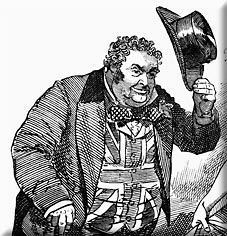
Looks a little like Scalia, no?

१९ जून, २०१४

"The word 'innovate' — to make new — used to have chiefly negative connotations..."

"... it signified excessive novelty, without purpose or end. Edmund Burke called the French Revolution a 'revolt of innovation'; Federalists declared themselves to be 'enemies to innovation.' George Washington, on his deathbed, was said to have uttered these words: 'Beware of innovation in politics.' Noah Webster warned in his dictionary, in 1828, 'It is often dangerous to innovate on the customs of a nation.'"

From "The Disruption Machine/What the gospel of innovation gets wrong," an excellent New Yorker article by Jill Lepore.

१७ जून, २०१३

"An extraordinary fuss about eavesdropping started in the spring of 1844..."

"... when Giuseppe Mazzini, an Italian exile in London, became convinced that the British government was opening his mail. Mazzini, a revolutionary who’d been thrown in jail in Genoa, imprisoned in Savona, sentenced to death in absentia, and arrested in Paris, was plotting the unification of the kingdoms of Italy and the founding of an Italian republic. He suspected that, in London, he’d been the victim of what he called 'post-office espionage': he believed that the Home Secretary, Sir James Graham, had ordered his mail to be opened, at the request of the Austrian Ambassador, who, like many people, feared what Mazzini hoped—that an insurrection in Italy would spark a series of revolutions across Europe. Mazzini knew how to find out: he put poppy seeds, strands of hair, and grains of sand into envelopes, sealed the envelopes with wax, and sent them, by post, to himself. When the letters arrived—still sealed—they contained no poppy seeds, no hair, and no grains of sand. Mazzini then had his friend Thomas Duncombe, a Member of Parliament, submit a petition to the House of Commons. Duncombe wanted to know if Graham really had ordered the opening of Mazzini’s mail. Was the British government in the business of prying into people’s private correspondence? Graham said the answer to that question was a secret."

So begins "The Prism: Privacy in an age of publicity," by Jill LePore at The New Yorker.

१२ जून, २०१२

A New Yorker article about Supreme Court history makes a big error.

Says lawprof David Bernstein — who's written a great book that covers the era of history in question:
[Jill] Lepore writes, “In 1910, Taft appointed Hughes to the Supreme Court, where, as a champion of civil liberties, he often joined with Holmes in dissent.”...

For decades Holmes’s liberal acolytes and fans argued to the contrary, but it’s well-established at this point that he was no champion of civil liberties. Holmes did eventually become a defender of freedom of speech, but that didn’t occur until after Hughes quit the Court to run for president in 1916.
Much more detail at the link.

And here's the New Yorker article. For all the history, it's really another one of those articles — like the Jeffrey Rosen TNR essay we talked about yesterday — trying to shape public opinion around the potential Supreme Court opinion that strikes down the Affordable Care Act. Like Rosen, she says:
What people think about judicial review usually depends on what they think about the composition of the Court. When the Court is liberal, liberals think judicial review is good, and conservatives think it’s bad. This is also true the other way around....
And like Rosen, she ends with an embrace of the value that law and politics should be separate — even as, like Rosen, she nudges us to think that it's the conservatives on the Court who pose the threat:
The separation of law from politics... has proved elusive. That’s not surprising—no such separation being wholly possible—but some years have been better than others. One of the worst was 2000, when the Court determined the outcome of a disputed Presidential election. The real loser in that election, Justice John Paul Stevens said in his dissent in Bush v. Gore, “is the Nation’s confidence in the judge as an impartial guardian of the rule of law.”...

Federally, few rulings have wreaked such havoc on the political process as the 2010 case Citizens United v. Federal Election Commission, whereby the Roberts Court struck down much of the McCain-Feingold Act, which placed restrictions on corporate and union funding of political campaigns. Stevens, in his dissent, warned that “a democracy cannot function effectively when its constituent members believe laws are being bought and sold.”

That, in the end, is the traffic to worry about. If not only legislators but judges serve at the pleasure of lobbyists, the people will have ceased to be their own rulers. Law will be commerce. And money will be king.
That's a strange way to end it, since federal judges are appointed and don't have to run for election. The independence of the federal judiciary isn't threatened by Citizens United. The independence of the federal judiciary, if anything, produced Citizens United — in which the Supreme Court, stocked with election-free judges, struck down a federal statute that was an effort by elected officials to control who gets to speak during elections.

And since we're talking about New Yorker fact-checking, I don't like: "the McCain-Feingold Act, which placed restrictions on corporate and union funding of political campaigns." Citizens United struck down a restriction on spending on one's own speech. It wasn't about contributions to political campaigns, i.e., funding.