From "Man Who Told of a Childhood With Wolves Dies at 80/Marcos Rodríguez Pantoja’s improbable story of a wild youth became the subject of a study, and inspired a novel and film" (NYT gift link).
wolves लेबल असलेली पोस्ट दाखवित आहे. सर्व पोस्ट्स दर्शवा
wolves लेबल असलेली पोस्ट दाखवित आहे. सर्व पोस्ट्स दर्शवा
२५ ऑगस्ट, २०२६
"Claims of having grown up in the wild are widely viewed with skepticism, and expertise in the subject is rare."
"There have been some notable cases, though they are few.... As Mr. Rodríguez told it, he was born into a poor family in southern Spain in June 1946. His mother died when he was very young, and the woman his father later married was an abusive stepmother.... When he was about 7, he said, he was put in the care of an old goatherd, to be trained to replace him..... The old man then died or disappeared, and young Marcos began to fend for himself.... Mr. Rodríguez said he lived in the wild for about 11 years with the help of wolves and other animals. In 1965, he was discovered by law enforcement authorities among wolves, wearing animal skins. He described his return to life among humans as something he did not know how to manage and would never fully embrace..... Mr. Rodríguez said he struggled with human society for much of his life. Employers had taken advantage of him over the years, people had mocked him and he had been happiest among the animals, he said in interviews...."
From "Man Who Told of a Childhood With Wolves Dies at 80/Marcos Rodríguez Pantoja’s improbable story of a wild youth became the subject of a study, and inspired a novel and film" (NYT gift link).
From "Man Who Told of a Childhood With Wolves Dies at 80/Marcos Rodríguez Pantoja’s improbable story of a wild youth became the subject of a study, and inspired a novel and film" (NYT gift link).


३ जून, २०२६
There is "a soft toy called the Monster Wolf Mini that is intended to scare off Japan’s increasingly aggressive bears and can be carried by hikers."
"The plushie, which can be attached to a bag or clothing, has glowing eyes and a built-in speaker that plays growling sounds at an adjustable volume.... That robot looks like a cross between Beelzebub and Basil Brush, with shaggy fur, a grotesque fanged face and glowing red eyes. When its sensors detect an approaching animal it flashes LED lights and makes a sound, played at random from 50 different recorded noises, including a car horn, barks, blood-curdling howls, the sounds of hunting rifles and human voices. Although it cannot walk, four piston-like legs add another level of unpredictability by moving the Monster Wolf’s body...."
I'm reading "The soft, fluffy toy designed to scare off killer bears/The Monster Wolf Mini will keep hikers safe with flashing lights and a built-in growl" (London Times).
That's from last February, but it was one of the clickable "related articles" accompanying a new article titled "Four injured as bear rampages through office complex/The attack in Fukushima is the latest incident in a part of Japan where animals and humans compete for space" (video of the attack at the link).
Here's Monster Wolf Mini:
One question remains. Who's Basil Brush?
७ नोव्हेंबर, २०२५
"In 2022, a group of union members asked the Sierra Club to 'follow [its] values of antiracism and justice' and cancel sightseeing trips it operated in Israel...."
"'Palestine is an environmental issue from our standpoint,' Erica Dodt, the president of the Progressive Workers’ Union, which includes Sierra Club employees, said in an interview. 'People are a huge part of our environment.'... Internally, the club’s commitment to a progressive workplace curdled into a culture of allegations and investigations.... Delia Malone, an ecologist and volunteer for the club’s Colorado chapter, said she heard from attorneys hired by the Sierra Club, seeking to interview her as part of an investigation against her. 'I said, "What’s the claim, and who made the claim?" And they said, "We can’t tell you that,"' Ms. Malone said. Ms. Malone thought that someone else in the chapter had filed a complaint. She recalled an incident when a club staff member had scolded her for saying that the club should lobby Colorado’s legislature for more protections for wolves. 'One of the staff said, "That’s fine, Delia. But what do wolves have to do with equity, justice and inclusion?"' Ms. Malone said...."
From "The Sierra Club Embraced Social Justice. Then It Tore Itself Apart. The environmental group gave up its singular focus on climate change for a broader agenda. The ensuing internal strife left it weakened as it takes on the Trump administration" (NYT).
From "The Sierra Club Embraced Social Justice. Then It Tore Itself Apart. The environmental group gave up its singular focus on climate change for a broader agenda. The ensuing internal strife left it weakened as it takes on the Trump administration" (NYT).
२० ऑक्टोबर, २०२५
"Democrats say the use of silly inflatable costumes is a way to undercut Republican portrayals of such events as violent 'hate America rallies.'"
The Washington Post sets out to answer the question "Why protesters against Trump are wearing frog, chicken and T. rex costumes."
If you feel you need to put on a costume to disguise what you are, doesn't that suggest that you are the scary thing you're trying to cover up? I think of the wolf in sheep's clothing.
The image of wolf in sheep's clothing comes from in the Sermon on the Mount. Jesus said: "Beware of false prophets, who come to you in sheep’s clothing, but inwardly they are ravening wolves."
From the WaPo article:
३० जानेवारी, २०२४
"There is no threat to humans from wolves. I live in northern Minnesota wolf country, and wolves avoid people like the plague."
"I've come across them when walking in the woods and they always run away. The two most dangerous animals for me are very large and very small: a bull moose during rut, and deer ticks which spread Lyme's disease. Deer are more dangerous because of car accidents. When Wisconsin reintroduced wolves, car-deer impacts went down. I'm a retired farmer, and farming is a high-risk business. You can't eliminate all risk from it. As for wolf attacks on dogs, the problem is small ankle-biter dogs who don't know when to back off. I had huskies, and they never received any attacks from wolves. But then, huskies speak fluent wolftail and know when to submit."
That's the top-rated comment on "What Can Americans Agree on? Wolves" (NYT). That's a free access link. The article is by Erica Berry, author of "Wolfish: Wolf, Self, and the Stories We Tell About Fear."
That's the top-rated comment on "What Can Americans Agree on? Wolves" (NYT). That's a free access link. The article is by Erica Berry, author of "Wolfish: Wolf, Self, and the Stories We Tell About Fear."
२४ जून, २०२३
"The History of Lobotomies and One Flew Over the Cuckoo's Nest."
At 1:02: Duncan Trussell starts talking about "One Flew Over the Cuckoo's Nest" — "It's completely different from the movie... Ken Kesey, he was like..." — and Joe Rogan, who'd just said he read the book, blurts out: "Ken Kesey wrote it?!" Trussell lets that go and proceeds to put the story, as told in the book, into his own words.
At 3:22: Duncan and Joe discuss the real-world medical practice of lobotomies: "They really did that"/"They really did that.... What happened to the person? 'They became a really good patient.'"
At 4:45: Duncan and Joe discuss Thomas Eagleton and electroshock therapy for depression. "Today, in this victimhood society, if you said he suffered from clinical depression but he sought help, [he]'d be a shining example: Look at him!... He's a hero!"
१२ जानेवारी, २०२३
"The National Park Service is moving to prohibit hunters on some public lands in Alaska from baiting black bears with doughnuts and using spotlights..."
"... to shoot hibernating bears and cubs in their dens, techniques allowed by the Trump administration but considered inhumane by conservationists. A rule proposed by the National Park Service on Friday would essentially restore restrictions that existed during the Obama administration but were gutted under President Donald J. Trump. Under the new policy, hunters on Alaska wildlife preserves would also no longer be able to kill adult wolves and pups in their dens, or use motorboats to shoot swimming caribou.... Sara Amundson, president of the Humane Society Legislative Fund, issued a statement calling the new rule 'a victory for Alaska’s iconic wildlife species. Baiting bears just to blast them over a pile of doughnuts is just wrong'...."
७ डिसेंबर, २०२२
६ डिसेंबर, २०२२
"The elk problem is really interesting. I do feel that there has to be population control both on the part of humans and animals."
"Now, the available methods of contraception for animals are not always good.... But humans and animals have to limit our own population growth in order for the world to be minimally just. With the elk, there are things that have been tried: shooting them in cold blood; some kind of population control; introducing wolves to tear the elks limb from limb. People say that’s better because it’s nature. I don’t like that argument. For the elk, a bullet to the brain — if the person knew how to shoot, which a lot of hunters don’t — would be a lot better than the wolf’s tearing them apart...."
Said Martha Nussbaum, quoted in "Do Humans Owe Animals Equal Rights? Martha Nussbaum Thinks So" (NYT).
५ मार्च, २०२२
What controversial issue is uniting right-wing Ron Johnson and left-wing Tammy Baldwin?
Ending the protection of wolves.
The bill comes after a federal judge in California last month ordered protections be restored for wolves across most of the U.S. after the Trump administration removed them from the endangered species list. Re-listing wolves on the list effectively banned any wolf hunting or trapping seasons and prohibited farmers and ranchers from killing wolves preying on livestock.
१२ फेब्रुवारी, २०२२
"Wisconsin law requires the DNR to hold a hunting season between November and February whenever the wolf is not listed as endangered, but this winter’s hunt was put on hold...."
"U.S. District Judge Jeffrey White in Oakland, California, said the U.S. Fish and Wildlife Service had failed to show wolf populations could be sustained in the Midwest and portions of the West without protection under the Endangered Species Act, so he reinstated them as an endangered species.... Permits that allowed land owners to kill wolves when experiencing conflicts with the animals are no longer valid, the [Wisconsin] DNR said.... Training dogs to track and trail wolves is also no longer allowed, the DNR said. The DNR said it 'remains committed' to helping people who have conflicts with wolves."
३ मार्च, २०२१
"Hunters in Wisconsin killed more than 200 wolves last week, far exceeding the state’s limit as they scrambled to take advantage of Trump-era wildlife rules..."
"... that they worry may be tightened by the Biden administration.
At least 216 wolves were killed in less than 60 hours, exceeding the state quota of 119 and prompting Wisconsin to end what was meant to be a one-week hunt four days early.... Environmentalists... said the large number of wolves killed in such a short time underscored the need for President Biden to put the gray wolf back on the list of animals protected under the Endangered Species Act. 'These animals were killed using packs of dogs, snares and leg-hold traps,' Kitty Block, chief executive of the Humane Society of the United States, said on Tuesday. 'It was a race to kill these animals in the most cruel ways.'... The resurgence of wolves in certain parts of the country has been called a success story for conservationists. But as their numbers grew, ranchers have had to contend with wolves’ appetite for cattle and sheep. Conservationists counter that wolves keep deer, elk and other species in check and therefore help prevent more vegetation loss.... Hunter Nation said the large number of wolves hunted in such a short period of time showed that the population had 'significantly increased.' The group said that in 2014, it took two months for hunters to kill about 100 wolves. 'This season it took just three days!'... Richard M. Esenberg, a lawyer for Hunter Nation, said it was misleading for animal rights activists to claim that hunters had killed double the number of wolves allowed by the state. The state had set a quota of 200 wolves, with 119 for hunters who applied for permits with the department and 81 set aside to the Ojibwe Tribes under their treaty rights....
But the tribes consider wolves to be sacred and made a deliberate decision not to hunt them, said Dylan Jennings, a spokesman for the Great Lakes Indian Fish and Wildlife Commission, which represents the tribes. The tribes saw their allocation as a way to conserve a large number of the wolves — not to give hunters more animals to kill, he said."
So many conflicting interests there. But obviously there are a lot of wolves, and presumably the endangered species category needs to be restricted to animals that are quite scarce, not animals that we love. Here you have an animal that is loved — even regarded as sacred. The hunters probably love the animal in a hunterly way. Some people hate or fear wolves, and some farmers and ranchers have anti-wolf economic interests. I have no idea what the solution is, but I think I'd recommend rationality over sentimentality. It may be rational to defer — to some extent — to the tribes' belief in the sacredness of the wolves and that corresponding reverence for wolves that lives in the hearts of some of the people.
२५ जून, २०२०
Sorry, "wolf whistle" is already taken.
As I got into my car this morning, I caught the end of a discussion of what I think was Donald Trump's racism. I had MSNBC on the satellite radio, so it was "Morning Joe." Somebody with an English accent was bemoaning someone who I can only assume was Trump and he casually used the words "wolf whistle" to mean what "dog whistle" normally means, but much more dangerous.
But a "wolf whistle" is...
In the never-ending quest to impugn Donald Trump, as you invent new terms and think you are clever, try checking whether the terms are already taken.
But a "wolf whistle" is...
... a distinctive two-note glissando whistled sound made to show high interest in or approval of something or someone, especially a woman viewed as physically or sexually attractive. Today, a wolf whistle directed at a woman is sometimes considered a precursor to sexual harassment, or a form of sexual harassment in itself.Not everything is about racism and Trump.
According to Adam Edwards of Daily Express, the wolf whistle originates from the navy General Call made with a boatswain's pipe. The General Call is made on a ship to get the attention of all hands for an announcement. Sailors in harbour would whistle the General Call upon seeing an attractive woman to draw fellow sailors' attention to her. It was eventually picked up by passers-by, not knowing the real meaning of the whistle, and passed on. During a 2015 broadcast of A Way with Words, doubt was cast upon this explanation by lexicographer Grant Barrett, who noted that it was very thinly supported. The Turn To Call is far closer to the wolf whistle than the General Call.
The standard sound for a coin insertion for the Bally Manufacturing pinball machine "Playboy" (featuring iconography from Playboy magazine) is the wolf whistle.
In the never-ending quest to impugn Donald Trump, as you invent new terms and think you are clever, try checking whether the terms are already taken.
२४ मे, २०२०
I'm trying to write up one wolf story, and another wolf story pops ups. I'm beset by wolves this morning.
I express my frustration out loud like this: "Remember 'Women who Run with the Wolves'? What the hell was that?"
"I also remember Naomi Wolf," says Meade.
"May I quote you?"
"Yes," he answers, adding "I also remember Wolf Blitzer."
So the first story I'm trying very hard to process for this blog is: "A Feud in Wolf-Kink Erotica Raises a Deep Legal Question/What do copyright and authorship mean in the crowdsourced realm known as the Omegaverse?" That's in the NYT. I've had the tag open since yesterday, and this morning Meade sent me the link to it, so my blogging it is overdetermined and seemingly mandatory and pressing.
Wolf-kink erotica sounds interesting, and here it is tangled up in law — "a deep legal question." When is law deep? How about erotica? Is erotica deep? How deep is your erotica?
Maybe it would all make more sense to me if I were more of a woman who runs with the wolves. Here's Wikipedia on the 1992 book "Women Who Run with the Wolves: Myths and Stories of the Wild Woman Archetype" by "Clarissa Pinkola Estés, Ph.D" — a book I saw and shunned hundreds of times back in those days when I used to go to bookstores all the time. The book looks at "myths, fairy tales, folk tales and stories" and extracts a "Wild Woman archetype of the feminine psyche" and purports to demonstrate that "wolves and women are relational by nature."
You never hear about that anymore — wild women and the way we're like wolves. Or, no, wait, here's a NYT piece from 2018, "The Wild Woman Awakens/The 1992 feminist sensation 'Women Who Run With the Wolves' has returned, as a new generation of artists embrace women’s bodies in all their hormonal, bloody glory." That's by Amanda Hess, who's found a copy of the old book:
"I also remember Naomi Wolf," says Meade.
"May I quote you?"
"Yes," he answers, adding "I also remember Wolf Blitzer."
So the first story I'm trying very hard to process for this blog is: "A Feud in Wolf-Kink Erotica Raises a Deep Legal Question/What do copyright and authorship mean in the crowdsourced realm known as the Omegaverse?" That's in the NYT. I've had the tag open since yesterday, and this morning Meade sent me the link to it, so my blogging it is overdetermined and seemingly mandatory and pressing.
Wolf-kink erotica sounds interesting, and here it is tangled up in law — "a deep legal question." When is law deep? How about erotica? Is erotica deep? How deep is your erotica?
[A]ll Omegaverse couples engage in wolflike behavior. Alphas “rut” and Omegas go through heat cycles, releasing pheromones that drive Alphas into a lusty frenzy. One particular physiological quirk that’s ubiquitous in Omegaverse stories, called knotting, comes from a real feature of wolves’ penises, which swell during intercourse, causing the mating pair to remain physically bound to increase the chance of insemination.... In the past decade, more than 70,000 stories set in the Omegaverse have been published on the fan fiction site Archive of Our Own.... On Amazon, there are hundreds of novels for sale, including titles like “Pregnant Rock Star Omega,” “Wolf Spirit: A Reverse Harem Omegaverse Romance” and “Some Bunny to Love: An M/M MPreg Shifter Romance,” an improbable tale involving an Alpha male who can transform into a rabbit....I'm trying to get my brain around that — my brain, which swells during blogging — and this story pops up: "Bolivian orchestra stranded at ‘haunted’ German castle surrounded by wolves" (NY Post). Come on, now.
A Bolivian pan flute orchestra has been stuck in quarantine on the grounds of a grand 15th century palace outside of Berlin for two months. Over 20 members of the Orquesta Experimental de Instrumentos Nativos have been stuck on the grounds and buildings of Rheinsberg Palace, a castle, complete with moat....Not just an orchestra — a pan flute orchestra. Not just a castle — a castle with a moat. So many elements. It's like the internet is toying with me. How can it be an "orchestra" if it's all pan flutes?
Maybe it would all make more sense to me if I were more of a woman who runs with the wolves. Here's Wikipedia on the 1992 book "Women Who Run with the Wolves: Myths and Stories of the Wild Woman Archetype" by "Clarissa Pinkola Estés, Ph.D" — a book I saw and shunned hundreds of times back in those days when I used to go to bookstores all the time. The book looks at "myths, fairy tales, folk tales and stories" and extracts a "Wild Woman archetype of the feminine psyche" and purports to demonstrate that "wolves and women are relational by nature."
You never hear about that anymore — wild women and the way we're like wolves. Or, no, wait, here's a NYT piece from 2018, "The Wild Woman Awakens/The 1992 feminist sensation 'Women Who Run With the Wolves' has returned, as a new generation of artists embrace women’s bodies in all their hormonal, bloody glory." That's by Amanda Hess, who's found a copy of the old book:
१६ फेब्रुवारी, २०२०
"It’s one thing to deplore eugenics on ideological, political, moral grounds. It’s quite another to conclude that it wouldn’t work in practice. Of course it would."
"It works for cows, horses, pigs, dogs & roses. Why on earth wouldn’t it work for humans? Facts ignore ideology."
Tweeted Richard Dawkins at 1:26 a.m., and I think that's why "eugenics" is trending on Twitter this morning. He followed up, an hour ago, with this: "For those determined to miss the point, I deplore the idea of a eugenic policy. I simply said deploring it doesn’t mean it wouldn’t work. Just as we breed cows to yield more milk, we could breed humans to run faster or jump higher. But heaven forbid that we should do it."
Here's #eugenics — in case you want to see what people are saying right now. It's a slog to get through all the many people who are saying I see eugenics is trending. I'll just cherry-pick some good substantive stuff (which sounds kind of eugenics-y!):
"The thing about people who believe in eugenics is that they always believe themselves to be the superior kind of human. No-one ever thinks that it could make *people like them* obsolete..." (Joanne Harris).
"I mean, the biggest problem with Richard Dawkins take on eugenics is that he'd probably consider his own traits to be superior and then the world would be full of insufferable assholes" (Nick Jack Pappas).
"While Richard Dawkins is a noted biologist, his science on eugenics is bad. We turned magnificent wolves into pure breed dogs with severe genetic defects causing joint and heart problems and cancer. In fact, many Cavalier spaniels develop mitral valve and neurological disorders"/"Eugenics does not create superior species. We turned mighty buffalo herds roaming the plains into factory farmed cows, the independent stallion into the pony, and the wild boar into the pig. We weaken the gene pool selecting for traits desirable for us but not for the subject" (Eugene Gu MD).
"All of Dawkins’ tweets make more sense if you add '... Mr Bond' at the end of them" (Ned Hartley).
Tweeted Richard Dawkins at 1:26 a.m., and I think that's why "eugenics" is trending on Twitter this morning. He followed up, an hour ago, with this: "For those determined to miss the point, I deplore the idea of a eugenic policy. I simply said deploring it doesn’t mean it wouldn’t work. Just as we breed cows to yield more milk, we could breed humans to run faster or jump higher. But heaven forbid that we should do it."
Here's #eugenics — in case you want to see what people are saying right now. It's a slog to get through all the many people who are saying I see eugenics is trending. I'll just cherry-pick some good substantive stuff (which sounds kind of eugenics-y!):
"The thing about people who believe in eugenics is that they always believe themselves to be the superior kind of human. No-one ever thinks that it could make *people like them* obsolete..." (Joanne Harris).
"I mean, the biggest problem with Richard Dawkins take on eugenics is that he'd probably consider his own traits to be superior and then the world would be full of insufferable assholes" (Nick Jack Pappas).
"While Richard Dawkins is a noted biologist, his science on eugenics is bad. We turned magnificent wolves into pure breed dogs with severe genetic defects causing joint and heart problems and cancer. In fact, many Cavalier spaniels develop mitral valve and neurological disorders"/"Eugenics does not create superior species. We turned mighty buffalo herds roaming the plains into factory farmed cows, the independent stallion into the pony, and the wild boar into the pig. We weaken the gene pool selecting for traits desirable for us but not for the subject" (Eugene Gu MD).
"All of Dawkins’ tweets make more sense if you add '... Mr Bond' at the end of them" (Ned Hartley).
९ डिसेंबर, २०१९
In the Monday fog, a hidden sunrise.
1. I could hear rain as the sunrise time (7:18) approached, so I considered skipping a day. It was foggy too, but not foggy enough to worry about the drive. I stepped outside in my slippers to check the intensity of the rain. It was exactly the kind of rain that, years ago, I started calling my favorite kind of precipitation — little droplets that seem suspended like a mist.
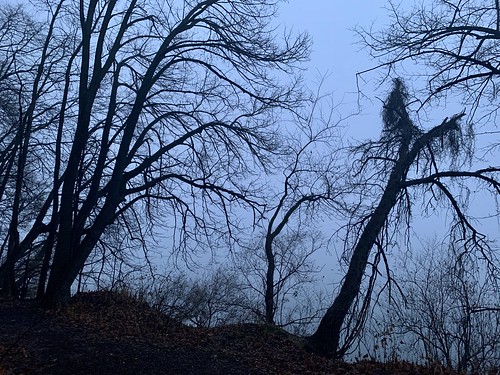
2. It feels nice on the skin, gentle, though the look of things is rather creepy. At 7:21:
3. Something that makes a run happen is to not think about it much. Just do one thing after another. Get your shoes on, your jacket, put the right things in your pocket, get in the car. Don't even think ahead to the next street after the next turn until you've turned. Don't imagine getting out of the car, just continue until the point where you get out of the car. And so forth. Isn't that how we live life most of the time? Be in the moment and accord each step the dignity of regarding it as complete and worthy in itself.
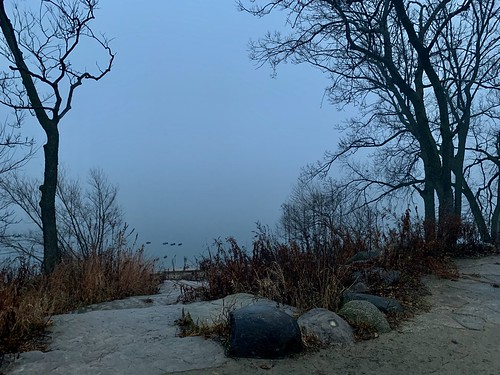
4. In all my sunrise runs, there has only been one other day when there was fog that made it impossible to see the opposite shore of Lake Mendota. That was October 31, here (with lots of snow). Today, it looked like this at my vantage point. You'll just have to try to remember where the shore line is supposed to be. This is 7:25, 7 minutes after the actual sunrise time:
5. By 7:37, the shore came vaguely into shape. The little dot of light is not the sun, but car headlights:
2. It feels nice on the skin, gentle, though the look of things is rather creepy. At 7:21:
3. Something that makes a run happen is to not think about it much. Just do one thing after another. Get your shoes on, your jacket, put the right things in your pocket, get in the car. Don't even think ahead to the next street after the next turn until you've turned. Don't imagine getting out of the car, just continue until the point where you get out of the car. And so forth. Isn't that how we live life most of the time? Be in the moment and accord each step the dignity of regarding it as complete and worthy in itself.
4. In all my sunrise runs, there has only been one other day when there was fog that made it impossible to see the opposite shore of Lake Mendota. That was October 31, here (with lots of snow). Today, it looked like this at my vantage point. You'll just have to try to remember where the shore line is supposed to be. This is 7:25, 7 minutes after the actual sunrise time:
5. By 7:37, the shore came vaguely into shape. The little dot of light is not the sun, but car headlights:
१८ फेब्रुवारी, २०१९
"Suppose that instead of one shepherd boy, there are a few dozen. They are tired of the villagers dismissing their complaints about less threatening creatures..."
"... like stray dogs and coyotes. One of them proposes a plan: they will start using the word 'wolf' to refer to all menacing animals. They agree and the new usage catches on. For a while, the villagers are indeed more responsive to their complaints. The plan backfires, however, when a real wolf arrives and cries of 'Wolf!' fail to trigger the alarm they once did. What the boys in the story do with the word 'wolf,' modern intellectuals do with words like 'violence.' When ordinary people think of violence, they think of things like bombs exploding, gunfire, and brawls. Most dictionary definitions of 'violence' mention physical harm or force. Academics, ignoring common usage, speak of 'administrative violence,' 'data violence,' 'epistemic violence' and other heretofore unknown forms of violence. Philosopher Kristie Dotson defines the last of these as follows: 'Epistemic violence in testimony is a refusal, intentional or unintentional, of an audience to communicatively reciprocate a linguistic exchange owing to pernicious ignorance.'"
From "The Boy Who Inflated the Concept of ‘Wolf’" by Spencer Case (Quillette).
From "The Boy Who Inflated the Concept of ‘Wolf’" by Spencer Case (Quillette).
२९ ऑगस्ट, २०१८
"What Rodríguez remembers of his time living wild is that it was 'glorious.'"
"When he was found by the police and brought down from the mountains, an untroubled, simple adolescence among animals and birds was cruelly cut short. He had always found it hard to relate to humans, who were baffled by his ignorance and infuriated by his inability to communicate.... [Marcos Rodríguez Pantoja] told me he was still a child, only six or seven, the first time he encountered wolves. He was looking for shelter from a storm when he stumbled across a den. Not knowing any better, he entered the cave and fell asleep with the pups. The she-wolf had been out hunting, and when she returned with food, she growled and snarled at the boy. He thought the wolf was going to attack him, he says, but she let him take a piece of the meat instead. Wolves are not the only animals he lived among: he says he made friends with foxes and snakes, and that his enemy was the wild boar. He says he spoke to them all in a mix of grunts, howls and half-remembered words: 'I couldn’t tell you what language it was, but I did speak.'... 'When a person talks, they might say one thing but mean another. Animals don’t do that,' Rodríguez told me.... José España, a biologist and specialist in wolf behaviour, who knows Rodríguez.. says... 'When [Rodríguez] says the fox laughed at him, or that he had to tell off the snake, he gives us a version of the true reality, what he believes happened – or how, at least, he explained the reality to himself,' Janer told me. 'Marcos’s mind was desperate for social acceptance,' he told me, 'so instead of understanding the animals’ presence as incentivised by the food, he thought they were trying to make friends.'"
From "How to be human: the man who was raised by wolves/Abandoned as a child, Marcos Rodríguez Pantoja survived alone in the wild for 15 years. But living with people proved to be even more difficult" in The Guardian.
From "How to be human: the man who was raised by wolves/Abandoned as a child, Marcos Rodríguez Pantoja survived alone in the wild for 15 years. But living with people proved to be even more difficult" in The Guardian.
१४ जून, २०१८
"Top 5 Wisconsin wildlife risks to humans? Maybe not what you think."
Okay. I'll play. I only read the headline in the Milwaukee Journal Sentinel and have not glanced at the answers, though I did see the photo of bees. So I will include bees. The other 4? I'll say: spiders, bats, deer (car crashes), and ticks.
Okay, now I'm looking. Deer was correct. I left out mosquitoes (even though I was thinking about mosquitoes! I feel like cheating and adding mosquitoes to my list). Ticks was correct. Bees was correct. Bats and spiders were wrong. The final category is bears, wolves and cougars, and I must say I considered bears and wolves but decided against it, in part because of the "Maybe not what you think," but also because I can't remember ever reading about a bear or wolf attack in Wisconsin. You think of the big predators when you're out in the wilder places, but when do they ever get anywhere near you? It's those pesky ticks, waiting on the tip of every leaf, that will get you.
Well... 2 brown recluse spiders have been found in Wisconsin in the last quarter century.
As for bats: "The last four cases of human rabies in Wisconsin occurred in 1959, 2000, 2004 and 2010. All four Wisconsin cases acquired the disease from infected bats." The thing about bats is that they can get in your house and you have to deal with it as if the bat carried the horrific disease. You're never lying in bed and suddenly think There's a bear in the house! and spring into action. I mean, I know it has happened....
Okay, now I'm looking. Deer was correct. I left out mosquitoes (even though I was thinking about mosquitoes! I feel like cheating and adding mosquitoes to my list). Ticks was correct. Bees was correct. Bats and spiders were wrong. The final category is bears, wolves and cougars, and I must say I considered bears and wolves but decided against it, in part because of the "Maybe not what you think," but also because I can't remember ever reading about a bear or wolf attack in Wisconsin. You think of the big predators when you're out in the wilder places, but when do they ever get anywhere near you? It's those pesky ticks, waiting on the tip of every leaf, that will get you.
The threats to humans from Wisconsin's largest wild predators are, statistically speaking, extremely low.Yeah, so why are they on the list?
The last recorded injury to a human from a bear was in June 2017 when a man sustained a bite to the thigh in Florence County.That said! I'll that-said you. You said, "Maybe not what you think." That said, you shouldn't have put bears, wolves, and cougars on the list. Did you check bats and spiders? Hmm?! I'm checking.
"Most of these bear/human interactions are a result of dog/bear interaction and the human rushes in to save their dog," said USDA's Hirchert. "An actual predatory action towards a human from a bear is extremely rare in Wisconsin."
There has been no wolf or cougar attack on a human in Wisconsin in modern history, according to USDA records.
That said, the big animals rightfully elicit an abundance of caution.
Well... 2 brown recluse spiders have been found in Wisconsin in the last quarter century.
As for bats: "The last four cases of human rabies in Wisconsin occurred in 1959, 2000, 2004 and 2010. All four Wisconsin cases acquired the disease from infected bats." The thing about bats is that they can get in your house and you have to deal with it as if the bat carried the horrific disease. You're never lying in bed and suddenly think There's a bear in the house! and spring into action. I mean, I know it has happened....
१२ जून, २०१८
Trump — the wolf — "is trying to transform the nature of relationships."
David Brooks writes:
As for the metaphor, does the wolf deserve Brooks's contempt?

Those who lost faith in [the dream that nations could effortlessly merge into a cosmopolitan Pan-European community] began to elect wolves in order to destroy it. The wolves — whether Donald Trump, Vladimir Putin, Viktor Orban, Rodrigo Duterte, Recep Tayyip Erdogan or any of the others — don’t so much have shared ideology as a shared mentality....Was it really "affection, loyalty, trust and reciprocity" before Trump came along and changed it? I think Trump would say that America was taken advantage of and got conned by what was only a superficial display of affection, loyalty, trust and reciprocity. I think he'd say that American Presidents failed to take adequate account of the "competition, self-interest, suspicion and efforts to establish dominance" that were always involved. So is Trump changing "the nature of relationships" or speaking more clearly and openly about their complexity?
Wolves perceive the world as a war of all against all and seek to create the world in which wolves thrive, which is a world without agreed-upon rules, without restraining institutions, norms and etiquette.... But in the low-trust Trumpian worldview, values don’t matter; there are only interests. In the Trumpian worldview, friendship is just a con that other people try to pull on you before they screw you over. The low-trust style of politics is realism on steroids.
Whether it’s on the world stage, at home or in his own administration, Trump is trying to transform the nature of relationships. Trump takes every relationship that has historically been based on affection, loyalty, trust and reciprocity and turns it into a relationship based on competition, self-interest, suspicion and efforts to establish dominance....
What Trump did to the G-7 is essentially the same thing he did to the G.O.P. He simply refused to play by everybody else’s rules and he effectively changed the game. Trump is really good at destroying systems people have lost faith in.....
As for the metaphor, does the wolf deserve Brooks's contempt?

याची सदस्यत्व घ्या:
पोस्ट (Atom)


 पोस्ट्स


