"... were still a regular sight in the early Noughties. You could glimpse our kind on trains and in cafés: wan, bespectacled and dreamy, trailing after our parents, clutching our grubby, sticky copies of The Chronicles of Narnia or Northern Lights. It was the era of Philip Pullman, of Horrible Histories, of Artemis Fowl.
Above all, it was the age of Harry Potter, with its feverish midnight queues of miniature witches and wizards up past their bedtime to get their hands on the latest instalment (my sister and I went to the cavernous, warehouse-sized Borders bookshop at Silverlink Retail Park wearing bin bags for Hogwarts capes).... [A]s the age of print fades away and the angry, distractible age of the smartphone dawns, I think we find ourselves facing a post-literate world that will resemble the pre-literate world: less democratic, less rational and less enlightened...."
If you use any of those links to buy a book, I receive a commission, and I'm telling you that because I believe that transparency is required, but in fact, I only link to books that I wanted to mention anyway.
"... and that printed volumes are truer to an author’s intent, better suited to lingering over language, superior through and through. Maybe so. But do the evangelists of that religion pause to wonder why we heretics exist? Some of us worship differently not because we haven’t seen the light, but because we don’t see well."
Writes Frank Bruni, in his newsletter (NYT gift link).
He describes his vision problem: "Almost nine years ago, I had a stroke that ravaged the optic nerve behind my right eye and rendered that eye pretty much useless. I wrote about that in this 2018 essay.... Since the incident, my slightly off-kilter monocular vision hasn’t deteriorated further.... [There is a] gap between what each of us struggles with and what the people in our orbits know or see of it.... It’s the source of so much ignorance, insensitivity and even cruelty."
(If you click through to the newsletter, you'll see the headline is "Buttigieg and El-Sayed Are Teaching Democrats to Speak Republican." You might want to read that. I did, but then I didn't want to blog about it... and did want to blog about the old audiobooks issue, even though I've blogged it many times before, as a click on my "audiobooks" tag will prove.)
This is a genuinely new point in what is for me a very old question/"question." (What's the question? Do audiobooks "count"? What does that even mean?) Egan also makes many of the familiar points about audiobooks: You can do other things while listening — chores, crafts, exercise — and it's good for people with vision troubles, great for drifting off to sleep, etc. etc.
But I love this idea that the audiobook is more intimate, bringing you closer to the material. Is that even true?! I think she's saying something about the experience of hearing in contrast to seeing. When seeing, you are looking at a physical object outside of your head. Or so it seems. The words are out there, on the page, your eyes allow you to sense them. But sound feels like it has entered your head, almost like your own thoughts, especially if you're using earphones. And yet both hearing and seeing happen in your brain, through a nerve located deep inside the organ that is part of your head — your optic nerve in the back of your eye or your auditory nerve in your inner ear.
So the intimacy of hearing as opposed to seeing is a subjective feeling, don't you agree? But then the question becomes whether we prefer this intimacy when reading? I suspect that by using vision to consume a book, you maintain a more sharply critical mind. The page is out there. It's the other. We're suspicious. Or admiring. The audiobook reaches us differently. It's automatically already inside us, stirring us like music, like the murmurings of a loved one.
Meade intended to say: Please add that to our Audible account. But by hitting a share button, Amazon added the seemingly friendly generic message, "I think you might like this book." The book is "How to Die"! I think you might like How to Die....
Actually, I think the "Seneca" tag originated as a commenter name, here. Back in 2009, someone with the pen name Seneca helped me distinguish a butterfly from a moth (and another commenter made a comic animation out of my photograph of a rather moth-y butterfly).
"It can help you locate an emotion within yourself, which is important to health as a form of emotional processing. Poetry also contains complex, unexpected elements, like when Shakespeare uses god as a verb in Coriolanus: 'This last old man … godded me.' In an fMRI study... such literary surprise was shown to be stimulating to the brain... [Literature] can cause us to recall our most complex experiences and derive meaning from them. A poem or story read aloud is particularly enthralling... because it becomes a live presence in the room, with a more direct and penetrative quality, akin to live music.... Discussing the literature that you read aloud can be particularly valuable.... [D]oing so helps penetrate rigid thinking and can dislodge dysfunctional thought patterns.... [It may] expand[] emotional vocabulary... perhaps even more so than cognitive behavioral therapy...."
This essay talks about reading out loud to another person and reading aloud when you are alone. There is some discussion of the benefit of listening to another person read to you. You might adopt the practice of taking turns reading aloud with your spouse. There's a brief mention of audiobooks, in the context of saying that you'll remember more of a book if you read it out loud.
"Accompanied by live piano music, the in-person and virtual reading series fosters 'healthy peer pressure' and a sense of community, according to the Silent Reading Party website.
Silent Reading Party offshoots are proliferating worldwide.... The $20 events take place at night and typically sell out weeks ahead of time.
Curious to explore the power of healthy peer pressure, I paid $10 to attend a recent late-night Silent Reading Party on Zoom.... For two hours, a pianist accompanied readers with dreamy New Age music, occasionally interrupted by the icy clink of a bartender’s cocktail shaker.
I read my book, occasionally forgetting I was not alone. Then I’d peer at the hotel scene, where participants read in silence, took notes and sipped their drinks...."
You'll notice that the bit I quoted has nothing to do with what's in the headline. But it's a sidetrack that caught my interest. When I'd first read about the idea of a "silent reading party," I thought it was a pleasant idea. I thought the website was used to let people know where the group reading would take place. I was surprised that you had to buy tickets (and that some clown would be tickling the ivories). If you want to read with other people around you, go to a café. Or — here's an outlandish idea — a library.
Peterson observes that the idea that attention spans are shrinking fails to account for the widespread consumption of audiobooks and very long podcasts. Ramaswamy first responds by speculating that there's a kind of "low-level dyslexia," and most people are a little slower reading than listening, and that means they are really capable of absorbing more complex material than they're willing or able to read.
Ramaswamy immediately posits a second theory: There's a hunger for "human connectivity," and people want a "disintermediated relationship" that they get from hearing the voice of the person who is generating ideas. Peterson jumps on that: It's why unscripted podcasts work so well. Peterson says books can go deeper, but it's easier to deceive people with a book. You can "craft your lies." But with a podcast, you get spontaneity, tone, and demeanor. People experience Joe Rogan as "genuine." "It's the antithesis of the crafted Hillary-Clinton political-class message." It's why Donald Trump was so successful.
I'm just summarizing (as the presence of Abraham Lincoln in my tags hints), and the conversation continues. I haven't set an end point. You'll see how long your attention span reaches.
"... or going on hikes while visiting his son in Utah.... The 72-year-old tracked his walks meticulously via his FitBit, saying the journey took nearly 50 million steps to complete.... After eight years, and 10 months, Kraemer made it around the world while listening to 148 books, burning through an average of two pairs of shoes each year."
This post is intended as a palate cleanser after that last post on luxury gyms in L.A. and NYC, where only "cool" people can join. Kraemer epitomizes uncoolness — walking outside in a midsize city in the Midwest, paying only for a Fitbit, shoes, and (maybe) audiobooks — but coolness is always a matter of interpretation, and I was never willing to accept that the luxury gyms are cool. Your mileage may vary, and as you journey on your way through the world, it's up to you to decide what counts as cool and what constitutes walking around the world.
Makes me think of this song, which will always be cool to me.
One of the things discussed in the article is the likelihood that AI voices will take over the work. I don't think AI can convey the right expression — not that human readers always get the narration right. I listen to a lot of audiobooks (and articles) and I can, from time to time, tell that the reader has misunderstood the text. But AI obviously does not understand. There is no mind to understand. And the human ear repels the voice that has no mind behind the words. The AI cannot "have sex with itself" and experience pleasure in the reading of the words. There is no pleasure to be had.
"Or poems by Jacques Prévert, when night falls and you walk through the streets of Montmartre. You don’t need to understand all the words. It is like listening to music!"
What do you think of listening to poetry in a language you don't understand? If you're in that language's home country, wouldn't it be better to keep the earphones out and let the ambient sounds in?
Or maybe "along the quays of the Seine," the overheard speech is not what you want for your aesthetic experience. I could be not French at all, but whatever outside language the tourists brought in, or it could be French, but not the perfectly romantic dream of French you want for yourself.
"Try instead to cultivate what psychologists call freely moving thoughts. Such nimble thinking might start with a yearning to see your grandmother, then careen to that feeling you get when looking down at clouds from an airplane, and then suddenly you’re pondering how deep you’d have to bore into the earth below your feet before you hit magma. Research suggests that people who do more of that type of mind-wandering are happier.
Facilitate unconstrained thinking by engaging in an easy, repetitive activity like walking; avoid it during riskier undertakings like driving."
It's funny that walking, that is, physically wandering, helps the mind wander. That makes me think of one of my favorite songs, "I Wonder as I Wander" — sung here by the man who wrote it, John Jacob Niles. And there it is, the mind wandering once again, and I'm not even walking. Just blogging, not slogging. Tripping along.
I like walking, but I find I get my best mind wandering done while running. I do 1.6 miles at sunrise nearly every day, and I like the quality of thinking that happens with that activity — at that time of day, in that setting. If I start thinking about, say, a movie I just watched — e.g., today, "Little Murders" — I can access all sorts of ideas about it and tangential to it.
Maybe I could do even better mind wandering while walking, but there's so much mind space in walking that I use an audiobook to fill it up. I rarely use headphones while running, but I nearly always use headphones while walking alone (and conversation when walking not alone). Maybe I should leave the headphones out — they're fixing 2 holes that stop my mind from wandering.
The other thing I do for exercise lately is mountain biking. Now, mountain biking is terrible for mind wandering. It's something I like about mountain biking: My mind automatically stays focused on precisely the task right there in front of me. It's great for flow. Flow, the mental state. There's also flow, the type of mountain bike track. That flow/flow is like the wander/wander mentioned above.
Anyway, here's the original trailer for that movie, a weird and very dark romcom about what happens when a thoroughly apathetic man (Elliott Gould) goes along for the relationship with a entirely energetically optimistic woman:
I don't think there's a better bad wedding than in that movie, with Don Sutherland as the hippie priest:
Why does one decide to marry? Social pressure? Boredom? Loneliness? Sexual appeasement? Love? I won't put any of these reasons down. Each in its own way is adequate, each is all right. Last year, I married a musician who wanted to get married in order to stop masturbating. Please, don't be startled, I'm not putting him down. That marriage did not work. But the man tried. He is now separated, still masturbating, but he is at peace with himself because he tried society's way.
So did I use all the ideas my mind wandered into as I wrote this post? No, not yet anyway. There was that Donovan, but the lyric ran through the head with a misremembered word, "trip" for "skip": "Rebel against society/Such a tiny speck... -ulating whether to be a hip or/Skip along quite merrily." It fits now, though — don't you think? — with that priest's wedding homily.
"The most recent went, like, 'Ahhh, I’ve barely read any Russian literature!' Though I was a Kafka nut as a teenager. So now I’m halfway through Maggie Gyllenhaal’s reading of 'Anna Karenina.' Which is long."
Here's that audiobook of "Anna Karenina." Listen to the sample before you spring for it. Famous actors are not necessarily the best book narrators. I was just saying I couldn't listen to Jennifer Jason Leigh narrating "Once Upon a Time in Hollywood." American actresses tend to have casual, idiosyncratic speech patterns — good for dialogue but distracting or irritating for the long haul through descriptions and multiple characters.
Farrow is 33. Maybe that's the key age for worrying that you're not better read. "Waves of panic" sounds extreme, but maybe people — some people — are deeply distressed that they haven't read all the books it seems you're supposed to have read. If there's anyone I associate with that feeling, it's Woody Allen. Maybe fear of not having read the great Russian classics is a displaced communion with his estranged father. The How-I-Spend-My-Sundays piece of literary fluff does have a reference to Woody — a veiled reference:
I found that when I was looking for discussion of how a female narrator does male voices. I'd just finished an audiobook that had a very skillful female narrator, but after watching the movie of the same book, I realized how much the narrator had influenced how I thought about the male character in the book.
She was great at producing a lower pitch for the male, but she also used a somewhat morose, gruff, flat tone. Maybe this particular character deserved that interpretation, but is that what the author intended? It's not really any different from the way actors in the movie have their interpretation of the character and don't and can't simply channel the author.
But I wondered whether female audiobook narrators are relying on a stereotype of men — that they are emotionally flat. Here's an opinion I've read in a few different places: When female audiobook narrators do males they sound like all women sound when they are mocking men and doing a "male" voice.
That might be a reason to prefer male audiobook narrators, but I've certainly noticed that a lot of them rely on the idea of women as gentle and restrained or bubbly and lightweight. The video above shows a male narrator — Travis Baldree — who is impressively serious about producing a full range of female characters. What books does he narrate? I looked it up. Not the sort of thing I'd read, but here's "Shadeslinger: The Ripple System, Book 1."
It's LitRPG. I need to look up what that is. Per Wikipedia:
LitRPG, short for Literary Role Playing Game, is a literary genre combining the conventions of computer RPGs with science-fiction and fantasy novels.... [G]ames or game-like challenges form an essential part of the story, and visible RPG statistics (for example strength, intelligence, damage) are a significant part of the reading experience.
RPGs — I had to look that up too — are role-playing video games, "where the player controls the actions of a character (or several party members) immersed in some well-defined world, usually involving some form of character development by way of recording statistics." It's funny to think of wanting to set aside the game and read that in a book, but then again, why trouble yourself with playing a game when you can just read the game-like story? And with the audiobook, you can get out of the house, go walking and running and doing your errands or commuting. You can't do those things while playing a videogame.
FROM THE EMAIL: Scott sends the "obligatory Seinfeld reference":
AND: Andrew writes: "This is one of those rare times when Seinfeld is not the go-to reference. Rather, it's Elizabeth Holmes from Theranos" — here. "If you wish to manipulate, use a deeper voice." It's weird that her manipulation worked — apparently on some ridiculous older men. To me, she sounds like a huge phony. Which is what she was.
I said into my AirPods. So nonspecific! I was out and about and not in a good position to skip things, but I was also forcing myself to accept whatever it was that I had put into my iPhone music library. I have so many audiobooks, but they're in a different app, so it's only rarely that spoken word comes up when I'm playing the "Music" app randomly. I can tell Siri to skip a track, so it's not as though I'd need to dig the iPhone out of my bag and squint to read it in the sunlight. But I sometimes adopt a discipline of listening to what The Randomness wants from me at any given moment.
Yesterday, it was "Kaddish," written and spoken by Allen Ginsberg, because a CD collection I bought long ago — "Holy Soul Jelly Roll: Poems & Songs" — took up residence in the Music app and not the audiobook app. There's other spoken word in the Music app. In fact, there was one thing I told Siri to skip yesterday — the oral argument in King v. Burwell. I will submit to The Randomness, but only so far. I considered skipping "Kaddish," but, I thought, I can do this. How long can it be? I dug in. It's an hour. (Audio. Text.)
Anyway... that radically changed the nature of my outing. But I stuck it out. Sample text:
If you want to understand why podcasting is killing, he says, you first need to appreciate the world-changing, brain-rewiring transformation in how we consume information.
Reading or watching the news is no longer immersive, as it was when you sat down with a bunch of papers or in front of a living room TV. Now it is a fragmented experience, usually done on a cellphone.
“The problem,” he told me, “is that the cellphone also has YouTube videos of the craziest things ever — babies landing on cats and animal attacks and naked people.”
Why would you read a 2,000-word story about the collapse of health care in Venezuela when you can zone out with some TikToks?...
While I cook dinner I’m likely listening to Rogan, Sam Harris, “The Portal” or “Red Scare.” I go for morning walks and listen to “The Daily.” You can’t cook or walk while reading.
I agree that podcasts are better when you are cooking or brushing your teeth and so forth, but you can read a book while walking. That's about the only way I can maintain the focus to really read a book — straight through. I walk and listen to an audiobook. The immersive experience is exactly what you want on an extended walk. Maybe Bari Weiss is talking about walking in a crowded city, which needs something more snippet-y.
Anyway, I listen to Joe Rogan's podcast, and it's easy for me to see why what he does is working and also why it's so hard to do what he does, even if not thinking about it and feeling okay with the idea that you're dumb is an essential part of how it's done.
"... found itself on the audiobook best-seller list last year. When the publisher Recorded Books needed someone to narrate all five volumes of Robert Alter’s new, acclaimed translation of the Hebrew Bible, Ballerini was chosen to read it.... After years spent giving voice to novelists ranging from Dean Koontz to Ha Jin, Ballerini was now also the voice of God.... At 50, Edoardo Ballerini enjoys a particular kind of stardom.... Reading and recording for hours was harder than he expected. Sound booths are small and airless; before too long, a reader’s throat grows parched, and the need to swallow becomes increasingly hard to ignore. 'I used to have to go home and pass out,' Ballerini told me, recalling his first foray. 'It’s exhausting. The best comparison I can think of is to long-distance running. It’s easy to say you just put one foot in front of the other for a long time. You actually do it, it’s difficult.'... Ballerini recognizes the responsibility involved in interpreting others’ words, so much so that he almost declined to narrate Alter’s translation of the Bible... He had made it clear to the producers that if he took on the project, he would not orate it, James Earl Jones-style; nor would character sketches drive his performance. His goal was simply to read it with the natural incantation of storytelling, as best he could, even when just listing dozens of multisyllabic biblical names. His one predetermined decision was that he would slow down when he read as God. 'I’m God,' he said. 'I’m not in any hurry — no one’s going anywhere when I speak.' He would avoid theological interpretation, and yet even a wholly neutral delivery would be a choice of consequence...."
"Like all animals, humans require stimulation; without something to break the monotony, most of us end up like a tiger pacing its cage—stressed, depressed, and prone to problematic behaviors. Indeed, many scientists believe that boredom is one of the most serious challenges facing future spacefarers. Until now, design for space has focused on survival. But [Ariel Ekblaw, founder of the MIT Media Lab's Space Exploration Initiative] thinks it's possible, even essential, to imagine an entirely new microgravitational culture, one that doesn't simply adapt Earth products and technologies but instead conceives them anew. Cady Coleman amused herself by playing her flute on the International Space Station—another astronaut brought his bagpipes—but future travelers might instead pick up a Telemetron. They might wear clothes spun of special zero-g silk, or sculpt delicate forms that couldn't exist on Earth, or choreograph new forms of dance, assisted by their robot tails. They might, in other words, stop seeing themselves as homesick earthlings and begin to feel like stimulated, satisfied spacelings."
The article goes on to talk about food, but I came screeching to a halt at "Cady Coleman amused herself by playing her flute on the International Space Station" and was appalled at what I heard next: "another astronaut brought his bagpipes."
You're stuck for months in "a hermetically sealed tube," with other people, and you're allowed to tootle on some acoustic musical instrument? Put that on the list of things that make me "end up like a tiger pacing its cage." Maybe "monotony" is on the list, but if the list is in order of how quickly and how far it will drive somebody nuts, a fellow passenger playing the bagpipes (or flute) is a lot higher on the list. Who wants this "amused herself" sort of approach to shared, close-quarters living?
Anyway... I say "when I heard" because I'm listening to magazine articles on the app Audm. It love it! I'd resisted it, because you have to pay about $60 a year, but now that I've got it, I strongly recommend it. The selection of articles is excellent, and the audio format gets me through substantial things that I would only skim if left to my eyes alone.
ADDED: A tidbit from the discussion of food:
Like generations of chefs before her, [industrial designer Maggie] Coblentz began by taking advantage of the local environment. Liquids are known to behave peculiarly in microgravity, forming wobbly blobs rather than streams or droplets. This made her think of molecular gastronomy, in particular the technique of using calcium chloride and sodium alginate to turn liquids into squishy, caviar-like spheres that burst delightfully on the tongue. Coblentz got to work on a special spherification station to test in zero g—basically a plexiglass glove box equipped with preloaded syringes. She would inject a bead of ginger extract into a lemon-flavored bubble, or blood orange into a beet juice globule, creating spheres within spheres that would deliver a unique multipop sensation unattainable on Earth.
General Foods saw it long ago with Cosmic Candy AKA Space Dust (in the Pop Rocks tradition).
To get to bed earlier, you also have to slow down in the evenings. Excitement makes it harder to sleep. “Smartphones and laptops are just too exciting,” [said Dr. Alex Dimitriu, founder of the Menlo Park Psychiatry and Sleep Medicine clinic]. “So many people find it easier to go to sleep after reading a book than after trawling the internet. Do more quiet, relaxing activities in the hour or two before you plan to sleep.” Books, audiobooks, just listening to music or even meditating are all perfect — though make sure you don’t mess around with your phone too much....
Personally, I find it much easier to get to bed earlier if I let myself get a little bit bored in the evenings. Sleep is preferable to great literature, at least after 10 p.m.
There's also some discussion of the "blue light" of screens. That might have something to do with why reading on screens is (supposedly) detrimental to getting a good night's sleep. But put that to the side and consider the idea that reading on a screen is significantly more exciting than reading a book. Books should be the very best of reading, but I know I lock into reading screens for hours, and I rarely just sit and read a book. Even when the book is much better material, it can't compete with the action of being on line, clicking here and there, exploring and discovering along the infinite pathways.
The truth is, when I want to read a book, I get the audiobook and go for long walks, and I get through many books that way. I don't — like the author of the NYT article — feel bored when I'm reading books I've chosen, but I do feel endlessly tempted to go somewhere in my reading, that is, to click through to various places and to have my choices create my reading pathways. Maybe the audiobook walks work for me because the walk itself is my choosing where to go, moment to moment, and the book is the stationary thing that corresponds to the chair when I'm reading on line.
When you fall asleep, you have the ultimate personally chosen pathway — a dream. In my dreams, I'm always walking around looking for things, trying to figure things out.
And of course, when I write a blog post, I get to wander around wherever I want. It's a compelling combination of language, curiosity, personal choice, random discovery, and freedom of movement — perfectly intrinsically rewarding.
1. I could hear rain as the sunrise time (7:18) approached, so I considered skipping a day. It was foggy too, but not foggy enough to worry about the drive. I stepped outside in my slippers to check the intensity of the rain. It was exactly the kind of rain that, years ago, I started calling my favorite kind of precipitation — little droplets that seem suspended like a mist.
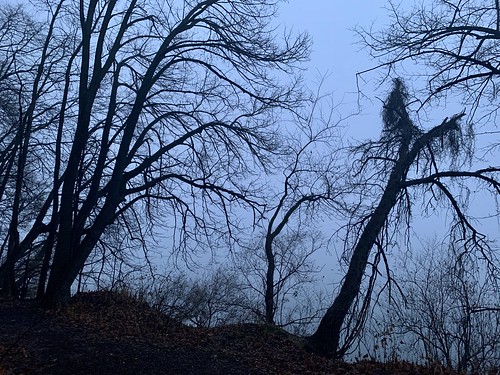
2. It feels nice on the skin, gentle, though the look of things is rather creepy. At 7:21:
3. Something that makes a run happen is to not think about it much. Just do one thing after another. Get your shoes on, your jacket, put the right things in your pocket, get in the car. Don't even think ahead to the next street after the next turn until you've turned. Don't imagine getting out of the car, just continue until the point where you get out of the car. And so forth. Isn't that how we live life most of the time? Be in the moment and accord each step the dignity of regarding it as complete and worthy in itself.
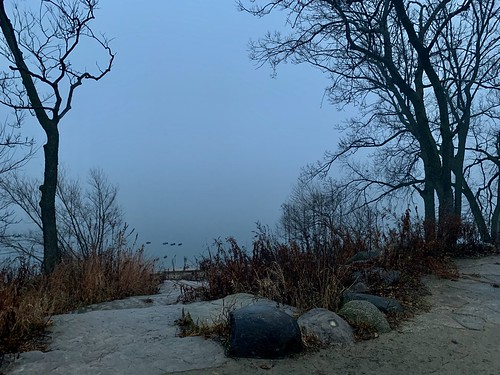
4. In all my sunrise runs, there has only been one other day when there was fog that made it impossible to see the opposite shore of Lake Mendota. That was October 31, here (with lots of snow). Today, it looked like this at my vantage point. You'll just have to try to remember where the shore line is supposed to be. This is 7:25, 7 minutes after the actual sunrise time:
5. By 7:37, the shore came vaguely into shape. The little dot of light is not the sun, but car headlights:
I am a participant in the Amazon Services LLC Associates Program, an affiliate advertising program designed to provide a means for me to earn fees by linking to Amazon.com and affiliated sites.
Encourage Althouse by making a donation:
Make a 1-time donation or set up a monthly donation of any amount you choose:




 पोस्ट्स


