Showing posts with label Fernandinande. Show all posts

May 29, 2020

How thinking the word "mansplaining" is like finding yourself in a lucid dream.

In this post I put up an hour ago, I talked about the photograph of Joe Biden at the top of the WaPo article "Racial tragedies stoke pressure on Joe Biden to pick a nonwhite running mate."

Here's a fragment of the photograph to show the "gesture and demeanor" I wanted to describe:


I said (jocosely): "I could only think of 'mansplaining.' Is there a word 'whitesplaining'?"

In the comments, Fernandistein said, "It's a standard gesture for politicians and other salesmen" — linking to "7 Hand Gestures to Get People to Listen to You."

All 7 gestures are depicted with a stylized image of a white man. The closest one to Biden's is this:


Biden's gesture is actually more open, but it's so open it reads as more of shrug, more What the hell am I supposed to do about it?

But anyway... I thought the "7 Hand Gestures to Get People to Listen to You" could just as well have been titled "7 Hand Gestures for Mansplaining." And, of course, Fernandistein observed, these are  standard gestures for politicians and other salesmen.

It's the standardness that makes it useful to have the word "mansplaining." It's why mansplaining is worth talking about openly. You see so damned much of it.

Yeah, it may work to fix people into listening mode, even as then they wonder why am I listening to this guy and when is this going to end and what can I possibly do to regain my agency in this interaction.

The term "mansplaining" helps the listener. It's like when you're dreaming and and you find a way to realize you're in a dream, and that makes it a lucid dream, and you gain powers of your own and can do things you want and serve your own interests.

If you find yourself in thrall to one of these men who've gotten you to listen — with their hand gestures and words and whatnot — if you can think "mansplaining," then you've acquired the kind of consciousness you have in a lucid dream. You can think: Now, what do I want to do?

January 26, 2020

The children are the future. Get ready.


AdyBarkan's bio reads: "Fighting for social justice + America's democracy. Living with @rachael_scar, Carl, and Willow, in Santa Barbara. Dying of ALS. Author of 'Eyes to the Wind.'"

This is a parent who is no Trump fan, but he's so proud of "Art of the Deal" talent in his own toddler.

And it makes me wonder, what qualities do you love to see developing in your young child that you loathe when you encounter them fully developed in adults?

IN THE COMMENTS: rehajm detects "Sarcasm." And Fernandistein says:
Um (don't you hate it when people write that?), I think he's actually trying to say that Trump acts like a 3-year old because they share some characteristics; they both walk and eat, etc. It's a very clever idea, especially when you consider that it was co-opted by this progressive activist.
I admit I didn't read it as an intentional slap at Trump, but I do think rehajm and Fernandistein are right. I attribute my insensitivity to sarcasm to my recent exposure to TikTok videos featuring toddlers arguing in the manner of an asshole adult. These videos are received as delightful and celebrated on TikTok, and I'm always thinking: You are really making a horrible mistake here.

Note that Ady Barkan does not mention Trump. He's trusting his readers to make the connection. My mistake was to make the connection without giving him credit for expecting me to do that. So let me make up for that by linking to his book, "Eyes to the Wind," about which Booklist wrote, "The book’s primary question is existential: how to live when you are dying? Barkan’s answer is to share, open up, act, and capital-R Resist, and his memoir, clearly and candidly written, establishes a legacy."

November 5, 2019

The perils of futurism in the world of Donald Trump.

I ran into this April 1991 New York Magazine article "Star Bores/Too Much Madonna? Too Much Nancy, Teddy, Cher? Or Is There Never Enough?"

This was purely by accident, as I was searching for something that I never found — a common saying from the past that was something like: Americans can't understand any message that won't fit on a T-shirt. Or: Any political philosophy that can't fit on a T-shirt might as well not exist because Americans are not terribly intellectual and have a short attention span.

That question came up in the context of writing a post this morning that contained the quoted sentence: "Intellectual curiosity has been replaced by ostentatious consumption, quality by quantity and political activism by slogans that fit on baseball caps."

In the comments Fernandistein reacted to that quote:
That is a standard and ageless "I'm better than most people" statement, but I wonder if the emitter of those words was intellectually curious enough to know that baseball caps didn't exist until around 1900, and that acronyms were almost non-existent until the 1940s, and that the slogan he refers to is actually more complicated and effective than the slogan of his probable hero.
The link on "probable hero" goes to the "F" section of Wikipedia's list of political slogans, so I'm not positive which "F" slogan is being pointed at, but I believe it is "Forward," and the "probable hero" is Barack Obama.

And samanthasmom said:
Baseball caps are better than campaign buttons. They keep your head warm or cool and shade your eyes from the sun. We've just become more practical with how we wear our slogans.
That got me thinking about the old T-shirt line, which was itself something that would fit on a T-shirt, but I guess it wasn't snappy enough to remember verbatim. And the internet won't help me. I found a huge page of "T-shirt Quotes" at BrainyQuote and they all seem to be somebody saying it's stylish to wear a T-shirt.

"I've always thought of the T-shirt as the Alpha and Omega of the fashion alphabet," said Giorgio Armani, which can't possibly be true, though it might be "true" within the fashion designer mentality, which is ridiculously nonliteral.

But I stumbled into "Star Bores." Who was everyone sick of in 1991? Of course, I did the normal 2019 thing and searched the text for "Trump." I scored:


Remember Faith Popcorn — the futurist? Remember futurists? "Donald Trump had no business in the spotlight." That's great. Especially the "had"... all the way back in 1991.The futurist we barely remember was talking about a man whose stardom seemed to be in the past. She had no inkling that 3 decades later he would be the biggest star in the world. Futurism ain't what it used to be. Or maybe it is, because futurism used to be wrong. I can see that now. Hindsight is 2019... and quite hilarious:

August 17, 2019

"It was a market that had never been played to... Nobody had sung their song to them."

Said Peter Fonda in 2018, talking about "Easy Rider." He is quoted in his NYT obituary, "Peter Fonda, ‘Easy Rider’ Actor and Screenwriter, Is Dead at 79."

That movie was so important to us young Boomers, half a century ago.
In 1967, Roger Corman, then the king of the low-budget movies, directed “The Trip” from a script by an up-and-coming actor, Jack Nicholson. Alongside Bruce Dern, Dennis Hopper and Susan Strasberg, Mr. Fonda starred as a mild-mannered television commercial director who uses LSD for the first time and makes the most of it. “Easy Rider,” which he also produced, came two years later.
There was also LSD in "Easy Rider."


What did Peter Fonda say about LSD in his later years?
“For me, it solved a great deal,” he said. “However, I didn’t take it and go out running through the city looking at lights. I was very circumspect and lay down on a couch.” Luckily, he added, “I don’t have an addictive character, and nothing except pot stayed with me.”
There's also The Beatles connection:
His mother committed suicide in 1950, when he was 10 and Jane was 13. Less than a year later, Mr. Fonda shot himself in the stomach with a pistol. Interviewed by The New York Times decades later, he insisted that it was an accident, not a suicide attempt or even a warning. “You shoot yourself in the hand or foot if you want attention,” he said, “not the way I did.”

Years later, he talked about the experience with John Lennon, who was reportedly inspired to write the line “I know what it’s like to be dead” in the Beatles’ song “She Said She Said.”
Here's how Wikipedia tells it:

July 26, 2019

"Is society's 'Man up' message fuelling a suicide crisis among men?"

A question asked at BBC.
"I felt I had to be part of it, to fit into the team. To be part of that, I had to have that laddish bravado - I think that's why men can struggle so much," James says. "Then I got caught in this whirlpool of despair - should I be laddish even if I didn't enjoy being laddish? I was trying to fit into how society thinks young men should act."...

Simon Gunning, chief executive of Campaign Against Living Miserably (Calm), told MPs masculinity was often equated with having what it took to put food on the table. "It has been defined as this strange conflation of stoicism and strength, meaning the strong silent type," he said....
IN THE COMMENTS: Fernandistein quotes "society's 'Man up' message" and asks:
"Society" has a message? If so, google ngram thinks that society's "man up" message has been declining since about 1920.
Here's the ngram:


That made me check out "laddish":

June 30, 2019

Is it true that "The term 'tomboy' has long sounded alarms among conservative parenting factions for its perceived association with lesbianism and departure from traditional femininity"?

I'm trying to read "'Tomboy' is anachronistic. But the concept still has something to teach us," by Lynne Stahl (a humanities librarian who teaches popular culture, gender theory, and critical information studies at at West Virginia University)(in WaPo).

I'm interested in the idea of a "tomboy," which I remember from my long-ago youth. There was a girl in our neighborhood who was the tomboy. It was what she was. What did she do? I remember only 2 elements: 1. She ran around with no shirt on in the summertime, and 2. She loved the 3 Stooges — especially Moe.

From the second paragraph of the WaPo article:
The term “tomboy” has long sounded alarms among conservative parenting factions for its perceived association with lesbianism and departure from traditional femininity...
With my memories of childhood, I wondered if that's true. Do conservatives look askance at tomboys? I haven't consorted with many conservatives in the last 50 years, but, growing up, it seemed that people were pleased to see a tomboy. I heard pride. So I clicked that link on "conservative parenting factions" and got:

[IMAGE MISSING/LINK HAS GONE DEAD]

Did the link go to just one book (as evidence of "factions")?

Click the image to enlarge it and clarify and you'll be able to see the URL: "https://www.amazon.com/Parents-Guide-Preventing-Homosexuality/dp/0830823794." I wondered if there was a parents guide to preventing homosexuality and, if so, whether it represented real "conservative factions."

I tried searching Amazon for parents guide to preventing homosexuality and the top item — and the only even remotely apt item — was this:


That's not the Richard Cohen who was my husband in the 1970s and 80s (and it's not the Richard Cohen who's a Washington Post columnist). This person is presented as a "psychotherapist." The description of the book says: "Did you know that every day people change from 'gay' to straight? This is a must read for every parent, teacher, counselor, clergy, and all who wish to understand what drives homosexual feelings and how to respond in love." I don't know how much that has to do with feeling alarmed about manifestations of tomboyism.

Stahl (the author of the WaPo article) continues, saying that the term "tomboy" has...
... come under scrutiny in progressive circles, too, with some critics arguing that it upholds the essentialist notion that anatomy largely determines children’s behaviors and inclinations. The author of a 2017 New York Times essay who wrote that her daughter was more a tomboy than a transboy sparked debate around gender-nonconforming children, and the argument about this trope has also unfolded across Facebook communities and clinical studies.
Yes, I blogged about that 2017 article ("My Daughter Is Not Transgender. She’s a Tomboy," by Lisa Selin Davis). I said:
Davis is trying so hard to be politically correct, and everything she writes is so scrupulously polite. But in the process she's shedding light on an important problem: More pliable parents and children are being urged to interpret gender-role fluidity/nonconformity as a condition that needs treatment with medical interventions.
Stahl, in the WaPo column, is bringing up this topic because there's another Hollywood adaptation of "Little Women" in the works, and "Little Women" has a character, Jo, and she's explicitly called a tomboy. From Chapter 1:
"Jo does use such slang words!" observed Amy, with a reproving look at the long figure stretched on the rug.

Jo immediately sat up, put her hands in her pockets, and began to whistle.

"Don't, Jo. It's so boyish!"

"That's why I do it."

"I detest rude, unladylike girls!"

"I hate affected, niminy-piminy chits!"

"Birds in their little nests agree," sang Beth, the peacemaker, with such a funny face that both sharp voices softened to a laugh, and the "pecking" ended for that time.

"Really, girls, you are both to be blamed," said Meg, beginning to lecture in her elder-sisterly fashion. "You are old enough to leave off boyish tricks, and to behave better, Josephine. It didn't matter so much when you were a little girl, but now you are so tall, and turn up your hair, you should remember that you are a young lady."

"I'm not! And if turning up my hair makes me one, I'll wear it in two tails till I'm twenty," cried Jo, pulling off her net, and shaking down a chestnut mane. "I hate to think I've got to grow up, and be Miss March, and wear long gowns, and look as prim as a China Aster! It's bad enough to be a girl, anyway, when I like boy's games and work and manners! I can't get over my disappointment in not being a boy. And it's worse than ever now, for I'm dying to go and fight with Papa. And I can only stay home and knit, like a poky old woman!"

And Jo shook the blue army sock till the needles rattled like castanets, and her ball bounded across the room.

"Poor Jo! It's too bad, but it can't be helped. So you must try to be contented with making your name boyish, and playing brother to us girls," said Beth, stroking the rough head with a hand that all the dish washing and dusting in the world could not make ungentle in its touch.

"As for you, Amy," continued Meg, "you are altogether too particular and prim. Your airs are funny now, but you'll grow up an affected little goose, if you don't take care. I like your nice manners and refined ways of speaking, when you don't try to be elegant. But your absurd words are as bad as Jo's slang."

"If Jo is a tomboy and Amy a goose, what am I, please?" asked Beth, ready to share the lecture.

"You're a dear, and nothing else," answered Meg warmly, and no one contradicted her, for the 'Mouse' was the pet of the family.
These 4 female stereotypes, so crisply reeled out in Chapter 1, are seared into the American mind. I remember reading that, and I thought it was obvious that the one to be was Beth (who's so good it's — spoiler alert — the death of her). But then I thought it was obvious that the best Stooge was Curly, but our local tomboy loved Moe.

Anyway, what are we doing here? Does the WaPo writer, Stahl, have anything new today, anything beyond The Great Tomboy Foofaraw of 2017? She notes — remember, she's a librarian — that "fictional stories about tomboys... also feature plotlines that inevitably pair these characters off with boys, offering uncomplicatedly happy, tidy conclusions in which the tomboy drops her resistance and acquires a boyfriend." (Was tomboyishness "resistance" to love from a man?)
It’s a process that constricts their characteristic independence, and it can feel torturous for those of us who don’t identify with traditional femininity — and who see something of ourselves in fictional figures who reject it. Empathetic viewers might want to see a character embrace her singleness, even if an actual lesbian pairing is too much to hope for.

The attempt to fix the tomboy by marrying her off invites disturbing associations with real-life medical practices that “correct” high levels of hormones associated with masculine characteristics.
Isn't that inviting disturbing associations with real-life medical practices that 'correct' hormones in transgender youths? Speaking of correct, I'm assuming Stahl wants to be politically correct (and she does inject some pro-transgender material near the end, the maximum distance from this disapproval of hormone "correction").

And can't women "who don’t identify with traditional femininity" find happiness with a man? Is there something inherently independent about "an actual lesbian pairing." It seems to me, people who pair up — whether with a man or a woman — may sacrifice their individuality, but they shouldn't, and they don't need to. I'm sure there are plenty of women "who don’t identify with traditional femininity" who pair up with a man, maintain their identity, and have a great time with their man. And the man likes it too. I mean, the lady will go camping.

Stahl observes that writers of popular stories, including Louisa May Alcott, go for the predictable plotline of having the tomboy put on some feminine clothes and realize how much she wants a man. Stahl makes the solid point that readers can and will "ignore contrived endings" and find satisfaction in the meat of the story, where there is expression of tomboy individualism. She concludes:
If we want greater gender autonomy, we have to understand how traditional ideas about gender linger in the stories we tell and the endings we envision for ourselves. Beyond resisting gender norms, tomboys give us a way to see the complex dynamics that shape our expression and perception of identity. And even if the word “tomboy” is reaching its own ending, the tomboy’s refusal to conform keeps its power still.
I still don't see why "tomboy" must die. If you like this character type, why not keep it alive? Beth may have  — spoiler alert — died of her own overflowing dearness, but doesn't the tomboy have the wherewithal to survive?

Stahl purports to value "the complex dynamics that shape our expression and perception of identity," and once we fully understand that — helped, per Stahl, by the tomboy — the tomboy, a stereotype, has no environment that can support her continuing life.

But if we ever got there, all stereotypes would be anachronisms.

IN THE COMMENTS: Fernandistein says, "ngram of tomboy shows the popularity of the word almost linearly increasing since 1860":

May 24, 2019

The Guardian changed a headline about "beta-male misogyny" to "nice-guy misogyny."

An hour ago, I wrote a blog post about "Moby's treatment of Natalie Portman is a masterclass in beta-male misogyny." The headline now reads, "Moby's treatment of Natalie Portman is a masterclass in nice-guy misogyny":
In the comments to my post, Fernandistein says:
masterclass in beta-male misogyny

Now it says "masterclass in nice-guy misogyny".

Maybe someone got their tropes about memes mixed up.
Yeah, I wonder what happened. Did someone decide "beta-male" is not politically correct? Beta males are in the down position, but who knew a feminist attack had to be reined in and couldn't disparage a man's masculinity with that particular pejorative? Did "beta male" become taboo just this morning?

I'd like to read the memo on that new rule! I'm thinking right wingers insult men that way, so left wingers need to refrain. Or maybe it's a little too close to homophobia. Whatever... I don't think "nice-guy" can just be swapped in. I don't think Moby presents himself as nice.

I know a lot of men complain that women don't value the "nice guy," and that's a topic for feminist analysis, but I doubt it's what the author of the re-headlined piece thought she was talking about. "Beta male" has been expunged from the article. (Still in the URL though.)

August 18, 2018

Keeping up with The Kinks.


IN THE COMMENTS: Fernandistein said:
Too bad they're not named Ray Davies and Dave Rabies.

July 8, 2018

I am only on a journey of immersive experiences, not explaining any social, political, and economic changes of today.

P1180121

P1180123

(I took these photos in the Museum of Contemporary Art in Chicago. The post headline is inspired by Fernandistein's fantastic mashup of David Sedaris and Herman Melville.)

"There’s a growing concern in publishing about cultural sensitivities. Do you make a point of ignoring them?"

The Guardian interviewer asks David Sedaris. He answers:
A lot of times people will say after a reading: “I can’t believe what you said”, and I’m literally thinking: “What did I say?” I feel like so many of those issues are really just the enemies of comedy. After every show it’s something. There’s an essay where a woman shits in her pants on the aeroplane and I said it looked like she’d taken her skirt off a long-dead Gypsy, because I want people to see the colour of the skirt. I read that in Edinburgh and this young man comes up and says: “I have a bone to pick with you. I’m one-tenth Gypsy. I really don’t appreciate you using that word.” I’m like: “Call me when you’re nine-tenths Gypsy.” I mean, who isn’t one-tenth Gypsy? Writing isn’t propaganda.
Also, why David Sedaris hates "Moby-Dick":
About 15 years ago, Esquire asked me to pick a classic I’d never read, and I started it and thought there is no way I’m going to finish this book, so I told myself I could not take a bath or wash my hair until I finished the book. I hated that book.
How to hate a book. And so much water in that one:
But even so, amid the tornadoed Atlantic of my being, do I myself still for ever centrally disport in mute calm; and while ponderous planets of unwaning woe revolve round me, deep down and deep inland there I still bathe me in eternal mildness of joy.
That sentence is from "Moby-Dick" (obviously). Here's the new David Sedaris book, "Calypso" (which I've read a few times).
The dress culottes weren’t as expensive as the pants that come up to my nipples, but still they were extravagant. I buy a lot of what I think of as “at-home clothes,” things I’d wear at my desk or when lying around at night after a bath, but never outdoors. These troubling, Jiminy Cricket–style trousers, for instance, that I bought at another of my favorite Japanese stores, 45rpm. They have horizontal stripes and make my ass look like a half dozen coins collected in a sack made from an old prison uniform.
That's David Sedaris. See how different from Melville? And yet both authors have a bath.

IN THE COMMENTS: Fernandistein said:
Those two sucky types, married for mildness:

But even so, amid the tornadoed dress culottes, do I myself still for ever centrally disport in “at-home clothes”; and while extravagant stripes of unwaning fashion revolve round my nipples, deep down and deep inland there I still shoppe me in eternal mildness of Japanese stores.

March 8, 2018

"Since 1851, The New York Times has published thousands of obituaries: of heads of state, opera singers, the inventor of Stove Top stuffing and the namer of the Slinky."

"The vast majority chronicled the lives of men, mostly white ones; even in the last two years, just over one in five of our subjects were female. Charlotte Brontë wrote 'Jane Eyre'; Emily Warren Roebling oversaw construction of the Brooklyn Bridge when her husband fell ill; Madhubala transfixed Bollywood; Ida B. Wells campaigned against lynching. Yet all of their deaths went unremarked in our pages, until now...."

From "Overlooked/Since 1851, obituaries in The New York Times have been dominated by white men. Now, we're adding the stories of 15 remarkable women." (NYT). Among the omitted are Diane Arbus, who died in 1971. You'd think by 1971, the NYT would have caught up to the idea that women are people. But perhaps the fame of Diane Arbus was slow-developing, mostly post-death.  I was, at first, struck by the failure to do an obituary for Sylvia Plath, but she died in 1963, and I think it's pretty clear in that case that her fame arrived posthumously, perhaps because women's-movement proponents were working to elevate stories about women.

Yes, we the general public got to know Arbus because of a book of her work that came out in 1972 (a year after her death), and Sylvia Plath got big because of "The Bell Jar," which was published in 1971, 8 years after her death. And both Arbus and Plath committed suicide. As the NYT says in its late-arriving obituary for Plath, "Because the death was a suicide, Plath’s family did not much advertise it...." If someone who is not already quite famous commits suicide, I'm guessing, obituaries are rare, even for white men.

As for obituaries like the one for the man who invented Stove Top stuffing and the man who named the Slinky, they don't stand for the proposition that men don't have to do much to get a NYT obituary. They stand for the NYT practice of doing quirky obituaries for people with interestingly specific accomplishments. These are a wonderful sub-genre in the NYT, some of the most fun reading the newspaper offers. Don't diminish these obituaries as evidence of sex discrimination. I love those things, and they're often about women.

Here's an article from last year about a documentary about writing obituaries in the NYT:

August 3, 2017

"Why do I find Stephen Miller completely compelling and want to write a novel about him? Why do I not want to write a novel about Jim Acosta?"

Tweets "American Psycho" author Bret Easton Ellis.

Should you want to be the guy Bret Easton Ellis wants to write a novel about?

If you don't know what he's talking about, here's the hilarious/painful interchange between Miller (the Trump adviser) and Acosta (of CNN):


Selected quotes:

Acosta: “What the president is proposing here does not sound like it’s in keeping with American tradition when it comes to immigration. The Statue of Liberty says, ‘Give me your tired, your poor, your huddled masses yearning to breathe free.’”

Miller: “I don’t want to get off into a whole thing about history here, but the Statue of Liberty is a symbol of liberty and lighting the world. It’s a symbol of American liberty lighting the world. The poem that you’re referring to, that was added later, is not actually a part of the original Statue of Liberty.”

Aside from his suitability as a character in a novel, Miller is certainly right that Acosta is conflating the Emma Lazarus poem with the Statue and that the original historical meaning of the statue precedes and is not the same as those famous lines in the poem. WaPo points that out:
“New Colossus” was not part of the original statue built by the French and given to the American people as a gift to celebrate the country’s centennial. Poet Emma Lazarus was asked to compose the poem in 1883 as part of a fundraising effort to build the statue’s base.... In 1903, 16 years after Lazarus’ death, the poem was inscribed on the statue’s base, just as millions of immigrants were streaming into New York harbor....

Earlier this year Rush Limbaugh blamed Lazarus for the false connection. “The Statue of Liberty had absolutely nothing to do with immigration,” Limbaugh said on a January 31 broadcast. “So why do people think that it does? Well, there was a socialist poet.”...
From the Rush Limbaugh link:
It was originally intended to be delivered to celebrate the centennial of the Declaration, the American Revolution.... The statue was not intended to recognize immigration. It was intended to recognize liberty and freedom. If you think they’re intertwined, don’t be misled.
Rush proceeds to mock Madeleine Albright for saying that Trump's immigration policy is making the Statue of Liberty cry:
The statue doesn’t cry. The statue is a statue. It’s made out of bronze. It doesn’t cry. There aren’t any tears coming from the eyes of the Statue of Liberty ’cause there aren’t any eyes, and the Statue of Liberty is not welcoming immigrants. What it represents is the beacon of liberty and freedom!
Yeah, well, maybe, but it's not made out of bronze. It's pure copper. We're just all misreading everything. But there's a continuum from misreading to interpretation. I can say for a fact that the statue is made out of copper, but the meaning of the statue is cultural, and it means what it has come to mean in the hearts of Americans. What the French had specifically in mind when they sent it to us is relevant if that's what's in our hearts.

You know, it wasn't even green when it arrived. Being copper, it was copper-colored. Do original meaning fans deny that it's green?

IN THE COMMENTS: Fernandinande wrote:
"American Psycho"/I tried reading that a few months ago, and speaking of run-on sentences and that silly "grade" metric, I stopped reading after a two-page sentence which painfully detailed all the products and actions the guy used in his morning routine.
And yet, it you gave me 2 pages right now of Bret Easton Ellis's description of what he imagines Stephen Miller does and uses in his morning routine, I'd eagerly, happily read every word of it. I assume it would be... completely compelling.

April 30, 2017

On not being Facebook's "you."

Facebook assumes you use Facebook to keep in touch with family and friends by displaying yourself a nice person, a person with friends and family who loves smiling faces and romping doggies. We have this very modern, pushing-the-envelope form of communication, but it wants customers in the billions, so it has to picture The Customer as a pretty conventional person. It talks to this person as "you," and being on the receiving end of that "you," I often feel insulted. Like this morning:


IN THE COMMENTS: Fernandinande said:
Strongly worded letter follows.

I don't like the way the tip of the dog's ear extends into the white border of his picture. I also don't like the fact that a different dog is in front of that picture.
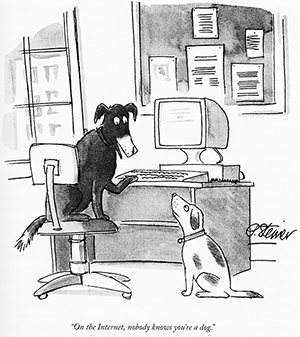
LOL. But I like the implication that the dog is on Facebook sharing dog pictures. It's a fantastic representation of how Facebook undermines the beauty of the internet as expressed in the classic cartoon:


By the way, that cartoon has its own Wikipedia page. Excerpt:
Peter Steiner, a cartoonist and contributor to The New Yorker since 1979, said the cartoon initially did not get a lot of attention. Later it took on a life of its own, and that he felt similar to the person who created the "smiley face". In fact, Steiner was not that interested in the Internet when he drew the cartoon, and although he did have an online account, he recalled attaching no "profound" meaning to the cartoon; it was just something he drew in the manner of a "make-up-a-caption" cartoon....

The cartoon symbolizes an understanding of Internet privacy that stresses the ability of users to send and receive messages in general anonymity. Lawrence Lessig suggests "no one knows" because Internet protocols do not force users to identify themselves; although local access points such as a user's university may, this information is privately held by the local access point and is not an intrinsic part of the Internet transaction.....

April 11, 2017

"Now [Hillary Clinton] can add 'fashion muse' and 'footwear model' to the list [of important titles], thanks to Katy Perry, who designed a pair of pumps in her honor, dubbing them The Hillary."

"And when Clinton got her hands on a pair of the baby pink pumps, she was more than happy to show them off to their best effect for Perry’s Instagram."

Effuses People Magazine's "Style" section.

Speaking of style, what atrocious writing style! When I hear "got her hands on a pair of baby pink pumps," I'm the kind of person who immediately wants to say: and got her feet on a pair of adult blue gloves. And when I hear "more than happy," I go looking for the George Carlin clip:


ADDED: I got to that link via Drudge, who follows it with what I think is a non-accidental line-up of links:


Thanks to Fernandinande (commenting in the café post below) for prompting me to acknowledge Drudge and to perceive intentional drudgtaposition. Notice how the word "pump" appears twice. Well, what do you think? Intentional comic juxtaposition? Here's another way to frame the screenshot. What do you think of this?


You've got the 2 images of something normally unseen. We peer in utero at unborn babies. (What are they doing?) And we gawk endlessly at a belly a man had dressed to cover. Bracketing these 2 images of human beings who did not choose self-exposure are 2 women who dearly want and demand our attention, who pose with forthright willingness for the camera: 1. Hillary Clinton, positioning herself like a cute-girl marionette, displays pop-star-branded candy-colored shoes, and 2. Ayn Rand stares at us in utterly serious black and white, imposing her imperious will that says we must see her as both distinctly beautiful and absolutely devoid of girlishness.

December 16, 2015

"Cop Who Sought Photos of Teen’s Erection in Sexting Case Commits Suicide Moments Before Arrest."

"Police Detective David Edward Abbott, a member of the Northern Virginia-Washington D.C. Internet Crimes Against Children Task Force, committed suicide Tuesday before law enforcement could arrest him on suspicion of sexually abusing minors," Hit & Run reports.
Abbott, you will recall, was the detective in the noteworthy teen sexting case from July 2014, in which the authorities sought a warrant to take the 17-year-old male suspect to the hospital, inject him with a drug that would give him an erection, photograph his genitals, and compare the photo with existing pictures of his genitals the police had confiscated from his 15-year-old girlfriend’s phone....
Abbott sued the boy's lawyer for saying "Who does this? It's just crazy." He called that defamation, in that it made him look like a pedophile. Later, he was suspected of having sexual contact with 2 adolescent boys, and when the police came to arrest him, he shot himself dead.

IN THE COMMENTS: MadisonMan points to my July 2014 post about Abbott's proposal to photograph the boy's medically induced erection and the lawyer's "Who does this?" reaction. My reaction on seeing that old post is:
Wow, I'm surprised to see that I blogged about that... and only last year. When I read [about the case] this morning, I felt I'd never heard of it and was very shocked that the police would propose to do this. (Did they ever do it?) I must have some strong repression reflexes. I really felt, this morning, that if I had ever seen this before I would have blogged it, so I didn't remember blogging it or ever seeing it, even though it makes a big, very distressing impact on me.
MadisonMan looks through the comments at the old post and singles out this, from Fernandiande:
You can see a picture of the child-abusing sex pervert here: "Master" Detective Abbott.

April 7, 2015

"To many Democrats and professors at Harvard, Mr. Tribe is a traitor."

Says this NYT article, "Laurence Tribe Fights Climate Case Against Star Pupil From Harvard, President Obama":
“The administration’s climate rule is far from perfect, but sweeping assertions of unconstitutionality are baseless,” Jody Freeman, director of the environmental law program at Harvard Law School, and Richard Lazarus, an expert in environmental law who has argued over a dozen cases before the Supreme Court, wrote in a rebuttal to Mr. Tribe’s brief on the Harvard Law School website. “Were Professor Tribe’s name not attached to them, no one would take them seriously.”...

[A] number of legal scholars and current and former members of the Obama administration say that Mr. Tribe has eroded his credibility by using his platform as a scholar to promote a corporate agenda — specifically, the mining and burning of coal.

“Whether he intended it or not, Tribe has been weaponized by the Republican Party in an orchestrated takedown of the president’s climate plan,” said one former administration official.
Tribe says that he's "very comfortable" representing Peabody Energy, because the arguments he needs to make "happened to coincide with what I believe." The NYT provides a quote to cast doubt on Tribe's veracity...
“That a leading scholar of constitutional matters has identical views as officials of a coal company — that his constitutional views are the same as the views that best promote his client — there’s something odd there,” said Richard L. Revesz, director of the Institute for Policy Integrity at the New York University School of Law.
... and a prediction of his social death...
The Republicans who are citing Mr. Tribe’s work are not surprised. Mr. McKenna, the Republican lobbyist, said dryly, “He’s about to be banned from a lot of cocktail parties.”
Oh, you poor man, now the only friends you'll have are friends nobody wants. 

IN THE COMMENTS: Fernandinande said:
"Were Professor Tribe’s name..."

I first read that as referring to the name of a tribe of "Were-professors," who attack when the moon is full.

August 5, 2014

The Robinowl and the Scottie Selfie.


Fernandinande transformed my photograph, the one of the fledgling robin in whose eye I saw myself, and Meade came forward with his own accidental selfies in the eyes of an animal:

P1160583

ADDED: See the entire adorable the 10 month-old Scottish Terrier Gillie at Meade's blog Puparazzo.