Prestonwood Baptist Church with their 'Gift of 'Christmas 2025' show, feat. the Little Drummer Boy pic.twitter.com/cdXIvBl9ds
— Protestia (@Protestia) December 9, 2025
Showing posts with label over-complication. Show all posts
Showing posts with label over-complication. Show all posts
December 10, 2025
This expresses exactly what I feel about the song "Little Drummer Boy."


November 9, 2025
"Capes that flowed into skirts, coats on top of denim jackets and socks worn over tights.... layers were bright sweaters or cozy scarves... many people were covered up [or] wearing shorts, high-slit skirts or other layers...."
In case you want to feel as though it will be perfectly fashionable to throw on as many oversized comfortable layers of whatever you happen to find in your closet, look at the photographs at "Layers Upon Layers of Lively Fall Fashion/Capes that flowed into skirts, coats on top of denim jackets, socks over tights — and don’t forget scarves and sweaters" (NYT)(free-access link).
The article is by Simbarashe Cha, who works in the tradition of the much-missed Bill Cunningham. Scanning the photographs, I get the feeling he was working on sets that didn't pan out. One unrealized set is "twins" (2 individuals out and about while dressed somewhat like each other). Another is the double breasted jacket. Those pictures are tucked into fashion's biggest catch-all: layers.
I was reminded of the famous advice attributed to Coco Chanel:
October 7, 2025
The problem isn't "too much gold." It's too much ornamentation.
What are all those stick-on doodads? They don't mean anything. They don't seem to be about America.
🚨 JUST IN: The White House has released new footage of the current Trump Oval Office and liberals are furious that there's "too much gold."
— Eric Daugherty (@EricLDaugh) October 7, 2025
It actually looks stunning.
Trump's Oval looks leagues better than Biden and Obama's.pic.twitter.com/TtCZrl3Hur
December 21, 2024
"Many basically ordinary activities conceal, or can conceal, vast amounts of effort. Packing, for me, has turned out to be like..."
"... staying fit, or being well read, or cooking a decent weeknight dinner for a family of four, in that it requires a surprising amount of consistent work over time. The effort isn’t just practical but intellectual. You’re a better packer, for instance, when you master the concept of a 'distinction without a difference'... there might be no appreciable difference between two distinctive-seeming garments.... Overpacking has the effect of deferring decisions, shifting them from your house to your hotel room. When you understand this, you become more motivated in your packing: it’s senseless to add not just to your physical load but to your mental one.... My new goal is to become as organized in life as I am on the road; my hope is that packing will end up being a kind of laboratory for the development of a more rational me...."
Writes Joshua Rothman, "Why Can’t You Pack a Bag? Our overstuffed suitcases burden us more than we realize" (The New Yorker).
Front-load your decisionmaking, and don't look back. You know, some people travel with just the clothes they wear and pack nothing at all!
May 30, 2024
"The prosecution theory is essentially a Russian nesting doll of criminal violations..."
"... under New York law, falsifying business records is a felony only if the records were falsified in furtherance of another crime. Prosecutors have said that other crime was violating a state law against unlawfully promoting or preventing an election. But the 'unlawful' reference in the state code has to refer to a distinct, different crime. In Trump’s case, prosecutors have offered three types of crimes that would make the state election-meddling charge come into play: federal election law crimes, tax crimes or false business records. The jury must be unanimous when it comes to determining whether Trump is guilty or not guilty of each specific falsifying business records count, and whether he did so in an effort to unlawfully impact an election, New York Supreme Court Justice Juan Merchan said. He added, however, that the panel did not have to be unanimous about which of those three types of crimes could serve as the underlying violation that brings the state election charge into play."
Writes Devlin Barrett, in "Jurors must be unanimous to convict Trump, can disagree on underlying crimes/While jurors deliberated in the first trial of a former U.S. president, Donald Trump railed online against one feature of the charges he faces" (WaPo).
Trump's on-line railing said the judge didn't require "a unanimous decision." And you can see why he said that. The WaPo article makes the unfairness clear enough. It doesn't come out and say Trump is right, but it refrains from saying he's wrong. I don't think he's wrong. It's hard to believe something so complicated was piled together. I'd love to hear the jury trying to sort this out. I'm picturing them puzzled to the point of exasperation. If one juror were able to explain the instruction correctly, I would expect responses like "You've got to be kidding" and "What did you even just say?"
Writes Devlin Barrett, in "Jurors must be unanimous to convict Trump, can disagree on underlying crimes/While jurors deliberated in the first trial of a former U.S. president, Donald Trump railed online against one feature of the charges he faces" (WaPo).
Trump's on-line railing said the judge didn't require "a unanimous decision." And you can see why he said that. The WaPo article makes the unfairness clear enough. It doesn't come out and say Trump is right, but it refrains from saying he's wrong. I don't think he's wrong. It's hard to believe something so complicated was piled together. I'd love to hear the jury trying to sort this out. I'm picturing them puzzled to the point of exasperation. If one juror were able to explain the instruction correctly, I would expect responses like "You've got to be kidding" and "What did you even just say?"
October 20, 2023
The contestants were so feminist that they didn't recognize a simplified definition of feminism.
Three contestants stumped by the definition of feminism. Very telling. #Jeopardy pic.twitter.com/V5E2a7UqAx
— Dr. Joe (@DrJRJoe) October 19, 2023
April 30, 2023
The complicated woman and the complicated man.
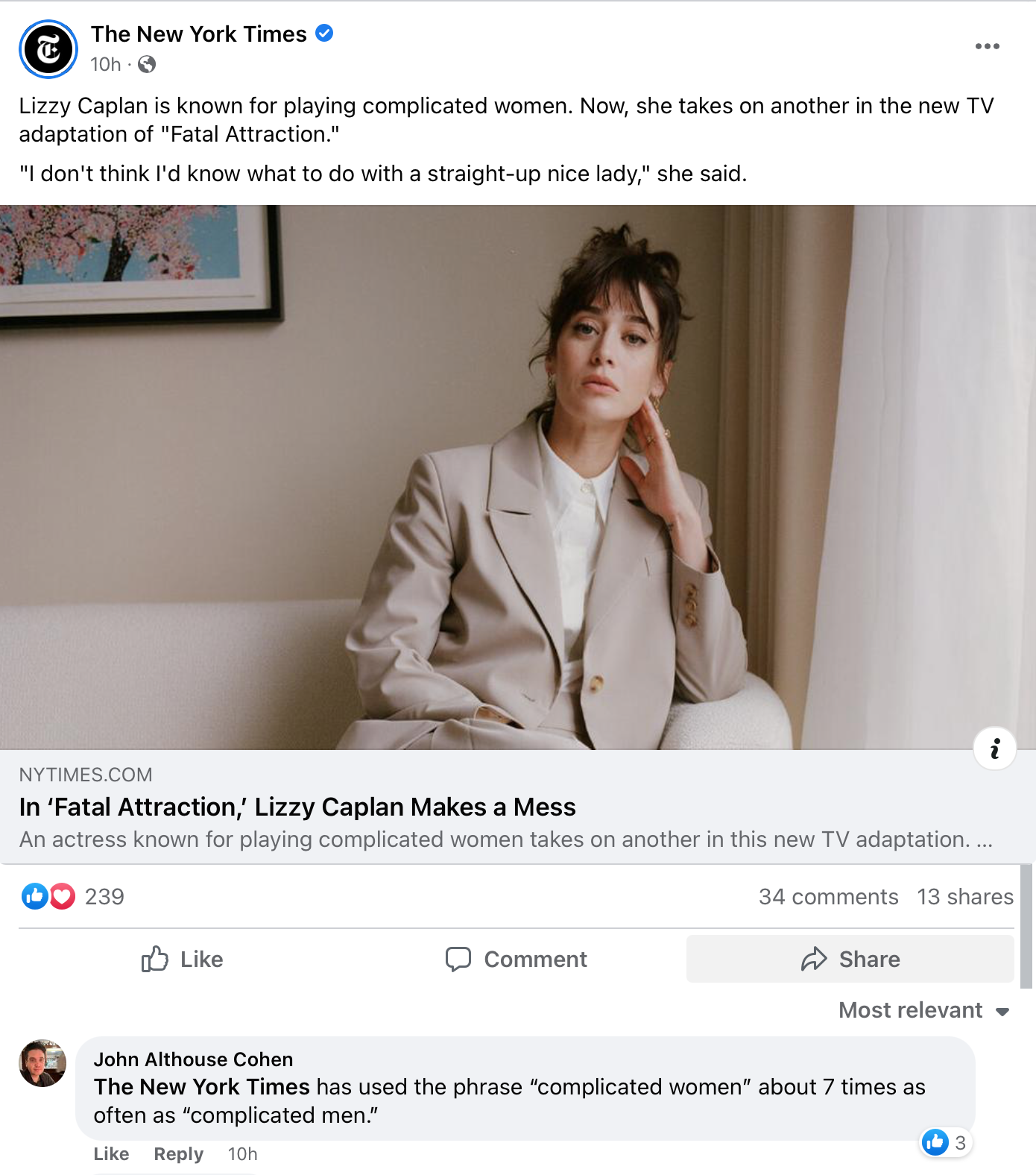 My son John comments on a NYT post at Facebook.
This is a variation on a point I've made a few times: The mainstream media present whatever is true of the woman as good. If the same quality were found to be true of a man, it would be presented as bad.
In this case — complicatedness — is something that — in a woman — feels intriguing and sophisticated. But what the hell is a "complicated man"? We're not wasting our time exploring his psyche. Screw him. He's an asshole.
But the complicated woman....
February 10, 2023

February 3, 2023
"[T]he gap between Covid-19 mortality and overall excess mortality has proved remarkably, and mystifyingly, persistent...."
Writes David Wallace-Wells, in "Why Are So Many Americans Dying Right Now?" (NYT).
[A]lmost every week for more than six months, the agency has calculated that total excess mortality was 50 percent larger than and often almost twice as large as the number of official Covid-19 deaths.... What are the hypotheses?
July 22, 2022
"This Biennale, which runs through Sept. 18, is serious. Very serious. It verges on humorless...."
"[The curator's] statement notes that today’s 'profusion of sprawling, monumental exhibitions' mirrors 'the material excesses' of global capitalism, and asks: 'So why add yet another exhibition to this?'
The answer he reaches is that art — perhaps uniquely — can reclaim our attention from algorithmically enforced social control.... Mai Nguyen-Long’s 'Vomit Girl' and 'Specimen' sculpture series... grapple with the aftermath of Agent Orange bombings in Vietnam....
Even blunter are Mayuri Chari’s vulvas sculpted from cow dung... address the shaming of women’s bodies in India amid conservative Hinduism’s obsession with purity.... This Biennale is... all over the place — one must study the scatter in an attempt to understand the collision that produced it.
Its contradictions, I suspect, reflect those of the 'decolonial'.... Whereas decolonization in the classic sense was a political, territorial project with no inherent grievance against modernity, today’s 'decolonial practice' is about changing systems of knowledge — a woolier, potentially endless project. This Biennale is presented as a gathering of 'decolonial strategies.' The task... is tending 'all of the wounds accumulated throughout the history of Western modernity.'... This Berlin Biennale feels... overloaded by its own conceptual apparatus...."
March 8, 2022
"For April Fools’ Day in 2016, Wardle made Robin... Two strangers were paired in a small chatroom and then given three options..."
"... stay in the small room, merge with others to form a bigger room, or abandon the chat. The moral of the game was that bigger is not always better, and people seemed to get it. 'Much like reddit, it starts small and you can talk to people, then it gets bigger and shittier and noisier,' the top-voted comment read. 'Can confirm,' the next comment read. 'Started with 2 people, was pleasantries. With 16, its a noise chamber.' Wardle told me, 'Very quickly, as eight becomes sixteen becomes thirty-two, you start to see spam, name-calling—all the classic terrible Internet stuff.' Still, he added, most people chose to keep merging: 'There seems to be something compelling about the competition to become the biggest room, even if you know it’s going to be painful.'"
From "Does Wordle Prove That We Can Have Nice Things on the Internet?/Josh Wardle created the viral game as part of his ongoing quest to design online spaces that don’t devolve into spam and swastikas" (The New Yorker).
June 2, 2021
"Every one who has had the misfortune to talk with people in the heart or on the edge of mental disorder, knows that their most sinister quality is a horrible clarity of detail..."
"... a connecting of one thing with another in a map more elaborate than a maze... If you argue with a madman, it is extremely probable that you will get the worst of it; for in many ways his mind moves all the quicker for not being delayed by the things that go with good judgment. He is not hampered by a sense of humor or by charity, or by the dumb certainties of experience. He is the more logical for losing certain sane affections. Indeed, the common phrase for insanity is in this respect a misleading one. The madman is not the man who has lost his reason. The madman is the man who has lost everything except his reason."
From "Orthodoxy" by G. K. Chesterton.
March 2, 2020
Why would Democrats take advice from Bill Kristol?
I'm reading "The Simple Answer/Don't overthink your Super Tuesday vote" by Bill Kristol (Bulwark).
There's an illustration of a Joe Biden wearing a blue Make America Great Again hat and smiling boyishly.
Under the illustration is a quote from Ronald Reagan: "They say the world has become too complex for simple answers. They are wrong. There are no easy answers, but there are simple answers."
From the Kristol text:
Hey, I have just the right tag for this: "over-complication."
ADDED: I had to publish this post to click on my "over-complication" tag, and the most recent post with this tag — from January 11th — says:
There's an illustration of a Joe Biden wearing a blue Make America Great Again hat and smiling boyishly.
Under the illustration is a quote from Ronald Reagan: "They say the world has become too complex for simple answers. They are wrong. There are no easy answers, but there are simple answers."
From the Kristol text:
You are a normal American. You don’t like demagogues of the right or the left. You want competent, responsible governance somewhere in the vicinity of the broad center. You cherish American exceptionalism, and you know that means rejecting European-style demagoguery of the right and left that exploits people’s anxieties and seduces them with false promises. You dread a future featuring an authoritarian and illiberal party facing off against a socialist and illiberal party. And so you don’t want to face a choice–you don’t want the country to face a choice– between Donald Trump and Bernie Sanders in November.Duh! You vote for Biden.
What are you to do?...
Hey, I have just the right tag for this: "over-complication."
ADDED: I had to publish this post to click on my "over-complication" tag, and the most recent post with this tag — from January 11th — says:
ADDED: I had to publish this post to click on my "over-complication" tag, which I probably could have used a few more times if I'd kept it in mind. It's the kind of tag I love, specific but abstract, so it collects things from scattered topics that resonate. Today's post is only the 6th time I've used it since I created it in 2009 to observe that I'd "crossed the over-complication line" with a post that had a strange set of tags ("abortion, Althouse + Meade, Beccah Beushausen, beer, blogging, dolls, fake, James Frey, Meade, Oprah, Orson Welles, prayer, writing"). It took me a year to use it again, with this great quote from Gertrude Stein: "She always says she dislikes the abnormal, it is so obvious. She says the normal is so much more simply complicated and interesting." Didn't use it again until 2011 — "A Very Simple Venn Diagram of Where the Tea Party and Occupy Wall Street Agree" — and then once in 2017 (a labyrinthine sentence about feminism) and once in 2019 (a New Yorker critic bothered by the complexity of the movie "Joker").The topic of that January 11th post was, like this post today, the Biden vs. Sanders question. But things were different then. Nate Silver had written:
So while Biden’s in a reasonably strong and perhaps even slightly underrated position, it’s slightly more likely than not that Biden won’t be the nominee. Sen. Bernie Sanders has the next-best shot... Like all of our models, it’s empirically driven... Since the primaries themselves are fairly complex process, the model is fairly complex also.... Models with more complexity are easier to screw up and can be more sensitive to initial assumptions....
January 11, 2020
"So while Biden’s in a reasonably strong and perhaps even slightly underrated position, it’s slightly more likely than not that Biden won’t be the nominee."
"Sen. Bernie Sanders has the next-best shot, with a 22 percent chance at a majority, followed by Sen. Elizabeth Warren at 12 percent and former Mayor Pete Buttigieg at 10 percent. There’s also a 14 percent chance — about 1 in 7 — that no one will win a majority of pledged delegates by June 6, which could lead to a contested convention. The model works by simulating the nomination race thousands of times, accounting for the bounces that candidates may receive by winning or losing states, along with other contingencies — such as candidates dropping out and polls moving in response to debates and news events. Like all of our models, it’s empirically driven, built using data from the 15 competitive nomination races since 1980. Since the primaries themselves are fairly complex process, the model is fairly complex also — which we mean as a warning as much as a brag. Models with more complexity are easier to screw up and can be more sensitive to initial assumptions — so we’d encourage you to read more about how our model works."
Nate Silver explains, using his amazing science.
ADDED: I had to publish this post to click on my "over-complication" tag, which I probably could have used a few more times if I'd kept it in mind. It's the kind of tag I love, specific but abstract, so it collects things from scattered topics that resonate. Today's post is only the 6th time I've used it since I created it in 2009 to observe that I'd "crossed the over-complication line" with a post that had a strange set of tags ("abortion, Althouse + Meade, Beccah Beushausen, beer, blogging, dolls, fake, James Frey, Meade, Oprah, Orson Welles, prayer, writing"). It took me a year to use it again, with this great quote from Gertrude Stein: "She always says she dislikes the abnormal, it is so obvious. She says the normal is so much more simply complicated and interesting." Didn't use it again until 2011 — "A Very Simple Venn Diagram of Where the Tea Party and Occupy Wall Street Agree" — and then once in 2017 (a labyrinthine sentence about feminism) and once in 2019 (a New Yorker critic bothered by the complexity of the movie "Joker").
Nate Silver explains, using his amazing science.
ADDED: I had to publish this post to click on my "over-complication" tag, which I probably could have used a few more times if I'd kept it in mind. It's the kind of tag I love, specific but abstract, so it collects things from scattered topics that resonate. Today's post is only the 6th time I've used it since I created it in 2009 to observe that I'd "crossed the over-complication line" with a post that had a strange set of tags ("abortion, Althouse + Meade, Beccah Beushausen, beer, blogging, dolls, fake, James Frey, Meade, Oprah, Orson Welles, prayer, writing"). It took me a year to use it again, with this great quote from Gertrude Stein: "She always says she dislikes the abnormal, it is so obvious. She says the normal is so much more simply complicated and interesting." Didn't use it again until 2011 — "A Very Simple Venn Diagram of Where the Tea Party and Occupy Wall Street Agree" — and then once in 2017 (a labyrinthine sentence about feminism) and once in 2019 (a New Yorker critic bothered by the complexity of the movie "Joker").
October 6, 2019
"'Joker' reflects political cowardice on the part of a filmmaker, and perhaps of a studio, in emptying out the specifics of the city’s modern history and current American politics so that the movie can be released as mere entertainment to viewers who are exasperated with the idea of movies being discussed in political terms—i.e., to Republicans...."
"[T]he movie plays into the hands of current-day political rhetoric—namely, the emphasis by Republicans who, when it comes to gun control, would rather deny weapons to the mentally ill than restrict weaponry for everyone. In the wake of Arthur’s killing spree, a public figure—Thomas Wayne (Brett Cullen), a wealthy banker for whom Penny worked decades earlier, and who, of course, is the father of a boy named Bruce—speaks of killers such as Arthur as 'clowns.' This comment gives rise to a sudden mass movement of activists who dress like clowns and target the rich and the powerful. The trope resembles Hillary Clinton’s reference to many of the supporters of Donald Trump as 'deplorables,' a term that was adopted by some as a badge of honor—except in 'Joker' the epithet applies rather to radicals on the left, who loom as a menace waiting to happen...."
From "'Joker' Is a Viewing Experience of Rare, Numbing Emptiness" by Richard Brody (in The New Yorker).
Brody is bothered by the movie's "incoherence," and I think he's mostly annoyed that the comic-book material isn't organized according to a comic-book politics of right and left. He calls the movie "empty" over and over, but it seems as though he's bothered by complexity — there's too much and it's not composed in a stark, easily recognized pattern.
From "'Joker' Is a Viewing Experience of Rare, Numbing Emptiness" by Richard Brody (in The New Yorker).
Brody is bothered by the movie's "incoherence," and I think he's mostly annoyed that the comic-book material isn't organized according to a comic-book politics of right and left. He calls the movie "empty" over and over, but it seems as though he's bothered by complexity — there's too much and it's not composed in a stark, easily recognized pattern.
February 8, 2017
Sentence of the day.
"Reading that second line, I immediately thought of an irksome scene in Megyn Kelly’s memoir, in which Kelly tells Sheryl Sandberg that she’s not a feminist, and Sandberg—whose entire feminist initiative is based on making the movement palatable to people like Kelly, and whose awkward accommodation of the Trump Administration should surprise no one—'passed no judgment' on Kelly’s distaste for the term."
Let me rewrite that with a bracketed phrase for "that second line":
Let me rewrite that with a bracketed phrase for "that second line":
"Reading [that the 'majority of women benefited from the work of these few {radical, heavily invested women}, while often quickly trying to disassociate themselves from them'], I immediately thought of an irksome scene in Megyn Kelly’s memoir, in which Kelly tells Sheryl Sandberg that she’s not a feminist, and Sandberg—whose entire feminist initiative is based on making the movement palatable to people like Kelly, and whose awkward accommodation of the Trump Administration should surprise no one—'passed no judgment' on Kelly’s distaste for the term."The sentence is from "The Case Against Feminism," by Jia Tolentino (in The New Yorker), reviewing "Why I Am Not a Feminist," by Jessa Crispin. It's all very labyrinthine and tied up in knots, but the simple idea is that there's radical feminism and mainstream feminism.
October 23, 2011
"A Very Simple Venn Diagram of Where the Tea Party and Occupy Wall Street Agree."

Blogged by Alexis Madrigal at The Atlantic back on October 14th (so I don't know why my attention hasn't been directed at this before (Is it too obvious? The obviousness is what I love about it)).
August 8, 2010
"She always says she dislikes the abnormal, it is so obvious."
"She says the normal is so much more simply complicated and interesting."
Gertrude Stein, writing about herself in the 3rd person.
Part 2 in a continuing series of blog posts made from passages I marked in books I read long ago.
Gertrude Stein, writing about herself in the 3rd person.
Part 2 in a continuing series of blog posts made from passages I marked in books I read long ago.
June 13, 2009
Post with too many subjects.
I know I've crossed the over-complication line with this post. Look at all those tags: abortion, Althouse + Meade, Beccah Beushausen, beer, blogging, dolls, fake, James Frey, Meade, Oprah, Orson Welles, prayer, writing...
Subscribe to:
Posts (Atom)


 Posts
Posts


