"In 1453, Mehmed II conquered Constantinople, and although his troops plundered what they could carry, the building was saved and turned into a mosque. For 500 years it was the venerated center of the Muslim Ottoman Empire.... Minarets were added, and later the great Ottoman architect Sinan built massive buttresses to prevent the walls from buckling under the weight of the dome, which was damaged in earthquakes. With the fall of the Ottoman Empire... Mustafa Kemal Ataturk, founder of the modern secular republic of Turkey, ended the role of religion in the state and closed religious institutions.... But [President Recep Tayyip] Erdogan’s supporters speak of the building as the third holiest site in Islam, after the Grand Mosque of Mecca and Al-Aqsa Mosque in Jerusalem, and insist that once a mosque it should never be unconsecrated."
From "Erdogan Talks of Making Hagia Sophia a Mosque Again, to International Dismay/The World Heritage site was once a potent symbol of Christian-Muslim rivalry, and it could become one once more" (NYT).
"Beyond politics, art historians and conservationists worry that they will lose access for study and research if the monument becomes a working mosque, and tourist companies and city authorities fear that visitors will be deterred from coming. The monument is the most visited tourist site in Turkey, with 3.7 million visitors last year.... The greatest worry is what will happen to the incomparable medieval mosaics, among them depictions of Christ, the Virgin Mary and John the Baptist, alongside rare portraits of imperial figures including Emperor Justinian I and Empress Zoe, one of the few women to rule in her own right. The mosaics were whitewashed for the more than five centuries during Ottoman rule — the depiction of the human form being considered idolatry — and were uncovered and restored only after Hagia Sophia was turned into a museum in the 1930s..... If the museum becomes a mosque, the mosaics will have to be covered during Muslim prayers somehow, including seraphs high up at the base of the dome. Tourists and non-Muslims may be restricted to certain areas...."
A thousand years is a long time and 500 years is a long time. All that religion in one phenomenal place, but the solution, since 1935, has been to keep it as a museum.
It's interesting to encounter this problem at a time when we here in America are struggling over whether to retain images of human heroes. I respect the desire to use a structure to practice a living religion — especially in a phenomenally beautiful building — but the artwork is artwork of another religion, and there's such a strong interest in protecting access for Christians and those of us who love art and architecture.
Here's a "Great Courses" episode on Hagia Sophia (click on Episode 3). I've seen it and strongly recommend it. You'll get lots of closeup looks at the mosaics and the architectural details. I've watched the whole course — "The World's Greatest Churches" — and the teacher ranks Hagia Sophia as the greatest church building in the world.
Showing posts with label iconoclasm. Show all posts
Showing posts with label iconoclasm. Show all posts
July 8, 2020


July 5, 2020
In 2 speeches, this 4th of July weekend, Trump has set out his campaign theme — in contrast to the recent iconoclasm — and my first question is: Where had Biden located himself?
No jokes about the basement. I know that's his physical location. I want to know where he has positioned himself between Trump — who's conspicuously embracing the traditional American icons and ideals — and the protesters — who are tearing down monuments and denouncing the old ideals.
I saw that Joe Biden gave a 4th of July speech and found the transcript. I was settling to "live-blog" my reading of the speech — as I did yesterday with the first of Trump's weekend speeches — but — copying the text — I saw that it was just a minute-long bit. Does it do much of anything at all? One thing Biden might do is keep relatively quiet and low-key and reserve the ability to move to any place he wants on that continuum between the icon-worshippers and the iconoclasts.
Here's the entire text of Biden's July 4th speech:
__________________
* This is such a great recording:
I saw that Joe Biden gave a 4th of July speech and found the transcript. I was settling to "live-blog" my reading of the speech — as I did yesterday with the first of Trump's weekend speeches — but — copying the text — I saw that it was just a minute-long bit. Does it do much of anything at all? One thing Biden might do is keep relatively quiet and low-key and reserve the ability to move to any place he wants on that continuum between the icon-worshippers and the iconoclasts.
Here's the entire text of Biden's July 4th speech:
Our country was founded on an idea, “We hold these truths to be self evident, that all men are created equal.” We’ve never lived up to it. Jefferson himself didn’t. He held slaves, women were excluded, but once proposed it was an idea that couldn’t be constrained.It sounds as though he wants to be right in the center of the continuum.
It survived the ravages of the Civil War, the dogs of Bull Connor, the assassination of Martin Luther King and more than 200 years of systemic racism, and just weeks ago the murder of George Floyd. Through it all, these words have gnawed at our conscience and pulled us towards justice.Now, he's embraced the concept of "systemic racism." It's a given. A truth to be held self-evident.
American history is no fairy tale.That is, the idealized version of the story is propaganda. It doesn't get to exactly what's real. But the "systemic racism" story is also propaganda. As campaign rhetoric, Biden rejects the "fairy tale" version of American history, but he's offering up as the alternative the horror show version of American history. We'll see how far he will lean into that "systemic racism" theme.
It’s been a constant push and pull between two parts of our character, the idea that all men and women, all people are created equal, and the racism that has torn us apart.Oh, how he wants to be smack dab in the middle.*
We have a chance now to give the marginalized, the demonized, the isolated, the oppressed a full share of the American dream. We have a chance to rip the roots of systemic racism out of this country.How? If it's systemic it's interwoven into everything. Virtually everyone agrees that if it's there, we want it out, but how are you going to do that? The answer is, I think, it doesn't matter. He's just trying to get in the right spot so he can be voted for. And you've got to admit, what he's saying sounds like Obama. Shouldn't that be enough?
We have a chance to live up to the words that have founded this nation. This Independence Day let’s not just celebrate the words, let’s celebrate that promise and commit to work, the work that we must do to fulfill that promise. We remain locked in the battle for the soul of this nation, but believe me, truly, it’s a battle we can and we will win if we act together. Happy Fourth.It's a battle for the soul! And the way he will do this battle is by looking as though he's right in the middle. I do think he's slightly off-center to the left, because he gave very little of his 1 minute of air time to the traditional values of America. He only named one of the 4th of July historical figures, Jefferson, and only to say that he didn't live up to the text he wrote, the text we still ought to venerate, as we try to get closer to its abstract ideal.
__________________
* This is such a great recording:
July 1, 2020
"The iconoclasm is good for us. It’s a great political issue for the president."
Said an anonymous "senior [Trump] campaign official," quoted in "Trump’s Twitter feed reads like a local crime blotter as he stokes a culture war" by Josh Dawsey (WaPo). The "crime blotter" material in question is the vandalism aimed at public statues and monuments. And, yes, it makes sense for the Trump campaign to see this as a good issue for them, but they didn't start the unrest and destruction. It strikes me as unfair to say that he's "stoking" any kind of "war," when the protests and attendant violence arose out of police actions in particular cities (cities run by Democrats).
What did Trump have to do with that? Is he supposed to stand back and say nothing? His antagonists take whatever they can get, every single day, and spin it against him. Are they "stoking" a "war"? No, they're just doing their normal thing, plying their trade, writing columns like "Trump’s Twitter feed reads like a local crime blotter as he stokes a culture war" by Josh Dawsey in The Washington Post. Josh Dawsey is writing that and Trump is doing his tweets, taking the material of the day, and spinning it into an argument for his side.
Of course, he's going to improve his political standing by crying out against "the two Anarchists who threw paint on the magnificent George Washington Statue in Manhattan" and the rest of the violence toward inanimate objects. He sees and takes the advantage of embracing and extolling the icons in this time of iconoclasm.
Dawsey quotes the presidential historian Douglas Brinkley:
But look more closely: This dynamic of Trump taking advantage of the iconoclasm and the iconoclasts ramping up their destruction might hurt the moderate Democrats who are trying to win the 2020 elections. It's not a good issue for them, and hanging back and waiting for it to die down and go away on its own isn't working.
ADDED: I'm reading the Wikipedia page for Douglas Brinkley:
What did Trump have to do with that? Is he supposed to stand back and say nothing? His antagonists take whatever they can get, every single day, and spin it against him. Are they "stoking" a "war"? No, they're just doing their normal thing, plying their trade, writing columns like "Trump’s Twitter feed reads like a local crime blotter as he stokes a culture war" by Josh Dawsey in The Washington Post. Josh Dawsey is writing that and Trump is doing his tweets, taking the material of the day, and spinning it into an argument for his side.
Of course, he's going to improve his political standing by crying out against "the two Anarchists who threw paint on the magnificent George Washington Statue in Manhattan" and the rest of the violence toward inanimate objects. He sees and takes the advantage of embracing and extolling the icons in this time of iconoclasm.
Dawsey quotes the presidential historian Douglas Brinkley:
"His argument is Main Street values against a crazy wave of anarchy. A lot will depend on how inflamed the monument issue gets. Trump has a vested issue in this. He’s actually cheering the anarchists on, daring them to take more down."He’s actually cheering the anarchists on... You see how that works (in the mind of the eminent historian)? Because Trump speaks out against the destruction and some people hate Trump, they're inspired to do more destruction. It's a way to get Trump. And you see the rank perversity of the implicit argument: Don't speak out against the destructiveness you oppose, because it will only inflame the destroyers, and they will do more destruction.
But look more closely: This dynamic of Trump taking advantage of the iconoclasm and the iconoclasts ramping up their destruction might hurt the moderate Democrats who are trying to win the 2020 elections. It's not a good issue for them, and hanging back and waiting for it to die down and go away on its own isn't working.
ADDED: I'm reading the Wikipedia page for Douglas Brinkley:
[D]uring the 2013 inauguration coverage, CNN referred to him as "a man who knows more about the presidency than just about any human being alive." In contrast, in 2006, historian Wilfred McClay in the New York Sun appraised Brinkley's scholarship as one that has failed to "put forward a single memorable idea, a single original analysis, or a single lapidary phrase." Similarly, author Bill Bryson characterized Brinkley as "a minor American academic and sometime critic whose powers of observation and generosity of spirit would fit comfortably into a proton and still leave room for an echo."
July 25, 2018
Iconoclasm.
"Trump’s Star on Hollywood Walk of Fame Destroyed With Pickaxe" (Daily Beast).

No, it wasn't really gentler times! It was 1941, and Woody was doing "Talking Hitler's Head Off Blues."
"This Machine Kills Fascists" has its own Wikipedia page. There, we learn that in later years, Pete Seeger had "This Machine Surrounds Hate and Forces it to Surrender" on his banjo — as he sang "Waist Deep in Big Muddy," protesting the Vietnam War.
And Donovan had "This machine kills" on his guitar — and explained that "fascism was already dead" and his "machine would kill greed and delusion." Delusion!? Yes, Donovan can help with delusions — Get together/Work it out/Simplicity/Is what it's about...
But today's news is of a pickaxe in a guitar case. The destruction is direct — smashing with a tool — not indirect like music that has to enter the human mind and motivate the action of others.
By the way, a submachine gun in a violin case is a TV Trope: "This has been done so much that nowadays when some people see a violin case, they assume it contains firearms." Jinx in "League of Legends" says, "What's in my violin case? Violence!"
Now, that guy with the pickaxe used his tool to destroy, but he didn't destroy a man. He didn't "kill fascists." He destroyed an inanimate thing. And that's iconoclasm:
"Multiple people—including police—tell me a man walked up with a guitar case and pulled out the pick axe. Then, it’s believed, he called police himself to report it, but left the scene before they got here. Now, he’s nowhere to be found."Guitar case, eh? Reminds me of gentler times, when Woody Guthrie had a sign on his guitar, "This Machine Kills Fascists."
No, it wasn't really gentler times! It was 1941, and Woody was doing "Talking Hitler's Head Off Blues."
"This Machine Kills Fascists" has its own Wikipedia page. There, we learn that in later years, Pete Seeger had "This Machine Surrounds Hate and Forces it to Surrender" on his banjo — as he sang "Waist Deep in Big Muddy," protesting the Vietnam War.
And Donovan had "This machine kills" on his guitar — and explained that "fascism was already dead" and his "machine would kill greed and delusion." Delusion!? Yes, Donovan can help with delusions — Get together/Work it out/Simplicity/Is what it's about...
But today's news is of a pickaxe in a guitar case. The destruction is direct — smashing with a tool — not indirect like music that has to enter the human mind and motivate the action of others.
By the way, a submachine gun in a violin case is a TV Trope: "This has been done so much that nowadays when some people see a violin case, they assume it contains firearms." Jinx in "League of Legends" says, "What's in my violin case? Violence!"
Now, that guy with the pickaxe used his tool to destroy, but he didn't destroy a man. He didn't "kill fascists." He destroyed an inanimate thing. And that's iconoclasm:
Iconoclasm is the social belief in the importance of the destruction of icons and other images or monuments, most frequently for religious or political reasons....
May 11, 2017
"Crews, wearing masks to cover their faces, worked under a heavy police presence starting at 3 a.m. to dismantle the statue..."
... of Jefferson Davis, in New Orleans.
In New Orleans, we have the political branch of government making a decision about the design of shared public space. The people, acting through government, have the power to redesign their spaces to express their current values. Those who object to the new decisions have a right to protest (but not to commit or threaten acts of violence). They lost elections. Let them try to win in the future by arguing that the statues should be moved out of the warehouse and back to the public square (or simply that a dignified and accurate historical museum should be built).
We've talked before on this blog about removing statues from public places. We've seen it done for aesthetic reasons (where the honored person looked ugly), and we've seen it for political reasons:
[The city spokesperson] said the law enforcement officials took extra precautions because of “consistent threats, harassment and intimidation tactics” surrounding the removal.ADDED: The statues are not getting destroyed. They're being warehoused, potentially to be displayed at some point in a museum setting, buffered by contextualizing historical materials. So this is not like the Taliban blowing up the Bamiyan Buddhas. Nor is it a case of a court dictating that a monument must come down. (My thoughts drifted back to Justice Breyer's decision against requiring the removal of the 10 Commandments monument on the Texas statehouse grounds.)
Some protesters carrying Confederate flags shouted “cowards” and “totalitarianism” as it was removed....
Other works expected to be removed are a bronze statue of Gen. Robert E. Lee that has stood in a traffic circle, named Lee Circle, in the city’s central business district since 1884, and an equestrian statue of P.G.T. Beauregard, a Confederate general. Because of the threat of violence, the city would not release details on the timeline for when the remaining two statues would be removed.
In New Orleans, we have the political branch of government making a decision about the design of shared public space. The people, acting through government, have the power to redesign their spaces to express their current values. Those who object to the new decisions have a right to protest (but not to commit or threaten acts of violence). They lost elections. Let them try to win in the future by arguing that the statues should be moved out of the warehouse and back to the public square (or simply that a dignified and accurate historical museum should be built).
We've talked before on this blog about removing statues from public places. We've seen it done for aesthetic reasons (where the honored person looked ugly), and we've seen it for political reasons:
Iconoclasm. If you're inclined to reach back into history, you will, perhaps, find it everywhere. From the Wikipedia article "Iconoclasm," here are "The Sons of Liberty pulling down the statue of George III of the United Kingdom on Bowling Green (New York City), 1776":New Orleans needs its Grūtas Park.
And I can't look at that and not think about the statue of Saddam Hussein that our military tore down in Bagdhad in April 2003. And what of all those monumental statues of Vladimir Lenin that came in for destruction when the Soviet Union dissolved. Would you like to see them all removed?
I know there's at least one still standing, because the NYT, just a couple days ago, ran a story cooing over an aging American couple who are using Airbnb to live in various European cities and the slideshow features the man, dressed in shorts, like a child, and standing, like a child, knee-high to "this statue of Lenin in Lithuania." The hand of the smiling child-man reaches out to encircle the index finger of Soviet dictator. In another photo, the woman, in a short skirt, poses at the feet of a giant Stalin. This one too is "in Lithuania." We're told there's "a sculpture garden." Isn't that nice?
I need to do my own research to find out about "Grūtas Park (unofficially known as Stalin's World...)... a sculpture garden of Soviet-era statues and an exposition of other Soviet ideological relics from the times of the Lithuanian SSR."
Founded in 2001 by entrepreneur Viliumas Malinauskas, the park is located near Druskininkai, about 130 kilometres (81 mi) southwest of Vilnius, Lithuania.... Its establishment faced some fierce opposition, and its existence is still controversial.... The park also contains playgrounds, a mini-zoo and cafes, all containing relics of the Soviet era. On special occasions actors stage re-enactments of various Soviet-sponsored festivals.So there's an alternative to iconoclasm.
February 27, 2015
What's so bad about Scott Walker's "If I can take on 100,000 protesters, I can do the same across the globe"?
"I think the bust of Fighting Bob La Follette is kind of Soviet-like," says Meade, reading the previous post about the Islamic iconoclasm in Mosul and anti-Soviet iconoclasm in the former Soviet states (and the preservation of Soviet sculptures in Lithuania).
Here's a picture I took of the monumental head on February 25, 2011, a little over a week after the big protests had begun in and around the Wisconsin capitol:
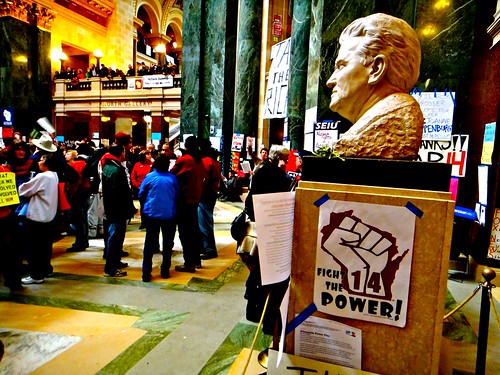
I originally blogged that here, with other photographs, including one showing how some protesters had used the back of the Veterans Memorial as a component of what they called their "Information Station."
And let me use this post to comment on something Scott Walker said at the end of his CPAC speech yesterday. What would he do about ISIS? "If I can take on 100,000 protesters, I can do the same across the globe." That was bad, obviously, and Walker has sent his spokeswoman to rephrase what was supposedly in The Head of Walker. (I'm saying "The Head of Walker" because I'm picturing a "Soviet-like" head of Walker some day, in the capitol, eye-to-eye with Bob La Follette, which would be the "more speech" alternative to iconoclasm.) The spokeswoman said:
Is that the kind of leadership he's proposing to use in the war on terror? It can't be. The relevant component of leadership that I'm seeing is something I associate with George W. Bush: silent acceptance of abuse from his critics. Walker said "If I can take on 100,000 protesters," but he didn't take them on. He let them carry on. That may have been wise under the circumstances, but it tells us close to nothing about what he would do with enemies who won't limit themselves to protesting and when he can't control the outcome through partisan domination of a legislature. Sheer cockiness won't do the trick — "If I can take on 100,000 protesters, I can do the same across the globe." And that was a cockiness beyond what we saw — and got tired of — in George Bush.
Here's a picture I took of the monumental head on February 25, 2011, a little over a week after the big protests had begun in and around the Wisconsin capitol:
I originally blogged that here, with other photographs, including one showing how some protesters had used the back of the Veterans Memorial as a component of what they called their "Information Station."
And let me use this post to comment on something Scott Walker said at the end of his CPAC speech yesterday. What would he do about ISIS? "If I can take on 100,000 protesters, I can do the same across the globe." That was bad, obviously, and Walker has sent his spokeswoman to rephrase what was supposedly in The Head of Walker. (I'm saying "The Head of Walker" because I'm picturing a "Soviet-like" head of Walker some day, in the capitol, eye-to-eye with Bob La Follette, which would be the "more speech" alternative to iconoclasm.) The spokeswoman said:
Governor Walker... was in no way comparing any American citizen to ISIS. What the governor was saying was when faced with adversity he chooses strength and leadership. Those are the qualities we need to fix the leadership void this White House has created.There's still a problem. How would the form of leadership demonstrated during the protests transfer to the war on terrorism? Scott Walker's approach to the protests was to let them play out — replete with loud chanting and drumming and lots of taped up signs in the capitol and huge marches outside — all the while knowing he had the votes in the legislature to pass the law that the protesters were protesting. He chose silent inaction, putting up with it, in a situation where he knew he'd win in the end, and, in fact, when the legislation finally passed, the protests ended. There was still the recall effort, and there was plenty more speech lambasting Walker, but Walker knew all along he had the upper hand, and instead of trying to counter the speech of the protesters (or even to get them cleared out of the capitol), he sat back and let them have what probably looked to most Wisconsinites like a big tantrum. He knew that the protesters knew that they could not cross the line from semi-organized protest to anything like violence or the threat of violence. The no-response response was therefore effective.
Is that the kind of leadership he's proposing to use in the war on terror? It can't be. The relevant component of leadership that I'm seeing is something I associate with George W. Bush: silent acceptance of abuse from his critics. Walker said "If I can take on 100,000 protesters," but he didn't take them on. He let them carry on. That may have been wise under the circumstances, but it tells us close to nothing about what he would do with enemies who won't limit themselves to protesting and when he can't control the outcome through partisan domination of a legislature. Sheer cockiness won't do the trick — "If I can take on 100,000 protesters, I can do the same across the globe." And that was a cockiness beyond what we saw — and got tired of — in George Bush.
ISIS endeavors to destroy the art of ancient Nineveh (AKA Mosul).
The efforts at destruction that you see at the beginning of this video are not as horrible as they look, for reasons that are explained half way through.
Watch out for the British expert who appears at 1:47. She thinks it's "pretty rotten for the people who actually live" in northern Iraq that so many of the original works of art have been transferred to Western museums — even as it's apparent that if those sculptures had been left in northern Iraq, they would now be sledgehammered to bits. Or does she — do we — think that if the artworks had been left in place, the history of Iraq would have played out on a different path, and the people who live there would have treasured and protected the world's artistic heritage? From the article at the link (to the British Channel 4 site):

And I can't look at that and not think about the statue of Saddam Hussein that our military tore down in Bagdhad in April 2003. And what of all those monumental statues of Vladimir Lenin that came in for destruction when the Soviet Union dissolved. Would you like to see them all removed?
I know there's at least one still standing, because the NYT, just a couple days ago, ran a story cooing over an aging American couple who are using Airbnb to live in various European cities and the slideshow features the man, dressed in shorts, like a child, and standing, like a child, knee-high to "this statue of Lenin in Lithuania." The hand of the smiling child-man reaches out to encircle the index finger of Soviet dictator. In another photo, the woman, in a short skirt, poses at the feet of a giant Stalin. This one too is "in Lithuania." We're told there's "a sculpture garden." Isn't that nice?
I need to do my own research to find out about "Grūtas Park (unofficially known as Stalin's World...)... a sculpture garden of Soviet-era statues and an exposition of other Soviet ideological relics from the times of the Lithuanian SSR."
Watch out for the British expert who appears at 1:47. She thinks it's "pretty rotten for the people who actually live" in northern Iraq that so many of the original works of art have been transferred to Western museums — even as it's apparent that if those sculptures had been left in northern Iraq, they would now be sledgehammered to bits. Or does she — do we — think that if the artworks had been left in place, the history of Iraq would have played out on a different path, and the people who live there would have treasured and protected the world's artistic heritage? From the article at the link (to the British Channel 4 site):
The demolition squad of the Islamic State are following in the tradition of the Taliban who blew up the Buddhas at Bamyan, in Afghanistan, and the Malian jihadi group Ansar al Dine which destroyed mud tombs and ancient Islamic manuscripts in Timbuktu. They quote suras from the Koran that they say demand the destruction of idols and icons.Iconoclasm. If you're inclined to reach back into history, you will, perhaps, find it everywhere. From the Wikipedia article "Iconoclasm," here are "The Sons of Liberty pulling down the statue of George III of the United Kingdom on Bowling Green (New York City), 1776":
But iconoclasm isn't just a Salafi Islamic idea. In the 17th Century, puritans, under the rule of Oliver Cromwell, destroyed Catholic holy objects and art in Britain.
"We pulled down two mighty great angells, with wings, and divers other angells . . . and about a hundred chirubims and angells," wrote William Dowsing, Cromwell's chief wrecker, after leading his henchmen into Peterhouse college chapel in Cambridge in December 1643.

And I can't look at that and not think about the statue of Saddam Hussein that our military tore down in Bagdhad in April 2003. And what of all those monumental statues of Vladimir Lenin that came in for destruction when the Soviet Union dissolved. Would you like to see them all removed?
I know there's at least one still standing, because the NYT, just a couple days ago, ran a story cooing over an aging American couple who are using Airbnb to live in various European cities and the slideshow features the man, dressed in shorts, like a child, and standing, like a child, knee-high to "this statue of Lenin in Lithuania." The hand of the smiling child-man reaches out to encircle the index finger of Soviet dictator. In another photo, the woman, in a short skirt, poses at the feet of a giant Stalin. This one too is "in Lithuania." We're told there's "a sculpture garden." Isn't that nice?
I need to do my own research to find out about "Grūtas Park (unofficially known as Stalin's World...)... a sculpture garden of Soviet-era statues and an exposition of other Soviet ideological relics from the times of the Lithuanian SSR."
Founded in 2001 by entrepreneur Viliumas Malinauskas, the park is located near Druskininkai, about 130 kilometres (81 mi) southwest of Vilnius, Lithuania.... Its establishment faced some fierce opposition, and its existence is still controversial.... The park also contains playgrounds, a mini-zoo and cafes, all containing relics of the Soviet era. On special occasions actors stage re-enactments of various Soviet-sponsored festivals.So there's an alternative to iconoclasm.
February 26, 2006
Audible Althouse #38.
Subscribe to:
Posts (Atom)


 Posts
Posts


