Showing posts with label computers. Show all posts

August 11, 2025

"The rhetoric was, if you just learned to code, work hard and get a computer science degree, you can get six figures for your starting salary...."

Said Manasi Mishra, a recent graduate of Purdue with a computer science degree, quoted in "Goodbye, $165,000 Tech Jobs. Student Coders Seek Work at Chipotle. As companies like Amazon and Microsoft lay off workers and embrace A.I. coding tools, computer science graduates say they’re struggling to land tech jobs" (NYT).
In response to questions from The New York Times, more than 150 college students and recent graduates — from state schools including the universities of Maryland, Texas and Washington, as well as private universities like Cornell and Stanford — shared their experiences. Some said they had applied to hundreds, and in several cases thousands, of tech jobs at companies, nonprofits and government agencies. The process can be arduous, with tech companies asking candidates to complete online coding assessments and, for those who do well, live coding tests and interviews. But many computing graduates said their monthslong job quests often ended in intense disappointment or worse: companies ghosting them. Some faulted the tech industry, saying they felt “gaslit” about their career prospects. Others described their job search experiences as “bleak,” “disheartening” or “soul-crushing.”

It wasn't long ago at all that students who studied things other than coding were taunted with the imperative "Learn to code." Such a useful skill, so suddenly obsolete. 

May 24, 2025

"Screen time together is better than individual device time, experts say. Start playing multiplayer video games like Mario Kart on the same screen...."

"Pick a movie or TV show to watch together as a family, without checking a your phone. 'TV is underrated in the age of short form video, if you’re worried about their attention span,' says Devorah Heitner, author of 'Growing Up in Public: Coming of Age in a Digital World.' 'It’s an opportunity to connect, and it’s also an opportunity to have a shared vocabulary.'"

From "The White House is worried about kids’ screen time. Here are five things parents can do. A new MAHA-led report on childhood health has harsh words about screen time, but the reality is more nuanced" (WaPo)(free-access link).

Did you ever think it would come to this, that the situation with children would get so bad that watching more TV would come to be regarded as therapeutic?!

That's a free access link, so you can see multiple other issues, such as the painful dissonance for parents who want to get their kids off the devices but hate to be on the same page with Trump and Bobby.

January 10, 2024

"When classes were virtual, students would log on some days, and some days they wouldn’t.... For parents, it might seem easier that way."

"No dragging kids out of bed before daybreak. No wrestling them into proper clothes. No getting them to the bus stop as one’s own work waited. 'You were able to just do the things you needed to do,' Johnson said. 'Everybody was comfortable. It was, "I can go to my computer, my baby is in my room on the computer. We’re good."' After that hiatus, relearning old behaviors was hard. 'If I were a child, and I could stay at home on my computer, in my room, and play with my little toys on the side, pick up the game for your break or lunchtime, how hard is it to sit in a school building for seven hours?' she said. 'It takes us to help build those habits, and I don’t think just one person can do it alone.' Some parents, unimpressed by what instruction consisted of during remote learning, didn’t see missing school as that consequential. Some simply liked having their kids around."

Writes Alec MacGillis, in "Has School Become Optional? In the past few years, chronic absenteeism has nearly doubled. The fight to get students back in classrooms has only just begun" (The New Yorker).

"Johnson" = Shepria Johnson, employed by Concentric Education Solutions, which contracts with school districts to make home visits to families with truant children. 

Interesting detail: "Concentric hired dozens of employees, many of them young Black college graduates. It gave them two weeks of training, which included instruction as basic as how to knock on doors. 'I tell everyone, "Knock a little harder, but don’t knock like the police,"' a Concentric manager said."

November 1, 2023

A philosophy is being "piped to Earth," and "It's a death cult... They are propagating the extinction of humanity and civilization."

Said Elon Musk:


Listen to the whole context. He's responding to Joe's prompt to tell us why he bought Twitter, and —warning that it would sound melodramatic — he says he thought that Twitter had taken the mindset of the San Francisco area and amplified it and made it dominant to the point where all life on Earth was in danger. There's quite a lot of talk of the "Extinctionist" movement, and the phrase "death cult" is used repeatedly. 

"If you take environmentalism to an extreme," Musk says, "You start to view humanity as a plague on the surface of the earth, like a mold or something." He asserts that the Earth could do well with 10 times as many people as we have now.

ADDED: Musk goes on to talk about AI: "If AI gets programmed by the Extinctionists, it's utility function will be the extinction of humanity."

AND: He asserts that Twitter had become "an arm of the government" — "a state publication." But: "Old Twitter was completely controlled by the far left." I think I see his point, but those statements don't fit together. The government is not the far left, so both can't be in complete control. 

ALSO: "San Francisco/Berkeley is a niche ideology.... Is there a place that's more far left?... From their standpoint, everything is to the right...," Musk says. Twitter was an "accidental far-left information weapon" because the technology happened to develop in that geographic area, and then people who couldn't have created the "weapon" were nevertheless there — "co-located" — where they could pick up the weapon and make it their own. 

That made me think of the old adage attributed to Napoleon: "The tools belong to the man who can use them." That seems applicable here. And then there's also the old Audre Lorde line which seems to say the opposite of what was happing at Old Twitter: "The master’s tools will never dismantle the master’s house."

BUT: "The tools belong to the man who can use them," but here, the tool that was once called Twitter belonged to the far-left denizens of San Francisco/Berkeley, but Musk arrived on the scene with enough money to buy it from them.

October 13, 2023

"Rapid advances in artificial intelligence have made it easy to generate believable audio, allowing anyone from foreign actors to music fans to copy somebody’s voice..."

"... leading to a flood of faked content on the web, sewing [sic] discord, confusion and anger. Last week, the actor Tom Hanks warned his social media followers that bad actors used his voice to falsely imitate him hawking dental plans. Over the summer, TikTok accounts used AI narrators to display fake news reports that erroneously linked former president Barack Obama to the death of his personal chef. On Thursday, a bipartisan group of senators announced a draft bill, called the No Fakes Act, that would penalize people for producing or distributing an AI-generated replica of someone in an audiovisual or voice recording without their consent...."

ADDED: It's funny to see "sewing discord" for "sowing discord"! If you were sewing discord, you'd be mending it, not scattering it about.

September 15, 2023

"I can’t describe the feeling it gives you. It reminded me of when other cultures say, 'Don’t take my picture because it is taking away your soul.'"

Said Tim Burton, quoted in "Tim Burton hits out at ‘disturbing’ AI, likens it to a robot ‘taking’ your soul" (CNN). 

He was referring to a Buzzfeed article that used AI to rework Disney movies — “Frozen,” “The Lion King,” “Sleeping Beauty,” and “The Little Mermaid” — into Tim Burton movies.

"It takes something from your soul or psyche; that is very disturbing, especially if it has to do with you. It’s like a robot taking your humanity, your soul."

Presumably, if a human being worked up the same idea — in Mad Magazine, for example — it wouldn't be disturbing. It would be the grand old tradition of satire and parody. But it's just too easy for AI to run with ideas like this and produce a fully realized image.

Here's the Buzzfeed article. Actually, the images are not very good. They get boring very fast. Maybe it hurts Burton's feelings that his style is banal. Why does he feel AI is stealing his "soul"? If he's an artist, he should have way more soul than anything that's reflected in these pictures, which seems to be an idiotic attachment to big-eyed girls.

August 16, 2023

"Google’s A.I. safety experts had said ... that users could experience 'diminished health and well-being' and a 'loss of agency' if they took life advice from A.I."

"They had added that some users who grew too dependent on the technology could think it was sentient. And... when Google launched Bard, it said the chatbot was barred from giving medical, financial or legal advice. Bard shares mental health resources with users who say they are experiencing mental distress. The tools are still being evaluated and the company may decide not to employ them.... Google has also been testing a helpmate for journalists that can generate news articles, rewrite them and suggest headlines.... The company’s A.I. safety experts had also expressed concern about the economic harms of generative A.I.... arguing that it could lead to the 'deskilling of creative writers.' Other tools being tested can draft critiques of an argument, explain graphs and generate quizzes, word and number puzzles."

July 16, 2023

"If a digital replica of you — without your bothersome need for money and the time to lead a life — can do the job, who needs you?"

Asks James Poniewozik in "We Are All Background Actors/Why should you care about the strikes in Hollywood? Because they are much more than a revolt of the privileged" (NYT). 

You could, I guess, make the argument that if someone is insignificant enough to be replaced by software, then they’re in the wrong business.... 

“We are all going to be in jeopardy of being replaced by machines,” Fran Drescher, the actors’ guild president, said in announcing the strike.... 

You may think of Hollywood creatives as a privileged class, but if their employers think about them like this, are you sure yours thinks any differently of you?... 

You may never notice background actors... Yet they’re the difference between a sterile scene and a living one. They create the impression that... there is a full, complete universe....

Poniewozik, the TV critic for the NYT, interweaves 3 themes that I think are quite different and I'd like to separate: 

1. The work done by background actors — how valuable it is to us, the viewers, who ought to want movies and TV shows made with real actors filling out the scenes. 

2. The need to make acting a good enough career with a reliable income for a wide swath of human beings. They'd like to pay you for one day's work, while they scan your face, a face they could then use a million times, instead of hiring a thousand actors a thousand times.

3. The extent to which computers are coming to replace all human workers. Time for all of us to dig in and resist the threat?

Are any — or all — of these concerns enough to outlaw the face-scanning shortcut? Let's keep the 3 ideas separate:

1. If there is aesthetic value to using real background actors, then it's like other aesthetic choices — e.g., shooting on location — that increase the cost of a production. We, the viewers, make the ultimate choice. If we love and lavish money on expensive productions with more elaborate realism, then we might get more of them. But we might also love movies and TV shows that wouldn't be made at all if the costs weren't kept down. 

2. This is the real labor issue. The actors have a union and they are sticking together. And yet Poniewozik's argument is that they are us. How so? 

3. Here, maybe we are all doomed. Is it time to wake up?

July 14, 2023

"Give A.I. my job right now!"

"I'm a stupid human...."

June 19, 2023

A history of the weekend.

I'm reading the Wikipedia article "Workweek and weekend":
A continuous seven day cycle that runs throughout history, paying no attention whatsoever to the phases of the moon and having a fixed day of rest, was most likely first practised in Judaism, dated to the 6th century BC at the latest.

In Ancient Rome (753 BC–476 AD), every eight days there was a nundinae. It was a market day, during which children were exempted from school and agricultural workers stopped work in the field and came to the city to sell the produce of their labor or to practice religious rites.

The French Revolutionary Calendar (1793–1805) had ten-day weeks (called décades) and allowed décadi, one out of the ten days, as a leisure day.

June 5, 2023

"Just as the Industrial Revolution sparked transcendentalism in the U.S. and romanticism in Europe—both movements that challenged conformity and prioritized truth, nature, and individualism..."

"... today we need a cultural and philosophical revolution of our own. This new movement should prioritize humans above machines and reimagine human relationships with nature and with technology, while still advancing what this technology can do at its best. Artificial intelligence will, unquestionably, help us make miraculous, lifesaving discoveries. The danger lies in outsourcing our humanity to this technology without discipline, especially as it eclipses us in apperception. We need a human renaissance in the age of intelligent machines.... Today’s elementary-school children... deserve a modern technological and informational environment built on Enlightenment values: reason, human autonomy, and the respectful exchange of ideas.... No book, no photograph, no television broadcast, no tweet, no meme, no augmented reality, no hologram, no AI-generated blueprint or fever dream can replace what we as humans experience. This is why you make the trip, you cross the ocean, you watch the sunset, you hear the crickets, you notice the phase of the moon...."


Very nice. Too late, though, isn't it?

May 29, 2023

"They’re torturing themselves now, which is kind of fun to see. They’re afraid that their little AIs are going to come for them."

"They’re apocalyptic, and so existential, because they have no connection to real life and how things work. They’re afraid the AIs are going to be as mean to them as they’ve been to us."

Said Doug Rushkoff, quoted in "'They’re afraid their AIs will come for them': Doug Rushkoff on why tech billionaires are in escape mode/The leading intellect on digital culture believes the recent tech reckoning is corrective justice for Silicon Valley barons" (The Guardian).

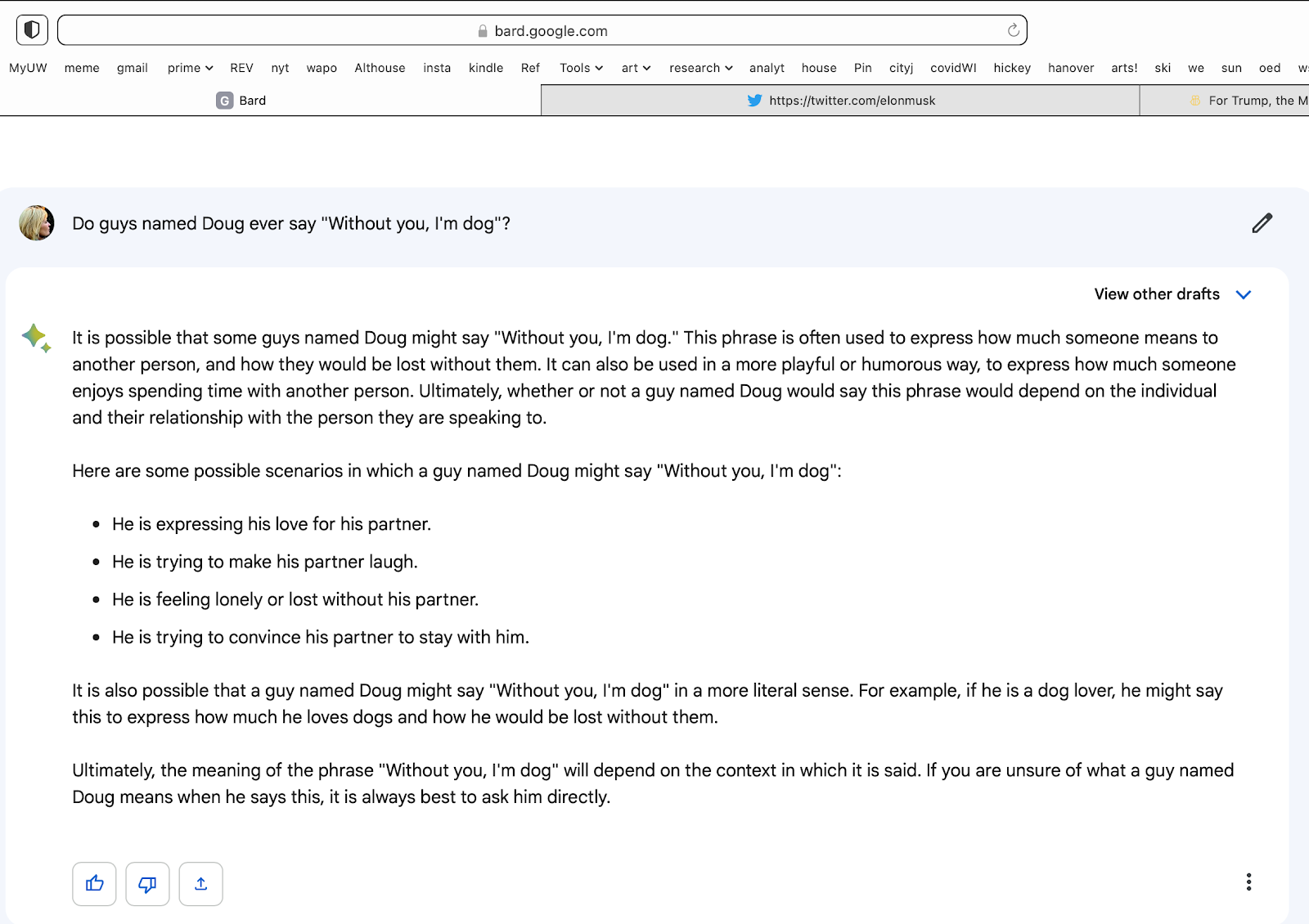
I don't know know whether to be afraid of AI. I observe from a distance and occasionally dip into it whimsically, like this:


Clearly, AI can't keep up with me, but that doesn't mean I shouldn't worry. The whole world is drifting somewhere I won't understand.

ADDED: Having tried Bard, I gave ChatGPT a chance:

May 26, 2023

"Grimes is enlisting free labor - potentially thousands of people, and a lot of them children - to make music with various aspects of her likeness, under the guise of a creative endeavor..."

"... and the chance to 'work with Grimes.' In reality, she's a burgeoning CEO in the midst of building a virtual sweatshop, something companies have been doing for eons, except now it appears this artist wants to give it a try. For example, not long ago she brought up taking 50% of the royalties of some of the more popular songs made with her likeness. And, just now in this article, she's playfully bringing up taking one of the AI-sampled songs someone made, and making her own version. She has all the right in the world to do it, but it's not a revolution I would like to see, and I don't understand why this would be something to praise."

Here's a page full of the labor of artists using Grimes AI and competing for a $10,000 prize.

Here's one example that was embedded over at the NYT and commented on by the true winner of this game, Grimes:


She said: "I love how weird this song is — it sounds really inhuman.... You can hear the technology very profoundly. What I like about the early A.I. stuff is that you can hear the technology very profoundly. I think people will appreciate that more in five years when they realize people only made stuff like this for a couple months."

So don't worry. This seems inhuman, but later AI will seem human. You'll be nostalgic for this in the future. You'll think something like: Remember when what was inhuman felt sweetly and tragically inhuman? We've lost touch with the poignancy that was the inhumanity of early AI. It's all just uniformly "human" now.

April 27, 2023

"The last time the Supreme Court decided whether a work produced using a machine was eligible for copyright was in 1884."

"The case involved a photograph of Oscar Wilde taken by Napoleon Sarony. Rejecting the view that photographs were simply mechanical reproductions, the court recognized that they are 'representatives of original intellectual conceptions of the author.' That is, the author of a photograph is its originator, or the person who 'represents, creates, or gives effect to the idea, fancy, or imagination.'... Had the court excluded photography from copyright, it would not have flourished as profession or art.... This isn’t to suggest that AI-prompted works should be broadly protected. To the extent that creators use common prompts to generate similar images, the scope of copyright should be very thin, to protect against verbatim copying. But there is a big difference between a thin copyright and no copyright at all. Unfortunately, the Copyright Office’s new policy hurts American creators... [who] will bear the brunt of the office’s newfound duty to disclose AI-generated works — and to expressly exclude such works from copyright...."

Writes lawprof Edward Lee, in "A terrible decision on AI-made images hurts creators" (WaPo).

Here's that photograph of Oscar Wilde:

>

From the Metropolitan Museum:

April 11, 2023

"The average person who’s looking at this stuff, I don’t think they care. I don’t expect the person I’m looking at online to be the person they say they are."

"I’m not going to meet this person in real life... At the end of the day, if they’re not real, who really cares?"

Said an unnamed AI user, quoted in "'Claudia’ offers nude photos for pay. Experts say she’s an AI fake. Will users feel ripped off as image-generating AI tools fuel a new wave of porn and scams?" (WaPo).

Isn't it better if real human beings are not used in making porn? 

"[W]ho really cares?" I suppose some people care, just like you might care if a movie has real-life stunts or CGI animation. You like thinking that somebody really did that.  

A separate problem is "inpainting," which works the face of a real person onto the AI-created body.

March 29, 2023

The annoying use of "you" in headlines these days is especially annoying when they assign mistakes to you that you haven't made.

I found this one especially irksome: "Why You Fell for the Fake Pope Coat/The pope didn’t actually wear that great jacket, but a lot of people were ready to believe he did" (The Atlantic).

I didn't think this really happened, did you? The Atlantic article explains "why" something that didn't happen — my falling for the fake Pope coat — happened and offers to help me not make such non-mistakes in the future. I haven't read the advice about not falling for AI-generated images because, on my own, I'm experiencing and developing skepticism and powers of observation and common sense.

In the case of the Pope's coat, it's way overdetermined that he didn't wear that. The Pope is unlikely to ever be anywhere so cold that a coat like that would even be comfortable. And if he was, he'd have to wear more of a hat than his usual minimal beanie, and he would need mittens. The source photo had to be taken indoors, probably on a fashion runway. And it screams "fashion." And the Pope never wears things that speak of fashion. It's always only traditional garb. Finally, what's he carrying? A water bottle? The Pope is never going to hydrate while out walking. I'm sure he has people to provide him with water if he needs it, but he'd never dangle a plastic bottle from his fingertips.

February 7, 2023

I don't like seeing Elon Musk flaunting this kind of hostility.


ADDED: Musk's tweeting this is ambiguous. He could mean I am this person. But he could mean Guys like this are pathetic and dangerous. Presumably, he intends the ambiguity. And the simplest interpretation is that he wants us to heat up Twitter with debate about what the hell this means. 

January 30, 2023

"Perhaps it’s unreasonable to expect the free version of a 2022 AI to be able to discuss heady philosophies of personhood and the nature of sentience..."

"... when it probably has little claim to either. Still, Rachael seemed perhaps too ready to be non-committal, to change the subject, or to give a vague, generic, universally-appropriate answer to questions which really demanded more...."

Writes Phil Rhodes in "The melancholy experience of making an AI friend" (Red Shark).

I'm reading this after writing about my desire for an AI app that would  engage me in philosophical conversations. I said I wasn't looking for "a companion to stave off loneliness or make me feel good about myself — e.g., Replika." 

But Rhodes's "Rachael" does come from the app Replika. He writes:

January 28, 2023

"That... section was tough not just because I didn't know WTF [that one word] was, but because it gets really tight in there..."

"... and there are only a few clues to help you out with [that word], and those are either cross-referenced or vague."

Writes Rex Parker, about today's NYT crossword, about what was the last word I got. Maybe you haven't done the puzzle yet, so I'm putting a page break before the spoilers, but what follows is of interest even if you don't do the puzzle: