From "Why One Artist Transcribed All 900-Plus Pages of ‘Moby-Dick’ by Hand/For Bethany Collins, Herman Melville’s novel is rife with centuries-old political anxieties that still resonate today" (NYT).
March 4, 2026
"For four months... the Chicago-based artist Bethany Collins woke up every day before dawn, brewed coffee and sat down at her dining table to copy out Herman Melville’s 'Moby-Dick' (1851) with a nib pen."
From "Why One Artist Transcribed All 900-Plus Pages of ‘Moby-Dick’ by Hand/For Bethany Collins, Herman Melville’s novel is rife with centuries-old political anxieties that still resonate today" (NYT).
February 25, 2026
"The first duty in life is that we all strike a pose... I struck a pose, I put a mask on, and at times my face grew into it, becoming someone I couldn't even recognize.""
Newsom attributes the line —"The first duty in life is that we all strike a pose, and the second duty no one's really figured out" — to Oscar Wilde.Two-faced California Governor Gavin Newsom says that he's been wearing a "mask" for years.
— RNC Research (@RNCResearch) February 25, 2026
NEWSOM: "I put a mask on, and at times my face grew into it…"
What a strange, little man. pic.twitter.com/HawZxCDqk6
November 29, 2025
"I write fiction because it’s a way of making statements I can disown, and I write plays because dialogue is the most respectable way of contradicting myself."
[In] Travesties (1975)... Lenin, the Dadaist Tristan Tzara and James Joyce meet in Zurich during the First World War and become involved in a production of The Importance of Being Earnest.
March 27, 2024
"Trump is America’s biggest comedian. His badinage is hardly Wildean, but his put-downs, honed to the sharpness of stilettos..."
Asks Fintan O'Toole, in "Laugh Riot/To understand Trump’s continuing hold over his fans, we have to ask: Why do they find him so funny?" (NYRB).
Maybe that's behind a paywall, and you can't read O'Toole's answer. Maybe you can answer his question on your own. I can't quote the whole thing.
April 27, 2023
"The last time the Supreme Court decided whether a work produced using a machine was eligible for copyright was in 1884."
August 12, 2022
"Written as though theft were something to be winked at. Bless this newspaper, which even in its decorating articles can't call a spade a spade."
Writes a commenter at the New York Times article, "The Lamp That’s Taking Over New York/A sleek newcomer, the Pina Pro, is appearing on droves of outdoor tables in the city — and sometimes disappearing, as diners fall for its mellow glow" ("At Altro Paradiso, a few lamps have mysteriously disappeared, Ms. Miller said. When the restaurant didn’t yet have one for every table, 'people would fight over them,' she added.")
"Rather than taking the chance of unintentionally offending someone or of being misunderstood, it is best to relinquish the old innocuous proverbial expression all together."
CECILY: "Do you suggest, Miss Fairfax, that I entrapped Ernest into an engagement? How dare you? This is no time for wearing the shallow mask of manners. When I see a spade I call it a spade."
GWENDOLEN: [Satirically.] "I am glad to say that I have never seen a spade. It is obvious that our social spheres have been widely different."
January 29, 2021
"The Conservative Case Against the Boomers/For bleakness, scope, and entropic finality, the progressive critique of the generation has nothing on the social-conservative one."
In the view of an increasingly prominent cohort of Catholic intellectuals, Americans have, in the long span of the boomer generation, gone from public-spirited to narcotized, porn-addicted, and profoundly narcissistic, incapable not only of the headline acts of idealism to which boomers once aspired, such as changing the relations between the races or the sexes, but also of the mundane ones, such as raising children with discipline and care....
[Conservative writer Helen] Andrews... sums up the boomer legacy: “Drugged up, divorced, ignorant, and indebted, but at least they did it out of idealism.” This story, at least the way Andrews tells it, is about the establishment of a new aristocracy, and she structures it through six stories of prominent boomers: Steve Jobs, Aaron Sorkin, Jeffrey Sachs, Camille Paglia, Al Sharpton, and Sonia Sotomayor.
January 19, 2021
"Are teens watching Pretend It's a City?" — asks Raphael Bob-Waksberg about the Martin Scorsese series — on Netflix — with Fran Lebowitz.
Raphael Bob-Waksberg is the comic writer associated with the animated Netflix show "Bojack Horseman." I have read and enjoyed his story collection "Someone Who Will Love You in All Your Damaged Glory." I follow him on Twitter, and I loved his question. I've watched the Fran Lebowitz series, and I'm the same age as she is (and lived in the NYC in the 70s and 80s), so I liked it, but what about these kids today?Are teens watching Pretend It's a City? Have the alternative teens discovered Fran Lebowitz? I feel like for a particular sort of high schooler this show could be It Exactly - a key into a different kind of being: "Oh, I'm That." If you are a teen or know a teen, please report.
— Raphael Bob-Waksberg (@RaphaelBW) January 19, 2021
I clicked around and found this:alternative teens discovered her a'ight pic.twitter.com/cJ7lUd9v3G
— ☹☹⌛⌛⚰⚰♻♻ (@zaws) January 19, 2021
I love Fran Lebowitz too... & I would love to be simply excited for this new netflix thing but I have some awfully depressing news... Fran Lebowitz is a TERF! I know this because in this 2010 documentary about Candy Darling, Beautiful Darling, Lebowitz articulates the TERF position just about as explicitly as you can--that Candy isn't a woman, but a man tragically and fetishistically fixated on womanhood.... I suppose I am bringing it up because, as usual, it's that thing where an older cis lesbian has been just about as explicitly hateful towards trans people as you can be, but because she's an elder or whatever we're all pretending that never happened....
TERF = trans-exclusionary radical feminist.
You can watch the entire documentary "Beautiful Darling" here, but I'll just embed the trailer, which begins with Lebowitz talking about Darling:
November 11, 2020
"She likes jokes. She likes the one David Hockney told her once. It goes: 'The trouble with Van Gogh is if you tell him something it goes in one ear and stays there.'"
Was Hambling's tribute to Oscar Wilde more respectful? He's rising out of a tomb.Genuine question: Why present Mary Wollstonecraft as naked?
— Aunty Malorie Blackman (@malorieblackman) November 10, 2020
I’ve seen many statues of male writers, rights activists and philosophers and I can’t remember any of them being bare-assed. https://t.co/CNUmBgzldD
May 10, 2020
"Oh, but they're weird and they're wonderful."
... and I'm just seeing and being surprised that "weird and wonderful" is, officially (according to the OED) a colloquial phrase. A couple posts down, I got embroiled in the subject of what "weird" means and what's up with the people who overuse the word "weird," and I ran into this other subject that needed its own post.
The colloquial phrase "weird and wonderful" means — according to the unlinkable OED — "marvellous in a strange or eccentric way; both remarkable and peculiar or unfathomable; exotic, outlandish. Frequently ironical or derogatory."
1886 O. Wilde in Pall Mall Gaz. 1 Feb. 5/1 There is psychology of a weird and wonderful kind.This is news to me. I don't think it's a colloquial phrase in America. Or maybe it is, and I just hadn't noticed.
1908 T. E. Lawrence Let. 9 Aug. in Home Lett. (1954) 70 Their food is weird and wonderful....
1978 S. Naipaul North of South ii. vi. 227 A weird and wonderful place is Jo'burg.
From the NYT in just this past year: "a weird and wonderful coincidence," "her weird and wonderful new play," "Weird and wonderful plants are tumbling into gardens," "weird and wonderful obsession with her kids’ effluvia," "weird and wonderful supporting characters, including a sex-crazed elderly woman next-door neighbor," "an ordinary childhood that... could only come across as weird and wonderful," "a skin-contact, amphora-aged zibibbo from South Australia that’s as weird and wonderful as wine gets," etc.
That's how I tested colloquialness, and I guess the answer is... well, what makes a colloquial phrase? You can't have separate dictionary entries for every set of words that get put together with some frequency. Is "wild and wonderful" a colloquial phrase? Is "wonder of wonders"? Is "colloquial phrase" a colloquial phrase?
September 25, 2018
The CNN headline says "Toobin calls out Kavanaugh's 'weird' interview."
According to Toobin, Kavanaugh disrupted the usual appearance of nonpartisanship for Supreme Court nominees by going on Fox News, AKA "Republican television." That's what's "weird"! "Go on the 'Today' show, go on '20/20'" he advised. I'd say what's weird is the pretense that anyplace is neutral.
What does "weird" mean anyway? Originally, "weird" was a noun that meant fate or destiny or someone with the power to control destiny. As an adjective, it meant having the power to control fate. Think of the "weird sisters" in "MacBeth."
In the 1800s, the meaning becomes "Partaking of or suggestive of the supernatural; of a mysterious or unearthly character; unaccountably or uncomfortably strange; uncanny" (OED). The poet Shelley wrote, "Some said, I was a fiend from my weird cave, Who had stolen human shape." And then it was "Out of the ordinary course, strange, unusual; hence, odd, fantastic." There was Charles Dickens writing, "He was a man with a weird belief in him that no one could count the stones of Stonehenge twice, and make the same number of them."
The OED recognizes the colloquial phrase "weird and wonderful" — meaning "marvellous in a strange or eccentric way; both remarkable and peculiar or unfathomable; exotic, outlandish. Frequently ironical or derogatory." Oscar Wilde wrote, "There is psychology of a weird and wonderful kind." And T. E. Lawrence wrote, "Their food is weird and wonderful." This intrigued me. "Weird and wonderful" is a standard phrase. I'll never hear "Bennie and the Jets" the same way again:
Oh, but they're weird and they're wonderful
Oh, Bennie, she's really keen
She's got electric boots
A mohair suit
You know I read it in a magazine
B-B-B-Bennie and the Jets

Oh, but he's weird and he's wonderful/Jeffrey Toobin is really keen/He's got electric news/Contemptuous boos/It's the best news I've ever seen....
July 1, 2018
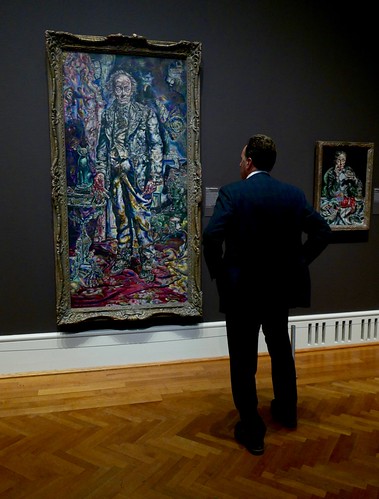
"The Picture of Dorian Gray."

At the Art Institute of Chicago, a man stops to look at "The Picture of Dorian Gray," a painting by Ivan Albright that was used in the 1945 movie version of the Oscar Wilde book.
Here's the fantastic scene in the movie when the portrait is revealed. The pacing, the music, and the sudden use of color in a black and white movie make the revelation surprisingly visceral, even though you know what you are going to see.
From the book:
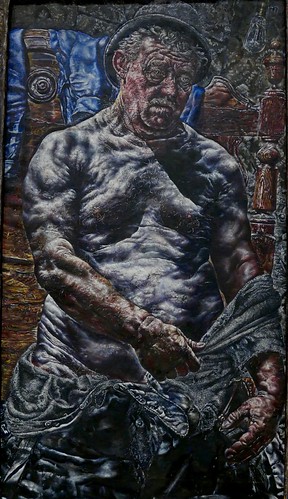
“Years ago, when I was a boy,” said Dorian Gray, crushing the flower in his hand, “you met me, flattered me, and taught me to be vain of my good looks. One day you introduced me to a friend of yours, who explained to me the wonder of youth, and you finished the portrait of me that revealed to me the wonder of beauty. In a mad moment, that, even now, I don’t know whether I regret or not, I made a wish, perhaps you would call it a prayer.... It has destroyed me.”ADDED: The painting is not properly viewed as a "movie prop," as one commenter puts it. At the Art Institute there was a special exhibit devoted to Albright (titled "Flesh"). Here's one of the most striking paintings (from 1930/1931), "And God Created Man in His Own Image":
“I don’t believe it is my picture.”
“Can’t you see your ideal in it?” said Dorian, bitterly.
“My ideal, as you call it....”
“As you called it.”
“There was nothing evil in it, nothing shameful. You were to me such an ideal as I shall never meet again. This is the face of a satyr.”
“It is the face of my soul.”
“Christ! what a thing I must have worshipped! It has the eyes of a devil.”
“Each of us has Heaven and Hell in him, Basil,” cried Dorian, with a wild gesture of despair.

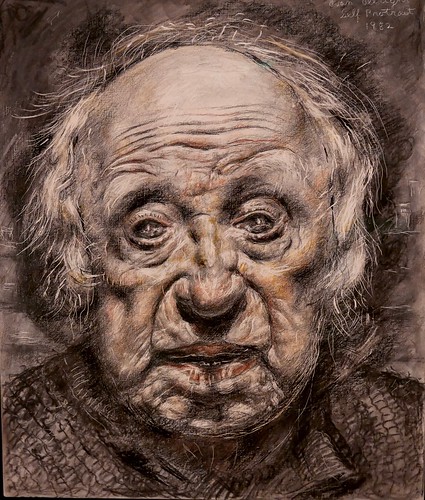
There was also a collection of self-portraits, including this one from 1982:
February 4, 2018
Alec Baldwin may be Donald Trump's "Picture of Dorian Gray."
I made a few screen shots of Baldwin to show you what I mean:
And here's a Time photo essay illustrating the proposition that Presidents age quickly. I'm not saying that President Trump looks young, only that he's staying the same, even as the Trump Presidency wears away poor Alec.
January 7, 2018
“I have nothing to declare except my genius" — said Oscar Wilde.
So I wouldn't be so sure I knew "How Actual Smart People Talk About Themselves." That's the title of a piece at The Atlantic by James Fallows, who's implicitly talking about himself, implicitly assuring us that he is a smart man who knows the smart people. That is, he is one of the elite who got snookered in the last election.
But the people Fallows talks about in his article are scientists and computer people. Wilde was a brilliant humorous writer, famous, especially, for short, hilarious sentences. Trump is much more like Wilde than like Bill Gates and that guy who won the Nobel Prize in medicine when he was in his 40s.
Here's Fallows:
Virtually none of them (need to) say it. There are a few prominent exceptions, of talented people who annoyingly go out of their way to announce that fact. Muhammed Ali is the charming extreme exception illustrating the rule: he said he was The Greatest, and was. Most greats don’t need to say so....Once you admit there's an exception, you've got to say Trump is not like the exception. But Trump is like Muhammad Ali. He's making his reputation in large part by speaking entertainingly to the public. And, like Oscar Wilde's declaration of genius, Ali's proclamation of greatness felt like exuberant, extroverted fun to those who loved him. What Trump is doing feels like that too. If you hate Trump, you'll balk at that, but you need to know that there were many people who reacted negatively to Ali's "I am the greatest." I remember it very well, because I loved "I am the greatest" at the time, and I remember why I loved it. It was liberating. You could throw off your inhibition and proclaim your greatness.
September 13, 2017
"I have grown to love secrecy. It seems to be the one thing that can make modern life mysterious or marvellous to us."
Wrote Oscar Wilde, in "The Picture of Dorian Gray" (1890).
July 10, 2017
"It would be easy to mock David Mamet for his decision to slap a $25,000 fine on theatres that stage post-play discussions of his work."
Writes Michael Billington, who nevertheless finds it "absurd" to threaten theaters with "punitive financial sanctions." I think Billington is being overdramatic. Mamet grants permission to stage his plays and he imposes conditions. If theaters don't like the conditions, they can pick another play. The cost of violating the conditions needs to be adequate to deter flouting them.
Billington says, "Mamet’s status and integrity as a writer is not being undermined with post-show talks."
First, Mamet doesn't need to prove that there's something objectively wrong with post-show talks. He's the artist, and he's determining how he wants his play shown. He could even have a preference for something that would undercut his "status and integrity." For example, he could say you must perform the entire text, even if the play has a long boring speech in the middle that doesn't advance the plot.
Second, it's actually easy to see how a post-show talk could undermine his status and integrity. The playwright could prefer that the members of the audience exit the theater with his words and his words alone gestating in their heads. The discussion session is another performance after the play, and its words — more pedestrian and outside of the playwright's control — will crowd his carefully chosen words. Worse, the discussion purports to explain and interpret the playwright's words, so it will change how they grow and flourish in the mind of the playgoer. It's also likely — as the 1985 quote indicates — that the discussion will fixate on some issue, and the play will be reduced to an example of a current social problem. It's a diminishment masquerading as an expansion.
By the way, I once participated in an after-play discussion. It wasn't my idea, but I was invited to do it because of my status as a law professor and the play had a legal theme. The play was "Gross Indecency: The Three Trials of Oscar Wilde." I hated the assumption that I was there only to supply legal analysis, and I got myself extremely well informed about Oscar Wilde before doing it. Watching the play, I had loads of things to talk about, but the actual discussion, in my view, was unsatisfying. There's far too much going on in a work of art to discuss on a level that belongs on the very stage where the play just happened.
In this view, I could see a playwright demanding that there be no curtain call.
April 18, 2017
"It pains me to say it, but I am a failed artist. 'Pains me' because nothing in my life..."
So begins "My Life As a Failed Artist" by the art critic Jerry Saltz.
I like the part when he looks at his old work — it's a long series illustrating Dante's "Divine Comedy" — decides it's "fabulous!," then gets his wife, who's also an art critic, and she looks at the stuff for a long time, and says it's "okay." He's all: “Okay?! What do you mean ‘okay’? I think they’re beautiful. Aren’t they great?”
She turned back to the drawings, looked a little longer, and finally said, “They’re generic. And impersonal. No one would know what these are about. And what’s with the triangles? Are they supposed to be women?” I shot back, “No! They’re Hell!”There must be at least 10 cleverer ways to answer the question "what’s with the triangles — Are they supposed to be women?" without losing the idea that the triangles were Hell. Why aren't we getting better repartee from Saltz? He's an art critic, he's being self-deprecating, and he quotes Oscar Wilde repeatedly:
Oscar Wilde said, “Without the critical faculty, there is no artistic creation at all.”...
[Wilde] wrote that art that’s too obvious, that we “know too quickly,” that is “too intelligible,” fails. “The one thing not worth looking at is the obvious.”...
Wilde also wrote that “the vague is always repellent.”...
Wilde [wrote] “All bad poetry... springs from genuine feeling … It is with the best intentions that the worst work is done.” ... [H]e also wrote, “Criticism demands infinitely more cultivation than creation does.”
April 2, 2016
The treadmill.
The picture comes from the Wikipedia article on treadmills, which I was reading because my son John had done a Facebook post linking to a Forbes article that displayed like this...
... and I thought it was a sad sign of the times that the idea of "relaxing and rejuvenating activities" was illustrated by a person running on a treadmill. A treadmill was once a very clear symbol of drudgery.
I was looking for a video clip from the movie about Oscar Wilde that showed him on the prison treadmill — this kind of treadmill....
... and I didn't find it, but searching for Oscar Wilde + treadmill got me to this:
January 13, 2016
Trouble in "Serial" land?
“There are more paths we need to go down,” [said executive producer Julie Snyder.] “Since we started broadcasting the show, we have gotten more people willing to talk, and because of that, it has opened up more avenues of reporting.” She declined to comment on whom those interviews were with, or what additional reporting the show needed to pursue. “We have narrative developments,” she said. “I hesitate on calling them news developments.”There's also the fact that the show is not doing as well as the last season, the one about an imprisoned man and a murder we'd never heard of. Shifting to Bergdahl is telling us about somebody we already knew and had already, perhaps, processed into a kind of oblivion. Did we really want to pull him back into our attention and, week by week, hour by hour, take some differing complicated perspectives on him?
The characters in both seasons are mysterious men. We can wonder who is this guy? But in season 1, there was the solidity of knowing a young woman really was murdered and a young man really was suffering the punishment, and the mystery was whether he's the murderer. In season 2, we know the external reality of what the man did. That part is solid. The mystery lies in why he did it and what it meant to him. He's not been punished yet (though we might decide his suffering in captivity was punishment enough, so let's leave him alone). It lies in the future, what the legal process will give him. His mental state will play some part in that determination. But we'll see that unfold in the news as his trial proceeds.
Why would we want the alternative viewings of the mind of Bergdahl as managed and manipulated by the "Serial" crowd? I think the answer should be: Because there's a fascinating, delicate art to the the "Serial" presentation. But when art is about real-life facts subject to dispute, especially about current events, there's a lot of static between you and the artist. It can make you want to turn the dial to another channel.
ADDED: Saying that about art made me think about this, a quote from David Bowie that I'd read earlier this morning on Facebook. You can see that I commented over there, linking to the comments section of an old post of mine in which my ex-husband quoted Oscar Wilde: "Views are held by those who are not artists." That old post, by the way, links to 2 other posts, one of which quotes me quoting myself in my own comments section — recursive enough for you? — saying something about Bob Dylan that caused an uproar back in 2005: "To be a great artist is inherently right wing...." Lots of my current husband in the comments there, 4 years before I met him, talking about Bob Dylan, saying things like: "I thought Ann's quote was very smart - nearly brilliant" and "Seriously, with her aversion to politics and her ability to tweak the self-satisfaction and dogmatism of diverse groups, don't you agree that AA just might be the '66 Dylan of this new blogging medium, albeit sober? She is clearly an inspired artist hitting her stride."
January 8, 2016
"Transfer of emotion" — the "practiced salesman’s term for the magical moment when a consumer becomes one with a garment he has just met."
It would understate things to say that an emotional transfer kicked in when I put on the sleek two-button suit, whose details — pick-stitched lapels; deep double vents; waist adjusters (to eliminate a belt’s bisecting ugliness); a superfluous yet appealingly anachronistic ticket pocket — contributed to the spell.... Seldom have I felt more like money than I did while riding the R train to work on the morning I took the suit for its test ride, or when sluicing through the Times Square mobs and Elmos wearing Mr. Lauren’s $5,995 suit....A very interesting experiment, well described. And I really loved this quote from Oscar Wilde: "Fashion is a form of ugliness so absolutely unbearable that we have to alter it every six months!"
That had me searching my Kindle version of "Complete Works of Oscar Wilde" for the word "ugliness." I happened upon this interchange in "The Picture of Dorian Gray":
“How can you say that? I admit that I think that it is better to be beautiful than to be good. But on the other hand no one is more ready than I am to acknowledge that it is better to be good than to be ugly.”
“Ugliness is one of the seven deadly sins, then?” cried the Duchess....
“Ugliness is one of the seven deadly virtues, Gladys....”
>