Perfection. pic.twitter.com/Gurj0l8nJn
— Savage (@SavageSports_) January 29, 2026
Showing posts with label The Monkees. Show all posts
Showing posts with label The Monkees. Show all posts
January 29, 2026
At least he's in the Injustice Hall of Fame.


September 26, 2025
"Assata Shakur, the Black revolutionary once known as JoAnne Chesimard... died on Thursday in Havana. She was 78...."
"Assata Shakur was both lionized and demonized long after she and the Black Liberation Army, the militant group she had embraced, faded from broad public consciousness. To supporters she was a tireless battler against racial oppression. To detractors she was a stone-cold cop killer, the first woman to land on the F.B.I.’s 'most wanted terrorists' list, with $2 million in state and federal money offered for her capture. For her part, Ms. Shakur regarded herself as 'a 20th-century escaped slave.'..."
September 15, 2025
"The two young men came up with the Monkees’ theme music on a walk to the park, and they developed a friendly but savvy relationship with the actors."
"They realized, for example, that by recording each member of the Monkees singing individually, they could avoid the actors horsing around and trying to impress one another. Musically, Mr. Boyce and Mr. Hart struck a fine balance between several imperatives. Study the Beatles, but don’t imitate them to the point of absurdity; catch the spirit of the ’60s in the use of Indian instruments and lyrics about 'the young generation,' but don’t be too challenging. Some veteran producers became frustrated trying to make the Monkees into a real band and gave up. Mr. Boyce and Mr. Hart persisted. 'To us,' Mr. Hart wrote, 'it was the chance of a lifetime.' Robert Luke Harshman was born on Feb. 18, 1939, in Phoenix. Bobby formed a lifelong relationship with the Hammond B-3 electric organ by playing it in the Pentecostal church his family attended...."
From "Bobby Hart, Who Helped Give the Monkees Their Music, Dies at 86/The hit songwriting duo he and Tommy Boyce formed in the 1960s was best known for the unexpectedly popular tunes of a made-for-TV band" (NYT).
From "Bobby Hart, Who Helped Give the Monkees Their Music, Dies at 86/The hit songwriting duo he and Tommy Boyce formed in the 1960s was best known for the unexpectedly popular tunes of a made-for-TV band" (NYT).
March 29, 2025
"We’re pretty surprised, that’s for sure. She wasn’t even just like a dog; she was an absolute princess as well. She had a car seat, and she slept in our bed."
Said Georgia Gardner, 24, about her 1-year-old, 8-pound dachshund Valerie.
Gardner is quoted in "Tiny dachshund survives 16 months on remote island but eludes rescuers/Her owners call her a 'princess.' But little Valerie has likely toughened up, says the wildlife group looking for her, living off roadkill and evading poisonous snakes" (WaPo)(free-access link, so you can see the pictures and read the thrilling details).
A song for Valerie:
And:
March 8, 2024
"In perfect sync with his much-hyped generation, Keith... adored the Monkees more than the Beatles and was briefly a Jesus freak...."
"Haring may have out-Warholed Warhol, a mentor and collaborator, in enjoying celebrity friends.... But he was less cool than hot, eager and earnest: handing out free buttons and selling cheap merch at his prescient Pop Shop but fretting about his place in the canon and firing off indignant letters to editors. Time magazine’s influential critic Robert Hughes emerges here as a particular Joker to his Batman, likening Haring and his friend Jean-Michel Basquiat to 'those two what’s their names on "Miami Vice"' and calling them 'Keith Boring' and 'Jean-Michel Basketcase.' (Good lord!)..."
ADDED: The New Yorker article is "Keith Haring, the Boy Who Cried Art/Was he a brilliant painter or a brilliant brand?" Excerpt:
July 24, 2023
June 13, 2023
This morning on Twitter, Alice Cooper is trending....
ADDED: I think Alice Cooper is trending because "Johnny Depp was mobbed by fans as he and Alice Cooper stepped out in Istanbul, Turkey ahead of their gig with their band Hollywood Vampires as part of their live tour on Monday" (Daily Mail).Alice Cooper is trending…. So here is Alice, me and Groucho Marx.#AliceCooper pic.twitter.com/BM8iEfvNTu
— Micky Dolenz (@TheMickyDolenz1) June 13, 2023
August 30, 2022
"When the Monkees launched their inaugural tour in 1967, they played to throngs of screaming teenagers – and at least one FBI informant."
"'During the concert, subliminal messages were depicted on the screen which, in the opinion of [informant’s name redacted], constituted "left wing intervention of a political nature,"' reads a document in the Monkees FBI file. 'These messages and pictures were flashed of riots, in Berkley, anti-U.S. messages on the war in Vietnam, racial riots in Selma, Alabama, and similar messages which had unfavorable response[s] from the audience.' This tiny portion of the band’s FBI file was released to the public a little over a decade ago, and now Micky Dolenz, the group’s sole surviving member, has filed a lawsuit against the FBI... hoping to see the rest of the file after failing to get his hands on it via a Freedom of Information Act request.... 'The Monkees reflected, especially in their later years with projects like [their 1968 art house movie] Head, a counterculture from what institutional authority was at the time,' [said Dolenz's lawyer.] 'And [J. Edgar] Hoover’s FBI, in the Sixties in particular, was infamous for monitoring the counterculture, whether they committed unlawful actions or not.'"
December 19, 2021
"I don't wanna minimize — denigrate — Mike's talent, but I had a money machine rolling."
The quote in the headline appears at 17:00. "Mike" is the late Mike Nesmith.
This is a really interesting documentary presentation of The Monkees story. They were so troubled by the line between real and fake. It may be a little hard for people of today even to grasp how truth was at stake. They were real actors, doing a real comedy show, and they really sang. Why the angst?!
ADDED: At 18:05: "And I walked in with a song I really believed in, called 'Sugar, Sugar.'"
December 10, 2021
"With infinite love we announce that Michael Nesmith has passed away this morning in his home, surrounded by family, peacefully and of natural causes."
Said the family, quoted in "Michael Nesmith, Monkees Singer-Songwriter, Dead at 78" (Rolling Stone).
“This being, ‘What is this thing? What have we got here? What’s required of us? Is this a band? Is this a television show?’ When you go back to the genesis of this thing, it is a television show because it has all those traditional beats. But something else was going on, and it struck a chord way out of proportion to the original swing of the hammer. You hit the gong and suddenly it’s huge.”
I thoroughly loved The Monkees. I remember reading about the show before it began and awaiting it eagerly. I remember when Mike Nesmith was called "Mike Wool Hat Nesmith" — as if he was too hard to identify without the added attribute of the hat and the continual pointing out of it. I remember he was, essentially, the John Lennon of the group, sarcastic and a little mean.
I still listen to The Monkees and too much time has passed to put them down, even if, long ago you did put them down, when they were too busy singing to put you down. They came up in my playlist as I was sunrise-running this morning: "I'm Not Your Stepping Stone."
Here are The Monkees — the Monkees then still living — last month:
And now there's one Monkee left — our dear Circus Boy:
February 21, 2019
March 12, 2018
"The little girls started screaming: 'We want Davy; we want the Monkees'... You could almost see the little girls asking their mothers: 'Mom why is that man setting his guitar on fire.'"
Mickey Dolenz, playing in Greenwich Village last Saturday, delivered patter about the time the Monkees on tour had Jimi Hendrix as their opening act. And then Mickey and his current band played "Purple Haze."
The band last Saturday included Mickey's sister Coco, who sang"Daydream Believer" "I'm a Believer" with him — that song (which was written by Neil Diamond) had the late Davy Jones originally singing the lead — and Coco took on the erstwhile role of Linda Ronstadt in a version of "Different Drum" and the Grace Slick part in "White Rabbit":
Here's Coco in 1967, as photographed in Fave:

I think Fave was a spin-off from Tiger Beat. First issue:

ADDED: I tried to find "Davy's Private Glads & Sads!" but Google has a better memory of the the mid-19th century:
The band last Saturday included Mickey's sister Coco, who sang
Here's Coco in 1967, as photographed in Fave:

I think Fave was a spin-off from Tiger Beat. First issue:

ADDED: I tried to find "Davy's Private Glads & Sads!" but Google has a better memory of the the mid-19th century:
December 4, 2017
"In this vast and troubled world, we sometimes lose our way, but I am never lost/I feel this way because...."
"It was Mr. Margo’s idea for the Happenings to do an up-tempo version of the Gershwin brothers’ 'I Got Rhythm,' his nephew Noah Margo said. The record reached No. 3 on the Billboard singles chart in 1967."
That's from the NYT obituary: "Mitch Margo, an Original Member of the Tokens, Dies at 70." You think of The Tokens — if you think of them — as the group that did the much-loved early-60s song "The Lion Sleeps Tonight." But I see that The Tokens went on to produce records for The Chiffons, Randy and the Rainbows, and Tony Orlando and Dawn. Mitch Margo was one of the producers on the sublime Chiffons hit "He's So Fine." *
And I know the most famous Randy and the Rainbows song without looking it up: "Denise." That also seems to have been produced by The Tokens (under the production company name Bright Tunes). "Denise" was redone in 1978 by Blondie as "Denis," which — apart from the masculinization of the love interest — aurally copies the Randy and the Rainbows version, though the visual effect is quite different:
Denis Denis, oh with your eyes so blue/Denis Denis, I've got a crush on you...
And Mitch Margo wrote "Laugh," the Monkees song, and "Slow Dance," which, we're told, The Carpenters released in 1989.
Speaking of dying, did Karen Carpenter survive to the year 1989? No, she died in 1983. But you can listen to the song while looking at video of Karen slow dancing with her brother Richard, here.
If that's too sad, here's "Laugh," replete with way-too-frenetic Monkees antics.
___________________
* "He's So Fine" was written by Ronnie Mack. You know that song "Jimmy Mack" — "Jimmy Mack, when are you coming back?" — which seems to be about a boyfriend who's staying away too long, was inspired by Ronnie Mack, who had died of Hodgkin's lymphoma when he was only 23.
Jay Siegel of the Tokens later said of Mack's songs: "They had the most incredible lyrics; not intellectual lyrics, but just the things that people speak of in everyday language. Most people don't have the talent to write them down as music, but he did.... [Had he lived] he...would have been one of the most successful songwriters of the '60s."
April 18, 2017


January 19, 2017
Just got totally distracted into the subject of songs about magazines.
In the comments to the first post of the day, we were talking about the line "We can try to understand/The New York Times' effect on man" which appears in a NYT video about people doing an exercise routine in the Metropolitan Museum of Art. I said:
2 songs that had popped into my head were not on the list: "Bennie and the Jets" ("She's got electric boots a mohair suit/You know I read it in a magazine"). And "Darling Nikki" — the song that upset Tipper Gore — rhymes "magazine" with "a sex fiend":
Then I found this Guardian article that for no apparent reason had already fixated on the topic and put together a playlist of 55 songs.
It has one song that should have popped into my head, one of my all time favorite songs, "(I'm Not Your) Steppin' Stone":
You're reading all those high fashion magazines/The clothes you're wearin' girl are causing public scenes...
I love the contrast between the "public scenes" in those 2 videos.
Here's a discussion of the line... [in the] book "Hot Stuff: Disco and The Remaking of American Culture"... "Presumably [the Bee Gees] were trying to fit in a reference to the city and convey something about upward mobility. But these are such inelegant, head-shaking lines that for years critic Dave Marsh, eager for more class-conscious lyrics, misheard them as 'We can try to understand / The New York Times don't make a man.'"But is the word "magazine" hard to work with? Magazine is kind of a great set of syllables. And magazines stir up so many aspirations and desires. Why wouldn't you write a song with the word "magazine"?
The author of the book observes that the movies shows the NYT delivered each morning to the female character. I would add — based on decades-old memory of ["Saturday Night Fever"] — that the NYT represented the NYC that the characters — who lived in seedy 70s Brooklyn — dreamed of reaching some day and the characters do make it to Manhattan in the end.
The movie was based on a New York Magazine article "Tribal Rites of the New Saturday Night." Maybe the NYT is mentioned in the song because "Times" scans better than "Magazine."
2 songs that had popped into my head were not on the list: "Bennie and the Jets" ("She's got electric boots a mohair suit/You know I read it in a magazine"). And "Darling Nikki" — the song that upset Tipper Gore — rhymes "magazine" with "a sex fiend":
Then I found this Guardian article that for no apparent reason had already fixated on the topic and put together a playlist of 55 songs.
It has one song that should have popped into my head, one of my all time favorite songs, "(I'm Not Your) Steppin' Stone":
You're reading all those high fashion magazines/The clothes you're wearin' girl are causing public scenes...
I love the contrast between the "public scenes" in those 2 videos.
September 8, 2016
50 years ago today: The TV show "Star Trek" premiered.
Lots of tributes and memories around the web today — links collected here.
I was extremely interested in new TV shows in 1966, but this one didn't reach me. I was more of a "Twilight Zone" person. I was up for science fiction, but I wanted more interesting ideas, more mysterious phenomena, not campy adventure. To see the same cast of characters in their tight-fitting outfits might have worked on me if I'd perceived Kirk or Spock as virtual boyfriends. But they were not. Too old. And their hair was too short. For cute boys, I was watching "The Monkees."
Here are the TV listings from half a century ago. "Twilight Zone" wasn't on anymore, but "The Monkees" were. I know I gave "Star Trek" a chance, but can see that it had to compete with "Bewitched." I'm sure I watched "Bewitched" (and "That Girl"). I'd still choose "Bewitched" over "Star Trek" if I had to watch one of them right now.
I was extremely interested in new TV shows in 1966, but this one didn't reach me. I was more of a "Twilight Zone" person. I was up for science fiction, but I wanted more interesting ideas, more mysterious phenomena, not campy adventure. To see the same cast of characters in their tight-fitting outfits might have worked on me if I'd perceived Kirk or Spock as virtual boyfriends. But they were not. Too old. And their hair was too short. For cute boys, I was watching "The Monkees."
Here are the TV listings from half a century ago. "Twilight Zone" wasn't on anymore, but "The Monkees" were. I know I gave "Star Trek" a chance, but can see that it had to compete with "Bewitched." I'm sure I watched "Bewitched" (and "That Girl"). I'd still choose "Bewitched" over "Star Trek" if I had to watch one of them right now.
April 9, 2016
"No, we’re not going to wrap this up — I’m going to wrap you up. You go sit down over there and learn something."
Said Steve Miller at the Rock and Roll Hall of Fame induction ceremony last night.
"This is how close this whole show came to not happening because of the way the artists are being treated...."What was his problem?
“The whole process is unpleasant.... They need to respect the artists they say they’re honoring, which they don’t.”It seems to be about money. He didn't like the licensing agreements for the TV show of the ceremony, and he didn't like the way the tickets were distributed:
“When they told me I was inducted they said, ‘You have two tickets — one for your wife and one for yourself. Want another one? It’s $10,000. Sorry, that’s the way it goes.... What about my band? What about their wives?”Who benefits from the Rock and Roll Hall of Fame? When an artist gets in, is he mostly giving or mostly getting? I guess it depends on the artist. Steve Miller was lucky to get in at all, wasn't he? Maybe they told him that — or suggested as much — when they drove the bargain. They have to put on a show every year, and I wonder if some people — like Miller — are brought in to fill out the concert and maybe they realize that they're second tier and treated as such. I mean, what is the process for getting in?
Janet Morrissey of The New York Times wrote, "With fame and money at stake, it's no surprise that a lot of backstage lobbying goes on. Why any particular act is chosen in any particular year is a mystery to performers as well as outsiders – and committee members say they want to keep it that way." Jon Landau, the chairman of the nominating committee, says they prefer it that way. "We've done a good job of keeping the proceedings nontransparent. It all dies in the room."...Here's some opinion on the Hall of Fame by Mike Nesmith (in the context of responding to the controversy over whether The Monkees, who are not in, should be):
I can see the HOF is a private enterprise. It seems to operate as a business, and the inductees are there by some action of the owners of the Enterprise. The inductees appear to be chosen at the owner’s pleasure.Yes, I know. He misspelled "stubs." He misspelled "stubs" and his mother invented Liquid Paper. If you look up Mike Nesmith in the modern "Dictionary of Received Ideas," you'll read one thing: His mother invented Liquid Paper. Liquid Paper, not Wite-Out. "Wite" isn't the right way to spell "white," you know. All the errors can be corrected later, so maybe you shouldn't worry about errors anymore. Mike Nesmith moved on after the metaphorical hurricane. He was living in a metaphorical mobile home, not the metaphorical record player designed by I.M. Pei — which is not a misspelling of I Am Pay — which was bankrolled — in part — by the needy people of Cleveland.
This seems proper to me.
It is their business in any case. It does not seem to me that the HOF carries a public mandate, nor should it be compelled to conform to one.
And that may be the rub.
The main argument afoot is that popularity and the history and the work should somehow provide the HOF not only a mandate but also validation that should compel and convince them/it, and also be enforceable.
That doesn’t seem like a good argument, but as I say – I don’t know. I rode out the hurricane in the mobile home that is all that is left standing while all about it are vacant concrete pads and stubbs of power lines.
November 8, 2014
This was going to be a comment on that post — one step down — about "Valerie," but it took on a life of its own.
Don't forget the old Monkees song, spelled a little differently: "Valleri."
According to Wikipedia, it was written because Don Kirshner thought the Monkees needed a "girl's name" song: "[Tommy] Boyce and [Bobby]Hart improvised 'Valleri' on their way to Kirshner's office, after pretending over the telephone that the song was already finished."
Lyrics here: "Valleri, I love my Valleri/There's a girl I know who makes me feel so good/And I wouldn't live without her, even if I could/They call her 'Valleri', I love my Valleri/Oh yeah, come on..."
Oh, yeah, come on, we're almost at Kirshner's! We need one more verse!
"She's the same little girl who used to hang around my door/But she sure looks different than the way she looked before...."
Oh, no! They went with the old too-young-girl-might-finally-be-old-enough theme. What do you expect two 29-year-old men under time pressure to write a girl's name song for a group of pseudo-teenage boys to sing about a teenage girl?
According to Wikipedia, it was written because Don Kirshner thought the Monkees needed a "girl's name" song: "[Tommy] Boyce and [Bobby]Hart improvised 'Valleri' on their way to Kirshner's office, after pretending over the telephone that the song was already finished."
Lyrics here: "Valleri, I love my Valleri/There's a girl I know who makes me feel so good/And I wouldn't live without her, even if I could/They call her 'Valleri', I love my Valleri/Oh yeah, come on..."
Oh, yeah, come on, we're almost at Kirshner's! We need one more verse!
"She's the same little girl who used to hang around my door/But she sure looks different than the way she looked before...."
Oh, no! They went with the old too-young-girl-might-finally-be-old-enough theme. What do you expect two 29-year-old men under time pressure to write a girl's name song for a group of pseudo-teenage boys to sing about a teenage girl?
November 4, 2014
Greg Orman explains the clown/clown car distinction to Bob Dole.
"I want to assure you that this is not true" — that Orman did not call the 91-year-old Kansan patriarch a clown — "and is not my opinion of you in any way, shape or form. My reference to a 'clown car' was commenting on the near-endless number of political supporters of Senator [Pat] Roberts who have piled out of Washington to support him, none of whom I think are clowns. I certainly wasn't calling you - or any of the others supporting Senator Roberts - a 'clown.'"
For some reason, this makes me want to show you this photo I took back in March 2011:
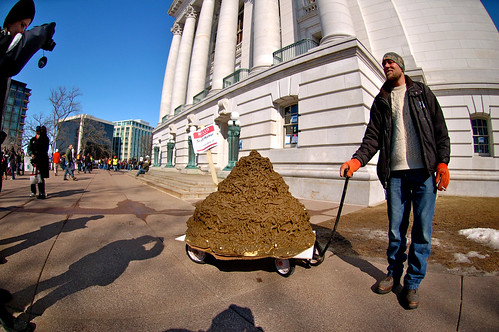
Originally blogged under the title: "Everybody wants to take a photo of a man wheeling the large pile of shit that has a 'Hello My Name Is Scott Walker' sign stuck in it." I'm thinking of saying something like: There, it's clear that the man means to say, Scott Walker is shit. He's not simply a man riding in on a shit wagon. He is a pile of shit, being wheeled around on a small vehicle that may or may not be specifically purposed as a shit wagon. And even if that were a shit wagon, it wouldn't mean that if any given person were to take a ride on the shit wagon, that would make him shit. When you take a hay ride on a hay wagon, that doesn't make you hay.
But then, who rides in a clown car other than clowns? And what makes a car a clown car aside from its being full of clowns? There's no specifically purposed vehicle known as a clown car. It's just a Volkswagen Beetle or some other such small car.
Now, I do get Orman's point. "Clown car" was a funny way to refer to a seemingly endless supply of surrogates that the GOP sent into Kansas to help Roberts, and there is something ludicrous about a candidate who depends too heavily on surrogates. So there's deniability. But, come on, Orman called Bob Dole a clown. He handed Roberts a gift there, he knows it, and he had to walk it back. Ludicrously.
IN THE COMMENTS: CWJ said "Althouse, The candidate's name is Greg Orman not Gary." Corrected. Thanks. I must have confused him with Gary Oldman.

AND: Rejham said: "'Greg Orman, not Gary.' Ha! Gary Orman was great on Laugh-in though..." Oh, yeah. Gary Owens...
For some reason, this makes me want to show you this photo I took back in March 2011:
Originally blogged under the title: "Everybody wants to take a photo of a man wheeling the large pile of shit that has a 'Hello My Name Is Scott Walker' sign stuck in it." I'm thinking of saying something like: There, it's clear that the man means to say, Scott Walker is shit. He's not simply a man riding in on a shit wagon. He is a pile of shit, being wheeled around on a small vehicle that may or may not be specifically purposed as a shit wagon. And even if that were a shit wagon, it wouldn't mean that if any given person were to take a ride on the shit wagon, that would make him shit. When you take a hay ride on a hay wagon, that doesn't make you hay.
But then, who rides in a clown car other than clowns? And what makes a car a clown car aside from its being full of clowns? There's no specifically purposed vehicle known as a clown car. It's just a Volkswagen Beetle or some other such small car.
Now, I do get Orman's point. "Clown car" was a funny way to refer to a seemingly endless supply of surrogates that the GOP sent into Kansas to help Roberts, and there is something ludicrous about a candidate who depends too heavily on surrogates. So there's deniability. But, come on, Orman called Bob Dole a clown. He handed Roberts a gift there, he knows it, and he had to walk it back. Ludicrously.
IN THE COMMENTS: CWJ said "Althouse, The candidate's name is Greg Orman not Gary." Corrected. Thanks. I must have confused him with Gary Oldman.

AND: Rejham said: "'Greg Orman, not Gary.' Ha! Gary Orman was great on Laugh-in though..." Oh, yeah. Gary Owens...
November 2, 2013
"I first heard Linda's record on the radio in Philadelphia, while riding in a limo with the Monkees."
"No one in the car believed I had written the song. Linda did more for that song than the Greenbriar Boys' version. She infused it with a different level of passion and sensuality. Coming from the perspective of a woman instead of a guy, the song had a new context. You sensed Linda had personally experienced the lyrics—that she needed to be free."
Everything you ever wanted to know about "Different Drum."
ADDED: Linda Ronstadt has gone public talking about her Parkinson's Disease:
Everything you ever wanted to know about "Different Drum."
ADDED: Linda Ronstadt has gone public talking about her Parkinson's Disease:
Subscribe to:
Posts (Atom)


 Posts
Posts


