"No one ever believes me when I tell them it’s 1.91 acres.... They always think it’s much, much bigger, because you have all of these little mini-follies and these little windy paths that you get a little bit lost in as if you were in a much larger garden. But you’re not."
Showing posts with label gardens. Show all posts
Showing posts with label gardens. Show all posts
May 27, 2026
"Bob would just mow paths through the meadows and put a bench down and just read his book, and probably have a drink."
I'm reading "Sometimes, the Best Way to Explore a Landscape Is to Sit Down/Madoo, in Sagaponack, N.Y., is giving visitors a different way to view a garden, with outdoor seating in a variety of styles and colors" (NYT).


March 27, 2026
We were talking about raspberries.
The New York Times brings harrowing forebodings: "Where Might the Iran War Hit Your Wallet? Start With Raspberries. It takes a lot of fuel to produce this delicate fruit, which can be a sensitive barometer as oil costs rise."
Raspberries are the divas of fresh produce.... They do best stacked lightly in refrigerated trucks cooled and powered with diesel fuel. Even on a plane, the berries must be refrigerated. All this makes them one of the most fuel-intensive items in the produce aisle. And they bear a message from the near future: The Iran war is likely to grow your grocery bill. Raspberries were already expensive, but the wholesale price of fresh berries has doubled since January, according to federal Agricultural Marketing Service reports. At a Whole Foods Market in Atlanta on Tuesday, a six-ounce plastic container of organic raspberries cost nearly $8. That’s about 20 cents a berry....
You know what you could do in support of the war effort? If the price of fresh raspberries doubles, eat half as many raspberries. Or don't buy fresh raspberries when they are out of season. Be more of a locavore and pick something that is in season or buy frozen berries. They're fine in a smoothie. I mean this war with Iran has been going on since the Carter administration and we're currently very heavily committed to forcing it to end decisively. Can't you handle this insanely minuscule raspberry problem? Who is this out-of-season-berry-munching Whole-Foods-shopping lady who won't contribute?
Remember when women dug in and helped:
June 2, 2025
"I was irked 30 years ago when our neighbor said she intended to install a free-standing fence between our driveways...."
Writes Margaret Renkl, in "What if Robert Frost’s Neighbor Was Right?" (NYT)(free-access link, the first of the 10 allotted to me in June).
By the time she died two years ago, the unbeloved fence had become the scaffolding for pokeweed and native vines.... The fence had been built in a shadowbox style, and the gaps between the boards gave reaching vines room for twisting.... After our neighbor passed, a developer bought her modest, meticulously maintained house and reduced it to rubble.... The new fence sits on top of a concrete wall.... Unlike the old shadowbox fence, this new fence has a front side and a back side, and it’s the back side that faces us. Worse, its unbroken expanse gives climbing vines no purchase. It took 30 years for the realization to dawn, but once the new flat-board fence went up, I finally understood that my late neighbor had gone to some expense to make the fence she built as attractive on our side as on hers. This choice was her version of neighborliness. I was just too caught up in my own contrary definition of neighborliness to see it....
You can listen to Frost reading his poem, "Mending Wall," here. And here's the text of the poem, which is not entirely about the literal wall. The NYT essay is about a fence. It's quite literal. Renkl has a lot of feelings about fences and neighbors — different kinds of fences and different kinds of neighbors. Do you have neighbors who bring up Trump when you thought you were just talking about your gardens? Well, let me assure you, the NYT essayist does not bring up Trump. It's lovely, all that wall wall wall and never a peep about Trump's wall. Yes, I know, I'm bad to bring it up. But how can you talk about not bringing something up without bringing it up.
May 6, 2025
"This garden is very interesting in that it’s part of a spiritual practice: It’s used for meditation. Moss is very tiny..."
"... and being in the garden, looking so closely to distinguish one type from another, requires a special kind of attention. It opens up a completely different kind of universe."
Said Harvard architecture professor Toshiko Mori, about the Saihoji Kokedera Temple and Moss Garden in Kyoto, quoted in "The 25 Gardens You Must SeeWe asked six horticultural experts to debate and ultimately choose the places that’ve changed the way we look at — and think about — plants" (NYT)(free-access link, so you can see all the photos and read about the other gardens).
Said Harvard architecture professor Toshiko Mori, about the Saihoji Kokedera Temple and Moss Garden in Kyoto, quoted in "The 25 Gardens You Must SeeWe asked six horticultural experts to debate and ultimately choose the places that’ve changed the way we look at — and think about — plants" (NYT)(free-access link, so you can see all the photos and read about the other gardens).
I love the story of the creation of this garden: "In 1339, Muso Kokushi, a Buddhist high priest and master gardener, created what’s believed to be the first-ever karesansui (dry landscape)... carefully placed rocks and swaths of sand or gravel raked to invoke rippling water... In the nineteenth century, Saihoji was flooded repeatedly when a nearby river overflowed its banks... Rather than fight nature, the monks embraced change... With more than 120 varieties [of moss]... Saihoji looks quite different than it did in Kokushi’s day, but, in the hands of the monks who continue to maintain it, its purpose of encouraging serenity and contemplation hasn’t changed....."
The monks carry on a traditional practice of meditation, bound to this site for 7 centuries. But what would it be for you to drop in one day?
September 9, 2024
A fairy garden for Kamala.
"This is something people do around here. There's a name for it, I think, but I've forgotten what it is — if I ever knew" — I wrote, back in 2021. Commenters told me what it is: a "fairy garden."

Here's one that my son Chris found today:
Photo by Chris.
May 29, 2024
"He has found snakes, and even a freshwater eel, in his pool, but the water is clear enough that he can spot animals before there’s trouble."
From "Come On Over, I Just Installed a Pond/Backyards that feature natural pools trade chlorine for plants, don’t need to be closed for winter and may feature kois with names like Cutie" (NYT).
I'm skeptical! The "he" who "can spot animals before there’s trouble" is a man whose business is installing "natural" pools.
By the way, I love the subreddit, r/FindTheSniper, which features photographs where it's hard to see the snake (or other wildlife). I'm now convinced that I've walked by many snakes.
Anyway, let's say you do spot the snake before there’s "trouble," what do you do? I think you back off, and in the end, cede the pond territory to the wild things. Who is in the business of removing "natural" ponds (and their creepy denizens)?
June 28, 2023
June 11, 2023
The (dubious) outdoor-bathtub trend.
I'm trying to read "Ready for a Nice, Soothing Bath? Just Head to the Backyard. Cheaper than pools and more private than hot tubs, the bathtub is leaving the bathroom and has designs on your garden, or even your treehouse" (NYT).
We're told that "wellness" is a big "concern of homeowners" and that includes "intentional outdoor features, like bathtubs." These are not "hot tubs," which, we're told, are "social features" — associated with multiple users and drinking. These are for "one person just being with nature, being with themselves, having that detox from devices and daily life."
July 27, 2022
July 7, 2022
"Often the problem is 'death by a thousand cuts'... when we garden too aggressively in the root zone" of a tree.
"Or worse, if an irrigation system is installed, slicing repeatedly through the tree’s lifelines.
He is a proponent of 'living green mulch, not a ring of bark mulch.' But transforming an area under established woody plants into a ground-covering, herbaceous layer requires a gentle hand and patience.
'You need to start with small plants or divisions and dig very little holes,' he said.
Think soil knife, not shovel: With larger tools (or plants), the tree roots will get chopped up. 'A few is no big deal,' he said. '“But when you’re disturbing lots of roots, that can affect the tree.'"
From "In Your Enthusiasm for Planting, Don’t Forget About the Trees/Trees can take a lot of punishment, but they have their limits. Here’s how to work around them safely" by Margaret Roach (NYT).
"He" = Christopher Roddick, head arborist and foreman of grounds at the Brooklyn Botanic Garden.
From "In Your Enthusiasm for Planting, Don’t Forget About the Trees/Trees can take a lot of punishment, but they have their limits. Here’s how to work around them safely" by Margaret Roach (NYT).
"He" = Christopher Roddick, head arborist and foreman of grounds at the Brooklyn Botanic Garden.
This article caught my attention because it seemed so weird to me to think about people who would forget about their trees. And yet I have encountered people who are fired up about things they want to do with their yard that really do amount to forgetting about the trees.
April 7, 2022
At the Golden Café...
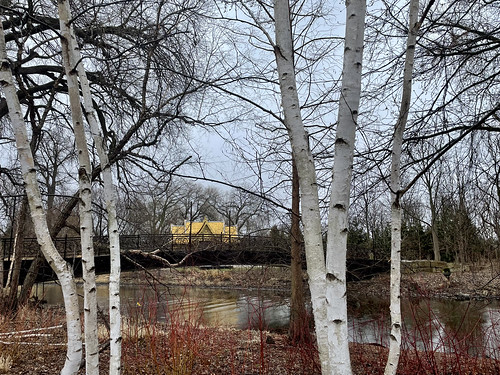
... you can talk about anything you want.
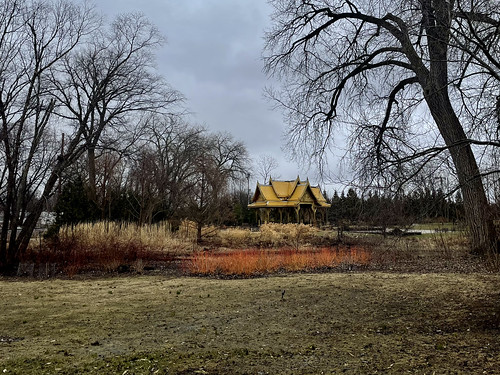
Photos taken in the early afternoon today, in very light rain, in Olbrich Gardens.
March 4, 2022
The NYT has an article about "gravel gardens" that features the horticulturist at Madison's Olbrich Gardens.
"'I’ve never liked the name, because it just doesn’t conjure the look of what’s possible,' said [Jeff] Epping, the director of horticulture at Olbrich Botanical Gardens, in Madison, Wis., where he created his first gravel garden in 2009, and has planted three more since.... It is precisely because of the gravel that upkeep is so drastically reduced. This is no mere top-dressing — not a mulch layer, but a deliberate foundation four or five inches deep that the garden is planted into. That depth discourages weeds from finding a foothold, while minimizing runoff, directing available water to where roots can use it. Caring for an established gravel garden requires even less attention week to week than taking care of a lawn, which 'might as well be a parking lot, as far as the garden’s creatures go,' Mr. Epping said.... As in a raised bed, what is required is a perimeter barrier — in this case, about six inches high — to contain the gravel at a consistent depth throughout. Otherwise, pebbles near the edges would naturally spread out, and the thinner layer of gravel would invite weeds to self-sow...."
June 6, 2021
Backyard seen from the 3rd-floor window at 5:47 a.m.
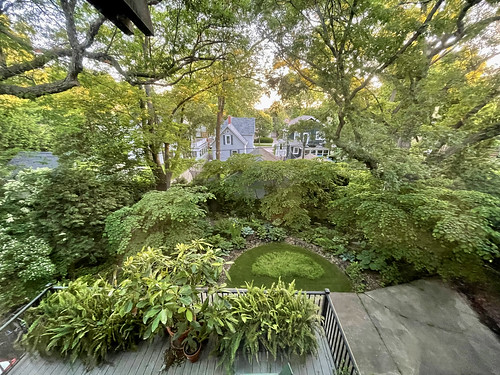
I love the way this was designed and grown to be looked at from above. I'm nearly always seeing it from the 3rd or 2nd floor. It's nice at ground level too, but I'm delighted by the undulating shapes of the low treetops. And of course, I love the part I call "the protractor." The long grass inside of the mown grass is wheat.
May 13, 2021
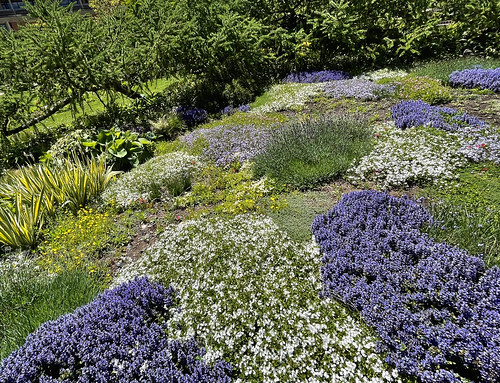
Backyard protractor wheatfield.
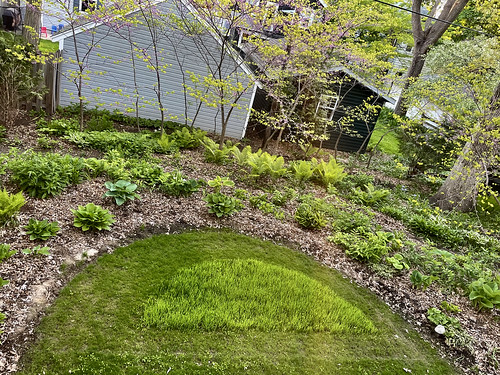
Yes, it's our backyard. Yes, it's a wheatfield. Obviously, it's in the shape of a protractor — an old-time-y open-center protractor.
February 7, 2021
Bruce Springsteen (and Jeep) call us (the Super Bowl watchers) back to the middle, to "the ReUnited States of America."
We see Bruce in Kansas, the geographic center of the contiguous 48 states, and he's mourning about how "the middle has been a hard place to get to lately." It's not overtly political, but I get the feeling that we're being told that the person who is President now, is more or less in the middle, and we ought to come together and feel good about that.
This is — Variety tells us — the first ad Bruce Springsteen has ever done. He'd never even allowed his songs to be used in ads.
There’s no art in this White House. There’s no literature, no poetry, no music. There are no pets in this White House. No loyal man’s best friend, no Socks the family cat, no kids’ science fairs. No time when the president takes off his blue suit, red tie uniform and becomes human. Except when he puts on his white shirt and khaki pants uniform, and hides from the American people to play golf. There are no images of the first family enjoying themselves together in a moment of relaxation. No Obamas on the beach in Hawaii moments or Bushes fishing in Kennebunkport. No Reagans on horseback. No Kennedys playing touch football on the Cape. Where’d that country go? Where did all the fun, the joy, and the expression of love and happiness go? We used to be the country that did the ice bucket challenge and raised millions for charity. We used to have a president who calmed and soothed the nation instead of dividing it. And a first lady who planted a garden instead of ripping one out. We are rudderless and joyless. We have lost the cultural aspects of society that make America great. We have lost our mojo, our fun, our happiness, our cheering on of others, the shared experience of humanity that makes it all worth it. The challenges and the triumphs that we shared and celebrated, the unique can-do spirit that America has always been known for. We are lost. We’ve lost so much in so short a time. On November 3rd, vote them out.
So, Bruce got what he said he wanted, the President who calms and soothes us instead of riling us up. And Bruce is driving a Jeep in Kansas to call us back into a dreamworld of Americana.
January 25, 2021
"Sightings of some of Britain’s best-loved garden birds have fallen, a report suggests, blaming the reduction on fewer hedges and overly 'tidy' gardening."
The London Times reports on a side-effect of the lockdown. People are tidying up too much.
The editor of BBC Gardeners’ World Magazine says: "More hedges are coming down... the sorts of habitats we’ve provided . . . are being ripped out... [Birds] need a slightly messy space... They need leaf litter, a bit of rotting wood at the back of a hedge. If you haven’t got a caterpillar, the blue tit has nothing to feed on."September 16, 2020
"Residents at a Chinese housing complex who looked forward to living in a verdant 'vertical forest' found themselves in a veritable hell..."
"... with mosquitoes swarming their eco-paradise, according to a report. The experimental green project at Chengdu’s Qiyi City Forest Garden attracted buyers for all 826 apartments, but it also attracted the pesky insects that gave the towers a post-apocalyptic facade...."
The NY Post reports.
This is why you need to test your ideas of paradise.
By the way, aren't there a million stories where people think they have found paradise and then they realize it is hell?
But what I don't understand is — it's China — why don't they just fumigate like mad? I know it's supposed to look like an eco-paradise, but do they really care about the use of insecticide? That surprises me. I'm suspicious of this story. Please entertain me by concocting a conspiracy theory.
The NY Post reports.
This is why you need to test your ideas of paradise.
By the way, aren't there a million stories where people think they have found paradise and then they realize it is hell?
But what I don't understand is — it's China — why don't they just fumigate like mad? I know it's supposed to look like an eco-paradise, but do they really care about the use of insecticide? That surprises me. I'm suspicious of this story. Please entertain me by concocting a conspiracy theory.
August 22, 2020
The political eye.
It’s been ruined. https://t.co/zHGsR0ognR
— Markos Moulitsas (@markos) August 22, 2020
August 19, 2020
"Gardening has been a solace to so many... because it invokes the prospect of some kind of future, however uncertain and unpredictable it may be."
"'When the future seems either very bleak, or people are too depressed to imagine one, gardening gives you a toehold in the future'.... It can also help reconcile us to the inevitability of our demise. At the Barn garden, Tom Stuart-Smith told me that every spring... he goes around the garden with a notebook, to make plans about where to add things in the autumn. 'I think a lot about next year, but I also think, absolutely, about what it’s going to be like when I am dead,' he said. The future promised by a garden may not always be ours to enjoy, but a future there will be, with or without us in it.... Under the current circumstances, I have no great confidence that my mother will ever again travel to London and see this garden of mine. 'Have you room for a honeysuckle?' she wrote to me. I planted one in a sunny spot against the wall, in the hope that the near-invisible trellis of wires that I hammered to the brick will help it stand upright, as if it were doing so on its own."
From "The Therapeutic Power of Gardening/Can anxious minds find solace working with plants? A therapist and her husband, a garden designer, say yes" by Rebecca Mead (The New Yorker).
Have you been gardening during the coronavirus lockdown?
ADDED: "Gardening has been a solace to so many... because it invokes the prospect of some kind of future..." Invokes?! Should be evokes. If The New Yorker is already getting stuff like that wrong, the future looks kind of dismal!
ALSO: From the New Yorker cartoon bank, there's this from May 2019 by Roz Chast:

If the trolls were saying "The world is falling apart, and YOU'RE GARDENING?!?" back in May 2019, imagine what they're saying in 2020.
From "The Therapeutic Power of Gardening/Can anxious minds find solace working with plants? A therapist and her husband, a garden designer, say yes" by Rebecca Mead (The New Yorker).
Have you been gardening during the coronavirus lockdown?
ADDED: "Gardening has been a solace to so many... because it invokes the prospect of some kind of future..." Invokes?! Should be evokes. If The New Yorker is already getting stuff like that wrong, the future looks kind of dismal!
ALSO: From the New Yorker cartoon bank, there's this from May 2019 by Roz Chast:

If the trolls were saying "The world is falling apart, and YOU'RE GARDENING?!?" back in May 2019, imagine what they're saying in 2020.
Subscribe to:
Posts (Atom)


 Posts
Posts


