"... as tour groups jostle and throng and sometimes shove one another in hopes of getting close enough to snap a cellphone picture of the world’s most famous painting.... The Mona Lisa moment can be had in the galleries of New York’s Museum of Modern Art, which has become so crowded that serious art lovers now avoid it... The problem isn’t just crowds, or noise or distraction; it is the annihilation of one of the essential components for viewing art, which is extended individual contemplation... In the late 19th- and throughout much of the 20th century, museums stood as temples of art, delivering lessons about the 'civilizing' value of culture. In the middle of the last century, new generations of museum leadership began to stress more populist ideas of openness and equality in the gallery experience. That second age of American museums — the Age of Access — has bred the seeds of its own destruction, generating a cultural experience that attracts enormous crowds, but without giving them any substantial engagement with the materiality or cultural complexity of the art itself.... Are contemporary art museums, in fact, providing something of value to the public?"
From
"This new museum doesn’t want Instagram or crowds. Does that make it elitist?" by Philip Kennicott, the art and architecture critic at WaPo. Kennicott isn't suggesting excluding the riffraff to make way for the thoughtful, nuanced people. That would be plainly elitist. His answer, befitting an architecture critic, is architecture — things like narrowing hallways to choke the flow of crowds.
This subject connects to something
we were talking about 2 days ago,
"‘Overtourism’ Worries Europe. How Much Did Technology Help Get Us There?" by Farhad Majoo (NYT).
The Farhad Majoo article clearly fit with my longterm interest in the problems of travel. I almost want to say the
impossibility of travel. Museums are a subcategory of travel, since travelers often see the museums of the places they travel to, and in my personal experience, museums are at the top of what I've wanted to do when traveling. I see that Kennicott called museums "impossibly crowded," and maybe that was just hyperbole, but I think he's seeing what I'm seeing. The presence of other people changes the environment from the place
you want to see, so the place you want to go no longer exists. Traveling
there is literally impossible.
Is that elitist? I'd say, no. It's just aesthetically sensitive and aware. It's only elitist if you think your sensibilities justify excluding the people who don't mind the problems as they continue to crowd the places that you'd go to if they were virtually empty. If you cede these places to the other people, you're the opposite of an elitist. You're a populist.
And that reminds me of how I felt when Donald Trump won the election.
ADDED: When I went to Paris in the 90s, I didn't bring a camera. I had a sketchbook, and the comments to this post — exploring the idea of seeing the parts of the museum where the crowds don't — made me remember this page:
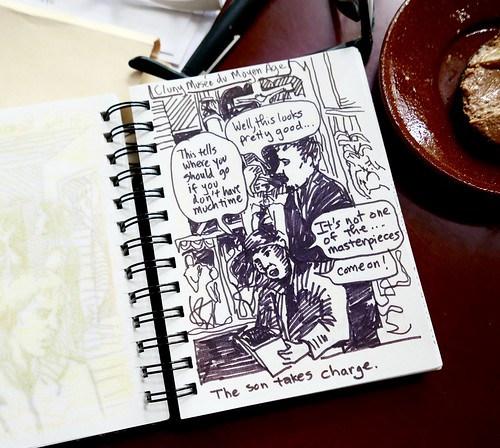
AND: Here's something I wrote in my Paris notebook that's quite relevant to this post. Transcribed verbatim: "I spent so much time today at the museum — walking all over the Louvre — there is so much here that you get numb, you don't care. If you had to travel from church to church to see each piece, it would mean much more. But as it is, you get to the point where you traipse along, casting your eyes about to see if anything
really grabs you (oh, yeah, they're about to deliver a second axe chop to the neck of a saint who's not dead yet! That's cool — heh, heh. I saw some kids pointing this out — & aren't they on the same wave-length perhaps as the artist — in his time). One américain says, 'Let's skip this shit' & I don't think 'What a crass/ignorant little man!' I think 'I know
exactly how you feel.' But much is good. I don't mean to slight it. It's just that one really doesn't
prefer culture in one humongous globule! And yet in our modern world, great art has been globbed up in large Louvrish hunks, so this is the only way you
can see it. For a normal look, you must look at the art of your own time, as the medievals viewed crosses and chalices in their own churches, localized and, not unimportantly, imbued with meaning: the beliefs that they shared with the art & artists themselves."


 Posts
Posts


