We'd planned to stay in for the sunrise, but at the last minute, Meade decided to venture forth. He got this picture at 7:25 — 13 minutes after the official sunrise time:
The strong winds had already broken up the ice. Here's how it looked at 4:46 in the afternoon. This is my photograph, as you may be able to tell from the shadow in the lower left corner:
That's the familiar vantage point, and you can see the lake ice is gone except for the wall of ice blocks shoved up against the shore. That's a bit impervious to the brutal wind. I don't know how I made it all the way out there. It wasn't really cold, but oh! the wind.
Here's the video Meade made as I was standing there. Take note of the strong waves in the lake and the ring of fire:
Write about whatever you want in the comments. This is the overnight open thread.
".... reporters have already gathered, the sound system just briefly played a clip of Johnny Cash singing, 'Ghost Riders in the Sky.' The song, according to the website Ballad of America, is a 'cautionary tale warning a cowboy that if he doesn‘t change his ways, he will one day join the damned cowboys doomed to try to 'catch the Devil’s herd across these endless skies.'"
"At Bedminster, in the parallel universe that will serve as a political rally of sorts, club workers have set up bunting, American flags, roughly 150 white chairs for attendees and the type of blue podium that Trump used as president. The work is going on under blistering sunshine and to the dulcet tones of 'Bennie and the Jets,' by Elton John, over the speaker system."
Hey kids, plug into the faithless, maybe they're blinded, but Bennie makes them ageless... we fight our parents out in the streets to find who's right and who's wrong....
"We are alarmed by the use of social media to really over-proliferate this violence in our communities. This is contributing to the violence that we are seeing all over the country. It one of the rivers we have to dam."
There are so many songs about violence, often sung from the point of view of a murderer. Indeed, the second one that sprang to my mind was from the sanctimonious promoter of censorship, Neil Young:
I don't know rap. Never heard of "drill rap" before just now. So I have no rap-focused opinion. But I oppose censorship, and I understand art well enough to make the distinction between the writer and the story told.
Down by the river I shot my baby/Down by the river/Dead, ooh/Shot her dead, ooh....
"He went over to Elvis and said 'I didn’t know you could play.'
Elvis responded 'I can’t,' at which point Jerry Lee said, 'Well then, why don’t you let me sit down?'
Elvis just replied 'Well, I’d like to try,' and carried on noodling.... [T]he majority of the [Million Dollar Quartet session] consists of Elvis on acoustic guitar or piano, Jerry Lee on piano when Elvis isn’t playing it, and them all singing together, with Elvis or Jerry Lee taking most of the lead vocals.... Both Elvis and Jerry Lee were brought up in the Assembly of God, a Pentecostal 'holy roller' church.... ['Jesus Walked that Lonesome Valley'] is interesting, as even though it’s a call-and-response song and starts with Elvis taking the lead and Jerry Lee doing the responses, by the first verse Jerry Lee has already taken over the lead and left Elvis echoing him, rather than vice versa. You can hear there exactly how this friendly rivalry was already working. Remember, at this time, Jerry Lee Lewis was nobody at all, someone who had one single out which had been out a matter of days. But here he is duetting with the 'King of Rock and Roll,' and seeing himself as the person who should naturally be taking the lead."
You can listen to the recording of "Jesus Walked that Lonesome Valley" on YouTube here.
And here's a link to the Wikipedia page for Lewis, where I went because I wanted to check my belief that he's still alive. He is. But I also saw: "On November 22, 1976, Lewis was arrested outside Elvis Presley's Graceland home for allegedly intending to shoot him... 'Elvis, watching on the closed-circuit television, told guards to call the police... The cops asked Elvis, "What do you want us to do?" And Elvis told 'em, "Lock him up." That hurt my feelings.'" Elvis avoided death that night, but proceeded to die on his own, 8 months later.
"At least until all this science starts to fog up our mental windshields and we, the people, start to wear out. Our irritability mounts; our attention wanes; the guide-rope in our mouth starts to chafe. It is then that the bawdy obstreperousness and its odd twin, the glory hallelujah, of democracy come into view — a single unit; maddening, infuriating, nevertheless fused. And Greg Abbott or someone else steps up to lead the beast forward, by instinct if not by Hoyle... The love of democratic citizens for experts shouldn’t be overestimated. The nature of democracy is preference for or deference to popular wisdom, however unwise that wisdom may prove in action. It’s been a long time since this pandemic started. People are tired. People want to see, and relate to, each other. That’s human nature. The human nature-affirmers like Greg Abbott, with a little luck and sense of timing, are likely to come out way ahead of their castigators and vilifiers, Robert Francis (Beto) O’Rourke conspicuously included."
The Spectator is British, but Murchison is American. He even went to the University of Texas. I had to look that up because the use of "glory hallelujah" hit my ear as a foreigner's mistake. To me, the phrase — which you see in the title and the text ("its odd twin, the glory hallelujah, of democracy") — is entirely evocative of "The Battle Hymn of the Republic," and Texas was in the Confederacy.
There's an episode of The Johnny Cash Show from 1969 where the man himself makes a little speech with a pretty big error. "Here's a song that was reportedly sung by both sides in the Civil War," Cash says, guitar in hand, to kick off a performance of "The Battle Hymn of the Republic.... which proves to me that a song can belong to all of us."
Cash was wrong, but in the years after the Civil War, the song came to be sung in church, at football games, and at labor union events. And on all sorts of political occasions:
"Rather than remove this content, we want to acknowledge its harmful impact, learn from it and spark conversation to create a more inclusive future together. Disney is committed to creating stories with inspirational and aspirational themes that reflect the rich diversity of the human experience around the globe."
The NY Post reports, adding "It’s unstated precisely what Disney considers to be offensive on the show, but some characters depict Native American, Middle Eastern and Asian people. And in season five, legendary country singer Johnny Cash is seen performing in front of a Confederate flag."
"Native American, Middle Eastern and Asian people"? The ethnic group I remember getting poked fun at was the Swedish...
But who cares about the feelings of the Swedish these days?
These shows were made between 1976 and 1981. Basically, during the Carter administration. Disney wants to be able to keep showing them and has — clunkily but wisely — slapped on a warning to fend off demands that the show be taken off the air. I'd like to give Disney some support here. They have a big old archive and they ought to make it available, not replace it all with paternalistic... maternalistic pablum.
I'm seeing some criticism like: "Nothing screams offensive like fury puppets. When I think of a cultural danger to society, it’s obviously Jim Henson’s Muppets."
I object... and not just because that critic wrote "fury" for "furry." I object because that criticism is offensive to puppets.
Puppets can excel at delivering offense. Here's an example of striving to use puppets to offend:
From the clip: "[Puppets are] human enough to be believable, but imaginary enough to be convincing when they're doing things that are crazy."
Read about "Spitting Image" and its U.S. counterpart "D.C. Follies." There are deliberately offensive puppets — real satire. I'd like to see more of that — satire of specific individuals.
But many things done with puppets are just stereotypes. I know I had some marionettes when I was a child circa 1960. One was a clown. One was a cowboy. And one was a Chinese person. It was blatant stereotyping, similar to the idea of the Chinese seen in "Fantasia":
"Fantasia" is, of course, one of the gems of the Disney archive. There are people today who would demand that no one be allowed to see that film — that film and many other works of art. Disney seems to be trying to manage the pressure. I wouldn't just laugh at Disney for taking its problem seriously and putting up a warning.
"This program includes negative depictions" — ha ha. How can you do comedy without negative depictions? Isn't that the whole idea?
ADDED: "Gary, I hate to break it to you, but the world is on the brink of disaster...."
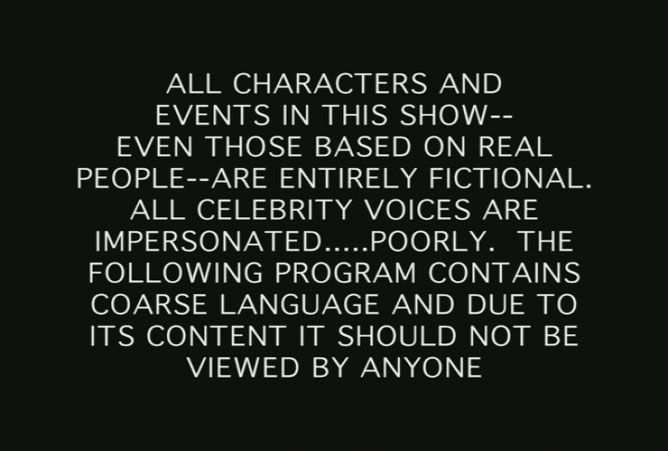
AND: Speaking of "South Park" and disclaimers, "South Park" has always — or it seems like always — begun with this disclaimer (which is also a parody of disclaimers):
I've never seen "A Christmas Story," though I am one of Jean Shepherd's biggest fans. For years, in the 1960s, I used to get in bed in time to hear the "Call to Post" — which, today, sounds like something about blogging — on my radio tuned to WOR. And then...
Listening to those Jean Shepherd radio shows in the dark, night after night, was the pop culture highlight of lifetime. Of course, I heard him read "A Christmas Story" ever year. That was a tradition. But better than that was any random show on whatever he decided to talk about that night — another story of his childhood (back in Indiana) or some odd trail of musings.
Shepherd's oral narrative style was a precursor to that used by Spalding Gray and Garrison Keillor. Marshall McLuhan in Understanding Media wrote that Shepherd "regards radio as a new medium for a new kind of novel that he writes nightly." In the Seinfeld season-six DVD set, commenting on the episode titled "The Gymnast", Jerry Seinfeld said, "He really formed my entire comedic sensibility—I learned how to do comedy from Jean Shepherd."...
Shepherd was an influence on Bill Griffith's Zippy comic strip, as Griffith noted in his strip for January 9, 2000. Griffith explained, "The inspiration—just plucking random memories from my childhood, as I'm wont to do in my Sunday strip (also a way to expand beyond Zippy)—and Shep was a big part of them."
In an interview with New York magazine, Steely Dan's Donald Fagen says that the eponymous figure from his solo album The Nightfly was based on Jean Shepherd.
Though he primarily spent his radio career playing music, New York Top-40 DJ Dan Ingram has acknowledged Shepherd's style as an influence.
An article he wrote for the March–April 1957 issue of MAD, "The Night People vs Creeping Meatballism", described the differences between what he considered to be "day people" (conformists) and "night people" (nonconformists).
A few days ago, in conversation on Facebook, I reconsidered my lifelong policy of averting my eyes from the film version of "A Christmas Story." Just to present my own comments:
I've never seen "A Christmas Story" because I am too devoted to Jean Shepherd and the original story as told over the radio....
I know [you hear Shepherd's voice-over narration in the film], but I don't want to see the ideal replaced by a literal acting-out of the story by human actors. The adult's voice creates the kid feeling. I don't want to see a real boy acting out the emotions for the camera. It's radio, the ultimate in radio, and not film...
I think I need to change my position. "A Christmas Story" is a deviation from Shepherd's usual show, because he was reading a story — not riffing in real time — that had been published in a book and a magazine (Playboy). So it wasn't the pure radio ideal that I'm so staunch about. It is not one of his stories about his own youth, because he says before reading the story that the boy is *not* him.
So did I finally watch the movie? No. Not yet, anyway. But I was motivated to listen to a random old show — something about midwestern drug stores. Nothing to do with Christmas, but I was listening on Christmas.
I don't think of Shepherd as Christmas-y, and it annoys me a bit that so many people do. The radio show should be much more important that that one film version of a story he used to read on the radio. Should be, and perhaps is, as its influence is deeply woven into many things we actively enjoy today. It's baked into this blog.
"... but the internet governs our lives today. It used to be that when you communicated with someone, the person you were communicating with was as important as the information; Now on the internet, the person is unimportant at all. Becoming your own filter will be the challenge of the future. Will our children's children's children need the companionship of humans - or will they have evolved in a world where that's not important? It sounds awful doesn't it? But maybe it will be fine, and the companionship of robots and an intelligent internet will be sufficient. Who am I to say?"
These are the last spoken words in the film, which then ends with some scientists outdoors playing guitar/banjo/fiddle and singing the old song "Salty Dog." I can see there's a Johnny Cash version of this song and a Flatt & Scruggs, but the version I've known for half a century is by Mississippi John Hurt.
Flatt & Scruggs sing, "Let me be your salty dog or I won't be your man at all," and so does Johnny Cash, but Mississippi John Hurt sings "Let me be your salty dog/I don't want to be your man at all." It makes a difference! Ah, here's the whole script for the movie, and it gives the lyrics: "Let me be your salty dog/I won't be your man at all." That makes a difference too — a difference that affects what I want to say. But let me try anyway.
The movie not only talks about the loss of humanity on the internet (as the last spoken words show), it includes the famous cartoon, "On the Internet, nobody knows you're a dog" (showing an actual dog using the internet). You see where I'm going with this. The film ends with the spoken idea that maybe in the future people won't need the companionship of another human, and then you get the sung lyric of an offer of companionship that excludes being an man. The singer wants to be your dog and not your man. In one way, very literally, it reinforces the Krauss + New Yorker cartoon idea of evolving away from real touch with another person.
But because of the way we suddenly see and hear live human beings together playing and singing, we are roused into feeling that nothing could be more important than getting together with other people in the flesh. It's the very last thing in the movie, number one. Secondly, these men are obviously vitally alive and enjoying their immediately company. Thirdly, they are singing an enthusiastic plea for physical love from the "you" whose salty dog they are begging to be. I feel certain the film's final send off is a message to hold onto your humanity.
And yet that message is complicated by the old line about not wanting to be a man at all. Even before we got abstracted into the bodiless world of the internet, there were songs expressing an intense desire to escape being a man. But that was in the opposite direction from abstraction and into the role of dog. It was a desire to be even more intensely in the fleshly, embodied world.
"Salty Dog" is an old song, not to be confused with "Salty Dog" by Procol Harum (which is about sailors). The idea of being your dog has been around for a long time. Here's "I Wanna Be Your Dog" by The Stooges:
Also, for those who've followed the story of Althouse and Meade, there's the line "We want to BE your dog."
"And that is a crime against morality.... Blame is assessed and pressed like hot iron into the flanks of the rich, or of 'corporations,' and others with means, a moronic and frightening misunderstanding of how jobs are created. It is as if 'The Big Rock Candy Mountain' has become economic policy. And by such logic all we must do is lower the rich into a giant cauldron, add salt and bay leaves and boil them down for soup to soothe the neighborhoods on fire... What isn't discussed enough when riots happen and neighborhoods burn is the one thing most common to all these decaying urban tinderboxes. They're run by Democrats. Baltimore is a Democratic city, Milwaukee is a Democratic city, Chicago, Detroit, and on and on. This is a most inconvenient truth. This is what binds them."
Imagine having a beach house in 1971, being 37 years old, having a 29-year-old Harrison Ford, doing carpentry work for you and experiencing him as a great moral force.
Didion was married, you should know. She married John Gregory Dunne in 1964, and they remained married until he dropped dead in 2003. I say "dropped dead" because I read "The Year of Magical Thinking," which begins with that scene.
But how was the young carpenter a moral force? Here's a little song:
"We found continued and heightened activity... Measurable conscious activity is much, much higher after the heart stops — within the first 30 seconds.... That really just, just really blew our mind. ... That really is consistent with what patients report"....
I thought this was already well known, but I guess euthanizing rats and getting this data is new. Still, were the scientists' minds actually blown? Isn't this what they expected? Wouldn't it have been more mind-blowing if there hadn't been a brain activity burst — because that's what would support the supernatural interpretation of the near-death experiences reported by human beings?
IN THE COMMENTS: Hagar asks: "Why is euthanizing used as a euphemism for killing?" Yeah, euthanasia is killing to spare the animal pain. These rats were killed just to watch them die, like Johnny Cash and that man in Reno, except Johnny Cash didn't have electrodes implanted in the man's brain, nor did he seriously collect and analyze data or shake our beliefs in the existence of heaven and hell.
I've already blogged about the underlying story (as another in my long series of posts about makeshift death-site memorials). This post is about the mistake of putting the story under the already stupid "astrology & paranormal" tag. Did somebody at the Examiner think actual ghosts — to the extent that makes any sense — were involved? Like, maybe it was some college town variation on the old "Ghost Riders in the Sky" legend:
"(Ghost) Riders in the Sky: A Cowboy Legend" is a country and cowboy-style song [that] tells a folk tale of a cowboy who has a vision of red-eyed, steel-hooved cattle thundering across the sky, being chased by the spirits of damned cowboys. One warns him that if he does not change his ways, he will be doomed to join them, forever "trying to catch the Devil's herd across these endless skies."
Here's Marty Robbins singing the song. Or if you prefer: Johnny Cash. Or here it is by the singer who possesses the voice that is the first singing voice that I ever heard and thought: This is the greatest voice ever. I must have been about 4 years old at the time, considering the year that the greatest recording ever — as I saw it — came out (1955).
But back to "Ghost Riders." Here are the lyrics. I'd love parody lyrics applicable to apparitions of college-town bike riders.
"His iPod selections were those of a kid from the '70s with his heart in the '60s"...
In fact, loaded on his iPod were a total of 21 Dylan albums, including all six volumes of the singer's bootleg series, but no studio recordings more recent than 1989's Oh Mercy, Isaacson writes. The artists appearing next most frequently on Jobs' iPod were the Beatles, with songs from seven of their albums, followed by the Rolling Stones, with six albums. Others making the cut: Aretha Franklin, B.B. King, Buddy Holly, Buffalo Springfield, Don McLean, Donovan, the Doors, Janis Joplin, Jefferson Airplane, Jimi Hendrix, Johnny Cash, John Mellencamp, and Simon and Garfunkel, plus the Monkees' "I'm a Believer" and Sam the Sham and the Pharoahs' "Wooly Bully."
What if your iPod contents were splattered across the headlines? Would you be embarrassed?
Yes, they are both TLC shows, but why did TLC think the people watching a show about Sarah Palin and her family would be susceptible to a show about the Kennedys? (Meade raised this question in the comments to the post earlier today about "Sarah Palin's Alaska.")
Your first thought might be that it doesn't make much sense because liberals love the Kennedys and conservatives love the Palins. But let's assume TLC isn't run by idiots, that they know how to appeal to viewers. If you had to argue that a good chunk of the "Sarah Palin's Alaska" audience would like to watch "Kennedys' Home Movies," what would you argue?
I'd say: Not all American TV-watchers are strongly grounded in one political party or the other. These people are not cemented to abstract ideology. They may feel their way into politics through personalities. Or they may not care that much about politics at all and simply enjoy peering into the family lives of celebrities, and politicians are a special, elite breed of celebrity, like royalty. The Kennedys have been, for many people, America's royalty, and the Palins may be the new royal family that people who like that sort of thing like.
Obviously, there are differences. The Kennedys posed as European-style aristocracy, and the Palins present themselves as working-class Americans. But both are very much big, colorful families with a strong sense of geographical place — Massachusetts/Alaska — and a mesmerizingly beautiful and feminine woman to fascinate us. Both families have a lot of children who we get to see looking robust and active in outdoor settings — especially boats.
There's a romanticism of the family about it all. I'm not saying that's good. It's a point of entry by which political opinion seeps into a certain very common type of American brain. And it happens through television. Pay attention.
***
By the way, what do you think of the crazy culture clash that is Johnny Cash singing the Beatles ("In My Life") over home movies of the Kennedys?
I haven't been reading many of the ten bests lists this year. Here's one, rounding up the usual suspects, the Oscar-y crap with landscapes/history/biography and those heavy-handed sexuality and violence themes.
What a big drag! I especially loathe the biopic. This year, we're supposed to care about Truman Capote and Johnny Cash -- I mean a pretentious actor impersonating Truman Capote or Johnny Cash. Last year, we were supposed to be excited about Liam Neeson pretending to be Alfred Kinsey and Jamie Foxx pretending to be Ray Charles. Both of those '04 movies played on cable TV yesterday evening and I was switching back and forth trying to get a bit of a sense of what was thought to be so good there. Neeson seemed to be giving a competent performance as a dull man, but Foxx was being a giant ham. I was cringing.
Why can't we just see actual footage of Ray Charles? It's disconcerting to imitate his mannerisms. Since there's plenty of film of the man, why not make a documentary? Is this acting stunt worth doing? I seriously do not understand why they make so many biopics, especially of people there's plenty of film of, especially when they are singers and we've got innumerable filmed recordings of their concert performances.
Is it because the actor can show us the actual consumption of drugs and alcohol, and we can drag in an actress for him to have big, loud fights with? Those awful domestic disputes! I'm never interested in seeing a man and a woman just yelling at each other about their relationship! I think Elizabeth Taylor and Richard Burton are interesting in "Who's Afraid of Virginia Woolf," but, after that, I really don't need any more. Husband and wife squabbles! Why not just live in an apartment building with thin walls?
I avoided nearly every movie in 2005, pursuant to my aversion to movies. But I did see a few and I can give my full stamp of approval to one. It's a documentary: "Grizzly Man."
I am a participant in the Amazon Services LLC Associates Program, an affiliate advertising program designed to provide a means for me to earn fees by linking to Amazon.com and affiliated sites.
Encourage Althouse by making a donation:
Make a 1-time donation or set up a monthly donation of any amount you choose:




 Posts
Posts


