"Hewitt stormed off the set during the online show 'First Look' with Jonathan Capehart and Ruth Marcus, who claimed former President Donald Trump was 'laying the groundwork'” to contest Tuesday’s election if he lost. After being cut off by Capehart, an MSNBC host, and then accused by him of spouting misinformation, Hewitt ripped out his earpiece and said: 'I’m done. This is the most unfair election ad I’ve ever been a part of.' Hewitt, who hosts a nationally syndicated radio show, then quit the paper, which has been roiled by owner Jeff Bezos’ decision to kill an endorsement for Vice President Kamala Harris."
The NY Post reports (with video of Hewitt up and leaving).
Hugh Hewitt लेबल असलेली पोस्ट दाखवित आहे. सर्व पोस्ट्स दर्शवा
Hugh Hewitt लेबल असलेली पोस्ट दाखवित आहे. सर्व पोस्ट्स दर्शवा
२ नोव्हेंबर, २०२४


२० ऑगस्ट, २०२२
"I later went down a Larry McMurtry rabbit hole, and barely escaped, after reading 'Lonesome Dove'...."
That's the most interesting line in Hugh Hewitt's account of his life history of reading, misleadingly titled "What I’m reading this summer" (WaPo).
The years lost to Larry McMurtry seem to have been when Hewitt, who is 66, was in his 30s. He offers no explanation for why McMurtry books were a rabbit hole and does not examine what life would have been like if he hadn't escaped from it.
I was only distracted by that because I'm in the middle of reading 2 Larry McMurtry books — "Walter Benjamin at the Dairy Queen: Reflections on Sixty and Beyond" and "The Last Picture Show" — and I'd never even considered reading McMurtry until this year.
Did I fall into a rabbit hole? I've been reading the first book, WBATDQROSAB, for months and can't remember why I started, and I've been reading TLPS because I happened to finally, after all these years, watched the movie, and I had a few questions — Did Ruth have an abortion? — and I wanted to find the answers — No, she had a mild case of breast cancer.
१५ नोव्हेंबर, २०२१
Hugh Hewitt writes "'Roe' will be overturned. The federal courts will go back to normal" in The Washington Post.
Okay, I'll bite. Let's read it. I'm reacting in real time ("live-blogging" my reading):
One of [the weight-bearing walls of constitutionalism] is a federal judiciary confined to its proper role, which is most definitely not that of reviewing state statutes having to do with the regulation of abortion.
I'll just have to guess that he's positing this because he thinks abortion isn't a constitutional right, but he might be saying he doesn't think courts should protect individual rights from the choices of the majority or because he thinks only state courts should protect individuals from rights-invading choices made by state and local government authorities.
The high court has been doing it steadily since Roe v. Wade was handed down in 1973, but with its consideration next month of Dobbs v. Jackson Women’s Health Organization, the pattern is likely ending.
Is that "likely"? I'd place my bet on the side of preserving the longstanding precedent, but we shall see.
“Out, out damn spot” is the perfect summary of the thinking of serious conservatives toward Roe, as well as Planned Parenthood v. Casey, the 1992 case that narrowed Roe.
Out, out damn spot?!! That's what Lady Macbeth says — it's "damned" though, not "damn" — when she hallucinates blood on her hands after committing murder. How going insane perfectly summarizes the thinking of "serious" conservatives I don't know.
And spare me the claim that your people's thinking is "serious." My son John recently asked on Facebook "What word do you think is overused?" and I said: "I have 3: serious, deeply, and garner." Watch out for it and you'll see the idiotic effectiveness attributed to the word "serious." If you're serious, demonstrate seriousness. Don't just tell me you're serious. And don't use "serious" in the "true Scotsman" sense, which is what Hewitt is doing with "serious conservatives." The serious conservatives are the ones who see Roe as a bloodstain that's driving them crazy (or whatever HH thinks "Out, out damn spot" perfectly summarizes).
४ जून, २०२१
"In his classic essay, 'The Inner Ring,' C.S. Lewis warned about 'the delicious knowledge that we — we four or five all huddled beside this stove — are the people who know.'"
"Lewis lectured rising British university students that 'from the first day on which you enter your profession until the day when you are too old to care,' that they would be driven by the desire to be within the Inner Ring. It is, of course, a fallacy; there is no special knowledge that emanates from such bonfires. Lewis went on to describe the perilous dangers such an illusion carried, dangers to the soul if not necessarily someone’s career. 'It may end in a crash, a scandal, and penal servitude; it may end in millions, a peerage and giving the prizes at your old school,' he argued. 'But you will be a scoundrel.' 'Of all the passions,' he added, 'the passion for the Inner Ring is most skillful in making a man who is not yet a very bad man do very bad things.'"
From "Opinion: The sad self-importance of journalists" by Hugh Hewitt (WaPo).
The C.S. Lewis material is good, but Hewitt doesn't do enough with it, and it's hard not to laugh along with the top-rated comment: "Self-important 'journalist' writes about self-importance of journalists..."
६ जुलै, २०१८
"The Bush lives loudly in Kavanaugh."
Said former Virginia attorney general Ken Cuccinelli II, about Brett M. Kavanaugh, who is (supposedly) one of 3 finalists for the Supreme Court nomination, quoted in "Trump narrows list for Supreme Court pick, with focus on Kavanaugh and Kethledge" (WaPo).
Cuccinelli is making a very witty play on "The dogma lives loudly within you," which is something Sen. Dianne Feinstein famously said to Amy Coney Barrett, who is another one of the 3 finalists.
Kavanaugh worked in the George W. Bush White House, and that counts as a negative, apparently, among Trump people. Cuccinelli also said, "He looks, walks and quacks like John G. Roberts Jr." I remember when John Roberts seemed like perfection in a Supreme Court nominee, but things have changed.
The 3rd potential nominee is Raymond Kethledge, and WaPo says "Kavanaugh and Kethledge have the 'inside track,' according to a person close to the president," because Coney Barrett has less than a year of judging to top off her 10 years of law professing. (I'll just note that Elena Kagan was mainly a law professor/dean and had not served as a judge at all before joining the Supreme Court.)
So... at the moment, it looks like Kethledge is the one. Here's a Politico article, "Kethledge gets 11th hour push as potential consensus pick for Supreme Court/Boosters for the Michigan-based judge are portraying him as eminently confirmable." I guess if "11th hour" things are possible, it could turn out to be someone we haven't been talking about yet, but I'll read this article anyway:
Back to the Politico article:
Cuccinelli is making a very witty play on "The dogma lives loudly within you," which is something Sen. Dianne Feinstein famously said to Amy Coney Barrett, who is another one of the 3 finalists.
Kavanaugh worked in the George W. Bush White House, and that counts as a negative, apparently, among Trump people. Cuccinelli also said, "He looks, walks and quacks like John G. Roberts Jr." I remember when John Roberts seemed like perfection in a Supreme Court nominee, but things have changed.
The 3rd potential nominee is Raymond Kethledge, and WaPo says "Kavanaugh and Kethledge have the 'inside track,' according to a person close to the president," because Coney Barrett has less than a year of judging to top off her 10 years of law professing. (I'll just note that Elena Kagan was mainly a law professor/dean and had not served as a judge at all before joining the Supreme Court.)
So... at the moment, it looks like Kethledge is the one. Here's a Politico article, "Kethledge gets 11th hour push as potential consensus pick for Supreme Court/Boosters for the Michigan-based judge are portraying him as eminently confirmable." I guess if "11th hour" things are possible, it could turn out to be someone we haven't been talking about yet, but I'll read this article anyway:
Former aides and supporters of Kethledge, a Michigan resident who moves outside Washington circles and is considered the least known of the leading contenders, are quietly circulating positive information about the judge’s personal life, political profile and reassuring record on the U.S. Court of Appeals for the 6th Circuit...What religion (if any) is Kethledge? I'm having a hard time finding an answer, though I see that Hugh Hewitt, pushing Kethledge in "Here’s who Trump should pick for the Supreme Court" (WaPo), called him "a man of faith." What faith? Is it possible that he's not Catholic, like every other Republican appointee?
Confidants also are sharing tidbits from what they describe as his encouraging early interactions with Trump, who is prioritizing personal chemistry and political magnetism along with a potential nominee’s legal record. “They just really hit it off,” said one Republican close to the White House....
Kethledge lacks Kavanaugh’s vast D.C. network and does not excite grass-roots conservatives in the same way as Barrett — a Roman Catholic, Notre Dame law professor and mother of seven who is electrifying the anti-abortion ranks....
Back to the Politico article:
Kethledge met his wife, Jessica, when they were only 13 years old. The couple have two children... Kethledge... once gave a speech at his alma mater, the University of Michigan Law School, which includes a somewhat unflattering comparison of himself to Bill Murray’s character in “Caddyshack.”Golf. There's a point of affiliation. Hey, I found the "Caddyshack" quote, in this speech text, which begins:
३० डिसेंबर, २०१६
Is President Trump going to adhere to the presidential tradition of press conferences?
Here's a transcript of Hugh Hewitt's conversation with Sean Spicer, who will be the new White House Press Secretary. They're talking about whether President Trump will have the same kind of press conferences we've seen from past presidents, which Hewitt characterized as "regular" and "energetic."
I had to stop and check to see what the tradition of press conferences really is. Has it been distinct and consistent? Here's a piece from the White House Historical Association. Woodrow Wilson started the practice of press conferences, and all of his successors (so far) have used it.
Calvin Coolidge considered it "rather necessary to the carrying on of our republican institution that the people should have a fairly accurate report of what the president is trying to do." Fairly accurate. Trying to do.
JFK — who's right in the middle of the line of men that begins with Wilson and ends with Obama — gave the first live, televised press conferences. Up until Eisenhower, the sessions were not even on the record, and the President retained the power to rewrite his quotes. When Truman said "I think the greatest asset that the Kremlin has is Senator McCarthy," the reporters helped him see that the quote was too exciting and they even assisted him in mushing it up into: "The greatest asset that the Kremlin has is the partisan attempt in the Senate to sabotage the bipartisan foreign policy of the United States."
JFK made the televised press conference into something that served his agenda and suited his particular gifts and desired image. Later Presidents accepted Kennedy's approach but also adapted it. George H. W. Bush introduced the joint press conference with world leaders. Obama has often substituted interviews with one chosen reporter. In his first 2 years, Obama did 21 Kennedy-style press conferences to a roomful of reporters and 269 of those one-on-one encounters.
With that background on presidential press conferences, let's get back to Hewitt and Spicer:
I had to stop and check to see what the tradition of press conferences really is. Has it been distinct and consistent? Here's a piece from the White House Historical Association. Woodrow Wilson started the practice of press conferences, and all of his successors (so far) have used it.
Calvin Coolidge considered it "rather necessary to the carrying on of our republican institution that the people should have a fairly accurate report of what the president is trying to do." Fairly accurate. Trying to do.
JFK — who's right in the middle of the line of men that begins with Wilson and ends with Obama — gave the first live, televised press conferences. Up until Eisenhower, the sessions were not even on the record, and the President retained the power to rewrite his quotes. When Truman said "I think the greatest asset that the Kremlin has is Senator McCarthy," the reporters helped him see that the quote was too exciting and they even assisted him in mushing it up into: "The greatest asset that the Kremlin has is the partisan attempt in the Senate to sabotage the bipartisan foreign policy of the United States."
JFK made the televised press conference into something that served his agenda and suited his particular gifts and desired image. Later Presidents accepted Kennedy's approach but also adapted it. George H. W. Bush introduced the joint press conference with world leaders. Obama has often substituted interviews with one chosen reporter. In his first 2 years, Obama did 21 Kennedy-style press conferences to a roomful of reporters and 269 of those one-on-one encounters.
With that background on presidential press conferences, let's get back to Hewitt and Spicer:
९ सप्टेंबर, २०१६
"If Donald Trump had made Gary Johnson's Aleppo gaffe, he would have said it's just an 'Arab name.'"
Says John Althouse Cohen, presenting this clip...
... which I watched and then said:
... which I watched and then said:
Are we supposed to know the names of the current leaders of ISIS? I only notice these names when I read the news that we killed one. Well, now that one's gone, so I can forget that name. I guess there's another that I'll hear about when I read he was important and now he's dead. This has gone on for so many years.That is, Trump says things ordinary people think:
"Hugh was giving me name after name—Arab name, Arab name, Arab—and there are few people anywhere, ANYWHERE, that would have known those names. I think he was reading them off a sheet."My chief resistance to Trump is that he's so weird, but one way that he's weird is that he's ordinary.
१२ ऑगस्ट, २०१६
Is playing dumb — pretending not to understand what Trump means — a good tactic?
I'm really tired of it, but then I pay excessive attention to the jabber of the day. I find it hard to bother to talk about Trump's saying Obama is "the founder of ISIS" and Hillary Clinton is "the co-founder." Really, does anyone want to own up to being so deficient in language skill that they don't get it? Apparently they do. Here's Allegra Kirkland at Talking Points Memo: "Trump Now Says Claim That Obama Was ‘Founder Of ISIS’ Was ‘Sarcasm.'"
I remember when liberals liked to present themselves as the smart people. But these are not normal times.
OH: Are these times when I must say that my "these are not normal times" is sarcasm?
ADDED: I think Trump's comment is easily understood, so the tactic of focusing on it gets it more widely heard and contemplated.
Does anyone think Trump is actually confused and just getting something wrong? He's making an attack and getting it spread virally. It's memorable and (darkly) funny. I could see thinking that a President shouldn't indulge in figures of speech that can be misunderstood, but the current criticism is mostly trying to deprive Trump of the power to say things in a vivid, effective way. Trump knows that, as his dialogue with Hugh Hewitt shows:
I remember when liberals liked to present themselves as the smart people. But these are not normal times.
OH: Are these times when I must say that my "these are not normal times" is sarcasm?
ADDED: I think Trump's comment is easily understood, so the tactic of focusing on it gets it more widely heard and contemplated.
Does anyone think Trump is actually confused and just getting something wrong? He's making an attack and getting it spread virally. It's memorable and (darkly) funny. I could see thinking that a President shouldn't indulge in figures of speech that can be misunderstood, but the current criticism is mostly trying to deprive Trump of the power to say things in a vivid, effective way. Trump knows that, as his dialogue with Hugh Hewitt shows:
DT: No, it’s no mistake. Everyone’s liking it. I think they’re liking it.... do you not like that?Yes, they do, so it's effective... until it's not effective. And that's what Trump's antagonists would like to take away from him. They would like us to hear his speech as evidence that this man is mentally unbalanced. That is, they want to unbalance our minds, so we no longer hear him and understand but hear him and are triggered to think he's mentally unbalanced.
HH: I don’t. I think I would say they created, they lost the peace. They created the Libyan vacuum, they created the vacuum into which ISIS came, but they didn’t create ISIS. That’s what I would say.
DT: Well, I disagree.... I mean, with his bad policies, that’s why ISIS came about.... If he would have done things properly, you wouldn’t have had ISIS.... Therefore, he was the founder of ISIS.
HH: And that’s, I’d just use different language to communicate it...
DT: But they wouldn’t talk about your language, and they do talk about my language, right?
३१ डिसेंबर, २०१५
4 imagined reactions to Jeb's New Year's Eve anti-Trump ad.
I'm not saying any of these are my reaction. These are just 4 sketches of what's going on in the head of 4 imagined viewers of Jeb's video.
1. The music is so annoying! Why is Jeb annoying me? If he had something important to say, would he be poking me in the eardrums like that? Go away, Jeb. You've lost. Can't you at least be dignified about it? Are you using high-energy music because Trump called you low energy? You're trying to scare me about "chaos," so you put on chaos music? But if I'm chaos-averse enough to take your prompt and fear Chaos Trump, I'm chaos-averse enough to click off the video before I see the five terrible things you've cherry picked on Trump, and if I can put up with the music, well, maybe I'm the kind of person who likes the way Trump is shaking things up on smug insiders like you.
2. Why appropriate New Year's Eve? Can't I just enjoy my holiday? I suppose you know you're going down and you've decided to go out with a bang. Couldn't you wait until the holidays are over, and couldn't you end it with some grace and dignity, like by embracing the best other candidate to carry forward the old tradition of Republican moderation or whatever it is you're supposed to represent? Was I supposed to receive this ad in a spirit of holiday drunkenness, like: Whoa! Everything is spiraling out of control! I need to get this Trump spirit out of my system and make a New Year's resolution to quit drinking that stuff? Sorry, Jeb. I was never drunk on Trump, and I resent the insinuation. I'm listening, and I'm thinking, and maybe you need to do some of that New Year's reflection on the subject of whether the people who are responding to Trump are actually stone cold sober.
3. Oh, man, these jerks, these nerds, trying to get a gotcha on Trump. Right off, there's this what's your favorite Bible verse bullshit. Yeah, I'll say "bullshit." Trump said "bullshit" twice to a big crowd of Iowans and Nebraskans the other day. I don't have a Bible verse on the tip of my brain to hand out to any clown who thinks he's got a way to prove I'm not religious. Or, hey, here: "It is written, you shall not test the Lord your God." That means, if you're testing me, you're the Satan in this conversation. Look it up. It's Matthew 4. And "nuclear triad"? And Hugh Hewitt, with his glossy hairdo and his legs-of-the-triad hand gestures... you're testing us again. Yeah, we don't know the term. Trump didn't know the term. So what? So the hell what? And Jeb collecting all this stuff is like the dweeby schoolboy who does a Nelson Muntz "ha ha" at the school marm's corrections. I'm sticking with the popular boy, Trump.
4. Thanks, Jeb, for waking me up to the terrible chaos that lies ahead if any human being becomes President. Please enfold me now in your tender arms and comfort me.
२९ नोव्हेंबर, २०१५
Chuck Todd was heavily pushing the politicization of the Colorado Planned Parenthood shooting.
It permeated "Meet the Press" today. The worst part was in this segment of the interview with Ben Carson:
Earlier, Todd asked a similar question of Donald Trump, albeit without the inappropriate reference to "yelling."
CHUCK TODD: There was this shooting in Colorado Springs. And overnight, there's now been reports that the shooter was yelling about baby parts.Yelling? I thought "no more baby parts" only appeared somewhere in the shooter's rambling, unfocused interview with the police. Todd is making it seem like an Allahu-Akbar-type battle cry.
CHUCK TODD: Planned Parenthood put out this statement, "We've seen an alarming increase in hateful rhetoric and smear campaigns against abortion providers and patients over the last few months. That environment breeds acts of violence. Americans reject the hatred and vitriol that fueled this tragedy." That was, again, from a Planned Parenthood Rocky Mountain spokesperson. Do you believe that the rhetoric got too heated on Planned Parenthood? And are you concerned that it may have motivated a mentally disturbed individual?Carson handled the question by going utterly generic — rejecting "any hateful rhetoric directed at anyone from any source" and recommending that we "stop trying to destroy each other" and "work constructively."
Earlier, Todd asked a similar question of Donald Trump, albeit without the inappropriate reference to "yelling."
CHUCK TODD: Now, a spokesperson for Planned Parenthood is concerned that the heated rhetoric around the Planned Parenthood debate could've had an adverse effect, basically, on this mentally disturbed individual. Do you think the rhetoric got out of hand on Planned Parenthood?Trump stuck to his idea that the man (Robert Lewis Dear) is mentally ill. And that's when Todd brought up that "he was talking about baby parts and things like that... during his interview." Todd seemed to be trying to get Trump to back off on the political headway that anti-abortion forces have made with the undercover Planned Parenthood videos. Trump did not give him that (though he took a sideswipe at Republicans):
१६ सप्टेंबर, २०१५
Watch the big GOP debate with me.
I don't know if I can pull off some good old-fashioned live-blogging. I see my son John is set up to live-blog, and I'm sure he'll do good work. I'll just update this post, making a numbered list if any insights strike me, and I invite you to participate in the comments. I'm not rooting for anyone, not playing any drinking games, not obsessed with Trump, not anything in particular... just open to the moment.
1. As they take their place behind the lectern, Jeb and Ben are jotting down notes and Trump, between them, is standing, swiveling, and displaying his game face. Carly's in royal blue, matching the large airplane that is stretched out behind them. Now, Jake Tapper is explaining the ground rules, introducing Hugh Hewitt and Dana Bash. Rubio wipes sweat from his brow.
2. Very short intros. Rand Paul is an eye surgeon who defends the Constitution, Huckabee says hi, Marco Rubio makes a joke about drinking water, Ted Cruz is a husband to his best friend, Ben Carson stresses the pediatric part of his career because he's here for the children, Trump wrote "The Art of the Deal" and made billions and billions of dollars, Jeb looks forward to talking about fixing Washington, Scott Walker emulates Ronald Reagan, Carly started out as a secretary, Kasich is ready to lift us up, and Christie is gonna give back what Obama stole from us.
3. Carly gets the first question and she won't answer it: Is she comfortable with Trump's finger on the nuclear button? She just calls him an "entertainer." Trump gets to respond: He's a businessman, and his temperament is "very good, very calm." Rand Paul got sideswiped by Trump, so he gets to respond, and he says that a guy that would sideswipe like that shouldn't have his finger on the button. Trump: "I never attacked him on his looks, and believe me, there's plenty of subject matter there."
4. Scott Walker breaks in without waiting to be asked a question or to get a turn triggered by an attack from someone else. It was Jeb who was asked a question, and Jeb triggered a Trump response opportunity. Walker just butted in.
5. Tapper wanted to ask another question, and Kasich started talking, so now he's been given an opportunity. Kasich is copying Walker, creating more chaos, and ironically, the point he wants to make is that the show is going to be too chaotic for the folks watching at home.
6. Christie offers to be our "vessel." Jeb is asked if he's "a puppet" for his donors. Jeb says Trump offered him money in exchange for getting gambling in Florida, and Trump said that didn't happen, because if it had, he would have gotten it. Jeb tries to break in, and Trump gives mock approval: "More energy tonight, I like it."
7. The candidates are all sweating like mad. How can they run the government if they can't even run a room in the Reagan Library?
8. "There's just something missing from our President. He doesn't have courage." Says Trump (talking about Syria).
9. Kasich breaks in ferociously. He's yelling and looking swollen and red. He's seething. This is interfering with my sense of him as everybody's dad.
10. Huckabee is complaining about the Supreme Court "redefining marriage" and championing Kim Davis. Jeb agrees with him, but in a much milder, mellower way.
11. Cruz calls Planned Parenthood "an ongoing criminal enterprise."
12. Tapper tells Carly Fiorina to respond to Trump's statement a few days ago that when he said "look at that face," he wasn't talking about her looks but her "persona." She's asked to talk about Trump's persona. She could have had a prepared remark for this, but she's thinking on her feet and uses a line that Trump just used against Jeb Bush: people heard very clearly what he said. She said that, then absolutely shuts up, and the crowd cheers. Trump smirks, then leans forward and says: "I think she's got a beautiful face and she's a beautiful woman." I think that was a prepared remark (and a lie) and Carly utterly refrains from giving an appreciative smile. She's got her game face.
13. Jeb is annoyed that Trump once said that Jeb may have a "soft spot" for Mexicans because his wife is Mexican. Trump babbles about what a lovely woman Jeb's wife is, but resists Jeb's demands for an apology. There's the wife out in the audience, come on, apologize to her. Trump won't do it. He's done nothing wrong, he says.
14. Speak English! Assimilate! Says Trump. Jeb says he is speaking English, but if someone asks him a question in Spanish, he's going to answer in Spanish. That's an opening for Rubio to break in and talk about his immigrant grandfather taught him that he was blessed to live in America... and he taught him that in Spanish. And he wants people who speak Spanish to hear from the President in Spanish, not from some translator on Spanish TV.
15. "We're the only ones dumb enough, stupid enough" to have birthright citizenship, says Trump. And he's not buying that it's in the Constitution.
16. Fiorina thinks the Constitution would have to be amended, which isn't likely. She concentrates on blaming the Democrats for not reforming immigration back when they had control of the Senate. They don't want to solve the problem. They want the issue to remain live.
17. Trump is turning beet red fighting with Carly over who's the better businessperson. He impugns her business career and she impugns him. Christie breaks in to say the person watching at home could "care less" about this back-and-forth about their careers. You 2 are both successful, what about the people out there who are not successful? Christie blusters.
18. "A track record" is important, Carly responds, without losing her cool at all. If we're going to talk about Christie's record in government, we should talk about the business record of the candidates who are coming to the race from business.
19. Aw, Rand Paul's reduced to playing with his pencils.
20. Hugh Hewitt wants to talk about who can win in the general election and who's going to attack Hillary Clinton? Kasich isn't ready to do that yet. But "at the end of the day..." (That was one of my drinking game cues, by the way. And Ben Carson has already proclaimed something "ridiculous!")
21. Trump effuses about Hugh Hewitt's declaring Trump "the best interview in America" and the camera shows Hewitt grinning responsively. What a bromance!
22. "Finally!" I say, and the crowd gives a big cheer, when Jeb says "Let me say one thing about my brother: He kept us safe."
23. Trump tried to high-five Carson and Carson received it in a way that moved it around into a regular handshake. Don't slap the neurosurgeon's gifted hands! The cause for Trump's move was Carson's statement that he'd advised George W. Bush in 2003 not to go to war in Iraq. (Trump had previously stated that he's the only one on the stage who opposed the Iraq war at the time.)
24. Do you think the questions are being evenly distributed? My sense of it is that they keep coming back to Jeb Bush.
25. Cruz thinks Bush I should have appointed Edith Jones instead of David Souter and Bush II should have appointed Michael Luttig instead of John Roberts to the Supreme Court. Jones and Luttig were both "rock-ribbed conservatives." The Presidents Bush both took the easier route and didn't want to fight for conservative Justices. Cruz's appointees will "not act like philosopher kings."
26. How long is this darned thing? I thought 2 hours. Then I thought 2 and a half. Now, I'm thinking it's going to go on for 3 hours. This is madness! (And I watched some of the other debate, the one with Santorum and... I forget who... Lindsey Graham... Pataki. One other. I have to ask Meade: Jindal.)
27. Oh, good: marijuana. I could use some marijuana at this point. The question goes to Paul, who thinks the laws hurt the poor and racial minorities. Bush confesses to smoking marijuana 40 years ago.
28. Paul is dominating for a long time on the marijuana question. He calls attention to Christie's willingness to enforce the federal criminal law against people in Colorado, who may think that their state has legalized marijuana, so — as Paul puts it — Christie doesn't believe in the 10th Amendment and "states' rights."
29. "Autism has become an epidemic," says Trump when he's asked whether he'll stop saying that vaccines are linked to autism. Carson is asked to comment and he says, "He's an okay doctor"... which is a quote of something Trump once said about Carson, so some pretty good humor from Carson, even if it's not enough pushback. Trump's point is that all he's saying is that vaccinations are too "bunched up" — too much is pumped all at once into a "beautiful little baby" and parents ought to have some discretion to space out the vaccines the way he did with his babies. Carson agrees with that point, and Trump reaches over to pat Carson on the elbow.
30. Uh-oh, lighthearted questions. First, what woman should be on the $10 bill. Huckabee says his own wife. Blechh. Cruz wants the $20 bill, not the $10 bill changed, and he'd put Rosa Parks (as would Rubio). Carson wants his own mother on the bill. Trump wants Ivanka or Rosa Parks. Jeb wants Margaret Thatcher. Walker wants Clara Barton! Carly wouldn't change the bills, and we should recognize that "women are not a special interest group." Kasich wants "Mother Theresa, a lady I had a chance to meet." Christie provoked laughs nationwide, I suspect, by saying "I think the Addams Family has been shorted in the currency business," causing a million people to quip "Morticia?!" (He meant Abigail Adams.)
31. What Secret Service nickname should you have? Carly Fiorina says "Secretariat," because, you know, she started out as a secretary, but I'm sure a million Americans just made a "horse-faced" joke. Bush wants to be "Ever Ready" — trying to establish that he's not low energy. Walker wants to be Harley (for his motorcycle). Trump says "Humble." Rubio wants to be "Gator."
32. What was up with that "Defeat Bloomberg" ad?
33. They're all boringly predicting what the world will be like after their presidency. The blabby question from Tapper was framed to invite them to connect that to Ronald Reagan... as if there hadn't been enough opportunities in all these many hours for the candidates to liken themselves to Ronald Reagan.
34. Who most improved his case? I asked the question out loud and immediately thought: Rand Paul. Meade answered: Rand Paul. But he's got a long way to go. Did anyone hurt his case significantly? I don't think so. It's more: Who needed to make some real progress here and didn't? Maybe Walker.
35. After the debate, in an interview, Trump says what he learned is that he can stand for 3 hours. Yeah, that was a severe challenge — having to stand there for 3 hours. It was hard enough to sit through!
36. John opines that Carly Fiorina won.
1. As they take their place behind the lectern, Jeb and Ben are jotting down notes and Trump, between them, is standing, swiveling, and displaying his game face. Carly's in royal blue, matching the large airplane that is stretched out behind them. Now, Jake Tapper is explaining the ground rules, introducing Hugh Hewitt and Dana Bash. Rubio wipes sweat from his brow.
2. Very short intros. Rand Paul is an eye surgeon who defends the Constitution, Huckabee says hi, Marco Rubio makes a joke about drinking water, Ted Cruz is a husband to his best friend, Ben Carson stresses the pediatric part of his career because he's here for the children, Trump wrote "The Art of the Deal" and made billions and billions of dollars, Jeb looks forward to talking about fixing Washington, Scott Walker emulates Ronald Reagan, Carly started out as a secretary, Kasich is ready to lift us up, and Christie is gonna give back what Obama stole from us.
3. Carly gets the first question and she won't answer it: Is she comfortable with Trump's finger on the nuclear button? She just calls him an "entertainer." Trump gets to respond: He's a businessman, and his temperament is "very good, very calm." Rand Paul got sideswiped by Trump, so he gets to respond, and he says that a guy that would sideswipe like that shouldn't have his finger on the button. Trump: "I never attacked him on his looks, and believe me, there's plenty of subject matter there."
4. Scott Walker breaks in without waiting to be asked a question or to get a turn triggered by an attack from someone else. It was Jeb who was asked a question, and Jeb triggered a Trump response opportunity. Walker just butted in.
5. Tapper wanted to ask another question, and Kasich started talking, so now he's been given an opportunity. Kasich is copying Walker, creating more chaos, and ironically, the point he wants to make is that the show is going to be too chaotic for the folks watching at home.
6. Christie offers to be our "vessel." Jeb is asked if he's "a puppet" for his donors. Jeb says Trump offered him money in exchange for getting gambling in Florida, and Trump said that didn't happen, because if it had, he would have gotten it. Jeb tries to break in, and Trump gives mock approval: "More energy tonight, I like it."
7. The candidates are all sweating like mad. How can they run the government if they can't even run a room in the Reagan Library?
8. "There's just something missing from our President. He doesn't have courage." Says Trump (talking about Syria).
9. Kasich breaks in ferociously. He's yelling and looking swollen and red. He's seething. This is interfering with my sense of him as everybody's dad.
10. Huckabee is complaining about the Supreme Court "redefining marriage" and championing Kim Davis. Jeb agrees with him, but in a much milder, mellower way.
11. Cruz calls Planned Parenthood "an ongoing criminal enterprise."
12. Tapper tells Carly Fiorina to respond to Trump's statement a few days ago that when he said "look at that face," he wasn't talking about her looks but her "persona." She's asked to talk about Trump's persona. She could have had a prepared remark for this, but she's thinking on her feet and uses a line that Trump just used against Jeb Bush: people heard very clearly what he said. She said that, then absolutely shuts up, and the crowd cheers. Trump smirks, then leans forward and says: "I think she's got a beautiful face and she's a beautiful woman." I think that was a prepared remark (and a lie) and Carly utterly refrains from giving an appreciative smile. She's got her game face.
13. Jeb is annoyed that Trump once said that Jeb may have a "soft spot" for Mexicans because his wife is Mexican. Trump babbles about what a lovely woman Jeb's wife is, but resists Jeb's demands for an apology. There's the wife out in the audience, come on, apologize to her. Trump won't do it. He's done nothing wrong, he says.
14. Speak English! Assimilate! Says Trump. Jeb says he is speaking English, but if someone asks him a question in Spanish, he's going to answer in Spanish. That's an opening for Rubio to break in and talk about his immigrant grandfather taught him that he was blessed to live in America... and he taught him that in Spanish. And he wants people who speak Spanish to hear from the President in Spanish, not from some translator on Spanish TV.
15. "We're the only ones dumb enough, stupid enough" to have birthright citizenship, says Trump. And he's not buying that it's in the Constitution.
16. Fiorina thinks the Constitution would have to be amended, which isn't likely. She concentrates on blaming the Democrats for not reforming immigration back when they had control of the Senate. They don't want to solve the problem. They want the issue to remain live.
17. Trump is turning beet red fighting with Carly over who's the better businessperson. He impugns her business career and she impugns him. Christie breaks in to say the person watching at home could "care less" about this back-and-forth about their careers. You 2 are both successful, what about the people out there who are not successful? Christie blusters.
18. "A track record" is important, Carly responds, without losing her cool at all. If we're going to talk about Christie's record in government, we should talk about the business record of the candidates who are coming to the race from business.
19. Aw, Rand Paul's reduced to playing with his pencils.
20. Hugh Hewitt wants to talk about who can win in the general election and who's going to attack Hillary Clinton? Kasich isn't ready to do that yet. But "at the end of the day..." (That was one of my drinking game cues, by the way. And Ben Carson has already proclaimed something "ridiculous!")
21. Trump effuses about Hugh Hewitt's declaring Trump "the best interview in America" and the camera shows Hewitt grinning responsively. What a bromance!
22. "Finally!" I say, and the crowd gives a big cheer, when Jeb says "Let me say one thing about my brother: He kept us safe."
23. Trump tried to high-five Carson and Carson received it in a way that moved it around into a regular handshake. Don't slap the neurosurgeon's gifted hands! The cause for Trump's move was Carson's statement that he'd advised George W. Bush in 2003 not to go to war in Iraq. (Trump had previously stated that he's the only one on the stage who opposed the Iraq war at the time.)
24. Do you think the questions are being evenly distributed? My sense of it is that they keep coming back to Jeb Bush.
25. Cruz thinks Bush I should have appointed Edith Jones instead of David Souter and Bush II should have appointed Michael Luttig instead of John Roberts to the Supreme Court. Jones and Luttig were both "rock-ribbed conservatives." The Presidents Bush both took the easier route and didn't want to fight for conservative Justices. Cruz's appointees will "not act like philosopher kings."
26. How long is this darned thing? I thought 2 hours. Then I thought 2 and a half. Now, I'm thinking it's going to go on for 3 hours. This is madness! (And I watched some of the other debate, the one with Santorum and... I forget who... Lindsey Graham... Pataki. One other. I have to ask Meade: Jindal.)
27. Oh, good: marijuana. I could use some marijuana at this point. The question goes to Paul, who thinks the laws hurt the poor and racial minorities. Bush confesses to smoking marijuana 40 years ago.
28. Paul is dominating for a long time on the marijuana question. He calls attention to Christie's willingness to enforce the federal criminal law against people in Colorado, who may think that their state has legalized marijuana, so — as Paul puts it — Christie doesn't believe in the 10th Amendment and "states' rights."
29. "Autism has become an epidemic," says Trump when he's asked whether he'll stop saying that vaccines are linked to autism. Carson is asked to comment and he says, "He's an okay doctor"... which is a quote of something Trump once said about Carson, so some pretty good humor from Carson, even if it's not enough pushback. Trump's point is that all he's saying is that vaccinations are too "bunched up" — too much is pumped all at once into a "beautiful little baby" and parents ought to have some discretion to space out the vaccines the way he did with his babies. Carson agrees with that point, and Trump reaches over to pat Carson on the elbow.
30. Uh-oh, lighthearted questions. First, what woman should be on the $10 bill. Huckabee says his own wife. Blechh. Cruz wants the $20 bill, not the $10 bill changed, and he'd put Rosa Parks (as would Rubio). Carson wants his own mother on the bill. Trump wants Ivanka or Rosa Parks. Jeb wants Margaret Thatcher. Walker wants Clara Barton! Carly wouldn't change the bills, and we should recognize that "women are not a special interest group." Kasich wants "Mother Theresa, a lady I had a chance to meet." Christie provoked laughs nationwide, I suspect, by saying "I think the Addams Family has been shorted in the currency business," causing a million people to quip "Morticia?!" (He meant Abigail Adams.)
31. What Secret Service nickname should you have? Carly Fiorina says "Secretariat," because, you know, she started out as a secretary, but I'm sure a million Americans just made a "horse-faced" joke. Bush wants to be "Ever Ready" — trying to establish that he's not low energy. Walker wants to be Harley (for his motorcycle). Trump says "Humble." Rubio wants to be "Gator."
32. What was up with that "Defeat Bloomberg" ad?
33. They're all boringly predicting what the world will be like after their presidency. The blabby question from Tapper was framed to invite them to connect that to Ronald Reagan... as if there hadn't been enough opportunities in all these many hours for the candidates to liken themselves to Ronald Reagan.
34. Who most improved his case? I asked the question out loud and immediately thought: Rand Paul. Meade answered: Rand Paul. But he's got a long way to go. Did anyone hurt his case significantly? I don't think so. It's more: Who needed to make some real progress here and didn't? Maybe Walker.
35. After the debate, in an interview, Trump says what he learned is that he can stand for 3 hours. Yeah, that was a severe challenge — having to stand there for 3 hours. It was hard enough to sit through!
36. John opines that Carly Fiorina won.
४ सप्टेंबर, २०१५
"I’m looking for the next commander-in-chief, to know who Hassan Nasrallah is, and Zawahiri, and al-Julani, and al-Baghdadi. Do you know the players without a scorecard, yet, Donald Trump?"
"No... You know, I’ll tell you honestly, I think by the time we get to office, they’ll all be changed. They’ll be all gone. I knew you were going to ask me things like this, and there’s no reason, because, No. 1, I’ll find, I will hopefully find Gen. Douglas MacArthur in the pack... I will be so good at the military, your head will spin. But obviously, I’m not meeting these people. I’m not seeing these people.... Now, as far as what you’re talking about now, I will know every detail, and I will have the right plan, not a plan like this where we’re probably going backwards based on everything that I’m hearing, but we’re probably going backwards, zero respect. We have, we are not a respected country, and certainly as it relates to ISIS and what’s going on, and Iran."
Trump responds to Hugh Hewitt.
Hewitt asked a type of question that we've seen used to trip up presidential candidates in the past. Trump demonstrated a new way to answer. There's none of the fear or shame in getting caught not knowing something.
Compare George W. Bush, running for President in 1999:
Trump responds to Hugh Hewitt.
Hewitt asked a type of question that we've seen used to trip up presidential candidates in the past. Trump demonstrated a new way to answer. There's none of the fear or shame in getting caught not knowing something.
Compare George W. Bush, running for President in 1999:
''Can you name the general who is in charge of Pakistan?'' asked [Andy Hiller, political correspondent with WHDH-TV]. He was inquiring about Gen. Pervaiz Musharraf, who seized control of the country on Oct. 12.
''Wait, wait, is this 50 questions?'' asked Bush.
२४ फेब्रुवारी, २०१५
"I’ve got to see a man about a dog."
Says David Corn, blowing off Hugh Hewitt at the end of a long radio conversation about Corn's attack on Bill O'Reilly, a topic I've been avoiding all week and intend to continue to avoid.
I'm just blogging this because I'm interested in the phrase "I’ve got to see a man about a dog," which has its own Wikipedia entry:
Now, I also find it interesting — and this blog runs on interestingness, you know — that earlier in the Corn-Hewitt conversation, Hewitt used another old expression that has a dog in it: "I’ve got no dog in this fight." Maybe that put the dog image in the Corn's head... the head of Corn... the ear of Corn.
"No dog in this fight" has no page Wikipedia. Some people say "No dog in the hunt," but that's denounced as "a bastardization of two Southern idioms: 'no dog in the fight,' and 'that dog won't hunt.'"
I'm just blogging this because I'm interested in the phrase "I’ve got to see a man about a dog," which has its own Wikipedia entry:
To see a man about a dog (or see a man about a horse) is an English language colloquialism, usually used as a way to say one needs to apologize for one's imminent departure or absence – generally euphemistically to conceal one's true purpose, such as going to use the toilet or going to buy a drink.Some people say "I’ve got to see a man about a horse." Another variation is "I've got to see a dog about a man."
The original, non-facetious meaning was probably to place or settle a bet on a racing dog.
Now, I also find it interesting — and this blog runs on interestingness, you know — that earlier in the Corn-Hewitt conversation, Hewitt used another old expression that has a dog in it: "I’ve got no dog in this fight." Maybe that put the dog image in the Corn's head... the head of Corn... the ear of Corn.
"No dog in this fight" has no page Wikipedia. Some people say "No dog in the hunt," but that's denounced as "a bastardization of two Southern idioms: 'no dog in the fight,' and 'that dog won't hunt.'"
२ मार्च, २०१४
Hillary Clinton as Secretary of State has been forgotten, or let's pretend it has.
A colloquy on "Meet the Press" this morning:

Thanks to Irene in (the comments to the previous post) for calling attention to that (as an illustration of my observation: "I take that to mean Kerry is weak and he knows it.")
And here's Hugh Hewitt, writing yesterday about the upcoming 5th anniversary of Hillary's reset button.
DAVID GREGORY: Before I get to my final question on Israel, with a big meeting with Benjamin Netanyahu, the prime minister coming to meet with President Obama. Marco Rubio is on this program in just a few minutes in saying it's time for the administration to publicly acknowledge that the reset with Russia is dead. Do you acknowledge that?
SECRETARY JOHN KERRY: Well, I don't know what you mean by the reset.
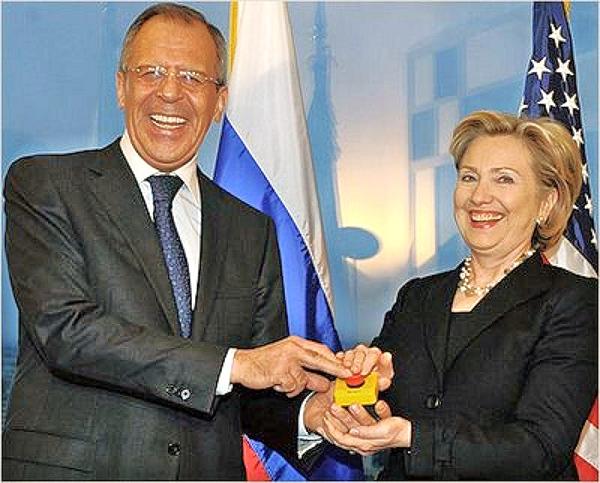
Thanks to Irene in (the comments to the previous post) for calling attention to that (as an illustration of my observation: "I take that to mean Kerry is weak and he knows it.")
And here's Hugh Hewitt, writing yesterday about the upcoming 5th anniversary of Hillary's reset button.
It is astonishing that so failed a figure would presume to seek the presidency but she is measuring herself against Joe Biden so that is a partial explanation. I have asked a number of pundits, reporters or elected officials to tell me what she accomplished in her long tenure at State....
६ डिसेंबर, २००७
A frightening mix of bodily fluids.
Former Bush communications adviser Dan Bartlett talks about blogs:
What about the blogs?Please don't regurgitate into the IV.
We had to set up a whole new apparatus to deal with the challenges they pose. Are they real journalists? ...
... If one of those journalists-turned-bloggers, Chris Cillizza, e-mails you to say he needs an interview, and at the same time one of the Post’s print reporters—say, Dan Balz—e-mails you and says he needs an interview, and you can do only one . . .
Balz.
Because the print edition of the Post has more of an impact?
Because Balz is on multiple platforms. He’s booked more easily on television. He’s read by more people. He influences people a bit more. Now, the question might not be as much Chris versus Dan as maybe, “Is it Dan Balz or one of the guys at [the conservative blog] Power Line?”
Yeah, or what if [conservative blogger] Hugh Hewitt called?
That’s when you start going, “Hmm . . .” Because they do reach people who are influential.
Well, they reach the president’s base.
That’s what I mean by influential. I mean, talk about a direct IV into the vein of your support. It’s a very efficient way to communicate. They regurgitate exactly and put up on their blogs what you said to them. It is something that we’ve cultivated and have really tried to put quite a bit of focus on.
१९ ऑक्टोबर, २००७
Hugh Hewitt talks to Clarence Thomas about religion, Jeffrey Toobin, blogs, jihadists, Black Power, Anita Hill, George Bush....
1. Does Catholicism affect his judging? Hugh Hewitt asks Clarence Thomas. Hewitt notes that Chicago dean Geoffrey Stone of Chicago has said that Catholicism infused the the Court's recent "partial-birth" abortion decision. Answer:
5. Hewitt asks Thomas if he's "aware of the war," which seems like a ridiculous question, but what he means is does the knowledge of the war affect his judging. But then, Hewitt poses a really insightful question:
7. Hewitt asks him if he likes George Bush:
Oh, no. In fact, it works just the opposite. My view is simply that the important thing that it pushes you toward is adherence to your oath, which is to judge impartially. And my view is once you start sort of putting your personal beliefs and opinions into the law, or into the Constitution, you cease to have legitimacy, and I don’t think you should be on the Bench. Now I find that fascinating, though, that people would say things like that, and in the same breath, what I get, is the criticism that I don’t judge as a black judge, you know?2. Thomas loved Justice White:
I’m supposed to somehow include my race in my judging, but the religion, you don’t include in your judging. I don’t think you should include either in your judging, and I don’t. And in sixteen years on the Bench, well, I’m one week short of sixteen years. But in the almost sixteen years I’ve been on the Bench on the Supreme Court, I have never done that. And in the more than sixteen I’ve been a federal judge, I have never done that.
I just loved the way Byron White conducted himself. I love the fact that he felt that the job was important, he felt that the Court was important, that the Constitution and our laws were important, but he wasn’t. that he was there to do his job and go home. And that’s what he did. He was just a good man.3. Has he read "The Nine"? No, and he won't, but he knows Hewitt didn't like it. Hewitt says he thought Jeffrey Toobin was "very unfair" to some of the Justices, the way he made the Court — after Bush v. Gore — look "dysfunctional," with "bitterness is going on and people are crying and crushed." Thomas:
I didn’t see anybody crying. And the last I can remember is that after we announced the opinion, we all went upstairs and had lunch.4. Hewitt asks Thomas if he reads the blogs! He says "no," then backtracks":
HH: He writes in there that the Court’s embarrassed by Bush v. Gore. Is that fair?
CT: I haven’t seen it (laughing). Look, I suffer from the disadvantage that I’m there every day.
HH: (laughing)
CT: I mean, this would all probably make more sense to me if I wasn’t there. I’ve not seen any embarrassment, I haven’t seen any dysfunctional, any evidence that the Court is dysfunctional. And so I can’t, I really can’t comment on something that’s not happening.
No….some of them. You know, occasionally I’ll read something, but not that much.Are the lawprof blogs really "public opinion"? This gets Thomas off the subject of blogs and back to the denial that he lets public opinion affect his decisions. But the law blogs contain legal arguments. Sometimes...
HH: And do your colleagues? Or are they still practicing Supreme Court jurisprudence the old fashioned way, via the briefs and not public opinion?
5. Hewitt asks Thomas if he's "aware of the war," which seems like a ridiculous question, but what he means is does the knowledge of the war affect his judging. But then, Hewitt poses a really insightful question:
HH: I was…when I was reading My Grandfather’s Son, I had an unusual question that I wrote down. Do you understand the jihadists who are these angry, young men, who are locked out of opportunity, who suffer discrimination of the worst sort, and who really have nowhere to go except into this sort of conflict?6. And Hewitt's got a theory about Anita Hill:
CT: Well, I can’t say that I understand them. I do know that for example in this country, and I make this point in the whole portion of the book in 1968, when I talk about being drawn into this whole notion of black power, and that is that you know, when you feel locked out, you do gravitate toward things that feel, that seem empowering. At least that’s the way it was for me. I can’t speak for others. And so this black power notion made you feel, it was invigorating, and it made you feel empowered. And it could also be debilitating, as I found out later, or self-destructive. But I can’t speak for them, but I know in my own case, it was sort of something similar to that, but not nearly as, I guess, as universal.
HH: I want to try out my theory on you, and maybe you can comment or not, but that she had told little lies to explain failures that got out of hand, and she had to defend them. Does that make sense to you?We don't get to hear his speculation, of course.
CT: That makes sense, but you know, again, I can’t, I have not gotten into whether or not…I could speculate, but I think it would probably, it would be remiss if I did so.
7. Hewitt asks him if he likes George Bush:
I admire anybody who stands up and leads. Now you can always disagree with a person here or there, but I admire anybody who gets in a position and actually tries to lead.There's some faint praise!
७ ऑगस्ट, २००७
"Did Scott Thomas Beauchamp lie under oath to U.S. Army investigators, or did he lie to his editors at the New Republic?"
Asks Michael Goldfarb:
It's also easy to see how The New Republic succumbed. The writing was sharp, the man was on the scene where he could witness important events, and he was speaking in a voice they wanted to project. Why weren't they more afraid of being duped? Was it because he was saying what they wanted to be true, giving weight to their arguments against the war? (Here's the lead story over there right now.) Maybe they thought they were protected from the suicidal blunder of getting taken in by another Stephen Glass because they were publishing the writing not as a news article but as a "diary."
Let's look back at Stephen Glass:
There's plenty of commentary following on the Goldfarb piece.
Like me, Mark Steyn thinks of Glass: "[TNR] made the same mistakes all over again - falling for pat cinematic vividness, pseudo-novelistic dialogue, all designed to confirm prejudices so ingrained the editors didn't even recognize they were being pandered to. But this time they did it in war, which is worse."
Roger L. Simon says: "Fact-checking, in my experience, is a big lie. It barely exists in the mainstream media."
Cathy Young is skeptical of the notion that TNR fell for Beauchamp because of his antagonism to the war:
On the left, one theory has it that the army coerced a false confession out of Beauchamp.
And John Cole somehow winds up "now, more than ever, convinced that a certain segment of the Republican party and the right wing blogosphere is certifiably insane." Okaaaay...
Responding on the right is Uncle Jimbo:
UPDATE: TNR responds:
THE WEEKLY STANDARD has learned from a military source close to the investigation that Pvt. Scott Thomas Beauchamp--author of the much-disputed "Shock Troops" article in the New Republic's July 23 issue as well as two previous "Baghdad Diarist" columns--signed a sworn statement admitting that all three articles he published in the New Republic were exaggerations and falsehoods--fabrications containing only "a smidgen of truth," in the words of our source.Amazing, but not really amazing. It's easy to see how things like this happen. Beauchamp is a gifted writer, with a point of view and raw material. If the Weekly Standard's report is true, it means that Beauchamp -- who could have published a novel, perhaps an excellent one -- is also a man who subverted his own work by calling it true and making it a lie -- not fiction, but a lie. The motivations are not hard to fathom. He gained access to The New Republic -- which gave him stature and an instant readership.
Separately, we received this statement from Major Steven F. Lamb, the deputy Public Affairs Officer for Multi National Division-Baghdad:
An investigation has been completed and the allegations made by PVT Beauchamp were found to be false. His platoon and company were interviewed and no one could substantiate the claims.According to the military source, Beauchamp's recantation was volunteered on the first day of the military's investigation. So as Beauchamp was in Iraq signing an affidavit denying the truth of his stories, the New Republic was publishing a statement from him on its website on July 26, in which Beauchamp said, "I'm willing to stand by the entirety of my articles for the New Republic using my real name."
It's also easy to see how The New Republic succumbed. The writing was sharp, the man was on the scene where he could witness important events, and he was speaking in a voice they wanted to project. Why weren't they more afraid of being duped? Was it because he was saying what they wanted to be true, giving weight to their arguments against the war? (Here's the lead story over there right now.) Maybe they thought they were protected from the suicidal blunder of getting taken in by another Stephen Glass because they were publishing the writing not as a news article but as a "diary."
Let's look back at Stephen Glass:
“My life was one very long process of lying and lying again, to figure out how to cover those other lies,” says Glass....Read that whole article: Glass went to some trouble to beat the fact checkers. Here's some analysis in The Columbia Journalism Review about how TNR fell for Glass:
Glass' main job was at The New Republic, a distinguished magazine with a 90-year history of publishing political and social commentary. It also has a reputation for discovering young, talented writers like Glass.
He was editor of his college newspaper at the University of Pennsylvania and joined The New Republic as an editorial assistant in 1995. Not long afterward he was assigned to write a story on an arcane piece of Washington legislation. He thought it needed sprucing up and a serial liar was born.
“I remember thinking, ‘If I just had the exact quote that I wanted to make it work, it would be perfect.’ And I wrote something on my computer, and then I looked at it, and I let it stand. And then it ran in the magazine and I saw it. And I said to myself what I said every time these stories ran, ‘You must stop. You must stop.’ But I didn't.”
“I loved the electricity of people liking my stories. I loved going to story conference meetings and telling people what my story was going to be, and seeing the room excited. I wanted every story to be a home run.”...
“Everything around him turned out to be incredibly vivid or zany or in some other way memorable,” says [TNR literary editor Leon] Wieselteir. “And at the meetings, we used to wait for Steve's turn, so that he could report on his next caper. We got really suckered.”...
“I would tell a story, and there would be fact A, which maybe was true. And then there would be fact B, which was sort of partially true and partially fabricated. And there would be fact C which was more fabricated and almost not true,” says Glass.
“And there would be fact D, which was a complete whopper. And totally not true. And so people would be with me on these stories through fact A and through fact B. And so they would believe me to C. And then at D they were still believing me through the story.”
[T]he truth is Glass gamed the system, and brilliantly. He'd often submit stories late to the checkers so they were pressed for time. When they questioned his material, [TNR editor Charles] Lane says, Glass would provide forged faxes on fake letterheads of phony organizations, as well as fictitious notes, even voice mail or actual calls from people pretending to be sources....Asking questions... and then blowing it, all over again. You'd think, after Glass, TNR would be exceedingly careful when confronted with vivid writing with great quotes and anecdotes. Yet somehow, it seems to have gotten less careful. There's this notion that war makes the soldiers crazy. Journalists love it. Beauchamp reinforced it. It appears that war makes journalists crazy.
Shouldn't all the unnamed sources, obscure organizations, and wild scenes viewed only by the writer have been another tip-off? "I've searched my soul and asked, "Why didn't my bullshit meter go off?" says Lane. "But it's hilarious. By the time I got there so many wild stories had run and seemingly stood up, I trusted him."
Some journalists see in Glass the dark side of a new magazine journalism that puts a premium on sensationalism and style....
But those who knew Glass insist that his story is more about one rotten apple. After all, many writers are under pressure and don't make stuff up....
If there is any value to the saga of what may be the biggest hoax in modern American journalistic history, it's that it has many journalists asking questions about their checking systems.
There's plenty of commentary following on the Goldfarb piece.
Like me, Mark Steyn thinks of Glass: "[TNR] made the same mistakes all over again - falling for pat cinematic vividness, pseudo-novelistic dialogue, all designed to confirm prejudices so ingrained the editors didn't even recognize they were being pandered to. But this time they did it in war, which is worse."
Roger L. Simon says: "Fact-checking, in my experience, is a big lie. It barely exists in the mainstream media."
Cathy Young is skeptical of the notion that TNR fell for Beauchamp because of his antagonism to the war:
Is I recall, Beauchamp was recommended to TNR by his fiancee Elspeth Reeve, a staffer at the magazine. It's not as if the magazine went looking for a soldier to write "Diarist" pieces. I do think that, to a large extent, Beauchamp was given a platform because he was someone the TNR editors saw as "one of us": a guy with a background in creative writing and journalism, as well as a Howard Dean supporter. I think it's also fair to say that the first Diarist piece, while not negative toward American troops in Iraq, showed them as mired in bleak and awful futility: at the end, Beauchamp reflects on his feelings of helplessness at his inability to protect the boy. So in that sense, it certainly fits into the current world-view at TNR. On the other hand, it could also be read as implying that if we withdraw from Iraq, we will leave the population in the hands of people who cut out children's tongues to make a point.Hugh Hewitt calls TNR editor Frank Foer "the Dan Rather of the political magazine world, a laughing stock caught up in trying to publicly maintain an obvious lie as truth." He wants a head to roll.
On the left, one theory has it that the army coerced a false confession out of Beauchamp.
And John Cole somehow winds up "now, more than ever, convinced that a certain segment of the Republican party and the right wing blogosphere is certifiably insane." Okaaaay...
Responding on the right is Uncle Jimbo:
So as it turns out US troops are not heartless barbarians and that far too many people on the left can't accept that. Well from one of those barbarians who just happens to have more humanitarian and disaster assistance work under his belt than any of the smirking elite sitting around the table at Franklin "Which way is the door?" Foer's editorial meetings, F**k you very much! You finished what Glass started, and may this serve as a lesson to the many other supposed honest media sources, your agenda is pitifully obvious and your tactics so childishly unsophisticated that I almost feel guilty smacking you around. But I will, and I hope it stings.Enough for now. Suffice it to say there's a big fight on.
UPDATE: TNR responds:
We've talked to military personnel directly involved in the events that Scott Thomas Beauchamp described, and they corroborated his account as detailed in our statement. When we called Army spokesman Major Steven F. Lamb and asked about an anonymously sourced allegation that Beauchamp had recanted his articles in a sworn statement, he told us, "I have no knowledge of that." He added, "If someone is speaking anonymously [to The Weekly Standard], they are on their own." When we pressed Lamb for details on the Army investigation, he told us, "We don't go into the details of how we conduct our investigations."Goldfarb responds to that:
(1) They neglected to report that the Army has concluded its investigation and found Beauchamp's stories to be false. As Major Lamb, the very officer they quote, has said in an authorized statement: "An investigation has been completed and the allegations made by PVT Beauchamp were found to be false. His platoon and company were interviewed and no one could substantiate the claims."
(2) Does the failure of the New Republic to report the Army's conclusions mean that the editors believe the Army investigators are wrong about Beauchamp?
(3) We have full confidence in our reporting that Pvt Beauchamp recanted under oath in the course of the investigation. Is the New Republic claiming that Pvt Beauchamp made no such admission to Army investigators? Is Beauchamp?
३० मे, २००७
"The rest of the Republican Party is like Kate Winslet, desperately trying to pry the McCain campaign's frozen clammy hand from our own..."
Analogies from the mind of Hugh Hewitt, which is seething with hostility for John McCain... in a post that's illustrated with a picture of a DVD box that does not contain "Titanic," because the "Titanic" box doesn't have a picture of a big, smoking gun.
Conservatives are not happy with the immigration bill -- if we may judge from this poll of 51 right-wing bloggers.
CORRECTION: It's Dean Barnett, writing on a blog called Hugh Hewitt. (I thought once you named the blog after yourself, you'd missed the chance to bring in a co- or guest-blogger. I impetuously named my blog after myself, without giving any thought to the matter, but I do find it confusing when there is a name in big letters at the top, but someone else is writing.)
Conservatives are not happy with the immigration bill -- if we may judge from this poll of 51 right-wing bloggers.
CORRECTION: It's Dean Barnett, writing on a blog called Hugh Hewitt. (I thought once you named the blog after yourself, you'd missed the chance to bring in a co- or guest-blogger. I impetuously named my blog after myself, without giving any thought to the matter, but I do find it confusing when there is a name in big letters at the top, but someone else is writing.)
२७ डिसेंबर, २००६
"Joe, you're 23.... Can you be expert in anything?"
Hugh Hewitt grills Joseph Rago, that (surprisingly young) guy who put down bloggers in the Wall Street Journal the other day. Hugh rakes him over the coals with practiced skill, and little Joe survives the ordeal better than you might think he could.
१४ फेब्रुवारी, २००६
Hillary Clinton: angry or robotic?
From the transcript of Hugh Hewitt's interview with -- don't call him pundit! -- Jonathan Chait (via Insta-bestower-of-opinion):
HH: Okay. And yesterday's column is entitled "An Angry Hillary Suits the GOP. That's because Republicans have to open up a new line of attack for a female candidate." Let's put the proposition out there. You don't think she's angry?From the linked article by Chait:
JC: I think she's the opposite of angry. I think she's robotic, passionless, dull. Just on the surface, she just comes across as anything but angry. She comes across as someone who would just you know, put you to sleep, and sounds like she's about to go to sleep herself when she's speaking. Just sort of substantively, she has come to the Senate and just made best friends with all her enemies, and she's smiling and patting them on the back, and they're saying nice things about here. So she doesn't really seem to be someone whose motivated by anger in any way. So I think the whole charge is weird.
[Y]ou can't very well run against a female candidate by calling her unmanly. So the best substitute is to call her unwomanly instead. Rather than act perky and cheerful, she's angry. There's a bad word that's supposed to spring to mind when you think of her, and it begins with the letter "b."Yeah, well, calling a woman "robotic" and "passionless" is also a way of slamming her as unwomanly. The unsaid word in this case is "frigid."
याची सदस्यत्व घ्या:
पोस्ट (Atom)


 पोस्ट्स


