People always say the movie lacks the depth and character development of the book, but complaining about food is funny.
As for the lack of sex... Maureen Dowd wrote about that in "Nolan’s Zero-Eros 'Odyssey'" (NYT gift link): "In keeping with Gen Z’s waning interest in sex, the poem’s famous sex scenes have been excised, sapping erotic power from the female characters.... Nolan did not want his Odysseus betraying Penelope and enjoying his sojourns with other women. The director completely cut out the young princess Nausicaa, whom Homer’s Odysseus has a flirtation with, and neuters the text’s sexual encounters with Circe and Calypso...."
"You see that in the scene with Circe where the men are turned into pigs.... These men get addicted to eating and then she physically manipulates their bodies into the bodies of pigs.... thematically pretty interesting. And the idea is that he has to violate Zeus's law essentially one last time.... The thematic, I think, is kind of great...."
Says Ben Shapiro, strongly praising "The Odyssey," and not just because it has "very conservative messaging."
Midway through the long review, Ben turns to the supposed flaws conservatives have been talking about.
"... and the experience of pain and longing. Among the major gods, only Athena is personified (by an ethereal Zendaya), but she is not the warrior goddess of the poem. She is more like a projection of Odysseus’s own conscience, materializing the way an angel might land on one’s shoulder. She represents his desire for goodness, home, and order. (In the scenes of Troy’s sacking, we return to a repeated image of Athena’s statue being beheaded, the ultimate violation.) This is all very far from the dominant film depiction of Greek mythology that I remember from my own childhood, 1981’s Clash of the Titans, in which the gods hang out together in togas on Mount Olympus, with Laurence Olivier as Zeus dictating much of the action."
Zakaria’s is not another exercise in declinism. His point is not the demise of Gulliver, but the "rise of the rest.”... The real problem, Zakaria argues, is the rise of China.... Authoritarian modernization just hums along. The Party’s message reads "Enrich yourselves, but leave the driving to us,” and most of 1.3 billion Chinese seem happy to comply — and to consume. With power safely lodged in the Politburo, China does not conform to the historical pattern of "first rich, then rowdy,” which led to Tokyo’s and Berlin’s imperialist careers.....
Wrote W.H. Auden in the poem "Moon Landing," published in The New Yorker September 6, 1969. Here's the facsimile page for subscribers. But anyone can read it here.
I ran across it just now because, writing about a perfectly healthy woman who'd undergone assisted suicide, I'd stumbled across a 2011 piece in The New Yorker that brought up the word "meh," which naturally sent me to the OED.
According to its etymology page, "meh" probably came from the Yiddish word "me" — which means "be it as it may, so-so" — and, we're told, "It is unclear whether there is any direct connection with (earlier) mneh."
The OED's quote for "mneh" was what you see in the post title, W.H. Auden, in 1969, poetically dumping on the trip to the moon.
"Stephen King is susceptible to artificial intelligence. Danielle Steel is even more susceptible to artificial intelligence. The worse the writing, the more susceptible it is to artificial intelligence. I was talking to Salman Rushdie in Frankfurt, and he told me that someone had instructed ChatGPT to write a page of Rushdie. He said it was hilariously inept. I’ve had a couple of anxious emails from authors saying should I be concerned about artificial intelligence. It’s out there, and no one knows quite how to deal with it, but it’s not relevant to the people that we represent. It is relevant to other people who tend to be very popular."
I'm amused by Wylie's blithe snobbishness: That's got nothing to do with those of us who deal in literature.
I asked ChatGPT to write a blog post in the style of Salman Rushdie and assigned a topic — the subject of the previous post on this blog — home schooling. Here's the result, which I presume Rushdie would find hilariously inept:
Me: "What are some examples in literature of a person being told not to go somewhere, as if it would be dangerous, when in fact it would be beneficial to that person to do what he is being warned against? "
"... which many readers secretly consider a necessary evil. Even the very best produces a lingering frustration, an irritable awareness that we didn’t get what we came for. If translation is like sex, it often leaves us with a case of epididymal hypertension, or, in the vernacular, blue balls.
One of the worst things about a bad translation is that it’s unforgettable. The Pre-Raphaelite artist, designer, and utopian socialist William Morris took a run at Homer in 1887 and hit the wall hard. 'Tell me, O Muse, of the Shifty,” his translation of the Odyssey begins, “the man who wandered afar,/After the Holy Burg, Troy-town, he had wasted with war.'"
I saw Wired's promotion of the article on Twitter 2 days ago (2 members of my family independently shared this with me, so it must be my kind of raw material):
With a remarkable blend of intellect and empathy, Pete Buttigieg brings a fresh perspective to the forefront of public discourse. https://t.co/mzbXgnvkSv
Did I miss my chance to get in on the early mockery action or was I right to stop myself — because this thing might be brilliant writing? Is this something in the Hunter S. Thompson/Tom Wolfe tradition?
Legal Insurrection quotes the first, second, and fifth paragraphs and comments "It's so over the top." Yeah? And did the writer go over the top for a reason and with exciting, interesting words? Let's read the first 2 paragraphs and keep in mind that this might be great writing:
"One can imagine a Borgesian fable in which a fatiguologist, bent upon covering every aspect of the topic, dies of sheer inanition with the project incomplete. The more encyclopedic the mission, the stricter the boundaries that need to be set; if you’re expecting 'A History of Fatigue' to begin with the Iliad—whose protagonists are pre-wiped, having battled for nine years before the action of the poem gets under way—you are doomed to disappointment. Nothing about the ancient world, it would seem, appeals to Vigarello. He doubtless believes that everyone back then was brimming with juice and zip, and that if Achilles harried Hector three times around the walls of Troy it’s because both guys needed the exercise."
And I learned a word... or, at least, "inanition" seems like a new word to me. It is — according to the OED — "The action or process of emptying; the condition of being empty; spec. the exhausted condition resulting from want or insufficiency of nourishment."
I checked the 19-year history of this blog, and "inanition" did appear once. It was in a quote from... you could almost guess and have a good shot at getting it right...
Wikipedia explains at "Sardonicism," to which I was redirected when I clicked on the words "sardonic grin" in the caption "Sardo-Punic mask showing a Sardonic grin" under this riveting image:
I found that at the Wikipedia article "Punic people,"
which I was reading because the letter combination "punic" had arisen in the course of talking about a particular word puzzle.
"Or we may just be drawn to possibility itself, as in the poem 'The Road Not Taken': when Robert Frost tells us that choosing one path over the other made 'all the difference,' it doesn’t matter what the difference is... In the Iliad, Achilles chooses between two clearly defined fates, designed by the gods and foretold in advance: he can either fight and die at Troy or live a long, boring life.... But the world in which we live isn’t so neatly organized. Achilles didn’t have to wonder if he should have been pre-med or pre-law; we make such decisions knowing that they might shape our lives.... As Sartre says, we are who we are. But isn’t the negative space in a portrait part of that portrait? In the sense that our unled lives have been imagined by us, and are part of us, they are real; to know what someone isn’t—what she might have been, what she’s dreamed of being—this is to know someone intimately. "
This is a subject I raised a few days back, on the blog here. Do you have a "road not taken" point in your past — a particular moment? Do you question your fixation on that moment or do you find present-day meaning in the way that is preserved in your mind? It's not that there was a fork in the road, but that your life in its entirety is a fork, and you still have that fork.
ADDED: I have a post from 2007 called "The Road Not Taken." It's about a day I spent as a docent in a Frank Lloyd Wright gatehouse that has the inscription over the fireplace: "Taken the road less traveled by/That has made all the difference." (The precise Frost line is "I took the one less traveled by/And that has made all the difference.")
... you can write whatever you want... within reason.
I couldn't get a sunrise picture today, because it rained, and it rained all day, so it's a good day to use the Althouse Portal to Amazon. The warmer weather is here, and we bought 2 of these Bionaire window fans (which the NYT rated as by far the best window fan).
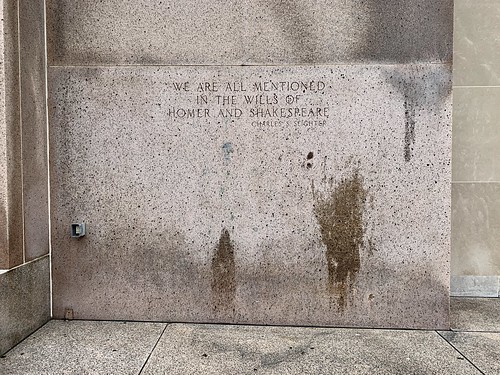
1. "Do you read Homer? 'Cause, maybe it ain't Shakespeare, but it *is* Homer" (Unknown).
2. "It's a mythos of sorts, if we wanted to get all sophisticated Joseph Campbell and the hero's journey, what makes a hero — are they born or just rise to the occasion?" (narciso, with typos corrected).
3. "Ann, the reason is people are more [unintelligent] than they were in times past" (wild chicken, with rude term censored).
4. "Dreams of our youth. The military adventure, the hot girl who finally agreed to a date, the university for finding answers, hitchhiking across the country, getting into a fist fight, making money, all ended in disappointment. Why the hell does anyone go to [a movie], especially romantic movies? An escape from the disappointment with our dreams" (Limited Perspective).
5. "My best guess is that Robert Downey Junior, who riffs on the tough [sci]-fi actors of the 60s, and the other highly paid actors who portray silly superheroes, are to the 2010s what Dylan, who riffed on the tough Delta Basin singers of the 30s, was to the 1960s. When a trained actor like Downey filters an older art form, to the kids who are watching, that is ancestor worship. They don't know they are getting something that is not quite the original. They are impressed by the backstory. (Tolkien pulled this trick in the Hobbit and the Lord of the Rings, in a different way - making you think that there was some great archetypal background to a story about a bunch of simple little Victorian hobbits running around a landscape, seeking to do good and defeat evil). I think that the superhero movies mostly sell to people in their 30s and below, which makes sense - not that they are kids, but compared to someone like Downey, who was an adult in the early 1980s, when all sorts of great actors and actresses, now long gone, were still alive --- well, they (people in their 30s) actually are kids, more or less. Hence, while 'Ironman' may be a joke to me, someone who is older than Downey, to them it is something like art. Also who does not like to eat movie theater popcorn and drink huge sodas?" (Anonymous).
6. "There is a (Super-Hero) shaped vacuum in the heart of every man which cannot be filled by any created thing, but only by God, the Creator, made known through Jesus" (Ingachuck'stoothlessARM).
7. "I’m with Althouse, I don’t understand the appeal of these superhero movies either. Wife and I just finished binge watching 'Les Miserables' on PBS app and it was wonderful, great performances by Dominic Wast and Lily Collins, and perfect sets and costumes. You would literally think you were in 1830s France. Now watching season 5 of 'Bosch' on Amazon. Nothing in theaters as good as these shows" (MountainMan).
8. "I wholeheartedly agree. 47 years ago, I devoured all the Marvel comic books (cost .20/each), learned how to read and loved them all (Silver Surfer, The Hulk, Iron Man, Captain America, et seq.) As an adult nearly 50 years later, watch these loud ass movies with teens at some multiplex? Bah" (Bay Area Guy).
9. "Some of the appeal has to be in the archetypes. Hulk is a comic representation of Dr. Jekyll and Mr. Hyde, for example ... and that story is about the duality of man. Civilization vs. barbarism. Jordan Peterson has a lot to say about archetypes in storytelling, and why they resonate so strongly with us" (Pianoman).
10. "For many of us, we grew up reading about these characters, and still love them. For others it the attraction is the story, a story as old as man himself...good guys versus bad guys and the good guys win. How could they possibly hold your interest? The same way women are fascinated by Harlequin romances and Fifty Shades of Grey. Who wouldn't want to be Tony Stark...rich, witty, super-smart and attractive to women. Or Captain America? Or Thor? The women in this universe are all smart, successful and heroic too. I’m genuinely mystified by this aspect of our culture. Don't look now, but your elitism is showing. At least you didn't call it deplorable" (Gahrie).
I'll go to 11 for Ice Nine: "Jeez, Ann, duh! Big explosions, and awesome car chases and crashes, and super cool magic flying guys, and hot shit outfits, and really easy to follow plots, and...Oh, you said 'adults' didn't you. Sorry."
"... not Greece, the civilization, though you’ll also hang with Aristotle, Aeschylus, Thucydides and the rest of the gang. There’s no choice in the matter. There’s little choice, period. Let your collegiate peers elsewhere design their own majors and frolic with Kerouac. For you it’s Kant. You have no major, only 'the program,' an exploration of the Western canon that was implemented in 1937 and has barely changed."
Bruni takes care to say "The degree to which “the program” omits the intellectual contributions of women and people of color troubles me." But clearly he loves the school, which he visited. He noticed 3 "dynamics":
-changed the oil -- myself -- on the 2001 Explorer.
-learned how to make a darn good Alfredo sauce.
-read both "Iliad" and "Odyssey."
-hired a guy to do some yard work I've been putting off.
Have you done better? Your immediate response will be to say "Yes!", but then look at the bullet points again, especially the one where I changed the oil in the 2001 Explorer. By myself.
Also in the comments Leslie Graves wrote: "Who would be on the cover of Time this year if the Koch acquisition had already taken place?"
Meade answers that question: "Someone born November 27, 1953 in Norfolk, VA maybe?"
Google tells me Meade is talking about Steve Bannon. That brings up 2 points:
1. Why would the Kochs want to highlight Bannon? The Kochs don't like Bannon publicly, but Bannon was instrumental in getting Trump elected and he's gone now. The Kochs haven't publicly liked Trump either, but as Bannon famously said: “If Pence were to become President for any reason, the government would be run by the Koch brothers—period. He’s been their tool for years... I’m concerned he’d be a President that the Kochs would own" (quoted in "The Danger of President Pence" in The New Yorker).
2. In yesterday's post, I expressed suspicion that Time did have the idea of making Trump Person of the year again this year, but only as a co-winner, and pairing him with someone in a negative way, which is what Time did to Bill Clinton in 1998 (making him co-Person with Kenneth Starr). Now, I'm seeing that the co-winner could very easily have been Steve Bannon.
Text here. I haven't listened/read yet, but I'm going to do both right now and I'll add to this post as I do.
ADDED: In the first sentence, Bob accepts that task implied by the prize, "wondering exactly how my songs related to literature." He shows his wondering, "in a roundabout way."
1. When he was 18, he saw Buddy Holly in concert, and he saw in Buddy "[e]verything I wasn't and wanted to be." The in-concert feeling was "electrifying." It wasn't just the words but the entire "presence" of the man and the music. Buddy "looked me right straight dead in the eye, and he transmitted something." Buddy passed on his powers, and then Buddy passed on out of this world.
2. Bob got a copy of a Leadbelly recording of "Cottonfields," and that "transported" him, as if he'd been "walking in darkness and all of the sudden the darkness was illuminated. It was like somebody laid hands on me." He doesn't say religion, but he uses the language of religion. He's a convert to folk music. It's "more vibrant and truthful to life" than the "radio songs" he grew up with. He starts to play: "By listening to all the early folk artists and singing the songs yourself, you pick up the vernacular. You internalize it."You get to "know that Stagger Lee was a bad man and that Frankie was a good girl." Bob absorbed "all the devices, the techniques, the secrets, the mysteries" and, as he wrote songs, figured out how to "make it all connect and move with the current of the day."
3. He credits "typical grammar school reading" for giving him "principals [sic!] and sensibilities and an informed view of the world." He lists Don Quixote, Ivanhoe, Robinson Crusoe, Gulliver's Travels, and Tale of Two Cities, but he wants to talk in depth about 3 works of literature, Moby Dick, All Quiet on the Western Front, and The Odyssey.
4. Moby Dick—"Everything is mixed in. All the myths: the Judeo Christian bible, Hindu myths, British legends, Saint George, Perseus, Hercules – they're all whalers. Greek mythology, the gory business of cutting up a whale. Lots of facts in this book, geographical knowledge, whale oil – good for coronation of royalty – noble families in the whaling industry... We see only the surface of things. We can interpret what lies below any way we see fit." What's that Bob Dylan song with Captain Ahab, I start wondering, but it's hard to search for at bobdylan.com because in the song — "Bob Dylan's 115th Dream" — it's Captain Arab (but I called it up by searching for "collateral," remembering, as I did, the line "They asked me for some collateral/And I pulled down my pants").
5. All Quiet on the Western Front — "You don't understand why the war isn't over. The army is so strapped for replacement troops that they're drafting young boys who are of little military use, but they're draftin' ‘em anyway because they're running out of men. Sickness and humiliation have broken your heart. You were betrayed by your parents, your schoolmasters, your ministers, and even your own government.... You've come to despise that older generation that sent you out into this madness, into this torture chamber.... Then a piece of shrapnel hits the side of your head and you're dead. You've been ruled out, crossed out. You've been exterminated. I put this book down and closed it up. I never wanted to read another war novel again, and I never did." Bob doesn't come out and say, and that's where I got my protest music. He says: "Charlie Poole from North Carolina had a song that connected to all this. It's called 'You Ain't Talkin' to Me,'" and he quotes those lyrics, protest song lyrics.
6. The Odyssey — the story of "a grown man trying to get home after fighting in a war." "He's a travelin' man, but he's making a lot of stops," says Bob, gesturing at but not naming Ricky Nelson, whose song "Travelin' Man" begins "I'm a travelin' man, I've made a lot of stops, all over the world." Bob talked about that song in his memoir "Chronicles: Volume One": "One afternoon I was... pouring Coke into a glass from a milk pitcher when I heard a voice coming cool through the screen of the radio speaker. Ricky Nelson was singing his new song, 'Travelin’ Man.' Ricky had a smooth touch... He sang his songs calm and steady like he was in the middle of a storm... I had been a big fan of Ricky’s and still liked him, but that type of music was on its way out. It had no chance of meaning anything. There’d be no future for that stuff in the future." Ricky sang those "radio songs" (see #2, above). Bob identifies with the travelin' man Odysseus. He speaks of himself in the second person: "You too have had drugs dropped into your wine. You too have shared a bed with the wrong woman. You too have been spellbound by magical voices, sweet voices with strange melodies... You have angered people you should not have. And you too have rambled this country all around. "
7. Bob asks: "So what does it all mean?" But he won't say what it means: "I've written all kinds of things into my songs. And I'm not going to worry about it – what it all means. When Melville put all his old testament, biblical references, scientific theories, Protestant doctrines, and all that knowledge of the sea and sailing ships and whales into one story, I don't think he would have worried about it either – what it all means."
8. Bob just wants to be alive, like Achilles, who told Odysseus that it's no good being dead: "And that if he could, he would choose to go back and be a lowly slave to a tenant farmer on Earth rather than be what he is – a king in the land of the dead – that whatever his struggles of life were, they were preferable to being here in this dead place." Bob doesn't mention it, but he's got a song called "Temporary Like Achilles." ("Achilles is in your alleyway/He don’t want me here, he does brag/He’s pointing to the sky/And he’s hungry, like a man in drag...").
9. Bob began "wondering exactly how my songs related to literature," and he ends saying "songs are unlike literature." "They're meant to be sung, not read." They're "alive in the land of the living."
The NYT has an article on Richard F. Thomas, "who has been gently teased by colleagues for teaching a freshman seminar about Bob Dylan."
Mr. Thomas uses the course, simply called “Bob Dylan,” to put the artist in context of not just popular culture of the last half-century, but the tradition of classical poets like Virgil and Homer....
There’s a stanza that goes: “I’m gonna spare the defeated — I’m gonna speak to the crowd/… I’m goin’ to teach peace to the conquered/I’m gonna tame the proud.” That’s pretty much a direct quote of lines spoken in the “Aeneid” by the ghost of Aeneas’s father, Anchises, who he sees in the underworld, and who basically says to him: “Other people will make sculpture. Your art, your job as a Roman, is to ‘spare defeated peoples, tame the proud.’”...
[H]e’s like Virgil or Ovid: someone who came late enough in the tradition and has enough tradition behind him — T. S. Eliot wrote about this — that he can control it and also be part of it, recreating and refreshing it.I don’t see any difference between a poet like Catullus or Virgil and Bob Dylan. I think they are doing the same things. It has to do with control of language, connecting of lyrics and melodies. That’s what makes it timeless....
I like that Thomas has never met Bob Dylan and doesn't see much need or even value to talking to him: "Whatever I asked him, he wouldn’t tell me. Dylan is very careful at controlling what he gets asked."
I agree. We were talking about something like that yesterday, and I was saying I didn't have any kind of feeling of wanting to know Bob Dylan personally. The Bob Dylan that matters to me comes through the art. That's the direct experience. No reason to want to go around that to get somewhere else when you're already here.
Well, I really like Professor Thomas and his Virgil-and-Ovid comparisons. I'm not going to criticize him. But seeing this article made me think the Nobel Prize is going to motivate and justify a lot of other teachers to build courses around Bob Dylan, to speak about him in lofty tones, and to impose him on the young. I'm picturing a lot of aging, self-indulgent professors devising their Bob Dylan courses....
ADDED: Here's Thomas's article "The Classical Dylan." Excerpt:
Like Dylan, Virgil was accused of plagiarism. There is an anecdote in Suetonius’ Life of Virgil 46 on the poet’s response to the critics’ charge of plagiarizing Homer: “Why don’t they try the same thefts? They’ll find out it’s easier to snatch Hercules’ club from him than a single line from Homer.” Dylan successfully stole three from Virgil, embracing T. S. Eliot’s maxim “immature poets imitate; mature poets steal.” Poems that are layered with intertexts reveal depths of meaning through our recognition of those texts as we import other contexts that work together with new images, metaphors, and other poetic or musical effects. That is true of Virgil, Dante, Milton, and as we saw, it was true of “Lonesome Day Blues” and much else on Love and Theft. This way of writing indeed seems to be particularly a feature of the mature Dylan, starting with Time Out Of Mind. In his December 5th, 2004, 60 Minutes interview he says of “It’s Alright, Ma,” “I don’t know how I got to write those songs.” When asked if he can still write like that he replies that he cannot: “I did it once, and I can do other things now. But, I can’t do that.”
... you might consider taking a much more dramatic approach to covering that text...
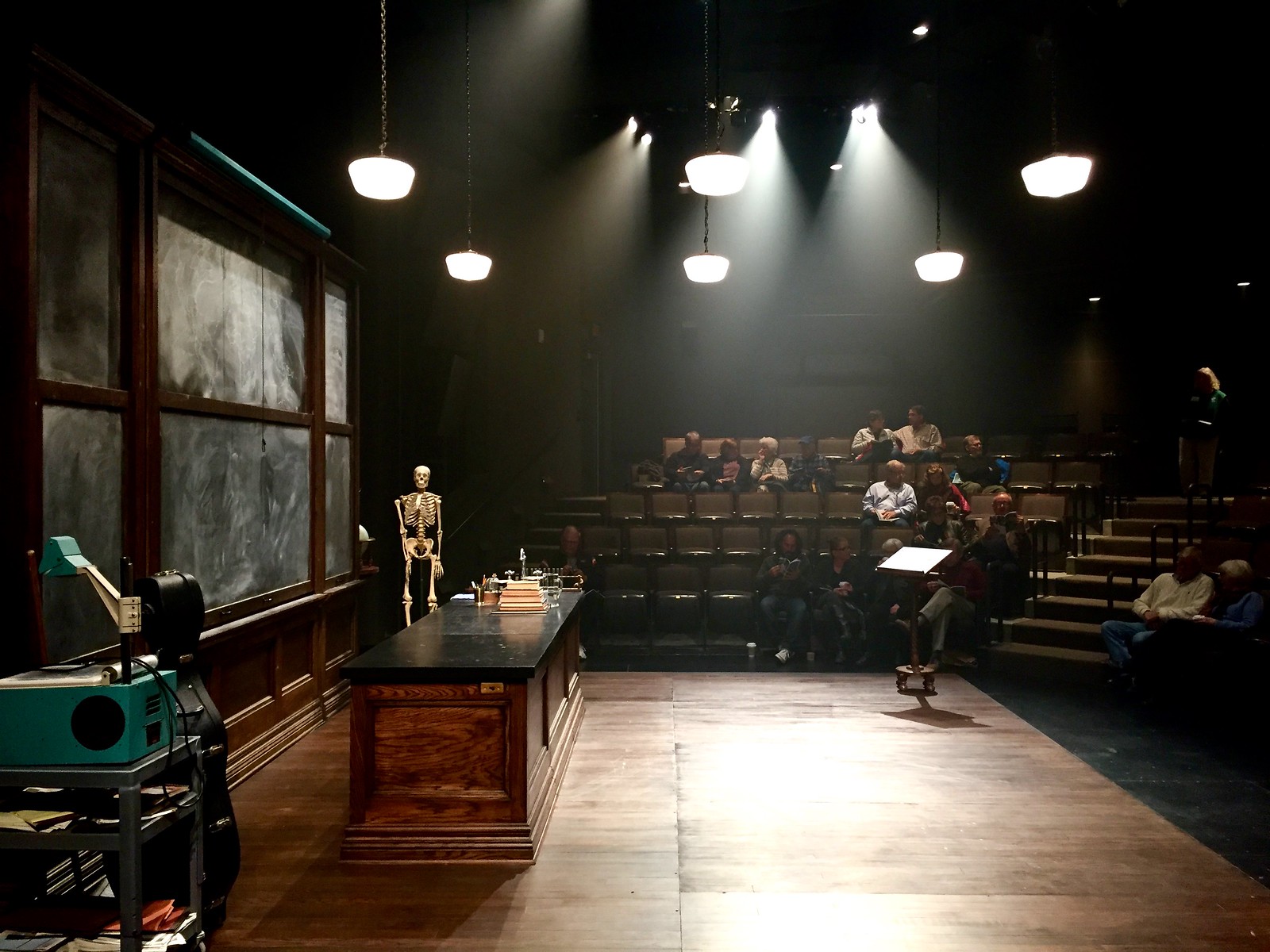
ADDED: This is the set of the play we saw last night, "An Iliad." Here's the text of the play, which I just bought for myself, because I want to go over it again. As for this wonderful production, which some of the commenters on this post have seen and are talking about, here's the description at the American Players Theater website:
This is a story you may think you know; a grand classic born on the backs of gods and warriors. But... Homer’s epic is razed and reborn through the heart of a war-weary poet (Jim DeVita, at his best both in this place and in this role). Bathed in bravery, blood and the heat of battle, the telling ravages our Poet every time. But there’s a reason he’s got the job. He may be able to make us understand. Maybe make us stop. History’s greatest battle whetted to a razor-sharp edge in a stunning night of theater....
Run time: 1 hour and 50 minutes. An Iliad will be performed without an intermission.
The actor's sheer endurance was impressive, and there was no loss of energy at any point. Using the smallness of the classroom — and its tiny props — to represent the arena of the Trojan War by some miracle created the sense that this war was all wars and one death (Hector's) was all deaths. Little things became big. A postcard burnt with a lighter became the burning of Alexandria. (I had to restrain myself from shouting "Fire!" — truthfully — in a crowded theater.) I am, you may know, drawn to the mysteries of relative size — here's my "big and small" tag — and I cannot, after 64 years of life, really get my mind around largeness. So it was extremely significant to me to see the large things explained in tininess, such as sand poured on a small tabletop to represent the final encounter between Hector and Achilles, played out in wiggling fingers.
I am a participant in the Amazon Services LLC Associates Program, an affiliate advertising program designed to provide a means for me to earn fees by linking to Amazon.com and affiliated sites.
Encourage Althouse by making a donation:
Make a 1-time donation or set up a monthly donation of any amount you choose:




 Posts
Posts


