Showing posts with label Hobbes. Show all posts
Showing posts with label Hobbes. Show all posts
October 17, 2025
"Sparked by a 2022 Twitter commenter who asserted that 'Yeah, Anne Frank had white privilege,' it reimagines Anne as 'Anita' — a pansexual Latina hiding from the Nazis..."
"... in a radically inclusive attic with her militant black mother, her neurodiverse father and assorted other disordered personalities.... For Peter, Anita’s love interest, the real challenge isn’t evading the Nazis; it’s daring to live your authentic self. Before coming out as non-binary, he laments to Anita: 'Outside, they’re fighting a war, but in here, I’m fighting expectations!'.... [T]he show’s real target isn’t Jews (or Nazis, for that matter) but the performative politics that have come to infect so much of cultural life...."


April 12, 2025
"Is there footage of this thing gasping for breath for two minutes before expiring? I need some light comedy before bed."
Says one commenter on "SC cop killer Mikal Mahdi chose upscale final meal before he was executed by firing squad" (NY Post).
And there is this, from Mahdi's lawyer: "Faced with barbaric and inhumane choices, Mikal Mahdi had chosen the lesser of the three evils.... Mikal chose the firing squad instead of being burned and mutilated in the electric chair, or suffering the lingering death on the lethal injection gurney."
That "the lesser of 2 evils" is a very common phrase and "the least/lesser of 3 evils" feels new is evidence of our tendency to see our choices as binary.
And there is this, from Mahdi's lawyer: "Faced with barbaric and inhumane choices, Mikal Mahdi had chosen the lesser of the three evils.... Mikal chose the firing squad instead of being burned and mutilated in the electric chair, or suffering the lingering death on the lethal injection gurney."
Having given you 2 sides of the death penalty issue, I will take the liberty to turn the topic to grammar — the lawyer's grammar. You shouldn't say "the lesser of three evils." It's correct to say "the lesser of 2 evils," but "lesser" is used when there are only 2 things. If there are more than 2, you've got to use "least" — "the least of 3 evils."
For the annals of Things I Asked Grok:
February 16, 2025
"The only way to deal with an unfree world is to become so absolutely free that your very existence is an act of rebellion."
Wrote Albert Camus, in my favorite of the 8 responses I got when I asked Grok "List similar quotes to 'He who saves his Country does not violate any Law.'" (The quote is something Trump put up, without context, on Truth Social.)
Is that a "similar" quote? Eh. "Similar" is a weak word. What's not "similar"? And what does it mean to "save" your country?
Here are the other 7 quotes:
November 27, 2023
An ambiguous "ought" in The New Yorker's "Why Trump’s Trials Should Be on TV."
This is an opinion column — subtitled "The conduct of the trials, their fairness, and their possibly damning verdicts will be at the center of the 2024 election. Transparency is crucial" — by Amy Davidson Sorkin.
I agree that the trials should be televised, as I wrote in "The ACLU sides with Trump: The gag order is unconstitutional" (October 26, 2023) and — quoting Trump's lawyers — "The prosecution wishes to continue this travesty in darkness. President Trump calls for sunlight" (November 11, 2023).
I agree that the trials should be televised, as I wrote in "The ACLU sides with Trump: The gag order is unconstitutional" (October 26, 2023) and — quoting Trump's lawyers — "The prosecution wishes to continue this travesty in darkness. President Trump calls for sunlight" (November 11, 2023).
Here are the last few sentences of the column:
There is apprehension about what [Trump] might say, and what his supporters might then do if they heed him.... Yet to believe that allowing the country to watch as Trump takes the stand would be more of a threat to the Republic than it would be to his defense is to accept his own myths about himself. The evidence against Trump ought to stand up to scrutiny far better than he will. Everybody should see that. Trump isn’t camera-shy; prosecutors have no reason to be, either.
Now, I know very well which of 2 possible meanings of "ought" Sorkin intended.
May 17, 2022
Ketanji Brown Jackson loves "Survivor" — calls it "the best show ever."
Why? — asks the Washington Post interviewer.
Answer:
Because it’s like a social experiment. It’s human nature, what do people do when they’re starving and how do they react to one another? It’s like this Hobbesian state of nature: How are we going to deal with this situation? I love it.
It really isn't a Hobbesian state of nature, though. If it were a Hobbesian state of nature, the tribes wouldn't be taking votes and eliminating competitors one by one in a strategic way with notion that one person would win a pile of money to take back when the game ends after a known, set number of days. If it were a Hobbesian state of nature, one tribe could raid another and kill them all, and you'd want to keep the best competitors around to help you as the game of survival would go on until you reached the only exit possible: death. There would be no bags of rice to tide you over, no sudden infusion of Applebee's calories. There would be bloody violence and no medical personnel to swoop in. There would be rape. And babies.
But it's my favorite TV show too. It's a wonderful game that shows something about how people attempt to find order within a group as they pursue an utterly selfish goal. But I would think a judge would see how much law there is.
(I'm not really knocking the judge. I'm sure that she realizes all the things I've said here and that if I were talking to her in person about "Survivor," we'd have a great conversation. And then she'd plot to vote me off the island.)
October 23, 2021
"In the Hobbesian formula, the Leviathan relies upon fear to suppress pride. It is pride that makes men difficult to govern."
"It may be illuminating to view our Covid moment through this lens and consider how small moments of humiliation may be put in the service of a long-standing political project, or find their meaning and normative force in it. Specifically, to play one’s part in Covid theatre, as in security theatre at the airport, is to suffer the unique humiliation of a rational being who submits to moments of social control that he knows to be founded upon untruths. That these are expressed in the language of science is especially grating. We need to consider the good faith intellectual positions that greased the skids for our slide into an illiberal form of governance. For, in addition to the political opportunism surrounding Covid, there were also well-meaning efforts to control the pandemic by altering people’s behaviour. The question is: what were the means employed for doing this, and what was the view of human beings that made such means attractive? What we got, in the end, without anyone really intending it, may fairly be called a propaganda state that seeks to manipulate without persuading...."
"The new public health despotism/Draconian rules are suppressing our humanity" by Matthew B. Crawford. There's much more at the link, but let me give you a little more below the fold:
"The new public health despotism/Draconian rules are suppressing our humanity" by Matthew B. Crawford. There's much more at the link, but let me give you a little more below the fold:
October 7, 2018
"Physical assault definitely violates most society's [sic] idea of a moral order, which perhaps explains why aggression plays some kind of role in most humor."
"Freud theorized that humor serves as a way to dissipate sexual or aggressive tension in a socially acceptable way. Thomas Hobbes argues in the Leviathan that laughter arises from feeling superior, and that it's an extension of a feeling of 'sudden glory' arising from recognizing someone else's comparative defect or weakness.... The brain gets its wires crossed when confronted by someone else getting hurt. As a pain-filled situation unfolds, a witness doesn't experience the negative emotional valence that the person in pain does, but the brain still registers an emotional arousal. It can mistakenly categorize the sudden spike in emotion as positive....."
From "FYI: Why Is It Funny When A Guy Gets Hit In The Groin?" — a 2013 Popular Science article — which I'm reading this morning after blogging about last night's "SNL" cold open which featured "Joe Manchin" punching "Chuck Schumer" in the balls. There was a lot more in that sketch, and I didn't find any of it too funny, but in the comments to my post, Meade wrote: "in this era of That's Not Funny, at least we still have male-on-male sexual assault to laugh at."
Is hitting a man in the balls a sexual assault? It depends on the meaning of "sexual." I remember the definition of "sexual behavior" used by Rachel Mitchell (the prosecutor) in questioning Brett Kavanaugh. It specified the outward behavior and excluded intent. If you were doing the behavior — e.g., rubbing your clothed genitals against another person's clothed genitals — it didn't matter if you weren't doing it for sexual gratification. It could be mere "horseplay," and it would be "sexual behavior." That's adopting a broad view of "sexual," and that was done, I think, to take the perspective of the person on the receiving end of the behavior.
What about the man on the receiving end of a hit in the balls? First, are we talking about real life or a comedy scene? Getting hit in the balls is extremely common in comedy — it has a TV Tropes article* — and that's one reason to avoid it. But let's think about whether it should be avoided because it's not taking sexual assault seriously. We don't laugh to see a woman hit in the genitals. I don't think I've ever seen that used in comedy. It's not a cliché, but why isn't it a hilarious twist on the old cliché? We know it's not. Violence against women! And now, remember the 1970s feminist ideology about rape: It's a crime of violence, not sex. Rapists are not doing something sexual. See how that fits with Rachel Mitchell's definition of "sexual behavior."
Now, let's get back to the Popular Science article:
_____________________________
* It was all the way back in 1995, that "The Simpsons" was trying to instruct us that this form of humor is so bad that only Homer Simpson is laughing:
ADDED: A reader sends a link to this example of a woman getting kicked in the crotch:
"King of the Hill" felt it could get away with that, I suspect, because: 1. It's a cartoon, 2. The woman is portrayed as stronger than men (not having balls is a super-power).
From "FYI: Why Is It Funny When A Guy Gets Hit In The Groin?" — a 2013 Popular Science article — which I'm reading this morning after blogging about last night's "SNL" cold open which featured "Joe Manchin" punching "Chuck Schumer" in the balls. There was a lot more in that sketch, and I didn't find any of it too funny, but in the comments to my post, Meade wrote: "in this era of That's Not Funny, at least we still have male-on-male sexual assault to laugh at."
Is hitting a man in the balls a sexual assault? It depends on the meaning of "sexual." I remember the definition of "sexual behavior" used by Rachel Mitchell (the prosecutor) in questioning Brett Kavanaugh. It specified the outward behavior and excluded intent. If you were doing the behavior — e.g., rubbing your clothed genitals against another person's clothed genitals — it didn't matter if you weren't doing it for sexual gratification. It could be mere "horseplay," and it would be "sexual behavior." That's adopting a broad view of "sexual," and that was done, I think, to take the perspective of the person on the receiving end of the behavior.
What about the man on the receiving end of a hit in the balls? First, are we talking about real life or a comedy scene? Getting hit in the balls is extremely common in comedy — it has a TV Tropes article* — and that's one reason to avoid it. But let's think about whether it should be avoided because it's not taking sexual assault seriously. We don't laugh to see a woman hit in the genitals. I don't think I've ever seen that used in comedy. It's not a cliché, but why isn't it a hilarious twist on the old cliché? We know it's not. Violence against women! And now, remember the 1970s feminist ideology about rape: It's a crime of violence, not sex. Rapists are not doing something sexual. See how that fits with Rachel Mitchell's definition of "sexual behavior."
Now, let's get back to the Popular Science article:
Besides the Freudian implications of the aggressive and sexual tension in the situation, there's also the suddenness with which a blow to the 'nads can take down even an otherwise big, strapping man.... Add that to the theories already at play with physical humor—benign violations, mistaken commitments, aggression, emotional arousal....And you don't have women to tell you "That's not funny." It's male on male and the men are free to laugh fraternalistically.... until the women crack down on that too. And why wouldn't we? You're not taking sexual violence seriously. Or do you think it's not sexual? Maybe if we get you to think of it as sexual, you guys will stop laughing at other men's pain. And don't try to fend off the ire of women by purporting to take pride in man-on-man sexuality. The sexuality is on the rape continuum and therefore not funny in the Era of That's Not Funny.
_____________________________
* It was all the way back in 1995, that "The Simpsons" was trying to instruct us that this form of humor is so bad that only Homer Simpson is laughing:
ADDED: A reader sends a link to this example of a woman getting kicked in the crotch:
"King of the Hill" felt it could get away with that, I suspect, because: 1. It's a cartoon, 2. The woman is portrayed as stronger than men (not having balls is a super-power).
January 6, 2017
WaPo gets it badly, hilariously wrong.
The fine print on this cover to WaPo's free publication Express is about a "massive march" in support of women's rights:

What an embarrassment.
They tweeted an apology — "We made a mistake on our cover this morning and we’re very embarrassed. We erroneously used a male symbol instead of a female symbol" — and a visualization of how it should have looked.

That's not as good graphically. If they'd known they'd have to use that shape, I don't think they'd have gone with that idea at all. With the female symbol, you lose the centrality of the circle and the dynamism of the moving-onward arrow. You lose the symbolism of people gathering together in a circle and then marching out — shooting forward.
With the female symbol, the circle is shunted off center by the clunky cross, which absorbs too many of the little people, and they're not breaking out into a march, but fixed and planted, like a stay-at-home wife, no symbolism of progress at all. In fact, they're at cross-purposes and getting in each other's way at the jammed intersection.
No wonder WaPo got it wrong. The male symbol is a better symbol.
And quite aside from the mistake, there's the problem of constructing a circle out of lots of tiny beings. It looks like this:
IN THE COMMENTS: traditionalguy said:
And Laslo Spatula said:

"This is the most famous picture in the history of political philosophy," writes polisci prof Larry Arnhardt.

"The king's body is composed of the human bodies of his subjects, who have their backs turned to the reader as they stare upward at the king's face.... These pictures convey visually Hobbes's teaching that a state of nature without government must become a state of war, in which human life must be 'solitary, poor, nasty, brutish, and short.' Therefore, to escape such a condition, any government is better than no government. And a highly centralized government with absolutely sovereign power is best of all."
What an embarrassment.
They tweeted an apology — "We made a mistake on our cover this morning and we’re very embarrassed. We erroneously used a male symbol instead of a female symbol" — and a visualization of how it should have looked.
That's not as good graphically. If they'd known they'd have to use that shape, I don't think they'd have gone with that idea at all. With the female symbol, you lose the centrality of the circle and the dynamism of the moving-onward arrow. You lose the symbolism of people gathering together in a circle and then marching out — shooting forward.
With the female symbol, the circle is shunted off center by the clunky cross, which absorbs too many of the little people, and they're not breaking out into a march, but fixed and planted, like a stay-at-home wife, no symbolism of progress at all. In fact, they're at cross-purposes and getting in each other's way at the jammed intersection.
No wonder WaPo got it wrong. The male symbol is a better symbol.
And quite aside from the mistake, there's the problem of constructing a circle out of lots of tiny beings. It looks like this:
IN THE COMMENTS: traditionalguy said:
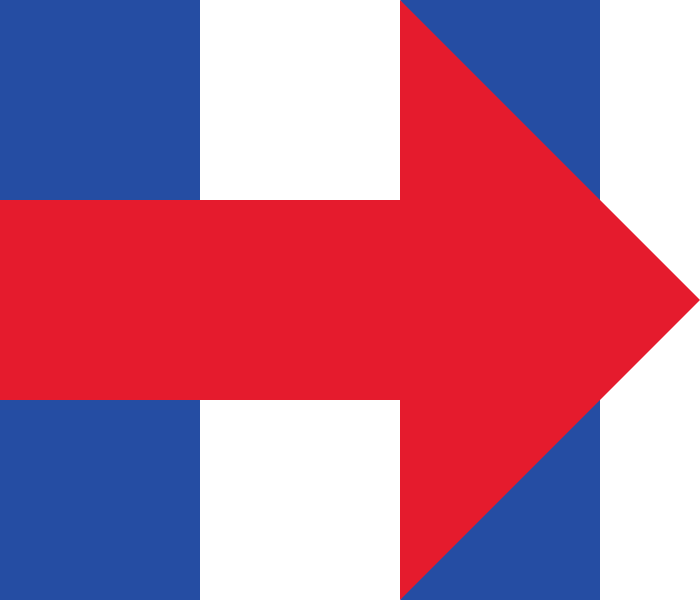
Maybe the artists were still under the spell of Hillary's campaign signage posted all over the WaPo offices.
And Laslo Spatula said:
They got it right the first time.That called to mind the famous frontispiece for "Leviathan":
A mass of women, drawn together by the force of One Man.
He gives them their Shape as a whole: the Shape to put in all their fears and narcissism and self-congratulation, all within the context of Him.
A herd, they have been corralled...
I am Laslo.
"This is the most famous picture in the history of political philosophy," writes polisci prof Larry Arnhardt.

"The king's body is composed of the human bodies of his subjects, who have their backs turned to the reader as they stare upward at the king's face.... These pictures convey visually Hobbes's teaching that a state of nature without government must become a state of war, in which human life must be 'solitary, poor, nasty, brutish, and short.' Therefore, to escape such a condition, any government is better than no government. And a highly centralized government with absolutely sovereign power is best of all."
March 7, 2016
Stunning pro-Trump propaganda from Drudge.

Wow. The restoration of youth to the face, the unfathomable color, the earthquake terminology — "TRUMP SHAKES WORLD ORDER."
The link goes to a tame Reuters item: "Foreign diplomats voicing alarm to U.S. officials about Trump." ("On Tuesday, General Philip Breedlove, the United States' top military commander in Europe, said... 'I get a lot of questions from our European counterparts on our election process this time in general... And I think they see a very different sort of public discussion than they have in the past.'")
The phrase "World Order" does not appear in the Reuters article. It sounds foreboding. I see that Henry Kissenger published a book 2 years ago with the title "World Order." From the NYT review:
There has always been a dark, almost Spenglerian cast to Mr. Kissinger’s thinking, and he sees ominous signs today of a descent back into a Hobbesian state of nature — in the bedlam overtaking Syria and Iraq, where “no common rules other than the law of superior force” seem to hold; in the spread of weapons of mass destruction and “the persistence of genocidal practices”; and in the Wild West of cyberspace, which has “revolutionized vulnerabilities.” In fact, he says, we are “insistently, at times almost desperately, in pursuit of a concept of world order,” at this moment in history when “chaos threatens side by side with unprecedented interdependence.”
March 2, 2016
"America never stopped being great. We need to make America whole. We have to fill in what’s been hollowed out."
"We have to make strong the broken places, re-stitch the bonds of trust and respect across our country.... [W]hat we need in America today is more love and kindness.... Instead of building walls we’re going to break down barriers and build … build ladders of opportunity and empowerment so every American can live up to his or her potential, because then and only then can America live up to its full potential too."
Said Hillary Clinton, in her Super Tuesday victory speech, clearly aimed at Donald Trump, answering his "Make America great again." America is always already great. Nothing to do there. The problem is that everyone isn't equally included in the greatness. We need to stitch us all together and fill in the hollowed-out gaps. It's a concise summary of the difference between the progressive enterprise and capitalism.
Trump has pushed back:
The idea that the people form a single body has phenomenal historic resonance. I'm picturing "Leviathan":

Think of the "body politic" — all the people in a particular country considered as a single group."
Said Hillary Clinton, in her Super Tuesday victory speech, clearly aimed at Donald Trump, answering his "Make America great again." America is always already great. Nothing to do there. The problem is that everyone isn't equally included in the greatness. We need to stitch us all together and fill in the hollowed-out gaps. It's a concise summary of the difference between the progressive enterprise and capitalism.
Trump has pushed back:
Hillary cannot make America great. She was talking about something yesterday, making America whole, whole. No, no, I don’t want whole. I want great again. I think I’ll use that as a commercial. We’ll make a split screen. She’ll be saying "we’re going to make America whole," whatever that means — I don’t think she knows what it means. We’re going to make America whole, and I’ll be saying, "we’re going to make America great again."What does "whole" even mean? He just says he doesn't know, perhaps nudging us to think it's jibberish, flim-flam, con artistry, but perhaps nudging lewd/sexist minds to hear "hole." But "whole" — I think, to be accurate — envisions the people as a single body, an ailing body, needing healing and restoration to full health, wholeness.
The idea that the people form a single body has phenomenal historic resonance. I'm picturing "Leviathan":

Think of the "body politic" — all the people in a particular country considered as a single group."
The analogy is typically continued by reference to the top of government as the head of state, but may be extended to other anatomical parts, as in political readings of the Aesop's fable, "The Belly and the Members."... The metaphor developed in Renaissance times, as the medical knowledge based upon the classical work of Galen was being challenged by new thinkers such as William Harvey. Analogies were made between the supposed causes of disease and disorder and their equivalents in the political field which were considered to be plagues or infections which might be remedied by purges and nostrums....And Jean Jacques-Rousseau wrote of "General Will":
As long as several men assembled together consider themselves as a single body, they have only one will which is directed towards their common preservation and general well-being. Then, all the animating forces of the state are vigorous and simple, and its principles are clear and luminous; it has no incompatible or conflicting interests; the common good makes itself so manifestly evident that only common sense is needed to discern it. Peace, unity and equality are the enemies of political sophistication. Upright and simple men are difficult to deceive precisely because of their simplicity; stratagems and clever arguments do not prevail upon them, they are not indeed subtle enough to be dupes....
March 18, 2013
"Warfare, unlike philosophy, could never be conducted from an armchair. Until now."
"For the first time in history, some soldiers have this in common with philosophers: they can do their jobs sitting down. They now have what I’ve always enjoyed, namely 'leisure,' in the Hobbesian sense of the word, meaning they are not constantly afraid of being killed. Hobbes thought that there are certain not-so-obvious perks to leisure (not being killed is the obvious one). For one, you get to think. This is what he means when he says that 'leisure is the mother of philosophy.' I tend to agree with Hobbes: only those who enjoy a certain amount of leisure can be philosophers."
Writes philosopher John Kaag, who, we're told, has a forthcoming book called "Drone Warfare." Better hurry, there's also another book called "Drone Warfare, coming out in April. That one is written by CODEPINK and Global Exchange cofounder Medea Benjamin, has a foreword by Barbara Ehrenreich, and a subtitle "Killing by Remote Control."
Writes philosopher John Kaag, who, we're told, has a forthcoming book called "Drone Warfare." Better hurry, there's also another book called "Drone Warfare, coming out in April. That one is written by CODEPINK and Global Exchange cofounder Medea Benjamin, has a foreword by Barbara Ehrenreich, and a subtitle "Killing by Remote Control."
December 19, 2012
Democrat, Democratic, Democratical.
Today, I encountered a word I'd never noticed before: "democratical." I was writing about the "common sense" meme and arrived at the Thomas Paine pamphlet "Common Sense" and John Adams's criticism of it as "so democratical, without any restraint or even an attempt at any equilibrium or counter poise, that it must produce confusion and every evil work."
The OED defines "democratical" to mean the same thing as "democratic," and it gives some usage examples going back to 1589 and continuing only to 1850:
The OED defines "democratical" to mean the same thing as "democratic," and it gives some usage examples going back to 1589 and continuing only to 1850:
April 8, 2012
One year into Obama's presidency, David Brooks wrote "he has come to seem like the sovereign on the cover of 'Leviathan'..."
"... the brain of the nation to which all the cells in the body and the nervous system must report and defer."
Brooks is talking about the bookcover that illustrates the previous post ("Romney, the man who says 'marvelous'"). He writes that "the illustration shows the British nation as a large man. The people make up the muscles and flesh. Then at the top, there is the king, who is the head and the mind."
Does Brooks marvel at Obama visualized as a large man andwe us the People as the muscles and flesh that constitute his body? Did Brooks abase himself and slobber that much?
Brooks is talking about the bookcover that illustrates the previous post ("Romney, the man who says 'marvelous'"). He writes that "the illustration shows the British nation as a large man. The people make up the muscles and flesh. Then at the top, there is the king, who is the head and the mind."
Does Brooks marvel at Obama visualized as a large man and
Romney, the man who says "marvelous."
Obama mocked Romney this way: "He said that he's 'very supportive' of this new budget, and he even called it 'marvelous' — which is a word you don't often hear when it comes to describing a budget." Comic pause. "It's a word you don't often hear generally."
This Reuters article takes the position that Obama meant us to think that a man who says "marvelous" is "out of touch" because "marvelous" is "a seemingly out of date" word. Reuters also quotes a polisci prof saying, "It's a word you kind of associate with the upper class, and I think that the intention was to tweak Romney for being wealthy and, you know, sort of brought up in the kinds of circles where they would say ‘marvelous.'"
Wealthy? Old fashioned? My first association, on hearing one man mock another for saying "marvelous," was: Gay. It's an I'm-more-manly move. I heard a smidgeon of homophobia. Perhaps I heard it because, a few days ago, on winning the Wisconsin primary, Romney introduced Ryan, saying: "Congressman Ryan, he's a great leader, wonderful speaker, but he's not gonna take Ann's place." (Ann being, of course, Mitt's wife.) At the time, I quipped: "Combatting the 'bromance' rumors!"
This is just a meme watch. Note that the budget Romney was talking about was Paul Ryan's budget. The alliance of Romney and Ryan is so good that I suspect the Obama campaign will toy with mockery that has a homophobic edge. Let's make their "marriage" seem unseemly. Not so blatantly that they can't deny it. Any homophobia can be disguised within a socially acceptable distaste for the rich. The word "effete" was practically created for this purpose. Do you remember when Vice President Spiro Agnew derided antiwar protesters as "an effete corps of impudent snobs"?
The word "marvelous" — which means "Such as to excite wonder or astonishment (chiefly in a positive sense); wonderful, astonishing, surprising; worthy of admiration" (OED) — is a very old word, going back to c1330: "Þe fift ledde Andalas, A kniȝt of meruailus los he was." (Arthour & Merlin.) The first use with modern spelling — the double L remains current — is from Thomas Hobbes, Leviathan ii. xxvi: "Miracles are Marvellous workes: but that which is marvellous to one, may not be so to another." And I like the D. H. Lawrence: "Their loving grew more mechanical, without the marvellous glamour." (Sons & Lovers xiii. 365.)
By the way, there's also an archaic and regional use of "marvelous," but that is as an adverb. You get things like: "Nancy Clemens... quoted a farmer who had been hurt in a motor accident: ‘No bones broke,’ said he, ‘but I sure was scratched up marvellous.’" (V. Randolph & G. P. Wilson Down in Holler 161.) That seems quite the opposite of effete. It's folksy. I could imagine some politician using that, probably quoting somebody... some farmer.
But Romney uttered "marvelous," the adjective. He was talking about Paul Ryan's budget, and Obama snickered. Am I wrong to hear a tone of homophobia? I Googled "gay men say marvelous." Sorry, to be so crude, but research can be so easy and I got the most marvelous return. It's Noël Coward's "I've Been To A Marvellous Party," in which male homosexuality and excessive wealth are merged marvelously. Listen to the whole thing, but here's the penultimate verse:
Who doesn't like the turtle? And the Leviathan?

This Reuters article takes the position that Obama meant us to think that a man who says "marvelous" is "out of touch" because "marvelous" is "a seemingly out of date" word. Reuters also quotes a polisci prof saying, "It's a word you kind of associate with the upper class, and I think that the intention was to tweak Romney for being wealthy and, you know, sort of brought up in the kinds of circles where they would say ‘marvelous.'"
Wealthy? Old fashioned? My first association, on hearing one man mock another for saying "marvelous," was: Gay. It's an I'm-more-manly move. I heard a smidgeon of homophobia. Perhaps I heard it because, a few days ago, on winning the Wisconsin primary, Romney introduced Ryan, saying: "Congressman Ryan, he's a great leader, wonderful speaker, but he's not gonna take Ann's place." (Ann being, of course, Mitt's wife.) At the time, I quipped: "Combatting the 'bromance' rumors!"
This is just a meme watch. Note that the budget Romney was talking about was Paul Ryan's budget. The alliance of Romney and Ryan is so good that I suspect the Obama campaign will toy with mockery that has a homophobic edge. Let's make their "marriage" seem unseemly. Not so blatantly that they can't deny it. Any homophobia can be disguised within a socially acceptable distaste for the rich. The word "effete" was practically created for this purpose. Do you remember when Vice President Spiro Agnew derided antiwar protesters as "an effete corps of impudent snobs"?
The word "marvelous" — which means "Such as to excite wonder or astonishment (chiefly in a positive sense); wonderful, astonishing, surprising; worthy of admiration" (OED) — is a very old word, going back to c1330: "Þe fift ledde Andalas, A kniȝt of meruailus los he was." (Arthour & Merlin.) The first use with modern spelling — the double L remains current — is from Thomas Hobbes, Leviathan ii. xxvi: "Miracles are Marvellous workes: but that which is marvellous to one, may not be so to another." And I like the D. H. Lawrence: "Their loving grew more mechanical, without the marvellous glamour." (Sons & Lovers xiii. 365.)
By the way, there's also an archaic and regional use of "marvelous," but that is as an adverb. You get things like: "Nancy Clemens... quoted a farmer who had been hurt in a motor accident: ‘No bones broke,’ said he, ‘but I sure was scratched up marvellous.’" (V. Randolph & G. P. Wilson Down in Holler 161.) That seems quite the opposite of effete. It's folksy. I could imagine some politician using that, probably quoting somebody... some farmer.
But Romney uttered "marvelous," the adjective. He was talking about Paul Ryan's budget, and Obama snickered. Am I wrong to hear a tone of homophobia? I Googled "gay men say marvelous." Sorry, to be so crude, but research can be so easy and I got the most marvelous return. It's Noël Coward's "I've Been To A Marvellous Party," in which male homosexuality and excessive wealth are merged marvelously. Listen to the whole thing, but here's the penultimate verse:
I went to a marvellous party we didn't sit down til tenI'm just waiting for young Paul Ryan to do a stunt at the bar with a lot of extraordinary men and then for Mitt Romney to suddenly cry "fiddle-de-de" and rip off his trousers and jump in the sea. And then Obama arrives with a turtle...
Y'know young Bobby Carr did a stunt at the bar with a lot of extraordinary men
And then Freda arrived with a turtle which shattered us all to the core
And then the Duchess passed out at a quarter to three
And suddenly Cyril cried 'fiddle-de-de'
And he ripped off his trousers and jumped in the sea
I couldn't have liked it more...
Who doesn't like the turtle? And the Leviathan?
Subscribe to:
Posts (Atom)


 Posts
Posts


