Showing posts with label Amy Davidson. Show all posts

October 28, 2024

"[Ketanji Brown] Jackson is not alone among Justices in telling her life story."

"There is a long tradition of memoirs, notably William O. Douglas’s 'Go East, Young Man,' which is famously colorful and perhaps factually dubious, and his 'The Court Years'; 'The Memoirs of Earl Warren,' published posthumously; Sandra Day O’Connor’s 'Lazy B,' written with her brother, about growing up on a ranch... and John Paul Stevens’s 'The Making of a Justice: Reflections on My First 94 Years'.... [Ketanji Brown Jackson's new memoir] belongs to a modern mini-genre of personal memoirs written much earlier, by sitting Justices. Clarence Thomas pioneered the form, with 'My Grandfather’s Son,' which appeared in 2007, sixteen years into his tenure... followed by Sonia Sotomayor, with 'My Beloved World,' in 2013, four years into hers. The pace has picked up. Brett Kavanaugh and Amy Coney Barrett have books in the works, too. It is almost as if, along with the judicial robes and clerks, newly confirmed Justices are issued book contracts. The advances alone may be the point. Thomas got a million and a half dollars. Sotomayor has built a franchise... that has earned her close to four million dollars. Barrett’s deal, worth a reported two million, was the subject of an open letter of protest.... Jackson’s contract is not public... The salary for an Associate Justice is about three hundred thousand dollars; there are caps on how much the Justices are allowed to earn for outside work, but book earnings are exempt."
This seems to call for the old Samuel Johnson quote: "No man but a blockhead ever wrote except for money."

And to answer the question in the article title: No. 

November 27, 2023

An ambiguous "ought" in The New Yorker's "Why Trump’s Trials Should Be on TV."

This is an opinion column — subtitled "The conduct of the trials, their fairness, and their possibly damning verdicts will be at the center of the 2024 election. Transparency is crucial" — by Amy Davidson Sorkin.

I agree that the trials should be televised, as I wrote in "The ACLU sides with Trump: The gag order is unconstitutional" (October 26, 2023) and — quoting Trump's lawyers — "The prosecution wishes to continue this travesty in darkness. President Trump calls for sunlight" (November 11, 2023).

Here are the last few sentences of the column:
There is apprehension about what [Trump] might say, and what his supporters might then do if they heed him.... Yet to believe that allowing the country to watch as Trump takes the stand would be more of a threat to the Republic than it would be to his defense is to accept his own myths about himself. The evidence against Trump ought to stand up to scrutiny far better than he will. Everybody should see that. Trump isn’t camera-shy; prosecutors have no reason to be, either.

Now, I know very well which of 2 possible meanings of "ought" Sorkin intended.

January 23, 2023

"It’s estimated that some fifty million new things get classified each year, and the more than two million people with security clearances, military and civilian, can potentially add to the pile..."

"... by one route or another. Presidents do not have the power to declassify documents psychically, as Trump has suggested, but their power to do so in other ways is surprisingly broad and ill-defined, governed largely by executive orders and precedent. That reality had complicated the legal case against Trump even before Biden’s lawyers found the first documents. The President has not yet said for sure if he will run again in 2024. The affair of the documents may prove something of a stress test. Republicans would no doubt like to see all these story lines—the documents, Hunter, the Corvette, Communists—merge into a lurid fog that obscures the real line between Trump’s case and Biden’s. They are not the same, and that is something worth emphasizing. But the fact that these two very different men, for different reasons, both had classified documents in their homes should be cause for reflection about our system of secrecy, too."

October 2, 2022

"[T]here is a feeling that the conservative Justices could make a landmark ruling out of almost any case."

"Sackett v. Environmental Protection Agency, the first case of the term, may seem to address a narrow question—the definition of 'navigable waters'—but it could become a vehicle for dismantling a wide range of regulations.... The Court will also adjudicate a suit, brought by Texas and Louisiana, claiming that the Biden Administration has, in effect, broken the law by focussing its border-enforcement efforts only on certain categories of migrants, such as those deemed a 'threat to public safety.' Notably, some Republicans have raised the possibility that, if the G.O.P. takes control of the House after the midterms, they may impeach President Biden on similar grounds...."

Writes Amy Davidson Sorkin, in "The Supreme Court’s Big New Term/There is a feeling with this Court that the conservative Justices could make a landmark ruling out of almost any case" (The New Yorker). 

September 11, 2017

"Another 9/11 Anniversary... Amid Hurricane Irma."

Today is 9/11, and we've come to expect solemn remembrance of the horrible destruction that took place 16 years ago, but there's ongoing real-life destruction in the news. Hurricane Irma has sole possession of the headlines this morning. I looked for stories that combine the news of the hurricane with remembrance of 9/11 and found very little. There's "Wife of 9/11 victim to mark day with hurricane relief" at The Boston Herald. That's small and tasteful. At The New Yorker, there's a different kind of effort to attach the 2 stories, "Another 9/11 Anniversary at Guantánamo, Amid Hurricane Irma" (by Amy Davidson Sorkin).
[A] measure of the futility of the legal response to the attacks is that there will soon enough be young military officers, at least eligible to serve as the equivalent of jurors on the military commission, who were also born after 9/11....

Meanwhile, the base made it through Irma relatively well, with downed power lines but few signs of damage, Rosenberg reported. There were, she noted, a few wet spots in the courtroom ceiling, which would need new tiles. The next time hurricane winds shift to Guantánamo, it might be better prepared. And the 9/11 trial, with its maddening mix of tragedy and absurdity, and its too-delayed promise of justice, might even be under way.

April 28, 2017

"Foreign countries and companies might appreciate the idea that they can more easily handle Donald Trump if they lavish his daughter with attention..."

"... this is a common enough practice when dealing with authoritarian governments. But it should at least cause a little unease here at home," writes Amy Davidson in "The Global Effort to Flatter Ivanka" (in The New Yorker). She's writing about that panel discussion about women and entrepreneurship that happened at the W20 conference, where Ivanka Trump got to share the stage with Angela Merkel, Queen Máxima, Christine Lagarde, and Chrystia Freeland.
And one saw, again... how the perceived need to pander to Ivanka Trump can distort almost any conversation. At one point, Freeland, the Canadian Foreign Minister, while making a point about the important role that fathers play in their daughters’ progress, said, as she looked at Ivanka, who nodded in agreement, that behind “every successful woman” was a very supportive father.
So it's Ivanka's fault that the Canadian Foreign Minister said something plainly wrong and obviously damaging to the self-esteem of millions of women?!
The moment played less as a shout-out to men in the developing world (which was likely what Freeland intended) than as a validation of the First Daughter concept.
Why does Freeland get the benefit of charitable interpretation and Ivanka get the blame for the negative aspect of a remark she did not make?
And it left little room for the fatherless, or for the defiant, or even for the sort of complexity experienced by, say, Queen Máxima, who is originally from Argentina, where her father was a member of the junta that ran that country’s Dirty War. Whatever their relationship, Máxima went along with the decision not to invite him to her wedding to the Crown Prince of the Netherlands, in deference to Dutch public opinion. Even royalty has to listen, sometimes.
Even royalty? Here you have Davidson complaining about the stature acquired by the daughter of a U.S. President, and somehow simultaneously viewing royalty as lofty. Ivanka may have her position by birth but the U.S. President was elected by the people. Royalty gets its power by birth and by marriage.

By the way, did Davidson ever critique the global effort to flatter Barack Obama's wife (not to mention the truly insane effort to flatter Bill Clinton's wife — which is the main reason we've got Ivanka Trump's father as President).

February 8, 2017

"Do the courts, or the American people, have any recourse when the President lies?"

Asks Amy Davidson (at The New Yorker), attempting to analyze yesterday's oral argument in Trump's immigration case.

My instinctive reactions were, in order: 1. Courts don't seek recourse (they look to the law to resolve disputes that are filed by parties who are seeking recourse), 2. The people always have political recourse — criticizing the President, voting against him in the next election, and pressuring our representatives in Congress to use their political powers (including impeachment) — so it's always wrong to give the impression that there must be recourse in courts or there is no recourse, and 3. All Presidents lie, the political culture is awash in lies, it always was and it always will be, so the notion that something must be done!!! because a President is lying is — to my ear — more lying.

But let's keep reading:
August Flentje, a special counsel to the Assistant Attorney General, who was arguing the case for the Trump Administration, said, in effect, that the emergency was that the restraining order got in the way of the President’s power to say that there was an emergency—to announce that the country was in danger....

When he was asked if the government had pointed to any evidence connecting [the countries identified in the executive order] to terrorism, he rejected the idea that it had to.... “We’re not acknowledging any review on the facts of the case,” Flentje said.

Immigration law does give latitude to the President when the country is in danger. But what happens when you have a President who the courts, and any objective person, know tells lies?...
Davidson is losing me. I think all Presidents lie. Whatever concern you have for the dangers of deceitful claims of emergency, you've got to have neutral principles of law and not special law for the President you think everyone must know is a liar.
As it happens, this question has come up before in our jurisprudence, because Donald Trump is not the first politician to lie. 
Okay. I needed that.
Our courts have dealt with the prospect of dissembling and misstated motives, particularly in the area of racial discrimination.... Judges seem to believe that Presidents will lie about many things, but that they might have some shame when it comes to the nation’s safety, particularly as they have access to classified information that the public does not....
Shame? Why would a President be less likely to lie about national security? That's the place where I most expect to hear lies.
“Could the President simply say in the order, we’re not going to let any Muslims in?” Judge Canby asked, at that point.
If the answer to that question is no, then maybe courts need to be able to dig past the veneer. Flentje didn't seem to have thought through the value and the downside of saying yes, so he floundered and more or less said no.

Really, Flentje's argument was awful. The President needed a lawyer who would have calmly, boldly, and authoritatively laid down the strong argument for presidential power. Flentje was the one who needed to convince the judges to act, to issue a stay. So really, they don't have to get embroiled in that question I put in the post title. They only need to do nothing.

July 11, 2016

"The story of how Theresa May, the United Kingdom’s Home Secretary, became the presumptive Prime Minister is one of tragi-farcical, politico-comic self-destruction."

Writes Amy Davidson in The New Yorker. Read the whole thing. I just want to excerpt the part about how one of May's rivals, the Energy Minister Andrea Leadsom, flamed out after the Times of London published an interview with the headline: "BEING A MOTHER GIVES ME EDGE ON MAY—LEADSOM" that began "Tory minister says she will be better leader because childless home secretary lacks ‘stake in future.'"
It went on to quote Leadsom, who often included the phrase “as a mum” in her pro-Leave statements, as saying that May “possibly has nieces, nephews, lots of people. But I have children who are going to have children who will directly be a part of what happens next.” This, she said, set her apart from May as a potential leader. She added, “I am sure Theresa will be really sad she doesn’t have children, so I don’t want this to be ‘Andrea has children, Theresa hasn’t,’ because I think that would be really horrible.” But, she went on, “genuinely I feel that being a mum means you have a very real stake in the future of our country, a tangible stake.” In other words, Andrea has children; Theresa hasn’t....

As a matter of logic, this disparagement of childless leaders is ludicrous... And, as a matter of politics, Leadsom’s comments were a wreck. She insulted the childless, and she seemed personally cruel to May, who has quietly said in the past that she is, indeed, sad about having never had children. (May, who is fifty-nine, has been married to her husband, a banker she met when they were both students at Oxford, for thirty-five years.)

... [Leadsom]  responded... by attacking the Times, tweeting that the story was “truly appalling and the exact opposite of what I said. I am disgusted.” Leadsom demanded that the paper release the transcript, which it did, along with the audio, and which not only confirmed the story but made Leadsom look worse. When the Times asked, “What is the main difference between you and Theresa May?,” her children and her “huge” family were practically the first things that Leadsom mentioned, after a passing reference to her knowledge of the economy and her “optimism.”

October 23, 2015

"Trey Gowdy Says His 11-Hour Benghazi Hearing Didn't Reveal Anything New."

HuffPo paraphrases.

AND: From Amy Davidson in The New Yorker:
Clinton has been immersed in politics for decades, and yet the panel managed to make the contrast between her manner and the ways of Washington look stark. She appeared to be a sensible outsider. At 7:15 P.M., nine hours after the hearings began, Martha Roby, of Alabama, asked Clinton about her movements when she went home on the night of the attack. “Were you alone?” she asked. Yes, Clinton said. “The whole night?” Clinton started to laugh once more. “I don’t see why that’s funny,” Roby said. Not funny, perhaps, but, like the Benghazi committee itself, absurd.

October 5, 2015

Obama bombed a hospital.

Where is the outrage?

ADDED: At the link, which goes to my son John's Facebook page, I said: "Imagine if Bush had done this." And John said: "We don't have to imagine..." and linked to a NYT article from 2008: "Evidence Points to Civilian Toll in Afghan Raid."

From Amy Davidson at The New Yorker: "Five Questions About the Bombing of a Hospital in Kunduz":
What did the Afghan forces want us to bomb? This is the fundamental issue: Was the hospital the target, or was the target something or someone “in the vicinity”?...
Why didn’t the bombing stop? It went on for an hour, in multiple waves, although [Doctors Without Borders, which runs the hospital] has said that it immediately called contacts in Afghanistan, Washington, D.C., and wherever else it could think of—it is used to operating in war zones, and has the phone numbers for calls like that—to try to get the attack stopped. Who was on the other end of the line? Did those interlocutors make further calls, to Afghans or Americans? General Campbell, asked by reporters if the Pentagon knew about the calls, said that it was a question for investigators. But, in this instance, the matter of communications gets to questions larger than logistics, such as... Do we understand our allies’ motives and priorities in Afghanistan?
ALSO: My phrase "Where is the outrage?" sounds like a stock phrase with a particular reference point, but what? Meade says it's from the 1996 presidential campaign. Bob Dole said it:
Sounding like a crusader, Bob Dole implored his audiences today to ''rise up'' against the nation's news organizations, which he said were protecting the Clinton Administration, and be outraged that President Clinton had, in Mr. Dole's words, violated the public trust....

Listing a string of questionable practices by the Administration, including accepting what he called laundered cash from foreigners and obtaining confidential F.B.I. files, Mr. Dole demanded repeatedly in Houston earlier in the day, ''Where is the outrage?''

Appearing at downtown performing arts center, where he stood before a giant mural depicting the glory days of the Lone Star State, Mr. Dole continued: ''Can you imagine former President Bush doing one of those things? No! And you never imagine Bob Dole doing one of those things either. So where's the outrage? Where's the outrage? When will the voters start to focus?''

September 8, 2015

"Trump, the businessman, tells Americans how the financial system is rigged against them. Carson, the brain surgeon, tells them how they are being denied knowledge."

"It doesn’t seem to matter that he is a man of science who does not believe in evolution and has called climate change 'irrelevant': he is an ideologue with the trappings of a technocrat.... In lieu of specifics, Carson tends to say that as a surgeon he has experience 'doing complex things' and making snap life-or-death decisions."

From a New Yorker piece by Amy Davidson about Ben Carson. (Open to nonsubscribers.)

August 12, 2015

"There are, after all, a few problems with Trump’s argument that he was just, in the Wall Street Journal’s memorable phrase, using 'facial hemorrhages as a metaphor for anger.'"

"One can begin with the obvious: more of Kelly’s body was implicated than was Wallace’s, and Trump has a long history of slurs aimed at women’s anatomy, which was what Kelly was asking him about. But stranger still is the idea that there was any anger to describe, literally or metaphorically. 'Look, she asked me a very nasty question. I have nothing against Megyn Kelly, but she asked me a very, very nasty question,' Trump said. She was 'very inappropriate,' and 'very angry.' And yet, in the video, she is calm, and never stops smiling. She did not, it is true, surrender or laugh appreciatively when he interrupted her to make a joke about how he thought another woman was ugly. Is that what an angry woman looks like from the Republican debate stage?"

From "How Trump Survived the Megyn Kelly Blowup," by Amy Davidson in The New Yorker.

May 8, 2015

A lone holdout juror...

... in the case of Etan Patz.

ADDED: Why are there photographs of the jurors? In the comments, someone says that the holdout juror "looks like a smug little prick & probably glad that he let the guy off." This is a man who held out for 18 days of deliberation. How do you expect a man who just did that to look?
Adam Sirois, juror No 11, said Hernandez's guilt had not been proven beyond reasonable doubt. During a press conference held at the conclusion of the trial, a smirking Sirois sheepishly raised his hand to indicate that he was the juror who was responsible for the mistrial.

Sirois told reporters Pedro Hernadenz's apparent mental health issues were a major concern for him, and that he could not convict the defendant solely based on his 'very bizarre' confession, reported ABC News.
So there are photographs because the jurors gave a press conference. The photographers must have taken thousands of pictures of Sirois's face, and the newspaper editors have chosen one, one that supports the "smirking... sheepishly" characterization. If he "looks like a smug little prick" to you, that's because the editors decided to help you think that and because the man just had an 18-day experience and was the kind of person who could stand up for his beliefs in a group setting for more than 2 weeks. Most people would cave and go along to get along. These people are much more likely to have a pleasant, unremarkable face.

AND: Amy Davidson in The New Yorker: "The doubt in this case was not just reasonable. It was, and is, profound."

ALSO: It should be clear that the jurors chose to give that press conference. They knew they didn't have to do it. And yet, if they had not taken advantage of the opportunity to engage with the press as a group, the press would have sought them out individually. 

April 26, 2015

"Was there a quid pro quo? Based on the Times reporting, there was certainly a lot of quid..."

"... (millions in donations that made it to a Clinton charity; a half-million-dollar speaker’s fee) and multiple quos (American diplomatic intervention with the Russians; approvals when the Russian firm offered a very “generous” price for Uranium One). The Clinton perspective is that, although the approvals were delivered by the State Department when Clinton led it, there is no evidence that she personally delivered them, or of the 'pro' in the equation. The Clinton campaign, in its response to the Times, noted that other agencies also had a voice in the approval process, and gave the Times a statement from someone on the approvals committee saying that Clinton hadn’t 'intervened.' The Clinton spokesman wouldn’t comment on whether Clinton was briefed about the matter. She was cc’d on a cable that mentioned the request for diplomatic help, but if there is a note in which she follows up with a directive—an e-mail, say—the Times doesn’t seem to have it. This speaks to some larger questions about political corruption. How do you prove it? Maybe the uranium people simply cared deeply about the undeniably good work the foundation is doing, and would have received the help and approvals anyway. In cases like this, though, how does the public maintain its trust?"

That's the first of "Five Questions About the Clintons and a Uranium Company," by Amy Davidson in The New Yorker. (And of course Davidson means everything that "an e-mail, say" seems to suggest.)

February 23, 2015

"Edward Snowden couldn't be here for some treason," said Neil Patrick Harris, the Oscars host, when the documentary about him won an award.

The award — for best documentary — to "Citizenfour" was expected, so the scriptwriters had plenty of time to come up with that joke. It's a neat joke, with its language precision. Or near-precision. The New Yorker's Amy Davison says:
Treason isn’t one of the crimes Snowden has been charged with—the government wants to prosecute him under the Espionage Act—but both the praise and the joke point to why this Snowden Oscar mattered. What he did was useful, and dangerous.

That wouldn’t have been enough if the movie were bad. But "Citizenfour" is worth watching....
Worth watching... in my book, that's a high standard. And "Citizenfour" didn't meet it, nor did the Oscars show, nor did any of the movies that were nominated (except one, "Grand Budapest Hotel," which I noticed in the HBO "On Demand" listings).

I liked the joke, because of its language precision and because it seemed at least a tad risky in the context of Hollywood celebrating itself. Or maybe it wasn't. Having given the award to "Citizenfour," Hollywood may have needed to get right with the Obama administration. "No, I don’t think Mr. Snowden was a patriot" is what Obama has said.

To get a link for this post, I googled "treason" and "patrick" — "patrick" because I didn't want to risk misspelling "neil" and I stopped before adding "harris" because I knew "treason" and "patrick" were enough to pull up the quote from last night in Google. This is pure happenstance:


And isn't Obama's "No, I don’t think Mr. Snowden was a patriot" a fascinating quote to recall after a week of chewing over Giuliani's Obama-not-a-patriot remark?

February 18, 2015

"Then there is Bush’s sense of how far to push, and that he was entitled to do so."

"In August, 2003, he wrote to one of the many judges involved, 'I normally would not address a letter to the judge in a pending legal proceeding…. However, my office has received over 27,000 emails reflecting understandable concern for the well-being of Terri Schiavo.' A Times report published last weekend, about Jeb’s many notes and requests to the White House on other matters when his father worked there, suggests that he 'normally' wasn’t shy at all about asserting influence inappropriately. At the very end, after the autopsy confirmed that Terri’s brain really was too damaged for the sort of consciousness that her parents imagined, Bush wrote to a state prosecutor asking him to investigate Michael Schiavo, suggesting that there had been a sinister gap between when Schiavo found his wife collapsed and when he called 911. 'I urge you to take a fresh look at this case without any preconceptions as to the outcome,' Bush wrote. The prosecutor found nothing."

The last paragraph of Amy Davidson's "The Punisher: Jeb Bush and the Schiavos."

January 23, 2015

My preference for fictionalized historical movies, with a particular note on the ones with a fictional country.

I'm thinking about why I don't want to see the movie "Selma" and why the only movie from last year that I took the time to watch was "The Grand Budapest Hotel." I also don't want to see "American Sniper," and I avoided the movie "Lincoln," even when it was staring me in the face on television and even though I love Daniel Day-Lewis. Maybe I just don't like to watch actors pretending to be particular historical figures. It's too much of an impersonation, and invention and originality is problematic. And maybe it's the distraction of the distortions done for dramatic effect, which seems to be the case with the character of LBJ in "Selma." I'm fully interested in history and am, right now, thoroughly immersed in the series of Robert A. Caro books about LBJ. I want to get as close to understanding the great historical character as I can, and any 2 hours immersed in those books serves that interest better than watching dramatic scenes in "Selma."

Here's the earlier blog post where I talk about the Maureen Dowd column criticizing the movie for making a "faux" "villain" out of LBJ. And here's a new piece in The New Yorker by Amy Davidson saying "Why 'Selma' Is More Than Fair to L.B.J." I dislike LBJ and regard him as a great villain (even if his particular form of villainy put him on the good side of some issues), and I don't really care whether the film is "fair" to him or not. If I saw the movie, it would be to pursue my own  interest in the way media massages the story. I'd write a blog post. The post would quote the line: "This is the West, sir. When the legend becomes fact, print the legend."


That's the end of "The Man Who Shot Liberty Valance," a great, great movie with a historical setting and a fictional story. Jimmy Stewart plays the part of a made-up U.S. Senator, Ransom "Ranse" Stoddard. The West, of course, was a real place, not a fictional place, and so it doesn't fit the category I really want to talk about in connection with "The Grand Budapest Hotel."

"The Grand Budapest Hotel" has a fictional historical story, set in a fictional Eastern European country, Zubrowka. (The name Zubrowka comes from the traditional Polish bison-grass flavored vodka.) Here's Wikipedia's plot summary for the movie — a lot about a vaguely explained war in the 1930s and its impact on a posh hotel. It is completely weird and fantastical and yet it conveys quite deep emotions about love and loss, and the resonance with history feels profound and comical. One feels history without needing to fuss over the accuracy. There can be no accuracy. I love that.

Zubrowka is the last country named on Wikipedia's "List of fictional countries," which I found because I was thinking about how great it was to have a fictional country in "The Grand Budapest Hotel" and wanted to think of other movies with a strong feeling of history in a particular place, where the place is fictional. Before looking, I thought of the great comedies "The Great Dictator" (Tomania) and "Duck Soup" (Freedonia and Sylvania). Wikipedia's list of fictional countries doesn't have "The Great Dictator," and not everything on the list has a fictional country used to tell a historical story. So I'm not looking for things like Florin (in "The Princess Bride") or Oz, because these are fantasy lands, not any kind of stand-in for a real geographical place on Earth, or Eastasia and Oceania in "1984" or Gilead in "The Handmaid's Tale" because these stories are not set in historical time but in the future.

So there's a category of movie that I want to say I love, that I want to put above the usual historical movies, but I haven't found enough examples to make a proper category. Perhaps "The Grand Budapest Hotel" is too original to define a category. In that case: grand!

June 13, 2013

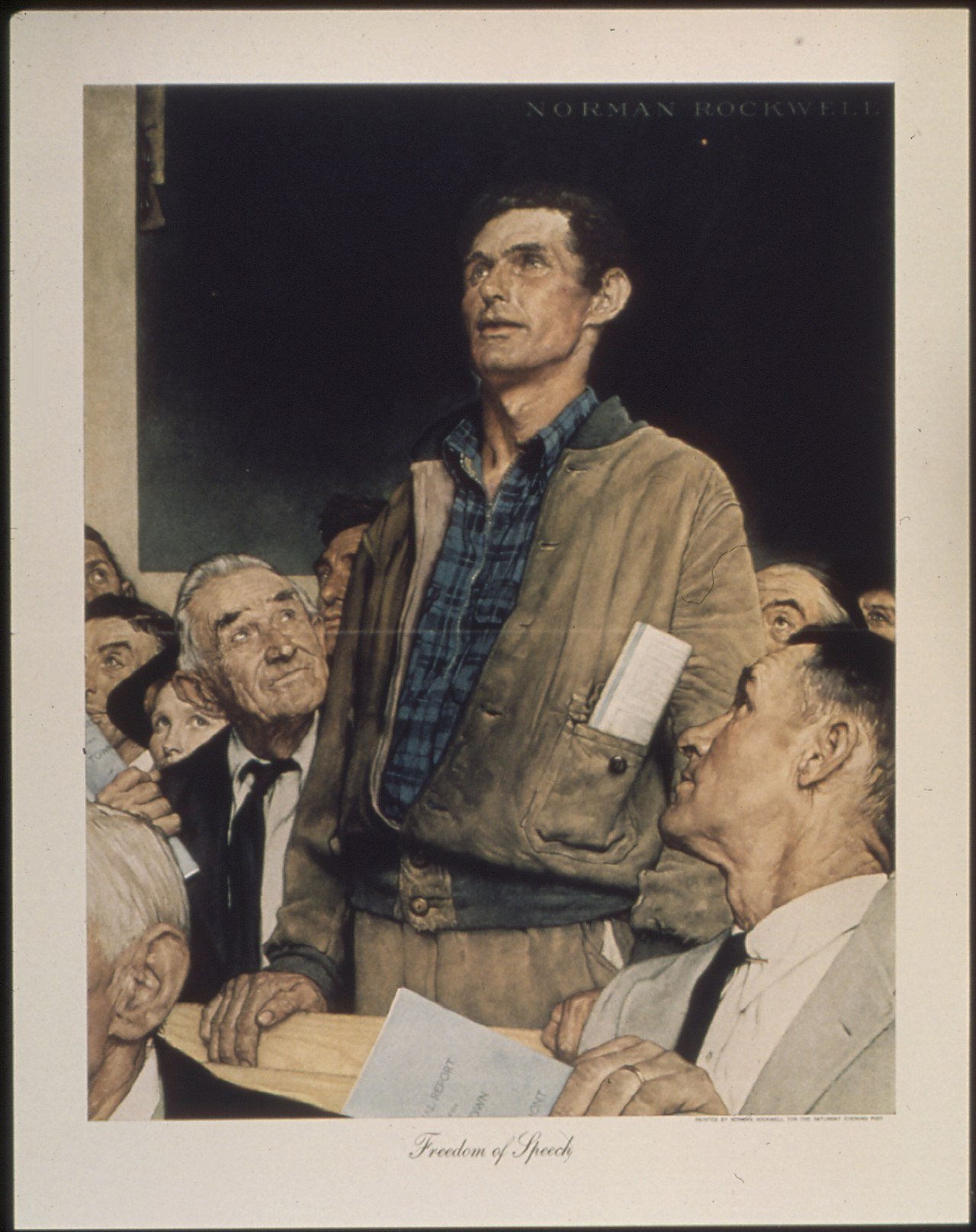
"Reading Brooks’s laments about Snowden and 'the fraying of the social fabric,' I found myself thinking about Norman Rockwell..."

"... if not in the same way Brooks might. (In 2008, after what he saw as a rhetorical triumph by Sarah Palin, Brooks wrote, 'Somewhere in heaven Norman Rockwell is smiling.') The image that came to mind was one of the panels from Rockwell’s 'Four Freedoms' series: the one on freedom of speech, in which a man stands up at what looks like a town meeting. He might be about twenty-nine. He is wearing a work jacket, so maybe he’s a high-school drop-out. There are better dressed people in the hall. And they are listening to him."

Writes Amy Davidson in The New Yorker, with the sentimentality that Rockwell haters loathe about Rockwell. Here's the referenced Rockwell painting:


I was going to snark that there's no way that guy is 29, but then I asked Meade, "How old does this guy look," and he said, "29." And, "That's what guys who work on the farm look like when they're 29."

Then I tried my other idea: "How do we know he's not a communist, dressed that way to trick the naively idealistic Norman-Rockwell-loving folks of that small town? He's dressed like a folksinger. He could be Pete Seeger." And Meade said: "You can tell by that greasy dirt on his jacket. That guy does real work."

We talked about the difference between this idealized farmer — with his real dirt, in a real place, with real people — and Edward Snowden — who operated within computer networks and evanesced into Asia. But it's 2013, and maybe that Rockwell character does need to be a man detached from the American soil, floating out there in unmediated space. And yet — as Meade said — "He's Tea Party."